
October 27, 2022 · 53 minutes · Episode 308
About this episode
Dr. Bojana Jankovic Weatherly, who practices Integrative & Functional Medicine, joins the show to talk about science-backed treatments that help achieve optimal thyroid health, how to recognize thyroid issues, and healing the body as a whole.

Learn more about your ad choices. Visit megaphone.fm/adchoices
See Privacy Policy at https://art19.com/privacy and California Privacy Notice at https://art19.com/privacy#do-not-sell-my-info.
Key quotes
“that's really acceptance for where we're at and what we can or cannot do in a given moment.”
“accept the situation as it is. And number two, take the elements that are within their control and make the best out of them.”
“I mean, we cannot function without an active thyroid gland.”
“it's so important to listen to the patient, to listen to the story, to really believe their experience because they're telling us their lived experience.”
“I always tell people, I never look at the labs outside of the context of what the patient is telling me.”
Related episodes
- Ep. 107 Naturopathic Medicine – Dr. Molly Jarchow, ND
- Ep. 196 Jaundice and Other Newborn Concerns – Dr. Princeton Ly
- Ep. 325 Dr. Nate Fox: Thrombophilia
- Ep. 86 Food is Medicine – Kelly Leveque
Transcript
AI-generated transcript with speaker labels — may contain errors, especially names and medical terms. Dr. Elliot Berlin, DC appears in blue; Dr. Bojana Jankovic Weatherly in orange.
Download PDF of the Transcript
Dr. Elliot Berlin, DC [1:13] Welcome to the important pregnancy and parenting podcast. I'm your host. Dr. Elliot Berlin today My guest is an integrative and functional medical doctor who treats everything from depression and anxiety Hypothyroidism nutrition and stress management and more from her practice in New York City Dr. Boyana Yankovitch Weatherly welcome to the podcast. Thank you so much. It's a pleasure to be here You're one of my favorite people certainly as a doctor you have everything that one would hope they could find in a medical doctor You're super brilliant warm empathetic You explain difficult things in ways that are easy to understand and digest one of my saddest moments in life medically was when I learned that you were
[2:19] Leaving Los Angeles for New York And then one of my happiest moments was when I found out we could see you anyway Because a lot of what we do today is telemedicine You're accessible to lots of people no matter where you are today We're gonna talk a little bit about functional medicine what that is and what it means Your background in history and then we're gonna focus on the incredible organ called the thyroid what it does It's function what happens when it dysfunctions How do you optimally take care of your thyroid and nurture it and what happens if you need to do? Medical intervention to help it out, but first let's start at the beginning. Where are you from?
Dr. Bojana Jankovic Weatherly [2:57] Originally, I'm from Serbia. I was born and raised in Serbia and In their early 90s, my family and I moved to Canada during the war in former Yugoslavia I did all of my training there up until the end of medical school including a master's degree in cancer research and medical school training I Subsequently moved to Los Angeles, which is where I met you once I started having kids Because of my husband he was working there and after a two-year long-distance relationship. We decided it's time So I completed my residency training there in internal medicine at Cedars-Sinai in the West LA VA and during this residency training is when we met when I somehow thought that I was able to
[3:42] Have kids and be pregnant during residency, so that was a very interesting moment in time I would struggle with either one of those things By the way, I did struggle
Dr. Elliot Berlin, DC [3:53] Yeah, but you smushed them together. You did it all at the same time When was your interest in medicine? When did that originate? I
Dr. Bojana Jankovic Weatherly [4:02] Would say in my early teens and I think that it came about in a really maybe Non-conventional way because my parents were very much against me going to medical school and I come from a background of my mother is a computer scientist. My father was an electrical engineer Math and sciences were something that was easier for me and that I loved and they thought why not just going to computer science Why not follow our path and I thought I need to work with people there was just something that was so When people say, you know medicine and healing and you and I've talked about this before is a calling I really felt called to it and I think that part of it was that I really was curious about and maybe this was in part shaped
[4:49] by my experience as an immigrant and being more adjacent in those early 90s in those formative years and Seeing people suffer through trauma, and being so curious about the human psychology and impacting people's lives. And then when I went on to explore this a little bit more, I started volunteering in senior centers and hospitals, and I just was really curious about the combination of mind and body. And science was always something that I loved, adored, that I could be immersed in 24-7. So it just kind of clicked. How amazing would it be to be able to serve people in this way, and then throughout my entire career, to learn and grow and research studies and apply these innovative modalities
[5:42] to my patients to improve their health and wellbeing. I thought it was this perfect marriage of what I was really curious about and how I wanted to be in this world and serve, and also the skill set that I thankfully happened to have.
Dr. Elliot Berlin, DC [5:57] Yeah, I think that's also part of what makes you such an amazing doctor, is you're not just looking at, you know, labs or, you know, an area of the body. You look at a human as a whole and don't separate all the components down into their individual little parts as if they're not connected to a larger system. And it's incredible. OK, so for you, pregnancy during residency, that's really intense. How did you cope?
Dr. Bojana Jankovic Weatherly [6:25] Initially, I think I coped with a lot of tears and really struggled with that feeling of guilt, actually, because I loved what I did. I loved serving patients. I loved running around the hospital and learning and being part of a team and supporting patients and treating patients and gaining that skill set and expertise. But I struggled on the inside because I realized that with 30 hour shifts and not sleeping many nights and not having time to stay hydrated or eat sometimes was not necessarily in the best interest of my baby. And I think that was my biggest struggle of am I doing something bad? Am I doing harm? Should I be slowing down? But then how do I slow down?
[7:17] I'm in this amazing training program. I'm doing what I love. I'm making some meaningful change. And that was really the biggest source of struggle. Not to mention the fact that when you're pregnant, it's not uncommon to feel tired, to feel nauseous. I have this story where I was seeing a patient and all of a sudden, as many women that have gone through this, that urge to vomit and that nausea when it reaches that threshold where you really can't hold it in, I've had that experience as well, where I unfortunately vomited in a patient. And I felt so terribly, but there was physiologically nothing that I could have done in that moment, or I didn't really feel it was coming until it
[7:59] was too late. And so it was really that struggle of can I do it both? Is this the right thing to do? Did I plan this really well? And so a lot of it was that internal struggle. How do I support my baby? And then the other physiological piece is just, you're so tired. I was exhausted. And, you know, typically kind of that second trimester is a little bit better. Of course, everybody's pregnancy journey is different, but I found that especially that first trimester, I was really tired, nauseous, and just really trying to make it through. I think that what made a big impact and what ultimately really led me to you is I reached this kind of critical point, I couldn't sleep one
[8:43] night and I was in a really negative state of mind and thinking, how am I going to do this? Like, can I actually get through this pregnancy and my residency? And of course, I was looking up all these studies about how shift work and long work hours have negative effects on the fetus and pregnancy outcomes that didn't make me feel any better. And then I had a realization. I thought, okay, well, I'm in this circumstance that I'm in. I chose this. I acknowledge it. I chose this. I timed it because I wanted to have kids at a certain age and whatnot. And so I said, okay, I have a choice now. I can either sit here and cry, or I can do the best I can in
[9:26] the circumstances that I'm given. And I think that that change of state really made a big impact because then what that led me to do is to say, okay, well, with the little bit of free time that I have, how am I going to use it? So I started doing prenatal yoga, which was incredibly healing and just helped me connect with my fetus. I mean, I have such fond memories of it. It really was beautiful. And I think I'm sure if we measured my cortisol levels, pre and post yoga session, I'm sure they significantly improved. I started working with a birth doula who, you know, Tracy Hartley, who really helped me feel more empowered in this experience of there are certain things
[10:06] that I can be in charge of, and there are certain things that I can control. And it's okay that there are some things that we can't control, that's okay too. And of course, being type A, being a physician, of course I want to control everything. And of course I want the best possible outcomes all the time for all of my patients. But there is an element of healing that's really acceptance for where we're at and what we can or cannot do in a given moment. So those two things were really helpful. And then that ultimately led me to you in part because, and of course I heard about you and your practice and in part because my dear friend who you also treated
[10:40] told me about you and she said, you know, you really should see Dr. Berlin and his team. You really should do this. And we happened to be pregnant at the same time and our kids are born within two days of each other. And so it was great timing, thankfully. And then I started seeing you in part because my baby was measuring too large. In fact, my second one was as well. One was over nine pounds. The other one was a little over 10 pounds. And of course, in that case, a lot of OB-GYNs start to get a little bit nervous about the fact that maybe we're gonna need to induce. Maybe we don't want this baby to grow so large so that it becomes it very difficult
[11:14] for you to have the baby naturally or there are potentially more complications down the road. And I found myself very resistant to that. I thought, again, I looked up studies and I said, well, it doesn't seem that size of the baby is really the determining factor with respect to induction, with respect to planning a C-section. And being of course, a conventional medicine physician, I read the science, I believe in science, I support the science. This is what I recommend to my patients. But at the same time, I also firmly believe that the least invasive way when safe is the way to go. And this is partly my personal preference and partly my belief as a physician.
[11:59] And this is what I wanted. And I found that in the conventional world, this wasn't really met with a great deal of support. And it wasn't until I started seeing you and acupuncturists that worked in your practice that you guys really gave me the confidence. You really made me feel like an empowered patient. I remember you saying, oh, don't worry. I've delivered larger babies. I've helped deliver larger babies. Like you're gonna be fine. We just need to support your anatomy. And I think that really understanding better the elements involved and understanding better, okay, how do we get my body to really prepare for this mentally and physically?
[12:36] And I was doing hypno birthing that my birth duo had recommended, which is essentially a type of guided imagery that takes you through the steps of birthing that helps to create that scenario. And I liken this a little bit to what high-performing athletes do. They'll do this guided imagery of winning, of doing a specific sequence of steps and visualize themselves. Well, this is kind of similar to that, I think. And so all of those things were incredibly helpful. And my takeaway from that experience was that empowered patients and proactive patients are the people that number one, accept the situation as it is. And number two, take the elements
[13:18] that are within their control and make the best out of them. And that is really what you guys helped me do, which is why I'm grateful to you forever. And thankfully, in my case, I was able to have the outcome that I envisioned. But even if I didn't, it would be okay because I would know that, you know what? We did everything we could. We supported and loved the body and the fetus, and we did what we could. And I would have been at peace with an intervention. But I think really the point is that we honored the natural process. We honored what in most cases really is this beautiful process with no complications. And I did have some minor complications
[13:56] that were fine down the road. But for me, it was just so important to honor this in a natural way and to combine the integrative and the conventional, which is then what ultimately led me to practice the way I practice for my patients.
Dr. Elliot Berlin, DC [14:08] Wow, yeah, I mean, in my mind, that's the win-win when you can get the best of both worlds. And I usually have to find at least two different practitioners and sort of get one side, one world from one of them and one world from the other, but then you have them both. So at the very least saves a lot of time. We compete a little bit because your name, Ljana Jankovic-Wetherly, is a mouthful. So your patients sometimes call you Dr. B.
Dr. Bojana Jankovic Weatherly [14:37] Exactly, yes.
Dr. Elliot Berlin, DC [14:38] And I'm Dr. B, so. I know. Dr. B and Dr. B. A few points about your story that you shared, beautiful story, is number one, that point about control. And I just see a very clear spectrum where on one end is pure total control and on the other end is pure total surrender. And there's everything in between. between, but it kind of means anything that you do to try to control the process takes away from your ability to surrender to it. So even sometimes people come in like I really want to have this baby before Saturday, I must have this, and that's control. If you do that, you can't surrender. And birth always looks better to me when someone's able to surrender. The more surrender, the better. And at the same time, you really
[15:27] put together, like I thought, an amazing team of people around you to support you. And there was this duality just to witness, you know, you invited me to your birth to support you, but to witness that incredible ring of people around you and to realize at the same time, you didn't need any of us just to look at you laboring. I oftentimes watch animals in nature just giving birth, elephants, around sources, other animals, and they seem so confident and so aware of the process that's happening within them. And they don't have a crew of helpers around them. And they probably didn't listen to a great podcast or read a book or anything like that. But they somehow know they just do it. And
[16:16] it's like a natural process. And then they usually look at the baby and start doing all the neonatal care somehow with no training. And that was you, you got yourself into this zone where I could see the people around you supporting you in the way that you had calculated. And at the same time, I could close my eyes and see just you with nobody around you would have been completely fine on your own, just birthing literally from within. And it was credible and a scene that I'll never forget is when I think all seven or eight people were in this tiny little bathroom at Cedar Sinai all somehow supporting you. But it was an incredible moment of just natural
[16:59] physical strength, mental strength, and just internal education, like what your body is just hardwired to do. It was just something that if other people could witness women could witness, they would be like, wait a second, I can do this.
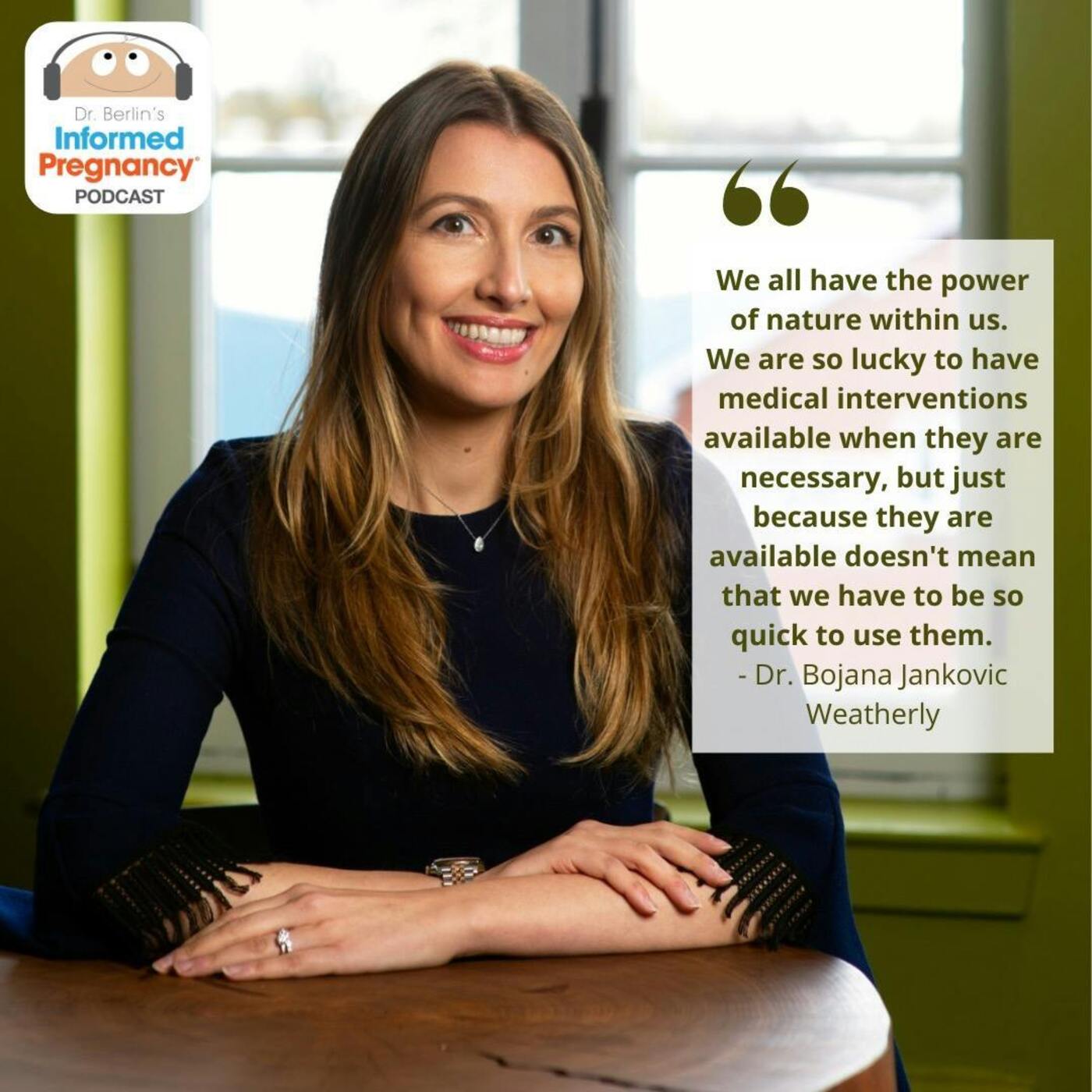
Dr. Bojana Jankovic Weatherly [17:13] I think you're absolutely right. I don't think that we realize the power that we have within us. That's not power in a sense that I have power, but the power of nature that we all have. And I think we're so lucky to live in this day and age where thankfully, we do have medical interventions available when they're necessary. But just because they're available doesn't mean that we have to be so quick to go that way necessarily. That being said, I always honor and always support whatever anyone's personal preferences are. But I think that for me, being able to, for example, as you mentioned, spend most of the time in the shower, in the bathroom, which by the way, took my pain on a scale of one to 10 from
[18:05] maybe a nine down to a seven, just that warm water dripping down my back with this excruciating pain. And knowing that, thankfully, the amazing staff at Cedars was completely fine with that. And it's like, okay, no problem, we'll do intermittent monitoring, you're fine now. And again, if there had been a more urgent situation that would have necessitated something else, of course, we would have done that. But there wasn't. And so being able to be in a position that felt more natural, the last thing I wanted to do was lie in a bed and be hooked up to IVs. I was like, no, get me standing. I need to be standing right now. And so for women to know when that's an option, when that's a choice, you
[18:48] can ask for that.
Dr. Elliot Berlin, DC [18:50] Yeah, I mean, yes, you can sort of script your birth experience. And you know, you have to be flexible. But everybody in the hospital works for you. And it's hard to see that sometimes. For you, the shower seemed amazingly calming. The nurse who seemingly never saw like a natural labor before was so moved by the whole thing. And I just remember she's like, you're sticking your arm out onto the counter and she's trying to start an IV for you because she didn't want to make you get out of the shower and go to bed. That was just like, incredible Tracy, you know, just knew the right things to say or not say, literally, I felt like an enormous fly on a wall in a tiny little stall. Eventually, I feel like
[19:39] the anesthesia all just came in, the doctor came in. And one thing that if everybody could have access to this could probably give birth in the shower would be your husband telling jokes and funny stories.
Dr. Bojana Jankovic Weatherly [19:50] Oh, that saved me. And I have to say in the moment, I remember one particular joke. I literally and I never believed this was actually physiologically possible, but it was during a contraction. I mean, I think I might have given birth a few minutes after that. It was literally during the most intense 100 out of 10 pain. And by the way, no epidural for my second birth. I ended up getting one at the very, very end, but he didn't kick in until after I because it was just so fast. And we didn't know it was going to be that fast. Before it was like 100 or 10, you know, it's like, I don't know if I can do this, he was saying this joke, it literally went to zero.
[20:26] Like I was not even aware of it for whatever those moments were of the joke and me laughing even. I did not think that was actually physiologically possible until it happened. And I thought, OK, how do we get more of this? How do we figure out how to help more people in this way? Yes, laughter is medicine. I think we should hire stand up, do less.
Dr. Elliot Berlin, DC [20:45] Yes, I know skill set. I love it. All right. I can talk to you for hours and hours. Let's take a little break. When we come back, we'll get deep into the thyroid. We'll be right back.

Dr. Elliot Berlin, DC [23:19] Welcome back to the podcast. We're talking to Dr. B, not me, Dr. Brianna. And so integrative medicine, let's talk about that. We have a little bit of a background on how you got into it. Let's talk about it specific to the thyroid. What is the thyroid? Where is the thyroid and what does it do?
Dr. Bojana Jankovic Weatherly [23:40] Absolutely. So the thyroid gland is located at the base of the neck and it's a butterfly shaped gland and the thyroid gland is very important in a number of different metabolic processes. So what it does is it makes thyroid hormones. And without getting into too, too many details, it produces T4, which is thyroxine and T3, triode of thyrinine, which are the two key hormones that will mention probably throughout this conversation. Let's see where they have nicknames.
Dr. Elliot Berlin, DC [24:12] T4 and T3.
Dr. Bojana Jankovic Weatherly [24:13] Exactly. That's what it'll stick to. It is stimulated by thyroid stimulating hormone, which is TSH, that tells it to produce and secrete more thyroid hormones. So that's kind of that basic mechanism. The pituitary gland, which is located in the brain, sends the signal called TSH to the thyroid at the base of the neck. And then in response to that, the thyroid makes T4 and T3. Now, what do these hormones do? They have a number of different roles in different systems and different organs in our body. So they regulate our metabolism. They support our skin, our hair, our brains. They have a contribution in our heart rate. They have a contribution in our bowel movements and our digestive tract.
[25:00] And in fact, a great deal of thyroid hormone is converted in the digestive tract, which is a whole other topic that we're not going to cover today, the gut microbiome and all these different things. But maybe we'll touch on it if we're able to. So those are some of the main things that have in fact, so it impacts our nervous system, our gastrointestinal system, cardiovascular system, our skin, our hair. That's kind of the broad overview.
Dr. Elliot Berlin, DC [25:24] Wow. It's kind of intense because unlike the nervous system, hormones travel through the blood. So when it's released by the thyroid, it's going to affect your whole body. It's just circulating through the blood binding to organs and having an effect on them. So even just on a surface level, that means that all of those different organs and functions are connected because once you release hormone, it's going to affect all of them.
Dr. Bojana Jankovic Weatherly [25:50] Absolutely. I mean, we cannot function without an active thyroid gland. If somebody, for instance, has had thyroid surgery because of thyroid cancer or maybe radioactive iodine ablation of their thyroid, they will require thyroid hormone in order to survive. So it's essential to our survival and it impacts a number of different organs throughout our body.
Dr. Elliot Berlin, DC [26:11] And if you're making TSH, if the pituitary in the brain is releasing the get going TSH and the thyroid response by producing hormone, does it produce both at the same time in response to that or can it sort of regulate which ones it wants to produce more of?
Dr. Bojana Jankovic Weatherly [26:31] That's an excellent question. Yes. So it produces both, but much more of T4 than T3. And then what happens is part of the regulation of the metabolism and partly what happens if we're, for instance, dealing with some type of a stressful state, it could be emotional stress, it could be toxins, it could be severe caloric deprivation. The thyroid will regulate, or I should say enzymes that are responsible for converting T4 to T3 will regulate how much of T4 is converted to T3 because T3 is the more active thyroid hormone and the thyroid produces more of T4. So then your body has that choice, that ability to regulate depending on what's going on and we can talk about some of these factors, how much of that T4 gets converted to T3
[27:20] because T3 being the more potent one, we want to really tightly regulate those ranges and research has shown that actually both free T4 and free T3 are very tightly regulated within 25% if you do one reading and then another reading another day in the body. So our body really fine tunes the T3 amounts based upon what it requires or based upon the stressors even that are present at that given time.
Dr. Elliot Berlin, DC [27:49] Wow, okay. Let's talk about some of those factors that influence.
Dr. Bojana Jankovic Weatherly [27:54] Absolutely. So some of the factors that I probably see most commonly in my practice, and that have been well documented in research, are when people change their dietary habits. And one of the things that people will often say, well, I'm consuming this low calorie diet, but let's say their goal is to lose weight and they're initially losing and then they start struggling with that. They reach a plateau. Now we will say there are a number of factors that can cause a plateau, but one of the things that we see happen is that if we're in a state of caloric deprivation consistently, so I'm not necessarily talking about intermittent fasting or time-restricted eating, which is
[28:38] again, a different conversation, which maybe we can touch on, but I'm just talking about consistent caloric deprivation. Let's say, you know, a thousand calories a day, something where 800 calories a day, very low. What your body is going to want to do as a survival mechanism, because this is something that is evolutionarily developed over time, is if your body is seeing a caloric deficit and you're burning more than what you're taking in and your body is concerned about, okay, now I have to go into starvation mode. I'm not getting enough. It slows down the metabolism. And in part, what happens is T4 to T3 conversion is reduced. So we're seeing lower T3 numbers because it wants to store a little
[29:16] bit more energy and not utilize energy so rapidly because it's not getting enough input. So that's probably one of the most common scenarios that we see. Another scenario that again, is not uncommon in people who may be acutely ill or people even who may be hospitalized is something that was called sick euthyroid. And what that is, is that again, TSAG may be normal or it may be slightly abnormal, that thyroid stimulating hormone, but we can see the T3 is low. And again, that T3 being low signals that conversion of T4 to T3 is slowing down because let's say if somebody is hospitalized, if somebody is very ill. Again, the body tries to conserve energy.
[30:02] It needs all the energy it can to fight the pathogens. It needs to recruit the immune system. So if you think about it, I mean, the body's really remarkably intelligent. And so, yes, there's pathology, which we'll talk about pathology meaning disease state that needs some sort of augmentation, some sort of health treatment by medicine. But then there are also these states where this is really just compensatory action by these mechanisms that are in place that are trying to keep you alive, which I think is really remarkable and just so humbling.
Dr. Elliot Berlin, DC [30:35] Absolutely. I mean, it goes back to the fact that our innate intelligence is smarter than our educated intelligence. And I say this all the time, both with birth and also with me, if I could close my eyes and hear the voice inside telling me this is what you should eat or you should get up and go move around, I'd probably be very, very healthy much more than I am now. But then on the way to work, I passed by one billboard in particular that is like a fluffy stack of pancakes with butter dripping off of it and syrup on it. And that voice is so deeply buried compared to all the noise that I'm not hearing the instructions on the inside and I'm doing a poor job
[31:18] at making my own decisions around that. And I think that's also true with childbirth, that innate intelligence is hardwired, it's programmed. You have a voice, but you can't hear it. There's so much noise around it that if somebody's telling you when to push and how to push and counting the seconds for you, how are you supposed to hear that voice inside that might be saying, wait, we're not quite ready to push yet even though we're 10 centimeters. So it's really incredible what our bodies are programmed to do, how brilliant they are. I was at a medical conference and a guy got up and he held up five fingers and he goes, I can safely say we understand about 5% of how the body works.
[31:57] And I thought that was really brave of him to do, but I also said you're exaggerating by at least 3%.
Dr. Bojana Jankovic Weatherly [32:03] I love it. I couldn't agree more. I mean, the more we learn and the more that we're looking at research, I mean, I'll give you an example and maybe this is something we can touch upon. One of the most common ways in which we treat hypothyroidism, underactive thyroid, which we'll talk about what that is, is thyroid hormone. We give people thyroid hormone medicine and that's what they take to replace their thyroid. But a small percentage of patients, it's been estimated 5%, up to 10% in my practice, many more because people seek me out when they're having these issues with thyroid disease. But in this proportion of people, that therapy, levothyroxine,
[32:43] that specific thyroid hormone, which is synthetic T4, it's kind of like that T4 that we talked about. So not the more active T3, but a proportion of people still feel all the symptoms on it. And so for a very long time, conventional medicine would deny that there's anything wrong because we would look at the TSH, the TSH would get better and we would say, no, no, no, it's all in your head. And of course that's the worst thing one can say to a patient and it's completely inaccurate. But we then later learned, and even the American Thyroid Association acknowledges this, the European Thyroid Association, this is a well-documented phenomenon that some people, for one reason or another,
[33:23] maybe in some cases it's that enzyme deficiency that converts that T4 to T3. It's just not quite working well, or there's not enough of that enzyme. And so even though they're taking the thyroid medicine, it's not efficiently converting to T3, which is the more active thyroid hormone. So as a result, they may need a little bit of tweaking. They may need a little bit of T3 in some scenarios, which kind of brings me back to, it's so important to listen to the patient, to listen to the story, to really believe their experience because they're telling us their lived experience. They're telling us how they feel. And I think that that subjective information
[34:00] is so important. As much as objectively, data are important. Of course, labs are important. I always tell people, I never look at the labs outside of the context of what the patient is telling me. You must look at the labs in the context of the individual, of their symptoms, of their history, of what they're reporting to you in order to make the best possible decisions and help guide them in that given time with treatment.
Dr. Elliot Berlin, DC [34:26] Which I think listeners are starting to get a taste of how I was not even close to exaggerating in my introduction of you, because sometimes I'll have labs done and all I'll get actually is an email with a report that says this is the normal value and these are in the normal range and this is a little above or a little below, not even necessarily with a description of what that means, but certainly not in the context of how I'm feeling. So, it's just such an incredible gift that you have and your dedication to your patients and your curiosity of how the mind… and body work together and how East and West can really maximize that function, optimize
[35:05] the function. So special. Let's talk a little bit more about when things go a little wrong with the thyroid. So you mentioned the term hyperthyroid, there's hyperthyroid and hypothyroid. Hyper always means a bit more of something, hypo means a bit less. So in the case of thyroid, hyperthyroid is some sort of over function and hypothyroid is some sort of under function or under production. They present very differently.
Dr. Bojana Jankovic Weatherly [35:30] They do, yes. And just for context, I will share that hypothyroidism is more common. We'll talk about both, but hypo is more common so that underactive thyroid gland is more common. And thyroid disease in general is actually more common in women than in men. And for context, I'll share that it's been estimated that about 12 million Americans have this condition, some type of thyroid disease. So just 12% of the U.S. population develops some type of thyroid disease in their lifetime. And one in eight women may have some degree of thyroid hormone deficiency in their lifetime. And it's about five to eight times more common in women than in men, which is why
[36:08] it's particularly important. You know, we talked a little bit about screening and we'll get a little bit deeper into what that screening means, but it's so important for women, especially if they have a family history of thyroid disease, that they do get screened and that they do get their thyroid labs checked periodically. But let's say, you know, again, we're going back to tuning into our bodies and what could be some of the possible symptoms caused by underactive thyroid. Let's cover that one first.
Dr. Elliot Berlin, DC [36:33] Okay.
Dr. Bojana Jankovic Weatherly [36:34] So when your thyroid is underactive, one may experience weight gain or difficulty losing weight, fatigue, just feeling sluggish, just not themselves. Maybe they need to take a nap during the day. Maybe they're just not feeling fully mentally sharp for work. They don't feel like exercising sensitivity to cold weather, constipation. In more extreme cases, the heart rate may slow down. They may experience dry skin, hair thinning or hair loss. For women, they may experience some menstrual irregularities, infertility, depression, and high cholesterol as well. So just from this set of symptoms, one can appreciate how many different systems in the body the
[37:18] thyroid can affect, but also how sometimes because these symptoms touch upon or overlap, I should say, with symptoms that could be caused by other conditions. Sometimes it can be difficult to just clinically distinguish, okay, this is definitely thyroid versus this is not.
Dr. Elliot Berlin, DC [37:35] Yeah. I mean, so broad and scary to think that it affects so many people in that way. Hypothyroid has a name for the condition.
Dr. Bojana Jankovic Weatherly [37:45] Yes, Hashimoto's thyroiditis. So Hashimoto's thyroiditis, interestingly, it's a state of autoimmunity. So it is considered to be an autoimmune disease. And I should say that's the most common cause of hypothyroidism. There are other ones, we can touch upon some of them. But Hashimoto's thyroiditis is the most common cause of hypothyroidism. And it's due to that immune infiltration or infiltration of immune cells into the thyroid, which ultimately cause destruction of the thyroid gland, which is ultimately why many people with Hashimoto's end up having to be on some type of supplemental hormone therapy because their thyroid gland is no longer able to make that output of thyroid
[38:27] hormones that their body requires.
Dr. Elliot Berlin, DC [38:29] Which on the other side of things is going to our educated intelligence how far we have come. The fact that we can recognize that that's an issue, we can identify the hormone and that we can sort of synthesize the hormone and regulate what would otherwise be a series of symptoms and deteriorations that would really affect somebody's life in an extremely negative way.
Dr. Bojana Jankovic Weatherly [38:52] Definitely, yes. Some of the other less common causes would be, as I mentioned before, thyroid surgery, if someone has had to have their thyroid out, particularly due to thyroid cancer, or radioactive iodine ablation of the thyroid gland. Some medications can also cause thyroid disease and abnormalities in thyroid functions, such as amyotorone, lithium. And so those are some of the things that people should be aware of that could be potential causes. There are other ones as well. There's postpartum thyroiditis, which can be more of a transient state that resolves, but really Hashimoto's is what we see most commonly in the clinical setting.
Dr. Elliot Berlin, DC [39:31] And the radiation is that from exposure?
Dr. Bojana Jankovic Weatherly [39:35] So the radioactive iodine ablation will typically occur if somebody has again, it could occur due to hyperthyroidism, for example, one of the treatments for hyperthyroidism is radioactive iodine ablation. So you're treating one thing, but then unfortunately, you induce another thing at the opposite end of the spectrum. So that could be one reason why that would be administered. We also see not in the US, but we also see that thyroidism can occur due to iodine deficiency. But what's very interesting, however, is that in populations that have iodine sufficiency or iodine excess, we start to see an upswing of hypothyroidism. So the iodine is a really fine balance. You don't want to be iodine deficient
[40:22] because iodine is an essential component of thyroid hormones. So thyroid hormones have iodine atoms on them. You absolutely need it. The thyroid uptakes iodine. But at the same time, if you have elevated levels of iodine, that could be a risk factor for thyroid disease, especially in people who are prone to Hashimoto's, who are prone to that autoimmunity.
Dr. Elliot Berlin, DC [40:44] Let's quickly talk about the other side, hyperthyroidism. What does that look like?
Dr. Bojana Jankovic Weatherly [40:49] So hyperthyroidism, if you imagine all the things I said before, but the opposite. So unexplained weight loss. People could be eating a lot of food, but they're just metabolizing it so quickly. They might feel, whereas people with hypo feel sluggish, slow, tired. People with overactive thyroid, they may have nervousness. They may even have tremors. They feel really hyper. They can even actually be hypomanic. I've seen people with untreated hyperthyroidism. They present as very nervous, very manic tremors. It really does affect our physiology so profoundly. So literally the opposite effect on the entire mind and body. Exactly. Yes. They sometimes can have mixed energy and fatigue symptoms. They could have
[41:33] high energy because again, they're just pumping out the high levels of thyroid hormone, but then that could ultimately lead to exhaustion. So they might report to you kind of the scaling of wiredness. So interesting. Yeah. They're sensitive to heat. They're sweating all the time. They have more frequent or loose bowel movements and they will have fast heart rate. And again, in a more extreme scenario, they are at risk of arrhythmias. So for instance, atrial fibrillation is something that we definitely want to avoid if somebody is hyperthyroid and this is something that their heart rate will be checked and they will be put on appropriate medications. If this is a concern, if this is an issue, they may have
[42:11] sweaty palms, anxiety. They may actually even develop vision problems and muscle weakness as
Dr. Elliot Berlin, DC [42:16] a result of high thyroid hormone. Wow. Tiny little organ, such profound effect. And there's a name for hyperthyroidism as well. Grave's disease would be the most common. Exactly. But not because of mortality. No. Sometimes people hear that. Like, does that mean I'm going to die? No. Okay. Let's take a little break. When we come back, I want to find out how we can take care of our thyroid, how it can optimize its function, baby it so it can baby us. We'll be right back. Wow. We're talking about everything thyroid with Dr. B and Dr. B, Dr. Boliana. I mean, on the more natural side, what are things that we can do to take care of our thyroid, optimize its function and health?
Dr. Bojana Jankovic Weatherly [43:08] So there's several things that we can do. And of course, as every topic in medicine, it's a subject of active research. So that is always the disclaimer in what I'm sharing. But if we look at autoimmune thyroiditis, meaning this autoimmune process against the thyroid gland, this is how we think about it. There's a genetic component and the genetic component, we are not able to control. We're given the genes we're given. We may be able to be in some control over how these genes are expressed, but we cannot at this time change our genetic makeup, but we can affect environmental factors. So really what we're going to focus on, what are the environmental factors that can really have an impact on the thyroid gland.
[43:50] The number one that I always tell people when it comes to any autoimmune condition really is vitamin D. We know that low vitamin D is correlated with immune dysfunction, with mood, with blood glucose dysregulation, and of course, not to mention bone problems. So it's important to keep a normal vitamin D level. What's really interesting is that vitamin D has been studied in the context of autoimmune thyroiditis. And it's been found that low vitamin D is correlated with autoimmune thyroiditis and that this condition can improve with vitamin D supplementation. Wow. So simple. Right. Yes. Seemingly very simple. So how do you get vitamin D hang out in the sun? You can hang out in the sun 15 to 30 minutes a day, depending on where you
[44:40] live, certainly and time of year, your skin type. Some people obviously may be at a higher risk of skin cancer. And I always tell people to put on their SPF just because of that risk, but we can also add foods that are rich in vitamin D as well as vitamin D supplements. I'm not able to give a specific recommendation as to the dose of the supplements, but one thing that I do for my patients is I check their vitamin D levels. The Institute of Medicine tells us that normal vitamin D is above 30 and typically goes up to 100. The golden range in the integrated and functional medicine practitioners world is typically between 50 to 80 in autoimmune conditions. So I typically have my patients have a little bit higher than what the Institute
[45:27] of Medicine recommends, but keeping in mind that there are some risks with having vitamin D being too high. So we definitely don't want to exceed that upper limit of normal and those risks being hypercalcemia and so on, which we won't get into. So vitamin D is crucial. Single digits of vitamin D or vitamin D in the teens, not acceptable. We have to get it up. It's easy to test exactly. Unfortunately, for whatever reason, some insurance plans make it very difficult to get it tested and covered, but it is something that in my opinion is very important and that we have a robust body of research for vitamin D and many different conditions that really makes it necessary for us to test, medically necessary. And we also have enough
[46:11] information that there are enough people in the population that are vitamin D insufficient or deficient. And I see this in my practice all the time. It's not like we test and then 99% of the people have normal D levels. No, a lot of people are low in vitamin D and they wouldn't know it. There's no specific symptom necessarily that will signal to your body, oh, your vitamin D is low. So this is definitely something that we need to be cautious about.
Dr. Elliot Berlin, DC [46:34] But I mean, among other things, many people, and like you said, depending where in the country, don't get out into the sun very often. I wonder if we're just cooped up in the office and then go home and we're cooped up at home and rinse and repeat.
Dr. Bojana Jankovic Weatherly [46:47] Exactly. And especially now that I'm practicing in the Northeast. I mean, I still have California patients, but I have a lot more Northeast patients. And I will say during these fall, winter, early spring months, we definitely see those vitamin D levels take a hit. So it's important to monitor and then supplement accordingly.
Dr. Elliot Berlin, DC [47:05] What are foods that are naturally high in vitamin D?
Dr. Bojana Jankovic Weatherly [47:08] So some of the foods that are naturally high in vitamin D would be seafood and fish. And what's really actually helpful is that fish come with your omega-3 fatty acids, which are also really important for anti-inflammatory benefits. And what's also really helpful with that is that it's important that vitamin D, again, depending upon what formulation you're taking, but it's important that vitamin D is taken with fatty food because vitamin D is a fat-soluble vitamin. And so this is how we're going to absorb it best. Unless you have a specific formulation that doesn't necessitate that you take it with food and it's already in this liposomal compound. But typically we want to be taking vitamin D
[47:45] with some fatty food for better absorption. And with fish, it actually just kind of allows us to have this in all kind of one package deal. Exactly. So like salmon, tuna, trout, mackerel, those are some of the best sources. Other sources, egg yolks, cheese, beef, liver, they have small amounts of vitamin D. I still find that most of my patients, even if they're consuming fish pretty regularly, I still find that most people do require some type of supplemental vitamin D. Wow. Okay. What else can we do for our thyroids? Selenium. Selenium is a very important nutrient. And unfortunately, because of a lot of the mineral depletion in our soil, we're finding that we're getting less and less selenium from
[48:25] food naturally. So selenium is essential for the production and conversion of thyroid hormones. And it's responsible for cleaning up the inflammation because it's an antioxidant that results from thyroid hormone production. Cause there is inflammation, normal chemical reactions that occur in the body. There's inflammation, there's oxidative stress. And so selenium helps to clean that up. So it's been found that people with Hashimoto's and selenium deficiency, when they're supplementing with selenium, this actually reduces thyroid antibody levels. I know we didn't touch upon thyroid antibody levels specifically, but there are a couple of thyroid antibodies that we typically check for when we're suspecting Hashimoto's and these are
[49:04] TPO antibody or thyroid peroxidase antibody and thyroglobulin antibody. And so when upwards of 90% of the patients, one of these antibodies will be elevated if they have Hashimoto's. Not everyone, by the way, not everyone with elevated antibody levels will necessarily have hypothyroidism. They still may have this inflammation as evidenced by antibody levels, but they may not necessarily progress to a low thyroid function. But it is interesting that if you're selenium deficient and you have that selenium repleted, the thyroid antibody levels go down, according to studies. What's also really interesting is that in pregnant women with thyroid antibodies, supplementation with selenium reduces subsequent
[49:45] inflammation of the thyroid gland, postpartum thyroiditis and hypothyroidism. Of course, I would say any supplementation, it's so important to talk to your doctor, especially during pregnancy, because there are many different supplements and herbs that are not studied in pregnancy, that's being said, having a high quality prenatal vitamin. And then if there's any specific deficiency supplemented for that deficiency is very, very important. And it's so important to work with a doctor that's knowledgeable about prenatals. And sometimes I just a kind of a sidebar. Sometimes I see prenatals that have super therapeutic doses of certain vitamins and that can be associated with a whole host of other issues. So it's really
[50:22] important that your doctor vets and knows exactly what's in your prenatal. Are you getting the right forms of vitamins? Are you getting the right doses as recommended by the various associations, the ACOG and so on? Because I have noticed this trend that sometimes companies, for whatever reason, put these mega doses that are actually not necessary and could potentially be excessive.
Dr. Elliot Berlin, DC [50:44] Sometimes I think they put them in there because they're not in very bioavailable forms and they need to put a lot more in in order for you to get the amount that you need. Maybe one way to improve that would just be put it in a better form to begin with. Right. All right. Well, we're winding out of time. So I have a question for you and I wonder if you have any final thoughts. My question for you is, is the thyroid more taxed during pregnancy? Is this something that comes up more frequently during pregnancy for people? The thyroid is absolutely more taxed during
Dr. Bojana Jankovic Weatherly [51:14] pregnancy. So if you think about it, you know, our metabolism, our requirements for energy are so much higher. We have another being in us, right, that we're feeding. And so what happens is interestingly, so the placenta produces human chorionic gonadotropin, commonly known as HCG, which actually increases T4 and T3 levels, circulating T4 and T3, which in turn suppress the TSH. So that's a whole other sidebar. But normal thyroid hormone ranges and normal TSH ranges in particular are a little bit different, especially in first trimester. So that's something that physicians are knowledgeable about and do look at, but that's one sidebar that happens. But thyroid also actually
[51:54] increases in size a little bit. It increases in terms of our iodine excretion, I should say increases, therefore iodine requirements increase. So this is why it's actually recommended that prenatals have the recommended daily amount of iodine in them. Also, thyroxine binding proteins go up and thyroxine is that T4 and thyroid hormone production overall goes up. So in healthy people, the thyroid adapts. Again, we rely on that natural wisdom, on that evolution that allows for our thyroid to adapt. However, when we're dealing with Hashimoto's, when we're dealing with someone who may be may already be on thyroid meds, it's really, really important to assess
[52:36] thyroid function during the trimesters and make sure that medications are accordingly adjusted, because there are consequences of underactive thyroid or not having enough thyroid hormone in pregnancy on the fetus as well. And so obviously, we want to avoid that. But there are really remarkable changes that happen. And I think this is just such an interesting area of research and something that we do need to pay attention to.
Dr. Elliot Berlin, DC [53:00] As always, I learned so much from you in a short period of time. Again, in a very digestible way. Do you have any final thoughts on thyroid and don't panic listeners, Dr. Brianna agreed to come back again, and we're going to be able to learn even more from her.
Dr. Bojana Jankovic Weatherly [53:17] Absolutely, absolutely. One thing that we did not mention is nutrition. And this is something that I spend a great deal of time talking to about my patients, because there are some studies showing that actually nutrition can affect our thyroid antibodies. And so this is where nutrition that's supportive to our gut, and that prevents leaky guts or increased intestinal permeability, which maybe that's our next topic.
Dr. Elliot Berlin, DC [53:43] I was just thinking that. Okay, cool.
Dr. Bojana Jankovic Weatherly [53:45] So things like avoiding gluten or talking to your doctor about avoiding gluten, diet rich in plants, plants are so so so important. It's been shown that people who consume more plants, more fiber, more fruit, more nuts, actually have lower thyroid antibodies in population studies than people who consume more animal fat, more butter, and that sort of thing. So it's so important to talk to your doctor or nutritionist who's knowledgeable on how different foods can affect the thyroid. They're also goitrogenic foods, which we're not going to go into, but just some terms to kind of put out there so that if you do struggle with thyroid disease, definitely, definitely talk to someone who can help
[54:21] guide you on the appropriate nutrition. Again, this is also an area of active research. So it's important to balance making sure that you're not taking in foods that could be potentially damaging, but also making sure that you're still having a well rounded diet so that you're not running into any nutritional deficiencies with a very, very restricted diet. So it's always that balance that we have to walk. And that's why it's so important to be working with someone who is able to guide you in this process.
Dr. Elliot Berlin, DC [54:46] Incredible. I learned a lot. I'm probably going to listen to this two or three times, just to really make sense of everything process at all. I am so grateful to you in general and for sharing your wisdom on this podcast today. Where can we find you online?
Dr. Bojana Jankovic Weatherly [55:01] So you can find me on drbojana.com. That's D-R-B-O-J-A-N-A.com. And then on Instagram, at dr.bojana, B-O-J-A-N-A. And we periodically have Instagram lives. We do talks. Actually, we have a methylation talk coming up with a guest speaker. And we support patients in California and New York, New Jersey, Connecticut, and Florida. And we're more than happy to see you or have a conversation with you if you'd like to get some guidance on thyroid disease and thyroid health.
Dr. Elliot Berlin, DC [55:34] Awesome. Now I'm taking leaky gut and then a whole episode on methylation. Wow. It doesn't end. Thank you. I'm gonna visit you there, Dr. Brianna Jankovic-Weathery. And if you wanna find more information like this or notes from today's podcast, visit informedpregnancy.com.
Want more pregnancy + parenting? Start your FREE TRIAL of Informed Pregnancy+ and get access to all our curated pregnancy and parenting content — original series, iconic birth films like The Business of Being Born, prenatal workouts and more.
