
February 20, 2023 · 45 minutes · Episode 328
About this episode
Square Baby, a frozen organic baby food subscription service, offers fully customizable meal plans. Their science-based, delicious menu is created by a Registered Dietitian and Certified Genetic Counselor and offers 100% Daily Nutrition and early allergen introduction options. The founders join the podcast to discuss the difference Square Baby can make for your family.

This episode is sponsored by Square Baby.
Connect with Square Baby online: www.squarebaby.com
Follow Square Baby here: www.instagram.com/squarebabyfood
Keep up with Dr. Berlin and the Informed Pregnancy Project online!
www.instagram.com/doctorberlin/
www.facebook.com/InformedPregnancy
Learn more about your ad choices. Visit megaphone.fm/adchoices
See Privacy Policy at https://art19.com/privacy and California Privacy Notice at https://art19.com/privacy#do-not-sell-my-info.
Key quotes
“So my kind of original experience walking down the baby food aisle was seeing that so many of the products were misleadingly marketed. They kind of made you feel like there was this balanced meal and it had quinoa in it and kale. But every time I would flip over the pouch, I would notice that they were very, very fruit heavy and high in sugar. And I felt like it was really just a bunch of applesauce with the sprinkling of superfoods.”
“So each of our meals have been designed to ladder up to 100% daily nutrition. So for example, any two of our meals for a six to eight month old or any three for an eight to 12 month old offers 100% of their daily veggies, fruits, grains, and protein.”
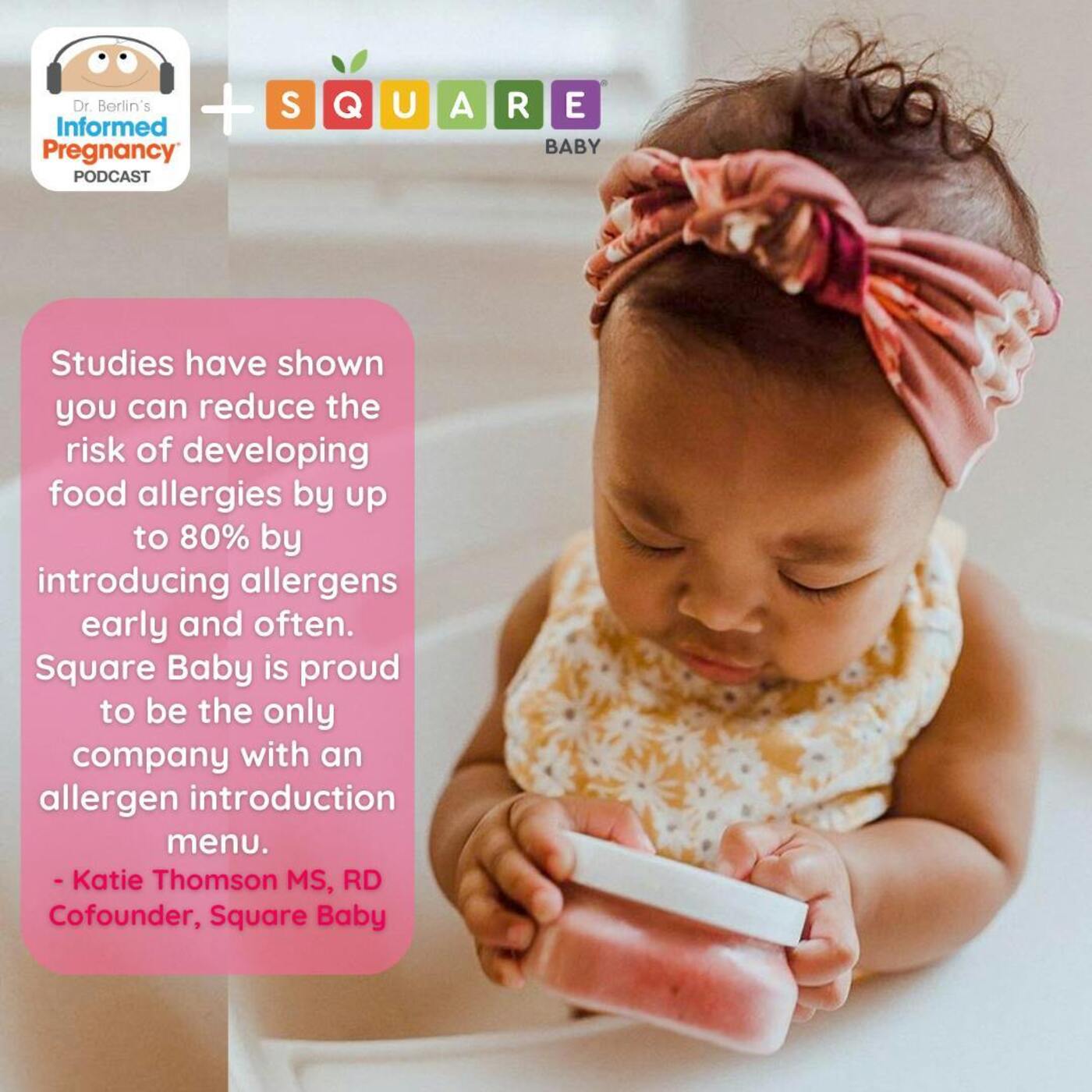
“And then extensive research went into the LEAP study and several other landmark studies that really proved that you can actually reduce the prevalence of food allergies by up to 80% by offering allergens early and often.”
“And you just have to be willing to step out of your comfort zone and pick up the phone, reach out, learn, as Katie said earlier, learn, learn, learn every day.”
“But I think just parent to parent, I think remembering to just stay calm and that so often a first try doesn't mean that they're not going to like it forever, but trying again, casually offering a lot of different things many times I think is the best way to go for sure.”
Related episodes
- Ep. 330 Square Baby Part 2: Early Allergen Introduction
- Ep. 332 Square Baby Part 3: The Stages of Baby Nutrition
- Ep. 329 Valentina Trentini: After Birth
- Ep. 333 Carson Meyer: A Doula's Birth Story
Transcript
AI-generated transcript with speaker labels — may contain errors, especially names and medical terms. Dr. Elliot Berlin, DC appears in blue; Katie Thomson in orange; Kendall Glynn in teal.
Download PDF of the Transcript
Dr. Elliot Berlin, DC [1:36] Welcome to the Informed Pregnancy and Parenting Podcast. I'm your host, pregnancy focused chiropractor, Dr. Elliot Berlin. In today's sponsored episode, I'm excited to get to know two moms, one, a nutritionist and registered dietician, and the other, a certified genetic counselor who together decided to aim their considerable expertise and experience at the baby food industry and came up with Square Baby, a fully customizable baby food subscription service that puts scientific research at the center and addresses your baby's every dietary need from palate development to allergy introduction and more. Katie Thomas and Kendall Glenn, welcome to the podcast.
Katie Thomson [2:17] Thank you so much for having us.
Kendall Glynn [2:19] Thank you.
Katie Thomson [2:19] We're excited to be here.
Dr. Elliot Berlin, DC [2:20] I'm so excited. I just want to learn so much about early nutrition and you guys, I mean, wow, what a resume. So we're all going to learn a lot today and it's not easy to have a baby. It's a lot of work to have a baby, but then to have a baby food company must be also a lot of work. Let's start at the beginning. Where are you guys from? Katie, where are you from?
Katie Thomson [2:41] I just landed in Bend, Oregon after moving around the country a bunch, but super excited to be here.
Dr. Elliot Berlin, DC [2:46] How is Oregon?
Katie Thomson [2:48] We live what it feels like on the side of a mountain and my kids and we love it outdoors every day.
Dr. Elliot Berlin, DC [2:54] That sounds amazing. Are there any houses on the block? I'm ready to get out of Los Angeles.
Katie Thomson [3:01] They're going fast first. I feel like everyone in California has figured out Bend, Oregon.
Dr. Elliot Berlin, DC [3:06] Yeah. Uh-oh, save a spot. So Kendall, you're closer to me.
Kendall Glynn [3:10] Yeah. Well, so I grew up in Southern California, Southern California gal that got transplanted inadvertently to San Francisco.
Dr. Elliot Berlin, DC [3:17] Up north.
Kendall Glynn [3:18] Yeah.
Dr. Elliot Berlin, DC [3:18] Do you like it up there?
Kendall Glynn [3:20] I do. It's like a different state. Still wear my Dodger blue, go into the game next week, but do love it up here. Yeah. I hope I don't offend anyone in San Francisco, but I got to stay true to my team.
Dr. Elliot Berlin, DC [3:31] If you don't offend anyone in San Francisco, you've done something wrong. You have to offend at least someone in San Francisco.
Kendall Glynn [3:38] That's true.
Dr. Elliot Berlin, DC [3:39] That's true.
Kendall Glynn [3:39] Okay.
Dr. Elliot Berlin, DC [3:39] You guys have an extensive background. Where do we start? Katie, let's start with you. What's your background?
Katie Thomson [3:44] So I got my undergrad in pre-med and then really started focusing on nutrition, became a registered dietician. And then actually, though I thought I would spend my career in clinical work, got my first job at Starbucks developing their first health and wellness strategy.
Dr. Elliot Berlin, DC [4:01] Oh.
Katie Thomson [4:01] Yeah.
Dr. Elliot Berlin, DC [4:02] I don't generally think of Starbucks for my health and wellness strategy, but I'll tell you what, if they take my insurance –
Katie Thomson [4:09] It used to be a thousand calorie coffee cakes and trans fat everywhere and no healthy options. So now at least there's some peg whites and salads and sandwiches and –
Dr. Elliot Berlin, DC [4:20] Truth. When I do feel in a healthy mood and I go in there, there is always a couple of things to choose from.
Katie Thomson [4:27] Thank you.
Dr. Elliot Berlin, DC [4:28] Well, I mean, the fact that they're on every corner, sometimes two on one corner means that you can go pretty much anywhere and get a little healthy snack. There you go. So pre-med and then nutrition and then dietician. What's the difference between nutrition and dietician?
Katie Thomson [4:42] Basically anyone can call themselves a nutritionist, whereas becoming a dietician, you have to go through a didactic school program and an internship and then take a test. So it's much more like accredited program.
Dr. Elliot Berlin, DC [4:53] Oh, okay. Well, now that I know that, I'm a nutritionist. I love that about me. There you
Katie Thomson [5:00] Go.
Dr. Elliot Berlin, DC [5:02] And then so after Starbucks, where'd you head out after that?
Katie Thomson [5:06] So had my first baby in 2008 and –
Dr. Elliot Berlin, DC [5:09] Congrats.
Katie Thomson [5:10] I know. Thank you. That's a long way to… Congratulations. He's now 13 and taller than me.
Dr. Elliot Berlin, DC [5:15] Oh, wow.
Katie Thomson [5:18] And basically just started having this crazy fire in me to change the baby food industry after walking the aisles myself looking for options for my son and disappointed in what I found and left Starbucks in 2010 when he was 18 months old because I just kind of couldn't put this idea down.
Dr. Elliot Berlin, DC [5:36] Oh, okay. So interesting because whatever you fed him, he apparently is growing just fine.
Katie Thomson [5:42] There was definitely some questionable choices there when I was… Yeah. I have this funny story of when I was looking for protein for my son and I felt like all of the pouches were really fruit heavy and misleadingly marketed. It was really hard to find protein. And I felt like the only way I could get protein in him were these little beanie weenies in a jar, floating in hot dog juice. And it was a really memorable moment for me feeling like, I guess this is how you give him protein. It was disgusting, but I was kind of too afraid to cook the meat. Would he be able to chew it and swallow it? So I felt like I needed the store bought, oh God, weenies in a jar.
[6:18] It was a breaking moment for me.
Dr. Elliot Berlin, DC [6:20] Wow. Oddly you just made me hungry. So strange. What about Ken, what's your background?
Kendall Glynn [6:26] Yeah, so I got my undergrad degree in biology and then I have a master's in biophysics and molecular genetics, which everyone's like, "What do you do with that?" What do you do with that? Yeah, I became a certified genetic counselor and spent most of my career in clinical practice in perinatal services and did a lot of consulting for a big fertility practice here in San Francisco. And then had the opportunity to start a private practice, actually the first full service perinatal practice here in San Francisco with five of the physicians I was working with. So exciting sink or swim moment.
Dr. Elliot Berlin, DC [7:00] Perinatal really with those swimmers that sometimes sink. Truth.
Kendall Glynn [7:06] Too true.
Dr. Elliot Berlin, DC [7:08] Was it a fertility practice or a full OBGYN practice?
Kendall Glynn [7:12] Yeah, full perinatal practice.
Dr. Elliot Berlin, DC [7:14] Perinatal. And so are you counseling with them before they get pregnant? That was my question, or are you just showing them what's on the screen?
Kendall Glynn [7:23] Both. So I would see patients with family history of some sort of hereditary disease and then also just counseling pregnant patients as well based on some sort of clinical prenatal finding, screening test results, amnio, CVS result, all that kind of stuff.
Dr. Elliot Berlin, DC [7:42] I mean, that's sometimes a really difficult job emotionally.
Kendall Glynn [7:46] Yeah. Yep. You know what? Working with couples and families and patients is a passion of mine in all ways. And so I feel like, yes, being with those patients in very challenging times is hard, but it's also incredibly rewarding to help guide them through that. And what I love is now kind of transitioning to nutrition. Katie and I have the opportunity to talk to our customers in so many different ways and it's interesting. It's very different information, but it's really, really rewarding to be able to work with our customers through their own nutrition challenges or feelings of frustration around picky eating and things like that. So incredibly, and sort of oddly enough, there's some real synergy with what I was doing and so passionate about in clinical care and what we're doing now with our customers.
Dr. Elliot Berlin, DC [8:38] All right. Let's talk about your families. You each have kids.
Kendall Glynn [8:41] We do. Apparently they're all very tall because mine are taller than me as well.
Dr. Elliot Berlin, DC [8:45] Oh, really? But just for clinical study purposes, you did not feed them weenies in a jar.
Kendall Glynn [8:50] I did not feed them weenies in jar. I was the parent who labored over cooking everything and would cry if they didn't like the recipe I had made. So it was kind of brutal.
Dr. Elliot Berlin, DC [9:02] That's a lot of pressure on everyone.
Kendall Glynn [9:05] That's a lot of pressure.
Dr. Elliot Berlin, DC [9:07] Yeah. I mean, I know Katie, you said you had your first baby while you were still working at Starbucks. And was your plan always to have kids? Was it something that you thought also would integrate well with work life?
Katie Thomson [9:22] Yeah. I grew up babysitting really from a very young age. Now that I look back at it, now that I have a 10 year old, I think I was going on family vacations, watching infants at a beach when I was 10. Crazy. But I always love, love, love children and caring for them and actually have been with my husband since I was 19, so kind of envisioned our family and –
Dr. Elliot Berlin, DC [9:46] Whoa. How did you meet at 19?
Katie Thomson [9:47] Oh, in college. Actually ski racing in high school right before then, but we were best friends in college for a couple of years, prank phone calling people. I should not tell the story. Going on runs together, skiing, whatever. And then yeah, started dating and kind of knew that was it at 19. So we waited until we were 26 to get married. We both went off to graduate school. He was across the country in Atlanta. I went up to Seattle and we spent two years long distance. And then I kind of had this ultimatum because he always wanted to have kids, but it was hard to feel like we were ready. You have enough money, you have enough time, you're in the place in your career where you want to be.
[10:22] And I said, okay, by 30, we're going to try to get pregnant. So we met that goal. I had my first baby at 30.
Dr. Elliot Berlin, DC [10:28] Oh, I like how you manifest. That's what we're going to do and you just do it.
Kendall Glynn [10:33] They did it.
Katie Thomson [10:34] I was lucky that it worked out as I had thought as many things do not.
Dr. Elliot Berlin, DC [10:39] Yeah. How was birth for you?
Katie Thomson [10:41] Well, let's see. Jackson, my first was 23 hours of labor. The epidural wore off halfway through, but I didn't know. I was like, "This feels pretty painful." And they're like, "It wore off. Would you like us to do it again?" Yes, I would. "Okay, stop pushing. Neat." And so that was –
Dr. Elliot Berlin, DC [10:58] I hope that's not how it works during appendicitis surgeries. Hey everybody.
Katie Thomson [11:04] Yes. So that, and I had both of my kids were sunny side up back labor, so they just took time. But both were very, very healthy and I would do it again in a heartbeat. I was one of those that despite the crazy cankles and me not being, I don't know, I didn't feel like the cutest pregnant gal, which is fine, but I absolutely loved the magic of being pregnant and watching your body go through and develop life. I just though it was so special.
Dr. Elliot Berlin, DC [11:32] So you're not exactly the same as Kendall because Kendall, you used to think babies were not cool.
Kendall Glynn [11:38] Yeah. I'm going to admit it. And then I'm probably going to offend somebody else. I'm sorry. Before I had my own kids, and again, I loved my patients. I loved the scans and seeing those kiddos on ultrasound, but I was not your friend who was going to come over and hold your baby. I didn't hold babies. I wasn't particularly excited about the old sip and sea, the party where people would pass around their baby and drink tea and hold the baby. I don't know. Maybe it was a thing where I felt like I was going to drop the baby. So yeah,
Dr. Elliot Berlin, DC [12:09] But
Kendall Glynn [12:09] Once I had my first son totally converted, love babies, we'll hold babies, bring them all. Anyone needs someone to hold a baby and I'll do it.
Dr. Elliot Berlin, DC [12:17] What changed?
Kendall Glynn [12:19] Oh, that's a good question. I think just having the experience, I'm the youngest in my family and never had a younger sibling to take care of. And unlike Katie, never babysat. So I just didn't have a lot of experience around babies or younger kids. So I think just having my own and seeing the development is so incredible in the first even few months to two years. And it's magical. I love it.
Dr. Elliot Berlin, DC [12:45] I never babysat because I was always afraid I would sit on the baby and then they would come home. It would be so hard to explain.
Katie Thomson [12:53] I have to say that knowing Kendall and anyone that knows her would never guess that she was the gal who didn't like baby. Gosh, now we're giving you the label of the gal that didn't like babies.
Kendall Glynn [13:03] The babies, I didn't like the baby.
Katie Thomson [13:05] But she is the best mom in the world.
Kendall Glynn [13:08] Thank you.
Katie Thomson [13:09] Yes. I look up to her and the parent that she is. So a natural.
Dr. Elliot Berlin, DC [13:13] Kendall, how were your births?
Kendall Glynn [13:16] It's interesting when you work in a hospital around people who are helping people deliver babies all day. I had a lot of support and I had heard so many different stories of how patients wanted labor to go, the birth plans, this and that, and saw it all go differently. So my goal was healthy kiddos and how they came, I was putting it out into the universe. So I actually had – I was so open. Yeah. I didn't have a plan. I just was like, "All right, let's see how this goes. And when we need to pivot, we'll pivot." And actually, I have to say all three were pretty typical, so nothing too exciting to report.
Dr. Elliot Berlin, DC [13:57] I didn't even know there was a typical when it came to childbirth.
Kendall Glynn [14:00] I know. Well, that's me. See? Yeah. The lady who doesn't like the babies and had… Although I will say I was a little bit in jeopardy of having one of my kids on the Bay Bridge. Once I got into labor, I was very efficient and my OB was like, "You need to drive her faster because she could be on the news," because we were living across the Bay Bridge anyway. We had to get in the city.
Dr. Elliot Berlin, DC [14:21] Oh, wow.
Kendall Glynn [14:21] It all worked out.
Dr. Elliot Berlin, DC [14:23] We have an episode of a patient who was trying to make it to the hospital with her second baby and wasn't going to make it. And they're just like, "Pull over on a safe street, call 911." She gets out of the car and she's so uncomfortable in the car. So she gets out of the car, almost spills out of the car into that little patch of grass between the sidewalk and the street and has her baby right there.
Katie Thomson [14:45] Oh my God.
Dr. Elliot Berlin, DC [14:46] And I was like, "Ugh, it's too bad," because she had been considering. I said, "It's too bad the sprinklers didn't go off or you could have had that water berth you were thinking about."
Kendall Glynn [14:54] See?
Dr. Elliot Berlin, DC [14:57] All right. You said pivot. We're going to pivot and learn how you guys came together to put the minds together and form this incredible company. But first we're going to take a quick break and we'll be right back.

Dr. Elliot Berlin, DC [16:34] Welcome back. We are talking to Katie Thompson and Kendall Glenn from Square Baby. Okay. So you each had your career path, you each had kids, and then somehow you got together and started this company. How'd you meet?
Katie Thomson [16:51] Yeah. So I had just moved to our town of Arenda from Richmond, Virginia. My husband and I moved around a ton for his advertising career, kind of popped around the country. And as soon as I moved to Arenda, I knew not a soul, joined a mom's group, and this mom immediately reached out to me and said, "Welcome to the community." And I said, "My son's going to be starting kindergarten at the school." And she says, "Great. Here are the five moms you need to know." And one of them was Kendall. And I have to tell you, those are those moments in your life where someone reaches out who totally didn't need to and makes a really thoughtful introduction. So Megan, shout out to you.
[17:29] But we really got to know each other as kind of two busy moms. We didn't really get together that much for some of the other gatherings, but we really got to know each other from working and volunteering in our community, overhauling the lunch program at our elementary school, just starting a nutrition program, and then also fundraising for the local schools and children's hospitals. So in that capacity, I got to see how Kendall and I really work together and knowing what I really needed in a co-founder where we really get along and have enough in common, but are different enough that we push each other. Kendall showed up to this field day that we were running and she had 17 spreadsheets of how the people are organized and the run of show and she had a bullhorn and a whistle and everything was organized and I was like, "That's my girl."
[18:18] And so I basically proposed to Kendall over text message and said, "If you have any interest in joining this crazy little idea, this kind of business plan that I've been working on, let's talk." And thank God she said yes.
Dr. Elliot Berlin, DC [18:31] Wow. Over text?
Katie Thomson [18:33] Yep.
Kendall Glynn [18:34] I have to say, I have to interject. We went on a 12 mile run and discussed, right, Kate? It was like we hammered it all out. And funny enough, I have a strong family history in the food industry. And so there was a little part in the back of my mind thinking, all right, this gal found out where some of my family works. And the reason she's asking is because I've got this other part of my family that is the food industry gurus, but she didn't know. So she actually wanted me for me and I was just so excited that I couldn't say no.
Dr. Elliot Berlin, DC [19:10] Wow. When you went on your 12 mile run, that's when you worked out the details?
Kendall Glynn [19:16] We did. It was actually really good. I think one thing that makes this partnership so strong is that we're both very honest with each other and we understand our own strengths and our own sort of opportunities for development and we compliment each other well. So I do remember on that run, we talked a lot about operations versus marketing versus how we work, how I work, how she works. So it was a very, very efficient and effective run, I'll say.
Dr. Elliot Berlin, DC [19:44] Wow. Usually like five minutes into my run, you can't hear anything over my heavy breathing and talking is way out of the question. So you guys are powerful. Okay. Why Square? Where's the concept of Square?
Katie Thomson [19:58] Yeah. So my kind of original experience walking down the baby food aisle was seeing that so many of the products were misleadingly marketed. They kind of made you feel like there was this balanced meal and it had quinoa in it and kale. But every time I would flip over the pouch, I would notice that they were very, very fruit heavy and high in sugar. And I felt like it was really just a bunch of applesauce with the sprinkling of superfoods. And so everything that I believe in from a nutrition perspective is all about balance and moderation. And I thought what we really need is three balanced meals a day, right? And so square foods is all about square meals and balanced nutrition.
[20:39] So each of our meals have been designed to ladder up to 100% daily nutrition. So for example, any two of our meals for a six to eight month old or any three for an eight to 12 month old offers 100% of their daily veggies, fruits, grains, and protein. And you'll never find a fruit-heavy meal. They're actually all very veggie forward, but cover 100% of their daily nutrition.
Dr. Elliot Berlin, DC [21:02] Oh, that sounds like a lot of math.
Katie Thomson [21:06] So many spreadsheets.
Kendall Glynn [21:06] Oh, you have no idea.
Dr. Elliot Berlin, DC [21:10] How long did it take from the 12 mile run till you actually had a launchable company?
Katie Thomson [21:17] It was about a year, honestly. So I had left Starbucks in 2010 with the idea, took a couple of years really to kind of figure out how to solve this. Was it a product? Was it a cookbook? Was it a website? Was it an app? Then it was, was it fresh? Was it in a pouch? Was it in a jar? Anyway, spent a lot of time doing the research and starting to build a business plan. But when Kendall and I got together, that's when we really kind of opened up all the books again and said, "Here's the research that we've done to date." And we spent 12 months really relooking at everything and kind of rebranding and tweaking the business plan. We raised a friends and family round and then launched within 12 months.
Dr. Elliot Berlin, DC [21:59] Because you also have a little bit of a business background, right Katie? So is that helpful in terms of structuring a company, raising funds?
Katie Thomson [22:06] Yeah. I would say I minored in business in college, but I feel like so much of startup world in general or maybe just anyone's first jobs is about being inquisitive and eager to learn and not being afraid to pick up the phone and make a hundred phone calls and see where those hundred phone calls lead to. So a lot of it is reaching out and seeking to learn on your own.
Dr. Elliot Berlin, DC [22:29] There's also another competitive skier on your team.
Katie Thomson [22:34] Were you a ski racer?
Dr. Elliot Berlin, DC [22:36] No, Kevin.
Katie Thomson [22:37] Oh.
Dr. Elliot Berlin, DC [22:39] I'll introduce you. Yeah.
Katie Thomson [22:43] I heard he's great.
Dr. Elliot Berlin, DC [22:45] So your husband Kevin is the chief creative officer.
Katie Thomson [22:49] That's right. It's an interesting dynamic. No, it's been amazing, I will say. So his background's in advertising. He's worked for what feels like a thousand advertising agencies, which has moved us around the country, but given him a ton of experience. But he's also one of those self-starters who's taught himself how to do photo shoots and build videos. And even though he's a writer, he's really kind of learned a bunch from a design perspective. So we really rely on him to push us outside of our comfort zone from a marketing perspective. And we've really enjoyed this time together. And what's fun is that even though when I kind of dreamt up this idea 12 years ago or whatever, now having a 10 and 13 year old get to watch their parents and Kendall work together is a really beautiful thing and they get to do it alongside us.
[23:42] So that's been pretty awesome.
Dr. Elliot Berlin, DC [23:44] Well, for you, Katie, but then also for Kendall, a lot of people can't work with their spouse and then you, Kendall, have to work with two spouses, not yours.
Kendall Glynn [23:53] Can I work with someone else's spouse? Is that what you're asking?
Dr. Elliot Berlin, DC [23:55] Yes, exactly. Look, my wife and I work together. She's a psychologist. So we spend so much time together, it could create areas of stress. But in our case, it doesn't matter because if we get into a little fight, she just takes us into her office and does therapy with her. But in general, people have a hard time working with partners. Is that challenging?
Kendall Glynn [24:13] Yeah. Well, I'll tell you from my perspective, I mean, I feel like Katie and Kevin have been in their previous life. They were the old couple that had been married for 70 years and still went to the mailbox together. I mean, they are hilarious. They'll work a whole day and then I'll just call her for something and they're on their way to the grocery store together. I think to myself, "You two are incredible." So they're awesome. And I will say, I give Kevin a whole lot of credit because he is just phenomenal at his job and he also allows Katie and I to really collaborate and drive the ship. And so it's a really ideal dynamic that could be extremely challenging with probably any other two people.
Dr. Elliot Berlin, DC [24:59] Yeah. Again, my head goes into funny places. Dynamic working with your own husband on projects could be stressful, but then also being the sort of connector between the other two.
Katie Thomson [25:11] Yeah. I mean, there's definitely moments where I'm like, "Can you talk to me in our husband and wife voice and not like in your work voice?" Because I'm a very sensitive soul for better or for worse. It's my greatest strength and the thing that I work on all the time. And it's interesting because Kevin is very firm in his recommendations and he's headstrong and he's very proven in what he's done. And sometimes I'm like, "Well, this is what I'm thinking. I prefer it this way. Or can you back up and not make the whole commercial before we've talked about it first?" So people are like, "Just let me do my thing." And I'm like, "Let's talk about it."
[25:46] Anyway, but really at the end of the day, if we walk away and have nothing except for, I hate the word journey, but the experience that we've had together, it will have been a win.
Dr. Elliot Berlin, DC [25:57] Cool. I know that your foods are squarely balanced. Now I understand that. And I know that you guys are very health oriented, but outside of that, what kind of attitudes and approaches do you think are healthy to have with kids and food from the beginning?
Katie Thomson [26:14] Yeah. I think especially having raised two kids that are older now and seeing them through the cycles of eating and relationship with food and trying to kind of build a healthy, an adventurous eater who's open to things beyond plain pasta and chicken nuggets, we really stress obviously balanced nutrition. I'm like a broken record, my poor kids. But we talk about instead of, I grew up, many of us in the 80s, 90s with fad diets and dieting parents and a focus on no carbs or where there was shame associated with eating certain foods. And it was very important to me, even though I have two boys and don't have any girls, that they understand that food should be fun and should be enjoyed, but also fuels your body.
[26:58] So let's think about balancing your plate and having sustained energy with protein and fiber and healthy fats. So I try to kind of educate them, especially with my 13-year-old. I'm like, oh my God, you're going to be on your own in college in not very long. And are you ready to go down the grocery aisle and know what to put in the basket? So it's more about balance and moderation always, but really trying to encourage them to enjoy food, to be adventurous and to kind of think about fueling their bodies.
Dr. Elliot Berlin, DC [27:30] What would you think at a younger age is something adventurous?
Katie Thomson [27:33] Gosh. So I always think about beets. This is kind of funny because I grew up actually very picky. I had a list of the foods that I told my parents that I would eat, not the list of foods I wouldn't. And it was like canned corn, canned green beans. I think those are my vegetables, period. Plain pasta, didn't like spaghetti sauce, chicken nuggets, fish sticks. And so I actually trained myself to like vegetables, this is embarrassing, by going to Subway in college and just starting, maybe this time I'll put a tomato on there and kind of hiding it amongst the oil and vinegar. Anyway, this really taught me that you can evolve the foods that you like and really begin to like them even after being a toddler.
[28:18] But Square Baby really celebrates having a diverse offering of foods and textures and flavors and not being afraid to offer bitter veggies and savory, earthy flavors like beets and broccoli and spinach and never hiding them and drowning them out in fruit.
Dr. Elliot Berlin, DC [28:35] It's interesting. Definitely my palate has learned to grow over time, but I started way behind you because you had canned corn and canned green beans and I was on candy corn and green lollipops.
Kendall Glynn [28:47] Those are good too.
Dr. Elliot Berlin, DC [28:48] They're delish, but those weren't my veggies, period. So yeah. Kendall, what's your approach, your health, nutrition, lifestyle approach?
Kendall Glynn [28:58] Yeah. Well, I grew up with a mom who was fiercely protective of family dinner. So my dad worked and traveled a lot, but no matter what happened, we all sat at the table together. She cooked one meal and I have to say she was ahead of her time. I mean, it was very balanced, always protein, grain and vegetables and a side salad. It was hilarious. Love her for this because I've sort of brought that to my family now as well. And I think kind of to echo what Katie's saying, I think as our kids have gotten older, I think building the foundation of adventurous eater, trying new things, variety of flavors and textures, I think now what I see with my kids and our family, we're very active family.
[29:41] My kids live very active lifestyles. And so I think it's really important for me to help educate them on the food as fuel messaging and really help them understand when they eat, how do they feel when they eat what they eat or how do they perform and really understanding about how to fuel their bodies What are the things they want to do? Whether that's a sport or concentrating through a long day of school. So that's really what I'm trying to instill in them now.
Dr. Elliot Berlin, DC [30:10] It's really cool to do that from a young age. It took me a long time to sort of see if I do this, this is how my body feels or my mind feels. If I eat that or if I get this amount of sleep or anything like that, this kind of exercise. But I never really thought about integrating that with little kids. Sadly, my youngest is already 12, but I'm going to try now that I know.
Kendall Glynn [30:32] No, go for it. They love it. It's like a little experiment every day. They eat a donut and then they don't feel so great.
Dr. Elliot Berlin, DC [30:39] Yeah. Okay. Let's take a little break. When we come back and find out how you took all of this passion and not just formulated an entity, but really formulated the product line as well. We'll take a break and we'll be right back. Welcome back. We are talking to Katie and Kendall from Square Baby. Your backgrounds are really interesting and how you both got into the health fields and your passion for health and just a healthy lifestyle and then wanting to give that to kids. It's cool to have all that passion and some knowledge, but coming out with a product line, especially food and especially for young ones, there's a lot of work that goes into that.
[31:30] How did you go about creating healthy nutritious food for a kid?
Katie Thomson [31:36] Yeah. So it really started with just a ton of research. Nutrition research, diving into the USDA and AAP recommendations, understanding the key milestones for growth and development. Of course, did a competitive analysis to really understand the landscape of what other companies were offering and what they weren't. But really as parents, we already really knew that landscape. But was really important, especially going from having our own babies over a decade ago to what is more relevant now. It was so important for us to really understand what are parents talking about now, what are their concerns, their needs? For example, baby lend weaning is a huge topic that's going on now and a conversation that wasn't happening before.
[32:19] So really understanding our customer so that we could deliver on what they're looking for. So that ended up coming to form with the square meal system that offered the 100% daily nutrition. We are the only company doing early allergen introduction, which was a huge gap in the market and based on more recent research and offered different proteins like chicken bone broth and salmon and eggs that you can't find on the market and parents are desperately looking for.
Dr. Elliot Berlin, DC [32:47] Early allergen introduction, meaning it sounds like the opposite of what people would think,
Katie Thomson [32:53] Right? Yeah. So when we were having our first babies, the AAP recommendations were do not give your kid a peanut until three and eggs and milk until one or two. It was a huge fear. You felt deathly afraid of giving your baby a peanut too early. And then extensive research went into the LEAP study and several other landmark studies that really proved that you can actually reduce the prevalence of food allergies by up to 80% by offering allergens early and often. So the LEAP study focused on peanut protein as early as four to six months and two grams serving three times a week. So there's very quantifiable research that now shows and has led to new recommendations supported by AAP and the USDA.
[33:36] Most baby food companies have not caught up to that and are touting allergen free, whereas we are putting milk and egg and fish and peanuts and tree nuts into our baby foods as an option.
Dr. Elliot Berlin, DC [33:48] I mean, I remember still, if one of my kids drops the chocolate chip, I freak out about the dog. If that dog eats that chocolate chip, terrible things are going to happen. And that's how people were when we were feeding our little kids. That's how people are about everything you just mentioned, nuts especially. So even though the recommendations have changed, have they taken off? Have people become less fearful, more excited to try to introduce allergens early on and prevent actual allergies?
Kendall Glynn [34:17] Yeah. It's been interesting. When we launched our peanut pumpkin pie meal, we launched it in conjunction with a big parent sampling event here in San Francisco. And we were kind of curious to get some of that feedback. And we were pleasantly surprised that we felt like instead of parents saying to us, "What? You're offering this peanut product?" They were thanking us. It's so hard to find a product that incorporates some of these allergens into a meal offering. And so I think that it's been really interesting. I think the parents are looking for these options. To your point, I think there's some kind of lag in the industry.
Dr. Elliot Berlin, DC [34:59] And you guys are ahead of the curve, so sometimes it's looking for people to see around the bend.
Kendall Glynn [35:04] Absolutely.
Dr. Elliot Berlin, DC [35:05] Okay. So you did the homework, you did a lot of research, and then there's so many things to think about. What the food is going to be, what the flavors are going to be like, what the nutritional content is going to be like. How are you going to package it? How are you going to distribute it? How are you going to market it? It's just building something from nothing takes so much effort. How did you guys get all that done after one 12 mile run?
Kendall Glynn [35:27] Yeah, it was all done after 12 miles. I'm going to clarify that right now. No. I have to say, Katie had done a tremendous amount of work before we joined forces. So I felt like in that year of preparation prior to our launch, it was really about refining the math, the research. We did some updated research and focus groups that year, but so much was done. And then I think it's just about, and I think any entrepreneur knows this and I've learned this absolutely, you just have to be scrappy. You pick up the phone every day and you take every call and someone wants to introduce you to this person, who wants to introduce you to that person. And you always say yes to those calls because you learn so much from every discussion, every contact.
[36:13] It's unbelievable to me how many people in really high leadership positions, positions of great expertise are willing to get on the phone with you for 30 minutes and to your point, outline your packaging plan or options. And you just have to be willing to step out of your comfort zone and pick up the phone, reach out, learn, as Katie said earlier, learn, learn, learn every day.
Dr. Elliot Berlin, DC [36:37] Did you start with a single product?
Kendall Glynn [36:40] As anyone who knows us knows we don't do anything that's easy. Starting with one single product would have been fantastic. We launched with 21.
Dr. Elliot Berlin, DC [36:52] Wow.
Katie Thomson [36:53] Yeah. It's what we wanted to do. We are a direct consumer company. So if you are in a grocery store setting, maybe you have one, two, three skews that capture the eye of the mom, parent, caregiver walking by. But as a direct to consumer company and really with our goal of solving meal time and taking baby from the first bites at four to six months to graduating them off into finger foods and things, we knew we needed to have the options and that meant 20 different meals.
Dr. Elliot Berlin, DC [37:22] Wow. I mean, it's so intense, but I mean, who tested all the flavor?
Katie Thomson [37:28] So my first baby, the beanie weenie baby.
Kendall Glynn [37:32] He's going to love that. He's going to love that he's now the beanie weenie baby.
Katie Thomson [37:36] He's going to follow him to college. Yeah. So I was working full-time with him and left Starbucks to kind of develop this idea. So I made some food for him, but for the most part, I needed the convenience of store bought for him. With Nolan, my second baby, I was focused solely on Square Baby and developing recipes. And so he tried every single one of them and some of them were mirrored off of the smoothies that I was making for myself. So Greenie Baby was this green smoothie that, because Nolan was a baby that just didn't want to be put down, I felt like I was always holding a blender and a baby. And so my nutrition for the day ended up being like I would make a 40 ounce smoothie or something that I could just take down during the day.
[38:17] Anyway, so Greenie Baby is after that green smoothie. And then Beet Berry is still his current favorite. Kendall and I actually started out in a commercial kitchen for the first three years after we launched. And so we would come home from a commercial kitchen and be like, did you make Beet Berry today? And I'm like, got to sell those buddies. But he still chugs that one and that I really love because I hated Beets until I was 30 and I got him to have a love for Beets as a five-year-old.
Dr. Elliot Berlin, DC [38:45] That's cool. My kids like golden beets. Oh yes.
Katie Thomson [38:48] They love
Kendall Glynn [38:49] Golden
Katie Thomson [38:49] Beets.
Kendall Glynn [38:49] Delicious.
Dr. Elliot Berlin, DC [38:51] Okay. So you're kind of testing them with the people around you, especially the little ones.
Katie Thomson [38:58] That's right. I mean, by the time we launched the company, most of our friends and most people we knew did not have babies. So we definitely had a few test customers that we were shipping to that really helped to kind of understand the shipping piece of it and what people they're ordering kind of habits and what they were reordering and liking and things like that. But for the most part, we're the taste testers in our family and we didn't do any large consumer testing groups because that would've been like 30 grand and we're like, no way, these are delicious. We don't need 30 grand Of Focus group. We're someone for a free slice of pizza.
Dr. Elliot Berlin, DC [39:32] Okay. I have two questions for you to kind of round out this volume one, this first in a three part series. And these are both practical questions, right? So one is when you're trying to get your kids to try new things and it can be super frustrating, do you have any tips for how to get over that frustrating hump without irritating both you and your child?
Kendall Glynn [39:53] Yeah. I think personally, parents need to remember that it's really important to try a food or a meal many times and you might want to try it in a variety of ways, right? Just like adults. I mean, some people like a warm meal, some people like something cooler. So thinking through temperatures and different textures and also realizing that at different times of day, a baby might be more excited or feel more hungry and that might be a better time versus right before nap when they're tired and really ready to go down or they've just been breastfed or given a bottle, that might not be the best time. But I think just parent to parent, I think remembering to just stay calm and that so often a first try doesn't mean that they're not going to like it forever, but trying again, casually offering a lot of different things many times I think is the best way to go for sure.
Dr. Elliot Berlin, DC [40:50] I mean, I even had to do that with myself because at some point I started incorporating juices into my routine and I always gravitate towards the ones with a lot of apple and stuff inside them. But actually there was a really great one with the red beets and purple cabbage and it was like fruit punch. It tasted literally like fruit punch. But I was so envious of the people who would just walk up and be like, "I'll take that green with no apple and tons of ginger in it." I'm like, "Oh my God, how are you going to get that down?" I would try and I would gag and choke and it would feel like I was drinking grass. But something that you said just triggered this for me, if I put it in the freezer till it almost became like slurpy texture, then I can get it down slowly, but I can get it down.
Kendall Glynn [41:32] Yeah. I'm the same way. I've tried. I know Katie can chug like a good green juice and I'm always envious and I have to have it super cold, just like that, almost ice cold. And I get a half a glass. I can't get the whole thing down. Half a glass, it's what I can do.
Dr. Elliot Berlin, DC [41:49] But still –
Kendall Glynn [41:49] But it's better than nothing.
Dr. Elliot Berlin, DC [41:52] Right. And I feel like working at it out there. I'll develop the pallet for you even though I'm like 500 years old now. So I said to you, my last question was for both of you, you're both very energetic, smart, successful. What do you feel, because you know so much now about nutrition, especially for kids, what do you feel like you wish you had known at the beginning of your parenting career that you know now?
Katie Thomson [42:21] I think I look back on not just nutrition, but so many of the things that were so stressful. And so often it was comparing yourself to other kids or other families or other milestones and how quickly are they crawling or walking and oh my gosh, your baby likes avocados. Mine doesn't. What am I doing wrong? And it's so easy to create this really stressful time for yourself. But I think just in general, know that if you stay consistent and give yourself some grace and kind of chill out about everything, the stress can really deter them from I think reaching those milestones sometimes. You can really ruin meal time and someone's excitement for trying new things if it's like an arm wrestle every time.
[43:05] Of course, we're all about being science-based and balanced nutrition, but of course, room for indulgences, room to feel like you had a day where you messed it all up. It's all good. It's all going to work out. This is a marathon, right? Not a moment.
Dr. Elliot Berlin, DC [43:21] Yeah. Or 12 miles is almost half a marathon.
Katie Thomson [43:24] Yeah. I have not run 12 miles since, just for the record.
Dr. Elliot Berlin, DC [43:27] Really? That was the last time?
Katie Thomson [43:28] My knees are shot and my back hurts from making baby food.
Dr. Elliot Berlin, DC [43:32] I do know a chiropractor. Kendall, what about you? What do you know now that you wish you had known earlier?
Kendall Glynn [43:41] Yeah. I mean, I would just echo what Katie said. And people tell you, and I think when you're in it, it's hard to listen, but just remember that there's a lot of time. And I think in terms of introducing food and thinking about nutrition for your babies, it's just like us, some days you're not as hungry and some days you don't feel like soba noodles or I don't know, whatever. And that's okay. And that it doesn't need to be stressful. And I think just slowing it down, taking it easy and knowing that with consistency and time, it's all good, it's going to change, and it definitely is a marathon, not a sprint.
Dr. Elliot Berlin, DC [44:20] That's really nice. It's interesting. A friend of mine, I went to her Facebook page and she had a post like, "If you could talk to your younger self and tell your younger self two words, what would you say?" And pretty much the gist of almost every post was slow down, calm down, relax, chill out. It's okay. I put nice hair.
Kendall Glynn [44:46] Brilliant. Thank you very much. That's the best one I've heard.
Dr. Elliot Berlin, DC [44:50] Anyway, there it is. I'm learning so much from you and there's a ton more. I really want to get into your whole company and product line and we're going to do that. We're going to keep talking in another part and then another part after that. So there's a lot to chew on here. No pun intended. Well, slightly, slightly.
Katie Thomson [45:07] Just a little.
Dr. Elliot Berlin, DC [45:09] Right now, who has access to Square Baby?
Katie Thomson [45:12] Oh gosh. So we have been a regional brand since we launched in 2018, and right now we're in the midst of scaling nationally. So going from this commercial kitchen up to a larger manufacturing kitchen facility. So we have been a wait list for what feels like an eternity because it's really hard for Kendall and I not to be in control of everything and to have to wait. But very soon we are launching nationally, relaunching, and we'll be able to get to every doorstep in the lower 48 states.
Dr. Elliot Berlin, DC [45:39] Oh, so I got to move out of Alaska or Hawaii.
Katie Thomson [45:41] Yeah. Yep.
Dr. Elliot Berlin, DC [45:42] But they have pretty good stuff in Alaska and Hawaii.
Kendall Glynn [45:45] That's right. And we might make an exception for you anyway,
Dr. Elliot Berlin, DC [45:47] So that would be – Thank you. Something to go with my salmon up there.
Kendall Glynn [45:51] That's right.
Dr. Elliot Berlin, DC [45:53] Okay. Amazing. Can't wait to continue the conversation. Before we go, please tell us where we can find you online.
Katie Thomson [46:00] So squarebaby. com and on Instagram @squarebabyfood.
Dr. Elliot Berlin, DC [46:05] Okay. I'm going to go check out Square Baby Food on Instagram right now. Wait to meet you and talk to you and learn from you. We're going to come back with another episode and learn some more. But until then, we will see you online and you can find us online at informedpregnancy. com.
Want more pregnancy + parenting? Start your FREE TRIAL of Informed Pregnancy+ and get access to all our curated pregnancy and parenting content — original series, iconic birth films like The Business of Being Born, prenatal workouts and more.
