
February 27, 2023 · 42 minutes · Episode 330
About this episode
Why is it important to introduce baby to allergens early and often? And what makes a “Square Meal” for baby? This episode takes a deep dive into the research and science behind the baby food subscription service, ‘Square Baby’, and the important things to know when choosing nutrition for your little one.

This episode is sponsored by Square Baby.
Connect with Square Baby online: www.squarebaby.com
Follow Square Baby here: www.instagram.com/squarebabyfood
Keep up with Dr. Berlin and the Informed Pregnancy Project online!
www.instagram.com/doctorberlin/
www.facebook.com/InformedPregnancy
Learn more about your ad choices. Visit megaphone.fm/adchoices
See Privacy Policy at https://art19.com/privacy and California Privacy Notice at https://art19.com/privacy#do-not-sell-my-info.
Key quotes
“This is newer research that's come out from the elite petite eat studies, all very cutely named, of course, but I've really changed the recommendation from instead of do not give your kid a peanut until they are three. Now it is give your kids peanuts as early as four to six months and several times a week, because you can actually help prevent food allergies like peanut up by up to 80% through early allergy introduction. So I would say that's such a”
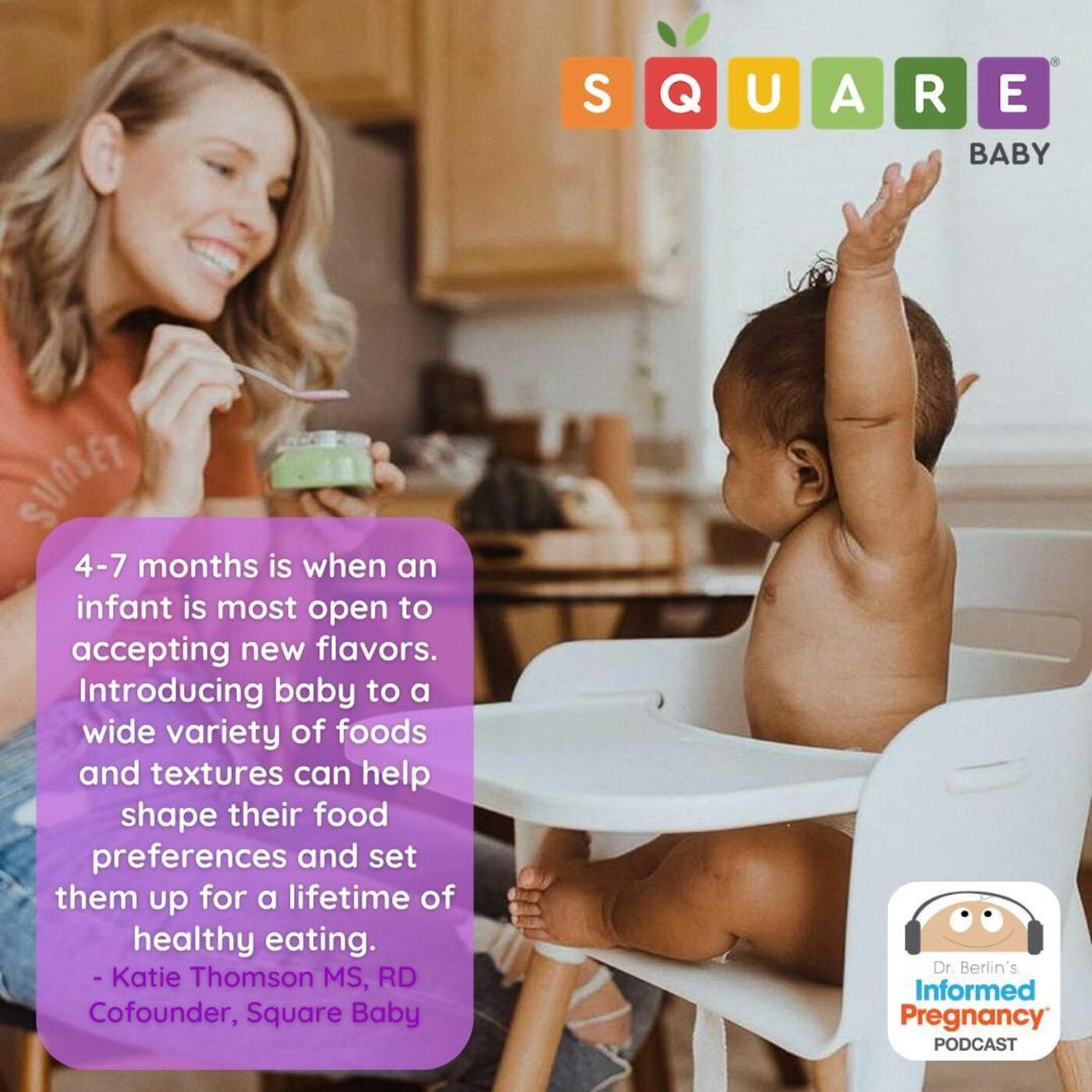
“And what I mean by that is just really developing baby's relationship with food, healthy eating habits and making sure that, you know, in this kind of critical period, which they've actually shown that four to seven months is a very critical window where an infant is most susceptible to liking new flavors, that these early days can really help shape their food preferences that, of course, then, you know, those healthy eating habits have a lasting impact over time, of course.”
“But I think that's a great takeaway for kind of one, balance your plate, try to get the food groups on there and in some amount of balance and try to get your kid as much of the rainbow as you can in a day.”
“but for an infant, you know, again, unless your baby's been diagnosed with an allergy, or you've been told by an allergist or pediatrician to avoid those foods, it really is important to look for those allergen introduction options. So of course, peanuts and tree nuts, but also milk and eggs and wheat and fish and shellfish. Yeah, I think I've got them all. But in general, this early period of their development is so key for helping to prevent food allergies. And it's something that we just never knew before.”
“shaming around picking one path or the other and our parents feeling like there's one right way to feed your baby. And I think with all things parenting, there's not one right way for anything, right? Whether it's because, you know, this is just what works for you or because of your baby's readiness or whatever it is, I think it's so important for us all to be more accepting and inclusive of what is right for each family. But I think that there's,”
Related episodes
- Ep. 328 Square Baby Part 1: 100% Daily Nutrition for Your Baby
- Ep. 332 Square Baby Part 3: The Stages of Baby Nutrition
- Ep. 329 Valentina Trentini: After Birth
- Ep. 331 The Umbilical Cord with Dr. Emiliano Chavira
Transcript
AI-generated transcript with speaker labels — may contain errors, especially names and medical terms. Dr. Elliot Berlin, DC appears in blue; Katie Thomson in orange.
Download PDF of the Transcript
Dr. Elliot Berlin, DC [1:36] Welcome to the informed pregnancy and parenting podcast. I'm your host pregnancy focused chiropractor. Dr. Elliot Berlin You've tuned in to part two of our square baby sponsored episode series in this episode We're going to delve deeper into the process behind the food selection As well as the important things to know when feeding your baby and how square baby addresses them My returning guest is one of the co-founders of square baby Katie Thompson. Welcome back to the podcast
Katie Thomson [2:04] Thanks so much for having me again. I learned so much last time
Dr. Elliot Berlin, DC [2:09] And today we're gonna get even deeper So I'm looking forward to learning more the kind of things that probably would have been helpful to know when I had little ones
Katie Thomson [2:17] That's right. That's how we all feel. It's all you know in retrospect, right?
Dr. Elliot Berlin, DC [2:22] Dang it All right, let's talk about the research you put a lot of research and effort into figuring out what makes a square meal for babies How did you go about doing it? Yeah, that's right. So
Katie Thomson [2:34] Initially, you know being a mom myself and cruising through the baby food aisles. What I found was there were so many misleadingly marketed foods I felt like many of them were fruit heavy And I really wanted to create a solution for parents that took all the guesswork out of feeding their baby and I knew that that started with sound research and recommendations, so I dove really quickly into everything in the AAP USDA and even wick was talking about related to nutrition and In even specifically more recently following the research on food allergies with some of the landmark studies like the leaps study And that shows that introducing allergens early and often can actually help to prevent allergies
[3:13] And then of course like any entrepreneur You have every conversation with anyone who's willing to talk to you from allergists to pediatricians to other brands even sharing Insights on you know common problems that we're trying to solve
Dr. Elliot Berlin, DC [3:26] Okay, so I think it's challenging I wanted to write a coffee table book where you have an issue a topic a question in health And then you have on one side all of the research that you can quote That is pro that idea and on the other side all the reason for that's anti of that idea And I think that because there's so much out there I mean just even this you mentioned AP which is American Academy of Pediatrics and USDA and like and then the other studies like You know I mean how does a person who doesn't have an extensive background in research even wade through the piles? To kind of see what's trustworthy and what's junk
Katie Thomson [4:11] Yeah, well in my opinion it shouldn't be up to the everyday consumer to have to dive that deep into research, right? Like certainly reading you know some blogs or Newsletters from a AP or something but as a dietitian. I got my master's in nutrition We spent a lot of time most of our time Going through research picking holes in certain studies presenting research, and it certainly wasn't the most fun thing for me personally But it was such a great discipline to learn to kind of understand how to sift through the BS that's out there Especially now where everyone's a nutrition expert that has a blog or an Instagram post or anything There's just information everywhere and there is a lot of stuff that's conflicting which is very you know confusing and frustrating for parents
[4:52] But certainly, you know science evolves and that's okay But you know learning to just trust in certain resources like the AAP always such a sound place to go because you know that there are layers of individuals and researchers that are approving every word on that website. Yeah, everything's like super scrutinized
Dr. Elliot Berlin, DC [5:13] and peer-reviewed. That's right. Well, what you're saying is I maybe shouldn't be getting most of my nutritional information from TikTok. I'm sure there's some really good stuff there.
Katie Thomson [5:26] Definitely some recipe ideas and some entertainment, which is important nowadays.
Dr. Elliot Berlin, DC [5:30] Recipes and entertainment are what I go to TikTok for, but not my trusted medical references. Okay. Getting back to you. So you have, and also Kendall, your partner,
Katie Thomson [5:41] have research background as well. Yes. Kendall's far smarter than me. She has a master's in biophysics and molecular genetics, which I find hard to even say, but yeah. And she remembers everything she's ever read and learned. She's like an amazing trap of knowledge. It's the best partner to have. Yeah. And then you also worked at Starbucks. Yeah. So that really taught me. So kind of going from a, you know, very clinical focus, research focus, master's degree, and then thinking I would end up in the clinical field. I got my first job at Starbucks, which is supposed to be this like three-week role where I came in and crunched the numbers and told them all the calories and all the different
[6:20] beverage iterations and all that. And then ended up taking on a more strategic role. And a big part of my job there was to, you know, of course, understand the recent research, but more so, you know, market insights, trends, what customers are looking for, really think, take myself a little bit, you know, out of just looking at science, science, science, and think about the customer. And I think honestly, like, that's what kind of brought the two things together for me for Square Baby. It's here's all the science and nutrition over here. And here's this customer with all these pain points. How do I simplify it so that they don't have to read all the research or figure out which brand they can trust,
[6:57] but to really simplify it for the parent. And then how did your own parenting experiences influence your research? Yeah, definitely. Like I always tell the story of going down that baby food aisle for the first time. You're so excited. Your baby's like made it to this next milestone and you've got your baby in the cart, you know, inevitably starts to cry and scream. And right away, you're like, this isn't what I, you know, I dreamt of, but really as a kind of food industry dietician at that point, he was really always thinking about how do we solve this moment, even at Starbucks, right? I was like, this is kind of a funny story, but we created the skinny latte because people
[7:33] would have line ordering anxiety is kind of how we termed it. You know, it was their place in line and they kind of forgot how to say, Oh, I need a non-fat and a sugar-free and a no whip. And so it's so silly, but that's how the skinny latte was born was because we were just trying to make that moment simpler for that customer who wanted that thing. So always just kind of thinking about how we can create a solution. So thinking through all of my own pain points on the last episode, I told you about how I wanted to get protein in my kid. And I felt like I was stuck with giving him these little beanie weenies in the jar. And I was like, this is not okay. So clearly we're looking for
[8:06] more protein. I wanted things beyond, you know, just the kind of the peas and carrots and sweet potatoes, you know, more adventurous foods and flavors. And then, you know, of course, you know, that balanced nutrition was really missing for me. I started to see more and more pouches come on the market. So my oldest kid who inspired this company is 13. So when we were feeding him, pouches were a new thing. It was like this very cool, like, Oh my gosh, there's a pouch with kale in it and quinoa. Like this is so exciting. But I started to become more and more frustrated when I saw that I would flip over that pouch and very often see that applesauce was the first ingredient almost
[8:40] every time. And the sugar was much higher than those brands that have been out there for decades. So really taking all those pain points as a parent really kind of led us to, you know, how do we solve this for them? And then as the science nutrition part of me wanted to make sure that we could substantiate any claims. So that's kind of where all that kind of research and all the data comes in is like, if we say it's balanced, if we say it's a hundred percent daily nutrition, how are you going to back that up? If you're, you know, sitting in court, trying to back up your claims. So
Dr. Elliot Berlin, DC [9:09] that's important too. I mean, it's so interesting because how you package something, it's the same thing like a novice trying to read through research. And I have some background research. It's very challenging for me to figure out sometimes what's truth versus fact. And same thing here with the labels. Sometimes you just look at how something is packaged or labeled and it kind of tricks you into thinking, well, I'm healthy. I'm going to be so healthy and good for your kid. And I'm more expensive, so I must be healthy. And then if you look a bit deeper, if you know what you're looking for, you all of a sudden realize you have some healthy things in there, but you're junk.
Katie Thomson [9:48] Yeah. So I, when I started at Starbucks, I actually sat on the regulatory affairs team. And so after kind of doing all the crunchium numbers and telling them how many calories were in their venti frappuccino or whatever, I was in charge of all the nutrition facts panels, all the ingredient statements and all the claims. So I very quickly learned how to kind of read your way down an aisle, right? And see where certain words have no meaning, like you can say nutritious and it has zero meaning, anyone could say it on anything, right? Healthy is a very specific definition. So you can kind of see through products to be marketed, how, you know, pictures on a product, as long as it has some
[10:24] avocado, well, they can have a giant avocado on the picture, right? And then it's mostly applesauce with just a teaspoon of avocado. So you start to sift through that. But I think what's the most challenging for not just in the baby food category is that yes, you know, nutrition facts panels and ingredient statements are regulated and should be trust. But what do we do with that number? How do we know, you know, what amount of sugar or what amount of fat or, you know, what we should be looking for in each product, right? Like those benchmarks
Dr. Elliot Berlin, DC [10:52] aren't as clear to us when we're going down the aisle. Sure. And then they also change over time. So why don't we take a little break and we come back. We'll talk about the first thousand days and during that time period, what kind of things babies need and what kind of things would be less good for them. Let's take a little break. We'll be right back. If you've ever

Dr. Elliot Berlin, DC [12:42] four times. Welcome back. We're talking to Katie Thompson on Square Baby. Let's talk nutrition and specifically the first thousand days. What kind of things do babies need in the
Katie Thomson [12:58] first thousand days for healthy growth and development? Yeah. So there's key nutrients that, you know, probably most people ever heard about or are hearing from their pediatrician, like calcium and iron, zinc, vitamin D, choline is one people hear about a little bit less. What's choline? It's mineral that's commonly found in eggs, actually. One egg provides a hundred percent of a baby's daily amount of choline and choline is an essential nutrient for brain development. Something honestly, like it wasn't even on my radar, honestly, when I was feeding my babies, whether it's kind of newer research or just something that's talked about a bit more. And that's certainly a reason why we have eggs on our menu. Calcium, iron,
[13:40] zinc, vitamin D, choline. Yep. Omega threes. Again, all the things that you're probably hearing from your pediatrician, but I think just as important and maybe talked about a little bit less is in the first 1000 days, you have this critical period for food allergy prevention. This is newer research that's come out from the elite petite eat studies, all very cutely named, of course, but I've really changed the recommendation from instead of do not give your kid a peanut until they are three. Now it is give your kids peanuts as early as four to six months and several times a week, because you can actually help prevent food allergies like peanut up by up to 80% through early allergy introduction. So I would say that's such a
[14:22] critical thing in this early, early time, as well as many parents are rightfully very, very scared about anaphylaxis and other, you know, very scary reactions to a food allergy. But before 12 months of age is actually the safest time to introduce allergens as their reactions are going to be smaller than if you were to delay that introduction.
Dr. Elliot Berlin, DC [14:46] I mean, when someone gives peanuts, let's say for the first time to get under 12 months, do you hold your breath or do you have to have anything ready?
Katie Thomson [14:54] Definitely. Well, first of all, I always say with any kind of medical advice, talk to your pediatrician or neurologist, but generally. Maybe they say, you know, try these things at home or whether you're at a doctor's office or at the pediatrician so often that first year, it might be a good idea to do it literally when you're there for a well check or for some other vaccination or something. Why not be there? But yeah, I mean, it's not a bad idea.
Dr. Elliot Berlin, DC [15:15] And like you said, you pretty much live there.
Katie Thomson [15:18] Yeah, totally. That's true. The other thing I did want to note about this first 1000 days and the importance of this window is pellet development. And what I mean by that is just really developing baby's relationship with food, healthy eating habits and making sure that, you know, in this kind of critical period, which they've actually shown that four to seven months is a very critical window where an infant is most susceptible to liking new flavors, that these early days can really help shape their food preferences that, of course, then, you know, those healthy eating habits have a lasting impact over time, of course. And then, lastly, I would say motor development and oral development skills.
[15:57] Normally, I think we wouldn't have had to talk about this a decade ago. But now with pouches being so prevalent, pouches are a great on the go. You know, I'm in an airplane, I'm going to the park, whatever I've been there. I've given my kid a pouch while driving as like a kind of a pacifier. I totally understand the need for them. But from a every meal kind of perspective, the importance of spoon feeding and finger foods for that oral and motor development skills are really important.
Dr. Elliot Berlin, DC [16:25] As you're talking about this, I'm not thinking about regrets. My kids are now older. They're all like tween teenage kids. But, you know, I think that in terms of a healthy lifestyle, the sooner you get them outdoors, running around, carrying a ball or whatever, the better off they're going to be health wise. And what you're saying here about food also rings true, like the sooner you get them eating, liking vegetables and things that have different tastes rather than, you know, super picky kids. I mean, would you say that this has a chance of decreasing pickiness in the eaters?
Katie Thomson [16:58] A hundred percent. So if you think about what we feed babies and their acceptance of like, here's some straight green beans and here's some straight broccoli and here's some spinach in a jar and some of the more even kind of what we wouldn't even want to touch, right? Because it looks so kind of muted or, you know, unappetizing or whatnot. They are much more susceptible to enjoying that new food. We say their taste buds have not grown to, you know, have a propensity or affinity for sweetness or craving salt. Like all of our palates have adjusted to the food we've been eating, right? So some people can put a salt shaker like crazy on their meal because
[17:34] they have built up a tolerance to it. Whereas infants are starting from scratch. They certainly have an affinity for sweetness from breast milk, but it's not the same thing as trying to get a toddler, you know, a strong willed toddler to try to eat something that they don't think they like, you know, don't want to eat, et cetera. So this period of time and offering things often and being adventurous is really important. I will also say when it comes to pickiness, it's been interesting kind of, you know, having kids that have grown up and, you know, having so many families over and seeing so many eating situations or whatever, that it's very easy to kind of label your kid as a picky
[18:07] eater and have that be sort of the excuse or make that the easy reason why like, Oh, my kid only eats plain pasta. Oh, you know, my kid will not touch that. And it's like, it is a hard fight sometimes, you know, and it's not the easy choice to say, you know what, you know, you're going to try in our house, at least you have to try one bite of each thing. If it's not your favorite, cool. We'll try again. We're never going to make food a fight or a terrible time. But this idea that your preferences can change, I think is important, but also letting a child know that like, you know, if they start to win every food battle, that becomes a very slippery slope and that's
[18:40] a hard thing to turn around when they get older.
Dr. Elliot Berlin, DC [18:43] It's really hard to turn around. Same, I think also the same with the inactivity, the just sitting around. But in my office now, you know, I see so many people for health and wellness care, and you can tell immediately the ones who are turned on to healthier foods at an earlier age and the ones who were turned on to exercise on an earlier age, you know, someone who's 30 like that versus someone who's 30, who has been inactive and eats junk as the mainstay of their diet. It's just two extremely different body types. So again, regrets in retrospect that I didn't get into those things earlier. And also that we did mediocre with the kids. My wife was really good at bringing them healthy foods from an earlier
[19:28] age, but you know, the picky ones, we didn't push, I presume we didn't push hard enough and you know, we're that plain pasta family. Well, one of our kids, for one of our kids, there's always time. I taught myself to like most vegetables in my twenties. So, Oh, it's just time to catch up. She's also vegetarian, but she doesn't like vegetables. So it's a kind of an interesting, all right. So we're talking about the first thousand days and all these different reasons why it's important to get kids on healthy food during that time. this is also the most critical time of development of all the different organ systems.
Katie Thomson [20:04] That's right.
Dr. Elliot Berlin, DC [20:06] And the microbiome, talk about that a little bit.
Katie Thomson [20:10] Yeah, well, gosh, I feel like that's something that when I got my masters 15 years ago, or whatever it was, it was still a bit more of a mystery. I feel like I've learned so much more, frankly, just chasing my own kind of health and nutrition, understanding my own body, but just how interconnected the microbiome is to the rest of the body when it comes to inflammation or digestion and growth, everything mood. There's so many things that are interconnected, which I know totally makes sense, but I feel like we're learning a lot more about how early diet as well as diet throughout your whole life, but especially early can really help strengthen and build that microbiome. So all the good, healthy gut bacteria that will
[20:53] help you to digest your food and kind of get the most nutrients out of your body. So certainly, all the same foods that nutritionists and pediatricians have been telling you to eat with whole grains and fruits and vegetables and lean proteins and healthy fats. It's all the same stuff that's important from immune system and brain and body development, but certainly the microbiome benefits from a healthy diet.
Dr. Elliot Berlin, DC [21:17] And we're just every day learning so much more about it. It's like we're just scratching the surface and there's already so much. It's a total puzzle. Yeah. And it's not just bacteria. It's all the microorganisms and there's gazillions of them. Okay. You have talked about how sometimes the baby food will have quinoa and something green in it, but then it's mostly apple sauce, but sometimes those fruits are good for us.
Katie Thomson [21:44] Absolutely. That's something that's so important as I talk about balanced nutrition and I kind of tell the applesauce story because it's something that I found to be so consistent across the category. It was like, oh my God, applesauce, applesauce, every single product I turn over, it said it was this four food group meal and it had this big picture of spinach on it. And I would rather it just tell me that this is a fruity meal with a little bit of hidden veggies or something, like at least be transparent and honest to the customer because if they feel like they've made this really great decision, they're giving their baby all the veggies they need, then that's where the rub is for me. But
[22:21] certainly fruit is a huge part of a healthy diet from a nutrient perspective, fiber, phytonutrients and just enjoyment. It's just obviously super delicious and never, you know, would I say cut fruit out of the diet, but certainly looking at our square meals, all of our square meals are balanced with the veggies, fruit, grains and protein, healthy fats. And what's amazing to me is, you know, we do have fruit in every meal, though sometimes I'll tell you the fruit is avocado, so we get our super savory ones when avocados, the fruit, but you just don't need that much sweetness. Babies don't need an applesauce amount of sweetness. Applesauce is totally fine here and there,
[23:01] but if everything they eat and suck out of a pouch and consume during the day is super sweet, it's going to be real hard to get that earthiness and bitterness and savory food into them, especially if you're going to switch from a baby food to table foods and have them eat the things, you know, that the rest of the family is eating. You know, you're likely not eating, you know, fruity smoothies all day long and would like for them to continue to,
Dr. Elliot Berlin, DC [23:23] you know, enjoy a variety of foods. You don't know me very well. You know, I didn't realize, you know, smoothies, you always think this is the same exact thing for older kids and adults. You think smoothies are going to be healthy and you're like, okay, I'll have some of the strawberry and banana and, you know, apple and yeah, that's not a healthy drink. Well, here's the deal. So a lot of times when
Katie Thomson [23:45] you make a smoothie at home, I've noticed like you can always throw, you know, spinach is like the magic ingredient that you can throw in like a stinking pound of spinach into, you know, a berry smoothie and no one knows the difference. Yeah. Zucchini is another great one squash, but there's something to be said about like whether you're hiding vegetables, right? Like, oh, we're sneaking this in and that's great. But also, you know, teaching your baby to love veggie forward or, you know, just veggies or veggie forward meals. So we're not hiding it, but I've noticed on my 10 year old now, Nolan, who's a total foodie, he really loves these smoothies. So he'll ask for them if we go out,
[24:21] you know, to a coffee shop or something. And he was like, can I get the smoothie? And of course, as a dietician mom who definitely is, you know, focused on creating a healthy relationship with food and not, you know, nothing is shamed and everything is a part of a healthy diet, but I'm trying to get him to understand. I go, well, look at the sugar grams on there. And he was like, ah, he was like 55. And I was like, that's like, you know, a Coke and a half. He was like, ah, I get it. I was like, so why don't you have half the smoothie? You know, cause it was a very fruit concentrated smoothie in a bottle, very different from if we would made one at home that, you know, probably had a bit more
Dr. Elliot Berlin, DC [24:53] food groups. Anyway, that's my whole dissertation. So I mean, now my smoothie is a little bit. of nut butter, unsweetened almond milk, ice, some hemp seeds, like you said, tons of spinach or power greens and some protein powder. And yeah, it's amazing. I drink it more slowly. And after I drink it, I'm not hungry at all for like three hours. It's a game changer. It's totally different. Okay. Well enough about me. I want to find out cause I keep hearing you talk about these squarely balanced meals from Square Baby, but I want to know more specifics about the meals and what's in them. So let's take a quick break. We'll be right back. Welcome back. We're talking to Katie Thompson, Square Baby. And I want
[25:49] to know about the food, Katie, tell me about the food. What are some of your more popular products?
Katie Thomson [25:55] Yeah. So when we launched, we had 20 different meals and I will say they sold pretty equally across the board, which is pretty exciting. I think people loved having the variety and love to be able to fill up their freezer with a bunch of different meals and have the whole rainbow. But certainly there's some favorites, the apple, curry, chicken, mango, coconut chicken have been some favorites amongst our families. I think partly because it's really hard to find, you know, chicken in a fresh baby food company. You'll see it in some of the jarred items, but we have a really amazing chicken bone broth from local butchers, Rolly Rody bone broth. Anyway, it's the best bone broth. So we're
[26:31] really proud of those meals.
Dr. Elliot Berlin, DC [26:33] How does it come?
Katie Thomson [26:34] Yeah. So they're made fresh and then immediately frozen right after making them. And then they're shipped to your doorstep frozen. So just like, you know, parents who you're making their own baby food very often will, you know, make a blender full and then put it in their freezer. We didn't want parents to have that pressure of, oh my gosh, this is going to go bad in four days or, you know, I'm throwing away these nice meals because they had a short shelf life. So the meals come in little container and you just thought of them and serve them.
Dr. Elliot Berlin, DC [27:01] Thonser. But is it like baby food consistency?
Katie Thomson [27:06] Yeah. So we have a range. I think it's really important to not, you know, just have one texture, you know, so we have from the kind of first bites, which tend to be really kind of on the thinner end, like a thin smoothie, but really, really super smooth and then kind of ranging up to thicker and chunkier so that, you know, again, even if baby is having mostly purees, we think it's important that they kind of graduate towards being ready for table foods. So as they grow and we have our, you know, more like eight plus months meals, they're getting more ready for, you know, chunky peas and little bits of avocado and sweet potato and things like that, that
[27:44] really kind of get them ready for table foods. So different textures for different ages. Yeah, they're all really spoonable. I think the last thing anyone really wants is like a thin puree, right? You can always thin something out with breast milk or formula. That's what we're all used to doing at home. But, you know, just having something that kind of sits on the spoon nicely, but certainly for each age and stage, there's foods that most babies are more ready for and can tolerate different textures, kind of a graduation process.
Dr. Elliot Berlin, DC [28:15] Okay. So break down something for me like apple curry chicken.
Katie Thomson [28:19] Oh, I love this one because of course it has apple, which, you know, has been my like sticking point of the baby food industry, but I was like, we're going to put, you know, apple sauce and baby food and have it, you know, be super balanced. So the first ingredient is zucchini and there's green peas. There's apple quinoa, coconut milk, chicken bone broth, curry. I think I covered it all. Yep. So it's kind of the, you know, the healthy fats of coconut milk, you know, gentle curry to help them start to enjoy different flavors. It's not at all spicy or overwhelming, but just kind of a warm flavor. Yeah. And kind of mildly sweet.
Dr. Elliot Berlin, DC [28:56] How do you come up with these? It's one thing to come up with the balanced nutrition element of it, but how do you come up with these combinations and flavors?
Katie Thomson [29:04] Honestly, you know, I'm definitely not a chef, but cooking enough for your family or just being interested in different recipes and combinations. You can think about like, Oh, gosh, that would make a really great baby food. But certainly like I started when I developed the whole square meal system, which is where, you know, all of our meals kind of ladder up to a hundred percent daily nutrition. So each of the meals is square and balanced, right? With veggies, fruits, grains, and protein. And then for example, an eight to 12 month old, any three of our meals is a hundred percent other daily recommended veggies, grains, proteins, fruit, et cetera. So the whole recipe
[29:37] system is all math, right? So like, for example, as we've been scaling up from our commercial kitchen into, you know, a larger kitchen facility, of course, these other R and D people would be like, you know, what you should do is that a little bit more applesauce to this. And I'm like, Nope, can't you know, that would be the easy solution, wouldn't it? But we stick to that promise of a hundred percent daily nutrition, which gave us parameters, but And just, you know, thinking about flavors that taste good together. And then honestly, we just made a whole bunch of blender, baby foods and tasted them ourselves.
Dr. Elliot Berlin, DC [30:09] Do your kids have any favorites?
Katie Thomson [30:11] They do. I think I might've mentioned in the last episode that my 10 year old loves the beat, Barry, Barry, Barry. So what I loved about this was that, you know, I hated beats until I was 30 and now they're my favorite, one of my favorite foods, but what I love, which is a great little anecdote for it, this working quote unquote for Nolan was that the first time we made strawberry shortcake, he asked to put beats on it and I happened to have fresh beats and I literally slice them up on top of his strawberry shortcake. And he was like, thank you. You know, like this is exactly what this combination means. And I was like, yes, mom, when, cause certainly there are a thousand
[30:47] non win moments as a mom, right? We were like, ah, you know, you know, but that was like a really great moment of that smoothie. Like he would chug it as a smoothie, right? The beat Barry, which has, you know, beat strawberries, oats, and yogurt. Pretty simple, but beats are the first ingredient. So they're not hidden in there. You definitely get the earthiness of it, but I love that he didn't shy away from that earthiness. I know. And then we use a lot of our purees as dips or sauces. So I've literally served our avocado greens, which is like a guacamole at a Superbowl party. I did add a little bit of jalapeno and some salt because we don't salt our meals.
[31:26] But I thought that was pretty cool that nobody knew that they were eating a big vat of baby food until the reveal. Yeah.
Dr. Elliot Berlin, DC [31:34] Well, to tell you what looks fantastic to me, he's on that pumpkin pie.
Katie Thomson [31:39] Um, yes. So that's my new favorite meal. We are so excited that that's a brand new meal. And it obviously includes hazelnut, which is a tree nut and an allergen. So it's great for earlier allergen reduction also has a little bit of egg, but it just has these warm flavors of pie and, you know, pumpkin forward and super creamy and really delicious. Also almond butter and banana is like, you would probably have that as a smoothie, like really yummy.
Dr. Elliot Berlin, DC [32:05] Count me in, count me in for that one.
Katie Thomson [32:08] Thanks.
Dr. Elliot Berlin, DC [32:09] I want that hazelnut pumpkin pie though, for Thanksgiving. Do you have a turkey meal?
Katie Thomson [32:16] You know, we do, we have a turkey tacos meal. We actually started this collaboration with one potato a couple of years ago and cause they're top selling meal was their turkey tacos. And I'm like, well, I can turn that into baby food. And so it has the turkey bone broth and avocado and bell peppers, corn, cumin, lime, super yummy. Also kind of like a really yummy guacamole. I feel like we have the easiest Thanksgiving dinner.
Dr. Elliot Berlin, DC [32:42] You've solved it.
Katie Thomson [32:44] Yeah. I'll send you an assortment.
Dr. Elliot Berlin, DC [32:46] Uh, okay. Rainbow. My nutritionist always said, I have like lots of different colors in your food palette. I found out the hard way. She wasn't talking about the colored sprinkles.
Katie Thomson [32:57] That's right. I know my kids will be like, look, mom, I'm eating the rainbow. And it's like, it all is right. And like, no, I think that's probably the easiest takeaway for any parent. Like none of us should have to look at every label and count, you know, gosh, has my kid gotten a hundred percent of their iron today? Am I counting up the percent DVs on the back of the nutrition factor? Like we don't live like that, but what we can think about is what colors has my kid eaten today? So you're not going to have a rainbow in every single meal. It's great if you do that's amazing, but you know, have they had enough green today, purples and the reds.
[33:31] And the reason behind this is obviously it's beautiful, but each color brings in a different phytonutrient, different, you know, cancer fighting properties and together they really provide you with the nutrition you need. Even white vegetables, like white potatoes and cauliflower, you know, obviously white and brown foods like beans and whole grains can be a part of that rainbow as well. But I think that's a great takeaway for kind of one, balance your plate, try to get the food groups on there and in some amount of balance and try to get your kid as much of the rainbow as you can in a day.
Dr. Elliot Berlin, DC [34:05] So for me or for another parent who doesn't have this much background walking down the aisles, when we pick up a label, what are some of the things that we could look for to identify better foods for our kids?
Katie Thomson [34:17] Yeah. You know, I will say that the front of the pack can be a bit more deceiving, right? That's where the pictures are. The, you know, the product name can kind of name a product for the most part, whatever you want to. And so you're not going to get a lot of information there where you're going to get that information as ingredient statements, the nutrition facts panels, because those don't lie. So I don't want to set any certain number and say, boy, if your baby has a meal that has over eight grams of sugar, that's terrible. And you're a bad parent because if you were to give them a meal of all mango or something, you really want them to try the mango.
[34:49] That's just fine. You know, as much as I kind of talk about the data and the science and this a hundred percent, like we're doing that because what we wanted to do is try to take the guesswork out of it. But if you're. choosing other brands or you're developing recipes or just feeding baby from what you have at home, all those things are totally fine. I think taking away some of that idea that it needs to be so prescriptive and perfect is for all things, parenting is a good idea, right? Like we don't need to be perfect all the time, but in general, what I like to do is kind of see through the BS of potential marketing. So if something is kind of touting
[35:25] green beans or whatever, and again, you see fruit as the first ingredient and it's got over nine or 10 grams of sugar, well, that's fine. You're probably not giving them that many green beans. You're probably giving them quite a bit of the first fruit ingredient. The other thing that kind of bothers me is my like personal rub is that we have these avocado meals where avocado is the first ingredient. They're like really lush and full of healthy fats and tons of avocado. And then you'll see these other products in the market. So our meal has six grams of healthy fats from avocado. And then you'll look at some of the other ones, tout it literally, avocados in the name and it has half of a gram of fat.
[35:59] I'm like, oh my gosh, you know, avocados, right? And I get it. They're doing that because they want the credit for avocado, but they don't want to put the expensive ingredient. And you know, it's like a teaspoon of equivalent of avocado. Anyway, so those are the kinds of things where you just sort of think through like, is this what I think I'm giving my baby and does this look balanced? But you know, it's nice to have a balance between fiber and protein and some healthy fats more moderate on the sugar. If you can aim for five or six grams or less, that's pretty great. But again, if you want to give your kiddo and all fruit and oatmeal meal, that's fine. You know,
Dr. Elliot Berlin, DC [36:35] it's all a part of the balance, right? Yeah. So a lot of times you see this exciting big words that say allergen free, but as we're learning that may not be the best thing.
Katie Thomson [36:47] Yeah. So certainly for infants, toddlers that have been diagnosed with a food allergy, that is incredibly important. And one of my closest friends, my son's best friend has a severe food allergy. So I obviously understand the absolute importance for allergen free foods, but for an infant, you know, again, unless your baby's been diagnosed with an allergy, or you've been told by an allergist or pediatrician to avoid those foods, it really is important to look for those allergen introduction options. So of course, peanuts and tree nuts, but also milk and eggs and wheat and fish and shellfish. Yeah, I think I've got them all. But in general, this early period of their development is so
[37:33] key for helping to prevent food allergies. And it's something that we just never knew before. So we know that food allergies have increased 50% from 1997 to 2011. And while researchers don't know the exact reasons behind this increase in food allergy, they do believe that it's due to a lack of exposure. So after decades of us parents being told, do not give your baby an allergen for the first year to three years of their life, this means that babies have been growing up the last several years, decades without this exposure, which has led to an increased prevalence of food allergies. I love when a company takes a look at what there
Dr. Elliot Berlin, DC [38:12] is and says, we can do better. And then does a boatload of research and then comes up with creative ideas on how to make the improvements. And so far Square Baby has addressed a whole bunch of things, including square balanced meals, veggies first, a lot of allergy information and early introduction, diversity of flavor and texture, the container rather than the pouch so that you can encourage babies to start spoon feeding and seeing and touching, experiencing the food in other ways. And also the fact that it's freshly made and frozen and delivered that way. So you optimize the nutrition that's in there. Do you also have options for vegetarian or vegan? Yeah, I'm so glad that you asked that.
Katie Thomson [39:00] Yes. So our square meal system has A, B, and C products. And we created them that way so that it made it very easy for different, you know, whether people are looking to avoid dairy or opt to be vegan family. Our B meals are all vegan. So their protein comes from beans and nuts and seeds. Our A meals are vegetarian. So they have yogurt as their protein. And then our C meals have chicken bone broth or egg, fish, et cetera. So animal protein. So it's really easy on our website to say, oh, my baby is dairy free, you know, and vegetarian or whatnot. We also have a bunch of different filters like I'm looking for extra iron or herbs and spices or more adventurous textures. And you can kind of sift
[39:44] through and see which meals really fit for you versus having to kind of go into every single meal details page and read and look at the picture because ain't nobody got time for that, right? Want someone to tell you what to buy. So thoughtful for you to do all that.
Dr. Elliot Berlin, DC [40:00] so easy for us. All right, Katie, any final thoughts?
Katie Thomson [40:04] Yeah. So, you know, it's been interesting, you know, newer topics since I've had kids for sure is this baby lead weaning. And I get asked a lot about it. And certainly we are a company that offers purees and a variety of textures. And so we get asked a lot about, you know, what do you think about baby lead weaning? And what I've noticed, sadly, is there's so much shaming around picking one path or the other and our parents feeling like there's one right way to feed your baby. And I think with all things parenting, there's not one right way for anything, right? Whether it's because, you know, this is just what works for you or because of your baby's readiness or whatever it is, I think it's so important for us all to
[40:44] be more accepting and inclusive of what is right for each family. But I think that there's, you know, room for both. And I see such a benefit, obviously, in the textures and why our purees have such a range of textures and not just an apple saucy texture, but have, you know, a chunky guacamole or kind of more of a dip texture. But there's a way to incorporate both of these quote unquote lifestyles, right? So you could use purees as a dip or a sauce. Our apple curry chicken is awesome over noodles or quinoa. If you think of the A based meals, right, the yogurt based, like peachy oatmeal or beat fairy, they make great yogurt alternatives or what some of our parents will say, oh, I feed them as a fro yo.
[41:26] Like you just kind of think about the purees as something different. It's not as though soft texture is not good for a baby's development, but like, how do we work these things? And you can also always add chunky food to a puree. You could add extra whole peas or diced up sweet potatoes or carrots or meat or whatever it is. But there's a way in which both of these worlds can live together. The purees, the baby led weaning and most RDs and pediatricians are going to recommend a mixture and a variety of foods, whether it's whole or finger feuds or purees. And that really what's most important is to listen to your own baby's readiness and cues. Some babies move on past purees super fast and some are
[42:03] hanging onto them and you really need them in order to get the food into your little one. I don't know about you, but I've certainly had like a lot of peas thrown at my face, which is fun. There's such an important part about learning to experience food and pick it up and hold it. But especially as I think about allergen reduction and the importance of getting some of these nutrients and foods in them, you know, oftentimes for parents, purees can be an easier thing to actually get your kiddo to eat and swallow. And then they can also, as they're ready, like play with the finger foods and learn to eat them. But perhaps it just can be a different road for every parent. I guess that's what I'm trying to say.
Dr. Elliot Berlin, DC [42:40] I wholeheartedly agree. And it's not only every family has their own way, but even each kid within a family sometimes has a completely different way than a different kid. And that's okay too. As always, your wealth of information and passion, and you can feel it in the conversations with you, how important this is to you, not just a business, but a mission. And we're on the receiving end of your passion and we appreciate it. We're going to do another episode, part three of three. And so there's a lot more that we get to learn from you up until then, where can we find you online?
Katie Thomson [43:14] So squarebaby.com and on social media at square baby food.
Dr. Elliot Berlin, DC [43:20] Amazing. I'm looking forward to seeing what you post up there and learning from you long after these episodes. Katie Thompson, thank you so much for joining us and at home. Thanks for listening to us. We look forward to seeing you on that Instagram as well at Dr. Berlin. It's T O C T O R B E R L I N.
Want more pregnancy + parenting? Start your FREE TRIAL of Informed Pregnancy+ and get access to all our curated pregnancy and parenting content — original series, iconic birth films like The Business of Being Born, prenatal workouts and more.
