March 2, 2023 · 47 minutes · Episode 331
About this episode
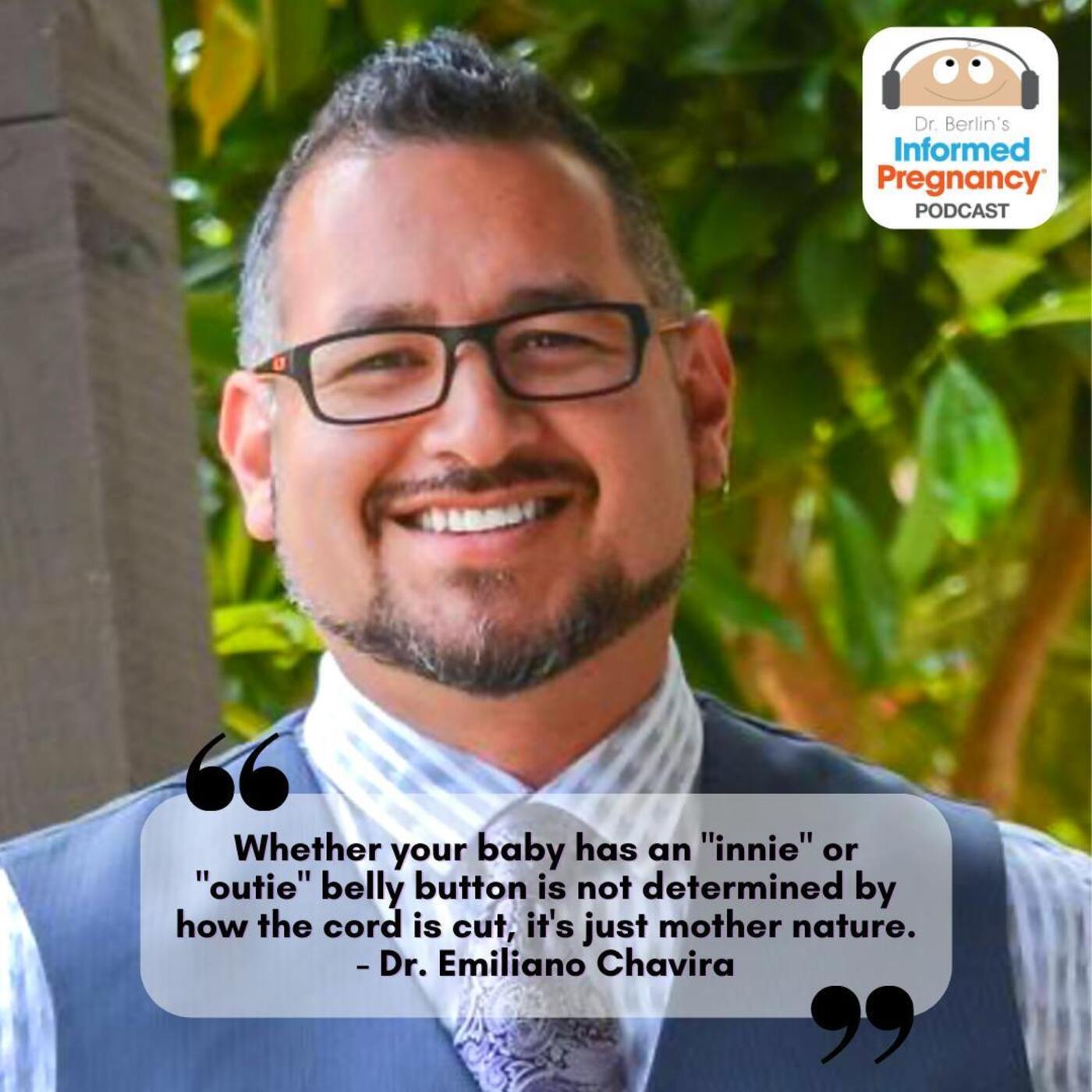
Maternal fetal medicine obstetrician-gynecologist Dr. Emiliano R. Chavira is back to discuss umbilical cords: what are they, how are they formed, what are some of the variations and complications, and what to do about them.

Connect with Dr. Chavira online: https://www.facebook.com/EmilianoChaviraMD/
Keep up with Dr. Berlin and the Informed Pregnancy Project online!
www.instagram.com/doctorberlin/
www.facebook.com/InformedPregnancy
Learn more about your ad choices. Visit megaphone.fm/adchoices
See Privacy Policy at https://art19.com/privacy and California Privacy Notice at https://art19.com/privacy#do-not-sell-my-info.
Key quotes
“Yeah, so the umbilical cord is really the lifeline for the fetus or the baby during the pregnancy It's a connection between the mother or the pregnant person and the fetus I think most people know that the umbilical cord is attached to the baby's belly button and then the other end of the cord is attached to the placenta which is also attached to the Uterine wall and that's where the vascular connection is between the baby and the mother so the mother's circulation flows into the uterus and it brings nutrients and oxygen Into the placenta which diffuses across into the fetal bloodstream that happens in the placenta and then this blood that's rich in oxygen nutrients flows through the umbilical cord to the baby, bringing all this stuff to the baby.”
“Okay, so a typical umbilical cord will have a single umbilical vein and two umbilical arteries. The vein tends to be larger than arteries. The vein is also a little more compressible. The arteries are stiffer. And then surrounding these vessels, the vessels are running through this extracellular matrix, which is this gelatinous type of tissue called Wharton's jelly.”
“And it's a very, very common finding in a term pregnancy. We'll see this in one out of every three or four births. And when you talk to the general public about this, there's a lot of awareness about the existence of the phenomenon of the nuchal cord. And there's a lot of anxiety about it.”
“Okay. Well, let's talk about what it is. Yeah. Okay. So in traditional obstetric teaching, you know, when you show up for training and your senior resident teaches you how to catch a baby, the baby is born. And then shortly thereafter, within a matter of seconds, you clamp the umbilical cord and you cut it and basically detach the baby from the mother. And then the baby goes wherever it goes. That's to the baby warmer, to the mother, wherever it is, but you've separated the baby, the mother, and then you start dealing with delivery of the placenta. So historically the cord is clamped immediately. Well, it's become very apparent with multiple studies that that's not the ideal management of the cord at the time of birth. There's a certain amount of blood contained in the placenta that gets transfused into the baby after the birth. And that has some beneficial effects. And so the current thinking is you should not clamp the cord right at the time of birth, but you should allow that natural transfusion to happen. And then the cord gets clamped at a later point in time, whether that be a minute, five minutes, 10 minutes, you know, whatever the interval is. So that's the concept of delayed cord clamping.”
“So I think in general, you know, people need to feel comfortable that these things are safe. They're not dangerous. You don't need to have a C section because of a nuclear cord. In fact, honestly, what you need to do is just sort of ignore that finding pretend like nobody ever knew about it and just treat the pregnancy as normal.”
Related episodes
- Ep. 325 Dr. Nate Fox: Thrombophilia
- Ep. 409 The Face of Birth with Kate and Gavin
- Ep. 390 Dr. Nathan Riley and Low Intervention Birth
- Ep. 385 Needed: Holistic Nutrition with Ryan Woodbury
Transcript
AI-generated transcript with speaker labels — may contain errors, especially names and medical terms. Dr. Elliot Berlin, DC appears in blue; Dr. Emiliano Chavira in orange.
Download PDF of the Transcript
Dr. Elliot Berlin, DC [1:13] Welcome to the informed pregnancy and parenting podcast. I am your host pregnancy focus chiropractor. Dr. Elliott Berlin My guest today needs no introduction. He's an old classic and favorite guest on the podcast He's an OB GYN and maternal fetal medical specialist here in Los Angeles We have some incredible episodes together talking about things like pregnancy over 35 and the arrived trial Today we're talking about Umbilical cords. What are they? How are they formed? What are some of the variations and complications? And what do you do about them? Dr. Emiliano Shavira, welcome back to the podcast. Thanks so much for the invitation. It's been a while
[2:17] You know when you pitched this topic to me, it really struck a chord. So I All right, let's jump into it first of all your background just in case anybody has been under a rock you are An OB GYN then specialize in maternal fetal medicine So that means that you do like a deeper more closer analysis of things that need a steeper looking at and then Whereas most of you stop delivering babies to sit in your office and look at MFM evaluations all day You still love to go catch them. That's right
Dr. Emiliano Chavira [2:53] Yeah, and the maternal fetal medicine it focuses on what some people understand is high-risk pregnancy Although I kind of despise that term You know it involves things either its maternal issues maternal Complications maternal medical conditions or its fetal things and it involves a lot of ultrasound So it's a very ultrasound, you know heavy Specialty, which is very, you know relevant to the issue of assessments of the umbilical cord
Dr. Elliot Berlin, DC [3:20] Mm-hmm. Is it true that you can get an ultrasound that attaches to your iPhone? Yeah
Dr. Emiliano Chavira [3:25] There are devices where there's like a handheld Ultrasound probe and then it Bluetooth's to your phone I've never used one so I don't know how good the quality is, but they are out there. Wow. Yeah
Dr. Elliot Berlin, DC [3:39] So that's pretty cool. And I wonder if they'll make that for hands for carpracters Yeah, we can remotely like you guys do the surgery with the gloves. I'm sure it's a matter of time the robot Yeah, cuz a lot of people during the pandemic work from home But I tried nobody wanted to lay down on my dining room table and get their little crack and stuff
Dr. Emiliano Chavira [3:58] So that's only because he never invited me wait, you've been
Dr. Elliot Berlin, DC [4:03] That's true Come back All right. Let's talk about the cord the umbilical cord Tell me in basic understanding of where does the cord come from? When does it develop? How is it made?
Dr. Emiliano Chavira [4:15] Yeah, so the umbilical cord is really the lifeline for the fetus or the baby during the pregnancy It's a connection between the mother or the pregnant person and the fetus I think most people know that the umbilical cord is attached to the baby's belly button and then the other end of the cord is attached to the placenta which is also attached to the Uterine wall and that's where the vascular connection is between the baby and the mother so the mother's circulation flows into the uterus and it brings nutrients and oxygen Into the placenta which diffuses across into the fetal bloodstream that happens in the placenta and then this blood that's rich in
[5:00] oxygen nutrients flows through the umbilical cord to the baby, bringing all this stuff to the baby. And it flows in through a single umbilical vein. Then the baby uses up all the good stuff, uses the oxygen, produces carbon dioxide, uses up the nutrients and produces some waste products. And those flow back out through the umbilical arteries back down the same umbilical cord, back to the placenta and back into the maternal bloodstream. And then the mother gets rid of those waste products. If you think about it, the umbilical cord has to develop from the very, very beginning of the pregnancy because it's the lifeline to the fetus. So, you know, pregnancy starts off as a single cell, right?
[5:39] And then it doubles and then you got four and then eight and 16 and turns into this massive cells which eventually separates away from the placental disc. And you have this connecting stock which over the next few weeks will develop into the umbilical cord which contains vessels. So that happens between like the third and the seventh weeks of pregnancy. By the time it gets to the seventh week, you have a formed umbilical cord.
Dr. Elliot Berlin, DC [6:09] Wow. I mean, it's mind blowing. All the pieces of this whole thing, whoever put this together, is mind blowing. But how that cord forms is just the right way between the two parties and nestles itself and even just the whole idea of a placenta that you kind of make a little command post for the nine months and then just spit it out. It's like disposable human organ. Yeah, it's very cool. Okay, so the umbilical cord, I remember this like back from a long time ago when I was studying anatomy and physiology. These umbilical arteries and veins are different than they're like backwards to all the other arteries and veins in the body, right? Because arteries always carry blood away from your heart
[6:53] and generally have oxygenated blood in them.
Dr. Emiliano Chavira [6:56] Right. So after birth, you think of children and adults, your heart pumps oxygenated blood that runs through the arteries out to the tissues and then the tissues use up that oxygen. And then the deoxygenated blood runs through the venous system back to the heart. And so in the umbilical cord, it's the opposite because oxygenated blood is running through a vein, returning from the placenta back to the fetus. And then the deoxygenated blood is pumped from the fetus through arteries back towards the placenta.
Dr. Elliot Berlin, DC [7:34] Right. Goes backwards in the cord. That's a little backwards. And you know, that explains my whole upbringing somehow. All right, so sometimes when the cord forms, things don't go exactly according to plan. Before we get into the different variations or complications that can happen, are there any things to do or not do to encourage a healthy cord?
Dr. Emiliano Chavira [8:00] You know, I think the development of the cord, I'm not really aware of anything that a pregnant person could do to influence that. I think that just sort of the workings of mother nature and it's gonna happen how it's gonna happen. So I think all you would really do is focus on, you know, healthy pregnancy behaviors, you know, eating healthy, getting exercise, good night's sleep, stress management, regular chiropractic treatments with Dr. Berlin. There's an interesting phenomenon that happens in early pregnancy, maybe from like week seven to 10 or 12. The little fetal intestines are forming. It's a small intestine, large intestine, and they actually herniate into the umbilical cord
[8:45] for a period of a couple of weeks. You can actually see this on ultrasound.
Dr. Elliot Berlin, DC [8:49] Wow.
Dr. Emiliano Chavira [8:50] And sometimes it gets mistaken for an anomaly because you see this mass in front of the baby's belly, but it's actually part of the normal physiologic development of the fetus. So it's called physiologic herniation of the gut into the umbilical cord. And it's thought to be that this is part of, you know, the way the bowel rotates inside the abdomen. There's a normal rotation that happens. And then the intestines will all slide back into the abdomen, exit the umbilical cord, and, you know, development proceeds as normal. So I've seen this multiple times where somebody looks at a fetal ultrasound and they see this mass and are concerned that it's a birth defect, that it's an anomaly,
[9:34] and the patient gets referred to maternal fetal medicine and everything later looks normal is because what they were looking at at the time was this physiologic herniation of the gut into the umbilical cord.
Dr. Elliot Berlin, DC [9:43] Well, that's really interesting. So when would you say that? You said around seven weeks?
Dr. Emiliano Chavira [9:46] Yeah, like seven to 10 weeks, seven to 11 weeks.
Dr. Elliot Berlin, DC [9:50] That's when you might see that. And in that early ultrasound, are you looking for any kind of evaluation of the cord or is it still too small?
Dr. Emiliano Chavira [9:58] You might be able to. to assess whether you have two arteries. I'm not necessarily looking at the cord, but you can see the arteries inside the fetus. They'll be surrounding the bladder. So in the first trimester, you can assess for the presence of the normal two arteries, but the cord itself is pretty hard to look at that early on.
Dr. Elliot Berlin, DC [10:21] Okay. Well, let's jump into the variations, but first a little break. We'll be right back. You don't want to miss this.

Dr. Elliot Berlin, DC [12:05] Welcome back to the Informed Pregnancy Podcast. We're talking about Dr. Emiliano Xavier about the wonderful umbilical cord. All right, tell me more about the normal anatomy of a cord.
Dr. Emiliano Chavira [12:15] Okay, so a typical umbilical cord will have a single umbilical vein and two umbilical arteries. The vein tends to be larger than arteries. The vein is also a little more compressible. The arteries are stiffer. And then surrounding these vessels, the vessels are running through this extracellular matrix, which is this gelatinous type of tissue called Wharton's jelly.
Dr. Elliot Berlin, DC [12:41] Yum.
Dr. Emiliano Chavira [12:42] And the function of that is to protect the cord, to protect the vessels in the cord against compression. So as the baby's moving around and swimming around and flipping around, interacting with the cord, the blood flow through the cord, it's not impeded from compression because it's protected by this Wharton's jelly. The cord tends to end up somewhere between like 50 to 60 centimeters long. That's pretty typical length. And the other thing is it winds, it twists. So when you see an umbilical cord, it has this twisted structure. Almost you can imagine like a telephone cord. People remember telephones with cords.
Dr. Elliot Berlin, DC [13:19] Yeah, I remember them getting tangled all the time. Yeah, so that's a typical. So it's a little convoluted. Yeah. Interesting. Okay, that's typical anatomy of a cord. Then you have some variations and some complications from mild. Where would you like to start?
Dr. Emiliano Chavira [13:38] Well, we could talk about those basic structures because there's variation there. So one variation that we commonly see is what's referred to as a single umbilical artery or sometimes two vessel cord. So instead of two arteries, there's just one. One of the arteries either never forms correctly or it fades away. And it's a fairly common finding. We might see this in like one to 2% of pregnancies. So, you know, if it's one out of 50, I might, you know, in the course of the week, see that every two or three days.
Dr. Elliot Berlin, DC [14:10] Oh, wow. Out of curiosity, does the artery that does exist, is it bigger than a typical artery?
Dr. Emiliano Chavira [14:15] No, it's about the same.
Dr. Elliot Berlin, DC [14:17] So it can do the job.
Dr. Emiliano Chavira [14:18] Yeah.
Dr. Elliot Berlin, DC [14:19] Like having two kidneys.
Dr. Emiliano Chavira [14:20] Yeah, and it actually usually does the job just fine. So when we have a single umbilical artery, there's a few things we look for. You have to look very carefully for other birth defects, other malformations, because sometimes single umbilical artery occurs in the setting of, you know, other birth defects. And so if you find that, that's a more, you know, complicated pregnancy. It can be seen sometimes in association with certain chromosomal disorders, you know, like Down syndrome, Trisomy 21, or Trisomy 18. So we're usually very interested in, you know, what the genetic screening. results are for this particular fetus. But if there's none of those other findings present
[15:06] and everything else is normal and you just have a single umbilical artery, those are usually healthy normal babies. If you read the medical literature, you will see that there's an association between single umbilical artery and growth restriction. And on a certain superficial level, that may kind of make sense. You know, like if the cord is what's supporting delivery of oxygen and nutrients to the baby, and if the cord is not normal, maybe that baby's not going to be able to grow normally. But in reality, you know, I see so many single umbilical arteries and a vast majority of cases, these babies are fine. They grow fine. They do fine. If those other tests are
Dr. Elliot Berlin, DC [15:47] negative, is there anything different to do other than just keep an eye on them?
Dr. Emiliano Chavira [15:51] Keep an eye on them. That's really it. You know, usually we would perform serial ultrasounds over the course of pregnancy to just keep track of the growth and make sure there's not a problem with the growth. And like I said, they usually grow fine. Some people might do this fetal monitoring in the end of the third trimester. Some people call it antepartum testing. Some people call it non-stress test, fetal surveillance, but basically it involves a quick ultrasound to check the amniotic fluid, make sure that's normal. And then you listen to the fetal heart rate for about a 20 minute period. And if those two findings are normal,
Dr. Elliot Berlin, DC [16:28] that's considered a reassuring fetal test. That's kind of interesting because the arteries are taking blood away from the baby. You would think if there was some sort of decrease in capacity to do work, bringing blood into the baby, that would be a more substantial concern. I mean, but it's a circular flow, right? It's a circuit. Stop being logical.
Dr. Emiliano Chavira [16:54] Yeah. So that is single umbilical artery. At what point do you usually diagnose it? Typically that would be identified at the fetal anatomy ultrasound, which tends to happen in the neighborhood of about 20 weeks. Oh, that neighborhood.
Dr. Elliot Berlin, DC [17:11] Yeah. I've been there. Yeah. Okay. So single umbilical artery. If my summary here is correct in the absence of other things, just wait and see, but probably going to be okay.
Dr. Emiliano Chavira [17:25] Yeah. It's a pretty benign finding in general. I'd say sweet. Where do we go from there? So the next thing that we would look at typically is where the umbilical cord inserts into the placenta. Okay. So typically you would expect the umbilical cord to attach the placenta somewhere in the central region. Okay. What's the quick overview of the placenta shape or structure? They tend to be disc shaped. Okay. Although sometimes they can be ovoid and sometimes you can see what are called by lobed placenta is almost maybe if you think about like a figure of eight or an infinity sign or a snowman, snow person is the shape.
Dr. Elliot Berlin, DC [18:18] Does it mean anything? I don't think it has much significant clinical importance. Okay. Even though like the by lobed, because sometimes if you just hear things like that, I was like, what is that a problem? Is that a concern? They're just different shapes, different varieties. Yeah. In general, I think so. Okay. So let's say it's a, just for visual, it's a disc shape. So there's the outer part of the disc and the inner part of the disc. You're saying the cord normally attaches somewhere towards the inner part. Yeah. Or like if you were
Dr. Emiliano Chavira [18:48] to picture a target, you know, and there's the outer blue ring and then the red ring, and then the bullseye is the yellow ring in the center. The cord will attach somewhere
Dr. Elliot Berlin, DC [18:58] in the center. Okay. Yeah. When you said target, I was picturing only white and red rings. That's Tarjay. Oh, so sorry. I didn't understand. I'll put it in the subtitles. That's right. All right. We're back. Okay. So we're looking for the cord to be towards the middle of the target. And I guess there's sometimes variations where it isn't. Right.
Dr. Emiliano Chavira [19:22] So sometimes the cord will insert closer to the edge of the placenta rather than in the center. And we would call that a marginal insertion. And you see that maybe 10% of the time, something like that. You might see it more commonly in twin pregnancies. That has been associated as well with growth restriction and preterm birth. However, what I would say about all these ultrasound findings, when you really start to dig into the medical literature, you find that the literature is somewhat scant, mixed results. probably a lot of unaccounted for confounders. So in general, I think maybe more is made of these variations than really should be.
Dr. Elliot Berlin, DC [20:12] You think the exit polls might be wrong?
Dr. Emiliano Chavira [20:14] I think it's something to be thoughtful about and, you know, mindful of, you know, the quality of the data could be better.
Dr. Elliot Berlin, DC [20:20] Hmm. Wow. So many questions. First of all, you said twins. So is there sometimes two courts going into one target?
Dr. Emiliano Chavira [20:28] Yes. Let's set twins aside for a moment.
Dr. Elliot Berlin, DC [20:31] Okay. But yes, peak my curiosity, but yes, absolutely.
Dr. Emiliano Chavira [20:35] So there's the marginal court insertion and then even more abnormal than that. Sometimes the insertion point is actually not on top of the placenta, but it's in the membranes somewhere adjacent to the placenta, right? So if we use our target example, you know, you have the yellow ring, the red ring and the blue ring. Well, you shoot the arrow and it doesn't hit any of the rings and it misses the target completely and hits the haystack that the target is hanging on. So it's off to the side somewhere. And the importance of that picture, a thin tree. And as the trunk, you know, reaches the ground, cause you know, that's how trees start right there in midair and the
[21:18] trunk grows down toward the ground. And when it hits the ground, then the roots spread out from there in all directions, right? You picture that. So the same thing happens with an umbilical cord. The cord is floating through the amniotic fluid, makes contact at the placental surface, and then branches out into vessels that then traverse across the surface of the placenta in all directions. All right. So if you picture that example of the tree with the roots, and usually that point where the tree is touching down the ground should be on top of the placenta. But in these cases, it's off to the side. And then the roots are running through the membranes to
[22:00] reach the surface of the placenta.
Dr. Elliot Berlin, DC [22:02] Wow. Okay. They're not anchored quite as well.
Dr. Emiliano Chavira [22:05] Well, that's exactly right. Because they are not protected by the Wharton's jelly. That's in the court itself. And they're not on the placental surface, which, you know, also provide some protection of those vessels. So they're kind of these naked vessels running through the amniotic membranes and they're unprotected. So this is probably a higher risk situation than some of the other variations that we've talked about. And this is referred to as a vellamentous cord insertion.
Dr. Elliot Berlin, DC [22:33] What's that terminology from?
Dr. Emiliano Chavira [22:35] My guess.
Dr. Elliot Berlin, DC [22:36] I mean, it sounds like velo sail, the term sail. Oh, okay. I thought like Velma from Scooby-Doo. Okay. So vellamentous, vellamentous cord insertion. So more concerning than the marginal cord insertion.
Dr. Emiliano Chavira [22:51] Yeah.
Dr. Elliot Berlin, DC [22:51] Marginal cord insertion goes into the placenta the way it's supposed to just off to the side, rather than the side and the vellamentous cord insertion doesn't quite really off the placenta.
Dr. Emiliano Chavira [23:02] Right.
Dr. Elliot Berlin, DC [23:03] And then the tentacles kind of make its way over there. Do they tend to run small?
Dr. Emiliano Chavira [23:08] So there does seem to be some correlation with growth restriction, but it's the kind of thing where you have a higher chance of seeing poor fetal growth than the general population, but it's also not a guarantee that that's going to happen. Most of these pregnancies will be normal. So I'll give you an example. One study that compared birth weights of the infants in this cohort of pregnancies found a low birth weight about 4% of the time. And when there was a vellamentous cord insertion, it was closer to like 15% of the time.
Dr. Elliot Berlin, DC [23:41] Oh, wow.
Dr. Emiliano Chavira [23:41] You know, three or four times higher, but on the other hand, that still leaves 85% of babies that were normally grown with a vellamentous cord with a vellamentous cord insertion.
Dr. Elliot Berlin, DC [23:51] Right. Okay. I mean, one of the things of the many things I love about you is you present data and then we can process it rather than just, you know, opinion.
Dr. Emiliano Chavira [24:02] Yeah.
Dr. Elliot Berlin, DC [24:02] So thank you for that. So with the vellamentous cord being a little bit more concerning, are there things during that pregnancy that one would do differently?
Dr. Emiliano Chavira [24:12] Well, there's no formal published guidelines that I'm aware of. I think most maternal fetal medicine specialists would recommend serial ultrasounds since growth restriction is more common. You don't want to keep a close eye on the growth. You know, if you do find a growth restricted baby, those fetuses are at a higher risk of stillbirth than the general population. So it's a finding that if it's there, you know, it's worth being aware of it and probably increasing your monitoring and then whether or not to do the fetal testing that we talked about, the antepartum testing. That's probably a matter of some controversy in a baby that's normally grown, it's probably going to be a lot more controversial and there
[24:56] will be probably universal agreement if the baby's growth is strict. then you're going to do the antipartum testing.
Dr. Elliot Berlin, DC [25:02] Mm-hmm. With developmental score, it sounds like maybe jostling would be a bad idea. Is there any sense of, like, don't be overly active or work out?
Dr. Emiliano Chavira [25:13] So I think anybody that makes that kind of recommendation, it's not evidence-based. It's just like your brain thinking. Maybe it's a good idea. Maybe it's a good idea, but you know, in the history of medical interventions, a lot of ideas that seem like good ideas, you know, once you study them, didn't pan out so well. So, you know, me personally, just as a matter of philosophy, I in general try to avoid making recommendations that don't have a good evidentiary basis. Because on the other hand, you know, there's so much, you know, if you tell a pregnant woman or pregnant person that they need to start restricting their activity, well, it's very clear there's tons and tons of
[25:56] research regarding the health benefits of physical activity and exercise and movement in pregnancy. So, you know, if you restrict those things, you may be potentially doing harm, and who knows whether there's really, you know, any benefit to that or not.
Dr. Elliot Berlin, DC [26:11] I know. I always have patients that are in some sort of restriction or modification along the way, and our patients love to work out. And they get, not just physically, but mentally, I think, a little bit drained or sad that they can't work out. And so to make them feel better, I always commit to not working out also, so they won't be the only one.
Dr. Emiliano Chavira [26:31] That's a 10 out of 10 on the empathy scale.
Dr. Elliot Berlin, DC [26:33] Thank you so much. That's why I get my two-star Yelp reviews. All right. There's a lot more cord here to talk about to record. We got to take another break. We'll be right back. Welcome back to the podcast. We're talking to Dr. Emiliano Chavira. We're just talking about developmental cord insertion, where the cord doesn't quite make it all the way in, like solidly into the placenta, but it's nearby and its little tentacles make its way in, unprotected, semi-protected, and there are different categories of that.
Dr. Emiliano Chavira [27:15] Yeah. So you can picture an umbilical cord that inserts like a centimeter away from the placental disc, as opposed to one that's three centimeters away, another one five centimeters away. So the farther away it is from the placenta, probably, you know, the more dangerous that is. And there's a particular version of this that actually is very high risk, and it depends on where in the uterus the cord is inserting into the membranes. So if the cord is inserting adjacent to the placenta, somewhere up top near the uterine fundus, that's a safer situation than if this happens down low somewhere close to the cervix. And the reason for that is when you eventually go into labor and the cervix start dilating,
[28:09] at some point the membranes are going to rupture and tear open. Sometimes that happens spontaneously, naturally. Sometimes it's done by, you know, the care provider artificially, but the membranes will rupture at some point or another. And if there are fetal vessels running through the area that ruptures, those vessels can be torn, at which point the baby is just going to be bleeding into the uterine cavity. And the fetal blood volume is pretty low. So it doesn't take long for blood loss in this situation to become life threatening for the baby. So when the vessels are, you know, running through the membranes between the umbilical cord and the placenta,
[28:57] and that is, you know, down low, close to the cervix, that situation is referred to as vasoprevia. What do you do about it? So there is some good news on this front. This is a scenario where the natural state of things, without medical interventions, this is associated with a pretty high rate of fetal loss. And the survival of babies in this situation when you don't know the diagnosis, maybe something in the neighborhood of like 60 percent or so. So there's a lot of fetal loss. But when you know the vasoprevia is there, typically what happens is these moms are admitted to the hospital in the third trimester and they are subjected to intense fetal monitoring, usually multiple times a day.
[29:48] And then the fetus is delivered early, maybe somewhere in the neighborhood of around 34 weeks. Oh, really early. By cesarean section. Right. And when you have this intensive monitoring medical management, the survival jumps up to something like 97, 99%. Wow. That was very, very high. So, you know, in obstetrics, there's so many things that we don't have, you know, good success stories. This is one diagnosis where you can really make a big impact.
Dr. Elliot Berlin, DC [30:17] Wow. So I guess people should go for regular OB checkups.
Dr. Emiliano Chavira [30:21] I mean, there are a lot of diagnoses that you might make with ultrasound that in the end, you don't really change the life trajectory of the baby significantly. In other words, like if you discover the issue after birth, that's just as well as, you know, discovering it in big pregnancy. But this is one of those exceptions where it makes an enormous difference, you know, to discover that that situation and then manage it appropriately.
Dr. Elliot Berlin, DC [30:47] Is that anywhere near similar to a funic or cord
Dr. Emiliano Chavira [30:52] presentation? Okay. So cord presentation is a different issue because vasoprevia is fetal vessels that are running between the umbilical cord and the placenta. Those vessels are attached to the membrane. They're running through the membranes. A cord presentation or a funic presentation is the umbilical cord that's free floating in the uterine cavity finds itself down low above the cervix, between the baby and the cervix. Okay. Or it could be adjacent to the fetal head, but it's somewhere, you know, down low in the uterus. So the risk there is when you labor, first of all, if the head, you know, mashes down on top of the cord that could cause some cord compression,
[31:39] you know, as you're laboring and having contractions and the, you know, the baby's sort of being pushed down onto the cervix. The other thing that can happen is as the cervix dilates and as membranes rupture and as fluid flows out, the umbilical cord could sort of what we call prolapse. It could sort of fall out and that can be a hidden cord prolapse. Like it may not be obvious. This is called an occult cord prolapse, which may be like adjacent to the baby's head in the birth canal, but it hasn't come out so far that, you know, you can feel it on exam or aware of it. So you can have these occult cord prolapses, and then you can have a complete Frank cord prolapse where a lupacord comes
[32:23] completely out of the vagina and is sort of dangling there between a mom's legs. And that is dangerous. Well, it depends that may be dangerous in certain settings. It's dangerous. So at term, when you have a term pregnancy, fortunately this cord prolapse is pretty uncommon. You know, they happen on occasion, but there's pretty infrequent complication, but you have a turn pregnancy and the baby is coming head first. In that situation, cord prolapse is a dangerous problem because, you know, the cord gets compressed by the head. And so, you know, blood flow, circulation, oxygen delivery to the baby is cut off. And you know, there are studies that show a very clear correlation the more
[33:15] time it takes you to deliver that baby, the higher risk that the baby's going to be injured or, you know, even not survive that. So it's a time sensitive emergency. There are certain breach presentations where cord prolapse may not necessarily result in cord compression. And there are studies looking at cord prolapse and the time interval between when the prolapse is diagnosed and how long the baby takes to be born. And there is actually not that much of a correlation between how long the cord is out and adverse outcomes. And it's because if you have a specifically a complete breach presentation where you have the fetal butt and the fetal legs,
[34:01] there's sort of places where the cord can pass through and not necessarily get compressed. So that little factoid is really only relevant to breach birth providers in most obstetricians, you know, they only do vaginal birth in head down babies. And so certainly in that situation, cord prolapse is a dangerous complication. And usually that's treated by emergency cesarean section in most cases.
Dr. Elliot Berlin, DC [34:29] Oh, as soon as they see the cord. Yeah. But you're saying for breach, if you have a bum down baby, it's not as big a concern.
Dr. Emiliano Chavira [34:38] So it depends on a specific type of breach. If you have a Frank breach and that means that it's just the baby's butt down there, it acts just like a fetal head. It completely fiddles. So with a Frank breach cord prolapse is equivalent to a cord prolapse with a head first baby. It's a dangerous complication. You probably need to go right to the center section. But if you have a complete breach, it may not result in cord compression the way it does with other presentations.
Dr. Elliot Berlin, DC [35:07] Okay. Completing the butts down, but the legs are also down.
Dr. Emiliano Chavira [35:12] Right. Correct.
Dr. Elliot Berlin, DC [35:13] Okay. Getting into the funic cord, is that something that you generally wouldn't deliver vaginally?
Dr. Emiliano Chavira [35:21] In most cases, you probably wouldn't. You know, you would have to have a way of moving the cord. And I don't know that there's a real obvious, easy way to do that. You know, just sort of trying to think outside the box, maybe doing some kind of inversion exercises and seeing if you can get things to shift around inside the uterine cavity. But you'd probably have to luck out for that cord to move out of the way. And I'm not sure there's a technique that could reliably move the cord out of the way for you. So you're probably delivering by C-section is the safest way to go in that scenario. Fortunately, that doesn't happen too commonly.
Dr. Elliot Berlin, DC [36:04] Oh, that's good. Is there other presentation issues with the cord? I mean, besides like the cord presentation being down or the ones that we talked about, are there any other places where the cord would be a concern? You know, there's the issue of the nuchal cord, right, where the cords around the fetal neck.
Dr. Emiliano Chavira [36:25] Okay. And it's a very, very common finding in a term pregnancy. We'll see this in one out of every three or four births. And when you talk to the general public about this, there's a lot of awareness about the existence of the phenomenon of the nuchal cord. And there's a lot of anxiety about it. I found in general that somehow it's very natural to perceive this as a dangerous circumstance.
Dr. Elliot Berlin, DC [36:53] Well, I think if we picture ourselves with the cord around our neck.
Dr. Emiliano Chavira [36:56] Yeah. You know, it's funny because for so many years as an obstetrician, my automatic thought was that people are concerned about compression of the cord. You know, if it's around the neck, you can compress the cord. And it never dawned on me. What people are worried about is asphyxiation of the baby because there's something around the neck. But they're not breathing. But they're not breathing. They're not breathing through the mouth or through the nose. They're breathing through the umbilical cord. Not through the airway. So if the airway is compressed. I guess, you know, I guess in theory, if you compress the neck hard enough, you can compress vessels that are going to the brain, the carotid arteries.
[37:39] I mean, I think if it was that tight, you would probably also get some compression of the cord itself. But, you know, the real concern is compression of the cord because, you know, like we said, the baby's not breathing through its nose and mouth the way we do. The oxygen is coming in and out of the umbilical cord. It's entering through the belly button. And it has all that Wharton's jelly. It has all that Wharton's jelly. And there's some science that is very well established about what happens when the cord gets compressed. And it's reflected in the feel heart rate. There are very immediate changes in the feel heart rate that you see if something compresses the cord.
[38:16] And so let's say a normal feel heart rate is somewhere in the range of like 110 to 160. So let's say, you know, the little baby's heart's beating along 130 beats a minute. Something squishes the cord. The heart rate slows down to 90 beats a minute. And then when you release the compression, the heart rate comes back up to 130. And so when you see this, you know, traced out on a piece of paper, it looks like a V, right? The heart rate drops down and comes back up. So that's a very reliable physiologic response. If something compresses the cord, you see what we call a variable feel heart rate deceleration. So conversely, if there is no deceleration,
[38:56] then you know that there's nothing compressing the cord or obstructing blood flow through the cord. So, you know, there's a very interesting phenomenon. You'll see a baby born that may have the cord wrapped around its neck once or twice. Rare cases, maybe even more. And you look at the feel heart tracing, you know, during labor, and there just wasn't much of any cord compression going on.
Dr. Elliot Berlin, DC [39:21] So it's designed for that, seemingly.
Dr. Emiliano Chavira [39:24] Absolutely.
Dr. Elliot Berlin, DC [39:25] Is more more concerning, like a three or four time rapid?
Dr. Emiliano Chavira [39:30] I don't know if I've ever seen any studies on that. You might think intuitively you've got a higher chance of having some cord compression with, you know, higher degrees of wrapping around, but I don't really know specifically.
Dr. Elliot Berlin, DC [39:45] Sometimes the cord is just short.
Dr. Emiliano Chavira [39:48] Yeah.
Dr. Elliot Berlin, DC [39:49] And, you know, you see sometimes the baby will come out and instead of going to the chest, they go to the belly because they can't reach. Yeah, the new extension cord. But could it be too short for them?
Dr. Emiliano Chavira [40:00] come out? I don't think so. I've never experienced anything like that. I have experienced cases where the cord was so short that the baby couldn't move away from the perineum. I mean, it's literally that short, like the baby could be born but move no farther. I saw that happen once on a twin birth. But a lot of times people are thinking conceptually about the cord holding up the baby, preventing the baby from descending, preventing the baby from moving. But the thing that you have to keep in mind is that cord is not attached to a fixed structure. In other words, like it's not attached to the maternal ribs. As the baby's moving down, that cord is not moving down.
[40:46] The cord is attached to the placenta, which is attached to the uterine wall. As the baby's moving down and the uterus is contracting and pushing everything out, everything is coming down together as a unit. As the top of the uterus is pushing down towards the maternal pelvis, the placenta is also coming downward. The cord is coming downward. Everything is moving as a unit. Does that make sense? Yeah. I'm trying to picture a good analogy,
Dr. Elliot Berlin, DC [41:17] but I can totally see it. It doesn't really matter if the cord is short, if the thing it's
Dr. Emiliano Chavira [41:21] attached to is moving along in the right direction. Yeah. So I think for a cord to be so short that the baby couldn't actually make it out the birth canal would have to be an extremely uncommon scenario. And I've never seen anything like that or read any case reports like that. What about a knot? A knot is pretty common. We see those here and there. I don't really know a percentage, but it might be, you know, 1% of the time, half a percent of the time where there's the baby's moving around and, you know, swims through loops and the cord gets tied into a knot. Again, my logical brain says, okay, if the main thing is compression, a knot doesn't sound ideal. So it's going to depend on whether it's pulled tightly or not.
[42:07] You know, if it's loose and again, the umbilical vein and the arteries are protected by this Wharton's jelly, then blood will flow through there just fine. And in fact, most of the time we see a knot, it's an incidental finding that was never seen on ultrasound. You know, we discovered it at the time of birth and the baby's fine. You know, there may be some cases where the knot gets pulled tightly and then, you know, impairs flow through the cord, but that's something that doesn't happen often. At the end of the
Dr. Elliot Berlin, DC [42:41] birth, when the baby comes out, people now talk about delayed cord clamping.
Dr. Emiliano Chavira [42:46] Do you have thoughts on the idea? I do. I think it's a misnomer. Okay. Well, let's talk about what it is. Yeah. Okay. So in traditional obstetric teaching, you know, when you show up for training and your senior resident teaches you how to catch a baby, the baby is born. And then shortly thereafter, within a matter of seconds, you clamp the umbilical cord and you cut it and basically detach the baby from the mother. And then the baby goes wherever it goes. That's to the baby warmer, to the mother, wherever it is, but you've separated the baby, the mother, and then you start dealing with delivery of the placenta. So historically the cord is clamped immediately. Well,
[43:33] it's become very apparent with multiple studies that that's not the ideal management of the cord at the time of birth. There's a certain amount of blood contained in the placenta that gets transfused into the baby after the birth. And that has some beneficial effects. And so the current thinking is you should not clamp the cord right at the time of birth, but you should allow that natural transfusion to happen. And then the cord gets clamped at a later point in time, whether that be a minute, five minutes, 10 minutes, you know, whatever the interval is. So that's the concept of delayed cord clamping. No, I think it's a euphemism that if you describe delayed cord clamping,
[44:21] that sounds like it's a maneuver. I'm going to do something new for this birth. I'm going to and this is going to confer benefits on your baby. Well, if you look at premature infants, the difference is tremendous. There's like a 25% difference in intraventricular hemorrhage, which is bleeding in the brain. It's one of the really dangerous complications that happens in pre-medic babies. So the way I think is appropriate to look at this. It's not that delayed cord clamping is a new maneuver that confers benefit. It's that the way we were doing it previously, which was premature cord clamping, that being causing harm.
Dr. Elliot Berlin, DC [45:02] I see what you're saying. But I miss number. Okay. So you're very into delayed court, very into delayed court. Clam.
Dr. Emiliano Chavira [45:07] You just don't like what it's called. Yeah. It obscures the fact that our traditional practice was harmful.
Dr. Elliot Berlin, DC [45:13] Right. Oh, I see. You almost remind me of Mitch Hedberg who used to say, why do we call it corn on the cob? That's just be called corn. It's the corn when we take it off the cob that we did something to it. Anyways. So yeah, I'm wondering anyway, none of the other animals take out a clamp and, you know, go for the cut right away. You know, I would do everything I do, like eat the baby, but sometimes we can learn from them.
Dr. Emiliano Chavira [45:37] Yeah.
Dr. Elliot Berlin, DC [45:38] I have another very important question. What determines the any or the Audi?
Dr. Emiliano Chavira [45:42] Yeah, I don't know. I think that's something that is not determined by the cutting of the cord. Okay. So eventually you cut and clamp the cord at whatever time point that is done and you leave a little bit of stock of umbilical cord. And so that might be an inch or something like that. And eventually that dries up, it desiccates and it falls off. And then the baby's belly button is remaining. So I know sometimes people will blame that on the care provider that they didn't do this cord right, but that's really just mother nature as always.
Dr. Elliot Berlin, DC [46:20] When I have you on the podcast, I've learned so much. You could even tell by my line of questioning, like, I don't know anything about the cord, but now I do. So thank you. Before we wrap it up. Is there anything that you wanted to add that we didn't cover?
Dr. Emiliano Chavira [46:32] You know, I think the main thing is so many of these topics and these issues and you know, the experience of pregnancy itself is so anxiety provoking, particularly with things like nuclear cord, and I've seen women who were told by their obstetrician that it was dangerous to labor. They were delivered by cesarean section because of, you know, the presence of a nuclear cord, seen an ultrasound. And it's just absolute nonsense. It is heartbreaking that, you know, the natural process of birth and, you know, childbirth was interrupted and transformed into surgical birth over an issue like this, but it happens fairly commonly that's not to say that the
[47:15] nuclear cord is never ever in any instance, going to be a problem, you know, in rare cases, it may be a problem, but if you're going to do a C section on every single mother that has a baby with a nuclear cord, that means we're going to do a C section on one out of every three to four babies for this reason, and then you got to think about all the complications that we're going to get from all those cesarean sections. So we're really just going to create a lot of complications that don't need to happen trying to avoid this one rare, you know, case. So I think in general, you know, people need to feel comfortable that these things are safe. They're not dangerous.
[47:55] You don't need to have a C section because of a nuclear cord. In fact, honestly, what you need to do is just sort of ignore that finding pretend like nobody ever knew about it and just treat the pregnancy as normal.
Dr. Elliot Berlin, DC [48:07] That's what I do with my liver enzymes.
Dr. Emiliano Chavira [48:09] There you go.
Dr. Elliot Berlin, DC [48:10] So doc, thank you so, so much. I'm already thinking about new topics to have you back for your manner of delivery and the way you break things down for us to understand them is really special. Thank you.
Dr. Emiliano Chavira [48:24] Well, I appreciate that. Thank you.
Dr. Elliot Berlin, DC [48:26] Where can we find you online?
Dr. Emiliano Chavira [48:28] I am pretty old.
Dr. Elliot Berlin, DC [48:31] Does this mean AOL?
Dr. Emiliano Chavira [48:34] Let me give you my MySpace address. You know, I have a very minimal social media footprint. It's on Facebook and it's basically my name and my degree. So Emiliano Travita, MD, MPH, FAC, OG on Facebook. Beautiful. MD fake cog.
Dr. Elliot Berlin, DC [48:54] Is there something after that?
Dr. Emiliano Chavira [48:56] The in between was the MPH master public health.
Dr. Elliot Berlin, DC [48:58] Oh, master public health.
Dr. Emiliano Chavira [48:59] MD, MPH, FAC, OG.
Dr. Elliot Berlin, DC [49:01] Yeah. I guess that wasn't taken. I'm really honest. You've got to add MD, MPH, FAC, OG.
Dr. Emiliano Chavira [49:07] Yeah.
Dr. Elliot Berlin, DC [49:08] All right, thanks so much. And you can always find us online at informedpregnancy.com or on Instagram at Dr. Berlin. D O C T O R B E R L I N.
Want more pregnancy + parenting? Start your FREE TRIAL of Informed Pregnancy+ and get access to all our curated pregnancy and parenting content — original series, iconic birth films like The Business of Being Born, prenatal workouts and more.