
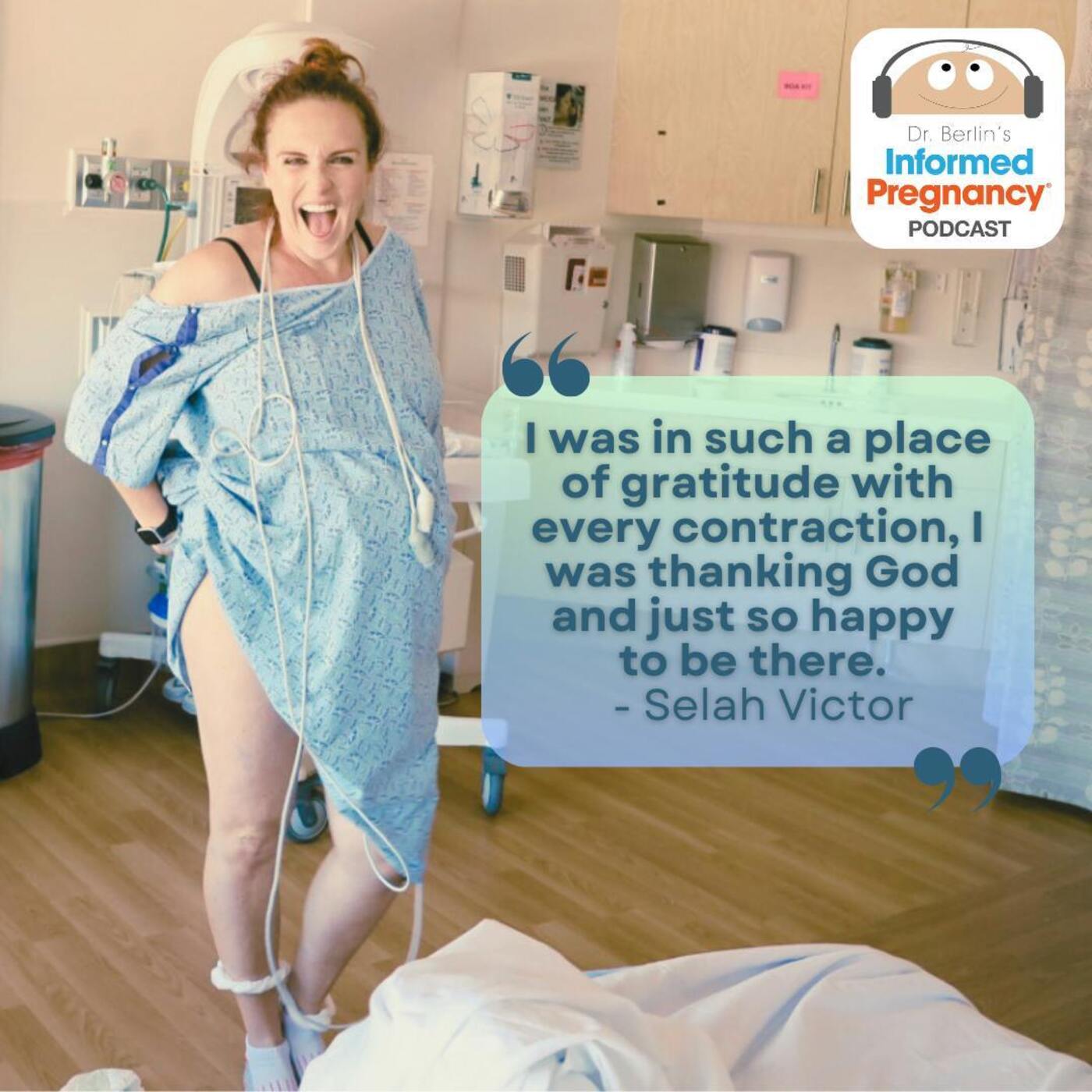
April 27, 2023 · 52 minutes · Episode 345
About this episode
Actress, comedian, and mother of three boys Selah Victor returns to share her very different birth experiences after two C-sections and most recently, a VBAC.

- Connect with Selah online: www.instagram.com/selahvictor
Keep up with Dr. Berlin and the Informed Pregnancy Project online!
www.instagram.com/doctorberlin/
www.facebook.com/InformedPregnancy
Learn more about your ad choices. Visit megaphone.fm/adchoices
See Privacy Policy at https://art19.com/privacy and California Privacy Notice at https://art19.com/privacy#do-not-sell-my-info.
Key quotes
“So they ended up in the NICU for five days and as any NICU mom will tell you it's just kind of miserable”
“Like he's the Michael Jordan of VBAC, you know?”
“Yeah, like Dr. Brock is a cowboy in that regard.”
“No NICU at all. He was in our room the whole time. Totally perfectly healthy, perfect”
“to switch and to relook at Dr. Brock, for example, that was huge. He was so incredible”
Related episodes
- Ep. 344 Selah Victor: Before Birth
- Ep. 405 Birth Stories with Valia Skiani
- Ep. 329 Valentina Trentini: After Birth
- Ep. 418 Exploring Freebirth with Catalina Clark
Transcript
AI-generated transcript with speaker labels — may contain errors, especially names and medical terms. Dr. Elliot Berlin, DC appears in blue; Selah Victor in orange.
Download PDF of the Transcript
Dr. Elliot Berlin, DC [1:13] Welcome to the informed pregnancy and parenting podcast. I'm your host Pregnancy focused chiropractor. Dr. Elliot Berlin. My guest today is an actor a Comedian a mommy a juggler because she has now three children Wow and boys not just three children three boys her original the before episode to this after episode was informed pregnancy plots on a brand new series called empowered mama She shares over there the experience of having her first two children both by caesarean birth And she was very pregnant and planning for a vaginal birth after caesarean we also did a stand-up comedy show together when she was 39 weeks and five days and I still had the bigger belly sailor Victor. Welcome to the podcast
[2:26] Thank you. Thank you for having me. I'm so excited to be here. I'm excited to have you and also Congratulations on having your third boy Yes, thank you. Someone told me recently. They're like three boys. You might as well have five kids So what happened was I was watching this brand new program online called empowered mama And I happen to notice that you shared your experience having your first two boys by caesarean birth My little recap would be the first one was ginormous Basically 1015. Yeah And then for the second one, you're planning a vaginal birth after caesarean But then at your doctor's visit the fluid was low. Yes Come on in. We'll just have another c-section
Selah Victor [3:23] Yeah that night she was like we have to get this baby out tonight Because the fluid was so low well and what was crazy was I planned on a V back but I hadn't done anything to plan It was the pandemic. I really didn't know what I didn't know. I just assumed I would have a V back You know, and now I know a lot more so that looking back was a huge mistake and I remedied it this one
Dr. Elliot Berlin, DC [3:49] Yeah, and just for a little more context something that was interesting is that your first two both ended up in the NICU
Selah Victor [3:57] Yes yeah, so that was one of the motivating factors to try something different because even though obviously not every C-section baby ends up in the NICU. I just thought it was really interesting and also the fact that there is a correlation between lung development and Not going through the vaginal canal because going through the vaginal canal their lungs get that practice where they You know go back and forth back and forth until they're out
Dr. Elliot Berlin, DC [4:27] All the fluid squeezed out of them exactly. Yes, that's
Selah Victor [4:32] Yeah, like sponges or whatever. Yeah, and in both of them in my first two They did not have all the fluid out So they ended up in the NICU for five days and as any NICU mom will tell you it's just kind of miserable To be in the NICU and it's not fun At least the way that the hospital I was at did it so I just was very motivated not to have same experience
Dr. Elliot Berlin, DC [4:53] Yeah, I can't imagine even on the best circumstances that NICU would be fun right? Yeah, and I only recently by doing a couple of episodes with NICU moms really started to get a deeper understanding of like, you're so freshly postpartum, like you just gave birth and all the learning curves and all the recoveries that are happening at the same time and all the shifts that are happening on a mind, body and spirit level to just add on top of that the stress of NICU and not going home with your baby. Not having the baby in your room, those, if you're in the hospital, you know what I mean? Recovering life, several days recovery from the surgery. So it's still gonna get bigger in my mind over time, but I got an extra sort of perception
[5:43] of the depth of what that must be like and I could see why you would want to avoid it because you also said in Empowered Mama that you had a good recovery, like a better recovery than you thought from your first at least.
Selah Victor [5:55] Yes, it wasn't terrible the first one because I didn't have another kid to watch or live or anything, you know, so I was like, oh yeah, this isn't so bad. Second one was a little worse for sure, but it still wasn't terrible. I had learned since and even as we get through this birth story, I have very high tolerance for pain.
Dr. Elliot Berlin, DC [6:13] Oh, I know that for sure. Yeah, on many levels before we jump into this third birth, I want to just have an idea because I don't even know what was your plan for your first birth?
Selah Victor [6:23] My plan for my first, it's so funny looking back because I remember the day my doctor said, you know, how heavy would you want to try to push out? And I looked at her without even hesitating. I literally said 12 pounds. I didn't know I was totally ignorant and stupid in a way, but she looked at me like I was crazy and I'm like, what, what's a couple more extra? Cause I knew 10 was big in my head. So I thought what's two more.
Dr. Elliot Berlin, DC [6:49] Yeah, well, I've never seen 12 and I've been to a lot of births. Actually I've had, you know, involvement in thousands of now on birth journeys. And I don't think I've ever had a patient have a 12 pound baby.
Selah Victor [7:04] I mean, it's crazy. Supposedly my great-grandmother had one, but I don't know if that was true. You know, it's like old folklore over the years getting passed down, but yeah, I do think I was in my head. Well, and even with my first, my water broke and even then I never felt contractions. They rushed me like straight to a C-section because there was meconium in the water. Yeah. So I never got to feel labor or anything, but even after my water broke, I was like, I can do this. And I knew he was very big from going to an MFM and all that. Dr. Rad, actually.
Dr. Elliot Berlin, DC [7:38] Yeah, I usually don't put a lot of stock in the prenatal weighings that they do since there's no speed or scale, but he's surprisingly accurate time and time again, I don't know.
Selah Victor [7:52] He almost got it to the ounce. Yeah. He was very detailed. I don't know.
Dr. Elliot Berlin, DC [7:56] Yeah. I don't know if he has a super machine or just a great sense of it, but he's usually right. So you ended up having a fairly big baby and then your water broke and there was meconium and they pulled you into a caesarian birth. But did you have sort of your mindset on one type of birth or another?
Selah Victor [8:15] I did. I was one of those who was just gung ho natural, no drugs, vaginal. My mom had eight babies without any drugs, all natural. So I'm like, I could do this. I've been a personal trainer in my twenties and early thirties before kids, and I've been, you know, a workout addict my whole life. So I'm like, I could do this. I'm strong, you know? And it was sort of the days before finding out, basically, I scheduled the C-section ironically for the day after my water broke. So I knew I was going to have a C-section because he was so big and I had come to terms with it and peace with it, but when my water broke, I did get a little excited, like, maybe this is going to happen, you know?
[8:57] Yeah. Yeah. It was hard. It's like emotional rollercoaster. I think the difference with him as around my first, and the reason I felt, I still feel peace about that first one is A, when he was pulled out of me, he was ginormous. Like I was like, I've never seen such a big newborn because he was just so chunky too, you know? It was my favorite though. I know. And his head was huge. Like I just was like, I don't know. Maybe I don't know if I could have done it. Yeah, maybe I dodged a bullet. So that was like the piece I felt. And then the second part of it was that I got to be with him the first 12 hours of his life until they realized he needed to go to the NICU.
[9:36] So that was a huge difference between the first and the second. So I think the second, I don't know if you want me to go into that part of it, but. Oh, what was the second? What happened there? Well, it was just a very, um, I don't want to use the word traumatic flippantly, but in the C-section, there was a very emergent situation with the doctor raising her voice. A lot of people rushed in and. everything, we didn't know what was happening. And it turns out obviously everything was fine, but he was rushed straight to the NICU for breathing and I wasn't with him. I was in recovery alone. It was just, you know, not ideal.
Dr. Elliot Berlin, DC [10:12] I mean, it sounds like there was a moment of near panic.
Selah Victor [10:15] Was that something she saw with the baby once you were open or. Yeah, basically she said his head had moved and she didn't want to cut through the placenta to get to him. So she cut a bigger incision, but she needed, you know, extra tools, which that's what she was yelling for. So it felt like something was very wrong. And, you know, hearing my husband's voice, everybody's voice around me. I just thought one of us is not going to make it out of life. Like it was really scary until I later found out what happened. But yeah, that happens sometimes with my contractors is once you cut into a wall, you don't know what you're going to find.
Dr. Elliot Berlin, DC [10:52] And it's true actually.
Selah Victor [10:55] I'm proud of myself. Cause usually my analogies are food-based.
Dr. Elliot Berlin, DC [10:59] Yeah, that was a good one. Actually very good.
Selah Victor [11:04] All right.
Dr. Elliot Berlin, DC [11:04] So you had to with a smile, not how you wanted, but exactly not your primary plan, but then for this third one, you really wanted to have a vaginal birth after this hearing, and as you said, you did more planning for it and a little more research. Let's take a little break. When we come back, we'll find out how you got ready for it. And then how things went down. We'll be right back.

Dr. Elliot Berlin, DC [13:03] Welcome back. We're talking to Salah Victor. All right. So two babies down. Third one comes and even you have great reasons for wanting to have a vaginal birth after cesarean, but I know in large parts of the country, it's very hard to find a doctor who will even support one vaginal birth after one cesarean, you're now at the point where you have vaginal birth that you're trying for after two cesarean. Is that difficult even in sunny Los Angeles, California? Like, is there a large pool of providers?
Selah Victor [13:33] No, there is not. It was very difficult. And actually I should back up when I was recovering from my second son's birth in the hospital room, I said to my husband, I will not get pregnant again, because I didn't think, you know, that I could ever, I would have to have another C-section. It was worse. The recovery for that one was worse. And of course the NICU, blah, blah, blah. So I just was like, I'm not doing this again. We're done. We're done having kids. So my third was a complete surprise. Yeah, that was a oopsie. And so I found myself in a situation where, well, okay. So basically I was breastfeeding. And then the cycle after I stopped breastfeeding is when we got pregnant.
[14:20] So there was that, but then there was also the fact that we did IVF with my first, my second was natural. So I should have known, but I'm like, I'm 41. What are the odds?
Dr. Elliot Berlin, DC [14:32] What are the odds?
Selah Victor [14:33] I guess we know. Yeah. Oh yeah. Apparently I'm fertile myrtle now. So my husband's like, okay. So you didn't have a period after your breastfed before this pregnancy? I had many, I think I had about a year's worth. I should have known. Oh, here's the crazy thing though. I did track my ovulation cycle, you know, every month, just in case to make sure we weren't, and I was not supposed to be ovulating that. day. So something was ordained from above because it was very odd and Oh, and that actually has that little tidbit has to do with later. I can tell you more about this, but the first OBI had had changed my due date basically, because he thought the baby was measuring bigger and the final OBI landed with, he said,
[15:22] no, it's based on your cycle. We're sticking to this due date. So
Dr. Elliot Berlin, DC [15:25] there's an OB switch. This is getting exciting. Yes. It's very, very, not a large pool yet. You have to so far. Yeah. So what that process was like finding basically, well, and this was
Selah Victor [15:41] what was crazy. When I first found out I was pregnant with this surprise miracle baby, I called my old OB who did the first two C sections because I thought, well, I don't know. That's just what you do. Right. And when her office told me she was not delivering anymore and I got chills, like I literally got chills thinking, Oh, maybe I don't have to have another C section because I knew she would have me do another C section. So I just thought maybe there's another way. Maybe I could explore actually getting a vaginal birth. And I knew from hearing one of my really good friends who had just had to be back and also listening after one. Yes. Sure.
[16:19] Hers was after one, but hearing her story and listening to vaginal birth stories on your podcast and on other podcasts, every time I would listen to one, I would cry. Like I would literally cry and just, I don't know. I just knew deep down that this is what I truly, truly wanted. And my friend, Laura led me into different, like, first of all, she said, you have to go to Dr. Berlin every week. Like I think I was really early at that point. I'm like, can I schedule every week? You're like, you don't really need to come in. Happy to see you, but yes. Yeah. We could spread it out a little at first, but yeah. So I was listening to her advice and started
[17:01] listening to your podcast, the VBAC link to everything that was like VBAC related coming in to see you interviewing doctors. I mean, I just went gung ho full force into this and doing research statistics really comfort me. Maybe that's illogical, but just knowing what the facts and the evidence are. And finding out that actually after one C-section, it's usually 1% chance of rupture, which by the way, if you didn't know, that's the biggest risk, uterine rupture for VBAC. And once you increase the C-sections, it goes a little bit higher. But for me, I'd never felt like it was a huge risk, personally. But anyway, I digress. So I started interviewing doctors and the first three were like, absolutely
[17:47] not. We will not do vaginal birth after two C-sections. And then a couple were what I call now VBAC tolerant, but not VBAC supportive.
Dr. Elliot Berlin, DC [17:57] That's a good phrase.
Selah Victor [17:58] Yeah, they were, you know, like, you can do it if this,
Dr. Elliot Berlin, DC [18:02] this, this, this, this, this, and
Selah Victor [18:04] has to be on the third day of a lunar month, and mercury has to be a little bit in retrograde. Yeah. Yeah, all of that. So then I landed on two doctors that were, I should say one was seemingly supportive, he ended up being VBAC tolerant category. And the other was totally supportive. And I actually went with the first the one that seemed supportive, but later was tolerant. And what I mean by that is in our first appointment, he and I really liked this doctor, he seems like a great doctor, but he did have a list of protocols and demands, so to speak, that I had to meet. And one of those was meeting with his MFM. Only his, by the way, no other second opinion, nothing. So I went to these
[18:50] specialist appointments with the MFM. And at the 20 week scan, he found that my uterine wall had one centimeter that was less than three millimeters thick, according to his ultrasound. And he said he was not comfortable with that. And to come back at 30 weeks and we'll reevaluate, but if it was worse, he would not recommend a VBAC. And whatever this MFM recommended is what that OB would do. No ifs, ands, ands, buts.
Dr. Elliot Berlin, DC [19:21] Well, okay, so just to, for anyone listening that might not know, you did mention the primary risk of doing vaginal birth after having had a cesarean birth is that there is a scar in the uterus from having it open to take the baby out. And it heals, but it's not as it was. And that scarring can be thin and may separate, may pull apart and open up during birth, during the intensity of labor. So I don't even know it because you said you're a data person. I know that they measure you know, sometimes some doctors measure, some don't, but do we have good data on?
Selah Victor [20:05] So, no, we do not. That is a good question. Yeah, because most women don't even get these tests done. Most VBAC patients don't go and get their uterine wall measured for thickness. So first of all, there's a lack of data there. And then secondly, the way they measure it learned is not extremely accurate and it doesn't necessarily correlate to uterine rupture. And many doctors, including another specialist I saw who has been on your podcast, and my OB that I ended up with do not think that there is any correlation actually to the data that exists.
Dr. Elliot Berlin, DC [20:46] Oh, I got you. So. Well, is that Dr. Shabir?
Selah Victor [20:49] Yeah. Dr. Shabir, I went for a second opinion.
Dr. Elliot Berlin, DC [20:52] Right, well, he's a pure data guy when he gives you, unless you ask for opinion, he's just giving you the facts. Right, so I wondered, that would be my go-to person anyway to be like, hey, Dr. Shabir, is there accuracy here? Okay, so basically from 20 weeks on then, you're sort of at the mercy of that maternal fetal medical specialist.
Selah Victor [21:14] Exactly, and nevermind the fact that this OB said I had to labor and deliver within 24 hours. I couldn't go past 40 weeks. All of these things at my first appointment, I didn't know were pretty strict protocols that a lot of women would not ever meet. So as it turns out, I did not meet when you hear what happened.
Dr. Elliot Berlin, DC [21:37] Are those their protocols in general for a VBAC
Selah Victor [21:40] or more specifically for a VBAC after two? I think it was more for the VBAC after two, but that's a good question. I don't know for sure with him what his lines would be with one cesarean.
Dr. Elliot Berlin, DC [21:54] What point did you switch?
Selah Victor [21:56] So after that 30 week, I probably should have switched before that because I knew at the 30 week he was gonna say it's even thinner. I mean, the uterine wall gets thinner as you get more pregnant. So I knew that was gonna be the case, but I just stayed with him. I don't know, I really liked him personality-wise and I wasn't crazy about the OB I ended up with and you and my doula, Joanna, both said, listen, you really need to give this other OB to a maiden name names. It's totally fine. He's been on the broadcast too before. I thought so. Okay, Dr. Brock, when I first met him, for whatever reason, I just didn't gel with him. And I just thought, no, he's not for me.
[22:41] He's not for me. And then you were so great about encouraging me to go meet with him again. Joanna felt the same way because both of you said he is so successful with what you wanna do. Like he's the Michael Jordan of VBAC, you know?
Dr. Elliot Berlin, DC [22:57] Yeah, they call him the VBAC king and I almost seem like a specialist. Like even if you love your OB, but VBAC is extremely important to you. And like you said, your doctor might be VBAC tolerant and maybe you're not sure, you know? It's almost like going to a specialist. Like if you go to a general doctor, but then something comes up and it's more heart-related then you go see a cardiologist as a specialist. He's a VBAC-ologist in my book.
Selah Victor [23:21] That is such a good way to say it. And when I went back to see him, to re-interview him, I guess, I saw him in a completely different light and I'm like, I don't have to be best friends with him. Like I just want someone who knows what they're doing and is very knowledgeable. And for whatever reason, I actually ended up feeling like he was like a friend because I got him. I got what he did. I got him and I felt completely safe with him, completely relaxed with him. His demure, it's so important. And he put all the fear out of my mind. He was just amazing. Like in every sense of the word and really came through for me at those last 10 weeks and the birth,
[24:01] which I'll get into, but.
Dr. Elliot Berlin, DC [24:03] Did he have his own set of deadlines, restrictions?
Selah Victor [24:07] So a little bit. He didn't have deadlines with like your due date, your whatever, which was great. He reminded me more of a midwife in a lot of ways. So basically he did like the vaginal ultrasound, one or two in the beginning, and then would do the abdominal ultrasound to check the health of the baby. In fact, there was a couple of times where he said, cause I would get worried and I'd say, do you think he's really big? And he said, well, what do you think? It's usually the mother's instinct after the first baby. Yeah. So I felt very safe and very confident. So then my due date situation came and that was when that last MFM with my last OB had put it at a week before
[24:52] because he said the baby was measuring a week before. And thank God, Dr. Brock based it off my cycle because what ended up happening was. at my 40 week appointment, I should say what I thought was my 40 week appointment. He said, no, you're not due for another week. And I'm like, Oh, thank God, because there were no signs of anything, you know,
Dr. Elliot Berlin, DC [25:14] most importantly afforded us the opportunity to do one more standup comedy show, but I mean, come on. Yeah. That was the perfect opportunity.
Selah Victor [25:24] I was a hit with that big belly.
Dr. Elliot Berlin, DC [25:26] I could do no wrong. That's just from the moment you walked out. Literally. They're like, what is she doing here? It was awesome. So thank you, Dr. Brock for running us a little more time. Thank you. Yes. And of course, bringing me more time for labor because a lot of doctors write that too. That's all detail. But he's also not, I mean, whatever the due date is, whatever 40 weeks actually is, it's not a cutoff point for him.
Selah Victor [25:55] No, it's not. I think he would have let me go even to 42, you know, his whole thing. Oh, when you asked about what were his standards or protocols, he wanted the baby to be in a good position. He wanted me to be monitored the entire labor. And he wanted me to put a catheter in for an epidural, just in case I needed to be rushed to C-section. I mean, then I wouldn't have to go into general anesthesia. And those were his three things.
Dr. Elliot Berlin, DC [26:24] Right. So you're not having to put any drugs in there if you don't want to.
Selah Victor [26:28] Exactly. Because he knew I wanted a drug-free birth. He was like, we just need this just in case you were to go to the C-section, which I actually really didn't want that. And I didn't want the monitoring. So I gave in to those two things because he was so awesome and supportive. But I, in the end, was right about those two things. And I'll tell you why more.
Dr. Elliot Berlin, DC [26:50] This is a perfect time to take a little break. And then when we come back, find out about how this birth happened. We'll be right back. Welcome back. We are talking to Sailor Victor. And the time is now. You waited a very long time for this birth. And now we've waited a long time. How did things get started?
Selah Victor [27:23] Yeah. So basically, we went out to dinner.
Dr. Elliot Berlin, DC [27:26] So you're out to dinner.
Selah Victor [27:28] So we're out to dinner. And this is just a side note. I was all dolled up for dinner. So that night, yes. And I had makeup, hair done, whatever. So that night, when I lost what I think now was my mucous blood, it was very little amount of sticky discharge and a little bloody show. But when that happened, it was about 10 PM. I thought, oh, I bet I'm going to go into labor. I'm keeping my hair and makeup on. A lot of people commented on that in my pictures. I'm like, yep, I was all dolled up. It's just how I always looked. Yeah, I woke up like that. But yeah, so that happened. And I got so excited because at this point, I'm 40 weeks and four days.
[28:13] And everyone thought my due date was the week before. So to everyone else, I'm 41 weeks and four days. So it's like, when is this happening? And I wasn't actually anxious because Dr. Brock was so reassuring. And also because I started a renovation of my home at 30 weeks. So I had a lot to do.
Dr. Elliot Berlin, DC [28:31] No, yes, you were juggling so many things.
Selah Victor [28:33] I was very busy.
Dr. Elliot Berlin, DC [28:34] So many things.
Selah Victor [28:36] So I was not anxious about when it would start. But when it did, I was, of course, excited. Also, because I had never experienced labor. So this was exciting. Immediately text my mom, get ready to come watch the two older boys. This is happening. And I texted my doula, Joanna, and she's like, okay, just go to bed. It could happen any minute or it could be days still. So just get some rest. Like, okay, so I go to bed. 2 a.m. I wake up and the pad I was wearing was soaked. My pants were wet. I thought, I think my water broke. But it wasn't so much water where with my first son, there was like a gush. So I wasn't totally sure. And neither was Joanna.
[29:17] She thought maybe it was still a little mucus block. So we didn't count that, so to speak, as my water breaking. Partly on purpose because we wanted to keep the clock stopped with labor. But sure enough, around 2 a.m., my contraction started. And yes, it was so exciting. Yeah, I know I'm like the only person on this planet that would be excited. Yeah, it was like, but they weren't very intense. They felt like period cramps. Like it wasn't that bad. And they were every 8 to 10 minutes or so. So they were pretty far apart. Joanna said, just go to sleep, try to rest. But I could not. I was just so excited. excitement. Okay. Yeah. Yeah. Yeah. Not because of the intensity. No, I was just like, this is
[30:06] happening. Like, this is amazing. I can't believe it. And then they started getting closer and closer. And it was like, every four minutes, one minute long, four, one, one, whatever that is, right. And it was an hour of that. And they were definitely getting more intense. Not at all, but they were in the end, which I now know, which is hilarious. Cause I looked back and like, Oh, that was nothing. I should have stayed home longer actually. But that was towards like four AM. And Joanna said, jump in the shower, try to just relax, try to rest more if you can. And then they kept coming close. They were about two to three minutes apart at that point.
[30:45] And I started getting moved in quick. Oh yeah. I started getting a little worried because I thought maybe I do have a high pain tolerance. Maybe I'm just not feeling them really hard. And this is going to happen. I've had several friends have accidental home births, like this is crazy. This is kind of getting worrisome now. So Joanna came around five and we tried to labor at home till about 10 ish. And then it just got where with two other kids, I couldn't concentrate. It was nerve wracking, you know, thinking what's happening. So I tried to eat a little bit. I couldn't really do that. So we just left for the hospital around 11. Oh, we called Dr. Brock and he was like, come in and your water broke, you know, explained
[31:30] what happened. We didn't know the broke, but he thought it did. So he said, come into the hospital. And Oh, that was another one of his protocols actually for VBAC. He did not want me to labor at home super, super long because of the risk of rupture. So in a way, typical for him, even with the VBAC, I think it's because of the VBAC after two. Yes, I think you're right. I think that was it. And I was okay with that. I mean, looking back, I wish I would have stayed at home a little longer because when I got there, they checked me and I was at a one. Oh, okay. I know. And it was really demoralizing. Yeah. Like at that point it had been 10 hours, 11 hours. I'm like, really?
[32:14] But still early, you know, I know. Well, I know that now, but at the time I was like, Oh, I thought it was so intense. Like I thought I was, you know, I would have been at least a three or something. Actually, Joanna said at that point, cause I should mention she is a licensed midwife as well. And she has been to, I don't know, something like 2,500 births. And she said what she has noticed a lot of times is the resident doctors or nurses will oftentimes underestimate how far along you are because it's also very subjective too, depending on how you check someone. Right. So it could be subjective, but it also could be not deliberately underestimating, but going for the lower number of what you find because they
[33:00] don't want the doctor to come and be like, Oh, I thought she was further along. You know
Dr. Elliot Berlin, DC [33:03] what I mean? So for them, a lot of times it's a timing game. The doctor doesn't want to be there too early and they don't want to stay too late. Depends on the system you're in, but with the private care where your specific doctor comes in to catch your baby and then wants to get out of there as soon as possible, the timing is tricky if they have to, you know, if they come in and they have to wait a few hours and really mess up their day.
Selah Victor [33:29] Exactly. So that's why they tend to a little bit underestimate or go with the lower number. So Joanna was like, I think you're actually a little bit further along. And that was really helpful to have her as a doula and have that support there in general. She really, really helped. She stayed. Well, I can get into that later, but she was really, really helpful. I highly recommend getting a doula, especially if you're trying for a VBAC, like that is a must have. Yeah. So we just kept laboring. She would, Joanna would have me do different positions, try to get whatever position was making the contractions come harder. And then I should say there was a few interesting things that happened in that early labor. First
[34:12] of all, I had a very specific prayer list. So I had like very specific things I was praying about that I wanted to go right in the birth. And interestingly enough, every single one happened except for one, which I'll get to later. Yeah. Okay. So one of the things was I wanted to go into labor naturally without induction, pitocin or whatever, which most OBs won't even let a VBAC have pitocin. But my doctor was open to it, which turned out to be a good thing. So this is why I went into this is what happened about 24 hours in where my contractions started to really get far apart, like seven to 10 minutes, which was crazy, right? Like just really slow down.
[35:00] And at that point, I think I was a six. And so, Dr. Barack was like, we got to start Pitocin. We got to get these contractions harder. It's been 24 hours.
Dr. Elliot Berlin, DC [35:09] Like an augmentation.
Selah Victor [35:11] Yeah. And at first I was like, well, I didn't want this, you know, but then it turns out I was grateful for it because it helped the contractions. But here's the crazy thing. It did not make them harder or more painful. Like that was the one part of the prayer is that I didn't want to choose them because I thought it would make the contractions more painful and cause rupture. I didn't feel any difference at all. Like it was crazy. It was insane. I know it did not feel different.
Dr. Elliot Berlin, DC [35:38] So felt the same to you, but they became closer together and more productive.
Selah Victor [35:42] They did slightly. They were still about five to six minutes apart. It was really strange, but this also was a blessing because we figured out the best position was side-lying with the peanut ball in between my knees and in between these long contraction rest periods. I would literally fall asleep, like take a cat nap.
Dr. Elliot Berlin, DC [36:03] Oh, wow. Unmedicated.
Selah Victor [36:05] Unmedicated. And all the nurses were like, we have never seen someone literally snore. That's what happens when you already have two boys.
Dr. Elliot Berlin, DC [36:14] It's just going to say that because I'm exhausted.
Selah Victor [36:16] Yeah, that's it. I need a nap. And it was sort of a blessing because I could rest in between. And so what turned out to be a 48 hour labor actually, I know did not feel like that. And at the same time, I had another thing that I was doing during contractions, which a lot of the nurses sort of started to comment on because they thought it was very, I guess odd, but I was thanking God through the contractions. Like I was in a place of gratitude because it makes me tear up now thinking about it because I was so happy to be there. I could not believe that I was feeling this, something I didn't think I'd ever feel. And I sort of felt like that after I got pregnant naturally with my second and my third.
[37:04] I never complained during pregnancy with any of them because I couldn't get pregnant for four years with my first. And so it was a very similar situation where I was like, I cannot complain through this. This is so awesome that I get to feel this. And yeah, it doesn't feel great, but it didn't hurt in a way that I thought it would. It felt like hard work, you know? So it was something that I was like very much in gratitude with. So I don't know.
Dr. Elliot Berlin, DC [37:29] This is a different paradigm, you know? Yeah. When you wanted something so bad and worked, fought for it and nobody thought you could do it. And people were really worried about you or questioned you or whatever for so long that it was like, yeah, I'm super happy to be here. I wonder just in general about the nurses because just because Dr. Burke has a comfort
Selah Victor [37:49] with vaginal birth after two cesarean, were the nurses nervous at all? Okay. So this was on my prayer list as well, that I would get supportive nurses that, you know, were on my team. And it was very interesting. The first nurse we got, I wouldn't say she was anti, but she was very intense. And thank God her shift ended pretty quickly within because I was like this nurses and she was really pushing me for that catheter to get, which I'll get to that. But I sort of was trying to push it off as long as possible because I knew I didn't want to epidural and I just felt like I don't want that. I don't want a catheter put in me, blah, blah, blah in my spine.
[38:29] So anyway, she was really pressuring me, really pressuring me. The second nurse was less so. And she was more chill, so to speak. She was great. I mean, there was nothing to complain about, but the third nurse was like a cheerleader. And it got to a point around hour 42, something like that, where there was this one resident doctor who just kept checking me and I just kept staying the same. And it was like 12 hours. I was still at eight or something. And at this point, I'm sort of skipping around. I hope that's okay. I skipped like a huge chunk, but basically at hour 45, it was like 5 PM on Monday. And I started in my little nap breaks, having these involuntary urges to push and
[39:18] all kinds of stuff was coming out of my body. So I just thought, oh my gosh, like I must be complete. Like I am pushing, you know, and everyone in the room thought she's ready. She's complete. And this resident doctor was like, nope, you're still at eight. And everyone was frustrated, even that cheerleader nurse and the doula and me and Tony, my husband. Anyway, so after the resident doctor left, I started crying. That was the first time I really just looked at everyone. I was like, I don't know. Can I do this? Like we're at hour 45 here. This is crazy. I have no pain meds. I don't know how much longer I can do this, you know? And that nurse was like, you are doing this. She's just like,
[39:56] you got this. I see you. in prayer and gratitude, I see you, I know you're gonna do, I know she was like, I'm praying with you, I'm thanking God with you and you're not giving up now. And so I'm like, okay. She was awesome, Shamika, I loved her. And that was awesome. And actually, side story about the resident doctor, this was very interesting and I think helpful for anyone trying to do this. There's something called the intrauterine catheter, do you know what I'm talking about?
Dr. Elliot Berlin, DC [40:28] IUPC.
Selah Victor [40:29] Thank you, IUPC. Pressure catheter, intrauterine pressure catheter, yeah. Yes, so they wanted to put that in and there is like a very small chance of puncture, uterine puncture. And she just kept pushing me, pushing me, pushing me to get this thing in. And I said, no, I don't want that. Like this is not helping me labor more. This is not, this is for your data. The monitor that they had me on kept falling so that's why they wanted it, to get better monitor of the contraction. And so I just kept refusing. And Joanna pointed out, and again, this is nothing against medical. I love my doctor, it's nurses and I love the medical society, whatever. This was just interesting how they will use something
[41:13] that has a small chance of something really bad happening like a uterine puncture, but they want that for their own good, right? Like it's conveniently okay for them to use that, but not other things. Does that make sense?
Dr. Elliot Berlin, DC [41:27] Yes and no. I mean, ultimately everything that they're wanting to do is for your good, but it's a measure that makes them more comfortable. Whereas I think maybe what I'm hearing, I don't wanna put words in your mouth, but maybe what I'm hearing you say is that there's certain obstetric risks that they're willing to take and other obstetric risks that may be very parallel and similar in terms of the amount of risk that they're not willing to take or not comfortable taking. And it seems somewhat arbitrary.
Selah Victor [42:01] That's right. Much better articulated than I did.
Dr. Elliot Berlin, DC [42:04] Well, no, but I mean, I don't have the emotional piece. Like when you want something and you're the one who's gonna be going through it and you're the one who's gonna have the risk and or the benefit, it seems like you would be the most important voice, especially if you're coming from a place of having done some research.
Selah Victor [42:23] Right and at that point, I didn't want one more wire in me that I had because they had the monitor. I was on wireless monitoring, but it wasn't picking up the signal. So then I was on wired monitoring, which was not ideal because you can't really walk far and it's in the way and they kept having to change the position of it. So it's very distracting.
Dr. Elliot Berlin, DC [42:45] I would also say you're way outside of the comfort zone of most hospital birth workers.
Selah Victor [42:52] It's true.
Dr. Elliot Berlin, DC [42:52] And on so many different levels. It's not just a vaginal birth, but it's a vaginal birth after two cesarean. You're after 40 weeks, you're unmedicated. Labor has been going on more than 24 hours. I know. So in many levels.
Selah Victor [43:05] This is all true.
Dr. Elliot Berlin, DC [43:06] They're outside their comfort zone.
Selah Victor [43:08] You're so right. Yeah, like Dr. Brock is a cowboy in that regard. Like he doesn't worry, but you're absolutely right. The rest of the medical staff was, yeah, they wanted to make sure. And I get it. And that's why, of course, I consented to the monitoring. I want to make sure the baby's okay. Absolutely. Like that was fine. I wish it could have been wireless, but that was why all that to say that was why I did not want the IU PC. I just did not want one more thing connected. The other reason I did not want that is going back to the catheter for whatever reason. I ended up consenting to the catheter because Dr. Brock was like, listen, it's Murphy's law.
[43:45] If you don't put it on, you're going to need it. If you do, you're not going to need it. Just wear your seatbelt.
Dr. Elliot Berlin, DC [43:49] Versus of argument, yeah.
Selah Victor [43:51] Yeah. And then I thought, you know what? I am trusting everything he's saying. He is awesome. He has not failed me. He's giving me, like you said, so much time, so much leeway. I'm just going to trust him. So they placed the catheter. And for whatever reason, Dr. Berlin, I don't know, it must've pinched a nerve. It's something that, yes, it was the only pain I felt. I mean, true pain, like excruciating. I threw up three times. It was insane. Yeah, so that was a bummer because obviously I was trying not to get it, but I knew it was important to him. And I just was like, this hurts so bad. I think it was also where Ari was at the time, where he had dropped because later in the labor,
[44:34] the pain just went away all of a sudden. So I don't know, it was really strange.
Dr. Elliot Berlin, DC [44:39] You self-medicated. You make your own cocktail of very powerful drugs that have a way to help you. So how did you get past eight centimeters?
Selah Victor [44:49] So then after that resident went out, after the tears and Shamika cheerleading me, Joanna said, I really actually think you're complete. I think this is an example of them under. estimating, you're pushing in voluntarily. Dr. Brock said he's going to come check you in three hours. Let's just keep doing what we're doing and laboring, you know, so I said, okay, sure enough, Dr. Brock comes three hours later and he says, you're complete. Like, thank God. Oh, by the way, I was 100% of faced pretty much almost the entire time. I was like, started at 90 or something. So that was good. Yeah. Baby was moving down. Yeah. So there was progress and that was encouraging. So then he says, you know,
[45:32] you're ready to push. And Joanna had warned me ahead of time. She's like pushing on your back. It's a really bad rap. But she said, in my experience, I found that is the best position to push. So she said, he's going to put you on your back. And I agree with it. Like I support it. So he did. And Joanna was on one side. Tony was on the other. They're each pushing a knee into my chest. And Dr. Brock put these like bars next to me to pull, you know, and I asked for a mirror so I could see my progress and like get motivated, I guess. And Dr. Brock was like the best coach. Like you've seen him, right? Yeah. I've been to birth as a doula with him. Oh, my gosh. I had been to a birth
[46:15] with him from my friend, Jen, you know, right. But I didn't remember this. He was like, pull your arms back, push your leg. Like he was like a track coach. And oh, yeah. Spawned to that because I was an athlete, you know. Yeah. So what a match on the level I wasn't anticipating. It was awesome. The nurses are like, Whoa, she's really pushing. And everyone was like, I've never seen someone push that well. But then this baby was so big. It was like three hours later. And Dr. Brock was like, say, look, you have one inch to go. You're so close, but it's been three hours and you've labored for, you know, 46, 47, whatever. And he goes, we have to use the vacuum. We got to get this baby out. Everything's
[47:02] fine. His heart rate stayed great. Everything was great. But he's like, you're gonna, you're gonna wear out. We got to use the vacuum. And I'm like, whatever, just get it out. I don't care. And again, this is why Dr. Brock is awesome. Because I have heard, I don't know how true this is. I've heard a lot of obese will not use a vacuum now because of the 1% risk of cranial damage. But he was willing to do whatever it took to get him out. And I've heard that some obese would have rushed me to a C section at that point, obviously would have been devastating. Oh, my God, you imagine. So he says, but listen, the vacuum is very intense. You're gonna need a little what he called push epidural in your catheter in the
[47:48] catheter. And so again, at that point, there was no fight left in me. I'm like, whatever, put it in. And Joanna looks at me like, Are you sure you said you didn't want him? Like, I don't care. I don't need to be a hero. So just get this baby out. So this is what's crazy. So again, like on my prayer list, there was like no pain meds, right? So in comes the anesthesiologist, and she's about to put the syringe in and she goes, there's a small crack on the cap of the catheter. And Dr. Brock's like, what? She's like, there's a small crack. I can't put the syringe in. It's goes against sanitation protocols. There could be bacteria in there. It's too late to put in a new catheter. She's pushing. She's
[48:27] writing, you know, whatever. We can't do it. And he's like, put the syringe in. It's fine. I'm sure it's fine. And she's like, I won't do it. And she left. And I know. So Joanna looks at me. She's like, I'm like, yes, I know. It was awesome. And so then Dr. Brock's like, Okay, you're gonna feel this, like, I'm gonna push on your stomach on your uterus. And then I'm gonna pull with the vacuum. Like, okay, so he does it. And again, it was an insane feeling. But it actually kind of felt like the C section when they do that. When they push that pressure. Yeah, that pressure. So I didn't feel like it hurts so bad. Okay, so they vacuum him out. And as you can see, I'll hold up his head is perfect, like
[49:14] literally perfect. No cranial. I know. That was awesome. And it was just awesome. He is on me within seconds. He was latching. I was crying. My husband's crying. It was just like, amazing. I could not believe that we did it like we did it. And I will say too, I Oh, this was the prayer that wasn't answered is that I didn't want to tear. But he was nine pounds, five ounces. I feel like God is like, yeah, good wish there.
Dr. Elliot Berlin, DC [49:45] Well, the vacuum generally some tearing with the vacuum.
Selah Victor [49:49] There's a little time. It wasn't bad. He said it was second degree. I didn't feel much pain when he was to tune me up. It just felt like pinches, whatever. But yeah, he was a huge baby. And everybody was like in the room, Dr. Brock, because at one of the first things I said was he's huge. Dr. Brock says he looks huge because he is huge. I know it was crazy. And I mean, it was such a great thing with my husband too, and everything the whole time. I mean, him who's so supportive. So it was just like magical, magical bonding between us, between like our baby, you know, everything. It was amazing. So no NICU. Oh, yeah. So that was the other little cherry on top.
[50:35] No NICU at all. He was in our room the whole time. Totally perfectly healthy, perfect breastfeeding. Everything was amazing. We got to go home in 24 hours. Unreal. You know, I had no clue. All I can really say is who's your chiropractor? I know. Okay, seriously though, that did help because Joanna said, if I had not been going to you that I mean, literally, I am not exaggerating. I think I went probably more than anybody else.
Dr. Elliot Berlin, DC [51:02] Yeah, I mean, at the end, we really started to, we did a lot of visits, but you could feel the progression. You could feel your body getting looser and more open, more relaxed, more functional.
Selah Victor [51:12] Yes. I need to do a commercial for you because she literally was like, in the end, she said, she was like, if you hadn't been going to all this cart, because the way they were pushing my knees in was just crazy. Like it was like, my whole body was open. So I really do credit you for that.
Dr. Elliot Berlin, DC [51:29] Well, I couldn't have done it without you, is what I generally say. Thank you so much for coming, for sharing your beautiful story. I will say this, like, no matter what comes your way, you not only have seemingly a high pain tolerance physically, but also I would say emotionally, like you wanted certain things in your births. And when they took a different turn, still always a smile from you and gratitude for the healthy baby. And, and then, you know, on this one, just what a journey to find the support and to change horses mid-battle, so to speak.
Selah Victor [52:09] So true. Well, thank you to you too. And Joanna for really encouraging me to not be afraid to switch and to relook at Dr. Brock, for example, that was huge. He was so incredible that if it weren't for you guys really encouraging me to go back and look at that again, I think I don't know what I would have done. I mean, I probably would have had an advice stayed with that other OB, another C-section, you know?
Dr. Elliot Berlin, DC [52:33] But ultimately that mind, body, spirit, strength and power to see what you want, know that you can do it and pursue it and do it, you know, literally against all odds. Congratulations to you. You're also a super funny actor and comedian. I don't want to let that slide by. So as we wind down, tell us where we can find you online.
Selah Victor [52:58] Oh, yes, at Sailor Victor on all the socials, TikTok, Facebook, Instagram. I'm like, what else is there? I'm not really on Twitter as much anymore. But anyway, yeah, at Sailor Victor and hopefully I'll be in a show soon with you.
Dr. Elliot Berlin, DC [53:14] Yeah. Oh, that'll be amazing. That'll be amazing. And then also that first birth or before episode, as we mentioned before, is on In Foreign Pregnancy Plus on a series called Empowered Mama. And it has like pictures and video. You really bring the whole thing to life. It's very cool.
Selah Victor [53:30] Yay. Oh, good. That's awesome.
Dr. Elliot Berlin, DC [53:34] And then for our listeners, everything we do can be found at InForeignPregnancy.com.
Want more pregnancy + parenting? Start your FREE TRIAL of Informed Pregnancy+ and get access to all our curated pregnancy and parenting content — original series, iconic birth films like The Business of Being Born, prenatal workouts and more.
