
September 7, 2023 · 44 minutes · Episode 371
About this episode
Los Angeles based energy healer Kristin Ford is helping guide mothers through the stages of pregnancy and birth through maternal right of passage ceremonies. She chats about a health scare that changed her entire outlook on life and her own journey to motherhood.

Connect with the guest!
- Check out Kirstin Ford’s website: https://www.kirstinbford.com/
- Connect with Kristin on social media: https://www.instagram.com/kirstinbford/
- Check out our recent blog post Understanding Life Through Prenatal Memory on Informed Pregnancy Blog: https://www.informedpregnancy.com/single-post/understanding-life-through-prenatal-memory-tainai-kioku-dr-akira-ikegawa-md
Keep up with Dr. Berlin and the Informed Pregnancy Project online!
- www.informedpregnancy.com
- www.instagram.com/doctorberlin/
- www.facebook.com/InformedPregnancy
- www.twitter.com/doctorberlin
Learn more about your ad choices. Visit megaphone.fm/adchoices
See Privacy Policy at https://art19.com/privacy and California Privacy Notice at https://art19.com/privacy#do-not-sell-my-info.
Key quotes
“I wanted to sit in the flames. And this was my journey, this was what I needed. I didn't want to rush through that.”
“I was a lioness, and I roared my son onto the earth.”
“I'm down regulating very upregulated nervous systems and I'm using touch or I'm using the flow of energy through my hands to help you come back to homeostasis, whatever that is for you.”
“you're clearing those channels, those chakras so that it's like an open highway. Things can move really freely.”
“They were there with me in the beginning just little reminders of how painful transformation can be but it's not a suffering.”
Related episodes
- Ep. 375 Dr. Rebecca Jackson: Brain Balance
- Ep. 340 Arista Ilona: A Birth Story
- Ep. 376 Behind the Lens: Birth Photography with Cristina King
- Ep. 333 Carson Meyer: A Doula's Birth Story
Transcript
AI-generated transcript with speaker labels — may contain errors, especially names and medical terms. Dr. Elliot Berlin, DC appears in blue; Kirstin Ford in orange.
Download PDF of the Transcript
Dr. Elliot Berlin, DC [0:12] Welcome to the Informed Pregnancy and Parenting Podcast. I'm your host, pregnancy-focused chiropractor Dr. Elliot Berlin. My guest today is a Los Angeles-based energy healer who specializes in rites of passage ceremonies for mothers from preconception to birth and all the way through ceremonial weaning and the arrival of subsequent children. In this episode, we'll discuss her own journey to motherhood, including an unexpected health scare and how that led to some big life changes. Kirsten Ford, welcome to the podcast.
Kirstin Ford [1:09] Hi. Thank you so much. It is such an honor to be here.
Dr. Elliot Berlin, DC [1:12] Ah, I want to learn everything from you, but let's start at the beginning. Where are you
Kirstin Ford [1:16] from originally? I am from Tulsa, Oklahoma. Tulsa, Oklahoma? What was that like growing up in Oklahoma? Oh, gosh. It was interesting. I definitely from very early on felt like very aware of how narrow focused a lot of the mindset is there. And I think there was always a feeling of like not quite fitting in. And I didn't know what that meant. And I didn't know how to reconcile it. But as an adult now reflecting back, I can see that I have a more open-minded view of life and very accepting of others. And sometimes in that part of the country, it can be very, yeah, you just don't experience a lot of different types of people. And I remember thinking Catholicism was like very different from baptism, which
[1:58] is how I grew up. And now that I know so many other religions and faiths, I'm like astounded by how little I was introduced to. Yeah. I mean, everything is paradigm. So,
Dr. Elliot Berlin, DC [2:11] you know, in that paradigm, they were quite different. But when you zoom out a little bit, you realize they're right next to each other on the bigger spectrum. And then now you're
Kirstin Ford [2:20] in Los Angeles. What brought you to LA? I came here to pursue acting. I grew up an artist. I was dancing and singing and acting. I did a lot of musical theater growing up. And I was a cheerleader. So I had this athletic side to me as well, which is where my love of science in the body comes from, which really fuels a lot of the work that I do today. But yeah, I came here to be an actress. And did you act in Oklahoma? I did, but it was mostly musical theater based. So you sing and dance? Yeah. Hashtag jealous. Yeah, I enjoy it. I think we can all pursue it. You know, I don't know that it has to be a profession where you're paid, but there's something really joyful about expression through your body. And
[3:05] I use my hands when I paint and I use my voice when I sing and my legs and spine when I dance. Like it's all expression to me. I'm all about the spine part. Yeah.
Dr. Elliot Berlin, DC [3:18] And so what was it like when you came to Los Angeles, the big city of acting,
Kirstin Ford [3:24] what was that experience like for you? Immediately? I felt really, really at home while also incredibly lonely because I had just gotten married and my husband and I, Travis, he had gone to the East coast. He was attending a really prestigious business school in Boston. And we both decided that it was in our best interest. And we wanted to support each other to pursue our dreams that he would go to Boston and attend HBS. And I would come out to LA to start acting. So it was a big adjustment in terms of, I don't have family out here. I don't have friends, but I also like a lot of people who moved to LA and initially just feel so vibrant and alive when they meet the city, because I don't know, there's an energy here
[4:10] that's just palpable. And I loved that. That was, it was so satiating to me. So it was a little bit of both, but I loved living here. And did you like come out with a specific mission on how you'd get into acting here? No, I really didn't know what I was doing. I didn't know how to approach it. And I stumbled into an acting class. It was a referral through my husband's cousin, who was the only person I knew in the city. And so I started in acting classes. And I think like a lot of new people to the city pursuing acting, that was where my friendship base really was rooted was in my acting class.
Dr. Elliot Berlin, DC [4:45] Ah, I see. And how did that go?
Kirstin Ford [4:48] I loved it. I truly, truly loved it. There was in my acting class, we did a lot of work. I got to actually perform nightly, weekly in classes. And that was really wonderful. The crushing thing, as a lot of people in the industry know, is you don't get to work professionally very frequently in the beginning. And that was a huge and rude awakening for me to realize how very challenging it was. So I lived for the classes and for those moments when I could perform, but it ultimately was something that I reflect back on and realized was a part of my unhappiness because of my personality and liking to be productive and creative, being in a career where I wasn't able
[5:28] to really do what I wanted to do as frequently as I wanted was a big part of my unhappiness that I just wasn't quite willing to acknowledge and see for a really long time.
Dr. Elliot Berlin, DC [5:41] I mean, it's kind of interesting that you realized your unhappiness sometimes and then the source of your unhappiness.
Kirstin Ford [5:50] Well, I didn't realize it as I was pursuing it. I had booked a couple things, some really big jobs and was trying to capitalize on those and leverage them into more work. And I had an amazing talent manager and things were looking really good, but the actual catalyst that helped me realize that I wasn't as happy as I thought was actually a health scare that I had if we wanna go down that.
Dr. Elliot Berlin, DC [6:14] Yeah, we talked about it in the intro. What happened?
Kirstin Ford [6:18] I found a really, really large lump on my thyroid, on my throat, and it was actually my sister's birthday, November 10th. And obviously scared me. I couldn't believe that I had never seen it before. And when I went to biopsy it, the test came back and they couldn't figure out if it was malignant or benign because of how large it was and just the nature of the nucleus. So my options were just to watch it and see if it changed.
Dr. Elliot Berlin, DC [6:46] Holy moly.
Kirstin Ford [6:47] Yeah, or just to have surgery. It was a really dark time and it made me realize that I didn't wanna pour my energy into something that didn't really matter. It was a huge awakening for me. And then it led me down this path that I've been on now for five years.
Dr. Elliot Berlin, DC [7:04] Okay, but what'd you do about the lump?
Kirstin Ford [7:06] So I had a lobectomy. I took out half my thyroid. So it was only on the far side of my left lobe. And they were able to biopsy the whole thing and found out that it was a very specific kind of nodule, something that rarely, rarely metastasizes. But the problem with it, the thing that was so scary is that it would fill with fluid and blood and then it would drain on itself.
Dr. Elliot Berlin, DC [7:28] Oh, so it was getting bigger and smaller?
Kirstin Ford [7:31] Yeah, and I could hear and I could feel that granular sound. There's a very specific sound to it. It's actually something that I've had to work through in my own somatic healing and a lot of the work that I do for myself. The sounds of that are very, very visceral for me.
Dr. Elliot Berlin, DC [7:48] So I'm sorry you had that scare. I'm glad you're okay. Then realizing acting wasn't giving you the fulfillment you wanted, did you pivot at that point to something different?
Kirstin Ford [8:00] No, I kind of just walked a very dark valley for like five or six months, a lot of self-reflection. I was fortunate enough to be in a position where I didn't need to jump into pursuing something else work-wise. And I was able to really reflect on what was happening and I faced my mortality and just a lot of things that were coming up for me. And I realized acting was something that I really love and I started painting and pursuing other forms of artistic expression, but I realized I didn't want that to be center stage. And so it was this-
Dr. Elliot Berlin, DC [8:32] Ah, literally.
Kirstin Ford [8:34] Literally center stage. First it was Reiki and then it was sound healing. And so I was introduced to these other avenues of not only healing, but resetting your nervous system and finding peace within your body and being in your body and allowing your body to feel safe again. These things were all afforded to me through these energy healing modalities. And each time I was introduced to them, they were just tools that I tucked into my tool belt, became a part of my personal life, but also things that I started sharing professionally as a yoga teacher.
Dr. Elliot Berlin, DC [9:07] Oh, wow. Okay, so also teaching yoga.
Kirstin Ford [9:10] Yeah.
Dr. Elliot Berlin, DC [9:11] Before we get into all that, because I wanna know about every single one of those things, the yoga, the sound healing, the Reiki, all the energy. Let's talk about, you have a child.
Kirstin Ford [9:23] Yes.
Dr. Elliot Berlin, DC [9:24] How was your pregnancy?
Kirstin Ford [9:27] It was actually really beautiful and blissful. It was in the middle of a pandemic. I had a very unique experience. Although I think I'm not the only one with this experience, but because of my personality and being a homebody and enjoying my garden and the things that I do around here, like painting and cooking, I found the isolation of the pandemic and being pregnant very, very sacred.
Dr. Elliot Berlin, DC [9:53] Oh, wow.
Kirstin Ford [9:54] I think also because of the work that I had been doing leading up to that point, I didn't miss. the social things that a lot of other people missed. And having never been pregnant, I didn't realize that I was missing a birth class in person or a breastfeeding class in person. So I didn't have anything to compare it to. Only now do I realize in the work that I do how beautiful community is. But I didn't have that. I had my sanctuary, I had my partner, I had my plants in the backyard and I happened to be helping nurture monarch butterflies at the time. So I had like 40 caterpillars that I was supplying milkweed plants to and it was a really beautiful 10 months.
Dr. Elliot Berlin, DC [10:34] Well, I hope they were wearing tiny little masks.
Kirstin Ford [10:37] I kept them safe. We socially distanced in the backyard.
Dr. Elliot Berlin, DC [10:41] Okay, good. And then during your pregnancy, did you have thoughts on birth, how you envisioned your birth?
Kirstin Ford [10:50] Yeah. And it's funny, the way I envisioned my birth being a reiki master and a sound healer and a yoga teacher, having had private clients leading up to the pandemic. You know, my work really revolved around quiet and sacredness. And I expected that I would sound like, you know, some Zen monk in the foothills throughout my birth. And it was actually, that was one of the things that was part of my reckoning in my birth. The surrendering that I had to come to terms with that all pregnant people will inevitably meet.
Dr. Elliot Berlin, DC [11:30] Okay, so in the plan, what was the setting? Was it gonna be home at a birth center or hospital?
Kirstin Ford [11:37] It was always at home. I wanted it to be dimly lit. I wanted, you know, to curate the music and really set the scene for what it was gonna be like. My husband and I had different playlists for the different parts of pregnancy to which, you know, very few of those actually ended up being needed.
Dr. Elliot Berlin, DC [11:54] Oh, the different parts of the labor?
Kirstin Ford [11:55] Yeah, we had the dance part where we're like really working away at the cervix and the off and all of that. And then we had like, okay, now we're getting into like the groove. It's gonna, we're gonna bring it down a little bit. And then we had a playlist for right when he was born and which we do pieces of that, or he did rather. I was nowhere near a phone or a Bluetooth, but yeah, it was thoughtfully curated. And I thought I would have a lot of control over that, but I, you know, as it goes, I didn't.
Dr. Elliot Berlin, DC [12:24] Well, let's get into that. How did it go?
Kirstin Ford [12:28] So I was pretty late, but I was like right on the mark for what you would expect a late mama to go into pregnancy or to labor. I was 41, three and my sister had come in town to be present at the birth and she'd already rebooked her flights to stay a little longer. So I was feeling immense pressure to go into labor. And that was really messing with me. When I did go into labor, my midwife had suggested a Foley balloon earlier in the day and I had it in for 30 minutes, but I was sobbing. And I told Travis, like, I don't want this in. I just don't want this in. And when it came out, it fell out and I was three centimeters. So I was ready. Like my body was already on the path
[13:06] and had been for many days.
Dr. Elliot Berlin, DC [13:09] Still at home?
Kirstin Ford [13:10] Still at home.
Dr. Elliot Berlin, DC [13:11] Okay.
Kirstin Ford [13:12] And so around dinner time, five or six was when I had my first contraction. And for a couple of hours, like I tried to rest. I tried to do the things they tell you to do. And I just kept thinking, this feeling is so intense. If this is going to get worse, I'm very, very nervous. By like 9 p.m. I was in the shower with my shower wand, scalding hot water, just moving through the waves. It was very, very intense, but it ended up being in retrospect a really short labor. When my midwife arrived at 1130, I was seven or eight centimeters, which explains why the waves were so intense. And we barely had time to get the birth pool set up. Like my husband's trying to work out kinks in the hose,
[13:58] which quick tip to anybody birthing at home, get your hose worked out, smoothed out before you need it.
Dr. Elliot Berlin, DC [14:06] Yeah, do a test run.
Kirstin Ford [14:08] Do a test run. So I got in there with like three inches of water and my sister's pouring hot water pants into the tub. And I get in there, I think it was close to one before I got in there. And that's when the interesting thing happened. The whole thing about my birth was I didn't want to tear. Desperately did not want to tear. It was all I thought about, it was, you know, Carson Madulo is like what we talked about. And so I didn't mind all these waves in my head, like the rushes that were coming on. But in hindsight, those were harder than the actual, the pushing. But what I did when pushing started was, and especially at the crowning stage, I wanted to sit in the flames.
[14:52] And this was my journey, this was what I needed. I didn't want to rush through that. There was a part of me, some people might use the word masochistic. but for me it was I wanted to know that I could walk into the fire and I wouldn't die because I had already had a tumor and I had faced my mortality. So this was like this redemptive moment of you can sit in the pain of things. You've been in the darkness, you've looked at cancer and now you are bringing a child into the world. And so all I wanted was to feel that fire with each stretch as I crowned. And my midwives like, keep going. And I remember saying, no, like I wanted to sit and feel it and I wanted to feel it dissipate.
[15:38] And then when it came again, what I didn't realize is that I was unnecessarily prolonging this phase that for some people can be 20 minutes long and I was or shorter. I really sat in that and it was what I needed in order to move to the other side of this alchemy, this chrysalis that I was in and my transformation but it was really intense. And yeah, it was a really beautiful process moving through that and it served me and it has served me in motherhood as well.
Dr. Elliot Berlin, DC [16:10] It sounds like you became the monarch butterfly.
Kirstin Ford [16:12] Yeah, I did. They were there with me in the beginning just little reminders of how painful transformation can be but it's not a suffering.
Dr. Elliot Berlin, DC [16:22] I wonder where the intense focus on not tearing came from if you know.
Kirstin Ford [16:32] You know, my mom had episiotomies, I think with, maybe with each of us. In the eighties, it was the go-to. They called it the husband's ditch. So unfortunate and would not fly today. But I think I had such a, I recoiled at the thought of that that I didn't want that. But the alternative was what if you just tear horrifically and that scared me. And my sister a few years earlier had actually torn higher up. So she had a clitoral tear. So up near the top of her labial tear. And we learned after the fact that that is far more intense than a perineal tear. And so I just had all these various experiences coming into my own perception and my experience
[17:18] that it just really made me want to avoid that.
Dr. Elliot Berlin, DC [17:22] That makes sense.
Kirstin Ford [17:23] And at one point, my midwife had suggested I get out of the birthing tub and I knew that tearing was more possible that the possibility of it was greater if I got out of the tub. So I don't know, I just, I was really, really cautious of like going too fast, letting it rip and just getting them out. I wanted to take my time with it.
Dr. Elliot Berlin, DC [17:40] Did you tear?
Kirstin Ford [17:41] No.
Dr. Elliot Berlin, DC [17:42] Oh, you got your wish.
Kirstin Ford [17:43] But you know what I think is worse is holding that stretched out position where all of those ligaments and muscles and tendons and fascia for 40 minutes. Because afterwards the pelvic floor therapy that you need, it's not just a stitch. It's not just a tear that heals. It's actually a lot more complicated and long-term.
Dr. Elliot Berlin, DC [18:07] Rehab.
Kirstin Ford [18:07] Yeah.
Dr. Elliot Berlin, DC [18:09] Well, congratulations.
Kirstin Ford [18:11] Thanks.
Dr. Elliot Berlin, DC [18:12] Let's take a little break here. And then when we come back, I wanna learn about the work that you do. We'll be right back.

Dr. Elliot Berlin, DC [19:58] Welcome back, we're talking to. Kirsten Ford. Wow, what a powerful and beautiful labor and birth story. And I wanted to jump into the work that you do. So, in addition to acting, you do lots of different types of energy work. And that is a process that sounds like it's evolved through your own experiences and then becoming a practitioner. And I imagine it evolves again after becoming a mom. Tell me about the journey.
Kirstin Ford [20:28] Yeah, I had to pause all of my private clients and sound healing that I was doing in studios around LA when the pandemic hit. So I had this natural break. And during that year, most of which I was pregnant, I did a year long Ayurvedic health program working toward becoming an Ayurvedic counselor.
Dr. Elliot Berlin, DC [20:48] Before we go further, can you define what that is Ayurvedic counseling?
Kirstin Ford [20:52] An Ayurvedic health counselor is or health coach is somebody who is studied in Ayurvedic wisdom and medicine, one of our most ancient healing modalities and life sciences, right alongside Chinese medicine. In Ayurveda, we really focus on balancing the energies of your body. So our constitution is made up of doshas is what we call them. And they are a mixture of the elements that you would find on the earth. So fire and water and earth, air and ether are the combinations. And each person has their own unique combination. I mean, percentages of each one. So an Ayurvedic health coach or health counselor or doctor would be someone who helps you understand how to balance your body in a way that is incredibly bespoke and
[21:43] specific to you and your constitution. It's finding the root causes of things based on your own upbringing and your life, as well as the life that you've been living in a more acute, shorter term. The way I apply that to maternal health is helping families and mamas as they prepare to conceive, give birth, and especially in the postpartum period. So I spent a year studying that.
Dr. Elliot Berlin, DC [22:11] Wow, powerful. Was that after you had your baby?
Kirstin Ford [22:15] It was while I was pregnant.
Dr. Elliot Berlin, DC [22:17] Oh, while you were pregnant. Okay. And what does that practically translate into in terms of, you know, somebody receiving your work?
Kirstin Ford [22:26] Yeah, in preconception, it would look like understanding where imbalances might be for you right now. Are you eating in a way that is seasonal based on dosha, vata, pitta, kapha? Are you, so eating and nutrition is a huge part of it. It's understanding your own lifestyle and how that informs your fertility. That would be preconception. And this is a very short kind of truncated version of imagination. But in pregnancy, it becomes even more important, I think, because so much is happening for newly pregnant person at mama, that having someone who understands how to balance those parts of your body, the system, and also nourish your tissues, which is an
[23:10] Ayurvedic view of nourishing your body, those become really important. And then in postpartum, there is so much healing available to you in the first 40 days that through the Ayurvedic lens, you can nourish your body through lifestyle practices and rituals, as well as nourishment. And you, the idea in Ayurveda is that for those 40 days, if you're nourishing yourself, you afford yourself 40 years of health, but also the opposite is true. So in those 40 days, if you are not taking care of yourself, then it can lead to 40 years of discomfort or disease in your body.
Dr. Elliot Berlin, DC [23:47] Wow. Yeah, powerful. Does your composition change during pregnancy as you're creating a new life?
Kirstin Ford [23:56] So your prokraty, your own constitution doesn't change necessarily, but your environment internally and externally does change. So the view is there's a understanding your own constitution and what's happening inside and around you can help you find more balance. So there's a lot of pitta that kicks up in second, third trimester, a ton of heat. Pitta is our fire, primarily fire element, and that gets really intense. So anyone who's been pregnant knows second trimester, especially third trimester, you're hot all the time. There's a lot of things that go into that, but it's understanding the more fundamental pieces of Ayurveda and applying them to your body allows you
[24:40] to find more ease. You aren't necessarily changing, but your experience is changing as your body is now holding life, someone else's life, and your child also has its own constitution that plays into it. It can get really involved, but it's also really fascinating.
Dr. Elliot Berlin, DC [24:57] So is there work you can do for the baby? baby prenatally?
Kirstin Ford [25:02] Interesting question. Not necessarily targeted at the baby's constitution. The baby's constitution, although it is formed at conception, it's not something that you would necessarily know. Maybe someone who's super intuitive might be able to guess, but like I knew my babe had a lot of pitta because of his activity level, but I couldn't confirm that until I gave birth to him and I got to see him and understand more about him. He didn't wear any of his cute little onesies. For three months, this kid was just diapers or naked. He was hot and sweating all the time. He goes in the sun now and he's immediately flushed, he sweats during his naps, nothing
[25:40] is wrong with him. He is predominantly pitta. He's got a lot of fire in him and you can see his personality.
Dr. Elliot Berlin, DC [25:46] A lot of heat. Yeah. Interesting. Okay. But then you also mentioned reiki, which is different.
Kirstin Ford [25:55] Reiki is energy healing. It's another system of healing that is really rooted in more of like the Earth's frequency and it's a really beautiful, yeah, very different from Ayurveda, but it's a very beautiful method for connecting to your body in a spiritual way. It doesn't have to feel spiritual. It can actually just be very relaxing. The easiest way to explain reiki to kind of a lay person would be to say, when I meet someone new and they're like, what's it going to feel like? It's a nervous system reset. I'm down regulating very upregulated nervous systems and I'm using touch or I'm using the flow of energy through my hands to help you come back to homeostasis, whatever
[26:47] that is for you.
Dr. Elliot Berlin, DC [26:48] Yeah. I will say for me, it's kind of interesting. You know, there's the stretch lab where you kind of go in and they stretch every muscle you can stretch in your body for you. And I always said, oh, wow, yoga for lazy people. And to me, when I had reiki, it felt like meditation for lazy people. I'm just sort of using lazy people in a humorous way, but really that's what it felt like. It felt like meditation was almost done for me, my own personal experience. And what I mean by that is when I meditate, my mind is all over the place. My mind, especially for me, I'm ADD, so my computer always has like 30 windows open and I'm working on a million different things.
[27:41] And eventually I run out of RAM and everything gets slow and not efficient. And I have to reboot. And when I reboot, the only things that are running in the foreground are the things that we need to operate the whole system. And the one or two things I want to focus on with my more complete focus. And that's how it feels like when I meditate. I usually when I come home from work, I work long days. I'll sometimes park either right around the corner or in the driveway and do just a five minute meditation to do the same thing for my mind, reboot, and only come back with my consciousness aware of the things that are needed for my system to operate and the one or two things that I want to focus on, which at that time
[28:25] are going to be my family. So when I had Reiki, I didn't know what to expect either the first time. And it seems like also different practitioners do it a slightly different ways or even different sessions with the same practitioner might not always be the same, but I was lying down and I just relaxed and had no expectations. And there was not even contact. I don't think she touched me, but when it was over, I just felt that same like my whole operating system had kind of shut down and come back online in a much more functional, efficient and relaxed way.
Kirstin Ford [29:05] Yeah, it creates coherency. That's exactly what you're talking about with meditation too, is moving out the things that are the stop signs or the yield signs, the blocks on an energetic level, and you're clearing those channels, those chakras so that it's like an open highway. Things can move really freely. And then you as your higher self gets to then say, all right, I'm the authority, I'm going to choose what feels like a priority for me right now. It's really beautiful. I love that you had that experience.
Dr. Elliot Berlin, DC [29:40] Oh, thank you. And then do you use Reiki for specific things in general or in the motherhood journey?
Kirstin Ford [29:49] I love that question. All the modalities I use, I use intuitively and I definitely get into a flow space. So in a ceremony that I hold with somebody, there is Some of, I call it the bones of it, or the architecture, I will build that. But I don't plan minute to minute. I don't have a lot of specifics that go into it. It's more being there and being present, understanding through channeled meditations what is going to best serve this person in their ceremony. But then also leaving that portal open for things to come in the moment and to read the energy and understand when we need to pivot. So when I use Reiki, sometimes it is very much, there's a C-section scar.
[30:30] We're gonna do a womb massage and we're gonna do a sound healing with a guided meditation where we actually do what's called body yantra. That's a specific kind of meditation where we map parts of the body to bring you back into communication with it. Like you're saying, clearing out the other tabs that are open and putting our attention on an area. And I use Reiki very specifically for that. But I also can use it just as a way to clear the space or to open up a portal. Yeah, it depends on the person.
Dr. Elliot Berlin, DC [31:02] You know, the way you're describing it. I train a bunch of people in massage. Our unique thing is that I went to massage therapy school and chiropractic school separately and smushed them together. And they go really well hand in hand, no pun intended. But when you first learn massage, a lot of it is about what to give, what to deliver to the bodies that you're working with. And you really don't become great at it, I think, until there's two-way communication. So while your hands are bringing some kind of energy or force or pressure or therapeutic healing into the body, they're also kind of listening to what the body's telling you back. For example, you'll still always ask,
[31:45] how is this pressure for you? But after a while, you don't really need to because the body tells you how the pressure is for them. And it sounds like that's the same with your modalities. You mentioned sound. And I only very recently experienced my first sound bath. And it was also very cool, totally different than what I expected. I didn't really know what to expect, but it was kind of amazing. She had gongs and singing bowls and other instruments. And it's not something that you hear it, but also your whole body hears it.
Kirstin Ford [32:21] Yes.
Dr. Elliot Berlin, DC [32:22] And I don't even know, other than being relaxing, I did it with my wife, just the two of us at Private Sound Bath. It was relaxing and bonding, but that's all I can tell you about it. I'm sure you can tell us a lot more.
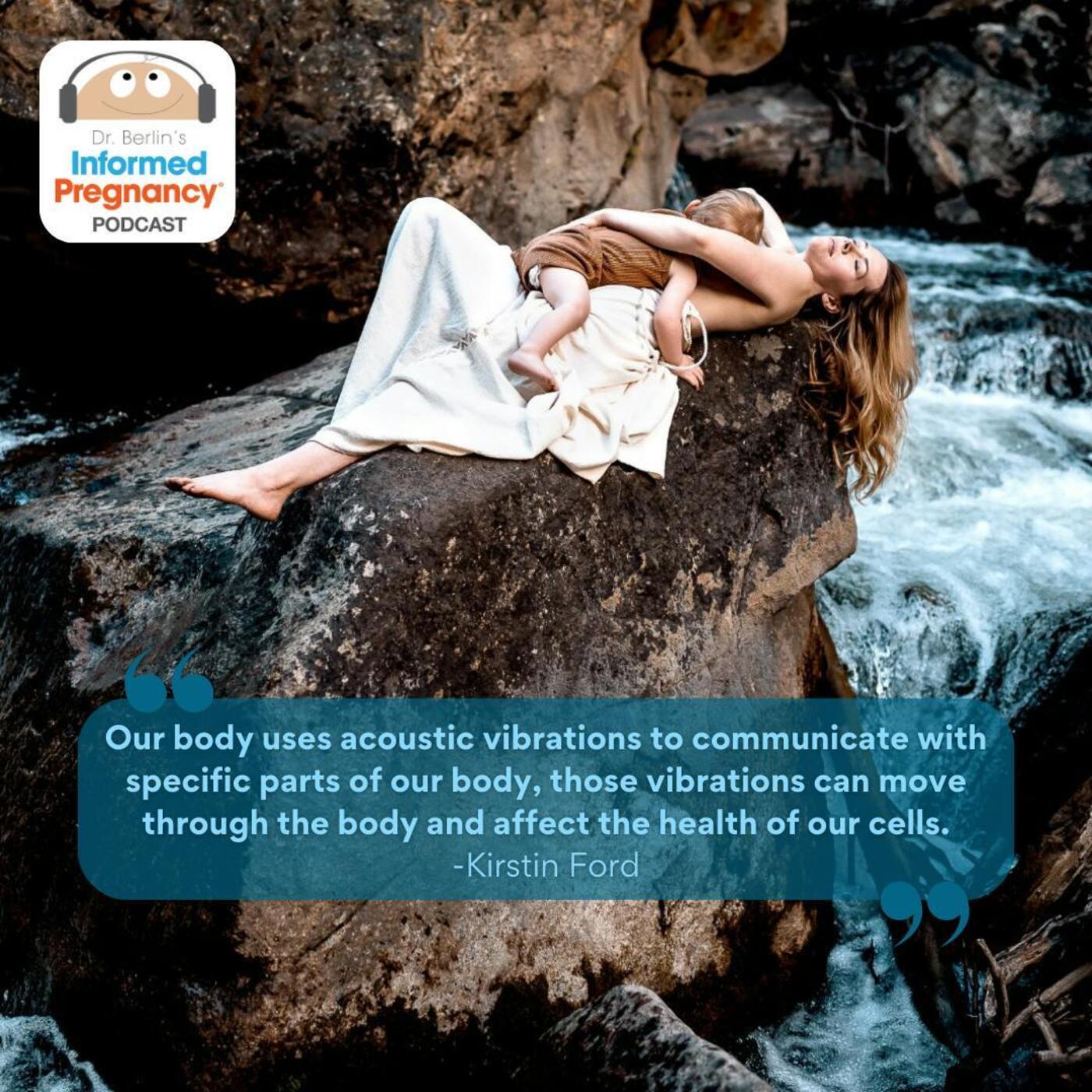
Kirstin Ford [32:36] Yeah, this was when I was really into teaching yoga. One of the things I did, not only delivering sound baths at studios, but also assisting with yoga teacher trainings, I would come in and do a sound healing lecture during one of their modules and sound is so important. And so one of my favorite things as I got deeper and deeper into studying vibrations is understanding that our body uses acoustic vibrations to communicate. It's a huge part of how our body communicates with our external environment, but also internally how our cells communicate. So understanding that a sound bath is, yes, it's an auditory experience, but it is also an acoustic vibrational experience.
[33:18] And those vibrations are communicating with specific parts of your body, the ones that actually are similar in frequency. And that's why they line up to the chakras and systems of the body as well. So those vibrations your cells are experiencing and science, having started to research this now, we understand that sound can move through the body to a degree and it can actually affect the health of those cells. What you're experiencing is this coherency where there's a vibratory pattern in a part of the body that is discordant with the cells around it. And that's the start of disease. And so the idea is that then you use sound healing and vibration to bring that back into
[34:00] not only a healing frequency, but the coherent frequency for that part of the body.
Dr. Elliot Berlin, DC [34:05] I once, when I was in Boulder, Colorado, I went to the Celestial Seasonings Factory pre-COVID where they make all the tea. And they have all these different rooms with different herbs in them and flowers. And then they have this one room that's like super sealed off from everything else. And they open it up and you can go inside and it's their mint room. And when you walk into the mint room, the reason they have it super sealed off is because the mint is so powerful that it would make everything else kind of minty if it was allowed to just be exposed. But I remember walking in there and you smell the mint, but you also feel it in all of your pores.
[34:49] You're surrounded on all sides by mint, like tons of mint. And that's kind of what the sound bath reminded me of. I was expecting to hear it, not to absorb it through my entire body.
Kirstin Ford [34:59] Totally.
Dr. Elliot Berlin, DC [35:00] Before we go to our break, my question for you is, are these ceremonies that you do and modalities
Kirstin Ford [35:06] that you do, are they always in person? No, I do virtual ceremonies too. I've had clients all over the country. The way I would explain, you know, if there's a person listening that's like, hmm, the thing is, is all this work, for the most part, is done in the ether. There is so much of our experience that isn't as heavy and dense as our bodies. Of course, we store things there, but this work can be done beyond four walls and beyond the visceral tangible body.
Dr. Elliot Berlin, DC [35:38] Yeah, I haven't perfected how to do that car practically yet. Sure, I get that. Hold your spine up to the camera. You can be the first, yeah. Oh, that's cool, because you clearly have so much built-up wisdom and experience and knowledge. It's amazing that it doesn't have to be limited to a drivable distance. Let's take one more break, and when we come back, we have a little surprise. Don't go anywhere. We'll be right back. Welcome back. We are talking to healer of all types and mama, Kirsten Ford. Okay, so we promised a little surprise, and here we are talking, and not only are you a mother, but you are about to be a mother again. Another pregnancy. So one wonders, based on your experience with your first pregnancy and
[36:41] birth and everything that you've done and learned in between, are there things you're
Kirstin Ford [36:46] doing differently this time around? Yes, yes. I think the first thing is that in Archer's birth, immediately after I gave birth, the first day or two after, I found myself sobbing, so ashamed of my birth, and my husband and my midwife and doula, everybody that I spoke to about it was really shocked, because to them, it was such a powerful and really tux book kind of birth, and as I processed why I felt so much grief and shame, I realized that it had everything to do with the way that I sounded, and I never expected that to be the thing, the quote unquote, trauma that would trip me up as I transitioned into motherhood, and that's how my first ceremony was born. My birth portal closing
[37:31] ceremony is actually processing the experience of your birth, and the experience of not sounding like a yogi, kind of moaning, blissfully giving birth, that was not at all my experience. I was a lioness, and I roared my son onto the earth. Primal. It was so primal, and I was very ashamed of that. I thought I sounded ugly and just terrible, and it was the way that I was raised. I was raised in Oklahoma. I was quiet and polite and pretty and all of these nice adjectives, and to be naked on the ground, on my knees, roaring and screaming and all of these things, guttural sounds, it was really shocking from my system. I mean, I had triggered so many things that I hadn't really faced, but it informed how I would be as a mother,
[38:21] and as I processed that over a few weeks, I realized that more mamas need this space to actually process what happened. Others have very serious trauma, that things go very differently than they expected, and some have surprise trauma like I did, just based on how I sounded, but it has really informed my passion and my heart, because I now understand that we need more rites of passage ceremonies for mamas to be able to process matressence, this very, very complex, nuanced, layered and long-standing journey that is just like a constant alchemy. We are put back into the chrysalis and emerging time and time again, and as I prepare for this second
[39:06] birth at home, the things I'm doing differently related to the birth are that I'm going to prepare for birth as a ceremony. I have fire element and water elements and the various things that I want to pull in, and I'm going to have a team of people, I'm going to have my partner and other people that understand what I want that to look like so that I don't have to handle it, because what went out the window the first time were the things that I had kept in my mind, but then when you're in labor, you're not in your mind, that never came to fruition. So I'm approaching it with like outsourcing a little bit more in that way, and I'm also allowing my birth to be the birth that it's going to be. I have no expectations to look a
[39:46] particular way, to wear a particular thing, to hear a particular thing. I just want it to unfold physiologically, primally, as my body knows and understands and experiences in the moment. surrender to that.
Dr. Elliot Berlin, DC [40:01] That's really insightful, I think, you learning from you and you processing you. It's triggering something for me, which I have the unusual perspective of being a fly on the wall at a lot of different births as a doula, especially as a guy who's a doula. And I find birth to be really powerful and beautiful and different. Like, each one's a snowflake, in a way. It's kind of interesting, based on personality alone, you sometimes picture, okay, when she's in labor, she's going to be making a ton of noise, like warn the neighbors. And then she just goes inside and it's very quiet. And I don't know, I would say peaceful, but yeah, just not loud and primal looking
[40:51] or maybe a different kind of primal. And then other times you have some of his personalities, or they're just quiet and muted and just proper. And then they just really come out in labor and there's everything in between. And sometimes you get what you expect, but I guess my point is when it looks uninhibited, it looks like the most powerful thing on the planet, whether it's more muted and quiet and composed looking, or whether it's more primal and animalistic and loud and thrashy, it's when it looks like that person doesn't feel any inhibition. She feels totally safe in her surroundings and comfortable to do what she's going to do. I actually remember one very particular time
[41:41] I was at a birth and she didn't tell anybody she wanted an unmedicated birth. We're at the hospital and she didn't say it because she didn't want to fail if she ended up getting medication, which I only found out afterwards. And so especially towards the middle and end, when her surges would come, she would make the loudest noises. Sometimes like a team of nurses would run in, are you okay, are you okay? And the second that surge was over, she would be like, yeah, I'm totally fine. And she would like make a joke about it. And I'm like, did you feel like a lot of intensity or pain at that moment? She's like, no, that's just the natural noise that came out of me in that moment.
[42:18] And so, yeah, when you see someone who's just feels safe and feels uninhibited, it just looks so dramatically beautiful. And it sounds like, you know, in many ways, like you had a dream birth, but you learned things about yourself that you could probably only learn from going through it.
Kirstin Ford [42:36] And that's the thing is you can't control in the midst of labor, in this liminal space, you don't have control over the mask that you normally wear, the facade, the conditioned idea of how you should present yourself or be, you don't have access to that. You have access to what you have access to. And it is in the integration period, which in ceremonies, there are three parts, that third final phase of a ceremony or a rite of passage is integration. So a person has to have that integration period to reflect on what they walked through, what that fire felt like. And some people need that more than others. I needed it in a very different way than my mama who did not expect her emergency C-section.
[43:17] But to have access to that is why I do these ceremonies. And I do a lot of different ceremonies now that preparing for birth actually will help clear some of the things so you can be uninhibited. My birth preparation circles, they're not medical at all. They're about being spiritually and mentally emotionally prepared. And the one after, the postpartum one is about integrating your experience and understanding your identity as a mother and who you are today.
Dr. Elliot Berlin, DC [43:43] Sounds amazing. Kirsten, I learned a lot from you today, thank you. And I know our audience did as well. Where can we find you online?
Kirstin Ford [43:53] I have a website, it's my name, kirstenbford.com. It's also my Instagram handle. I'm very active on Instagram so you can find a lot of my work there and interact with me there. And on my website, I've got email and ways to get in touch if you're looking to do a ceremony. And then I post circles as well. So you can stay up to date on Instagram with the link.
Dr. Elliot Berlin, DC [44:13] I will check it out. Kirsten B. Ford, good luck. I'm sending the most wonderful birthy vibes for you in your upcoming second birth and maybe we'll connect afterwards to see what you learned from this one.
Kirstin Ford [44:27] Yeah, I didn't mention the difference in this pregnancy that sticks out the most is that I don't know what week I'm on. I don't know the size of the animal of the baby inside of me, like all of those things. I didn't hire my midwife until second trimester. So I'm just taking a more intuitive and relaxed approach to this, which I think mostly applies to second time mommas. It's easier to do that if you've been there before.
Dr. Elliot Berlin, DC [44:50] Oh yeah, well, also you asked first time moms, how far along are you? You're like, oh, 19 weeks, seven days and 12 hours.
Kirstin Ford [44:56] Yes.
Dr. Elliot Berlin, DC [44:57] And then as subsequent babies, how many weeks are you on? I think I'm in the third trimester. Yeah, yeah. All right, amazing. Thank you again for joining me in at home. Thanks for listening to the Informed Pregnancy podcast. If you'd like more pregnancy and parenting information, including a massive library of streaming documentaries, fitness programs, and more, visit informedpregnancy.com.
Want more pregnancy + parenting? Start your FREE TRIAL of Informed Pregnancy+ and get access to all our curated pregnancy and parenting content — original series, iconic birth films like The Business of Being Born, prenatal workouts and more.
