
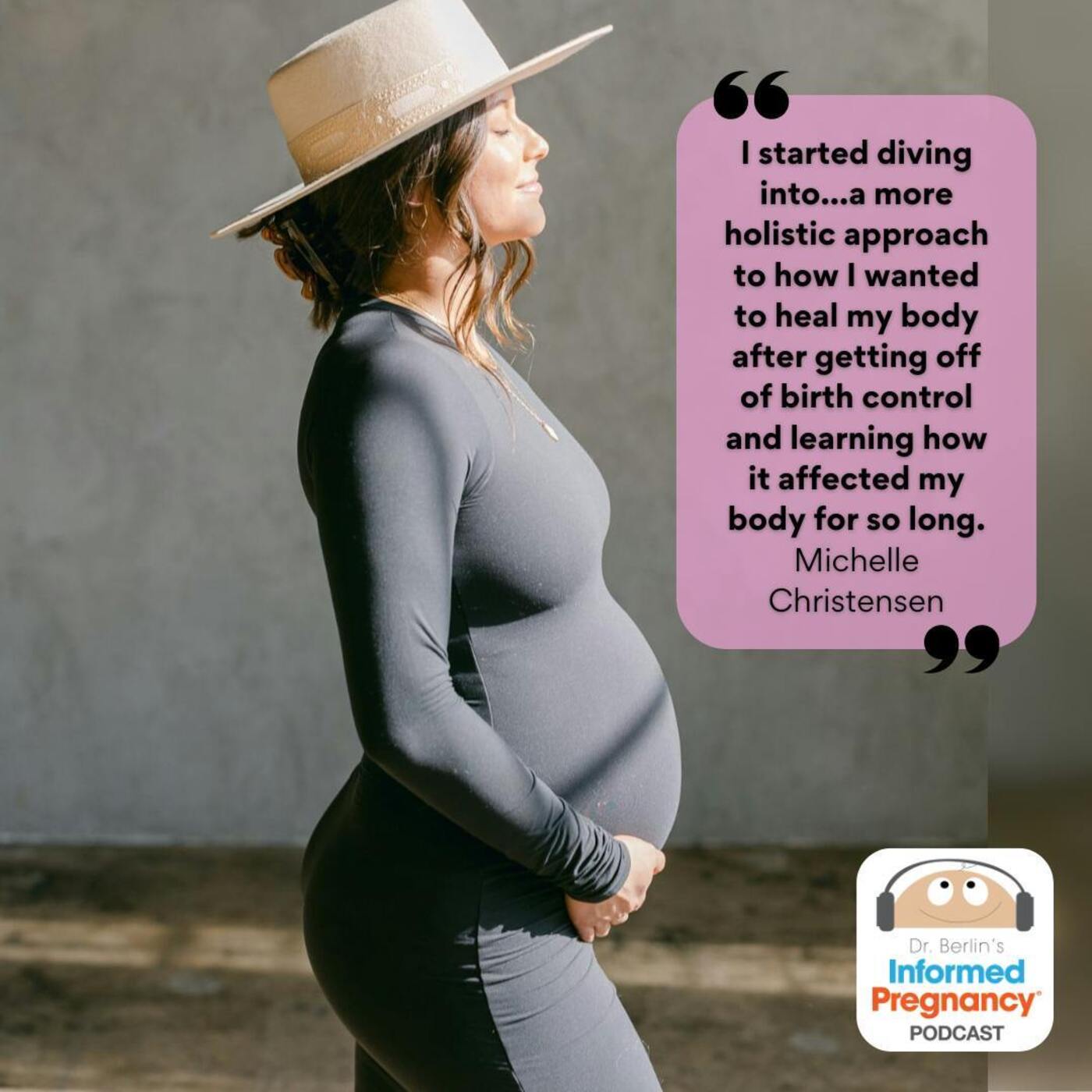
May 16, 2024 · 41 minutes · Episode 407
About this episode
Sound healer and women’s circle facilitator Michelle Christensen is 38 weeks pregnant with her first child. She discusses her work, her fascinating journey toward a holistic lifestyle, and her evolving birth plan.

Key quotes
“and I found out the next day after the surgery, but they took out a fallopian tube, my appendix. They had to repair my bladder because the cyst was sitting right on my bladder and they removed the ovary.”
“and I got pregnant and I literally did not believe it. Like my husband was like, you're pregnant before we even took a test.”
“and it's been a really beautiful experience just having someone sit down and listen to you for an hour and talk to you about everything”
“just having to surrender to something that I can't control, and that is the lesson in itself, the early motherhood lessons of having to let go of control.”
“And I get a little bit of best of both worlds where I can still be at home and labor and be comfortable and then go to the hospital.”
Related episodes
- Ep. 408 Michelle Christensen: After Birth
- Ep. 399 All About VBACs with Meagan Heaton
- Ep. 403 BellydanceBirth® with Maha al Musa
- Ep. 401 A Birth Story with Stephanie Devlin
Transcript
AI-generated transcript with speaker labels — may contain errors, especially names and medical terms. Dr. Elliot Berlin, DC appears in blue; Michelle Christensen in orange.
Download PDF of the Transcript
Dr. Elliot Berlin, DC [0:36] Welcome to the Informed Pregnancy and Parenting podcast. I'm your host, pregnancy-focused chiropractor, Dr. Elliott Berman. My guest today is a sound healer and women's circle facilitator. Currently, she is 38 weeks pregnant and preparing for her first child. She has a fascinating journey towards a holistic lifestyle, especially now during her pregnancy. We'll dive into her background, her approach to pregnancy, and her plans for childbirth, which have recently taken an unexpected turn. Michelle Christensen, welcome to the podcast.
Michelle Christensen [1:07] Thank you. Thank you for having me.
Dr. Elliot Berlin, DC [1:08] I'm so honored that you're here. Well, you haven't had your baby yet and you already have an interesting story. So without further ado, let's jump in. I'm fascinated by sound healing, which you do. How did you get into it? What is it? Tell me more.
Michelle Christensen [1:22] So I've been doing it for a few years now. It kind of just felt like a calling after I kind of started diving into the holistic world a little bit and I was going to sound baths and I really enjoyed them. So I was like, let me do this myself. So I took a training, a really amazing training a few years ago and I just started doing them at various studios over LA and they're basically just a sound bath where they use a sound healing as a form of meditation to induce relaxation in the mind and body. So people just come and lay down and relax and I have bowls and various instruments and just lead people through a meditation and they just come and go on a journey.
Dr. Elliot Berlin, DC [2:05] So these are like singing bowls that have different vibrational.
Michelle Christensen [2:08] Exactly, yeah. So crystal bowls and they're all infused with different crystals and vibrations and they all connect to different chakras and things like that.
Dr. Elliot Berlin, DC [2:17] Okay, I mean, I've been to sound baths. I was, first of all, very surprised there's no tub.
Michelle Christensen [2:22] Yes, we're not in a bath. Yeah, if I open a healing studio sound bath, I would just call it the tub.
Dr. Elliot Berlin, DC [2:30] I love it, that's a great name, let's do it. Oh, okay, business proposal. So sharks, anyway, moving on, I was really impressed with the sound bath that I went to on the East Side and her being able to play those bowls. First of all, it is a bath in the sense that you're in it, your whole body is in it. I can't really describe it exactly but you feel it in your whole entire body just like you would if you were in a water bath but she had this incredible skill for bringing together these different sounds and there was no talking, there was no meditation and this was my first time going, I thought this was gonna be like weird and boring and I just drifted off into such a not sleep
[3:08] but deeply relaxed place. It really felt like going in, my mind was a computer with 20 tabs open which I always have because I'm a little ADD and the computer starts to get slower and slower and less efficient, can't do stuff and then you reboot it and boom, it comes back on and it's lightning fast and only the things that need to be in the foreground are processed and everything else is accessible when you need it. That's how I felt when I came out of the sound bath and I thought, oh my goodness, she used those vibrational sounds to meditate for me.
Michelle Christensen [3:38] That's literally exactly the goal is what you explained. People come in from a busy day and the frequencies just really help your brain get out of that busy beta state that we're in all day and so your body can drop into a theta state and just relax and meditating can be hard for a lot of people so when you come to a sound bath, it gives you something to focus on and it touches your body on a cellular level so there's so many amazing benefits for the nervous system, for the immune system, yeah, it just touches your body on a cellular level so it's really amazing for so many things, anxiety, sleep, creativity.
Dr. Elliot Berlin, DC [4:15] I would call those thing balls and gongs and other tools, I would call them instruments and do you need to learn how to play those instruments in an effective way?
Michelle Christensen [4:25] Yeah, I think rather than just doing them and just going out into the world, you definitely wanna learn the frequencies and the different vibrations and how each instrument affects the body and yeah, of course you can plan for yourself but I think when you're doing it for other people, it's really great to learn the history and just all the benefits and the science behind sound tailing because it can really just make the experience better.
Dr. Elliot Berlin, DC [4:51] Well before we move on from that, you said that you had been going to them. How did you get introduced to your first one as a recipient?
Michelle Christensen [4:59] Oh gosh, I honestly don't really remember my first sound bath but I think I just started getting into meditating and just trying various modalities and I went to my first sound bath and I just was really interested in it and I was like, I wanna do this and so I looked up a training and bowls and just fully dived into it and it just kinda worked out and there was a training in like a month and everything just kind of unfolded and worked out perfectly, so it was meant to be.
Dr. Elliot Berlin, DC [5:29] And women's circle retreats.
Michelle Christensen [5:31] Yeah, so after doing the sound healing training and doing different sound baths around LA, I was like, okay, me and my friend who was a yoga instructor, we started doing women's circles and it's just bringing women together to create a sense of community and healing and same as the retreats, it just creates a space for women to come and just feel connected to one another and themselves and create intentions and yeah, just get a break from life and it's just a wellness retreat and there's yoga and tarot card reading and sound baths and connections and yeah, so it's just really beautiful way just to connect to yourself and others.
Dr. Elliot Berlin, DC [6:10] I do men's retreat with yogurt, frozen yogurt and we don't have tarot cards, we have carrot cake. I don't know.
Michelle Christensen [6:16] I love it.
Dr. Elliot Berlin, DC [6:17] Thank you.
Michelle Christensen [6:18] One time we don't mind observers from-
Dr. Elliot Berlin, DC [6:20] Perfect. Okay, but is your lifestyle like more of a holistic lifestyle in general?
Michelle Christensen [6:27] Yeah, so I think that kind of started to evolve a little bit when I started to dive into my health a little bit after getting off of birth control a few years ago and just a lot of issues started arising with my health and I just started diving into taking a more holistic approach to how I wanted to heal my body after getting off of birth control and just learning how it affected my body for so long and yeah, so just through working with a naturopathic doctor to figure out, okay, what are these symptoms and why are these happening to me and how can I get to the root cause without just going back on birth control and just masking everything.
Dr. Elliot Berlin, DC [7:04] Okay, let's get personal. How long were you on birth control for?
Michelle Christensen [7:07] About 10 years and back in the day and I'm sure this is still happening but it's like you go to the doctor and it's like, oh, I have period cramping and I was probably like 15. Well, actually the reason why I went on birth control was because I started Accutane which is a really serious acne medication and so they like you to be on birth control because if you get pregnant, it's a very serious drug that they give you and can cause a lot of problems for the baby so I was like 15, 16 and they're like, here's birth control and stayed on it for over 10 years and just one day I was like, this isn't serving my body anymore and I wanted to get off of it
[7:45] and I knew eventually I wanted to try and have a baby and so I kind of just wanted to see where it would take me and a lot of things started to arise after I got off of it and that's when I kind of just started, you know, diving into the holistic world and figuring out, okay, what is this and why is this happening to me?
Dr. Elliot Berlin, DC [8:03] So your story is not uncommon. Were you on the pill the whole time?
Michelle Christensen [8:07] Yeah, I was on the birth control pill the whole time.
Dr. Elliot Berlin, DC [8:09] What kind of symptoms did you have when you got off?
Michelle Christensen [8:13] So the acne came back, of course, and I just started having really intense periods and a lot of gut problems came up and so through working with a naturopathic doctor and kind of just trying to figure out what was going on, we assumed that I had endometriosis, which I know is very common these days and it's-
Dr. Elliot Berlin, DC [8:33] All the cold kids have it.
Michelle Christensen [8:34] Yeah, so as that kind of started to progress and I was trying to heal my body naturally, figured out that I had a really big cyst on one of my ovaries and this was about two years ago. It was a massive cyst. It was about like 10 centimeters and everyone was like, you need to get this out. Like this is very big and it can burst and cause even more problems. So I went into surgery to remove the cyst and suspected endometriosis and there was a lot of endometriosis and if people don't know what that is, it's when tissue grows outside of your uterus and it can just spread to other organs in your body. So they found a lot of endometriosis like scar tissue.
[9:20] So they went in and removed all of that and I found out the next day after the surgery, but they took out a fallopian tube, my appendix. They had to repair my bladder because the cyst was sitting right on my bladder and they removed the ovary. Everything was great with that and yeah, it just ended up being a lot more extensive surgery than we were kind of expecting.
Dr. Elliot Berlin, DC [9:40] How old were you?
Michelle Christensen [9:41] This was like two years ago. So I was like 27.
Dr. Elliot Berlin, DC [9:44] Okay, so I mean, that seems scary to wake up. Did you know you might lose a fallopian tube?
Michelle Christensen [9:49] No, I did not. I mean, they have you sign a waiver, like this long waiver and that wasn't something I was expecting and so it really threw me for a loop. I remember the next day recovering and had a catheter and yeah, it was a pretty intense surgery, but I remember reading the notes that they had sent me afterwards and saying that they took a fallopian tube and I just lost it because I was like, okay, what does this mean for me going forward, trying to conceive? Because I knew that I wanted to have a baby one day. So had to like talk to my doctor and figure out like, okay, what does this mean for me moving forward? And they kind of just told me,
[10:25] now's the best time for you to get pregnant because everything's cleaned up and chances might not be as great trying to conceive with only one fallopian tube, but it's doable. So I was like, okay. And we weren't quite ready to start trying for a baby at that time. We weren't married yet. So I knew down the line, but they're like, TikTok, you got some time before the scar tissue and everything starts coming back. So I felt like I was a little bit on a time crunch.
Dr. Elliot Berlin, DC [10:50] On a clock, yeah, totally. Okay, well, two years later, you're 38 weeks pregnant, so I know you can. I have a lot of questions, but let's take a quick break and delve into this pregnancy when we get back. We're talking to Michelle Christiansen, sound healer and all around great person. Okay, now you did get pregnant but you weren't quite ready to try when you found out like everything's been cleaned up. I hate, by the way, when I go to the kitchen and everything's been cleaned up, it's my worst time to start tinkering in there is when I leave the mess. But this is probably different. So when you were ready to get pregnant were you or did you just get pregnant?
Michelle Christensen [13:01] Yes and no. So after I did the surgery, they like you to come in every six months to make sure there's no cysts growing back. So we had gotten married, everything's great. You know, it was having my six months checkup and this was almost a year ago at this point. And they were like, oh, it looks like a cyst might be growing back. And yeah, it was just really hard for me to hear that. And I was like, okay, so maybe we don't have time we wanted to wait a little bit longer. We were in that newlywed phase. So we kind of just decided like, let's throw it out into the universe and see what happens if it's meant to be, it's meant to be. And we'll just kind of try and see what happens.
[13:42] So I remember my first month I did like the opulation test and all of these things and I wasn't ovulating the first month which was hard for me. And I was like, okay, maybe this is gonna be harder than I was kind of expecting. So first month we tried, didn't happen and I was already going down a rabbit hole like, oh my gosh, this is gonna be a tough journey. Second month I was ovulating and apparently when you only have one fallopian tube your ovaries can take turns on which sides they ovulate on. So I must've not had an egg drop that month, I guess. And so the next month I dropped down the working fallopian tube or the one that's there and I got pregnant and I literally did not believe it.
[14:24] Like my husband was like, you're pregnant before we even took a test. And I took a test pretty early, like maybe 26 days into my cycle because I just wanted to confirm that I wasn't pregnant and move on with my life because you're kind of just living in these two week periods where you're like, okay, we're gonna try and then two weeks later we're gonna take a test. And so I was like, okay, let me just know that I'm not pregnant and move on with my life and stop obsessing over it. And then I was like, bane to second line. My husband was like, you are pregnant when you Google it. It's like even the smallest little line, like you're pregnant and I still did not believe it.
[14:56] And I was like, there's no way I'm pregnant. Like I always thought I would deeply feel it but I think I was protecting myself a little bit and I didn't want to get my hopes up. The next day took another one and it was the one where it's like pregnant or not pregnant and I was pregnant.
Dr. Elliot Berlin, DC [15:12] You didn't trust the line.
Michelle Christensen [15:13] I didn't trust the line. So even at that point, I'm Googling like false positive pregnancy test and I was like, why are you Googling this? Like you're pregnant, yeah. So to my surprise, it happened a lot quicker than I was expecting.
Dr. Elliot Berlin, DC [15:29] Well, that's a great surprise. I guess because it sounds like you really wanted it.
Michelle Christensen [15:34] Yes, very much so. I did and started reading the spirit babies books and wanting to like call in the babies. And yeah, so I did. I've always known I wanted to be a mom.
Dr. Elliot Berlin, DC [15:44] Okay, so I mean, is this somewhere in that range when you start thinking about what you want birth to be like? I knew way before that that I wanted to have a natural home birth. What is that based on? Like what led to that?
Michelle Christensen [16:00] So I don't quite really know what exactly led me down that path, but I just for a very long time was so interested in watching all the Instagram videos of the beautiful water births and the baby coming out in the water and just having this really beautiful moment that's uninterrupted and so peaceful. And I was like, I want this. Like this looks so beautiful. And I think I was already on a more of a holistic path that I just knew I really didn't wanna be in a hospital setting personally. So even before I got pregnant, I knew I was like, there's no other option for me. Like I want a home birth and that's what I'm gonna have.
Dr. Elliot Berlin, DC [16:37] So you wanted a home birth with a midwife and who else did you envision around you?
Michelle Christensen [16:45] I knew I wanted to have a doula. I see myself being a doula one day, but we'll see that's way down the line. But I knew that I wanted a doula, someone just there supporting me emotionally, physically and throughout the process as well. And I wanted my husband. So I just didn't want a bunch of nurses and people I didn't know. I wanted it to just be a really sacred space at home.
Dr. Elliot Berlin, DC [17:06] You have pets? I do, but they're gonna be sent away if the home birth happens. All right, why not the pets? Are they anxious? Are they too high energy?
Michelle Christensen [17:18] One is yes. And so we just wanna focus on the baby for the first week and not worry about taking care of them and walking them. So once labor starts, they're being sent away and then we'll come back.
Dr. Elliot Berlin, DC [17:30] I only ask because I've had people who do home birth solely so their pets could be there with them.
Michelle Christensen [17:35] Oh no, I'm not.
Dr. Elliot Berlin, DC [17:36] Not that, okay.
Michelle Christensen [17:37] No, not me.
Dr. Elliot Berlin, DC [17:38] So through the pregnancy, how has midwifid care been? Cause you don't see an obstetrician really, you see a midwife for all your…
Michelle Christensen [17:45] No, so I started with an OB in the beginning cause I had a gynecologist who started going with her and she actually was like, I don't support home births so I have to let you go for my care. And that was pretty early on anyways. And I was planning on not continuing with her but I chose my midwife probably at like five weeks pregnant. I knew who I wanted to use and I called her and it's been a really beautiful experience just having someone sit down and listen to you for an hour and talk to you about everything from not just like, okay, let's look at your lab work and everything's good and okay, I'll see you in two weeks and talking about nutrition and lifestyle
[18:24] and are there fears? How are you feeling? And it's just a really whole experience of someone actually listening to what you want rather than like maybe pushing things on you. And yeah, it's just a really personal experience that I've really enjoyed so far and just being able to talk to someone who listens to the things that I really want and that's important to me.
Dr. Elliot Berlin, DC [18:48] Yeah, I mean, it seems like just a whole different model of care.
Michelle Christensen [18:51] It really is.
Dr. Elliot Berlin, DC [18:53] Where the obstetrician and there are some obstetricians that don't practice this way but generally speaking, the medical model doesn't set them up to spend a lot of time with you. And so they're really focused on is this baby healthy? Is this pregnancy healthy? Are you helping moving on but healthy from the sense of, like you said, labs and data and statistics is it growing the right sizes? Your feet look good. Does your blood look good? Does your blood pressure look good? Okay, get out. Whereas the holistic approach is just that. We're not just looking at you as an incubator. We're looking at you as an organism, a human with an emotional component, a spiritual component,
[19:32] a physical component and many elements that contribute to each of those components and seeing how you're doing with each of them. Like an idiot, I compare this to a pizza pie. I'm trying to attack health whenever I can. But really like different wedges of the pie. Maybe a trivial pursued cube. I don't know. Each little wedge represents something and sort of looking at it as a holistic picture and how is your relationship and how is your stress level and how is your nutrition. That says all the things you mentioned. It's kind of profound how different that feels from measure the bump and you know, pee in a cup and go home. So it sounds like you had your plan for birth in place.
[20:14] Like your team, who you wanted there or you didn't want there, those little four legged furry friends and a vision from all those videos that you had watched and you know, just it felt right to you. So things sort of took a turn at some point. I mean, you're still the baby in there. What happened?
Michelle Christensen [20:29] So in about 30 weeks, my midwife, you know, every time I see her, we listen to the heartbeat and she kind of, you know, feels the position of the baby and at 30 weeks, she was like, okay, I think there's a head that is up and not down. So, you know, at 30 weeks, not too concerned. Let's just, you know, maybe start doing some things where we can try and encourage the baby to flip and go head down, which is the way that, you know, if you want to have a home birth, there are doctors that will do breach at home, but my midwife, she does, you know, head down vaginal deliveries at home. So did start doing all the spinning baby stuff, laying on the ironing board upside down
[21:15] and being on the couch upside down with my hands on the floor, knees on the couch and going to start seeing you, I think in about 34 weeks, maybe.
Dr. Elliot Berlin, DC [21:27] So the time for spinning babies for people to use kind of like positional exercises to try to give the baby more opportunities to actually move into a different position. It seems to me like having a yoga background is helpful for spinning babies, for doing those positions and also having an ironing board, which people don't seem to have anymore.
Michelle Christensen [21:45] I did not have an ironing board. I literally had to go buy one from Target.
Dr. Elliot Berlin, DC [21:48] Yeah, in the breach department because nobody uses them for ironing anymore.
Michelle Christensen [21:51] It was in the breach department, exactly.
Dr. Elliot Berlin, DC [21:54] And did they feel weird? What did it feel like doing those interesting positions and exercise?
Michelle Christensen [22:01] Personally, I did not enjoy them. They kind of brought me a little bit of anxiety. I felt like it took away a little bit of the excitement because it felt like I was always focusing on, oh my gosh, I had to turn this baby and I have to lay on the ironing board and do my inversions and all of these things. And for me personally, it became a little overwhelming because every week that went on that he didn't turn, I was like, okay, if this baby doesn't turn, then I can't have my home birth that I envisioned. So for me, I didn't enjoy it, but it became like a full-time job.
Dr. Elliot Berlin, DC [22:35] Right, and then you did other things. You came and we started to massage with you to try to loosen up your soft tissues around your back and hips and pelvis and then aeropartic adjustments to keep the bones moving better. More anxiety with those visits?
Michelle Christensen [22:50] No, those were great. I mean, that was like the best part about it. At least there's some benefits of being briefed. Yeah, no, I mean, I got to come see you, which was great. And I still see you even though most likely this baby isn't gonna turn, but.
Dr. Elliot Berlin, DC [23:03] Did you do other things?
Michelle Christensen [23:05] Yes, acupuncture, which I was already doing pre-pregnancy and through pregnancy, but they started doing the mock Sebastian where it's burning the mug war on your pinky toe to try and encourage baby to turn and.
Dr. Elliot Berlin, DC [23:19] Which probably at home makes no sense, but if you've ever done acupuncture, it works on a series of points that correlate to where the vital energy where she runs through your body and their meridians pathways where the energy runs, just like you have a map of nerves and a map of blood vessels that is the same from person to person. So as the map of vital flow, energy flow through your body and the points along the way of these meridians, they correlate to different things. They correlate different functions and organs and cells in the body and you can manipulate them, especially if the energy is out of balance and you can manipulate them with needles,
[23:55] which is acupuncture. You can manipulate them with pressure, which is acupuncture and you can manipulate them with heat, depending on what you're trying to accomplish. And so the heat comes from burning interval stick called a moxa stick and burning it is mock Sebastian, like combustion. And the remedy in Chinese medicine for breach babies is using that heat to gently warm up points that correlate to the uterus that are down in your feet. And indeed there's both Eastern and Western journals reporting on moxa bastion, having that effect on babies that it does cause more natural movement in the womb. And I think the Journal of American Medical Association
[24:32] even came to the conclusion that more often than not, the baby will settle into the ideal head down position. Although none of us really have any clue exactly how it works. That said, it's a couple of thousand years old and has passed the test of time. So for you, when you burn that moxa, when you warm up those points in your feet, did you notice a difference? Some people do, some people don't.
Michelle Christensen [24:54] Not too much. I would do it at the acupuncture office, but I would also do it at home. My husband would do it for me while I was on the ironing board. So I was already in an inversion.
Dr. Elliot Berlin, DC [25:05] Oh, wow. Okay, multi-tester, just like that.
Michelle Christensen [25:08] Yes, and I would also do the ice pack on the top of the belly to try and encourage the baby to go away from the cold and towards the warm space down below. It's doing all of the things, but no, I really didn't feel more movement after using the Moxa-Bustion, but I don't know, he just isn't having it. He'll breach at 37 in a week. That's when he had to make a choice. Yes, we went and did the ACV with a doctor
Dr. Elliot Berlin, DC [25:42] and at a hospital. You know, that reminds me one thing, by the way, because you said your midwife only does head-down babies at home. In California, that's the scope of practice for midwives. It wasn't always that way, but 10 years ago they changed it and took away breach from midwives. So the only people who can attend breach birth at home now are obstetricians, and obviously there's not too many of us bluttin' around who will do that. We do, California, we have a lot of options in Los Angeles specifically, so I guess that option does exist here, but you went to see a doctor in a hospital and you did what you said was an ECB, an external cephalic version,
[26:19] where the doctor manually tries to turn the baby externally through your belly. What was that like? What was, from the time you got there, what was the experience like?
Michelle Christensen [26:28] Yeah, so at first I was unsure if I wanted to do it. I was like, you know, this baby wants to be head up. That's how he wants to come into this world, but after sitting with it for a little bit, I was like, okay, I wanna try everything that could potentially give me my home birth that I envision. So my amazing doula came with me for support and my husband and checked us in to labor and delivery. They like to do it at 37 weeks, I guess, in case you go into labor, and-
Dr. Elliot Berlin, DC [26:56] Meaning not before 37 weeks, because at 37 weeks, you're considered-
Michelle Christensen [27:00] Correct, yes. You wouldn't have a preemie if your water broke or something else happened during the- Yes, and the doctor that we went with, that my midwife and you suggested, he tried to do it and that baby was not moving. He was really engaged in the pelvis, I guess, and they were trying to get him out and to get him to flip, and he just didn't move an inch.
Dr. Elliot Berlin, DC [27:25] Okay, and this doctor, he does a ton of ECVs. He does a lot of bridge work because he still delivers bridge babies, so that's why you're a good candidate for a new one too. And so people from all over Southern California flock to him, you know, at 36 weeks and beyond. I do believe from everything I've seen, he's got the best success at turning these babies, you know, using just enough oomph to get the job done without overdoing it. And also, I think he doesn't really love when you have an epidural for it. You know, obviously, if you don't want to acquiesce, but the trend lately is for that to be pushed on people. Did you have pain meds during it?
Michelle Christensen [28:02] No, we did not use an epidural. He didn't even suggest that. I don't remember the medication- Herb Ewing. Yes, to relax the uterus, so I guess it's easier for him to be able to try and turn the baby without contractions.
Dr. Elliot Berlin, DC [28:17] Right, I think it helps loosen the uterus with the thinking that, hey, maybe it'll increase his success and not trigger you to go into labor while he's manipulating things. What did it feel like if you had no pain meds?
Michelle Christensen [28:30] To be honest, I prepared myself for a lot more pain. I thought it was gonna be a lot worse than it was. It was just a lot of pressure in my pelvis area, and I was sore for a few days afterwards, just from all the pressure of pushing, trying to get him out. From my experience, it wasn't as bad, but maybe if they were able to turn him, maybe it would have been more uncomfortable, but I don't think-
Dr. Elliot Berlin, DC [28:55] Well, it worked perfectly.
Michelle Christensen [28:56] Yeah, yes. I don't think he was using too much pressure because he probably could feel that the baby wasn't coming out, so it wasn't too bad.
Dr. Elliot Berlin, DC [29:05] Just so you know, I've had several people go to him after their initial external version when the different doctor didn't work, and he was able to get the baby to turn. It's a technical skill, and he does so much of it, but I think he just really has a great feel for when to use more and when to use less force. Anyways, so you left there with a breech baby yet again.
Michelle Christensen [29:26] Yep, yep.
Dr. Elliot Berlin, DC [29:27] After all the things, still breech. All right, now you're running out of options, but you have made some decisions. Let's take a little break and find out what you have in store when we get back.

Dr. Elliot Berlin, DC [29:49] Welcome back. We're talking to Michelle Christiansen, and your plan has already changed so much, and you've already been through so much, now both physically and emotionally, in this journey, and you're still just happy.
Michelle Christensen [30:03] Oh, thank you.
Dr. Elliot Berlin, DC [30:04] You're able to laugh at it, you're able to smile about it, but I know it's painful for you inside.
Michelle Christensen [30:09] Yes, definitely. It's been an emotional eight weeks at this point.
Dr. Elliot Berlin, DC [30:12] That also means you have some ability to surrender to the situation to some degree and just be like, I can't control everything, so I'm doing what I can, and I'm also riding the ride and seeing where it takes me. And that's hard, you know, I struggle with that. I think a lot of people struggle with the ability to let go. When I'm on a roller coaster, which I hate, but I don't want my kids to hate them the way I do, so I go just to introduce them to them, and I'm always trying to put my foot through the floorboard like there's a brake pedal on there, but there's no brake pedal. And one time, I think I've said this on the podcast before, one time I let go and just like surrendered to it,
[30:50] I had the best roller coaster ride I ever had.
Michelle Christensen [30:52] I bet you did.
Dr. Elliot Berlin, DC [30:53] And that's just what you're doing with your roller coaster ride here. So now you have to choose 38 weeks and change, babies coming soon by hook or by crook. What options do you have left and what have you set your sights on?
Michelle Christensen [31:07] So, yes, exactly what you just said, just having to surrender to something that I can't control, and that is the lesson in itself, the early motherhood lessons of having to let go of control. So the doctor that tried to do the ECV, he does vaginal breach, like you mentioned, that of like the two or three doctors in LA that still do it. So we're going with him to attempt and hopefully be able to succeed with a vaginal breach delivery at the hospital. So that's the plan right now, and still with my midwife. Still seeing her and she will come to my house and labor with me at home. Her and my doula will still do that. And she will check me and kind of just decide
[31:52] when it's a good time for me to go to the hospital and hopefully just push the baby out of the hospital. And I get a little bit of best of both worlds where I can still be at home and labor and be comfortable and then go to the hospital.
Dr. Elliot Berlin, DC [32:06] Yeah, I mean, it sounds like, first of all, great that you even have the option to do that, because most people in the United States really do not have that option. And your doctor does a lot of breach birth, so there's a lot of experience there. And I know for a fact he doesn't take everybody.
Michelle Christensen [32:20] Really?
Dr. Elliot Berlin, DC [32:21] Oh, absolutely, a hundred percent, meaning he'll only do a breach birth that he thinks is a good presentation for a healthy, safe delivery. So people go in there and there's a foot down or other things like that, maybe he's not engaging well, or I don't know, the head is extended back or just maybe too big for his comfort. He doesn't want to take that risk for himself or for you. Obviously he's wanting to go out there against the community norm and offer this option. So it's not all about him, but he really looks at a bunch of criteria to see are you a safe candidate for this vaginal breach delivery. So you've cleared all those check marks. Are there differences that he talked to you about
[32:58] like what to expect because the baby's breached? I mean, in general, he has no rules really on birth. It's what you want within the realm of safety, but he doesn't have like a hard cutoff. You must be off by 39 ways or you must have an epidural. You must be on your bed or whatever. Like a lot of things. I think he generally tells people and just eat when the nurse isn't in the room, you know, stuff like that. He wants you to have your birth the way you want to have it. But with breach, there may be some differences that he talked about that.
Michelle Christensen [33:27] Yeah, a little bit. And everything that you said, I do love that he believes in birth so much and physiological birth. And yeah, he doesn't really push too much. He seems very confident in what he does, which is great. But he said that he likes things to happen very quickly once you hit, I think, six or seven centimeters. He was like, if you weren't breached, you know, you can push for three, four hours. I don't care. But I think when the babies breach and the butt's coming out first and they like things, once he starts coming down the birth canal in six or seven centimeters, he likes things to progress quickly because I think because of the umbilical cord,
[34:08] it can get caught when the head's coming down. And just for safety reasons, that's just one of his main criteria is you can give it about an hour to push and…
Dr. Elliot Berlin, DC [34:18] Yeah, I've been to breach forth with him as a doula. And you don't, at least from my observation, in the moment, you don't feel like a lot of pressure from him like, hurry up and get this done. But I think he has these ideas on like, if your body is going to bring this baby down smoothly, without hiccups, then the baby's gonna come out smoothly without hiccups. And if your body's starting to show signs of struggle to bring the baby down and out smoothly, then let's not tempt that fate.
Michelle Christensen [34:48] Yeah, exactly, yeah. And I also love that. Yeah, of course, safety first always. And I love that I was able to talk to him about like delayed cord cutting and maybe waiting a little bit longer for the placenta to be delivered rather than some OBs aren't comfortable with those things. So I like that he's a little bit more flexible with things that I know that I would have been able to have at home and he's okay with doing it in the hospital setting as well.
Dr. Elliot Berlin, DC [35:14] Have you watched videos of breach forth?
Michelle Christensen [35:17] A couple. And I was actually thinking about this yesterday that I should probably watch some more, just to see positive ones. I actually wanna watch your documentary, the one that you mentioned to me, the Heads Up.
Dr. Elliot Berlin, DC [35:29] That's my documentary, I made it.
Michelle Christensen [35:30] I know, I was thinking about this yesterday. I was like, I need to watch this. So I think I'm actually gonna watch that tonight.
Dr. Elliot Berlin, DC [35:36] Heads Up, you're very similar, I think in a lot of ways to Sarah, who is the mom in the video who invited us to film her birth because she wanted literally people to be able to see a breach birth just to know that it's an option, and see what that would be like. So our camera person was incredible. She's did a lot of birth videography and she has this incredible way of just being a fly on the wall, yet still taking very close up video. And when you see that towards the end of the film, I think you'll be excited about it. But you're like, stature is the same. You have very similar body types and just positive attitude. And yeah, I think more of a holistic approach,
[36:16] very mind-body approach to get into it. And I don't know, we'll talk to you on the post podcast to see if you saw it and how you reacted to it. But it's a really beautiful birth, honestly. So that film is heads up. You got another little surprise. You know, as if they were never ending. Enough going on. Some late breaking news, which is?
Michelle Christensen [36:36] I was GBS positive.
Dr. Elliot Berlin, DC [36:38] Right, so towards the end of pregnancy, you get swabbed, a vaginal rectal swab looking for a particular bacteria called root B streptococcus GBS. And when you're GBS positive, it means you have a colony of that type of bacteria in the birth canal, not an infection. And it's a bacteria that's neutral for us as adults, but some cases, rarely, but some cases can cause infections for the baby. And so in the United States, the general protocol is to test for around 37 weeks. And if you are positive, to have you come to the hospital even earlier and start giving you antibiotics every four hours until the baby comes. That does not sound like the dreamy home birth
[37:21] in the pool that you're envisioning. It doesn't even sound like the semi-dreamy vaginal birth of a hospital that you're envisioning, but dumb baby. How does this affect your plans?
Michelle Christensen [37:32] Well, like you mentioned, you have to go to the hospital a little bit earlier than I probably would have gone because they like to start giving you antibiotics four hours before the baby comes out. I think that's correct. And I don't love the idea of antibiotics. I actually was on antibiotics a lot growing up because I would get a lot of UTIs. So it's really damaging to the gut. And I know that it can be passed on to the baby's gut as well. And so not ideal.
Dr. Elliot Berlin, DC [37:59] I have no data on this for real, but it seems like to me, anecdotally more likely to get like mastitis once you have vulnerability from breastfeeding where there's cracks in the skin that allow bacteria to get in and you've wiped out all of your protective bacteria. So a little bit more likely to get those breast infections. It's just anecdotal. I haven't read research on it, but you can see how systemically getting rid of all your bacteria, your good bacteria included, can lead to secondary issues, infection and other things like that. So I see why you wouldn't want it. Does it give you the option or it's just like, yes, this is what we're going to do?
Michelle Christensen [38:38] I haven't quite decided what I want to do yet. I actually haven't talked to my new doctor about this yet. So I don't know what he prefers. I don't know what we're going to do yet.
Dr. Elliot Berlin, DC [38:48] So talk to me afterwards and we'll see what I decide to do. What a great cliffhanger to end on. But I do have one question before we close this thing up. I mean, you've already had to face so much change from your vision to where we are now. And obviously there could be more change as we've been set up the babies sluggish on the way down or anything like that. He would recommend moving over to a stationary birth. Have you looked at that in your mind and accepted that, prepared for that if that is where things go?
Michelle Christensen [39:19] Yes, that is a very big fear of mine that I'm processing right now. And I know it's an option for sure. And when I saw him recently, I asked him like, what percentage of your breach deliveries end up in C-section? He said 20%, which I didn't think was too bad. My husband was like, it doesn't matter, Michelle. You don't have to ask. And I'm like, well, it makes me feel better than 70%.
Dr. Elliot Berlin, DC [39:40] Sure. Look, if you told me I have an 80% chance of winning Powerball, I'm already spending the money.
Michelle Christensen [39:47] Yeah, so I mean, 20% is, I don't know, lower than I was expecting, to be honest.
Dr. Elliot Berlin, DC [39:52] So of course it's- But it is more than five. So, and you know five people, you know. So I'm just saying like, it's not a very, very tiny number. No, it's not. But the odds are in your favor.
Michelle Christensen [40:04] Yes, but the odds have not been in my favor throughout this whole experience. So maybe this is the one. Hopefully I have, that's what I'm hoping. I'm hoping that after this whole journey that the birth is just straightforward, it's beautiful, baby comes out quickly, and I get the vaginal delivery unmedicated that I was hoping for. I am putting out all the juju in the world
Dr. Elliot Berlin, DC [40:25] for that to happen. Thank you. You're one of the nicest people. Michelle, we're gonna wrap this up. Tell me where we can find you online and also learn more about the healing arts that you do.
Michelle Christensen [40:36] Yeah, so you can follow me on Instagram, soundbymichelle, and yeah.
Dr. Elliot Berlin, DC [40:40] I'm gonna check it out. Yeah, we were just talking in the break about doing some sort of retreat for pregnancy.
Michelle Christensen [40:48] That would be a dream. I would love that. I would love to work on that with you.
Dr. Elliot Berlin, DC [40:52] My biggest contribution is usually coming up with a punny title for it.
Michelle Christensen [40:57] Yes, you're very good at that. So I'll leave that up to you.
Dr. Elliot Berlin, DC [41:00] Thank you very much. 20 years of being a dad. All right, Michelle, again, sending you the greatest wishes for an amazing experience.
Michelle Christensen [41:07] Thank you.
Dr. Elliot Berlin, DC [41:08] You certainly have earned it. And thank you for sharing here on this part one episode. And I look forward to hearing the story on the other side.
Michelle Christensen [41:15] Thank you so much for having me.
Dr. Elliot Berlin, DC [41:17] And at home, thanks for listening to the Informed Pregnancy Podcast. For more pregnancy parenting information, visit us online at informedpregnancy.com where you can find more of these podcasts, my brand new blog, Expectations, and tons of video content on Informed Pregnancy Plus.
Want more pregnancy + parenting? Start your FREE TRIAL of Informed Pregnancy+ and get access to all our curated pregnancy and parenting content — original series, iconic birth films like The Business of Being Born, prenatal workouts and more.
