
April 18, 2024 · 44 minutes · Episode 403
About this episode
International birth educator, creator of EmbodyBirth™ and BellydanceBirth®, and mother of three Maha al Musa joins the podcast. She discusses motherhood and her work, including her intuitive movement program for pregnancy and her holistic childbirth trainings offered to birth workers worldwide. IP+ members have access to her work within our subscription library!

Connect with Maha online: @embodybirthinternational and mahaalmusa.com
Access Maha’s content on Informed Pregnancy+
Key quotes
“And I always say that my birth preparation began in my mother's mother's womb. I teach that to women. It doesn't just start when I get pregnant. It starts way back when with my grandmother, even my great-grandmother. And we carry that lineage in our womb.”
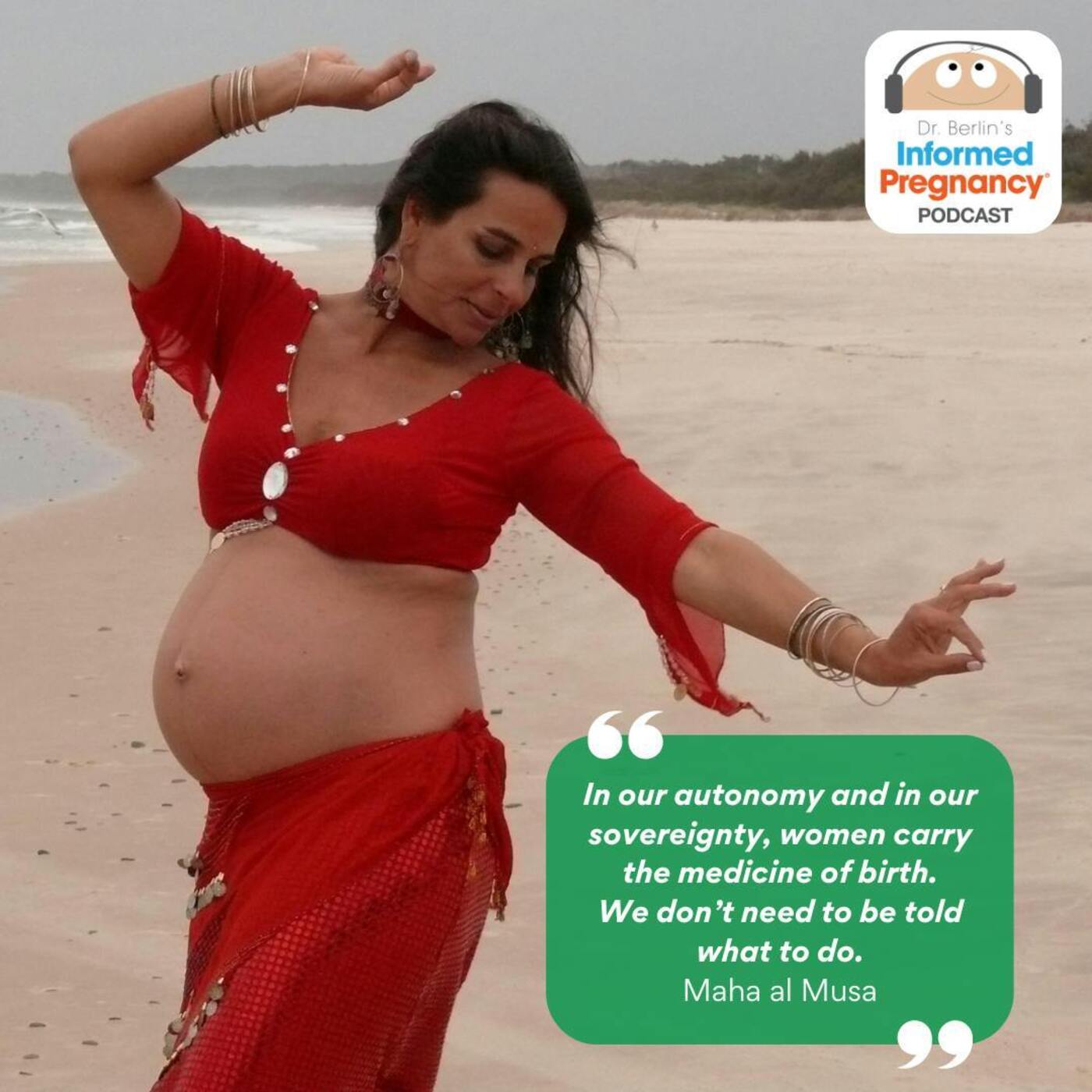
“You are a whole woman birthing your whole baby in your wholeness and in your holiness. Our stories, our lineage is our holiness. And when we can connect and do the repair and have the awareness of what we need to do in our autonomy and in our sovereignty, women carry the medicine of birth. We don't need to be told what to do. And that's a very significant part of my work is that sovereignty. And we say your body knows the wisdom of birth.”
“As we say in body birth, you cannot think birth. You need to feel birth. The baby doesn't come out of your head. The baby comes through the pelvis, the womb, the vagina. Get down to earth to birth.”
“You need to be patient. Patience is the medicine of birth. Sometimes I'm processing and when I'm able to be in that processing and feel that safety in the body and understand and be reassured that everything is good. We're just processing. Be with that.”
“and I feel really fantastic that women are waking up and looking for these kinds of teachings and support and bringing them home to themselves that's really what embodied birth is about”
Related episodes
- Ep. 399 All About VBACs with Meagan Heaton
- Ep. 402 Perinatal Mental Health with Dr. Jill Garrett
- Ep. 405 Birth Stories with Valia Skiani
- Ep. 401 A Birth Story with Stephanie Devlin
Transcript
AI-generated transcript with speaker labels — may contain errors, especially names and medical terms. Dr. Elliot Berlin, DC appears in blue; Maha al Musa in orange.
Download PDF of the Transcript
Dr. Elliot Berlin, DC [0:12] Welcome to the Informed Pregnancy & Parenting Podcast. I'm your host, pregnancy-focused chiropractor Dr. Elliott Berlin. My guest today is an international independent birth educator and creator of Embodied Birth and Belly Dance Birth. Informed Pregnancy Plus members have access to her powerful work within our subscription library and will also share where you can explore all of her work online. She has crafted a unique virtual intuitive movement program for pregnancy and shares her holistic childbirth trainings with birth workers around the globe. Beyond her professional accomplishments, she navigates the beautiful journey of motherhood with three children of her own, Maha Al Moussa.
[1:15] Welcome to the podcast.
Maha al Musa [1:17] Thank you very much. Wonderful to be here, Dr. Berlin, after all this time.
Dr. Elliot Berlin, DC [1:21] Seriously?
Maha al Musa [1:22] We have tried to connect. Yes. For years. It's wonderful.
Dr. Elliot Berlin, DC [1:26] Years, years. I love it. And, you know, I want to learn everything. But before we get into the art of your work, the genius of your work, really, I would like to go back to the beginning and find out how you got into this kind of work.
Maha al Musa [1:40] Sure, sure. So my background is Palestinian-Lebanese, Palestinian on my father's side, Lebanese on my mother's side. And unfortunately, when I was a six-month-old baby, my parents separated. And I was brought to Australia by my father when I was two in 1964. So I was disconnected from the mother, the motherland, the mother tongue, as I always say, and brought to Australia, this Western culture. And I always felt that severance from my natural mother. And it was always deep within me, my Middle Eastern roots, especially my father's mother, Amina, my grandmother. And we had our own birthing house in our village in Palestine, because she gave birth to her nine babies.
[2:28] And this was a very old birthing house of the family. And when my father told me the story, I deeply felt it on an embodied level that I was connected to my grandmother, Amina. And so I held her in my heart, as well as my mother that I'd been severed from. So I never, ever disconnected from my roots. They were a part of who I was growing up in Australia. And I was at boarding school at four, and then my dad married when I was seven, an Australian stepmother. So I was also very immersed in the Western Australian culture, which was very different to where I felt that I came from. Of course, you know, it was a very different culture. And I always say that my birth preparation began in my mother's mother's womb.
[3:18] I teach that to women. It doesn't just start when I get pregnant. It starts way back when with my grandmother, even my great-grandmother. And we carry that lineage in our womb. And I felt that, again, on a very embodied level. So really, that's where my work started and where it took off from. You know, this teaching and creating embodied birth, belly dance birth, very much influenced by my Middle Eastern roots, and especially my Palestinian grandmother and an Indigenous culture where she gave birth to nine babies with a midwife in this birthing house. And all her children would come to the house and be there through the birth with her. They're very much a social and family event.
[4:05] And I felt that this was important to build the lineage of the family. And I saw also that birth is a way to re-alchemize your lineage, rebirth your lineage, create the lineage that you want as a mother in your own pregnancy and birthing way. So lots of things were coming to me before I even became pregnant with my first son. So in many ways, this is my roots gave me the foundations of my work, which I have been teaching for almost 30 years, three decades of embodied birth and belly dance birth. And, you know, I came to a beautiful place in Australia when I was pregnant with my first son, which was a place called Byron Bay. It's a very progressive, conscious place.
[4:55] And it's actually a meeting place and an Aboriginal women's birthing place. So I felt that I had come home to the roots of who I was when I was pregnant with my first son, who's now 27. So it was a very powerful place for me to lay the seeds of my work and to lay the seeds of who I was. And in Byron Bay, it was the home of home birth as well. So when we were in the pregnancy support group, which we had in Byron Bay, 12 to 15 home birth midwives would come to that group and you could choose your midwife. You could interview your midwife. So as the mother, you were at the centre of the experience with your baby, choosing who do I resonate with? Who feels good in my energy field?
[5:45] Who feels good with what she could offer me? So we would interview midwives in that way, more traditional midwives, into how and what would that midwife give to me and enhance my journey. Because I'm already at the centre. I already have my foundation strong. She just enhances. So maybe she works with herbs or homeopathics. Maybe she's completely hands off. So we could interview those midwives and decide on who will I choose. It was beautiful. Very, very beautiful days. I'm talking the late 90s.
Dr. Elliot Berlin, DC [6:22] What do you know about your birth?
Maha al Musa [6:24] I don't know a lot about my birth. My father never told me about my birth other than it was in hospital. I was born in Kuwait City in a hospital there. And it was just a straightforward birth is what he told me. I actually got to meet my mum when I was 32, 33. So after 32 years, I met her in Lebanon. I found her. It was an incredible story that I had a very small black and white picture of her and her name in Arabic on the back and her registration number in Lebanon. And I was able to trace her through the Lebanese consulate in Sydney. And I found her, which was a miracle.
Dr. Elliot Berlin, DC [7:02] Wow.
Maha al Musa [7:02] My brother and I, yeah, went to Lebanon. So I was 32, 33. I'd never been pregnant. At that stage, I had trouble getting pregnant. I had what they call polycystic ovaries. But I knew deep down that it was something to do with the barrenness within my womb without having my mother, without having that lineage link to her. So I knew that there was something deeper. And I'd been trying to get pregnant for five years. And six months after I met her, I got pregnant.
Dr. Elliot Berlin, DC [7:34] Oh, wow.
Maha al Musa [7:35] Yeah, Dr. Belin. I didn't have the awareness, obviously. I hadn't been pregnant. I didn't understand things. I was at the beginning of my personal journey. So I didn't actually ask her about my birth. But I know my dad had said it was straightforward. But it was as though I melted into her arms and hands of love when I met her. And it's repair that I needed to realise that I was whole. That I am a whole woman. And I say this to women in my body birth. You are a whole woman birthing your whole baby in your wholeness and in your holiness. Our stories, our lineage is our holiness. And when we can connect and do the repair and have the awareness of what we need to do
[8:22] in our autonomy and in our sovereignty, women carry the medicine of birth. We don't need to be told what to do. And that's a very significant part of my work is that sovereignty. And we say your body knows the wisdom of birth. How do we access that? That's the key. How do I access that wisdom that I may have buried? Because of these kinds of stories. And we need to alchemize those stories. And they become the potency of our birth. The sacredness of the consciousness of birth that we gift to the world. That really is what my work is about.
Dr. Elliot Berlin, DC [9:06] I want to get even deeper into the two separate programs. But before we go there, how was that first birth for you?
Maha al Musa [9:13] Well, that's an interesting thing that you should say. Because my first son was born six weeks premature. And I had a home birth midwife set up ready to go. But I knew deep down that even though the foundations were there, I needed to be able to flow with what is. And I did a lot of dancing in his pregnancy. I really started to dance and move into my body and feel the rhythmic flow of my body and psyche. And knew that whatever rose, I had to meet that with the strength that lived within me with my baby. And so I got the lesson. He was six weeks early. I couldn't birth him at home. We ended up being in a hospital. My home birth midwife came to the hospital with me,
[9:59] which was such a blessing. And I gave natural birth to him, or as nature intended birth. And I knew that I had to be strong. And I had to hold him in that strength that I had. And I realized he was taken away from me because he wasn't breathing. He had hyaline membrane disease. Meaning his lungs weren't formed. And he was helicoptered away from me. I came home without a baby. The next day I drove up to see him. And then I realized, there it is. I was taken from my mom, six months of age. Here is my first baby taken from me. So instead of collapsing, I had to think. Six weeks early. Six weeks early. And I had to really resolve that separation I had with my son.
[10:49] Because I had that awareness, I was able to walk through that portal of healing with him. And I'm not saying it wasn't difficult. It was a very difficult situation. And I didn't have my mother there to support me. So I had to doubly pull on every bit of strength that I had. And he taught me a very big lesson about birth. Patterns of our stories, patterns of our lineage. And sometimes do rise up in order for us to face not only ourselves, our story, our baby story, but our maternal story. What is it that we inherit through that lineage? And it's not always negative. Sometimes too, as I said, there's the positive strength of our roots that we dance with into our births.
[11:41] And then post-birth. So it continues. It's a continuum from way back when to way forward as our children become our legacy of our story, of our family. And then it becomes our human family. What is the consciousness that we are gifting the world with through our births or the human family to raise consciousness for humanity, to raise love consciousness?
Dr. Elliot Berlin, DC [12:10] Fascinating. I'm going to take a little break, but when we come back, I'm going to dig deeper into your journeys, both your personal journey in motherhood and childbirth and also your professional journey. We'll be right back.

Dr. Elliot Berlin, DC [14:00] Welcome back. We're talking to Maha Amusa, and I want to learn everything I can about embodied birth and belly dance birth, which as I mentioned earlier, part of that program is in the Informed Pregnancy Plus subscription library, and the reviews are insane. In my office, everything that we do is loosening up from the outside in, massage, chiropractic adjustments, and when people watch your program and learn from you how to connect with parts of their body, their belly, their hips, their pelvis, and move in a way that helps them open up from the inside out, the synergy between what I'm doing and what you're doing essentially with them has led to incredible results on how people feel physically
[14:45] and emotionally going into their birth and during and after. So the work is very powerful. Let's get more into it. Embodied birth, that is childbirth education.
Maha al Musa [14:58] Yes. So my work originally was just belly dance for birth, and as I moved through the years and decades of teaching, I realized more and more that I'm teaching something more, not just movement for birth, but a deep sacred philosophy for birthing, as I've spoken about. So I knew that I had to expand the name. So it became embodied birth. Embodied birth being the philosophy and the psychology of birth, and for us as women, the physiology. So what is the connection of the biomedical pathology of the body, so to speak, but the natural body for birthing, the hormones and the endorphins, etc. And then the belly dance birth being the practice. But really, there are four parts to the work.
[15:47] But we need to be able to understand the journey. What is the intention of this journey? Where did I get my understanding of birth from? The society, the culture, family, friends, mother, grandmother, partner. Where do we get that imprint of birth from? So we dig deep, we excavate deeply into the embodiment. How did I get here? What is it that I know about myself? What has the culture told me about birth? And as I teach all over the world, from China, Vietnam, India, America, you know, Australia, everywhere, the main thing that most women are sitting with in their pregnancy is fear. Fear steps before any conscious understanding of birth, and it blocks the way.
[16:36] So it lives in the body, this fearfulness around birth. So when we start to unravel and understand, how did I get here? What is my intention? What is my vision, tapestry for my birth? All of these things. Then I start to let go of those layers of fear, because I start to come back to hear my autonomous voice. And my autonomous voice lives in my body. So then how do I activate and access that voice through the belly dance movements, or the mindful meditative movements for birth, my Middle Eastern lineage. So we take everything back down to basics and to the subtle energies that live within the womb, the body with our baby. So at the end of the day,
[17:25] what I need to do is connect to my knowing, my intention, my own consciousness, my lived experience, my lineage. And now I need to connect with my baby. And so in that place, it becomes the dance of the womb, emotion, energetic, psychic, sacred, physical. And then I'm connecting with my baby. So I can start to listen to my body speak through the movements. So instead of someone telling me, where is my baby lying? Which way do I need to put my body? No, we come back to our own voice. Our voice will speak to us as does our baby's voice. But that psychic highway runs between mother and baby on a daily, hourly basis. So in the body birth, we use the belly dance birth movements
[18:19] to come home to our own knowing, our own hands, hearts, wombs, babies for birth. So first and foremost, we set the foundations for listening to the language of birth that lives in my body. So these are very gentle movements. Anyone can do these movements. It's not cabaret belly dance. I've been doing them.
Dr. Elliot Berlin, DC [18:44] Yeah, beautiful.
Maha al Musa [18:46] Because they're releasing, they're opening. So when we work with subtle energies, I've had women who've done craniosacral, who've come and done my training. And they say it works beautifully because of the fluidity and the rhythms and the connection. So we're coming back down to feeling. As we say in body birth, you cannot think birth. You need to feel birth. The baby doesn't come out of your head. The baby comes through the pelvis, the womb, the vagina. Get down to earth to birth. So this is why these movements are beautiful to connect you to the dance that lives inside of you with your baby, different to what might live inside me. And as I breathe,
[19:33] so the trilogy of breath, sound and movement, I come home, as I said, to the circle, the figure eight, the spiral. And so it's this meditation. And we know that we need to relax our nervous system. Yeah, if our nervous system is not relaxed or in fear, our body won't open. Body constricts rather than opens and releases and surrenders. And that's the purpose of the movements is to also have awareness. Where is my body stuck? Where am I feeling that, you know, there's rigidity. Where do I feel flow? Connect to that breath, sound and movement. So it's so beautiful because it gives you back your sovereignty and opens up the channels or that portal to your own knowing
[20:27] with your baby. Cause at the end of the day, you have to birth that baby. It's a big journey.
Dr. Elliot Berlin, DC [20:34] It's so powerful what you're saying. I'll never have the experience, right? First hand experience. But as a birth worker for eight years, I've seen a lot of people have the experience of witnessed it. And the difference I've said on the podcast before, probably several times, the difference between watching somebody in labor who is in the fear state, fight or flight versus someone who is in a surrendered state, more of an oxytocin like state is not just night and day. It's much bigger than that. Someone who's fearful, who is sees a surge coming on, holds their breath, tightens their body, locks and fights themselves. It just sometimes looks violent.
[21:15] And then that same person, however they get there, when they realize that they are safe, not in danger, and are able to surrender and open up and relax into it, it's just night and day. And it's how you sometimes see, like we have the story on here called Labor Day Surprises. This woman, Sarah, who's fairly petite, has an 11 pound baby without even tearing. Vaginally unmedicated and doesn't even tear because everything is so open, so loose, so stretchy, so surrendered. And your work from both the cognitive part and also the movements are a fantastic way, an incredible tool, to help someone get there. It looks to me like when people practice, who maybe don't meditate,
[21:57] practice a little bit of guided imagery or meditation or hypnosis during the pregnancy, and then they can access that when they're in labor. Same thing when someone does these movements and listens to your empowering messages and prepares that way before birth, can access that during the birth and really help bring themselves into that safe feeling, oxytocin place of birth.
Maha al Musa [22:20] That's right. And the connection between the jaw and the pelvis, we start to make connections, the cervix and the lips, the vagina and the throat. So we will see this connection in my body. So the idea is I'm not disconnected from my body. I'm actually in my body and I'm working with those rhythms. I'm leaning in rather than resisting. And of course, we know through labor, and this has happened to me. I birthed my last at home at 46, my daughter. And because she was my third, I was going and excavating even more deeply through the layers of my psyche and my psyche womb and my physical womb. So I talk about these layers that we sometimes come to places
[23:03] where we have to dig deeper. So we think I've had my first baby, my second baby, but now I'm going even deeper into what I need to re-alchemize and repair, etc. So what these movements help us to do is to meet whatever is arising. Wherever I hit a hard spot or I hit an obstacle, I can be with that without fear, through that breath, sound and movement. And I say that there's stillness in rhythm and there's rhythm in stillness. Movement doesn't always mean that I'm moving physically. I'm energetically moving. So if I'm in a hospital and I get to that place where I've hit an obstacle or a difficult place within my psyche and my physical womb, my pelvis,
[23:51] I need to rest in that place. But what might happen in the hospital is they'll say, oh, she's not progressing. But yes, there's a lot going on there. You need to be patient. Patience is the medicine of birth. Sometimes I'm processing and when I'm able to be in that processing and feel that safety in the body and understand and be reassured that everything is good. We're just processing. Be with that. And if we can get that little bit of movement and then sometimes we unlock an emotional suppression or constriction. That is why I say birth is about healing. It gives us the opportunity. But we take that opportunity away from women. We rob women because we don't understand
[24:40] the sacredness and the emotionality of the experience because we rush it. We can't rush a mystical experience. We can't rush a spiritual portal opening. We must be in allowance with her, hold her with her in that place. And that's what I feel very sad about is women are robbed of this experience because of the expectation of the environment. And the environment is so important. Where do I choose to give birth? And many people have said to me, wow, you were so brave to birth at home at 46. No, that's where I felt comfortable. I was in my own power. I was in my sovereignty and I felt strong. And I went through those layers and I tell those stories
[25:30] in my training where I hit obstacles, you know, about some of the things in my life that I understood and my midwife understood where I was at, where I needed to go, where I needed to rest in the deep and excavate deeply to release that. So my daughter, which is who I birthed when I had her, she doesn't have to carry that now. I cleared it in the birth. And that is when we talk about the consciousness of birth, the raising of consciousness, fear to make way for, to heal through this journey. But the environment has to understand it. And unfortunately, not many women have an environment that fully gets this and understands this. So I teach a lot
[26:19] of birth professionals so they understand what could be happening. So I'm never talking about when there is an emergency. Of course, we come in and help the mother, they're in the baby. I'm talking about in the natural rhythmic flow of birth. Can we stand back and allow for those processing times to happen for the mother? Can we be patient? Can we be reassuring? Because I think that we do rob women of this deeper experience because we have an expectation about how birth should look. And we're all individual as women, a family line, creations, our medicine, everything that we carry. We bring that to the birth and we have the opportunity, as I've always said,
[27:11] to work with that, to work deeply into that.
Dr. Elliot Berlin, DC [27:14] I have an interesting story that's making a lot more sense to me now that I want to share with you about the ancestral line and what you carry into your own birth experience. I want to share that with you and sort of get your thoughts on it. But then also I'm curious about how your second birth went. We jumped from the first to the third and then your thoughts on breastfeeding. And at the end, of course, we're going to tell everybody where they can find your complete program and learn everything from you. I want to. I've been learning so much in such a short period of time. I can't believe it's taken us this long to get together. I only have regrets.
[27:47] All right, we'll be right back. Welcome back. We are talking to Maha Almosa. And okay, so you were talking about ancestral, sometimes trauma, sometimes just ancestral lineage that you carry with you into your birth. And we're working on a new podcast series that we call One Way or a Mother. And some of the most popular episodes of our podcast here on Informed Pregnancy are before and after birth stories where somebody comes beforehand says this is how my pregnancy is going. This is what I'm planning for my birth. And then they come back afterwards and this is how it went. And you know, in these formats where we have about 40 minutes sometimes to process a 40 hour birth,
[28:34] it feels a little bit rushed, more like bullet points than getting nitty gritty into the story. And so the feedback was we want more. We want to get deeper into the story. So we took interesting storylines, birth experiences, almost circuitous pathways to motherhood in some sense and really went in depth interviewing throughout the pregnancy, sometimes at the birth postpartum and not just the mom but her whole team around her, whether her partner, her family, her medical team, spiritual team. And the first one is kind of interesting because she has a very unexpected first birth experience where she's planning everything fairly natural and she has a lot of trust in her body
[29:14] and she does all the things that you would think to get your mind and body ready. And then in the moment, just very quickly escalated through that cascade of interventions that led into a caesarian birth that was a bit traumatic for her, I think because of, among other things, the loss of control, the feeling like it wasn't really even about her. And then when she was pregnant the second time around is where we catch up with her and she's planning a more empowered experience this time, aiming for vaginal birth but really just a more empowered experience. And through that we interviewed her and her husband, but we also interviewed her mom and her mom has some like
[29:51] really interesting insights from her history and her mother's history and her grandmother's history, different types of experiences and sometimes trauma that were brought into almost the genes that they passed down from mother to daughter, mother to daughter. And once we get there and she has a healer who kind of helps her process it, it's really amazing what a release it was for her to get in touch with that, that she holds onto those ancestral feelings and imprints that she holds onto and to be able to access them and, you know, look them head on and no longer fear them, you know, and no longer have them control her. And seemingly towards the end
[30:37] of her second pregnancy she really made a lot of headway there. She covered a lot of ground and talks about how she went into that second experience much more open and sort of in touch with the empowering parts of the ancestral lineage that she was given having overcome the parts that were challenges and hurdles and adversity. So as you were talking in the second, my mind is just going off. I've been listening to these conversations and I've been reading the transcripts and we've been editing and it's just one example of the firsthand experience where I'm like that what you're saying is so powerful, so powerful.
Maha al Musa [31:15] It is.
Dr. Elliot Berlin, DC [31:17] Now, getting back to you specifically, so your first experience you felt empowered but the baby came early and you had this experience and strength through almost surrender, I think, to the situation, not what you planned and what you needed in that moment and being able to do that. And then we have this third birth where you're 46 years old and have the baby at home with a midwife. What happened with the one in between?
Maha al Musa [31:41] That's right. I forgot to mention him. So yes, my second son was 1999. Beautiful home, water, lotus birth, absolute healing and he was an incredible pregnancy because he talked to me a lot. We talked to each other. We really got to know each other through the pregnancy, through the 10 moons and he was a very gentle soul and he helped me to heal a lot of my father wounds and he used to talk to me and say, Mom, you need to take time. You need to look after yourself. You know, it makes me cry when I think about it. It's so still visceral. I could feel him speaking to me and I really listened to what his guidance was and I did a lot of work on my father abuse
[32:34] and things that had happened and he supported me. His little baby. So that's where I really understood that psychic highway. It's real. It's there and talking with the baby, you know, dancing with your baby, connecting with your baby, singing with your baby and I think that sometimes we think the baby's kind of way over there in the distance. No, the baby is growing inside of you with you. It's a team partnership and it was a very, very beautiful healing. So he was born, as I said, 38 weeks but born at home and gentle, lovely, gorgeous birth and a lotus birth, which I did also with my third birth. But he was a very gentle, easy baby, very easy going
[33:22] and we still now he's 24. We still do have that kind of connection. Every baby brings a gift. Every one of our babies and my daughter as well, you know, and my first son. I mean, they are all the package deal but as a mother with the awareness that we have, pregnancy because we sometimes think, oh, it's going to be the same as before. No, you're a different person I think this new soul, you are going to have a different experience. It may have some similarities but be open and surrender to the experience as well. And I think that often birth education is very limited, you know, to measurements and logic and numbers and, you know, all these things
[34:08] that to me aren't as important as the emotional and sacred and psychic understanding. But often our society doesn't see the value of the experience and the value of mothers in our society and the experience that we are going into, the greatest expansion that we will ever experience. And each baby we're expanded in all different directions. Can I meet those directions? And that's why I love again the dance because the dance will take me through into those places where I meet myself, my baby, everything. It's a beautiful experience when we can slow down and honor the journey.
Dr. Elliot Berlin, DC [34:54] Two things come to mind. One is my son talked to me in ways that you're describing but not until he was 13 years old. And there's an excellent chance that he was talking to us much earlier and we just were totally oblivious to it. But I also got teary-eyed because he said some pretty profound things. And I'm just grateful that I had the presence to listen to him and hear him when I did. We made some big changes in life that I think I would have regretted had he not reached out and said what was on his mind that way. But also we have a film on our library that's called Prenatal Memory. It's an import from Japan, Dr. Ikigawa. He just spent so much of his career
[35:33] learning about what babies remember from their time inside the womb. And showing how conscious they are long before we realized that they're aware and that we can bond with them and connect with them in a much more conscious way. And for feedback regarding that film has been really interesting because people who are able to connect with a baby in that way then birth is not so much about you having to push this inanimate thing out of your body. It's literally a dance that you do together. And when you're in tune like that and connected it becomes a whole different experience.
Maha al Musa [36:08] And then also, Dr. Ikigawa just to add to that quickly is that also the imprint on the world changes. So therefore now we're not just awake we're just walking this path without awareness. Consciousness that comes with that awareness and that imprint is what we birth to the world. So no longer are we in division and separation but we are in harmony and love and compassion and understanding as human beings. When we go through those experiences as mother and baby that is what we birth to the world and that's what my work really tries to bring an understanding to and demonstrate that we must value mothers and babies for that to happen.
Dr. Elliot Berlin, DC [36:52] My goodness, how much does the world need that right now?
Maha al Musa [36:56] Yes.
Dr. Elliot Berlin, DC [36:57] Okay, so before we wind down I want to talk a little bit about breastfeeding and your work in activism and breastfeeding. How did that come about and teach me?
Maha al Musa [37:09] Yes, well having my baby at 46 I'd already been a birth educator for maybe 12 or 13 years and over the time we learned things as professionals, as educators always open to learning and I learned about natural term breastfeeding and I was very curious about that. What is that? Oh, you allow the child to wean when it's ready so it becomes breastfeeding to breast nurturing. The child decides when they're ready to stop. I thought, okay, I'm doing all of this consciousness with my daughter my third baby let me breastfeed her for as long as she wants and that's kind of how it started and it's not pushing them or not giving them the breast it's kind of demand feeding
[37:53] when they want to feed let them feed and so I did that with her and she just fed and then it became breast nurturing till she was eight and a half. I was 54 and a half a year post menopause. I'm sure I didn't have the milk as I had when she was younger but I just decided that you know I need to tell the world about this and funny thing was the Time magazine came out in 2012 with the lady on the front cover with her three and a half year old standing on a stool. You remember that? And I made a comment on a news story in Australia. I'm breastfeeding my daughter she's three and a half I'm nearly 50 there's nothing untoward about this it's normal and then I got all the phone calls
[38:37] and all the media and the newspapers and the you know different places all over the world asking me for interviews and so I stood up from 2012 to 2016 for public breastfeeding and as nature intended breastfeeding and of course you know all of the trolls and all of the negativity but also all of the positive stories and the support and women thanking me and it was an amazing journey and I was very forthright and very strong and I didn't really care what people thought you know this is what I was doing with my daughter and I got all of the criticism and everything else but I just said to people you know that's fine you can have your opinion but this is what we're doing
[39:20] and this is what many women can possibly do and you know the sexualization of the breast and the objectification of the woman's body all of those things came up but I just forged ahead because it was an embodied experience that I was having with my daughter so I was speaking from the experience and saying you don't have to do this I'm not speaking against anyone who chooses to formula feed or bottle feed their baby there's different ways that we can do this but the mother and the child know best and that is what I was bringing into the world and the health side of it and the choice side of it of course the media likes to divide and pitch the mother camps
[40:01] against each other that wasn't what my voice was it was just saying this is a way that you can continue to breastfeed breast nurture your child until they decide to wean and it was not a complicated thing it was made to be very complicated
Dr. Elliot Berlin, DC [40:17] well they like to divide and they like to shock and I think for most people even hearing any of those things on birth in general on birth at 46 breastfeeding for seven plus years breastfeeding into your 50s all of those are shocking to most people who think like you know maybe I'll make it to eight months breastfeeding and other things like that so what I take out of your message is that it is this connection that you have with your baby and for the two of you to be able to figure it out I think like probably other things even in the same person two different babies might react very differently and want or need different things
Maha al Musa [40:56] and I've just fed my boys for two years each because I didn't know about this natural term breastfeeding and I probably would have continued if I had known that this was a possibility and if they wanted to and if they wanted to and my daughter's 15 now Dr. Lillian she is the most incredible young woman emotional intelligence healthy strong well you know it's amazing she's not what people would say that she'll have some mental health issues or something wrong with her that's people's projections no
Dr. Elliot Berlin, DC [41:28] yeah exactly wow like I've mentioned now three or four times I've learned a tremendous amount from you in a short period of time and I know there's so much more where can people access your work and at what stage is it best to start
Maha al Musa [41:45] well I've got two streams one is for mothers to have resources and then I have birth professionals as well so my website mahalmusa.com you can go there I've got a beautiful belly dance birth bundle I've got some others who have it anytime really I have a beautiful pregnancy and birth preparation program which is online four modules 21 chapters and it includes all the belly dance birth but it's a very deep conscious wise dive into the things that I've been talking about now so not for the faint-hearted but it's very powerful and then I have an embodied birth online teacher training which you get that pregnancy program and then you get the training with me
[42:30] and you can do that on your own self-paced or mentored I'm taking women through a mentor training at the moment and I've just devised another two day foundations of embodied birth and belly dance birth in-person workshop so that could be something that birth professionals could do and then they could go on to be mentored with me or do the full certification training and I'm taking that this year to Taiwan, Switzerland, Italy, Europe for the first time I'm finally after nearly 30 years of children I can go further afield Australia is far away from the rest of the world and then China I did a lot of work in China I've been there six times and I have a one day
[43:13] feminine energy sacred sexuality conscious relationship workshop as well but I'm very excited and I'd love to come back to America as well and so I'm always looking for hosts and sponsors always reach out to me through my website and I'm on Instagram at embodied birth international as well you probably might leave those links but yeah for sure
Dr. Elliot Berlin, DC [43:35] we'll put them in the show notes
Maha al Musa [43:37] yeah and podcasts and interviews and it's a funny thing now you know I'm nearly 62 and it feels like after nearly 30 years of this work that everything is swung around and people are searching me out now so the younger women I think are starting to rise up and say there has to be more to this birth journey and I feel really fantastic that women are waking up and looking for these kinds of teachings and support and bringing them home to themselves that's really what embodied birth is about so I probably got another 20 years of
Dr. Elliot Berlin, DC [44:14] you also have your birth story as a video
Maha al Musa [44:18] video yes that was in my original DVD dance of the worm that you can buy on Vimeo actually so that's there on Vimeo and I've got a 45 minute dance stretch warm-up as well used to be in the original video but we don't have DVD anymore but yes you've got the dances on your platform
Dr. Elliot Berlin, DC [44:37] which is wonderful yeah amazing maha thank you so much for joining me I've learned a lot and I know that the audience has really learned a lot from listening to this episode and I strongly encourage they go check out your other offerings at mahaalmusa.com
Maha al Musa [44:53] yes thank you so much
Dr. Elliot Berlin, DC [44:55] my pleasure at home thanks for listening to the informed pregnancy podcast for more pregnancy and parenting information visit us online at informedpregnancy.com
Want more pregnancy + parenting? Start your FREE TRIAL of Informed Pregnancy+ and get access to all our curated pregnancy and parenting content — original series, iconic birth films like The Business of Being Born, prenatal workouts and more.
