December 19, 2024 · 46 minutes · Episode 438
About this episode
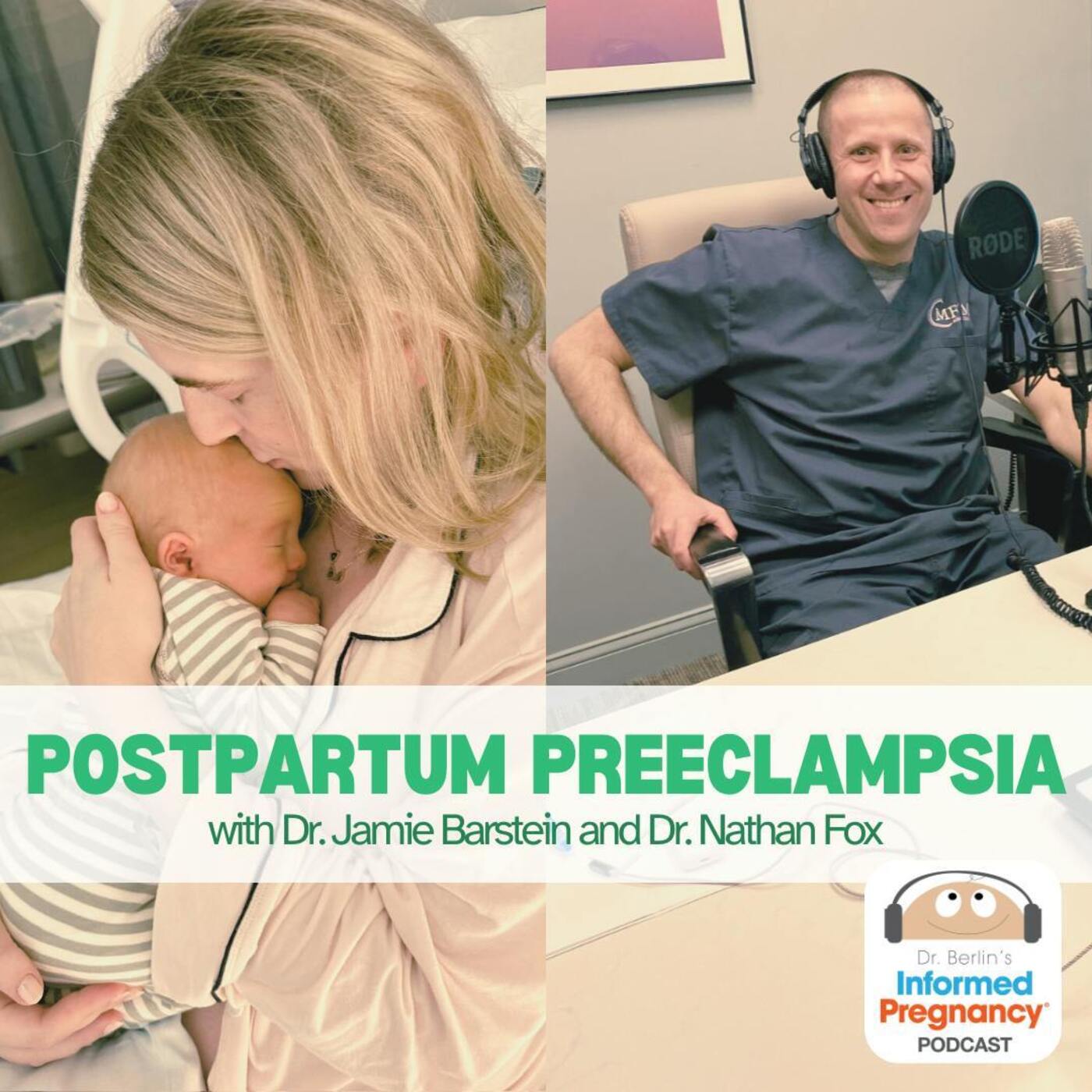
Preeclampsia, and specifically postpartum preeclampsia, is a serious and often misunderstood condition. We welcome two guests to discuss symptoms, treatments, and guidance about navigating the condition. Psychologist and mother Dr. Jamie Barstein shares about her personal experience with preeclampsia after her first baby and Dr. Nathan Fox, OBGYN and maternal fetal medicine specialist provides medical insight.

More about Dr. Fox:
Listen to Dr. Fox’s podcast here, now streaming on InformedPregnancy+
Key quotes
“And I remember it so vividly. Something was plugged in wrong and I couldn't get to work. And I remember texting my sister-in-law saying, do I really need to check my blood pressure? Can I just go to bed? And she's like, you should check your blood pressure. And I checked it and it was 190 over 110.”
“And so that's why it's one of these things that's kind of silent because you don't know your blood pressure is high. You don't know you have protein in your urine. Most people are swollen. And unless you have headaches or shortness of breath, you usually aren't gonna have symptoms related to those blood disorders.”
“Preeclampsia does kill people. Preeclampsia can be fatal and that's why it's such a serious condition.”
“And that continues even after you go home after delivery. Even if someone's preeclampsia was not like your story and they just had it in their first pregnancy in the more quote unquote typical way, I would still tell them the next time around, even after you go home, check it every day for at least two weeks.”
“Yeah, lean on your medical sources, right? Like trust your gut if something feels off or wrong. Trust your gut. I think a lot to that on-call doctor who, you know, may have been exhausted and I don't know, said, why are you checking your blood pressure? Something doesn't feel right. That's why I'm checking it. So trust your gut and also, you know, and advocate for yourself. And then also be mindful of when your anxiety”
Related episodes
- Ep. 435 Jackie Amézquita: After Birth
- Ep. 442 Jessica Zadeh: Before Birth
- Ep. 426 Mia Rigden: After Birth
- Ep. 446 Perinatal Exercise with Sarah Zahab
Transcript
AI-generated transcript with speaker labels — may contain errors, especially names and medical terms. Dr. Elliot Berlin, DC appears in blue; Dr. Jamie Barstein in orange; Dr. Nathan Fox in teal.
Download PDF of the Transcript
Dr. Elliot Berlin, DC [1:12] 's I gotta Welcome to the Informed Pregnancy and Parenting podcast. I'm your host, pregnancy-focused carb director, Dr. Elliot Berlin. Today, we're covering a serious but often misunderstood condition, preeclampsia, and specifically, postpartum preeclampsia. I'm excited to bring you both personal and medical insights to help you recognize symptoms, understand treatment options, and know what it's like to navigate this experience. We're joined today by two wonderful guests. First, we have Jamie Barstein, a child and adolescent psychologist, but more importantly for this episode, a mom, and a patient who faced postpartum preeclampsia after the birth of her first child.
[2:10] She's here to share her story of unexpected symptoms and the adjustments she made to prepare for a second postpartum period. Also joining us, Dr. Nathan Fox, a board-certified obstetrician gynecologist specializing in maternal fetal medicine. Try saying that five times quickly. Dr. Fox completed his medical degree and residency at Mount Sinai, followed by a fellowship at Weill Cornell Medical College. He's now a clinical professor at Mount Sinai and provides high-risk pregnancy care at Maternal Fetal Medicine Associates of New York. He's been a previous guest on a number of episodes of this podcast, and you can find his awesome podcast, the Healthful Woman podcast,
[2:47] at healthfulwoman.com and every place you listen to podcasts. And also, we have a bunch of your podcasts on Informed Pregnancy Plus, streaming right into your living room or wherever you listen and watch. Dr. Fox also co-authored the relatively new book, The Unexpected, with Emily Oster, an economist and author which explores common pregnancy complications and emphasizes the importance of data-driven support from maternal healthcare. Dr. Fox, welcome to the podcast.
Dr. Nathan Fox [3:14] Thank you for that terrific eulogy.
Dr. Elliot Berlin, DC [3:16] Ha ha ha ha.
Dr. Nathan Fox [3:18] Yeah, I'll be ready. They can call on me.
Dr. Elliot Berlin, DC [3:19] Ha ha ha ha. All right, it's a really important topic, preeclampsia in general, and also postpartum preeclampsia, which for reasons I'm not quite sure I'm seeing or hearing a lot more about of recent. We can potentially jump into whether that's actually more cases happening or people just being more aware of it. But Jamie, let's start with you because you experienced it and it came out of the left field for you. What was your experience with your first pregnancy and birth?
Dr. Jamie Barstein [3:44] Yeah, thank you. And also, Dr. Fox, super cool, your book. I can't wait to read it.
Dr. Nathan Fox [3:50] You'll be the third.
Dr. Jamie Barstein [3:51] Awesome.
Dr. Nathan Fox [3:52] Yeah, Emily Oster. No, I'm kidding. Emily is a rock star, so.
Dr. Jamie Barstein [3:56] Yeah, she's my god in terms of, yeah, as a psychologist too, for her friends. I'm like, just listen to what she says and it'll ease your anxiety, so.
Dr. Elliot Berlin, DC [4:05] Well, if she's your god, I'm like one of her angels. Okay.
Dr. Jamie Barstein [4:09] Yeah, all right.
Dr. Elliot Berlin, DC [4:10] I love it. The one with the little red horns?
Dr. Jamie Barstein [4:12] Probably. Yeah, so my daughter who's now three and a half had a fairly smooth pregnancy with her. I mean, you know, all things considered was nauseous and a few different things, but for the most part, fairly smooth, nothing significant. And then my delivery, so I went into labor, my water broke and ended up unsuccessful vaginal delivery and had a C-section. So, you know, I'm exhausted. I had had surgery, I had labored for 30 hours and came home from the hospital a few days later and was like, I just don't feel right. Actually, it was a day later that I came home from the hospital. This is like day four of having my daughter. And you know, I don't think you're supposed
[4:57] to really feel right after you've had a C-section and had a baby, but my sister-in-law who's a doctor, I had reached out to her and I said, I'm having a hard time catching my breath. And so she said, you know, she asked me, do you have a headache? I said, yeah, I have a headache. I mean, I've had a headache for really nine months of pregnancy before I was seeing Dr. Berlin to help me with my headaches.
Dr. Elliot Berlin, DC [5:20] Oh, I'm grateful for your headaches then.
Dr. Jamie Barstein [5:22] Yeah, yeah. And my feet were swollen, which they had been when I left the hospital, but my mom was really, my mom was here helping and she was really worried about how swollen my feet were. So my sister-in-law said, you know what? You should check your blood pressure. The only reason why I haven't had a blood pressure cuff is because it was COVID. And so I had, you know, a blood pressure monitor. So I had some stuff at home because not all of my appointments were in person. But otherwise, I mean, I wasn't told by anybody to check my blood pressure. And I remember it so vividly. Something was plugged in wrong and I couldn't get to work. And I remember texting my sister-in-law saying,
[5:56] do I really need to check my blood pressure? Can I just go to bed? And she's like, you should check your blood pressure. And I checked it and it was 190 over 110. And she's like, call your doctor, but you need to go back to, you know, the hospital. At which point I called my doctor and the doctor on call said to me, why are you checking your blood pressure? Which leads to me hysterically crying, you know, like, I don't know, I'm checking my blood pressure because I was told to check my blood pressure. And I remember the doctor on call says to me, are you anxious? I'm like, of course I'm anxious. Like I just- I am now. Yeah, I was told, you know,
[6:29] and so I remember the doctor on call told me to take some deep breaths and then, you know, took some deep breaths, took my blood pressure again. You know, it was similar. I think it's maybe 189 over, you know, 110 or something, I don't know. And said the same thing, you know, go back to the hospital now. And I mean, I don't even think I knew what postpartum preeclampsia was. I'd heard of preeclampsia, but I don't think I really understood that it's something that could affect you in the postpartum period. I mean, I know they're checking your blood pressure at the hospital, but it was really quite shocking. You know, get there, find out. I had, and Dr. Fox,
[7:04] you'll make sure I'm saying this right, but elevated platelets and liver enzymes and kidney enzymes that were atypical.
Dr. Nathan Fox [7:12] Probably low platelets.
Dr. Jamie Barstein [7:14] Low platelets, opposite?
Dr. Nathan Fox [7:16] Oh, they could have been elevated, but probably low and elevated liver enzymes. Did they give you the diagnosis of help?
Dr. Jamie Barstein [7:24] You know, they didn't give me the diagnosis of help. And maybe you can talk about what that is, but I did have kidney, liver and platelet abnormalities. And then the biggest thing that I had actually at that point was I also had excessive fluid in my lungs.
Dr. Nathan Fox [7:40] Oh my God.
Dr. Jamie Barstein [7:41] They had started me on magnesium, but it was causing more fluid in my lungs or a complication. And so they stopped the magnesium to then get the fluid out of my lungs and then restarted me on the magnesium.
Dr. Elliot Berlin, DC [7:54] I feel like if this is a jigsaw puzzle, you've put together some of the middle pieces and we need to put the frame around it to get a little perspective. But before we go there with Dr. Fox with all the information, a few questions for you, Jamie. First of all, you know, that's a pretty high blood pressure for anybody. What's your normal blood pressure? Do you know how it typically runs?
Dr. Jamie Barstein [8:13] Yeah, I mean, it's pretty normal. Maybe like 110 over 70. That's normal, right?
Dr. Nathan Fox [8:19] Yeah, so this would be much higher. Also, I think those home blood pressure cuffs are notoriously not that accurate, but when it's that high, especially twice, then even if it was just a green light, yellow light, red light, you've got a red light twice. And then the other thing is, was your blood pressure normal in the hospital before you left? I assume it was at the discharging.
Dr. Jamie Barstein [8:41] Yeah, normal blood pressure in the hospital before I left. Normal blood pressure at every appointment or any time I took my blood pressure during pregnancy. Yeah, there was no concerns about my blood pressure. I mean, I was discharged with, you know, no concerns. I mean, you know, to be honest, I was pretty out of it, but I don't vividly recall. So, you know, I'm sure there's something in that packet that they give you, but nothing that was like, hey, make sure you're checking your blood pressure. Here are symptoms to look out for. Those were things that were told to me in my most recent postpartum. And they said, because you're at risk for postpartum preeclampsia,
[9:14] here's what to look out for. But I didn't get any of that in the initial discharge.
Dr. Elliot Berlin, DC [9:18] Got it. All right, Doc, let's talk about preeclampsia first. And also the sort of, I think a lot of people misunderstand the pre is not in reference to labor. Sometimes people think like preeclampsia means a clamps before you go into labor, but it's a state of not yet a clamps yet. You clear this all up for us.
Dr. Nathan Fox [9:36] Yeah, so first of all, Jamie, that's pretty scary. You were pretty sick. I know you're aware of this, but just for the listeners, that's a pretty impressive, not in a good way presentation for what you had, because I'm glad you're okay and you were okay. So preeclampsia essentially, it's a condition that's related to pregnancy, meaning the only people who get preeclampsia are either pregnant women or people who were just pregnant. So you can get it postpartum like you did. It's related to the placenta and why people get preeclampsia and why others don't. We don't exactly know. We know a lot about what happens when one gets preeclampsia. And we know that there are risk factors for preeclampsia,
[10:20] but exactly why it happens in someone and not someone else is not clearly defined. But when it happens, typically the most common manifestations are your blood pressure goes up, which most people don't have symptoms when that happens. Occasionally people will get headaches when that happens, but usually they have no symptoms. So that's reason number one why it's challenging. Number two, they get protein in their urine, which has no symptoms associated. You would not know if you were peeing out protein in your urine. So that's the second reason. Consequently, that's why at every prenatal visit, the two things we have you do is get your blood pressure checked and pee in a cup.
[10:57] It's essentially because we're looking for preeclampsia because you wouldn't know at home. And then on top of those things, there could be a whole myriad of complications related to your platelets could be low, your liver enzymes could be high. It can affect your brain and cause severe headaches and cause potentially seizures. That's where the word eeclampsia comes from when you get a seizure. And preeclampsia is a state before that. It can affect how the baby grows and develops if you're still pregnant. It can cause you to get fluid in your lungs like you had. It can cause a whole host of things. It causes typically a lot of swelling. However, probably 50% of pregnant women
[11:34] have a ton of swelling anyways. And so that's why it's one of these things that's kind of silent because you don't know your blood pressure is high. You don't know you have protein in your urine. Most people are swollen. And unless you have headaches or shortness of breath, you usually aren't gonna have symptoms related to those blood disorders. Now the chance of getting preeclampsia at baseline is ballpark 5%. So one in 20 women will get it. People with risk factors like if you have twins or if you are let's say much older or sometimes if you had IVF or if you're coming to pregnancy a little bit overweight, it can be higher, but higher means like 10%.
[12:12] The only people who have a very high chance of it typically are people who come into pregnancy with high blood pressure as a condition, people with a history of preeclampsia and people who are significantly older like people in let's say their late 40s or 50s have a much higher chance. But the bulk of them happen or present during pregnancy or in the hospital after you deliver. So most people, if they're gonna get it, like if they're in that five, 10, whatever percent, will have signs and symptoms while they're pregnant or in the first 24 hours, let's say after delivery, so it'd be picked up in the hospital. It's a little bit unusual to have what you had,
[12:48] which is you're perfectly fine and you're in the hospital for three days because you had a C-section and then go home and have it. Again, it happens. It is absolutely possible, but it's unusual. And for that reason, it's not currently recommended that everybody go home and check their blood pressure to look for preeclampsia, although it seems to make sense. It's not currently recommended, I think because the chance of it happening is very low and probably a lot of people will get false scares related to abnormal machines or they won't have access and then they're gonna have to go somewhere else to get their blood pressure. And I think, again, I'm guessing here,
[13:23] but my guess of why it's not routinely recommended for everyone is sort of the logistics of it might be complicated. But certainly for people at high risk, we do tell them to take their blood or at least I do tell them to take their blood pressure at home and actually tell them about once a day for a week or two after they go home. I don't know if I would have told you that because again, I haven't done a full evaluation of you but you don't appear to be high risk from your story at least before your first pregnancy. But it is a routine thing when you leave the hospital to tell people, hey, if you have things like headaches or shortness of breath or extreme swelling
[13:55] or this or that to give us a call and it's possible they told you and you don't remember because who the hell remembers what they tell you and leave the hospital? Or it's possible they didn't tell you, I don't know. But I would imagine most hospitals do give people some sort of education about that but it's hard to remember those things.
Dr. Elliot Berlin, DC [14:09] Do we know what's behind the changes that are taking place with the mechanisms that makes it happen?
Dr. Nathan Fox [14:14] It's essentially the body's reaction to hormones from the placenta. It's sort of parallel to gestational diabetes where the hormones of the placenta cause you to sort of your sugar metabolism to get slowed down. But here, instead of your sugar metabolism, it's your blood vessels clamping down causing high blood pressure. And then when they clamp down in various organs, they can cause problems there. There are a lot of molecular pathways that have been worked out relating to various what we call angiogenic factors that come from the placenta. Those are factors that sort of promote blood vessel development in the uterus. But again, why it happens in one person
[14:51] and not someone else, some of it is luck. Some of it is probably factors we have not elucidated and some of it is probably predispositions like genetic or health reasons to have that reaction to it.
Dr. Elliot Berlin, DC [15:04] Okay, I want to take a quick break. When we come back, we'll find out what happened, Jamie, with your experience after you were diagnosed and also more about treatment in general. Don't go anywhere, we'll be right back.

Dr. Elliot Berlin, DC [15:27] Welcome back, we're talking about preeclampsia and postpartum preeclampsia with Jamie Barstein and Dr. Nathan Fox. Okay, so Jamie, what happened after you got to the hospital? You got in and your blood pressure was high, you found the enzymes, your headache was pounding, your feet were swollen and they put you on magnesium but then fluid in the lungs.
Dr. Jamie Barstein [15:46] Yeah, so the fluid had to come out of my lungs and my memory's a little hazy. So I think, didn't they restarted me on the magnesium? Would that make sense, Dr. Fox, that they restarted the magnesium or no?
Dr. Nathan Fox [16:00] They would probably give you medicine to get the fluid out of your lungs. They probably gave you a medicine to lower your blood pressure and they may or may not have restarted the magnesium based on how you responded to those things.
Dr. Jamie Barstein [16:12] Sure.
Dr. Nathan Fox [16:13] You know, magnesium does not cure or even treat preeclampsia. It just prevents the seizures, right? It prevents eclampsia seizures and the chance of getting a seizure diminishes the farther you get away from delivery. So sometimes, even if we admit people to the hospital for preeclampsia after delivery, sometimes we give them magnesium, sometimes we don't and how long we give it if you're on it is also somewhat arbitrary. So it could have gone either way. I don't know what they did with your magnesium, but it is concerning if you have fluid in your lungs because one of the side effects of magnesium is respiratory depression. You sort of don't breathe this heavy
[16:48] and you lose your urge to breathe. So people with fluid in their lungs, we get concerned that we're gonna harm them if we give them magnesium. So it's a delicate balance.
Dr. Jamie Barstein [16:56] Right, and I remember that. And I remember it being serious. I mean, I'm sure that this maybe is every doctor's worst nightmare. My cousin who works in emergency medicine said it's his worst nightmare. I kept looking at everyone saying, am I going to die? Am I going to die? And everyone's response was, it's good you're here.
Dr. Elliot Berlin, DC [17:12] Oh my God, the response should be no, you're not gonna die.
Dr. Jamie Barstein [17:16] Well, maybe it was no, but as a medically anxious person already, this definitely fed my medical anxiety, which is like, you're not gonna die and also it's good you're here. We need to treat everything that's happening for you.
Dr. Nathan Fox [17:27] Preeclampsia does kill people. Preeclampsia can be fatal and that's why it's such a serious condition. And one of the components of the alarming high rate of maternal mortality in this country is related to preeclampsia. However, it is quite unusual to die from preeclampsia while under medical care, that is good. That's paying attention to you and caring for you. Again, there's no guarantees in life or anything, but it is very, very unusual to die from preeclampsia if you are under the watch of people who are watching you.
Dr. Jamie Barstein [18:02] And I should say, I mean, I was at a fantastic hospital under wonderful care. Like I'm a very privileged person and it was really, you know, this is a top notch place. So, yeah.
Dr. Elliot Berlin, DC [18:15] I have a couple of questions here. Dr. Fox, first of all, you know, people take magnesium during pregnancy to help them feel calm and to sleep better and for the muscle cramps to go away, wickedly different than what you're talking about.
Dr. Nathan Fox [18:28] Yeah, so the magnesium people take in pregnancy for that or even for constipation or for headaches is oral and it's in the order of hundreds of milligrams you take by pill. But when we give magnesium for preeclampsia, it's given either typically intravenously, sometimes intramuscularly, meaning a one-time injection like a shot, but most of the places in the U.S. will give it intravenously and you're typically getting two grams an hour. So 2000 milligrams every hour by drip. So it's a much higher dose and it does not typically make people feel calm, relaxed and delightful. It usually makes people feel like, it ranges from some people who are very lucky
[19:10] don't have symptoms, but it ranges to that to people saying they feel like they have the flu, they feel like their head is on fire, they feel like their body's on fire. Yeah, so that's a very common symptom. People typically describe magnesium as exceedingly unpleasant in one way or another. Again, not everyone, some people are fortunate that they don't feel so much of that, but it's not the same thing as the pills people take and giving someone the pills would not help for preeclampsia.
Dr. Elliot Berlin, DC [19:34] That's almost always how people describe it to me that miserable, they hate it and also seemingly they're in a part of, almost like an extra care part of the unit. Like an intensive care unit almost. The best description I've heard is flu in a bag.
Dr. Jamie Barstein [19:50] Yeah, it's pretty miserable. So sharks. And I remember feeling somewhat like kind of loopy too. I also hadn't slept for days and all this stuff, but yes, very loopy, very out of it. And then there's the emotional piece, right? Of like, I just had this brand new baby.
Dr. Elliot Berlin, DC [20:06] Yes, that's what I'm wondering. Your baby's at home and you're at the hospital just a few days after giving birth. Oh, they didn't let the baby come with you?
Dr. Jamie Barstein [20:14] You know, the baby could have come with me. You know, it was also COVID times too. So my husband came to the hospital with me and my parents who were home visiting, they stayed with the baby. The baby came to visit me during the day. But I mean, it was a lot. I couldn't really take care of her and then my husband was taking care of me. That was really, really emotional for me. And I kept saying like, wow, I'm so grateful that this is me who's sick and not my baby. I can't imagine the stories, you know, when the baby is sick or when both are sick, but it really was just a really emotional experience to be separated and you know, yeah, it was hard.
[20:54] It was really hard.
Dr. Elliot Berlin, DC [20:55] And then were you pumping?
Dr. Jamie Barstein [20:57] Yeah, so then I started pumping, breastfeeding was new. And so there was this kind of experience of like, I wanna make this work, but then she wasn't latching and how much of this is also like, have we given each other time to latch? The one nice thing was there's a lactation consultants at the hospital. So when the baby was with me, it's funny calling her the baby. She's three and a half, you know, but it's like, she's separate, different person. Then when she was with me, the lactation consultant was helping. But yeah, I started pumping earlier than I wanted to start pumping, but I did. And then I remember the video of my mom saying like, look, Emmy's having her first breast milk
[21:35] and kind of syringing the breast milk into her while I was at the hospital and she would come with her. Yeah, yeah.
Dr. Elliot Berlin, DC [21:42] This is postpartum, but Doc, you said that essentially preeclampsia could be quite dangerous and it generally happens during the end of pregnancy. So what are the treatments for it while you're still pregnant?
Dr. Nathan Fox [21:55] So the only cure for preeclampsia is to deliver the placenta, which of course means to deliver the baby as well. And so there's always a decision that has to be made when someone has preeclampsia or a form of preeclampsia with mild, moderate, severe, whatever it is, what to do. And if you're towards the end of pregnancy, if you're near the due date, it's pretty clear the best thing to do is deliver. If you're preterm, premature, then a decision has to be made. Is it better to deliver and cure the preeclampsia and have a premature baby? Or is it better to wait, sort of sweat it out a little bit with the preeclampsia and let the baby mature a little bit longer?
[22:37] And that's obviously a very complex decision based on how early are we talking and how severe are we talking? So those are the variables. But generally to treat, you have to deliver. There are things we do in addition to that, there's medications we give to lower someone's blood pressure, which just temporizes things and prevents maybe a stroke from happening. Again, the magnesium doesn't treat the preeclampsia, it just helps prevent seizures. And so it's really delivery. But the ironic thing is that you, Jamie, developed your preeclampsia after the placenta was already delivered. And so we can't deliver the placenta again, right? It's already out.
[23:13] And so for whatever reason, in some people, those changes linger. The most typical presentation of preeclampsia is someone either towards the end of pregnancy or in delivery, their blood pressure starts to go up, they have preeclampsia, we deliver the baby, deliver the placenta. And then at some point thereafter, they get better. Sometimes it's two hours, sometimes it's two days, sometimes it's two weeks, and rarely it's two months. But at some point, they just get better and they continue to improve. But for whatever reason, there's a few people who after the placenta is out, that's the first time they ever manifest with the condition and they have like a delayed response to it.
[23:53] And we don't know why that is, but if you just wait, it will eventually turn the corner and get better. So I'm sure in the hospital, what they were doing is watching you, making sure your blood pressure is okay and you're okay and nothing bad is happening to you while they watch you and just give it time. And eventually it will just self-correct, turn the corner and you'll get better. I assume at some point you went home, did you have to go home on blood pressure medicine? Or how long were you on it? Couple of weeks?
Dr. Jamie Barstein [24:20] Couple of weeks, yeah. I think at my six-week appointment, I was really pretty much off. I was really anxious to go off of it. I mean, I'll be honest, even for months, maybe a year or two years postpartum, if I ever felt like shortness of breath, which off anxiety, but you know. But if I ever felt that I've checked my blood pressure, like my blood pressure must be high again, there's that feeling back to, and it's a condition that I had and I no longer had it, but I think just that trigger of like, is this coming back to me again?
Dr. Nathan Fox [24:52] It's not unreasonable. There are a certain small percentage of people who developed preeclampsia who it never goes away. And then we realize, oh, they don't just have preeclampsia, they actually have high blood pressure, they have hypertension. Because again, not everyone has their blood pressure checked routinely and sometimes the only time it happens is when you're pregnant. And so we sort of coincidentally diagnose someone with hypertension during pregnancy and it sort of presents as preeclampsia and then if it never goes away, they have hypertension. So that sometimes happens. And also, and I'm sure they told you this, that people who get preeclampsia in pregnancy,
[25:25] for whatever reason that's not well understood in their lifetime have a higher risk of developing hypertension 10, 20, 30 years from now. And so it's something that it's appropriate to be on the lookout for it and to have your blood pressure checked periodically and get a physical once a year or whatever it is. And the same is true for like gestational diabetes. If you have that in pregnancy, you have a slightly higher risk in your lifetime of getting it. It could be 30 years later, it's crazy. But it appears to be it's mostly just unmasking something about your body and your health. Not so much that the preeclampsia changes your body into somebody who gets hypertension,
[25:59] but more likely it's unmasking some sort of predisposition to it.
Dr. Elliot Berlin, DC [26:03] Is the 5% all preeclampsia or was that 5%? Do we know what the percent is of women who get it postpartum?
Dr. Nathan Fox [26:11] Oh, of that 5%, the majority do not get it postpartum. I'd have to look up the exact number, but I would say probably if I had to guess 80 to 90% of those it's gonna present probably before they deliver. And the chance of getting postpartum preeclampsia alone more than three days after delivering, I would guess is under 1%.
Dr. Jamie Barstein [26:32] It's so interesting though, cause Dr. Berlin, you see a lot more pregnant people than I do, but just within friend groups, I've had two close friends recently who also had preeclampsia postpartum without really any symptoms and were only checking their blood pressure because of my experience. I think, and you asked this before Dr. Berlin about whether it's actually happening at a higher clip or whether we're just diagnosing it more. And I think it's probably a little bit of both. Some of the risk factors for preeclampsia are increasing amongst childbearing folks specifically age, BMI, use of fertility treatments, things like that. Again, that's not to scare people.
[27:13] Most people who have whatever age BMI or fertility treatments do great. And God bless, they should have kids, but there is factors. And so those risk factors are a little bit more common, but I do think there is, since there's a little bit more awareness, people are more likely to get their blood pressure checked and because it's so much easier to do it now with home blood pressure cuffs and remote monitoring systems. And there's all these ways to do it with like smart technology that I think more people are checking. How many of them would have been horribly harmed if they didn't check? Hard to know. Sometimes it's very mild and it would have just passed on its own
[27:48] without anyone knowing. And other times it's probably saved lives, but that's probably fortunately rare.
Dr. Elliot Berlin, DC [27:55] Right, but that all makes a lot of sense to me given those risk factors and given people are having babies later and having more in vitro and other assisted reproductive technologies and more multiples. But it doesn't explain Jamie's friends because I don't think any of them had those particular factors. But checking and being able to find it earlier also probably, as you said, once the placenta is out, it's gonna go away at some point. So if it doesn't cause too much of a ruckus, just high blood pressure and maybe some swelling in the feet, or you probably would not really separate that from things that you naturally feel postpartum anyway.
Dr. Nathan Fox [28:28] Correct.
Dr. Elliot Berlin, DC [28:29] So it could have been some of those more silent cases are on the radar now. Before we go to another break, I have one question that if I was sitting at home listening to this, I would wonder, because you said it's a reaction to the placenta. A popular trend for people to eat the placenta now, if you have these kind of things related to placenta, whether it's gestational diabetes or hyperemesis or preeclampsia, was there a consideration or thought to not eat that placenta?
Dr. Nathan Fox [28:58] I got an answer and then I've got a story. The answer is when people consume their placentas, typically they are first processed and the processing of the placenta probably denatures a lot of the proteins that would potentially do this. And secondly, when you take a placenta and you eat it and it gets digested, it's probably a lot different than it being inside your body and secreting things directly through your bloodstream. So as far as I know, eating the placenta would not increase the risk of preeclampsia. Now, hyperemesis, if you throw up because it's gross, then that's a possibility. People could do whatever they want with that. The data supporting its benefits are limited
[29:42] and there's potential for risk. I think it's probably not great benefit or great risk. It's just a little bit unusual. I was meeting with a couple and they were talking to me about, we don't have a lot of people in my practice who do this occasionally. So they're talking to me about their plans to take home the placenta and what they're gonna do with it, how they're gonna eat it, and how they're gonna prepare it and all these things. And I don't know, I guess I'm not judging them. I don't really care either way, but I guess something about my face gave away that I thought this was a little unusual. So the husband, he said to me, Doc, you don't believe in eating your placenta?
[30:14] And so I said, well, it's not a matter of belief. I mean, I believe people do it. Like that's fine if you wanna do it, go ahead. But you know, it's just, it's not my thing. I'm not into it. So he decided to push forward. He leaned in, you know, sort of like leaned in and gave me a very stern look and said, Doc, don't you know that all mammals eat their placentas? And so I leaned in and I said, not this mammal.
Dr. Elliot Berlin, DC [30:37] Also, by the way, some of the animals out there eat the baby too, but we don't.
Dr. Nathan Fox [30:41] Whatever, again, I'm not judging anyone. God bless. If that makes people feel like they're doing better or whatever it is, go for it. It's just not my thing.
Dr. Elliot Berlin, DC [30:48] I think it's only a matter of time before we have impossible placenta anyway. And then anyway, let's take a little break. When we come back, we're gonna find out more about Jamie's second pregnancy. And if there's anything you can do to try to mitigate your risk of preeclampsia, we'll be right back. Welcome back. We're with Jamie Barcyn and Dr. Nathan Fox talking about preeclampsia. And in this case, in particular, postpartum preeclampsia. So Jamie, you got pregnant again. Is there a concern that once you've had preeclampsia, you might get it again?
Dr. Jamie Barstein [31:29] Yeah, I think, is it 50%, is that right?
Dr. Nathan Fox [31:32] It depends. Probably somewhere between 25 and 50% based on the circumstances.
Dr. Jamie Barstein [31:38] Well, in my head, it was flip a coin. I might get it, I might not.
Dr. Nathan Fox [31:41] Yours is pretty severe. So the more severe it is, the more likely it is to happen again the next time around. So I would have said it's probably somewhere 25 to 50%. But we would have operated under the assumption that it's a strong possibility and we would have been all hands on deck for your next pregnancy.
Dr. Jamie Barstein [31:56] Well, it's interesting when you said you were pretty sick. I have to say that that really validated my experience because I felt really sick and I felt sick for a long time postpartum. I mean, who knows what a normal experience is. Of course, postpartum is an experience regardless, but I do feel like it took a while from my physical health to feel like, I could even go for a walk without being out of breath. Again, how much of that is just normal postpartum experience? How much of that is preeclampsia? And I knew I wanted to have a second child, but it was definitely something that I'm already run pretty medically anxious and this was definitely a factor in terms of,
[32:34] I know I wanna do this, but I wanna be really thoughtful and mindful. So yes, pregnant again and taking baby aspirin every day. So that's to decrease my chances of having preeclampsia, right?
Dr. Nathan Fox [32:49] Yes.
Dr. Jamie Barstein [32:50] Who's that word?
Dr. Nathan Fox [32:51] No one really knows. I mean, you could fill a semi with the things we don't know about this, but there's thoughts about how it alters various angiogenic factors in the placenta and in your blood vessels and how your response is. But ultimately, aspirin has been studied extensively in terms of reducing the risk of preeclampsia. And the studies are pretty consistent in aggregate when you look at very large numbers that people who take a low dose of aspirin in pregnancy have a slightly lower risk of getting preeclampsia. It reduces it maybe like 10 to 20%. And that's a relative reduction, meaning so if your risk was 10%, it'll lower it to 8%. It doesn't lower it from 10 to zero.
[33:35] The questions are how much aspirin? Like do you take 81 milligrams, which is baby aspirin in the US? Do you take 162 milligrams, which are two baby aspirins? Just for comparison, one full aspirin is 325. So a baby aspirin is one fourth of an aspirin and two baby aspirins would be one half of an aspirin. In Europe, they sell 100 milligrams, they sell 150 milligrams, and people have tried all those different ones. But it's pretty much universally recommended if you've had a history of preeclampsia in the next pregnancy to take some form of low dose aspirin. Interestingly, in my practice, we recommend it to everybody across the board. Like literally I would stick it in a prenatal
[34:15] if I could, because it doesn't appear to be any downside. And the only reason it's not recommended universally is because most people walk around with a low risk and so lowering it from 5% to let's say 4% or 3.5%, it may not be worth it to recommend to millions and millions and millions of people to take baby aspirin. But in our practice, we do recommend it to everybody.
Dr. Jamie Barstein [34:36] Are there other things?
Dr. Elliot Berlin, DC [34:37] Other things that will lower the risk?
Dr. Nathan Fox [34:39] Yeah. There's some evidence that taking calcium supplements will lower the risk. That's predominantly studied in people who have very low calcium intake. And so in the past, when these studies were first done, like 20, 30 years ago, they were looking at like other countries with poor nutrition. And they said, if we give them calcium, it lowers the risk. And people sort of pooh-pooted in the US to like, we're not a developing country. Like we have great nutrition, we eat, but no one I take care of drinks milk or has dairy, right? Dairy is like poison now for everyone. So no one gets the recommended calcium, which is a thousand milligrams a day.
[35:18] That's for non-pregnant people. So when you're pregnant, a thousand a day. So I always ask them like, how much dairy do you eat in a given day? So I was like, oh, I might have a yogurt and maybe I put some milk on my coffee. I'm like, all right, that's 400. That's it. So I tell them my idea.
Dr. Jamie Barstein [35:31] But in LA, it's a soy yogurt anyway.
Dr. Nathan Fox [35:33] Yeah. So I tell pretty much everyone.
Dr. Jamie Barstein [35:35] I was gonna say zero dairy. In fact, the first trimester I had dairy, I threw up so much that my doctor was, let's cut out dairy.
Dr. Nathan Fox [35:41] Yes. So I tell people that they should get a thousand a day of calcium from all sources, wherever, you know, dietary supplements, whatever it is. One of the nice things about calcium is you can buy it as gummies, which are delicious. They can't put a thousand milligrams of calcium in a prenatal because the prenatal would be so big. You'd have to cut it with a fork and a knife. So the typical prenatal only has like a hundred or 200 maybe. So other than those, if you have chronic hypertension, taking blood pressure medicine seems to lower your risk of getting preeclampsia. Having a healthy lifestyle, like some sort of regular exercise that gets your heart rate up tends to be helpful.
[36:21] There's some evidence of certain diets that might help, but probably not that much. And then most of it is just monitoring. I tell people have a history of preeclampsia when you're pregnant, to start taking your blood pressure at home once a day in the third trimester, to be on the lookout for things like swelling. Even if you think it's normal, just make sure to check your blood pressure. If you're checking it every day, then you wouldn't have to worry about your swelling. Signs like, you know, again, headaches and unusual symptoms. And that continues even after you go home after delivery. Even if someone's preeclampsia was not like your story
[36:54] and they just had it in their first pregnancy in the more quote unquote typical way, I would still tell them the next time around, even after you go home, check it every day for at least two weeks.
Dr. Jamie Barstein [37:03] Yeah, that's exactly what I was doing. Yeah, checking my blood pressure. I checked my blood pressure pretty much daily all of pregnancy, because I was also medical anxiety and had a great doctor who said like, great, you know, check your blood pressure. If you're feeling off, check your blood pressure. If anything, that's gonna help your anxiety, right? Like to know like, okay, it might just be pregnancy that I'm feeling off because pregnancy is strange and also good. Like you are at risk, check your blood pressure. Yeah, so hearing you say stuff, a part of me is like, oh man, I should have taken calcium. That would have been the one thing.
Dr. Nathan Fox [37:34] Ah, probably not.
Dr. Jamie Barstein [37:36] Yeah, like I did the exercising and the eating healthy, right? But that's, you know, perfectionism. But yeah, so, you know, was really thoughtful, really mindful monitoring myself. You know, we're at the hospital and I ended up with a planned C-section this time. You know, every time the blood pressure thing goes off, we're like, breathing a sigh of relief. And then came home, was monitoring my blood pressure and unfortunately it was high. It was not nearly like it was after my daughter. So it was, I think 165 over maybe 110 again, I can't remember. So unfortunately went back to the hospital Say that again was like such an emotional experience for me.
[38:16] And it was interesting. It was less about leaving some of my second as a boy and it was less about leaving him. I was really mindful of preparing my toddler for the time I'd be away from her. And I kept thinking like, she's gonna wake up in the morning and say, where's mommy? Kids are so much more resilient than we often think. That was a projection of my own anxiety. And as a child psychologist, you know, rationally, but was just so emotional. Like I can't believe I'm here again. I can't believe I'm doing this again. I mean, it turned out I had a much, much milder form and was there for 24 hours this time and then took medication at home. But it was still, I mean,
[38:52] it was a pretty emotional process of like, you know, I think there was a little bit of kind of trauma response for me of like, I'm back here. I'm doing this again. I can't believe it. I did the things I was supposed to do. I took my aspirin and I ate healthy and I exercise and have a healthy lifestyle. But the reality is it can affect anyone.
Dr. Nathan Fox [39:10] Yeah. I mean, it probably had a more mild course because you caught it earlier.
Dr. Jamie Barstein [39:15] Yeah, for sure.
Dr. Nathan Fox [39:16] Yeah. Meaning the reason the blood pressure is lower, if you waited two, three, four more days, it probably would have been much higher and it probably would have been worse.
Dr. Jamie Barstein [39:22] Yeah. Yeah. I was like, please don't give me magnesium. Remember I came out there like, so we have good and bad news. The good news is that, you know, you're normal in these areas, but the bad news is, you know, this is preeclampsia and we do need to start you on magnesium.
Dr. Elliot Berlin, DC [39:39] Oh, not a fun drug.
Dr. Jamie Barstein [39:40] Yeah. Is there anything you can tell? Like if you're trying to monitor yourself and you check your blood pressure and it's a little high, is there anything you can tell from a urine dipstick at home? It's blood work, right?
Dr. Nathan Fox [39:50] If you have urine dipsticks at home and you can check for protein, that's fine. But if your blood pressure is high, you should be bumping it up to a professional at that point anyways.
Dr. Jamie Barstein [40:00] Really? Not just Shatch EBT?
Dr. Nathan Fox [40:02] Yeah. No, I mean, Shatch EBT is a professional, but yeah, if you have protein in your urine, but your blood pressure is normal, usually you're gonna stay at home. But if your blood pressure is high, whether you have protein in your urine or not, you should be seen. It doesn't matter.
Dr. Elliot Berlin, DC [40:14] Got it.
Dr. Nathan Fox [40:15] Yeah.
Dr. Elliot Berlin, DC [40:16] Well.
Dr. Nathan Fox [40:17] Are we doing it again?
Dr. Elliot Berlin, DC [40:17] That's what I was gonna ask.
Dr. Nathan Fox [40:18] Oh, I got it. That's a lot of- Number three, come to New York. Me and your sister-in-law will take care of you.
Dr. Jamie Barstein [40:23] Yeah, right? I know. I have a great therapist, a lot of processing with my therapist on whether I could do it again.
Dr. Elliot Berlin, DC [40:28] Yeah.
Dr. Jamie Barstein [40:29] I will share, that was part of the emotional experience I was having being re-hospitalized. And you know, I was thinking like, yes, I'm really emotional right now. A lot's happening. Was like, oh my God, am I gonna be able to do this again? You know, and sometimes I have some thoughts around like, maybe this time it'll be the worst, but I appreciate what you're saying too, is like, maybe it was milder because I caught it. And with both times was under good care. I think the first time was really just the shock of it all. I mean, not to say you can ever predict how anything's gonna go when it comes to pregnancy or delivery or postpartum, but you know, I think it's helpful to know
[41:01] that it's so rare, but I do feel like that knowledge around it is so important because, you know, I asked 99% of my friends, they're like, I didn't even know this could happen postpartum.
Dr. Nathan Fox [41:13] I mean, you're a psychologist, you don't need me to tell you this, but you know, a lot of the times when it gets really tough for people is when it's not necessarily the fact that it happened. Right, because people sometimes have very challenging parts. It's sort of the experience when you go through and if your experience doesn't match your expectations, that shock is much worse. And so the second time around, it's a bummer, obviously, that you got it again, but your expectations were that this could happen, it might happen, you're watching for it. And so it happened, you're disappointed, but you typically wouldn't have the same level of like trauma that you would
[41:47] when it comes out of left field. And so the hard part about that is, okay, so does that mean I should scare everybody who's pregnant? Oh, this could happen to you. And it's sort of like, you know, all right, so for the person who it happens to, great, their expectations were matched, but then for everyone else, you're just scaring the hell out of them. And so it's a tough balance for, you know, how do you educate people and have them understand these things and know these things in a way that doesn't scare the hell out of them.
Dr. Jamie Barstein [42:13] Right, that instead you're your own advocate.
Dr. Nathan Fox [42:15] Yeah. It's tough, it's like meta medicine. You know, how do you do these things in a way that keeps people as delighted as possible through the course of their pregnancy, but also keeping them really informed and keeping them, you know, educated and so they could advocate. And it's a very tough balance.
Dr. Elliot Berlin, DC [42:32] As we wind down this episode, we've shared a personal story of not once, but twice postpartum preeclampsia, thankfully treated well, but still a very, very physical and emotionally challenging condition. And we've given some information about the percentages and likelihood that it would happen both before and after birth, some of the signs and symptoms to look out for and be aware of, and even a little prevention potentially. On top of that, as a final note, somebody listening who's pregnant or considering a pregnancy, what would you guys recommend, Jamie, having lived through it, and also Dr. Fox, this difficult balance that you're mentioning
[43:09] of sort of wanting to be on the lookout, but not wanting to be terrified?
Dr. Nathan Fox [43:13] Stay away from WebMD.
Dr. Jamie Barstein [43:14] Yeah, lean on your medical sources, right? Like trust your gut if something feels off or wrong. Trust your gut. I think a lot to that on-call doctor who, you know, may have been exhausted and I don't know, said, why are you checking your blood pressure? Something doesn't feel right. That's why I'm checking it. So trust your gut and also, you know, and advocate for yourself. And then also be mindful of when your anxiety is taking over and, you know, I always call it spiraling into a path of now this is making me feel worse versus I'm gonna seek information, I'm gonna seek care in order to make sure I'm okay.
Dr. Nathan Fox [43:51] Yeah, I agree with that 100%. I would also say, and this is a plug for you, Dr. Blinn, and I guess for me as well, I think everyone, again, whether you're pregnant, whether you're thinking of getting pregnant, you have to find the sources of information that work for you that are reliable, that are understandable and that speak to you. And for everyone that's different, obviously, I would say this podcast right here is a very good one. And I think mine is a good one. There's others that are good, obviously, whether it's that, whether it's a book, like you mentioned, Emily has written great books, whether it's her books, whether it's another book,
[44:25] there are good websites. You just have to find what they are and that they're, again, reliable and they speak to you in a way that some people want more medical ease and other people want more colloquial. And you have to see which one it is and then try to educate yourself as much as possible in a way that's not terrifying. So you sort of know what the possibilities are and what could happen. And I would rely on those much more so than just Googling and finding the worst option out there and saying, all right, I'm gonna die.
Dr. Elliot Berlin, DC [44:51] I trust everything you say, especially this being a great podcast. I take that to heart. Okay, well, I wanna thank you both for being here and Jamie sharing your personal story and Dr. Fox sharing your professional expertise. Very potent episode with a lot of valuable information that I know will be helpful to a lot of people. Doc, you've been on our podcast before. For example, we talked about anemia and low plate levels in episode 228, external cephalic version is actually a very popular episode, episode 299 and thrombophilia in episode 325. There are others.
Dr. Nathan Fox [45:26] 299, that was the big one.
Dr. Elliot Berlin, DC [45:28] 299, yeah, we almost made it there. But there's more of you to go around aside from people living in New York who can come see you and you can be their doctor. Where else can we find you, your podcast and other resources?
Dr. Nathan Fox [45:41] So you could find me prowling about either the Upper East Side of Manhattan or England, New Jersey. I'm the middle-aged guy with all the cubs paraphernalia in the wrong town. So you'll find me there. Yeah, I mean, the podcast is probably the best way. As you said, it's called healthfullwoman.com. It's a horribly named podcast because it's impossible to pronounce, but it's like the word helpful, but health. Helpful. Yeah, and everywhere you find podcasts, we have a website, healthfullwoman.com. And again, as you said, that I was privileged to co-author a book with Professor Emily Oster, who is the best of the best. And that was a really cool experience.
[46:20] We have a whole chapter on people with the history of preeclampsia and other things that have happened to people's first pregnancies.
Dr. Elliot Berlin, DC [46:26] Well, I'm glad you're keeping busy.
Dr. Nathan Fox [46:28] Doing my best, man. Doing my best.
Dr. Elliot Berlin, DC [46:30] Thank you guys again. And at home, thanks for listening to our podcast. For more pregnancy and parenting information, just like this, visit us online at informpregnancy.com.
Want more pregnancy + parenting? Start your FREE TRIAL of Informed Pregnancy+ and get access to all our curated pregnancy and parenting content — original series, iconic birth films like The Business of Being Born, prenatal workouts and more.