
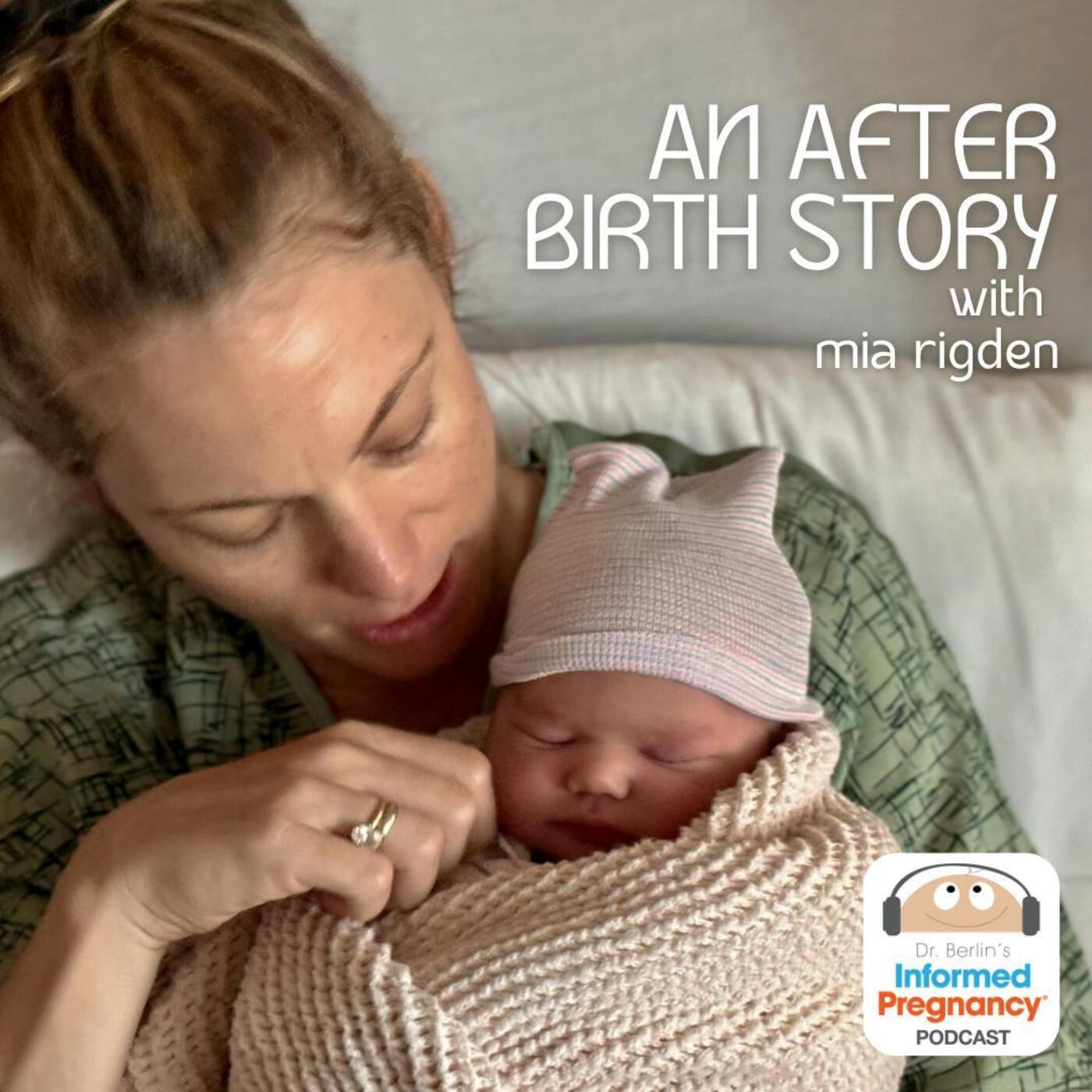
September 26, 2024 · 35 minutes · Episode 426
About this episode
Chef and nutritionist Mia Rigden returns to tell the birth story of her second child after an unplanned cesarean for her first birth.

Connect with the guest: miarigden.com and @mia_rigden
Key quotes
“It's amazing. I really highly recommend it pregnant or not to anyone. I think it's a very, very useful tool to put some data against, you know, your food and lifestyle practices and how they might be affecting you.”
“And, you know, I feel like you're in this position where you're strapped to this bed and you can't really move. And people are telling you these things that it's very difficult for there to be informed consent.”
“The baby comes out, she's perfectly healthy. Freya, my daughter Freya. My doctor walks over to me while I'm holding her and she whispers in my ear, nine pounds, 12 ounces. Almost like I was right, told you so. I mean, she delivered both of my babies and I adored her but it felt like a stab in the back”
“they were the ones that were like, this is absolutely unacceptable. Your bladder needs to be empty in order for the baby to lower. And that's when my husband and I started realizing like just how messed up and unfair it was.”
“Well, and you know, they say, I kind of hate this, like at least you have a healthy baby because I feel like that totally discounts the health of the mother, but she did come out extraordinarily healthy. Apparently even my placenta was like three pounds. And she was well-nourished in there 14 days late. So I feel obviously grateful for that.”
Related episodes
- Ep. 443 Jessica Zadeh: After Birth
- Ep. 435 Jackie Amézquita: After Birth
- Ep. 442 Jessica Zadeh: Before Birth
- Ep. 425 Mia Rigden: Before Birth
Transcript
AI-generated transcript with speaker labels — may contain errors, especially names and medical terms. Dr. Elliot Berlin, DC appears in blue; Mia Rigden in orange.
Download PDF of the Transcript
Dr. Elliot Berlin, DC [0:12] Welcome to the Informed Pregnancy and Parenting Podcast. I'm your host, pregnancy-focused chiropractor Dr. Elliott Berlin. You're listening to the second episode of a two-part before and after birth series. My guest today is a culinary enthusiast who recently transitioned from the bustling restaurant world to focus on her passion for nutrition, founding a business centered on the belief that good food should also be good for you. When we spoke last, she was expecting her second baby and shared with us her plans for a trial of labor after cesarean et tolec. Today she returns to share how her second birth went and her reflections on the entire experience.
[1:13] Mia Rigdon, welcome back to the podcast.
Mia Rigden [1:16] Thanks for having me.
Dr. Elliot Berlin, DC [1:18] Congratulations.
Mia Rigden [1:19] Thank you.
Dr. Elliot Berlin, DC [1:20] And another baby. It's great to see you again. As chiropractors, we love to say we're glad to see you're back.
Mia Rigden [1:26] Thank you very much.
Dr. Elliot Berlin, DC [1:29] I'll be here all night. For listeners who might need a little refresher, Mia's first pregnancy was smooth, but labor took an unexpected turn. She planned for an unmedicated hospital birth, her water broke, contractions didn't start right away. Once they did, they became really intense. She used nitrous oxide and got to two centimeters. Ultimately, an epidural landed her at eight centimeters, but labor kind of stalled and after a long time went by, there were some D cells. She had a cesarean birth and it wasn't the birth she wanted, but thankfully she had a smooth recovery. Did I get that right?
Mia Rigden [2:04] Yeah, pretty much.
Dr. Elliot Berlin, DC [2:05] OK, because I listened to the podcast. That's why. All right. And then at the end of it, you were super pregnant with your second baby and you were planning for what I said in the introduction was a TOLAC trial of labor after cesarean with the eventual hope of a VBAC, VBAC, vaginal birth after cesarean. And you mentioned that you had surrounded yourself with a lot of support, including a doula and that your health care team was on board. What were you doing at the end of pregnancy to prepare mentally and physically for the impending birth?
Mia Rigden [2:40] A lot. I was listening to your podcast a lot. I was visiting you, Dr. B, quite often, and I was just listening to a ton of podcasts, just trying to center myself mentally, physically. I had a very active pregnancy, which was, I think, really necessary for me personally, for my physical and my mental health. So I felt strong. I'm a nutritionist, and so I'm very focused on what I eat. I was eating a lot of protein every day. I was sleeping really well. I had a lot of energy. I actually was feeling pretty good up until close to the end. I was also wearing a continuous glucose monitor for most of my third trimester because my gestational diabetes test came back a little high.
[3:30] I hate getting my blood drawn. I'm such a baby. I didn't want to do the three hour test. And so I asked if I could just wear a CGM and my OB was fine with it. And all my results were pretty normal. But I think that wearing the glucose monitor actually helped me to just eat in a way that was better for my energy level. So I feel like in a way it was beneficial for me in feeling my best in that third trimester. So I actually felt pretty good right up until the end where Freya, my daughter, was very late. My son was 10 days late or nine days late. Now I can't even remember. Nine days. He was nine days late. And I was hoping that Freya would come a little bit earlier than that.
Dr. Elliot Berlin, DC [4:15] But yeah, well, I have this theory that ovens are not all set to 350 degrees and you want your cookies out when they're baked all the way, not just because 24 minutes went by. That's just one theory. But quick question about the CGM, because I know you don't like needles. We talked about that. I also hate needles. I don't mind putting them into other people. I don't like them drawing fluids out of my own body. Anyway, the CGM, first of all, I think a lot of people don't like needles and a lot of women have to tend with gestational diabetes. So what was the experience like of putting the CGM on and maintaining it compared to, let's say, sticking your finger all the time?
Mia Rigden [4:58] Well, I have worn a CGM before. I actually like to do it twice a year for a couple of weeks, because I just think it's a good practice. It's part of my work. It's something that I do with clients all the time. Putting it in your arm. I always have my husband do it for me, but you literally cannot feel it. And I always tell people if I'm able to do it because I'm literally the worst. I can't even watch someone getting a shot or blood drawn on TV. If I can do it, anyone can do it. So I was changing it every two weeks. You don't feel it. I think I just had a lot of heightened anxiety and it's easy to get a little obsessed with it. And so at the very end, I just took it off
[5:36] because all my blood sugar readings were normal. And I know how to eat for my blood sugar. That's a huge part of my nutrition practice. And I felt like I was just becoming a little bit obsessive of looking at it. I think which I'm just anxious about the birth and making sure that everything was going OK. And so putting in the actual monitor was fine. But after wearing it for three months, I felt like that was a little too much for me or two months, however long it was. But it sounds more like mentally than physically, more mentally than physically. I mean, appearance wise, you've got this black sticker on your arm, which I found kind of annoying.
[6:11] But other than that, it really is not a big deal. You do not feel it.
Dr. Elliot Berlin, DC [6:15] I mean, I'm curious, actually, I would want to try it and just see how my body reacts to different things that I'm eating. I know in theory.
Mia Rigden [6:23] It's amazing. I really highly recommend it pregnant or not to anyone. I think it's a very, very useful tool to put some data against, you know, your food and lifestyle practices and how they might be affecting you. Also, when you prick your finger, you're just getting that moment in time. And a couple of minutes earlier or later, your blood sugar could be different. You know, it just gives you a more accurate representation.
Dr. Elliot Berlin, DC [6:45] Cool. You know, side topic. OK, you were generally feeling good. I remember you being super active and me feeling bad about myself because I wasn't very pregnant and not active at all. And then you were eating well. And you said at the end, after you went past your 40 week mark, at some point you started to not feel so good.
Mia Rigden [7:04] I actually was feeling good. Physically, I felt fine. I just started to get a little bit nervous. My OB was very sick. She had a bad cold. I think her daughter got married. I don't know what happened, but she was sick and she was out. And so I felt like she wasn't really on me about moving things forward. She was always very supportive of my journey. And like with my pregnancy, with my son, Ozzy, she was fine with me going late. As an aside to that, I was three weeks late in the 80s when I was born. And my husband was 10 days late.
Dr. Elliot Berlin, DC [7:36] No way. In my research, I don't know, I'm not a doctor.
Mia Rigden [7:39] I don't do this, but they can be genetic. So I think that if it were genetic, it definitely runs on both sides of the family that, you know, we relate. Also, who knows how accurate it was back in the 80s, the due dates. But I was hoping that Freya would come a little earlier. But then I just started to get a little bit nervous every day that would pass. I wasn't having any contractions, you know, I didn't want to be induced because I knew that that increased the likelihood of a C-section. I also was aware that my son was large and that my daughter was measuring large, which I also think is genetic. And so I think my husband was a 10 pound baby.
[8:18] I was not, but I was nervous about that. And really the second week that I was late is when I started kind of panicking. I tried taking castor oil twice, but I was really nervous taking it. So I didn't take very much. In retrospect, I did feel contractions both times that I took it. But I don't think I took enough for it to start labor because I was very nervous about it. I went for a hike. I was doing everything that I possibly could.
Dr. Elliot Berlin, DC [8:49] Have you ever consumed castor oil before that? No. What did it taste like? And what did you have it with?
Mia Rigden [8:55] I put some orange juice in it. I mean, it honestly tasted like it was not good. It tasted like a very dirty cooking oil.
Dr. Elliot Berlin, DC [9:04] Oh, yummy.
Mia Rigden [9:05] I just down the hatch. I just took it real fast.
Dr. Elliot Berlin, DC [9:08] It was you did shots.
Mia Rigden [9:09] Did it give you the digestion or effects that people hate? OK, that's what I was worried about. But I don't think I took enough for it to really. But I did feel contractions both times and I was going to acupuncture a lot. I was really trying to get her out. And then during this time, were you checking cervix or? Well, I did. I went. I'm trying to remember one night because my doctor had been sick and then she was doing the rounds at St. John's, she said, just come in. And so I think I was at like two centimeters and the baby was fine. This was when I was about 10 days late. You know, they put the heart rate monitor on me and she was fine. And so they said, OK, that was on a Saturday.
[9:54] Should come back into the office on Monday. On Monday, she wanted to do an ultrasound, which I didn't want to do. And I told her at the hospital on Saturday night that I did not want an ultrasound, that I didn't care about the size of the baby. But she was fixated on this. But on Monday, she just insisted on doing an ultrasound before she checked me. And she was very concerned about the size of the baby and said that I needed a C-section. And then she checked me and realized that the baby had dropped quite a lot. And she was able to sweep my membranes, which she hadn't been able to do before because the baby was too high. So I don't know, maybe the castor oil helped with that.
[10:31] Who knows?
Dr. Elliot Berlin, DC [10:32] Did you have sweeps with the first birth?
Mia Rigden [10:35] No, the baby was always too high.
Dr. Elliot Berlin, DC [10:37] OK, so that was already some progress. What did the experience of the sweep was it?
Mia Rigden [10:43] It was fine. I didn't feel anything. But she did the ultrasound. Well, she did the ultrasound first. And she's like, you need a C-section. I mean, she put her hand over her mouth and looked at my husband, like in shock, which was not helpful.
Dr. Elliot Berlin, DC [10:55] What could possibly go wrong?
Mia Rigden [10:57] Where she did the membrane sweep or checked me or anything. And then she did the sweep and she recommended a C-section. And then she did the sweep. And she said, OK, the baby actually has dropped quite a bit. Let's revisit this tomorrow. And she said, I want you to come back in for an induction tomorrow if you haven't gone into labor naturally.
Dr. Elliot Berlin, DC [11:15] OK, that seems like a good stopping point to take a little break. We'll be right back.

Dr. Elliot Berlin, DC [12:56] Welcome back. We're talking to me, Rigden, and Labor's sort of around the corner for the second birth. You're past your due date. You're taking castor oil, you're hiking, you're doing all the things, acupuncture, and you go in for a check and it's kind of a weird check. The doctor says, in shock, you need a C-section because of the size. She was worried about the size.
Mia Rigden [13:17] Mm-hmm.
Dr. Elliot Berlin, DC [13:18] And then because the baby was low, you were able to get a membrane sweep. And then she said, come back tomorrow.
Mia Rigden [13:24] She said, come back tomorrow.
Dr. Elliot Berlin, DC [13:25] So after the sweep, you said you didn't feel much during the sweep. After the sweep, did you feel changes in your body?
Mia Rigden [13:32] Well, I got home and I took a shower and my water broke.
Dr. Elliot Berlin, DC [13:36] Oh, that's a change in your body.
Mia Rigden [13:37] Yeah, immediately it happened. And the contractions came on very fast, strong, two minutes apart. Sounds also reminiscent of the first time, no?
Dr. Elliot Berlin, DC [13:50] First time my water broke, but I didn't get any contractions for about 12 hours. Yeah, what I was remembering, I think, is you said once they did kick in, it wasn't like a slow gradual buildup. It was like, boom.
Mia Rigden [14:02] Yes. So what I understand from my first labor now is I think I was in back labor and this was the same experience. So no breaks in between contractions. I wanted to go to the hospital immediately. I didn't want to be at home. It was coming on fast and furious.
Dr. Elliot Berlin, DC [14:19] But you felt it in your back?
Mia Rigden [14:21] Well, the contractions were so close together that you would probably
Dr. Elliot Berlin, DC [14:25] know more than me, but I think the baby was posterior. Posterior. But were you physically feeling the intensity in your back and front?
Mia Rigden [14:33] I think so, yes, because I'll get there. But yes, I think when we got to the hospital, I had scalding hot water in the shower on my back for like two hours.
Dr. Elliot Berlin, DC [14:42] Wow.
Mia Rigden [14:43] I've never experienced a labor without that, but it was just extraordinarily intense. So we called our doula and she was at another birth. Oh, no, I know. So she sent a backup and we got to the hospital. I remember being really nervous just about being in the car. Like I couldn't sit in the car. It just all happened very, very quickly and very intensely. I got to the hospital. The doula got there shortly thereafter. And at that point, I had decided I was going to get an epidural because I was worried about the size of the baby and pushing the baby. My doctor had said at the appointment, and she's a very nice woman, but she was saying at that appointment that she only felt comfortable
[15:33] delivering the baby if there was a full team in the room.
Dr. Elliot Berlin, DC [15:37] NICU team?
Mia Rigden [15:38] No, like if the shoulder gets stuck of the baby and she was because of the size. And she was almost a little bit threatening. Like, I disagree with this, but I'm going to let you do it. I decided that I was most likely going to get the epidural. So I got to the hospital. I'm laboring. The contractions are so close together. I'm in so much pain. We're just in the shower the entire time. The backup doula who came, by the way, was like an angel from heaven.
Dr. Elliot Berlin, DC [16:06] Oh, that's nice.
Mia Rigden [16:08] It was disappointing that we didn't have that time beforehand to get to know each other and for to understand my goals. But she came in and we just love her dearly. She was wonderful. So that was OK. And the anesthesiologist came in and I was in so much pain. And I said, I don't want an epidural. And she was looking at me like I was crazy. And she was trying to get me to open my mouth to make sure there wasn't food in there. And, you know, it was really aggressive and rude. And so from that point on, I think it was four p.m. And I knew she was changing shift at seven. So we had this joke that I just wanted to wait until the next anesthesiologist was on.
[16:50] So I was doing the best I can. I was able to get to six centimeters without an epidural. And then I was very nervous because I was so tired. I was yawning in between contractions. And I didn't have a lot of confidence that I was going to be able to push out the baby. And I felt very nervous about the size of the baby. And so I opted to get the epidural. And I thought, OK, with Ozzy, my son, I only got to two centimeters and then I got the epidural and then I was able to relax and get to eight. So I was really happy that I had made it all the way to six centimeters. I felt like I was good with it and I liked our nurse and the new anesthesiologist that came in was wonderful.
[17:39] And so I was happy with it and I got the epidural and it was fine.
Dr. Elliot Berlin, DC [17:44] Is that the same kind of needle phobia as with like a blood draw?
Mia Rigden [17:48] Well, what I always would say to my doula, my doctor, to my husband, is that if I am asking for a needle, then you know it's really bad.
Dr. Elliot Berlin, DC [17:57] True.
Mia Rigden [17:57] Then you know I really need it. So I can't see it. And so I was just in so much pain I just could not wait for the relief. So I got the epidural. And, you know, when they do the epidural, they have to place a catheter. And the nurse was having some trouble placing the catheter. She had to do it twice. But I loved the nurse and we were joking. I finally was relaxed. And then as I remember, I'm lying there. And I guess my temperature had gone up a bit, which had happened with my son as well. And it was the middle of the night at this point or getting late. And my OB recommended antibiotics. I said I didn't want to take it. We tried Tylenol. My fever did go down for a little while and then it came back up.
[18:41] And, you know, I feel like you're in this position where you're strapped to this bed and you can't really move. And people are telling you these things that it's very difficult for there to be informed consent. And I don't know enough. I'm not a doctor. I'm not trying to be arrogant. I haven't delivered babies. But I don't know enough about how you develop an infection or if a fever is just your body's natural response to all of the things that are going on. But I finally agreed to the antibiotic because I was worried about being combative. I was just trying to be able to have the birth that I wanted. So I said OK to the antibiotic. I took the antibiotic.
[19:18] At one point, Freya's heart rate, Freya's my daughter, her heart rate dipped. I guess that she didn't like what side I was lying on or something like that. So all these people came in the room and it was a little intense. But then her heart rate cooled down and she seemed to be doing fine. And they checked me. And a couple hours later, still six centimeters.
Dr. Elliot Berlin, DC [19:41] Oh.
Mia Rigden [19:42] Yeah.
Dr. Elliot Berlin, DC [19:42] That's not what I thought you were going to say.
Mia Rigden [19:44] No. Still six centimeters. And I'm perplexed. And so the nurses were actually awesome. So part of what I think was the problem with my first birth was that I got the epidural and then I was just lying there. I never moved into different positions. And I'd gotten all the way to eight centimeters. And I'll never know. Maybe I could have been doing some moving stuff with the peanut ball, moving my legs. Maybe he would have wiggled down and I would have been able to give birth to him vaginally. But I don't know. I was just lying there. There was no peanut ball. Nothing. I had a doula. I have no idea why I was lying there for 12 hours. But I was. And I never progressed past eight centimeters.
[20:20] So this time, the nurses were all in there. I was able to move even with the epidural. So I was doing all these crazy things. They were really wonderful. They were so helpful and so kind. And I was able to rest. But I just was not progressing past six centimeters. And I felt like every time they would check me, which wasn't that often, like they would kind of say something different as far as the station of the baby. So I guess there's a little bit of subjectivity to that, depending on who's checking or how they're checking. Or a little wiggle room. So I was starting to get a little bit nervous. And I was feeling some pressure. So we thought maybe it was almost push time.
[21:04] And that's when we realized that I hadn't progressed. And they said, just tap on the epidural button a little more. Maybe it's wearing off. So I thought, OK. And they said, let's wait another hour or two. I can't remember all the specifics. So now it's getting to be 5 o'clock in the morning. They're checking me. No progression. I'm feeling a lot of pressure. Don't know what it is. So my doctor comes in. And I'm starting to get nervous about the shift change and not having my nurses, even though I love my doula. My doctor comes in. She says that I need a C-section. And I don't quite understand why. And so I ask. She said, my body creates babies
[21:51] that are bigger than anatomically I'm able to deliver. That's what I was told. And I said, that doesn't make any sense to me. What if this were 200 years ago? What would happen to me? And she thought about it. And she said, you'd probably be in labor for three days and then get sepsis and die. So we just wanted a little bit of time to think about it. But they were already preparing the operating room. And she's like, we already have the surgeon waiting. It was now, I don't know, 5, 30, 6 o'clock in the morning. They all go home at 7. So we took like 45 minutes to try and make a decision on what we wanna do. And I was having a really hard time saying
[22:32] that I was okay with this because I just felt like something wasn't right. And they're like, it's your choice. Like I have to physically give consent but I didn't really feel like I had much of a choice. Like I felt like our OB was annoyed with us. She had slept at the hospital and I know that she cared and I know that she wanted the best outcome but I was just feeling like she was annoyed with me which wasn't how I wanted to feel. And our doula was so kind and supportive. And so I finally gave the consent to do it. And we get into the operating room and they're like, they're reading off all the things. They're like failure to progress, whatever.
[23:09] And the operation is taking a very long time. And I'm like, this is taking so long. What's taking so long? Whatever. The baby comes out, she's perfectly healthy. Freya, my daughter Freya. My doctor walks over to me while I'm holding her and she whispers in my ear, nine pounds, 12 ounces. Almost like I was right, told you so. I mean, she delivered both of my babies and I adored her but it felt like a stab in the back because I did not wanna have a C-section. And you said this to me and I agree with you. The only thing worse than an unnecessary C-section is a woman who needs a C-section and can't have it. So I don't know, maybe I did need the C-section.
[23:47] Who knows? Anyways, I'm in the recovery postpartum area. You know, not in the recovery room. I'm in the postpartum area. And my husband I think went to pick my son up from school and my doctor walks in and she tells me that they discovered in surgery that the catheter had been misplaced and was draining amniotic fluid for 10 hours. And so the reason why I felt all that pressure was because my bladder was very full and I was hydrating and drinking electrolytes. So that's why when I thought the epidural wasn't working, it was just that my bladder was so full. So they only discovered it. Yeah, so they only discovered it in surgery and they, for some reason either had to
[24:33] or mistakenly, it's still unclear to me, had to puncture my bladder. Yeah, and so that's why the surgery took longer. And you know, the nurse who misplaced the catheter came to my room later and she was crying. She was very upset. My doctor said that the higher ups at the hospital were aware and that they would be contacting me and that it was unacceptable. But then she said that it wouldn't have changed the outcome and I said, well, are you sure about that? She said, I've thought about this long and hard and she felt horrible, I could tell. And she's like, I really don't think it would have changed the outcome. And I said, but you don't know that.
[25:08] And she said, no, we don't know that. And so I was kind of okay with it I was annoyed because they told me I had to go home with the catheter but the bladder heals apparently very well. So she said, I wouldn't have any long-term complications but that I needed to bring the catheter home with me for like three or four days. So I was on a text chain with my husband and then the two doulas because I had our backup doula who ended up coming and our other doula were with before and I told them what happened. And when I told them what happened, they were the ones that were like, this is absolutely unacceptable. Your bladder needs to be empty in order for the baby to lower.
[25:46] And that's when my husband and I started realizing like just how messed up and unfair it was. Who knows? Well, I don't know, maybe she was too big for my body. Maybe not, but when I think back on it and I think about my doctor telling me that I would get sepsis and die or that them listing out in the operating room failure to progress after I worked so hard to try to have this VBAC going to see you all the time, going to acupuncture all the time, hiring a doula all the time, all the money that I spent to get this. And I'm just hearing that my body is not anatomically set up for childbirth, failure to progress. I was kind of feeling like it was something with me.
[26:31] And then I find out that they made this very basic and critical error. It's really infuriating. And no one at the hospital ever contacted me.
Dr. Elliot Berlin, DC [26:41] Yeah, I imagine if they don't have to, they don't want to. I don't know, it's unfortunate. I mean, we're all human.
Mia Rigden [26:47] I don't blame the nurse. I actually really liked her. It was an unfortunate set of circumstances and I don't blame her at all. I just think-
Dr. Elliot Berlin, DC [26:56] Well, no, I mean, it sucks all around. It's just nature is that we're human and sometimes we don't get it right. Unfortunately, in this case for you, it might've had a big implication on your wishes for birth. I'm still processing what you just said. So I imagine that you probably are too. Let's take one final break and when we come back, we'll talk it through together. Back, we're talking to Mia. And I mean, that's a little surprising, that whole birth experience. You know, I remember talking to you in the first episode about, you know, your wish was trial of labor, vaginal birth after cesarean, but you were open to all the interventions if that's what was necessary.
[27:45] And then here, thinking through, just even on the surface, your experience of how labor comes on so quickly and so intensely for you. And back labor, I've seen the toughest people, you know, get hit with back labor and it just looks violent. It looks like your sacrum is being pushed so far back beyond where it's physiologically supposed to that you feel like you're gonna break in half. That's how people describe it and how it looked to me on several occasions. I don't know how you get past that, you know, without medical support, but you did till you got to six centimeters. And then not progressing was already another surprise. Would have thought like the first time
[28:25] once you had the epidural, things would actually progress faster. And then the infection doesn't work in your favor. And although a baby over 9 pounds, almost 10 pounds doesn't work in your favor either, you know, I'm not convinced that you can't birth a baby that big only because I've seen it a bunch of times.
Mia Rigden [28:44] I also don't know if I had given birth vaginally if she would have been smaller on their fluids. I don't know.
Dr. Elliot Berlin, DC [28:50] So you had a bunch of things working against you, but I will say that I'm not a medical person at a birth, I'm more of a support person, non-medical support, but how many times I've been on a birth that's either someone's laboring without an epidural and things are not progressing downward. And then eventually somebody suggests let's empty her bladder. And then that seems to make a big difference for some people, not for everyone. And so if space was already limited because the baby's on the larger side and you're narrow, it just seems like having a full bladder could have played a role. I mean, that just makes sense that it could have played a role, no way to know.
[29:27] And again, super unfortunate because human error happens and thankfully you are both okay, but you invested so much mind, body, spirit, resource into planning for a different experience. I'm sorry, it didn't go the way you wanted it to.
Mia Rigden [29:42] Well, and you know, they say, I kind of hate this, like at least you have a healthy baby because I feel like that totally discounts the health of the mother, but she did come out extraordinarily healthy. Apparently even my placenta was like three pounds. And she was well-nourished in there 14 days late. So I feel obviously grateful for that. And even with the stupid catheter, I was walking around that day, I feel like my recovery was quite good. And then once I got the catheter out, that was really a bummer for a few days, but then the recovery happened quite quickly and I already had a C-section scar. So it was so traumatic that I'm just grateful
[30:26] that I have my two babies because I would never do it again, which is not what I wanna say on a pregnancy podcast. And that was my hesitation on coming on here because it was so helpful for me to listen to all these stories, especially the VBAC stories that were these triumphs. And I was really looking forward to coming on here and sharing my triumphant experience. And I just was in disbelief that I wasn't given that opportunity. And I still don't know, I'll never know if I would have been able to have that experience because of the error that they made. And I think what really puts like a bad taste in my mouth was just the way that I was kind of treated
[31:09] as if it was something that was wrong with my body.
Dr. Elliot Berlin, DC [31:11] That makes sense. That would be frustrating. I think we lose sight of the fact that two things can be true at the same time. You could be very, very grateful to your body for making a healthy baby, to your birth team for supporting you in all the ways that they supported to you and to the universe for giving you a healthy baby and for you to return to full health. And at the same time, be mourning the loss of an experience that you wanted to have, a big one. And that doesn't make you not grateful for the other things and not appreciate the other things. And my experience in working with people and pregnancy and birth and postpartum is that it just,
[31:49] it takes some time. It takes some time to process and heal and something you might think about really forever from time to time, less intensely, but I guess even more lack of closure because you don't know how much that error affected you or didn't affect you. So I can totally understand why you would say that you would never do it again. You got hit with a double difficult birth, both times ending in caesareans that you didn't want to have. I think that listening to the podcast, we'd be doing a disservice if we only talk through the stories that went according to plan. The stories where people had, you know, the most magical and wonderful experiences,
[32:30] they happen a lot, but your story happens a lot too. And I think that going into it, for many people, it's helpful to hear lots of different experiences and to know a wide variety of possibilities are for how birth can go. So as difficult as it was for you to come and share your story, I really appreciate you. And I know that people are gonna listen to this story and learn from it or be able to relate to it because they had a similar story and be comforted by it. And I'm grateful that you came and shared.
Mia Rigden [33:05] Thanks for having me.
Dr. Elliot Berlin, DC [33:06] Before we wrap up, give me a couple of quick postnatal nutrition tips.
Mia Rigden [33:12] Oh, eat a ton of protein, tons, tons of protein. I think that that is, you know, something that I'm very focused on in my practice, whether you're pregnant postpartum or not, but I think that really helps you to heal. You know, in the immediate aftermath of birth, I recommend, you know, eating very easy to digest, warm, well-cooked foods over raw, cold foods like salads. It's just, you know, your organs are all moving back into place, your digestion is still figuring itself out. So, you know, I think that like, you know, easy to digest foods are really important, but then also making sure that you're eating a ton of protein so that your post-surgery or not,
[33:54] so that that tissue can heal, but also for your energy levels. You know, being a mom, whether you've got one kid, two kids, more, you know, it's very taxing on your body. And so what I find now that I have two children and I'm almost nine months postpartum at this point, but you know, what I find is that as a business owner and a mom is that I need to be operating at a very high level all the time. I don't have a lot of margin of error as far as, you know, oh, I had a long day at work, I'm just gonna sit on the couch and chill, or maybe I'll take a nap on Saturday afternoon. I really have to show up as my best, you know, as much as possible. And I find that, you know, trying to eat,
[34:34] you know, at least 100 grams of protein a day really helps me to have a lot of energy to reduce cravings, you know, more stable mood and blood sugar. I find that that's so important. And then obviously the ultimate eye roll when you have a baby is sleep, but in my house, you know, I try to do what I can to encourage the sleep of the whole family because I think that we all feel better and act better and mesh better as a family when we're arrested.
Dr. Elliot Berlin, DC [35:03] What are your favorite sources of protein?
Mia Rigden [35:06] Well, I'm all about diversity. So, you know, I like to eat different proteins every day. I actually have a sub stack and every Sunday I send out a meal prep menu with five dinner recipes.
Dr. Elliot Berlin, DC [35:19] Oh, amazing.
Mia Rigden [35:20] Yeah, so it's fun. So this week we had like a halibut with a salsa, cauliflower, brown rice, pilaf, and broccoli. We're doing tacos. We've got beef teriyaki bowls, frittata. So it's really fun to try and get a diversity of micro and macro nutrients.
Dr. Elliot Berlin, DC [35:37] I have not had lunch yet and now I'm not gonna be able to think about anything else. Thank you. Thank you, Rich. And where can we find you online for more nutrition-y stuff?
Mia Rigden [35:46] At Instagram, I'm Mia underscore Rigden. And then if you wanna follow my sub stack, miarigden.substack.com.
Dr. Elliot Berlin, DC [35:54] Thanks again, Mia. And at home, thanks for listening to our podcast. For more pregnancy and parenting information, just like this, visit us online at informedpregnancy.com.
Want more pregnancy + parenting? Start your FREE TRIAL of Informed Pregnancy+ and get access to all our curated pregnancy and parenting content — original series, iconic birth films like The Business of Being Born, prenatal workouts and more.
