
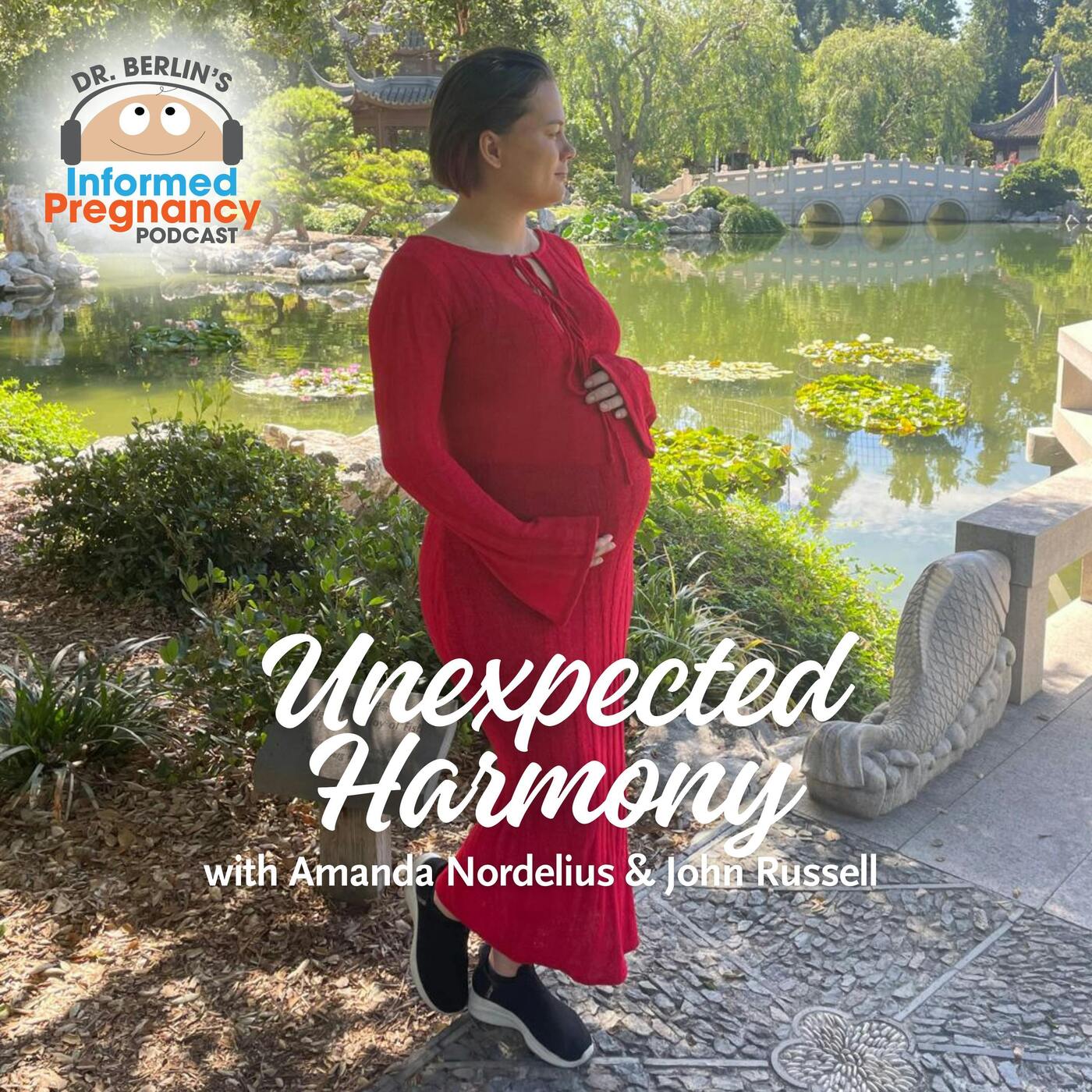
December 17, 2025 · 41 minutes · Episode 490
About this episode
International songwriting couple Amanda Nordelius and John Russell discuss their creative and home lives, including how they met on stage at Universal Studios and a surprising home breech birth.

Connect with the guests:
Grow with us on IP+! Informed Pregnancy Media presents two all new intimate short-form video series following Garrett and HeHe’s real-time pregnancy journeys as they prepare for an empowered birth and postpartum experience. Each episode features weekly updates with personal photos and videos to help bring these raw stories to life, a visually dynamic guide through each mother’s emotional and physical experiences.
Keep up with Dr. Berlin and Informed Pregnancy Media online!
Learn more about your ad choices. Visit megaphone.fm/adchoices
See Privacy Policy at https://art19.com/privacy and California Privacy Notice at https://art19.com/privacy#do-not-sell-my-info.
Key quotes
“And I think my piano knew every secret that I didn't tell anybody else. And it was my therapist and it was my best friend.”
“it doesn't have to be this way. It doesn't have to be a scary thing.”
“we felt the most peace we'd felt in the entire pregnancy.”
“depending on where I put my mind or how much I relaxed my body, the feeling of the contractions completely changed.”
“and we marched Amanda from the shower to our bedroom. She was coming out for her boxing entrance.”
Related episodes
- Ep. 495 Postpartum with Amanda Nordelius & John Russell
- Ep. 514 Before Baby #4 with Kara Sutton
- Ep. 500 The Unexpected with Dr. Elliot Berlin Part 1
- Ep. 493 In Conversation with Esther Friedman Schwartz
Transcript
AI-generated transcript with speaker labels — may contain errors, especially names and medical terms. Dr. Elliot Berlin, DC appears in blue; John Russell in orange; Amanda Nordelius in teal.
Download PDF of the Transcript
Dr. Elliot Berlin, DC [0:00] My guests today are an international songwriting couple splitting their time between Los Angeles and Stockholm. Together, they've built creative and family lives that blend two music cultures, two languages, and now two new parents' perspectives. They'll share how they met on stage at Universal Studios, what it's like collaborating in work and love, and the surprising turn their story takes with a home breach birth they hadn't planned for. I'm Pregnancy Focus chiropractor, Dr. Elliot Berlin, and you're listening to the Informed Pregnancy Podcast. Amanda Nordelius and John Russell, welcome to the podcast.
John Russell [0:50] Thank you. Thank you. Thanks for having us.
Dr. Elliot Berlin, DC [0:52] From Sweden.
John Russell [0:53] Yeah, all the way on the other side of the world right now.
Dr. Elliot Berlin, DC [0:56] I was just saying before, you guys have the best energy and I still feel it coming through the room as if you're in here with me.
John Russell [1:03] Thanks.
Dr. Elliot Berlin, DC [1:03] Even though the sun is coming up here and it must be going down there at the same time.
Amanda Nordelius [1:07] Well, the sun never really showed up here today.
John Russell [1:09] Yeah, that's true.
Dr. Elliot Berlin, DC [1:10] Oh, is it white night?
Amanda Nordelius [1:13] I mean, it's about three hours of light a day.
Dr. Elliot Berlin, DC [1:16] Oh, you just have dark all the time.
John Russell [1:18] Yeah.
Amanda Nordelius [1:18] We make up for it in the summer, but it's pretty rough in the winter.
Dr. Elliot Berlin, DC [1:22] Well, it's coming up over here so I can try to shine a little bit your way.
John Russell [1:27] Thank you.
Dr. Elliot Berlin, DC [1:28] We have so much to talk about. Let's start at the beginning with your background. John, you grew up in Detroit as a pastor's kid. What was that like?
John Russell [1:37] Oh gosh. Well, it's interesting. It has its definite pros and cons. I joke with people saying I was indoctrinated with religion from birth because my newborn baby picture, which is about me at 24 hours old, I'm holding a little Bible in my picture that says the little Bible.
Dr. Elliot Berlin, DC [2:00] Oh, Jesus.
John Russell [2:02] Exactly. Precisely. And so I had to navigate finding out what religion means to me and what God means to me on my own terms because you're just told this is what we believe and this is the thing to believe and this is what we do. And there's a lot of really deep concepts that are hard for a kid to understand.
Dr. Elliot Berlin, DC [2:28] Hard for adults to understand.
John Russell [2:30] Hard for adults to understand. So just kind of sifting through those and trying to keep the really good things that I learned and not keep the things that were holding me back, I would say.
Dr. Elliot Berlin, DC [2:41] Holding you back. So you're in music, you're a musician, but you considered law at some point. What was the journey like?
John Russell [2:51] That was kind of the plan was I wanted to be a lawyer. There was some sort of justice bone that I had that just couldn't let injustice pass me by without standing up and saying something about it. So it felt like that was a natural course, but –
Dr. Elliot Berlin, DC [3:06] Those seems like a biblical concept.
John Russell [3:08] Yeah, right. Exactly. I think so. I think it might've had something to do with that. But as I became a teenager and started feeling feelings, I decided songwriting and music was really where I felt the most passion and love.
Dr. Elliot Berlin, DC [3:25] At that point, did you have formal training?
John Russell [3:27] So not exactly. I grew up playing in church, which was honestly amazing training, especially when you're playing with gospel musicians who are some of the best in the world and you kind of just show up, maybe a guest shows up with music and they're just like, "All right, here's my set list. Learn how to play it now."
Dr. Elliot Berlin, DC [3:43] Wow.
John Russell [3:43] And so it's really great training process.
Dr. Elliot Berlin, DC [3:46] I feel like some incredibly soulful musicians start in church. They
John Russell [3:51] Do, yeah.
Dr. Elliot Berlin, DC [3:53] I had the opportunity to have a close relationship with John Legend, and I know he started in church as well.
John Russell [3:59] Yeah. Ironically, I also have a short relationship with John Legend.
Dr. Elliot Berlin, DC [4:03] Look at us.
John Russell [4:04] But yeah, he shared the same that he also –
Dr. Elliot Berlin, DC [4:07] Yeah, and you could hear it when he sings. You can feel that church energy come out of him.
John Russell [4:12] Exactly. Yeah. It's something really special about it. Undeniable.
Dr. Elliot Berlin, DC [4:16] So you do have that kind of musical background and then that took over your feelings for law?
John Russell [4:21] Yeah, it did. Yeah. I found that music and writing was how I processed life. And I think my piano knew every secret that I didn't tell anybody else. And it was my therapist and it was my best friend. And I think that I just learned, well, this is kind of how I want to live. I want to do this.
Dr. Elliot Berlin, DC [4:45] I don't want to make this about me, but…
John Russell [4:47] Please do.
Dr. Elliot Berlin, DC [4:49] My parents tried to get me piano lessons and I'm a little ADD and also I can play by ear. So anytime I could figure out how the melody was supposed to go, I would just play it and I couldn't look at those little squiggles and dots on the page anymore.
John Russell [5:04] Right.
Dr. Elliot Berlin, DC [5:04] No. So I could never really progress in my lessons, but I did do a lot of playing on my own and it was definitely my therapy. And I never thought about it the way you just said that about your piano, being the one who knows everything and helps you process.
John Russell [5:20] Yeah. We've got a lot of tears together.
Amanda Nordelius [5:23] Something with piano lessons that can be so boring for some reason. Classic little training with piano could be pretty challenging.
Dr. Elliot Berlin, DC [5:30] I should have gone to church.
John Russell [5:32] You should have gone to… Yeah,
Dr. Elliot Berlin, DC [5:35] Exactly. So Amanda, your story starts in a really different place, a small island life outside of Stockholm. And how did you get involved in songwriting also a musician?
Amanda Nordelius [5:45] I mean, it was just always a part of my life, I guess, just having music instruments at home. And I think Sweden as a culture, a lot of our TV shows here revolves around music in different ways, music competitions and songwriting competitions. And I think I just grew up loving music and art of all forms and just started to write, I think as a kid at six or seven years old and that was just always a part of my life.
Dr. Elliot Berlin, DC [6:17] Never considered law?
Amanda Nordelius [6:19] No, but I actually wanted to become an accountant for a while. And I think for me it was like, I'm just going to do music for fancies in my teenage years and then I will get serious. So a little similar to John. I had a different idea of a job and then I just got stuck and I never became an accountant.
Dr. Elliot Berlin, DC [6:38] Got stuck. So I mean, your career took off.
Amanda Nordelius [6:43] Yeah. And I do the admin for me and John for our company, so I guess I do get to do a little bit of that anyways.
Dr. Elliot Berlin, DC [6:48] Some accounting there too. How did you progress in your music career from writing songs at home in a small island to where it led?
Amanda Nordelius [7:01] Yeah, I mean, I went to songwriting school for a couple of years and then I became a part of this girl band in Sweden. And very long story short, we just ended up in Los Angeles with a management over there. And then I just stayed for about eight years or nine years.
John Russell [7:22] You just loved it so much.
Amanda Nordelius [7:23] I just loved it. It was just Los Angeles had a very different music scene at the time and Stockholm, there was no places to really play live. So it felt natural to move to a place where we could actually perform and just be sharing our music with people face to face.
Dr. Elliot Berlin, DC [7:41] I have two questions for you guys. Number one, I always wonder, lyrics first or melody first or does it not have to pick?
Amanda Nordelius [7:52] For me, it's melody for sure, but that's just me.
John Russell [7:55] I go both ways. So a lot of times when we're writing together or with other people, we'll go melody first and then fill in the lyrics. But a lot of times, sometimes a certain phrase will just evoke a certain melody in your brain, like Ain't No Sunshine When She's Gone. It just feels like that melody is the right way to sing those words. So it goes both ways for me. No, for sure.
Dr. Elliot Berlin, DC [8:22] I was afraid you were going to say that, so I'm not sure what to do when I get home tonight. Okay. The second question is, in your formative music years, did you have each of you inspirations that kind of inspired you?
Amanda Nordelius [8:37] I mean, there's so much. I don't even know where to begin. But I mean, I'm very inspired by, I think actually outside of music. I think I'm very inspired by modern art and I think that visual art really actually inspire me musically more than what music inspires me musically at times. I love to consume all the other art forms to be inspired musically. If I listen to music, I kind of feel overwhelmed. I'm like, no, I can't. I barely listen to music, which is a very strange trait.
John Russell [9:13] For a songwriter.
Amanda Nordelius [9:14] Yeah.
Dr. Elliot Berlin, DC [9:14] I almost never go to the chiropractor. Okay. And that's not true all the time.
John Russell [9:21] Yeah. I had a very rich, I would say, musical experience at home. We listened to a lot of Motown, obviously. We listened to a lot of great classics of Stevie Wonder, Aretha Franklin, Marvin Gaye.
Dr. Elliot Berlin, DC [9:37] Seemingly Bill Withers.
John Russell [9:39] Yeah, yeah, yeah. Exactly.
Dr. Elliot Berlin, DC [9:40] Sunshine.
John Russell [9:41] Yes. So that was a great foundation. As I got older, I was a bit of an emo kid in high school, so I love the rock scene and all of those things. And yeah, I feel like I have a very diverse palette that just kind of developed over the scope of my life. And now I put all of those things into one place, which is me, I suppose, which is the goal.
Dr. Elliot Berlin, DC [10:08] So you're both in Los Angeles and music kind of brings you together at Universal Studios. What's the story?
Amanda Nordelius [10:15] I mean, they had this program where you were a hired street performer basically, and we were both on the program, but you never play. Yeah, I guess you play at the same time, but at different spots. So even if you are playing at the same time, you don't really see each other because you're both playing. But then they had this anniversary show where everyone on the program came together and got to meet and hang out and play on the main stage at CityWalk. And we met in the green room for the first time. And we knew of each other, but we really met.
John Russell [10:51] I think it was after my set, before your set, and we met in the green room and it was love at first sight.
Amanda Nordelius [10:58] Yeah.
John Russell [10:58] I think you were eating pizza and lounging on your friend.
Amanda Nordelius [11:03] I love how you don't remember what I was wearing, but you remember what I was eating.
John Russell [11:06] Yes. You were wearing a really cool jacket. I do remember, as you were always super stylish. My crushes growing up were Cindy Lauper and Haley Williams. So Amanda was very much like that kind of alt girl, rock and roll.
Amanda Nordelius [11:26] I was very lucky that that was your preference.
John Russell [11:27] Funky style. I thought it was too emo for
Amanda Nordelius [11:32] Him.
John Russell [11:33] Also, we both thought each other were gay when we first met, so we didn't even know
Dr. Elliot Berlin, DC [11:38] That it was a possibility.
John Russell [11:39] This was going to develop into anything, but the spark was there regardless.
Amanda Nordelius [11:44] Yeah, it was. It truly was.
Dr. Elliot Berlin, DC [11:47] Yeah. Well, I think everyone should meet in a green room. It's so relaxing. What a great way to start a new journey. And then not too long ago, your journey took a turn towards parenthood. Why don't we take a quick break and we come back, we'll find out what that was like. Welcome back. We're talking to Amanda and John. Okay, so the green room is where everything starts for you guys. Turns out you're not gay and you like each other and you blend so many things together, including career. You start to work together, but then you somehow end up having a baby together. Was that a conscious choice to –
John Russell [14:04] It's hard to say. Yeah.
Amanda Nordelius [14:06] I think we had just been together for a month when we said we wanted to have kids for the first time. So it was very much a dream that had been with us for seven years. But I mean, I think we just both felt like we wanted to wait and the timing.
John Russell [14:23] It was a conscious choice to engage in intimacy and not have birth control. So it was also –
Amanda Nordelius [14:28] But we wanted the universe to decide.
John Russell [14:32] It was one of those things where it'll happen when it's meant to happen and it did. It happened at the perfect time.
Dr. Elliot Berlin, DC [14:38] Does not have birth control, meaning not even thinking about timing or things like that.
John Russell [14:44] We were tracking the timing actually.
Amanda Nordelius [14:48] Well, not after we decided to –
John Russell [14:50] The natural cycles?
Amanda Nordelius [14:52] Yeah, but we weren't tracking it in terms of this is the week, so we should be intimate this week. We were aware of my cycle over the years, but we weren't aiming, if that makes sense, to… I think that would've very much happened sooner or later. If we were trying and it wouldn't be successful, I think we would start to be more conscious about that. But it was also nice to just let the first year be kind of like… We didn't want to be too aware of it because it just felt freeing to not have to be.
John Russell [15:24] Yeah.
Dr. Elliot Berlin, DC [15:25] So how soon after you get together are you choosing to not prevent a pregnancy and how long after that until you're pregnant?
John Russell [15:35] Was it six years?
Amanda Nordelius [15:36] Yeah. Yeah.
John Russell [15:38] Yeah, six years. Five, six years.
Amanda Nordelius [15:39] Yeah. And then four months until we get pregnant.
John Russell [15:43] Yeah. Yeah. Pretty good.
Dr. Elliot Berlin, DC [15:45] Boom. What was it like finding out?
John Russell [15:49] It was so shocking. It was so strange because we had three pregnancy tests. They were all positive.
Dr. Elliot Berlin, DC [15:56] Nobody has one. I don't know why.
Amanda Nordelius [16:00] John was taking a nap. Well, it's this tricky thing with natural cycles where you're supposed to get your period a certain day, but if you don't get it that day, it moves till, "Oh, it's coming tomorrow." And if it doesn't show up that day, it will move again and be like, "Oh, it's coming tomorrow." So I looked at the app and every day when my period didn't show up, it said it's supposed to come tomorrow. So I though, "Oh, I must be going crazy. It's not supposed to come today. It' supposed to come tomorrow." It took me three days until I realized the app is just moving this little circle that says I'm getting my period, so my period is actually late.
[16:35] And that's what I was like, "Should go and get a pregnancy test."
John Russell [16:39] Or three.
Amanda Nordelius [16:39] Or three. And John was napping and I was like, "Is this when you should film this? Should we do a thing?" I mean, just for us, but then it feels kind of weird because if you're not pregnant, it just feels a little anti-climatic. So we were like, "How should we do this? This is the last second of our life that if we find out we're pregnant, this is the last time it will ever not be parents consciously, I guess.
John Russell [17:03] Yeah. When I saw the test, I looked at a man and I was like," So yeah, what does this mean?
Amanda Nordelius [17:08] "We even closed your family.
John Russell [17:10] All of a sudden now we're just pregnant. This is how this works. You just aren't pregnant and then you are? It was mind boggling that…
Amanda Nordelius [17:18] We called your family or your brother and my sister-in-law and we were like," What should we do? Should we view this as we are pregnant or should we wait a couple of weeks? "And they're like," You are pregnant. You should think that you are pregnant.
Dr. Elliot Berlin, DC [17:34] "Right. And here you are. Yeah. At that point, when you found out you were pregnant, did you have a vision on how you wanted pregnancy to be or how you wanted birth to be what you wanted to do or not do?
Amanda Nordelius [17:50] No, not at all.
John Russell [17:52] I think you –
Amanda Nordelius [17:53] At least on me.
John Russell [17:54] No. I don't know when, I guess those thoughts developed more, but I know there was just a little bit of an expectation of how things would go just because of your family history.
Dr. Elliot Berlin, DC [18:05] What's the family history?
Amanda Nordelius [18:07] Well, so it's just basically I was a C-section baby and my sister as well, and then my dad was, and John was. So I don't have a lot of, or at the time I did not have a lot of mom friends, so I didn't have a lot of experience or just knowledge about any other birth than C-section. So I think in a way I felt like that was how it was going to be for me too. It just felt like that's just the way. And in that way, I almost felt like I don't really need to educate myself on anything else. I mean, it was just such a natural thought that that's how it's going to be, so it didn't feel weird.
Dr. Elliot Berlin, DC [18:47] Were you all cesarean electively or were there specific reasons?
Amanda Nordelius [18:52] No, they were all…
John Russell [18:53] I was elected.
Amanda Nordelius [18:54] Oh, you were. Yeah, because you were the third.
Dr. Elliot Berlin, DC [18:57] Yeah. You were the third cesarean?
John Russell [18:59] Yeah.
Dr. Elliot Berlin, DC [18:59] That seems like a sort of… It could be an album.
Amanda Nordelius [19:06] A genius.
Dr. Elliot Berlin, DC [19:07] Oh, sorry.
John Russell [19:08] You're hired. You're a marketing guy.
Dr. Elliot Berlin, DC [19:11] Consulting on my side. Okay. Okay, so you were elected and then –
Amanda Nordelius [19:15] No, but I was breach.
Dr. Elliot Berlin, DC [19:16] Oh, you were breach. Oh, you were in Sweden? They don't do breach birth?
Amanda Nordelius [19:21] They do, but I was frank and also my water broke. I don't remember. I've asked about this so many times during my pregnancy.
Dr. Elliot Berlin, DC [19:31] I wouldn't expect you to remember.
Amanda Nordelius [19:33] But it is basically, it was an emergency C-section.
Dr. Elliot Berlin, DC [19:36] Oh, got it. You're still kind of frank.
Amanda Nordelius [19:40] Yeah, definitely. Oh, definitely.
Dr. Elliot Berlin, DC [19:42] It left an impression. Okay. So cesarean birth was not something foreign to you?
Amanda Nordelius [19:47] No, it was definitely not. And I think in general, I've been very scared and fearful around birth, both C-section and natural birth. I just thought it was a scary thing. I was a little scared about being pregnant. So I think a lot of it… I really knew I wanted kids, so I think I thought I'll just take it day by day, but I didn't necessarily want to maybe dream so much about it, and I just felt a little scary to do so.
Dr. Elliot Berlin, DC [20:14] I don't know if pregnancy changed you or you hide it really well, but by the time I met you were knee deep into pregnancy, you are exude badass confidence like I could do anything. So when you're talking about the fear of this, fear of that, I just would never have known.
Amanda Nordelius [20:33] No, I really changed. The third trimester completely changed me. We were in Sweden. I remember even the first trimester, my friend called me and she's like, "Do you have a doula yet? Do you have this? All the good ones go really fast." And I was like, "I don't even want to think about it." John booked all the, what do you call it? The Swedish brain here, the checkups, the ultrasounds, all those things John booked.
John Russell [21:02] Nobody had your number.
Amanda Nordelius [21:03] Nobody even had my number.
John Russell [21:04] I was talking to everyone on your behalf.
Amanda Nordelius [21:08] Yeah. People maybe thought we had a really strange dynamic in our relationship, but I really just didn't want to really… I don't know why it just made me very anxious. So John dealt with all of it. But then when we arrived in LA for my third trimester, in my guts, I just knew I wanted to have the baby in Los Angeles, and I felt like I would find the right people. And finally, third trimester, I was like, "I'm ready. Now I'm ready to actually be present, face this fear head on, find the right people, start to read the books, start to understand what birth is like." I was ready to get my fingers in the dirt, and I think that's when we met. I was just a different person in the third trimester.
Dr. Elliot Berlin, DC [21:50] I guess it's funny that you say head on, but we'll talk about that soon. So up until the third trimester, you're roughly in the back of your mind just planning to have a cesarean birth, just scheduled. What changed in the third trimester?
Amanda Nordelius [22:06] Well, so we met the doula that we decided to hire.
John Russell [22:10] Right. Our plan before that was we were with a group pregnancy situation, which was really awesome support, but their whole kind of care plan was like, "You come here every two weeks and then every one week in the third trimester and we'll do a little checkup and then we're going to send you to St. John's where you'll meet your doctor and then that's where you'll give birth." So it's like –
Dr. Elliot Berlin, DC [22:37] It's not the most common model here.
John Russell [22:40] Right. Yeah. So we told our doula about it and she was like, "So you're not going to have any sort of relationship with your doctor before you give birth?" "No, we don't know them. "She was like," That's a little weird in my opinion. I think you guys would really benefit from building a relationship and hopefully talking to a doctor about what options you have and them getting to know you to help your birth experience. "So she recommended a doctor. We took that first recommendation not knowing anything about the doctor, except for that they were recommended by our doula.
Amanda Nordelius [23:20] She recommended a few actually, but we just wanted –
John Russell [23:23] We just took the first recommendation.
Dr. Elliot Berlin, DC [23:25] Yeah. And so how did that change the vision?
Amanda Nordelius [23:30] I think it was just that doctor, as we were talking and I was sharing that I had my fear around birth, and she was just pointing out, she was just asking me very straight on," Why are you scared? What is scary about hospitals? What freaks you out about this? "And as I started to talk about it, she made me feel like… I mean, in a good way, she made me feel like… How do I say this the right way? She made me feel like it wasn't normal. Obviously, it's very normal to feel like I do, but she made me feel like it doesn't have to be this way. It doesn't have to be a scary thing. And maybe it's just whoever says it to you in the right time and place, but it just really, how she was approaching me was just speaking to a deeper part of me where I realized I just got perspective on my situation that I'm like," I'm just carrying this story.
[24:19] This is how it's going to go, and that's just it. "And something in our conversation made me realize that there might be another way, and maybe I should start to plan for that. And I'm there to dream about it, I guess.
Dr. Elliot Berlin, DC [24:33] Did you get excited about birth?
Amanda Nordelius [24:36] Yeah, I think I did. And I want to add too that I got a book about hypnobirthing from a friend in Sweden, and that also kind of sparked some kind of deeper earth woman in me. It felt like I was starting to connect with the physical body and process.
Dr. Elliot Berlin, DC [24:55] Okay, that's the Amanda I met.
Amanda Nordelius [24:57] Yes.
John Russell [24:57] Yeah.
Amanda Nordelius [24:59] I became a nerd kind of about it.
John Russell [25:01] But it made everything make sense. There was so much mystery wrapped around giving birth and what it would be like. It was kind of this cold medical procedure where you go to a place that you're supposed to go to when something's wrong with you to have a baby. So we had read through this book and it was talking about how birth is the most natural physiological process for humans to do. Your body is made for it, your body knows how to do it, your body needs to relax into it. It almost feels like labor is a misnomer at times because of how important it is for the body to be in a state of relaxation and peace and how important that is for oxytocin and everything to help the process along.
[25:48] So it really just… Everything started clicking, I think, after we started getting into that and like, "Oh, okay, this makes sense now." Nothing was really speaking to us before, and then that made everything make sense.
Amanda Nordelius [26:04] Yeah.
Dr. Elliot Berlin, DC [26:05] So it sounds like things were really changing for you in your perspective and from a fear of birth to an excitement about birth, and your plan for that scheduled C-section was going to change. I can't wait to hear what actually happened. We're going to take a quick break and we'll be right back.

Dr. Elliot Berlin, DC [26:28] Welcome back. We're talking to Amanda Nordelius and John Russell. Okay, so scheduled C-section changes. What was the vision, regardless of how it turned out, what was the vision after you had sort of met this new doctor and doula and had a change in perspective? What did the ideal birth look like for you at that point?
Amanda Nordelius [26:53] It was still a hospital birth. I think I had… When people shared home birth or birth center stories, there was something in me that was very curious and excited, but I didn't maybe listen to that voice because I thought that's for other people, not for us and definitely not for our first time birth. But very, very close or very soon we found out that our daughter was breech. So immediately I started to get kind of fearful again and felt like what are my options? Not actually knowing that in Sweden we do breach birth, ironically. I had left the country that actually do those things.
Dr. Elliot Berlin, DC [27:34] So I was a little surprised when you said you were born because of breach by cesarean, because Sweden's one of the places that still does it. Globally, there's not that much going on breach-wise.
Amanda Nordelius [27:45] Right. And we were just uneducated, so I didn't even know we did that until after birth when I told my family and they were like, "Sweden also do that. You know that, right?" But I still feel like I was supposed to find everyone on the journey that I was… You and amongst so many others that really helped us sculpt our birth story.
John Russell [28:09] The way that we met you, I think, is because the medical professionals and people we had on our team beside our doctor, I think everyone was trying to help us to get the baby to flip, to be head down. And so we did all the yoga poses. We did all the –
Amanda Nordelius [28:27] Spinning babies.
John Russell [28:28] All the exercises and everything.
Amanda Nordelius [28:31] I saw you. Sebastian.
John Russell [28:32] Yes. We came to Dr. Berlin.
Amanda Nordelius [28:36] Which was the best ever. I mean, regardless of spinning the baby or not, it was just the best treatment that I've ever received.
John Russell [28:44] Amazing.
Amanda Nordelius [28:44] Yeah.
Dr. Elliot Berlin, DC [28:45] Thank you. I'm so glad.
John Russell [28:47] And yeah, our little girl didn't want to flip.
Amanda Nordelius [28:51] I could sense that she didn't want to move.
John Russell [28:55] She's a rebellious alt girl like her mom. She wants to do things her way, and no matter what we did playing music or shining flashlights at the bottom of the womb or whatever, nothing was going to spin her around.
Dr. Elliot Berlin, DC [29:13] Well, I hope she came out wearing a cool jacket.
John Russell [29:17] She came out with a unique haircut, that's for sure.
Dr. Elliot Berlin, DC [29:19] Oh, that's awesome.
Amanda Nordelius [29:20] But yeah, so we had to start to dream about a possibility to do a natural birth breach, and we were just lucky that the doctor that we had hired was knowledgeable in that and experienced in that.
John Russell [29:34] I mean, it's crazy that we had basically no plan, and then we took the first recommendation for our doula. That doctor happened to be –
Amanda Nordelius [29:43] For a doctor, you mean?
John Russell [29:44] For the doctor. And that doctor happened to be maybe the only doctor in Southern California, or I don't know –
Dr. Elliot Berlin, DC [29:50] Still doesn't breach birth.
John Russell [29:51] I don't know how far that does breach birth and at home. And we had no idea when we hired the doctor.
Amanda Nordelius [29:57] And we also didn't know that our daughter was breech.
John Russell [30:00] So it was just like –
Amanda Nordelius [30:01] We were very lucky.
John Russell [30:02] The serendipity of everything falling into place was a miracle, honestly.
Amanda Nordelius [30:06] So we shared it with her. We said, "We have a breached baby. How do you feel about it?" And she was the only one who was like, "Okay, I mean, nothing has to change." She was just unbothered.
Dr. Elliot Berlin, DC [30:16] I know that you said during your postpartum phase, which we'll get to in a moment, you did watch a lot of Lord of the Rings, and this is sort of feeling like a photo one ring moment here, this journey, an episode. And how did the birth actually unfold?
Amanda Nordelius [30:30] So I had asked my doctor if I was allowed to choose in the moment of my birth, if I wanted to go to the hospital or stay at home. And she had said, yes, we can just feel it out. So to be sure, we had half of a birth kit at home in case. The day of the birth, we basically, we went to do a EVC.
Dr. Elliot Berlin, DC [30:53] ECV, external cell phone version.
Amanda Nordelius [30:56] Right. We went to do it, but when we arrived, we all realized or they realized that she was fixated and too far down. So they advised me against it. But because we were at the doctor's office, they were like, "Take this home birth kit home and then we're going to order a bigger one that arrives to the doorstep." And this was maybe 12 days before she was due.
John Russell [31:19] Yeah. And the strange thing was, was after the doctor said she's not going to flip, we felt the most peace we'd felt in the entire pregnancy. We went home that day and Amanda fell asleep, took a nap and looked like a graceful little angel sleeping on a cloud. She was so peaceful.
Amanda Nordelius [31:37] I think we had fully surrendered and accepted she is breached. It's going to happen. We are going to attempt a natural birth. It might be a home birth, it might be a hospital birth, but we're going to have this kid in case. And we just felt fully at peace to stop. We're not going to fight it anymore. We're just going to let it be this way. So yeah, I took a nap.
John Russell [31:56] I went out for a jog. Amanda got up from her nap and went and sat at the piano and played two chords.
Amanda Nordelius [32:04] And also I just want to add, I haven't played piano my entire pregnancy. This is the first time I'm like, I'm going to sit down and I'm going to write her song. It would be beautiful to write her something. And yeah, played two chords.
John Russell [32:16] Played two chords.
Dr. Elliot Berlin, DC [32:17] Are these major chords, minor chords? I'm trying to get a sense.
Amanda Nordelius [32:20] They were major. Good question. I was going for the Coldplay vibe, trying to write her something epic.
John Russell [32:27] But you played C and G and then your water
Amanda Nordelius [32:29] Broke.
John Russell [32:29] And then my water broke.
Amanda Nordelius [32:31] No,
Dr. Elliot Berlin, DC [32:32] I'm going to try to recommend that to my other clients who want to go into labor. The CG combination.
Amanda Nordelius [32:38] Forget about acupuncture. C and G. And I called John and I'm like, don't freak out, but my water just broke.
John Russell [32:47] So I sprinted home from the other side of the neighborhood. We immediately called our doctor.
Amanda Nordelius [32:53] And at that point we just knew, I mean we didn't even think twice. From that moment it was just going to be a home birth. Not once during the birth did I even think about the hospital. I didn't even consider it. It was just like we're home, it's going to be home.
Dr. Elliot Berlin, DC [33:08] Who was going to be there besides the two of you?
Amanda Nordelius [33:11] In that moment, I think I just felt very strongly that I just wanted to be alone with John. I think because I felt like the circumstances with the breach was so… I just felt like I really needed to just be on my own in a way. I mean obviously with the support of the doctor. So we decided last second to not go with the doula. It wasn't so much of a decision more than it was just not calling the doula and just doing birth alone, if that makes sense.
Dr. Elliot Berlin, DC [33:39] Sure.
Amanda Nordelius [33:41] Which felt like a crazy thing.
John Russell [33:43] It felt like a very Frodo and Sam in the third movie experience for sure. Just us two.
Dr. Elliot Berlin, DC [33:51] I mean,
Amanda Nordelius [33:51] I think it had some pros and cons. It was really nice to be just with John, but obviously there's certain positions that will, pain relief and stuff like that, that it would've been great to have that guidance. And I kind of had to figure that out on my own, but it was nice that it was just the two of us. So then yeah, it took about, I don't know, we slept through the night. I did all the hypnobirthing. I though I'm going to stick to hypnobirthing as long as I can and I don't think I'm going to make it all the way through, but I think I used it a lot in the first, the early labor. We were just doing affirmations, laying in bed and relaxing and using language like welcoming the surges and the waves.
John Russell [34:32] We watched the notebook.
Amanda Nordelius [34:33] Watched the notebook.
John Russell [34:34] Get the oxytocin flowing.
Amanda Nordelius [34:40] So the early labor was really nice, just very calm. And I think it was maybe about, I don't know how many hours, but 12 or 14 or something.
Dr. Elliot Berlin, DC [34:48] At what point does your doctor come over?
Amanda Nordelius [34:51] So she came over in the morning during early labor just to check the heart rate and stuff like that. I was also told if anything, we will go to the hospital, not when it's a red flag, but when it's a yellow flag, very early we will go. So I felt safe that if there's anything that feels off, we will leave immediately.
John Russell [35:12] She came back a few times that day and then –
Amanda Nordelius [35:14] I also had craniosacral therapy mid labor, which was really cool. It was actually one time in the session that I felt the contraction and it didn't feel painful at all. So there is actually pain free contractions. But I think that it was a very, overall, I think my strongest memory from birth is really depending on where I put my mind or how much I relaxed my body, the feeling of the contractions completely changed. The more I was fearful, tensed up, it was just so much more challenging. But when I was relaxing and welcoming, there was a lot of times it was really not painful and it was just cool how my mind and my body played such a huge part in that.
Dr. Elliot Berlin, DC [36:00] Amazing to be so consciously aware of that.
Amanda Nordelius [36:02] Yeah.
Dr. Elliot Berlin, DC [36:03] All right. So how did things turn out?
Amanda Nordelius [36:07] I mean the active labor in the shower –
John Russell [36:09] It was about two hours. The shower was a lifesaver.
Amanda Nordelius [36:12] Yeah.
John Russell [36:14] I was texting the doctor trying not to freak out because the doctor wasn't there yet and Amanda's contractions were two minutes apart.
Amanda Nordelius [36:21] Also, I had no clue. John timed it. I didn't ever know the time of it. I didn't want to be aware of time and space basically. So I didn't want to be like, oh, my contractions are slow and now they're fast. I knew I would get in my head about it. So I was just kind of present in my body and then John timed everything. So then in active labor, yeah you start to get a little freaked out because I was one minute apart.
John Russell [36:45] Yeah. No, I was cool as a cucumber on the surface, but yeah, I was a little nervous.
Dr. Elliot Berlin, DC [36:50] On the deep down inside.
John Russell [36:51] Yeah, exactly.
Amanda Nordelius [36:52] And at that point I was like, don't talk to me, don't touch me, but I want you to watch me. The moment he left the room, the contractions felt more uncomfortable and painful. So I was like, you have to be in the room, but don't stand in the
John Russell [37:03] Corner.
Dr. Elliot Berlin, DC [37:04] Fly on the wall.
Amanda Nordelius [37:06] Let me do my thing. And then I had this memory of a woman who had been on all fours from my Instagram. So I was like, maybe that's something I should try. So at the end of the active labor, I was just on all fours in the shower. I just had to go in a deeper and deeper squat it felt like for every contraction. I remember the knees on the tile in the shower, that was half of the challenge. I was like, I'm happy I've done some Pilates in my life.
Dr. Elliot Berlin, DC [37:33] So eventually your doctor does come.
John Russell [37:35] The doctor came right in the nick of time, the calvary coming over the hill and we marched Amanda from the shower to our bedroom. She was coming out for her boxing entrance.
Amanda Nordelius [37:52] And we meet three midwives that we've never met before.
John Russell [37:54] We met three midwives we hadn't met and our doctor and you –
Amanda Nordelius [38:01] Just jump on the bed.
John Russell [38:02] Started pushing.
Amanda Nordelius [38:04] Since it's breached, you can't do water birth obviously, or at least according to our knowledge, you have to do it on the bed.
John Russell [38:14] And you didn't know how to push because how can you know how to push? But you instinctually did kind of know and eventually figured it out and I think it was 16 minutes.
Amanda Nordelius [38:24] Yeah, it was a very intentional training.
John Russell [38:26] Yeah.
Dr. Elliot Berlin, DC [38:27] Wow.
Amanda Nordelius [38:27] There was no rest period, which I don't know. We heard also with breach, the pushing part is faster.
Dr. Elliot Berlin, DC [38:35] And the booty came out first?
Amanda Nordelius [38:37] Yeah. The booty came out first.
Dr. Elliot Berlin, DC [38:41] It's always a little interesting to watch a baby kind of back out of the parking space.
John Russell [38:44] It's so cute.
Amanda Nordelius [38:46] Yeah. So I was hugging John actually, so you didn't see it, but we have the birth video. It's very cute.
Dr. Elliot Berlin, DC [38:53] Yeah. Well, that is a total shift, if I've ever seen one, a 180. Did you ever finish the song by the way?
Amanda Nordelius [39:02] No. I still have to do that. She interrupted me mid-session. What is that?
Dr. Elliot Berlin, DC [39:06] I can't believe it. Just right when you're getting into the second chord, the water breaks.
Amanda Nordelius [39:10] Can I add that I think it was 20 minutes after she was born, our birth kit arrives at our Georgetown?
Dr. Elliot Berlin, DC [39:19] Well, I'm a little musical, but one thing I'm bad at is timing and the birth kit coming 20F, that's kind of my song.
John Russell [39:26] That's amazing.
Amanda Nordelius [39:28] I mean, it was still 12 days early. Didn't know if she would arrive early, but just a little too late.
Dr. Elliot Berlin, DC [39:35] You guys are a really lovely couple. Each individual has a great energy and together you have this even greater energy. And I really appreciate you coming and sharing that incredible journey and birth story. And what I would love to do is really talk about what happens next because as smooth, as incredible as that birth story was, it doesn't always stay smooth right away. And postpartum is, no matter how it goes, kind of rocky terrain, I think. And so I would love to learn more about how you navigated that and what the experience has been like. And you've been gracious enough to agree to come back for a second episode on postpartum, which I'm really looking forward to.
[40:22] Thank you so much for coming and joining me today and joining our audience today and sharing your story. Before we go from this episode, where can we find you guys online?
John Russell [40:34] Thank you, by the way. You could go to gluten-freemusic. com. That's basically our portfolio as you can see the work that we've done.
Dr. Elliot Berlin, DC [40:43] I love that for celiac music.
John Russell [40:49] Yeah, glutenfreemusic. com with a dash, gluten-free. Or yeah, I guess you can find our Instagrams as well. We always post things and sing some songs every once in a while on there.
Dr. Elliot Berlin, DC [40:59] Are they at your names?
John Russell [41:02] Yes. @johnshyrussell. So S-H-Y.
Amanda Nordelius [41:06] And Amanda. Nardelius.
Dr. Elliot Berlin, DC [41:09] A dot?
Amanda Nordelius [41:09] Yes.
Dr. Elliot Berlin, DC [41:09] Amanda. Nardelius. Amanda. Nardelius. gluten-free. I love it. Thank you again for joining us and at home. Thanks for listening to the Informed Pregnancy Podcast for more pregnancy and parenting information just like this. Visit us online at informedpregnancy. com and don't forget to tune in probably a few weeks down the road for part two, the postpartum journey.
Want more pregnancy + parenting? Start your FREE TRIAL of Informed Pregnancy+ and get access to all our curated pregnancy and parenting content — original series, iconic birth films like The Business of Being Born, prenatal workouts and more.
