by Informed Pregnancy and Parenting Project | Mar 14, 2023 | Health Conditions, Labor and Delivery, Podcast Transcripts
Elliot: Welcome to the Informed Pregnancy and Parenting Podcast. I am your host, pregnancy-focused chiropractor, Dr. Elliot Berlin.
You’ve tuned into the after episode of about before and after birth story. My guest today is from northern Italy. She’s a muralist and sign painter. Her first pregnancy went well. But after the birth, she started to feel some awful tailbone pain. Turns out it was broken. She just had her second baby, and we’re going to see how the pregnancy and birth differed. Valentina Trentini, welcome back to the podcast.
Valentina: Thank you for having me.
Elliot: Congratulations!
Valentina: Thank you!
Elliot: All right. So, we talked a bit in the first episode about all sorts of things. How you met your husband, that you didn’t like him. But then, you met him again, and you did like him, and you had babies together. Your first pregnancy, and your birth and how afterwards. If I remember correctly, you said you injured your tailbone during a snowboarding competition first.
Valentina: Yes, when I was 18.
Elliot: When you’re 18. And then, after you gave birth, it felt similar but nobody believed you.
Valentina: Yes, correct. Absolutely. It was horrible.
Elliot: Eventually, eight months of recovery later, you finally started to feel like yourself again after seeing an Italian osteopath.
Valentina: Yeah, absolutely. After like three sessions with her, it went back in place and the pain went away. Thank goodness. Because it was almost eight months of pain.
Elliot: It was such a critical eight months trying to take care of your newborn.
Valentina: Yeah. The first eight months, it was really terrible. I wouldn’t go back in time again and do that all over again.
Elliot: And even though you’re one of the world’s nicest people, and we need more of you, the planet made it difficult for you to have your next baby.
Valentina: Yes. I lost three babies between my older daughter and my current daughter. It was not fun. I went through a lot of pain and a lot of anxiety. I was really discouraged, but everything turned out fine. Thank goodness. I was really lucky.
Elliot: I mean, if you were finally doing IVF, and then right before you went in for your injections, you found out you were pregnant.
Valentina: Right the day before.
Elliot: Yeah.
Valentina: The day before I found out I was pregnant. I took two different tests to make sure that I was really pregnant.
Elliot: In your case, I probably would have taken 20. In your fertility testing, did anything ever come up as a reason why too much [unin 02:58] pregnancy?
Valentina: Absolutely not. Both me and my husband were completely fine. Nothing happened. Nothing at all. We were completely normal. And we never had a single problem. Even the fertility doctor was like, “I have no idea why you’re having these recurring miscarriages. But it’s kind of let’s say normal at your age because you’re past 35. And it can be kind of normal.” Nothing came up.
Elliot: During your pregnancy, understandably, you had some anxiousness, some fears. Did you have those in your first pregnancy?
Valentina: No. My first pregnancy, I was super chill. I was never anxious. I never had a single doubt. Like even with that doctor at the beginning told me, “Oh, you’re pregnant,” and was four weeks pregnant what he told me when we found out. He was like, “Well, we need to wait until eight weeks, we’re going to talk. And in four weeks, if something happens, it’s kind of normal.” I was like, “What can happen? Nothing is going to happen.” In my mind, I was like, “Well, I’m pregnant. I want to have a baby and it’s going to be done.”
Elliot: It’s going to happen.
Valentina: Yeah.
Elliot: So, this anxiousness that started to kick in, was that related to what?
Valentina: Well, at the beginning, I was anxious that I was going to have a miscarriage early. In the middle of it, I was anxious that my baby would have had a brain damage. And toward the end, I was anxious that I would have had a stillbirth. I think that when my brain started to understand that everything was going well, my brain was finding something wrong. Because I think that the pain that I went through with the three miscarriages was too much for me that my brain was trying to like put me in a safe place and be like, “Okay. Something is going to happen. You need to be prepared if something is going to happen.”
Elliot: Expect the worst.
Valentina: Yeah.
Elliot: Literally. I guess during pregnancy would say expecting the worst.
Valentina: Yeah.
Elliot: How did you deal with that anxiousness during the pregnancy?
Valentina: I did a lot of therapy. I was seeing my therapist every week. I was doing with you, a lot of sessions. And I was doing acupuncture, and I was doing a lot of physical exercises because I was trying to release all the stress and all the anxiousness. But it never went away. It was always in the back of my mind and my head. I was dealing with it. Like, living with it. Living with the fear, that living with the anxiousness, living with all these horrible feelings that I was trying to be happy and enjoy the pregnancy. Now, looking back at my pregnancy, everything was perfect. I never had a single problem. But it was a very hard nine months. I felt like I was holding my breath for nine months. That’s what I was feeling.
Elliot: You’re also concerned about that tailbone.
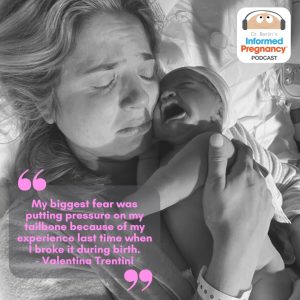
Valentina: Yeah. That was one of my biggest fear. At a certain point, I started to ask my doctor if I should have had a C-section instead of vaginal birth. Because I was like, “Maybe I have less chance of breaking my tailbone with a C-section.” My doctor is amazing. He was like, “Let me talk to a specialist that is a good friend of mine and ask him what you should do.” And even the specialist was like, “I will not do it if I were you.” My doctor was like, “I would not recommend that you have a C-section. Because yes, you’re going to recover in two months instead of eight.” But at the same time, it’s still like a major surgery. It’s still like something that your body is going to have to go through, and there can be complications, and you never know.
Elliot: And, of course, there’s a chance that your tailbone wouldn’t break.
Valentina: Yeah.
Elliot: All right. How was the very end of your pregnancy?
Valentina: The very end of my pregnancy was — I was still very anxious. But, actually, I started to feel a little bit more at peace. Because I was just counting the days. I was still thinking, “Oh, my God. I’m going to break my tailbone. I’m going to be in pain for so long.” But, at the same time, I was like, “Okay. We’re very close to giving birth. The baby’s still fine. She still kicks.” It was a mix of feelings. I was in a glass of emotions.
Elliot: When in the 40-week count there, and how did your labor start?
Valentina: The labor started when I was 39 weeks, 38 or 39? I think 39, yeah. Because I was six days early. I didn’t sleep that well the night before. My husband had a sore throat. He kept me up all night, and I was like, “Well, great. I cannot sleep.” Then I kind of like woke up at 7 a.m. I was like, “Something is like hurting.” I was like, “Oh, maybe it’s a contraction.” I started to time them, and I was like, “Oh, yeah. I’m having contractions.” I called my sister-in-law. She came from Oregon to help me and be in the room with me. I was like, “Okay. I think it’s time.” I told my husband and he was like, “Well, it’s 7 a.m. I need to go to work. Do I have a couple of hours?”
Elliot: Oh, wow!
Valentina: I was like, “No more. Not more than a couple of hours.” So, then, I called him at 9:30. I was like, “Why! They’re three minutes apart. I think it’s better if you come home right now.”
Elliot: Wow! Three minutes apart.
Valentina: Yeah. Let’s say, three to four minutes. Most of the time, there were three minutes apart.
Elliot: Also, what did they feel like?
Valentina: It was weird. Because with my first pregnancy, I was at home for seven hours and I just remember the worst part, the painful, painful part. This time, it was not bad. I was like, “Wow! This is actually not painful. So, I can do everything without an epidural. Like, this is easy.” I started to feel like contractions in my back, and I think that the adrenaline kicked in. I was just so happy. I wasn’t in that much pain.
Elliot: You were home with your sister-in-law?
Valentina: I was home with my sister-in-law, with my mother-in-law, with my niece and nephew, and my daughter.
Elliot: Oh, my goodness. It’s a big crowd of [unin 09:23].
Valentina: Everybody was around?
Elliot: Yes. And then, I was like, “Well, I looked at my daughter.” I was like, “Mimi, mommy is going away for two days. I’m coming back, and I’ll bring you a sister.” She was like, “Okay, mommy. I’m going to see you in two days.” I was like, “Okay.”
Elliot: She’s 4 years old?
Valentina: She’s 4.5, yes.
Elliot: Okay. So, she understands?
Valentina: Oh, yeah. She fully understands, big time.
Elliot: Well, let’s take a quick break. When we come back, we’ll find out what happens when you head to the hospital. We’ll be right back.
[break]
Elliot: Welcome back to the Informed Pregnancy Podcast. We’re talking to Valentina Trentini. She is in our story now in labor, a long journey to get there, and a lot of heartache and anxiousness going into it. But labor starts. Surrounded by a lot of family, except for your husband, who’s at work, and it’s not too intense. And you decide though to go to the hospital. Is that because the pattern changed?
Valentina: Because my doctor was like, “When you’re like less than five minutes apart, just come to the hospital. Just don’t stay home. We’re going to check. And then, if you need to go back home, we’re going to send you back home. If not, we’re just going to keep you here.” But the good thing is that I got there, I opened the door of the room where you check-in, and my doctor was there. It was the day that he was on call.
Elliot: Oh, wow. How nice.
Valentina: Yeah. I was the happiest person. It was amazing because a week before, he told me like, “Well, if you give birth on Friday or on Monday, that’s when I’m on call.” Actually, I went into labor on Friday. So, I got there. He checked on me. He was like, “Well, you’re 3 centimeters dilated. Usually, we keep you in the hospital at 4 to 5. But, I know you. I know you know your body. So, if you tell me that you prefer to stay here, I’m going to keep you here.” I was like, “I think that it’s changing really fast.” He was like, “Okay. Stay here.”
Elliot: Three centimeters. I mean, how was that news to you? Is that what you expected?
Valentina: No. I thought that I was more than that. But I was like, “Something is changing so fast.” The contractions are going so fast, and they’re more intense now that I was like, “Oh, I’m going to dilate faster than everyone thinks.” Actually, less than an hour later, I was at 5.5.
Elliot: [unin 11:55] quick.
Valentina: Yeah. I was screaming, and everyone got into the room. They were like, “Are you giving birth right now?” I was like, “No. Just in a lot of pain.”
Elliot: Okay. But your husband’s with you now?
Valentina: Yes. My husband was with me.
Elliot: Anybody else with you?
Valentina: I mean, his sister?
Elliot: Oh, your sister-in-law came also.
Valentina: Yes.
Elliot: Okay.
Valentina: The two of them.
Elliot: All right. When it got a lot more intense, do you remember where you felt it, and what about it was more intense?
Valentina: Actually, I was in the room, in the waiting room. I don’t know how you call it in English, but it’s like the room —
Elliot: Triage.
Valentina: Yeah. Triage, thank you. That one. When I was in the triage, the contraction started to get closer and closer together and very, very intense. But the thing is they had to put the monitor on my belly, and they had to monitor the baby for 20 minutes in a row. They didn’t tell me, so I kept moving because I was in a lot of pain.
Elliot: Restarting the count?
Valentina: Yes. So, every time, they were like, “No. We have to redo it. We have to redo it.” I was like, “No!” I was like, “Give me an epidural. I can’t deal with this anymore. I need an epidural right now.” And so, they put me in the room. And within an hour, they gave me an epidural. Thank goodness. I was in heaven. I was so happy. So, so happy.
Elliot: Did the first time you tell me the epidural slowed everything down for you?
Valentina: Yes. That’s what I think happened the first time. My doctor thinks that that was not the epidural. Because the epidural actually accelerated everything.
Elliot: Yeah. Speed things up.
Valentina: But I think that the first time the fact that my body was in shock. I was in so much pain, and my body just shut down. My body was like, “I can’t deal with this anymore. You need to relax. You need to rest for a little bit, and then we can continue to do this.” So, this time actually, the epidural, I was like 5.5, 6 when I got the epidural. And then, within like a couple of hours, I was already at 8. Everything was going perfectly.
Elliot: Fast-moving train.
Valentina: Yeah.
Elliot: Now, at this point, is there any of that anxiousness, or you feel calm? Is there any concern, talk about how to protect your tailbone for what’s coming next?
Valentina: At that point, I started to like see all the nurses coming in. All the nurses. The two nurses that I was assigned to, and the midwife, and my doctor. We all talked about, “Okay. Last time, I broke my tailbone. What can we do for this not to happen again?” The nurses were incredible. They were seriously amazing. They were all super understanding. They were like, “Okay. When it’s time to push, you’re going to push on your side, and you’re going to push on your hands and knees. We’re going to try to like not put any pressure on your tailbone.”
Elliot: Nice.
Valentina: That was my biggest fear, and I told them. They were seriously very understanding, and they were very sweet with me. To the point that I was talking to the nurse because she was asking me the questions, routine questions. She asked me, “Are you anxious, or any bad thoughts that you had during the pregnancy?” I was like, “Well, I’m scared that I’m going to have a stillbirth. But, you know, that’s me.” I try to put make a joke about it because I was kind of uncomfortable. Because every time that you tried to tell something like this to someone, they are very uncomfortable with you saying that.
Elliot: Sure.
Valentina: And she stopped. She walked around the bed because I was on my right side, and she was behind me. She looked at me in the eyes and she was like, “This is a different pregnancy. Nothing is going to happen to you. I’m here for you. Anything you need, you tell me. I’m here for you.”
It was the first time in almost two years that someone in the medical field really talked to me on a human level. And really made me feel comfortable. She was listening to me. She didn’t just say like, “Oh, yeah. You know, it’s fine. Everyone thinks that.” Or like she really thought that something was wrong, and she needed to tell me that she was there for me. It was amazing actually. And so, that really calmed me down. Then my doctor came in. It was like around 2 p.m. He was like, “Well, I don’t have any nurse right now to be with me, like to start to push, and I have two emergency C-section.”
Elliot: Oh, my goodness!
Valentina: Yeah. He was like, “Would you be comfortable to wait a little bit?” I was like, “I am on vacation. I have my epidural. I am not in pain. I have my bed. Don’t even worry about it. Do what you have to do, and come back when. If it’s time, I’m going to let you know.” And then, at 5 p.m., I was ready. And then, at 5:30, we started to push. I actually pushed on my side. And like last time, the pushing part was amazing. I felt empowered. I felt strong. I felt like, “Oh, my God! I can do this. This is really what I’m good at.”
Elliot: You’re a pusher.
Valentina: Yeah, I’m a pusher.
Elliot: Because of the epidural, how much could you feel or not feel?
Valentina: I felt everything.
Elliot: Did they deliberately turn it down?
Valentina: No. Because with Kaiser, they give you the remote so you can push the button and give yourself as much epidural as you want. But after a certain point, they tell you, “Okay. You’re almost there. You cannot push the button anymore. No more epidural because we need you to feel a little bit.”
Elliot: Yeah. You felt a lot.
Valentina: I felt a lot. Actually, when I was on my side, I was feeling more. So, she wanted me to go on my hands and knees because the baby wasn’t turned in an ideal position. The nurse, actually, she was amazing because she asked my husband and his sister to be on both sides. And then, you have this blanket and to wrap this blanket on my belly.
Elliot: A rebozo.
Valentina: Yes. She was like, “I saw this midwife doing it to another patient. Let’s see if this works with you.” They rub my belly for like, I would say five minutes. Something like that. And the baby turned. She was like, “Great. The baby just turned. You can be on your back, and then we can push her out.”
Elliot: Oh, wait a second. Did you feel the baby turn?
Valentina: I don’t remember that.
Elliot: Okay.
Valentina: I was like so in the moment that I don’t know if I felt a baby turn.
Elliot: Two more questions. One is because you said you could feel a lot with the epidural kind of wearing off. What sensations did you feel?
Valentina: Pain. Pain on my right side. Because she was pushing on my right side.
Elliot: Oh, like in your right hip?
Valentina: Yeah. The right hip, back, and a little bit in the front was where I was feeling it the most.
Elliot: That’s interesting. Because in pregnancy, you kind of had some discomfort there.
Valentina: Yeah, that’s true.
Elliot: Okay. So, then, the baby rotated into a better position. Do you still feel the pain at that point? And also, is it only with a contraction or you feel it all the time?
Valentina: I was feeling it all the time. But I knew that she was so close to coming out that it wasn’t a problem. And then, actually, when I was on my back, I thought that the nurse was giving me a perineal massage. I almost told her, “No massage. I don’t want that massage.” And I saw her that she wasn’t even close to me. I was like, “Oh, that’s the baby’s head.”
Elliot: The baby gave you a perineal massage.
Valentina: Yeah. The best part was that my sister-in-law told me, “Oh, I see some eyes. Oh, I see a chin. Oh, I see some shoulders.” And when she was telling me that, I was feeling everything. I was feeling the shoulders coming out. I was feeling everything coming out. It was like, with my daughter, I wasn’t feeling that, with my first daughter. That was incredible. I was like, “This is amazing!” It was seriously the most amazing feeling in the world.
Elliot: Wow, that’s great! A lot of people talk about burning during that time. Did you not feel burning?
Valentina: No. I felt a lot of pressure because her head was halfway out, and they kept her there for what felt an eternity. But, for sure, it was a few seconds. But, when she was coming out, I wasn’t feeling pain or burning sensation, nothing. I was just feeling her coming out.
Elliot: Literally, her body parts coming through you into the world.
Valentina: Yeah. And then, when they put her on me, I just asked everyone if she’s breathing, is she alive. “Is she breathing? Is she alive?” That’s what I was asking everyone.
Elliot: I mean, emotionally, how did that feel? When they put her on your chest and you were there, and she was healthy.
Valentina: I felt like a giant rock that was not on my shoulders anymore. I felt light. I felt this relieved. I felt that I could breathe. I remember that I was breathing, like deeply breathing. I was like, “Okay, she’s here. It’s done. It wasn’t that bad.” My head did everything. I was just relieved. I was seriously relieved and happy that I could breathe.
Elliot: All right. Let’s take one more break. When we come back, I have a few more questions about what happens next in the moment and after you get home. We’ll be right back.
[break]
Elliot: Welcome back to the Informed Pregnancy Podcast. We’re talking to Valentina Trentini.
Okay. A long, long road to get to that beautiful finish line. It sounds like a really gorgeous finish line for you. And also, sounds like the weight that had been sitting on you for nine months, on your shoulders, released as soon as the weight’s sitting on your pelvis is also released. You talked about how during pregnancy, the game plan was to sort of be on your side or all fours. But it sounds like when you actually push the baby out, you were on your back.
Valentina: Yeah.
Elliot: Was there a conscious change in choice?
Valentina: No. At that point, I was in the hands of the nurse and the doctor. I was just trusting them. Because they won my trust, and I was like very comfortable with them. The nurse was like, “Don’t worry. Even if you push, the last push is like on your back, everything is going to be fine. Nothing is going to happen to your tailbone. I promise you, we’re going to do everything we can for you not to be in pain anymore.” So, I just trusted them.
I think that I was feeling that everything was right. Because I could feel more than with my first daughter. I think that my body knew what was going on, and I knew what I was doing. That’s why I was like, “Okay. You want me on my back, I’m just going to be on my back.”
Elliot: Nice. How is your placenta delivery?
Valentina: It was fine. Even with my first daughter, it came out right after. They didn’t have to do anything. I didn’t even get any stitch. No stitching. Nothing.
Elliot: No tearing?
Valentina: Nothing. It was clean, perfect.
Elliot: Were you worried about what would happen on the epidural totally wore off?
Valentina: Yes, absolutely. When I started to feel way more. When I started to feel my legs again, I was like, “Oh, my God. Is everything fine? Am I in pain? No, I’m not in pain.” So, that’s great. Actually, they wanted to give me Motrin, the painkiller, for the pain. I didn’t even take it. I was not in pain. I was happy that I was not in pain. Very happy.
Elliot: Okay. So, no tailbone injury.
Valentina: Nope. Thank goodness, nope.
Elliot: All that worry.
Valentina: For no reason.
Elliot: And like you said, I think it was your nervous system trying to protect you.
Valentina: Yeah. I think that your mind is so powerful. I was in so much pain during the miscarriages. Three miscarriages in a year, it’s a lot for anyone.
Elliot: Yeah. I mean, one is scary.
Valentina: Yeah. The problem is that not being able to talk to anyone, and not being able to have a lot of support. Yeah. I had my therapist, and I had you, and my acupuncturist. But, other than that, none of my friends had to go through that. None of them. So, it can feel lonely. That’s why I think that my mind was like, “Okay. Let’s have a plan for the second pregnancy. Let’s find something that for sure it’s going to be wrong. Believe that it’s going to be wrong. So, then, if it’s going to be wrong, you’re going to be protected.”
Even if something goes wrong, it’s not that because you’re prepared it’s going to be less painful. Actually, it’s even worse. I was telling myself during my miscarriages, “See, I told you. You should have prepared yourself for like the worst. So, then when the worst was coming, you could have been prepared and not be in pain.” But then, you’re in so much pain anyway, and it’s really bad.
Elliot: Well, I’m sorry that you had all that pain and suffering, emotionally and physically. I can only imagine how much more you are excited to hug your little baby and to hear those cries, 24/7, whenever they happen. Just squeeze a little harder. How is postpartum and the house, having a toddler and a newborn at the same time?
Valentina: Well, it’s very hard. I think that she’d never prepare for this. I’m very lucky because my daughter, she’s 4.5 and she understands everything that is going on. Actually, she’s not really jealous about her sister. Actually, she’s super happy. She wants to cuddle her, and kiss her, and be with her all the time. But still, she’s still a toddler and she still wants my attention. And a newborn requires a lot of attention.
So, I have help. I’m really lucky that I have help. With my first daughter, I didn’t have anyone. I was home alone with her, and it was very, very hard. I promised myself that if I would have another daughter, another child, I would ask for help, which is the most important thing right now for me. Yeah, it’s great. It’s actually everything I wanted. It’s very tiring. It’s very hard. But I’m very happy. She’s here. Then, everything went well, and the pain is gone. That’s what I’m happy for.
Elliot: So, happy to hear that. What are you doing for your self-care now in the postpartum phase?
Valentina: I take long walks, which is what I really needed the most. I work in my studio, which is very relaxing. That’s my space. That’s my time. Nobody comes in my studio. I paint and I relax. For me now, that this is working and it’s the most important thing for me right now. I’m going to go back to therapy, for sure. Because I really need it. Because I think that the trauma is still there. I really need to deal with it, even if I’m feeling good.
Elliot: Sure.
Valentina: Yeah, painting is what makes me feel happy and relaxes me. So, that’s what I’m doing right now.
Elliot: I’m going to get paid for it.
Valentina: Yeah. Not bad.
Elliot: Are you still back to hanging off at bridges, and ropes, and things painting giant murals and banners?
Valentina: Well, now, no. Not yet. But now, I’m going to paint a couple of vintage cars. A couple of Porsche. I’m going to — what do I have again? I have another, some coffee shops, and some gold signs that I have to paint, which is very awesome. I love painting that stuff.
Elliot: I guess, my last question for you is does your family feel complete now, or do you see yourself expanding again in the future?
Valentina: That’s a good question. I’ve always wanted to have three kids, with my husband. When I met my husband, I was like, “I’m sure I want three kids with him.” I think that now, my family feels complete. I don’t know if I want to go through pregnancy again. Because it took a big toll on my mental health. For now, I’m fine. For now, I have two beautiful daughters and I couldn’t be happier. I don’t know. Maybe in six months, I’m going to tell you, “Well, I want to have another kid.” But I don’t think so. I think that holding my breath for nine months was enough for me.
Elliot: Yeah.
Valentina: To say, “No, I don’t want to go through that again.” Never say never, but that’s what I feel right now. I don’t think that that’s my path.
Elliot: Yeah. I mean, it’s good that you feel associated, but that also that you have an open mind. So, nothing’s final.
Valentina: Yeah. Nothing is written in stone. But I told my husband, “If you want another kid, maybe we’ll get a dog.” Maybe the dog is going to complete the family. I don’t know. We’ll figure it out. But I think that for now, we’re fine. We’re happy. It’s a happy ending. It was a very horrible story that has a happy ending, and I’m very lucky and very grateful that I can say that.
Elliot: I’m so happy for you. You’re the nicest person and very passionate. Every time I talk to you, I get hungry for pasta and pizza.
Valentina: Me, too, actually.
Elliot: Valentina, thanks so much for joining me and for sharing your story. Tell us again where we can find you online.
Valentina: You can find me @brushettasigns on Instagram, and brushettasigns.com. If you want to see my signs, and my murals, and my art, you can go there and I share everything. Every week, there is a different project.
Elliot: I can’t wait to go take a peek. I’ll see you there. At home, thanks for listening to our podcast. If you want more content like this, I would go to informedpregnancy.com.






 Hayley Oakes is a licensed midwife based in Los Angeles offering