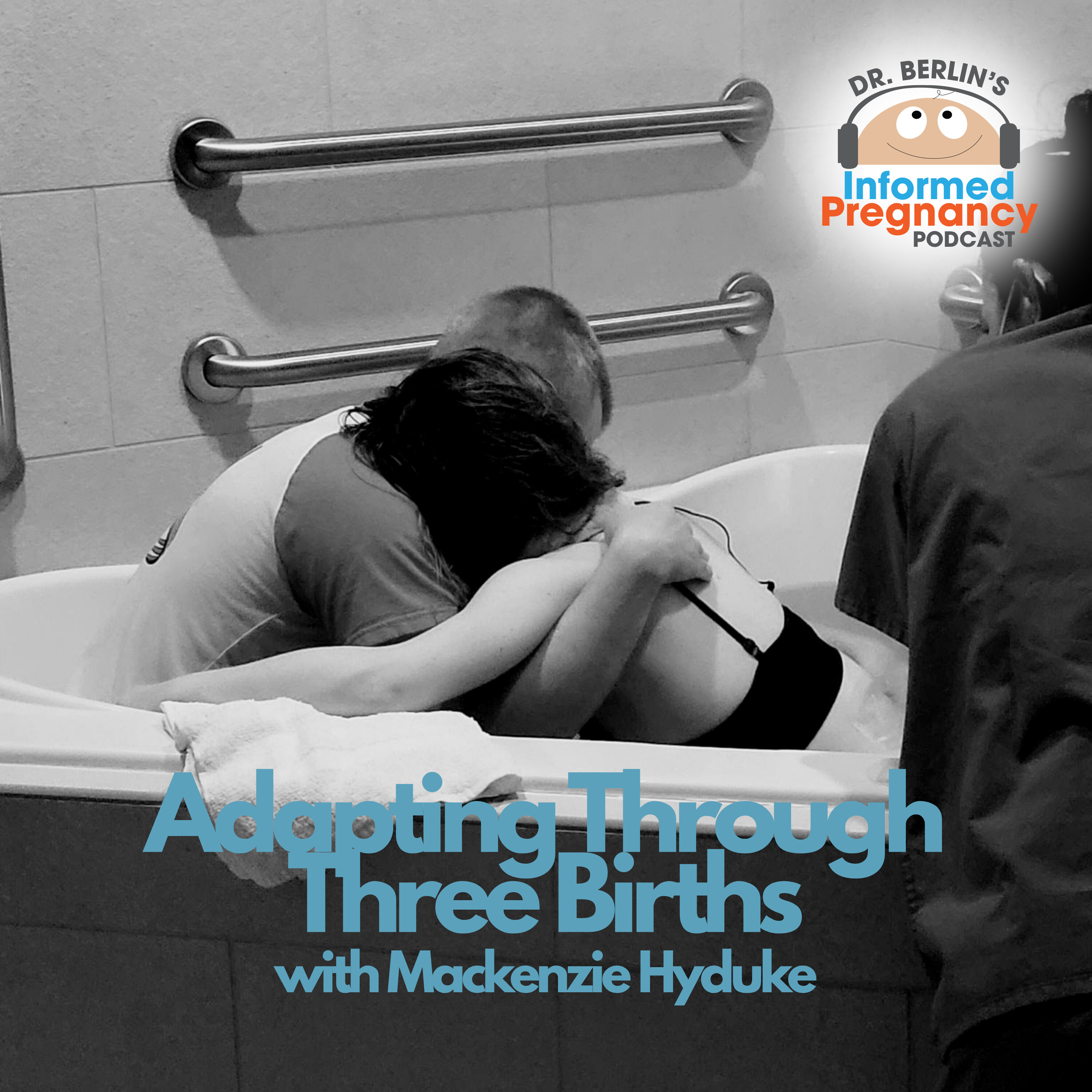
Military spouse and stay-at-home mom Mackenzie Hyduke discusses her three pregnancy and birth experiences including learning to advocate for yourself, building your village, and learning adaptability when very little in life stays put.
Grow with us on IP+! Informed Pregnancy Media presents two all new intimate short-form video series following Garrett and HeHe’s real-time pregnancy journeys as they prepare for an empowered birth and postpartum experience. Each episode features weekly updates with personal photos and videos to help bring these raw stories to life, a visually dynamic guide through each mother’s emotional and physical experiences.
“we're moving, I am always at home. I am always there for everything. I am always peak stability for my kids, no matter what else is going on.”
“and I wasn't really in my head enough to ask for clarification, to advocate for myself.”
“And the shower was like the peak for me. That was the best. Nothing has ever compared to the shower for coping strategy for me.”
“But I actually said a quote that I think you have said many times before that there's a difference between intensity or pain and suffering. And I said, I'm suffering.”
“They were such angels. They were amazing. I don't know if I would have done it, if they had not come in. I told them, like, they saved my birth. There's no question. They made me feel so heard and they were so encouraging. They were amazing.”
AI-generated transcript with speaker labels — may contain errors, especially names and medical terms. Dr. Elliot Berlin, DC appears in blue; Mackenzie Hyduke in orange.
Dr. Elliot Berlin, DC[0:00] My guest today never expected to become a military spouse or a stay-at-home mom, but through three pregnancies, three very different birth experiences, and repeated moves around the world, she learned just how much the people around you can shape your experience of birth and postpartum. She joins me today to talk about giving birth while repeatedly rebuilding the village, learning to advocate for yourself, and becoming adaptable when very little in life stays put. I'm pregnancy-focused chiropractor Dr. Elliott Berlin, and you're listening to the Informed Pregnancy Podcast. Mackenzie Hajduk, welcome to the podcast.
Mackenzie Hyduke[0:52] Thank you so much for having me.
Dr. Elliot Berlin, DC[0:54] My pleasure. I have so much to learn from you. I want to jump right in. Let's start before pregnancy and birth. Where did you grow up, and what did you imagine your adult life might look like?
Mackenzie Hyduke[1:04] I grew up right outside the Washington, D.C. area in Maryland, in Silver Spring, for anyone who knows Maryland well. I went to school in D.C. and was an only child, very close with my parents. Always expected, went to sort of a high-achieving school, and always expected to get a graduate degree. I don't know about go the corporate route, but do something high-powered and really focus on my career from a very young age.
Dr. Elliot Berlin, DC[1:39] Sounds driven.
Mackenzie Hyduke[1:40] I was very driven, yes. And my parents are both driven people.
Dr. Elliot Berlin, DC[1:46] Did you know graduate degree in what field?
Mackenzie Hyduke[1:49] No.
Dr. Elliot Berlin, DC[1:50] Okay.
Mackenzie Hyduke[1:51] I just assumed I would get a graduate degree from when I was very little.
Dr. Elliot Berlin, DC[1:56] How did things change?
Mackenzie Hyduke[1:58] Things didn't really change until I met my husband. I remained sort of career-focused while dating him, and do plan to go back to work one day, meaning work outside the home. I met him when I was going into my last year of college, and did indeed go on to get a master's in social work, which I am very proud of, and I'm very glad that I have, and will use someday. When we were dating, I think my priorities started to shift a little bit. He is in the military, and I knew that life would look like a lot of moves. And one thing that has been very important to me about being a stay-at-home mom is that if my husband is away, no matter where we live, no matter how frequently
[2:53] we're moving, I am always at home. I am always there for everything. I am always peak stability for my kids, no matter what else is going on. And so I think that started to kind of enter the framework of what is going to really matter to me in these years where they're small, and where my husband is still in the military. And we wanted at least a few kids, and that sort of started to enter my mind as something I was thinking about as well. Family had always been very important to me, but I had never thought about my future as a mom until I was really with him, and that just clarified a lot of things.
Dr. Elliot Berlin, DC[3:34] Still fairly young, just finishing college.
Mackenzie Hyduke[3:37] Yeah, so I met him when I was 21, and we didn't start having really serious conversations until, I would say, two years into dating because he would be moving at the three-year mark. And so we started to have serious conversations about where do we see this relationship going? What do we want our lives to look like?
Dr. Elliot Berlin, DC[3:59] And you had talked about having a few kids. You're an only child, and does he have siblings?
Mackenzie Hyduke[4:05] He is the eldest of five.
Dr. Elliot Berlin, DC[4:08] OK, so were you going for an average?
Mackenzie Hyduke[4:13] You could say that. We did have three. It ended up being an exact meet-in-the-middle situation. We may have a fourth down the line. I need a little bit of a gap, and we'll kind of see what happens. But yeah, that actually, I said three and he said five, and so our goal was four. But we both, for now, think that three is right for us. So we'll see. Yeah, we'll see.
Dr. Elliot Berlin, DC[4:40] So you decided to move forward with it. Where was that initial move to?
Mackenzie Hyduke[4:45] Yes, when we had been dating for about three years, he moved to South Korea. And both of us felt pretty strongly about not getting married just because he was moving, which is a really valid choice that a lot of military families make because of insurance, because… will only pay for you if you're married. And it was a really big leap to go not married. I had to just sort of show up in South Korea, hope that I could get a job on base so that I could get an ID card. We really had to sort of wing it, but we were not ready to get married yet. We wanted to live together. But yes, we were very serious and we moved to Korea and we spent a year there in Seoul. What was the first year like? Were you able
[5:32] to get what you needed? It was an amazing year. We lived together for the first time in a studio size office or quarters apartment. We got to explore a lot. We had a lot of more serious conversations about what we wanted our life to look like. And yes, we got engaged maybe a month after we moved. Oh, congratulations. Thank you. Where did you go from Korea? We went to Oahu, Hawaii. Oh, that doesn't sound horrible. It was lovely. The experience of COVID lessened the loveliness a bit, but it was truly amazing. And that didn't start until we'd been there for a year and a half, two years. So we got a lot out of it before we were inside a lot.
Dr. Elliot Berlin, DC[6:23] And it was a beautiful place to be outside during COVID. Yeah, patients that went to Hawaii just for COVID to be able to just be outside. They were working remotely anyway. Yes. But then you got married during COVID? We got married right before COVID. So our
Mackenzie Hyduke[6:42] seventh anniversary is actually tomorrow. We got married in October of 2019. So right before COVID.
Dr. Elliot Berlin, DC[6:49] Okay. The last wedding before everything got shut down.
Mackenzie Hyduke[6:53] Pretty much. I feel very lucky. Then did you have a pregnancy during COVID? I did. So we had a wedding slash honeymoon baby and COVID hit about 17, 18, 19 weeks. We took a very short trip to another island right as it was kind of starting abroad and was actually probably here, but it was not really a thing yet. And my husband's a physician and my husband was reading about it before it became popular to be worried about it and was worried about it. And I asked my OBs late February, 2020, is it okay for us to go on this plane? Do we need to cancel? And they said, Oh, it's fine. And we went and we were the only people with masks. We were nervous, but we managed to get
[7:52] this last trip in, which was lovely. And then came home and then in March, of course, everything shut down, which was very, very stressful for everyone, obviously. But there was a lot of added stuff with being pregnant. I was very worried about having him in the delivery room. I was very scared for the baby. It was a hard thing, I think, especially in a first pregnancy when you've never done it before and you have fairly low knowledge and confidence and experience with what's happening in general to then have a pandemic. Yeah, it sounds like a lot going on all at once, especially finishing grad school on top of that. Yes, I finished up when I was about
Dr. Elliot Berlin, DC[8:34] three months pregnant with him. A lot of balls in the air. Let's take a little break. When we come back, we'll find out how that pregnancy went and how your first birth went. Don't go anywhere. We'll be right back.
Dr. Elliot Berlin, DC[10:20] Welcome back to the Informed Pregnancy Podcast. We're talking to Mackenzie Hajduk. OK, you went from sort of a stable graduate school degree into let's get married, move to Korea as a military family, and then move to Hawaii, then get engaged, get married. Pandemic breaks out, you're pregnant, you're finishing grad school. But I guess now you're in your second trimester at this point in the story and need to think about birth. So did you have thoughts at that time?
Mackenzie Hyduke[10:56] Yes. So I had picked an OB who was very popular on island, very well known for kind of delivering midwifery sort of care, actually. He was the only OB in his practice. He delivered all the babies. He spent a lot of time with all his patients. So sometimes you would wait a lot. But the idea was you got phenomenal care. And I did have a great experience with him. And I just automatically assumed hospital, automatically assumed epidural, although I had a lot of time on my hands because of COVID. And I actually started listening to your podcast during that time, among some others. And the door opened to interest in unmedicated labor. But I was thoroughly unprepared
[11:41] and didn't really have, I didn't have strong feelings about it, I'd say. So pretty standard approach to my first birth.
Dr. Elliot Berlin, DC[11:51] OK, as that came around, it sounds like you like the OB. How was the experience of the birth?
Mackenzie Hyduke[11:58] Yes, so he was great. I had some low-ish fluid leading up to the end of my pregnancy. I ended up coming in with genuine oligohydramnios, very low fluid at 39 plus 4, I believe it was. I had an appointment. I had been having some NSTs. And I had tried to do a couple of sweeps to avoid induction because I really wanted to try to. But ultimately, that wasn't what happened. I was induced with Pitocin at 39.4 in the evening. I started at a 2 to a 3, and either 70% or 80% a face. So I had a fairly good head start after about a week of prodromal labor, which had been.
Dr. Elliot Berlin, DC[12:44] We should explain some of these terms. OK. So oligohydramnios, your amniotic fluid was lower than they're comfortable with. Membrane sweeps, they tried to kind of irritate the bag of fluid and see if it can cause contractions for you to get labor started. What did you just throw out there? Prodromal labor. Prodromal labor, so they got your labor kind of. I kind of describe prodromal labor as the car's in neutral. You're stepping on the gas. The engine is revving. You're using a lot of resources, but nothing's really happening. You're not progressing. Hasn't shifted into drive yet.
Mackenzie Hyduke[13:18] Yes. All of my Braxton tics have also always had a fair amount of sensation to them, and they felt like that. But they were every three to five minutes apart for like a solid week straight, fortunately. And it turns out I have them with every pregnancy, sweeps or not. Yeah, and a lot of it.
Dr. Elliot Berlin, DC[13:38] So. I'm in draining, energy draining. It sounds like it would be.
Mackenzie Hyduke[13:42] It was extremely draining before the first baby, because I didn't really know what was going on. I was paying a lot of attention to it. With the later ones, I just expected it, and it really did not faze me. But I was emotionally, it was a lot the first time. I was very stressed about it. Yeah.
Dr. Elliot Berlin, DC[14:02] And how did you kind of get out of that? And also during that time, what kind of support did you get about what was happening or what options might be?
Mackenzie Hyduke[14:11] So my OB told me that that's pretty much what he thought was going on. He said, don't come in until it's unbearable. Which saved me a trip to the hospital. I never went in. So I didn't have a go all the way down there, which is a 45 minute drive to Honolulu. We lived on the North Shore. It's a haul. I did not do that. But I don't know. I mean, I wasn't interacting with a lot of community at the time. I would talk to my mom on the phone and really just kind of waited out. I was trying to stay inside in the air conditioning, drinking just tons of water to keep my fluid up. It was a highly stressful period. And the way I got out of it was just the Pitocin.
[14:57] They started me at a two and told me, expect 24 to 36 hours. That's probably what it's gonna be. It took seven. It was a very quick first induction. Yes, they started me at a two, they raised the pitocin about every half hour by two and I only ever ended up at a six and my water broke. I started having some more reliable contractions and my water broke and there was just a zero to 60 situation. Felt like nothing to getting hit by a train. Every contraction, the pitocin was super, super intense. I had listened to enough podcasts that I knew pitocin would likely be more intense than a spontaneous contraction and I, after a few hours, with really fairly minimal coping strategies,
[15:55] said I would like an epidural. They checked me, I was about a four to a five. This was maybe at 10.30 at night after the induction had started at six. The anesthesiologist came in, turned all the lights on, had a boombox blaring. I was having contractions about one minute apart, lasting a minute long, really just back to back. It was very, very intense and I knew that that was not typical for four centimeters to have back to back contractions. So I just said, okay, let's get some pain relief, receive the epidural and fairly quickly had some relief, but then also fairly quickly it wore off on one side. So I had a brief period where I felt a lot better
[16:44] and then it started to wear off and at the same time, my baby started having some decelerations and that was really distressing to me because I didn't understand the difference between decelerations that were okay and decelerations that were concerning. And when I called the nurse to basically ask for either an epidural fix or replacement or whatever it was exactly that I needed and also to ask her about the decelerations and to be checked because I could feel a lot of pressure and they had told me if you feel a lot of pressure, let us know. So there was a lot going on all at once and she was really very dismissive of all of it, unfortunately.
[17:31] She told me, we just checked you half an hour ago and you were a four and a half. There's no way that you feel your baby's head. She completely didn't answer my epidural concerns and she said about the baby's heart, he's fine. We would be in here if he wasn't and I wasn't really in my head enough to ask for clarification, to advocate for myself. And so she left and I spent about another half an hour in kind of a holding pattern debating what to do with my husband. We were reading medical journals about decelerations, trying to figure out what was, yeah, it was a lot. And then my OB came about after that half hour, came to actually deliver the baby
[18:13] of a fourth time mom who was like next door and heard what was going on with me, came in, checked me, said, yeah, you're complete and had the nurse be replaced with someone else. He was really upset with her for which I was quite grateful to be advocated for. So yes, and then I started pushing and had my son 40 minutes later and he was healthy. He was six pounds, 15 ounces. He was healthy, but I felt immediately very, very weird. Really not how I expected to feel. I was kind of a mix of terrified and numb. Like all of the happy feelings that I thought I would have were really, really low. And all of the like just intensity and panicky stuff was really heightened.
[19:11] And I had been very emotionally connected to my pregnancy. So I just immediately knew there was something wrong is what I would say. And I did, I went on to have immediate onset postpartum depression. And I have always sort of associated it with the birth experience to a degree. I don't know if Pitocin doesn't interact well with me. I know that you don't get the same kind of endorphin rushes between contractions that you do with spontaneous labor. But the whole thing just was so not what I expected and really made me kind of think in a different direction going forward. I wanted to avoid pretty much everything that I had experienced.
Dr. Elliot Berlin, DC[19:53] I'm sorry you had that negative element to your first birth. I'm also grateful that you were both ended up healthy, but it sounds like it could have been better handled. I also want. because oxytocin has an effect on the brain that's very powerful, that's very calming and mood enhancing and pleasure enhancing that pitocin doesn't have. It just drives the gas pedal on the uterus just like oxytocin does, but doesn't give you the benefit on the other side. Okay, so flash forward, how long till the next pregnancy?
Mackenzie Hyduke[20:29] So we moved to Washington state when my first was almost one and then conceived my second when the first was 18 months old.
Dr. Elliot Berlin, DC[20:39] Okay, and it sounds like you learned lessons from your first birth that you wanted to take with you to the second. What were those lessons and how did you incorporate them?
Mackenzie Hyduke[20:50] So I listened to a lot more podcasts. I learned a lot about pitocin and induction and exactly what you were talking about, how it affects the brain and the emotional connection to labor. I decided that I wanted to pursue midwifery and there actually, I chose where I wanted to give birth before I even conceived. I picked a doula before I conceived. I went about it very, very differently. There's a hospital in Tacoma, Washington that has a midwifery birth center that's attached but not affiliated with labor and delivery. So midwives who also work in L&D will work there but there's no epidurals. It's just all midwives. It's a very different approach.
[21:36] They have queen beds. Yeah, baths in all the rooms. It's beautiful. They set up votives for you when you're coming in. So yes, and I set my mind. I said, I really don't want anything that I had with the first birth and I became super passionate about trying to have an unmedicated labor and delivery without really anything in my system. That was the goal.
Dr. Elliot Berlin, DC[22:02] Well, how did that go?
Mackenzie Hyduke[22:05] So it went great. At 40 plus two, I went in and I did have a fluid scan and my fluid was great.
Dr. Elliot Berlin, DC[22:14] Awesome, already. So. That's a better start.
Mackenzie Hyduke[22:17] Yeah. Yes, I was very happy about that. I went in at 40 plus two and because it was part of a hospital system, the midwife basically said to me, I have to say the word induction. I'm obligated to, and we don't need to talk about it anymore. And I did ask for a suite because I had already had almost two weeks of prodromal labor and I was at a three. Okay. So I said, I doubt this is gonna irritate my uterus anymore. I was having prodromal contractions three minutes apart. If I was awake, I could feel them. Fortunately, I could sleep through them. So I went for that. And the next day, woke up and had like some bloody show, some signs, but I was very not trusting in my body.
[23:07] I just thought I'm never going to go into labor. My body can't do this. And then that night, 40 plus three, I woke up at about 1130 having, they just felt a lot more substantial. They were the same three to four minutes apart, same time interval, but I could feel my body was doing more. And I was shaking like crazy and couldn't really sleep through them. So I labored a little bit and then called the birth center pretty quickly because I was nervous after a seven hour first time induction that I would give birth in the car, which I really didn't wanna do. So I kind of had a mental block being at home and I really just wanted to get into the space.
[23:56] And I just sort of labored not really progressing at home for a couple hours and then went in at 2 a.m. And indeed, as we drove into the parking lot, I had like my eye mask on. As we drove in, I had my first contraction where I really had to like moan and vocalize. And when they checked me, I was a five and a hundred percent effaced. And that was the start of what like really felt like true labor to me when I was able to get settled. We got into the room and my doula mostly helped me with counter pressure and like position changes. So about every half hour, we would switch to a new position because I would get bored and I would need to do something else.
[24:39] And then got in the shower after a while of laboring out in the room. And the shower was like the peak for me. That was the best. Nothing has ever compared to the shower for coping strategy for me. And, you know, I had done some hypnobirthing learning. So I was using some in for four. transitioned in the shower and then got out to try to give birth in the tub, which I actually then hated. Yeah, I got too hot. I sort of wish I had stayed in the shower, was so out of it. I was in, I mean, a laborland trance, unlike anything else I'd ever experienced or had ever experienced. With my third, I didn't quite hit that zone again. My waters had stayed intact, which I think played a big role in the sensation. I was really
[25:43] honestly underwhelmed until I was pushing him out and it turned out he had a nuchal fist. It like didn't compare to the pitocin with my first at a four, even when I was transitioning. I was in such a meditative state with the counting and my contractions were super regular. So it was really easy to kind of get in the zone and the vocalizing. And yeah, I started pushing and it turned out that my bag of waters was still intact. And I asked my doula, will it hurt more? And she said, yes. And I said, but will it be faster? And she said, yes. So I had them break it. And he was born after 20 minutes of pushing and three hours after we got to the birth center with a nuchal fist. And he was a lot
[26:33] bigger than my first. He was eight pounds, three ounces. So that was very exciting.
Dr. Elliot Berlin, DC[26:37] Healthy. Well, every couple of minutes in this episode, I want to say congratulations. Congratulations again. Nuchal fist, meaning the hand was right up by the head and they delivered together. So a little bit challenging there. Throughout your description of this birth, one thing that rings through is just, it was sort of like, I wanted to do this. So that's what we did. And I asked, can we do this? And it already sounds a lot different than the first birth where it was sort of like, you were just being told what you can and can't do and when. Let's take a little break. We'll recap those two. And then there was another baby we need to find out about. We'll be right back. Welcome back. We're talking to Mackenzie
[27:28] Hajduk. Okay. Two very different birth experiences. Overall, not thrilled with how the first one went. How did you feel after the second one? What did you learn from it?
Mackenzie Hyduke[27:38] And did you feel like you found the formula? Yes, it was truly amazing. Still the greatest moment of my life. The most amazing experience of my life. It was like my marathon. That was my marathon. Like my big goal. I was so proud. I felt the birth high was indescribable. I mean, I felt a complete 180 from how I felt after I had my first. What you said about me really directing everything was so true. I always forget this because it was so calm in the room. I had a hemorrhage, not a severe one, but I had a hemorrhage after he was born. And they were so calm and still said, you're bleeding a little more than we'd like. May we give you a shot of pitocin in the thigh, please? Yes. And I said yes. And it was just,
[28:31] it was so peaceful. I didn't even realize that that meant that I was hemorrhaging until after. And then of course, I felt pretty bad. I didn't have to have a transfusion, but the experience was so, I don't even think of that as having been a scary thing because of how it was handled. They were so peaceful. I led everything. I asked for everything. It was amazing. And it really, A, it gave me so much confidence in my body, in myself as a mother. It really changed how my postpartum experience was. I developed so much more confidence in my ability, in my intuitive abilities. It was a really transformational moment. And yes, I felt like, oh, I have the formula, but of course we moved. So I didn't get to then have
[29:23] the same place. Flash forward again, where are you living and how much later is this? How much time has elapsed? So we moved when my second was about a year and a half old and we moved to the DC area. So where I'm from, yes, this was intentional. I said I would like one baby near my family because yes, as we'd sort of discussed at the beginning, I have recreated a village with friends and I mean, really extraordinary communities throughout our time moving around, but I had always felt like I would really like to experience something. there, and cousins, and I was really hopeful that that would be a meaningful experience. So we moved back to Maryland and conceived. I actually had, we started trying a little earlier,
[30:24] but I had two back-to-back chemical pregnancies right before conceiving my third son. They're all boys. Oh yeah. And they have very different temperaments, but one of them has the energy of about five children. Yeah. Yes. So yes, we have three boys and ultimately my third son, Rex, was conceived when my second was two years and maybe two or three months old. Okay. How old is Rex now? His birthday was July 25th of 2025. So he's 14 months now.
Dr. Elliot Berlin, DC[31:02] 14 months. Okay. So what kind of birth options were available to you there?
Mackenzie Hyduke[31:08] So I wanted the exact same thing I had in Washington and it did not exist in DC. So there was no like attached birth center. And I thought about a home birth for a little bit. And I kind of wish that I was the type to mentally have a home birth, but I knew that I would be so like obsessed with what my other kids were doing. I'm very, very loud in labor like the whole time, including the only way that I can seem to successfully push out a baby is screaming at the absolute top of my lungs. Yes. I was told in my first birth that I was wasting a lot of energy with my face, but actually when I started screaming was the only time I got him out. So that works for you. Yes, it does. And I was not prepared
[32:03] to be screaming and also worrying about my kids. So I knew we wouldn't do home and I thought about a birth center, but ultimately I just wasn't comfortable enough with how far it was from a NICU. The transfer time would not have allowed me to relax. And I knew that relaxing would be the most important thing to an unmedicated birth. So I chose a hospital in DC that has a fairly good reputation for being, you know, physiological birth friendly and again found a doula and sort of went from there. And they do have midwives, although not enough to guarantee you a midwife during labor. Yes. Possible midwife. Maybe midwife. Yes. So should I get into how that birth started? Sure. Okay. So yes, that was also a pretty
[32:59] uncomplicated pregnancy. And I had even more prodromal labor this time. It seems like my body likes to, yeah, this time it was, I think almost three weeks, but I really developed the ability, especially after the second to just completely tune it out. My doula was traveling and I started having it. And that was the only time I was nervous was because she was too far away and I really wanted her to be there. So that was the only time the prodromal labor made me nervous, but we got to 40 weeks and I had an appointment and I was less dilated to start this time. I was a one and I did again ask for a sweep. And that night at 8.30 PM, I stood up and my water broke. So a new start to labor for me. And I sort of immediately
[33:51] said to my doula, oh no, I won't have a cushion this time. I was disappointed that my water had broken because I really loved, I felt like having the bag of waters intact for my second had made a difference in sensation. So I spent a couple of hours at home trying to really get my contractions going. I tried to shower, I tried to sleep, I tried the ball, multiple different things. Did you feel like it was more intense without the cushion? Yes. Okay. Very much so, but I also ended up having, there was a lot of fear in this birth because of some interactions with staff. So it's hard to say if I was having more of a psychological reaction or if actually
[34:39] the cushion made a big difference. He was seemingly in kind of a weird position, which made some things more challenging. Do you know specifically what the position was? No, no, no one really told me he was extremely low. I have pictures. I have never seen a baby this low. He was extremely low. And just based on the contraction pattern, I ended up having a very, very, very and like a lot of double peaking, a lot of two minute or longer contractions toward the end. And I think the theory is sort of that maybe he was kind of geegocked and having to reroute based on that. But it was really just my doula in the room for a while.
Dr. Elliot Berlin, DC[35:24] What were the interactions that stressed you out?
Mackenzie Hyduke[35:27] So we got to the hospital around midnight. I just decided to go because I thought mentally I would not relax and really let it kick off until I got there, which was right. So we got in and I was having contractions. They were just not very strong. And it was the end of July, so probably brand new residents. And I was told that they needed to check my cervix to feel whether my water had broken, even though I was a third time mom who had absolutely my water had broken. There was no question. I was like-
Dr. Elliot Berlin, DC[36:02] So back to not being listened to.
Mackenzie Hyduke[36:04] Yes, exactly. I mean, it was so obvious and I intentionally wore a pad and kept it for them. I said, I have a pad that you can test. I don't want to have my cervix checked because my water's broken and I don't have an established contraction pattern. I can guarantee you as a third time mom that my water's broken. She kept asking me and then sent in her attending who also kept asking me. And then they, again, both repeatedly tried to insist that I start Pitocin, even though I said, I had my last baby in about three hours. If I could just have some peace, I'm pretty sure my labor would really get going. It's been four hours since my water broke.
[36:49] I'm not sure why that's necessary. And they just kept asking. And eventually I asked them to completely leave me alone, which they did. And then my labor really started, but it was just stressful. Like there were a lot of things. Listening to the heart rate monitor again, they had it on me continuously for a while and listening to his heart was surprisingly really like triggering of some stuff with the first. I had not, yeah, I had not expected it, but I had really intermittent Doppler monitoring for my second automatically. And I ended up having to ask for it with the third and just listening to the heart, I was like borderline. He was fine, but really kind of panicky
[37:33] and had to ask them to turn the sound off so that I didn't have to hear it. And it was really stressful, just remembering the experiences with the first. And there was a parallel with them just not really paying any attention to what I was saying. And I felt like, oh, at this point, I'm a third time mom. Like I have a ton of experience. Aren't we gonna listen to me now? Yeah, so, but they did leave and that helped.
Dr. Elliot Berlin, DC[37:58] How did it end?
Mackenzie Hyduke[37:59] So it was my hardest labor. It was really, really hard. I had him at 8.35 the next morning. So it was also my longest. I was very, very close to getting an epidural. Like I said, really intense, difficult to predict contraction pattern that was really all over the place with a lot of double peaks and stuff like that. And so I wasn't able to get into the same kind of trance that I was with my second. And that was kind of disorienting. But amazingly, an hour and a half before I had him, two midwives came on shift to take over for the OB and the resident who I'd had. And they had an entire labor and delivery ward to take care of, but somehow didn't leave my side.
[38:47] Came in, took over the room, completely changed the energy in the room, had me try some different positions. The tub in the room had actually broken part way through my labor. So I was now, yeah, yeah. There were actually, there were amazing nurses trying to bail hot water from the sink for me. I mean, they were angels, but eventually they basically said, this is not gonna be an option. And I'd already been in the shower for hours. So I was really kind of at a breaking point towards the end. And I said, I need you to check me one more time. If I've progressed, I'm gonna keep going. But if I haven't, I'd like you to get the anesthesiologist to get an epidural,
[39:27] which I was really, really upset about because of just associations of how different the first two had been. I really wanted that same experience. But I actually said a quote that I think you have said many times before that there's a difference between intensity or pain and suffering. And I said, I'm suffering. And I mean, I had been really screaming, like had no control over my sounds for hours. And my husband was, told me later, like he thought I was pushing the whole time. He was panicked that the baby was gonna be born into the toilet. Like, it was really intense. And they checked me.
Dr. Elliot Berlin, DC[40:02] And you're a scream writer to begin with.
Mackenzie Hyduke[40:03] Yes, yes. just push now. And she said, I bet you can get rid of this. And I did. And he was born 15 minutes later and like all of a sudden it was over. And I mean, those mid, one of the midwives cried. They were such angels. They were amazing. I don't know if I would have done it, if they had not come in. I told them, like, they saved my birth. There's no question. They made me feel so heard and they were so encouraging. They were amazing.
Dr. Elliot Berlin, DC[40:42] Again, congratulations. Thank you. And a big one, like, you know, having attended birth, like the aftermath of what you just described is so emotional for everyone. Sometimes they're like, Hey, Dr. B come take a picture. And I'm like, thank goodness I don't wear mascara because it would be running all down my face. It can be so emotional. So you've had three really different birth experiences. And I wonder from two things. Number one, how was postpartum after that? Because they were different from the first two. And then I'll tell you my other
Mackenzie Hyduke[41:14] two questions. So that was, I would say actually my best postpartum. I was not necessarily as blissful. I was in a little bit of shock. I was immediately probably actually the most proud of that one because I had had to handle more and had really had to advocate for myself kind of strongly. And there's no way that I would have ever done that as a first time mom. And so I was really, really proud and I felt really strong. Having my mom around in particular was wonderful and made a really big difference to be able to lean on family as well as my husband, who's always been an amazing support. That was the only postpartum where I didn't have any like postpartum depression at any point, which was a beautiful gift.
[41:59] I'm so grateful for it. What do you attribute that? Is it the family support that you had? I think it was a mix of things. Yeah. I really think it was a mix of both. I think having family support around knowing that I had another person who I could call, my husband can't always just leave work. He can't just take the day off if someone's having a bad day. So if I'm not around other family, I know like I have to, this is on me. And knowing that I could also call my mom who works, but was just super present or my dad, if I really needed help in a pinch was like having a safety net, which was so nice and I think helped mentally. But also I think the experience of having had multiple babies and done that like hormonal,
[42:52] all of those ups and downs provided a lot of perspective and made me feel not quite so doom and gloom. If I was going through a hard phase, I knew it would be done and then it would be a new phase. And that experience was big for me.
Dr. Elliot Berlin, DC[43:08] I wonder after the three different experiences you had, if you could summarize your learnings, like what you learned from them, like if there were to be a fourth, what would you take from those three into the fourth? And also by the same token, somebody who's listening, who may be having their first or second, who can learn from your experiences, what would the take home lesson be?
Mackenzie Hyduke[43:33] So I was really attached with when having my third, I was really attached to this idea that it would be like my second, that if I prepared the same, if I was the same person, if I did all the same thought work, mental work, physical work ahead of time, that I would have the same experience. I was really attached to this idea, even though I was in a different place. And of course, rationally, I knew that was not true, but emotionally that I was very sort of tied up in that. And ultimately, the biggest lesson that I've kind of learned is your babies are going to do different things. The staff is going to do different things. You're going to maybe do different things. Your body's going to do different things that
[44:15] you can't predict, that you can't plan for, no matter how much like really important prep you've done, that there's going to be unpredictability and that A, your prep will help you with those moments of unpredictability. But also like your attitude is so enormous, like the attitude that you bring to your birth, like your commitment to yourself and your mentality. You have control over your mentality, no matter what is happening and what changes. And if you have that mentality and you have your attitude, and I mean, this goes for life too and motherhood, but that you have the ability to influence that always, what you're going to do and how you're going to approach the situation.
[45:02] So if I did go on to have a fourth, I the same, but that birth can be really beautiful and that you can have a say in how you handle it and how you handle the like curve balls along the way. And that that maybe makes more of a difference than everything going exactly according to plan.
Dr. Elliot Berlin, DC[45:23] I vote for Los Angeles if there's a fourth.
Mackenzie Hyduke[45:27] I don't think he could ever get stationed in Los Angeles, unfortunately, but that would
Dr. Elliot Berlin, DC[45:32] be great. I guess my last question really is about that. Really, as a military family, you're always moving and you're always having to rebuild that village from the ground up. So as sort of somebody with a lot of experience starting over, finding resources again for someone else who's maybe doing this for the first time, where do you start with that? And how do you assemble that group?
Mackenzie Hyduke[45:59] So it's been the first time when we moved to Hawaii, I not being a mom, I was way more kind of lackadaisical about it. But now when we get to a new place, I am basically saying yes to everything. If I meet someone and they invite me somewhere, I say yes to pretty much everything. We are building a community from the second we hit the ground. I ask for women's numbers. I say yes to everything that we possibly can. If one of my kids makes a friend, we are always immediately trying to build a community and show up for others and also have others in our environment. And I have it really fairly easy as a military spouse with my husband being a physician. I mean, I have friends who their husbands do other
[46:51] things where their husbands have been gone so much more and for so much longer than my husband has. But during the times where he has been gone, having that village in particular of other military spouses has been so incredible and such an unexpected gift that I like I used to be really I was not a very social kid. I wasn't very socially savvy. Can't picture it. I didn't pour. Thank you. But I didn't I don't I think it was maybe a bit of the only child thing. I was you know, yeah, didn't pour a ton of energy into that. But that has become like such a huge part of what's important
Dr. Elliot Berlin, DC[47:33] to our family. Okay. Wow. Thank you so much for sharing that entire journey. There's a lot of elements there and it's a lot of experience that you have. So the fact that you're sharing it with me and with the audience really gives perspective that sometimes is hard to come by and I really appreciate it. Mackenzie, where can we find you online? So I am at my handle on Instagram
Mackenzie Hyduke[47:58] is just Mackenzie. Hi, Duke. M-A-C-K-E-N-Z-I-E-H-Y-D-U-K-E. And my account is private and I like post a lot of pictures of my kids which is why it's private. But if you message me, I will happily accept especially if there's any military spouses who want to talk. I would love to connect with you or any
Dr. Elliot Berlin, DC[48:19] other moms. You go being social again. Thank you again. And at home, thanks for listening to the informed pregnancy podcast. For more pregnancy and parenting information just like this, visit us online at informed pregnancy.com.
Want more pregnancy + parenting? Start your FREE TRIAL of Informed Pregnancy+ and get access to all our curated pregnancy and parenting content — original series, iconic birth films like The Business of Being Born, prenatal workouts and more.
After witnessing her first births while shadowing an obstetrician, Dr. Estefania Magallanes came away thinking she may not want to have children at all. She joins the podcast to discuss her path to caring for pregnant patients, babies, and families as a chiropractor in Los Angeles.
Grow with us on IP+! Informed Pregnancy Media presents two all new intimate short-form video series following Garrett and HeHe’s real-time pregnancy journeys as they prepare for an empowered birth and postpartum experience. Each episode features weekly updates with personal photos and videos to help bring these raw stories to life, a visually dynamic guide through each mother’s emotional and physical experiences.
“I use about the same pressure as maybe if you're checking an avocado for ripeness at their grocery store, that's the most pressure that I would ever use.”
“I felt that my mom slipped through the cracks a little bit and didn't have a good advocate or good resources to be able to advocate for herself.”
“But the thing that makes it rewarding and the thing that keeps me coming back for more is actually that I get to be there for the moms.”
“I think our clients are more likely to be open minded, flexible, and not have an incredibly rigid birth plan.”
“I think now seeing how there are so many options and how you can do it on your own terms, it makes it feel like such a beautiful experience that I would like to be a part of someday.”
AI-generated transcript with speaker labels — may contain errors, especially names and medical terms. Dr. Elliot Berlin, DC appears in blue; Dr. Estefania Magallanes in orange.
Dr. Elliot Berlin, DC[0:00] Today's guest once thought she was headed to medical school, and after witnessing her first births while shadowing an obstetrician, she came away thinking she might not want to have children at all. Somehow that path eventually led to her becoming a chiropractor in Los Angeles and a career caring for pregnant patients, babies, and families alongside me right here at our Los Angeles practice. I'm pregnancy-focused chiropractor Dr. Elliot Berlin, and you're listening to the Informed Pregnancy Podcast. Dr. Estefania Magdalenas, welcome to the podcast.
Dr. Estefania Magallanes[0:47] Thank you for having me.
Dr. Elliot Berlin, DC[0:48] And it's probably still okay to say welcome to Los Angeles.
Dr. Estefania Magallanes[0:51] I'll take it. Thank you.
Dr. Elliot Berlin, DC[0:53] Let's start at the beginning. Where did you grow up, and what did you do prior to chiropractic?
Dr. Estefania Magallanes[0:59] Sure. So, whenever I was six, just getting ready to start the first grade, my parents and I actually immigrated from central Mexico to Texas, and then that's where I then grew up. That's where I did my undergrad, and that's also where I did my doctorate in chiropractic. And then fast forward to earlier this year, 2026, I moved out to Los Angeles to work with you.
Dr. Elliot Berlin, DC[1:26] What brought your family to Texas?
Dr. Estefania Magallanes[1:30] My grandmother on my mom's side already lived in Texas, and my parents were a young couple. They had a young child, and they decided that that was just going to be the best move for our future. And now I also have two younger siblings, and they also live in Texas.
Dr. Elliot Berlin, DC[1:48] Did you like Texas?
Dr. Estefania Magallanes[1:49] At first, it was a big culture shock. I remember the food being really just like not it for me. I remember missing the food a lot. But eventually I did grow to love it, of course.
Dr. Elliot Berlin, DC[2:02] And what did you think as a kid that you wanted to do career-wise when you got older?
Dr. Estefania Magallanes[2:09] Sure. My family is a lot of engineers and medical doctors, so that's what I would see around me the most. And I didn't think engineering was very interesting, but I did like the thought of looking at the body as a puzzle and being like, okay, it's meant to work a certain way. When it doesn't work this way, what's the piece that's affecting that? So growing up, medical school was the goal. All the way up through college, I was still pre-med. The more that I would work with medical doctors, the more that I felt like maybe this wasn't it for me. I still wasn't sure what would feel like a good fit, but I started to then branch out and look for things that felt more like a fit.
Dr. Elliot Berlin, DC[2:54] What was it about medicine that wasn't resonating with you?
Dr. Estefania Magallanes[2:58] Well, I mean, I think nowadays we hear about the way the system works a lot. And for me, I just felt that between the paperwork and all the steps that it takes to actually get someone the care that they need, I just wouldn't be helping people in my best capacity.
Dr. Elliot Berlin, DC[3:16] Yeah. You had your own medical condition as a teenager. What was going on for you?
Dr. Estefania Magallanes[3:23] Yes. So come to find out, I had been dealing with a couple of discs that were giving me some issues in my back, but as a teenager, that's not super common. I would run and I would get pins and needles in my entire left side body. And I was a pretty active kid. I weighted tables, I swam for school, and I lifted weights. The only thing that would set it off was running. And so we were looking at things to do with the heart, things to do with like maybe an extra rib was putting pressure. And eventually about five years later is whenever we realized, okay, this is a disc issue. And then that's when I started going to a chiropractor for my own things.
Dr. Elliot Berlin, DC[4:07] Was there a trauma that led up to it? Because like you said, you're young, strong, healthy, fit, and also very proactive working and surrounding yourself with opportunities to observe medicine. Just seems like everything was on your end. All systems go putting in the effort. Was there something that caused the disc issue for you?
Dr. Estefania Magallanes[4:28] Looking back on it, I think I can trace it back to I was playing sand volleyball with some friends and I went for a dig in the sand and just the way that I fell, something hurt my back because the next morning when I woke up for some practice, I couldn't even go upright. Now luckily for swimming, a lot of it you're laying down. So I was still able to do a lot of my practice. It was just after that whenever I would go to stand or walk, I noticed it. And then at that time, my coach just said, oh, walk it off, stretch it off. So that's what I did. And then eventually come to find out. I'm pretty sure that's what set off the disc.
Dr. Elliot Berlin, DC[5:06] And was that your introduction to chiropractic care?
Dr. Estefania Magallanes[5:10] Yes, it was. It came about as almost a last resort as it does so many times. I had a D.O. as my primary care and they basically came down to, oh, well, you know, your discs are in your back and you're very young. So we don't want to recommend any surgery. So how about you just don't run anymore and then you'll be good.
Dr. Elliot Berlin, DC[5:34] And you start running for a while?
Dr. Estefania Magallanes[5:37] Yes, because I wasn't sure what else to do. I knew that wasn't the end all be all answer that I wanted. But I also didn't want to put myself through any sort of spine surgery at 16, 17 years old. And so then whenever it was actually the summer before college, my mom was like, OK, I don't feel good about sending you away and you not being able to run or, you know, what if it gets worse? And so that's finally whenever I started going to a chiropractor.
Dr. Elliot Berlin, DC[6:05] And how did they approach it?
Dr. Estefania Magallanes[6:08] They were very nonchalant about it. I mean, to them, it was run of the mill. They're like, OK, yes, we see your MRI. We see your discs. It could help with the pins and needles or it could not. But let's give it a shot. And so, lo and behold, after a few adjustments, I did start to see some improvements. And so we kept my chiropractic journey going once I started college.
Dr. Elliot Berlin, DC[6:32] And were you able to get back to running?
Dr. Estefania Magallanes[6:35] Yes, I I run right now. I'm actually training for a half marathon, but I do 10 K's pretty easily now.
Dr. Elliot Berlin, DC[6:42] No pins and needles. No pins and needles. Amazing. So then is that what sort of made you think? What do you want to do for a career? This might be what you want to do.
Dr. Estefania Magallanes[6:53] So actually, no, I still didn't fully understand what the chiropractor was doing. I knew that he was, you know, manipulating my joints, but I didn't understand how that played into my pins and needles feeling. I didn't come around to seeing it as a career choice until actually the very last semester of college. I had been running through just the motions of taking the MCAT, applying to medical school because, you know, my parents had invested a lot of time and effort and money into that for me. And I didn't feel good about going up to them and being like, hey, so that thing that we've been wanting me to do for the last four years, I just don't think I want to do it.
[7:36] I didn't want to approach them in that way without having some sort of like solution or backup plan or whatever the case. And so my last semester of college, I took a it was a really tough class. I passed it barely by the skin of my teeth, but it was mammalian neuroanatomy. So it taught me about the development of the nervous system in mammals and humans. And that's where everything kind of clicked for me. I was able to see, oh, like if you help the nervous system, you can actually influence the development of an organism, how they learn, how they develop and just so many things down the line. And at the same time as I was going to my chiropractor,
[8:16] I was like, oh, like your whole nervous system is in your back. Then you're actually working with my nervous system. And so that specific lens is what led me to consider, you know, when babies are really young is when we can actually make a really big difference for them, because it's a big developmental stage for them.
Dr. Elliot Berlin, DC[8:34] It's so interesting that, you know, most people, I think, the majority of people see chiropractic of I have neck pain, back pain, sciatica, rib pain, and we're pretty good at getting that under control. But there's a much broader part of chiropractic and the whole regulation of the human organism that you got exposure to by accident through a tough class. How did your family take it when you finally did tell them, hey, I'm thinking about a different path?
Dr. Estefania Magallanes[9:02] Well, I'll be honest, my parents didn't really understand it at first. They were a little bit blindsided because, you know, I had been applying to medical school and things like that. So once they asked their questions about, like, well, what made you want to do this and how much do they make and what's the schooling look like? They were very supportive. So I appreciate them for that. Thanks, mom and dad. The only, I guess, tough people to win over was my extended family, the medical doctors in the family, and a lot of them practice in Mexico where chiropractic is still pretty new and, I guess, underground. If you want to call it that. So they really were like, well, what do you mean?
[9:42] If it's like a doctor, but it's not. And even now, like, they'll let me adjust them, but they'll always say, OK, just not my neck, please. So we're working on them. So a work in progress.
Dr. Elliot Berlin, DC[9:54] All right. Let's take a little break. When we come back, we'll find out how your career evolved. Don't go anywhere. We'll be right back.
Dr. Elliot Berlin, DC[10:11] Welcome back. We're talking with Dr. Stephanie Magdalenas. OK, so right now, your career is all about pregnancy, childbirth, postpartum, and it wasn't on that track. You were still pre-med. You had the unusual opportunity to shadow your uncle, who's an obstetrician. Take me into the room because you're pretty young and you're watching birth happen for the first time. What did you see and what did you think?
Dr. Estefania Magallanes[10:39] Sure thing. So at the time, I was like 19 or 20. I was in college. And yes, I was lucky that I had two uncles. One is an obstetrician. One is an anesthesiologist who was in charge of the OR at that hospital. So between the both of them, I was able to witness about a dozen births that were some of them more natural. Some of them were cesarean, either planned or emergent. And it really opened my eyes to sort of how traumatic it can be for mother and for baby and how a lot of the times, once you're in the hospital and it's delivery time, things tend to fall by the wayside. You know, you may have certain intentions going into your birth and then those intentions just change as you get there.
Dr. Elliot Berlin, DC[11:28] So I feel like sometimes people see childbirth and it makes them feel like, oh, my goodness, I want to do that. And sometimes people see childbirth and they're like, I never want to do that. And there's everything in between. How did it hit you on a personal level?
Dr. Estefania Magallanes[11:43] I definitely felt like I never wanted to do that. Even the natural and vaginal births that I saw, you know, they weren't considered traumatic, but I still just felt like the way that it happened in the hospital wasn't how I would have wanted it to happen for me. And so when I was only looking at the medical route and when that was my only exposure, I wasn't excited to have kids. I was like, I don't know how I'm going to do it. I may have to adopt, but like I would rather not have to go through that.
Dr. Elliot Berlin, DC[12:13] So you still wanted to be a parent and you just didn't want to do childbirth.
Dr. Estefania Magallanes[12:17] Yeah, pretty much. It was the childbirth that was the scary part for me.
Dr. Elliot Berlin, DC[12:21] Has that changed?
Dr. Estefania Magallanes[12:23] Definitely. I think now seeing how there are so many options and how you can do it on your own terms, it makes it feel like such a beautiful experience that I would like to be a part of someday. You know, I don't know what that looks like. That's something I can figure out later, but it's definitely changed my mind and made me come around that it can be a good experience.
Dr. Elliot Berlin, DC[12:45] Do you know much about your own birth experience?
Dr. Estefania Magallanes[12:48] Yes, and I do think that's also part of why this is so rewarding for me. My mother, I'm the oldest of three daughters. My mother had to have me as a C-section because I was breech. And so it was scheduled. She knew about it going in. But after me, my next sister was nine years. And then after that was 21 years later. And they told her that both of the next kids had to be a C-section when now I know that that's just not true. So I felt that my mom slipped through the cracks a little bit and didn't have a good advocate or good resources to be able to advocate for herself.
Dr. Elliot Berlin, DC[13:28] Yeah, that's unfortunate. I mean, it would have been nice for her to be given options. You know, obviously, always sharing what the risks and benefits are with each option and letting her choose. Do you think that affects the work that you do today?
Dr. Estefania Magallanes[13:46] 100 percent. I think that the work that I do today, I got into it because I wanted to help babies, mainly. But the thing that makes it rewarding and the thing that keeps me coming back for more is actually that I get to be there for the moms. They come to me in a time when everything's about the baby and how's the baby doing and where's the baby today. And I get to sort of slow down and check in on them and ask, you know, how are you doing and how are things feeling for you today? And I find that to be a really rewarding part.
Dr. Elliot Berlin, DC[14:19] Yeah, it's it's very nice. I've heard on many occasions, women sometimes feel like and then even after the baby comes, it's like they're not even there. They're just somebody to hold the baby. And the whole spotlight is on the baby. So it's pretty nice that you're able to offer that kind of support and care and reassurance sometimes to people who are going through what can be an intense journey. Yeah, yes. A lot of change going on, a lot of transitions. Yeah, mentally, physically and spiritually, all the above. So you graduated a few years ago while you're in chiropractic school. Did you have a vision of what practice might be like for you once you got out?
Dr. Estefania Magallanes[15:02] Yes and no. The thing with chiropractic school, for me at least, is it felt like drinking out of a fire hydrant. I was learning so much all the time and it's amazing. I loved that. But it also made it hard to know, you know, what's really out there as far as practices go and how do I want to make it my own? I did for sure know that I wanted to work with pregnancy and babies. I know that that's an important transition that I find a lot of intrigue in and that I can always keep learning more about. But long term, I was thinking, let me just get some experience. Let me get a feel for what's out there. And then I can really hone in and make it my own.
Dr. Elliot Berlin, DC[15:41] And what were the first jobs like out of school?
Dr. Estefania Magallanes[15:45] Yes, so I graduated in 2023 and my first job out of school was a family practice. So I got to treat people of all ages, all sizes, all types of conditions. And I'm really glad that I had that. I had a really great mentors, really great experience. I got to learn how to adjust on everybody. But the other side of that same coin, I also felt like I was not great at any one thing, and I felt like I really wanted to focus on, you know, if I really want to focus on pregnancy, like, let me start learning even more about that and let me make sure that I can get more experience. And so after about a year and a half there or two years, I then went into a personal injury, which was a total pivot.
[16:32] It pays well, but it's also a lot of paperwork and it's not as much patient time as I would have liked. And so I only lasted there just over like six months. And then that's when I was like, okay, what is it that I want this to look like long-term and let me hone in on, you know, in my dream scenario, where do I practice and what does that look like? And so lo and behold, I was still in Texas at that time. And, you know, in my ideal scenario, I wanted to be somewhere where I had access to the outdoors, somewhere where I had a community. And since I already had friends here, I said, let me figure out what it would look like to move to LA. And then the good thing about your last name is it starts with a B.
[17:18] So you're at the top of most lists. And when I looked up a pregnancy directory for chiropractors in Los Angeles, you were top of the list. So I just reached out, I emailed you and I mean, you know the rest, but now I'm here. Yeah.
Dr. Elliot Berlin, DC[17:36] First of all, your email could not come at a better time. We had an amazing doctor here who was taking care of most of the kids in the practice and a lot of moms during and after pregnancy, and she unfortunately had to move out of town. And my schedule was totally full and there was just going to be a big void of people needing this specific style of care with no way to provide it for them. And your email came through and I was like, what are the odds Texas? Cause we had just started looking around here and you have this incredible energy and all those things that we talked about during high school and college, the running and really applying yourself to your profession.
[18:21] And just constantly looking to learn more. And also you're just like a natural doctor, very empathetic, a great listener. And it was like, no question. I was like, this is going to be amazing. And it has been for us and for our patients. So we're very lucky to have found you too.
Dr. Estefania Magallanes[18:41] It's super mutual.
Dr. Elliot Berlin, DC[18:43] So our practice is very focused on kids and pregnancy. How is that for you?
Dr. Estefania Magallanes[18:50] I mean, it's amazing. It's, you know, everything I would ever want and more. Your approach is very unique in that you take your time with the massage work. And it's been really great to see how that ties in with the adjustment. And it just makes everything work so much better for the mamas. And of course with the babies, it's great to see how resilient they are and how fast they really respond to the care. Yeah.
Dr. Elliot Berlin, DC[19:19] I want to learn a little bit more about, I used to do everything. I used to do the adult care and the baby care, and I haven't done work with kids in a long time, but I see you getting these great results. So we're going to take a little break when we come back. I'd love to find out a little bit more about your technique. Don't go anywhere. We'll be right back. Welcome back to the informed pregnancy podcast. We're talking with Dr. Estefania Magdalenas. Okay. So I see these babies. I know that when I send them to you, I'm always going to get a text message or an email or a phone call saying, oh my goodness, that was the greatest thing she really helped our baby.
[20:05] Tell me about your technique and the kinds of things that you see in your approach and how you help them.
Dr. Estefania Magallanes[20:12] Sure. So a lot of the babies that we see are very, very young. We're talking, you know, four weeks old, sometimes older, sometimes younger. And whenever they come to us, we're really dealing with what's called birth trauma. And when babies are born, depending how they're born, they go through different stresses. So most commonly, maybe their necks are real tight coming out, or sometimes they're just stuck one way and they will only feed on one side. They'll have some latching issues. So when they come to me, I'm dealing with a really tight and a really fussy baby. And then I come in and I use seneosacral therapy, which is just a series of sustained holds.
[20:56] It's very light, but it's just a way to get the baby to lean into some stretches, lean into some relaxation. And the way that I explain it to parents is we're really looking for like a nervous system reset. So babies will, you know, their only job is to eat, sleep and poop. That's what we want from them. And anytime, yes. If there's ever an issue with any of those things that lets us know they're maybe not adjusting well and maybe not regulating well. So when we reset their nervous system, we look for either like a really big nap or a really big number two. And, you know, we hear about the rest and digest part of the nervous system. And so that's exactly what we're looking for.
[21:44] Sometimes it takes a couple of sessions, but usually the babies respond pretty quickly. Yeah.
Dr. Elliot Berlin, DC[21:49] So rest and digest the polar opposite of the fight or flight response. And there's this like imaginary thermostat where the nervous system is operating towards one end of that spectrum or the other. And with your techniques, you can bring them down to the relaxed mode of operation, which is infinitely healthier when there's no danger. I think a few things. First of all, I remember I was at a birth, a home birth and baby came out and look amazing, like a little floppy and we're trying different things and I just asked the mom, can I check the spine? And she's like, yeah, totally. And I just checked the spine, did a very, very small gentle adjustment,
[22:30] which we'll talk about in a second. Baby perked up pretty quick. No, I can't say for sure whether it was the adjustment or just time going by or other things that they were doing, but baby did great. But as a result of that, people sometimes are like, how old was your youngest patient and I'm like about two minutes.
Dr. Estefania Magallanes[22:47] Wow.
Dr. Elliot Berlin, DC[22:47] Yeah. Uh, but I think sometimes people hear chiropractic and baby and they're like, you know, terrified of the thought of you cracking the baby's little neck.
Dr. Estefania Magallanes[22:58] Of course.
Dr. Elliot Berlin, DC[22:59] But that's not really what you do.
Dr. Estefania Magallanes[23:03] No, not at all. So to be transparent, there's no popping or cracking of any kind on the babies. Their bones are still growing and being formed. So that's just not in the realm. Really, it's a sustained hold. And what I tell the parents is I use about the same pressure as maybe if you're checking an avocado for ripeness at their grocery store, that's the most pressure that I would ever use. And a lot of it too, is just stretching and seeing where the baby likes to go and where the baby maybe fights me and it needs a little bit of a push to stretch into. And usually once we get the baby going, they'll lean into it. And by the end of the session, they'll usually be a lot more of a calm
[23:47] baby than when they came in.
Dr. Elliot Berlin, DC[23:49] And what are the main things that people bring their babies in for?
Dr. Estefania Magallanes[23:56] Uh, main thing that I see is troubles feeding. So whether that be the latch is painful for mom or the baby's taking in a lot of air when feeding, or if it's that baby's really only able to feed on one side because their neck is so tight. And then the other thing is whenever they're really gassy and their bellies, you can just tell are really bloated and hard.
Dr. Elliot Berlin, DC[24:19] Are there other techniques that you use besides chiropractic and craniosacral therapy?
Dr. Estefania Magallanes[24:26] On the baby specifically, I only use chiropractic and craniosacral. On the moms, we do a lot more soft tissue work as you know, but those would be the main things.
Dr. Elliot Berlin, DC[24:38] How have you experienced, because you now work with people right up until they give birth and then postpartum to help with recovery and all the challenges that come with the early stages of motherhood. How are you hearing the birth experiences for your clients?
Dr. Estefania Magallanes[24:59] You know, our clients are amazing. A lot of them have a set plan, whether it be they want that federal and they want their OB with them at the hospital, or whether it be, you know, they have their midwife, they have their doula, they've already thought it all through. And so one thing that I think is cool about the patients that we see is a lot of them are so well prepared, but at the same time, they're very dynamic. And so, you know, a lot of the times the birth doesn't look like what you envision and a lot of our patients are very, they just take it in stride. And I think a lot of that is because they do have so many good people in their corner to where they feel that they're well equipped, that they know what
[25:41] they're getting into and, you know, they're able to just lean into, I'm getting a new baby. I'm so excited. Yeah.
Dr. Elliot Berlin, DC[25:49] And also I think our clients are more likely to be open minded, flexible, and not have an incredibly rigid birth plan. There's what they're aiming for, what they would like things to be, but something comes up like, for example, if the baby is breach or other things that can come up, I think that we try to make sure that they have an open mind and a flexibility to the birth plan so that if they have to go down from page one, which was the ideal vision they were hoping for to page two, it doesn't feel like they failed and it just feels like they're following their birth vision. And I think that really helps them be able to adapt in a healthy way.
[26:31] Doc, as you're still young, still learning, I always see you taking classes and learning new things postgraduate. Do you have things in the future that you want to add to your collection of tools?
Dr. Estefania Magallanes[26:45] Specifically right now, no one thing comes to mind. I just think I want to be the best that I can for my patients right now. So right now what I'm learning about is, you know, exercising through pregnancy and like the nutrition around it. I think that's the most type of questions that we get because a lot of our patients are knowledgeable. They want to know everything just in case they need to know it. And so I think exercising through pregnancy can sometimes be one of those things where it's like, well, do you do more of it? Do you do less of it? And, you know, ideally there's a good middle ground and that's going to be different for everybody.
[27:22] So I want to make sure that I'm confident in my recommendations for them.
Dr. Elliot Berlin, DC[27:26] Have you come to a point where you're excited to one day do pregnancy and birth yourself?
Dr. Estefania Magallanes[27:34] Sometimes yes, sometimes no. It depends on the day because, you know, it is still such a big unknown. But I think overall, until I have the partner that I'm looking for, it's just not going to be yes or no. I think it's going to depend on what that ends up looking like.
Dr. Elliot Berlin, DC[27:50] That makes sense. And I see like more and more our clients are inviting you to their births to attend and do body work and things like that. So I'm hopeful that you'll be able to witness some really great experiences.
Dr. Estefania Magallanes[28:02] Yes, I hope so too.
Dr. Elliot Berlin, DC[28:04] Doc, thanks so much for joining me and sharing about your personal and professional journey. Where can we find you online?
Dr. Estefania Magallanes[28:12] Yes, sir. Thank you for having me. My main online source is my Instagram and you can find me at Kyro Kismet underscore. Kyro Kismet underscore is taken. Nobody else can have that one. That's all mine.
Dr. Elliot Berlin, DC[28:28] Stephanie Amagalinas. Thanks again for joining me and at home. Thanks for listening to the informed pregnancy podcast. For more pregnancy and parenting information, just like this, a visit us online at informedpregnancy.com. And if you're in the Los Angeles area and need to tune up, visit us at drberlin.com.
Want more pregnancy + parenting? Start your FREE TRIAL of Informed Pregnancy+ and get access to all our curated pregnancy and parenting content — original series, iconic birth films like The Business of Being Born, prenatal workouts and more.
After her own experience with hypermesis gravidarum, clinical professor and leading researcher Marlena Fejzo discusses her own pregnancies and how she built on her own background in genetics and women’s studies to find out what causes the condition and how it may be prevented.
Grow with us on IP+! Informed Pregnancy Media presents two all new intimate short-form video series following Garrett and HeHe’s real-time pregnancy journeys as they prepare for an empowered birth and postpartum experience. Each episode features weekly updates with personal photos and videos to help bring these raw stories to life, a visually dynamic guide through each mother’s emotional and physical experiences.
“I got so weak that I had to use a buzzer to communicate. I couldn't even speak anymore. So yeah, so I think I was starving.”
“So it's not a choice. A lot of people will say, oh, I had that, but I just powered through it. No, this is not a choice. You really can't. You're unable.”
“And people with hyperemesis, they often have a genetic predisposition to producing lower levels of this hormone prior to pregnancy. And so when it rises rapidly in pregnancy, they generally are hypersensitive to it.”
“Yes, finally, I hope that we can convince people with our now biological knowledge about the etiology that it is not a made up condition for attention or a psychological condition.”
“So right now we have just initiated a clinical trial to test a medication called Metformin to raise the levels of GDF-15 prior to pregnancy in people with a history of hyperemesis”
AI-generated transcript with speaker labels — may contain errors, especially names and medical terms. Dr. Elliot Berlin, DC appears in blue; Marlena Fejzo in orange.
Dr. Elliot Berlin, DC[0:00] Severe nausea and vomiting in pregnancy is often dismissed as something people simply have to endure, but for some it can become a serious and even devastating medical condition. Today's guest knows that experience both personally and professionally. After facing hyperemesis gravidarum in her own pregnancies, she turned her background in genetics and women's health towards understanding what causes the condition and how it might one day be prevented. She is a clinical professor of population and public health sciences in the Center for Genetic Epidemiology at the Keck School of Medicine of UFC and one of the leading researchers studying hyperemesis.
[0:40] I'm pregnancy-focused chiropractor Dr. Elliot Berlin and you are listening to the Informed Pregnancy Podcast. Dr. Marlena Faso, welcome to the podcast.
Marlena Fejzo[1:06] Thank you for having me.
Dr. Elliot Berlin, DC[1:07] Welcome back, I should say. You've been on before, and this topic I feel like can't get enough air time. It's really important to talk about it. I think that there's not enough conversation around it, not enough people know, and even not enough doctors really talk about it and address it. So the more we can spread information about it, I think the better off people who struggle with it will be. Before we get to that, let's start at the beginning. You grew up in Los Angeles. What was your growing up like here?
Marlena Fejzo[1:38] I had a really charmed childhood. I have three siblings and my parents were great. They taught us all kinds of different things. They really wanted us to be well-rounded. We played tennis and went skiing and hiking and we went to concerts. We all learned musical instruments.
Dr. Elliot Berlin, DC[2:03] What do you play?
Marlena Fejzo[2:05] I play the flute. He used to play in quotes, I should say. We had a really full childhood. We went to museums. My parents taught us about art. It was a nice childhood. I grew up not just with the family, but cousins. My mom always liked to have people over, so we always had a very full house.
Dr. Elliot Berlin, DC[2:29] What did your parents do and did it influence what kind of work you ended up doing?
Marlena Fejzo[2:35] Not at all. My dad was a judge and my mother was a German professor, so I definitely picked a different field than them. As far as education, my parents were very interested in us having a good education and knowing that education is very important. My dad definitely encouraged me to stay in school as long as I could. He said that after that, when you have a job, it can get tedious. When you're learning, it's always interesting.
Dr. Elliot Berlin, DC[3:10] Did you always see yourself in health sciences?
Marlena Fejzo[3:14] I kind of wavered around. As a child, I was interested in animals and science. A lot of girls are interested in animals, but I was a little bit more than most. I had different jars of all the different phases of the butterfly from caterpillar, cocoon butterfly that I had in front of our house, and then I would expose them to different elements and see if it changed the outcome of whether it turned into a butterfly or not. So I took it a little bit further than most children. I do remember in sixth grade at an assembly, one of the parents, I think, who was a doctor passed around a lung from a smoker and a lung from a non smoker. And that had a huge impact on me.
[4:03] I remember at that point thinking, I want to be a scientist and try to understand what causes cancer, lung cancer. And I did do cancer research for 20 years in addition to my hyperemesis research. But then in junior high and high school and even in college, I pursued other possibilities and thought about other possibilities of different careers before my junior year in college when I took a genetics class and I just found genetics fascinating. I was actually an applied math major in college, but it was in my junior year that I took genetics and decided that that's what I wanted to do.
Dr. Elliot Berlin, DC[4:44] What about genetics pulled you away from mathematics?
Marlena Fejzo[4:48] I just found it so fascinating that there was sort of this secret code inside of you that could make a human being or an animal. And I just found it completely fascinating, genetics. And it had a more human element to it than mathematics. So I thought I'll try to apply to grad school in genetics and if I don't get in, then the next year I'll apply for mathematics. But I did get in and so.
Dr. Elliot Berlin, DC[5:18] What was grad school like in that field?
Marlena Fejzo[5:21] It was really an exciting time in graduate school because of the human genome project. And it was also kind of tedious as well compared to how it is now as far as genetics is concerned. But then we got to really learn the basics of, you know, genomic sequencing and firsthand in the lab rather than just sending it out like people do now. So, yeah, it was a very exciting time. And my mentor, Cynthia Morton, was doing a project on women's health, which was the genetics of uterine fibroids. And so that really resonated with me to be able to focus on a genetics project for my Ph.D. that was in women's health and much needed. So at that time, they didn't even know or a lot of people didn't even believe
[6:13] that uterine fibroids or Lymeomas could be genetics. So it was an interesting project.
Dr. Elliot Berlin, DC[6:19] Yeah, sounds very interesting. Then you moved from uterine fibroids to breast cancer research.
Marlena Fejzo[6:25] Yes. So for my postdoc, I went to UCSF and worked on the genetics of breast cancer. And I did that for a few years. And there were many people working on that. So it wasn't as much of a needed field as, for example, fibroids and hyperemesis, but it was still very interesting to me. Yeah. So I did that for a few years. And then I did a second postdoc in multiple sclerosis at UCLA, which also disproportionately affects women.
Dr. Elliot Berlin, DC[6:57] And these choices deliberately because you want to be in women's health.
Marlena Fejzo[7:03] I did have a stronger interest in focusing on women's health issues. You know, I'm a woman scientist and I felt like there was a need for more research in the areas of women's health. So, yes.
Dr. Elliot Berlin, DC[7:19] Well, now you're knee deep in one that really needs attention. Let's take a little commercial break and find out how you got involved in hyperemesis. We'll be right back.
Dr. Elliot Berlin, DC[7:40] Welcome back. We're talking to Dr. Marlena Fezo. Okay. A lot of background pulling you from not being a judge or a German professor to maybe math, but then women's health, genetics. And now you work in hyperemesis. We're going to describe what that is and really get into a lot of detail about it. But before we get there, how did hyperemesis become something that you were interested in?
Marlena Fejzo[8:09] Yeah, so I had never heard of hyperemesis. And I got pregnant when I was doing my post-doc in San Francisco. At that time, I was very sick. I missed eight weeks of work. I lost 15 pounds and I was only 105 pounds to start. And I went for IV fluids twice, but I was not given any medication or any diagnosis at that time.
Dr. Elliot Berlin, DC[8:34] Was it just something that they had seen in other people and didn't really have anything to treat or even any information?
Marlena Fejzo[8:43] No, they just gave me IV fluids and sent me home. When I called the doctor's office, the nurse told me, don't worry about it. The baby's getting everything it needs from you. If you can't take your prenatal vitamins, that's fine. Yeah, so not really treated. And I did get better in that pregnancy in the second half of my pregnancy and had a pretty easy rest of my pregnancy and delivery after that.
Dr. Elliot Berlin, DC[9:12] How many weeks did it last for you?
Marlena Fejzo[9:16] It lasted, I think, from six weeks. I was home for eight weeks and then was able to go back to work, but was still not feeling great at work. I had to just eat by myself. I couldn't go to the lunchroom without vomiting for a few weeks, but I was able to work. And then after 20 weeks, I started to be able to kind of eat normally and gain the weight back and gain weight in pregnancy.
Dr. Elliot Berlin, DC[9:43] Wow, that's pretty intense. Again, like you said, starting at a relatively low weight and then losing weight as you're getting more pregnant. Was it scary?
Marlena Fejzo[9:53] Yeah, it was very scary. I was lucky because my little brother was in graduate school at Berkeley at the time and he would come over on the bar to San Francisco in the middle of the day to check on me while my husband was at work and he would just read the paper. He said I was completely green and he would read the newspaper to me to try to get me through until lunchtime. And then he would just put a little tiny thing of food next to me and I would try to eat it and then tell him, take it away, take it away before vomiting and he would take it away. But that kind of got me through those weeks and I'm really grateful to him. But yes, it was very scary and I didn't know what it was.
Dr. Elliot Berlin, DC[10:32] Didn't come in contact with anybody else who had it?
Marlena Fejzo[10:36] No, I was pregnant at a relatively young age compared to my friends. So I just really didn't know. I didn't have other friends that were pregnant. And so I just didn't know.
Dr. Elliot Berlin, DC[10:50] Thankfully, the second half of your pregnancy sounds like it was better.
Marlena Fejzo[10:54] Yeah, it was fine. It was great, actually.
Dr. Elliot Berlin, DC[10:57] After you delivered your first, were you nervous to have another one because of that first experience?
Marlena Fejzo[11:03] Yes, I was very nervous, but I just held on to that saying that, you know, there can be huge variation from one pregnancy to the next. And I just hoped that it would be better. I didn't think it could be worse. But unfortunately, in my second pregnancy, it was much worse.
Dr. Elliot Berlin, DC[11:24] Did it start earlier or just come on more intensely?
Marlena Fejzo[11:28] It started around the same time, but it was much more intense. So in the first pregnancy, I could eat a little bit of something every day. But in the second pregnancy, I could not eat or drink anything. I couldn't even move without violently vomiting. So it was really torture. I just had to lay completely flat on my back. And still, if I turned to my side, I would start violently vomiting. I couldn't sit up. I couldn't get up to go to the bathroom or brush my teeth.
Dr. Elliot Berlin, DC[12:01] Wow, that's so intense.
Marlena Fejzo[12:04] Yeah, it was like being paralyzed.
Dr. Elliot Berlin, DC[12:06] I think someone listening could start to realize that's different than nausea and vomiting of pregnancy.
Marlena Fejzo[12:12] Yeah, it was very severe and really, really terrible.
Dr. Elliot Berlin, DC[12:19] And at this time, is it the same medical team that you're with?
Marlena Fejzo[12:23] No. So at this time, I was down in Los Angeles and I had a new doctor. This doctor did diagnose me right away. And he put me on IVs at home and home health care. So I wasn't in the hospital, which at first seemed like it would be a good idea because, you know, I had a two and a half year old at home. But I really should have been in the hospital because he didn't know how severe I was.
Dr. Elliot Berlin, DC[12:53] Are the IVs just helping with hydration or you're getting nutrition?
Marlena Fejzo[12:58] So it started off just with IVs. There was probably glucose in the IV. But yeah, I didn't start on nutrition. I couldn't eat anything and didn't keep anything down for, I think, eight weeks before I started. First, my doctor put me on seven different medications at once to try to get me to be able to eat finally and nothing helped. And so then he put me on TPN, which is like kind of a feeding tube that goes into your vein. And yeah, and started me on that total parenteral nutrition. But it was too late. So I ended up losing the pregnancy in the second trimester.
Dr. Elliot Berlin, DC[13:44] I'm so sorry. Meaning, had you started nutrition earlier, things might have turned out differently?
Marlena Fejzo[13:51] I think so, because with the nutrition, once I started on the nutrition, I felt sort of the strength to deal with the daily suffering. Whereas without it, I just was getting weaker and weaker. I got so weak that I had to use a buzzer to communicate. I couldn't even speak anymore. So yeah, so I think I was starving.
Dr. Elliot Berlin, DC[14:18] How long ago was this?
Marlena Fejzo[14:21] This was in 1999.
Dr. Elliot Berlin, DC[14:23] And were there any other resources made available to you?
Marlena Fejzo[14:28] No.
Dr. Elliot Berlin, DC[14:29] Like any kind of support group or sources of information about hyperemesis?
Marlena Fejzo[14:35] There was only one source online, which was a woman who had terminated her pregnancy due to HG. And she was, I think, Catholic. And so it was very devastating for her. And she created a website that had a little bit of information. So I think I had emailed her a little bit back and forth at the time, but that was it.
Dr. Elliot Berlin, DC[15:03] Is that what led you to study hyperemesis?
Marlena Fejzo[15:06] Yes, so during that time, my doctor had told me that I was just, my parents were taking turns taking care of me during the day when my husband was at work because I was getting fluids and I needed a bed pan. I couldn't get up. And so they had to come to change the bed pan and the medications. And so they were recently retired. And he told me that I was trying to get attention from them. And I was concentrating my symptoms to get attention. And he told me even that he had done a study on this that showed that people with hyperemesis were infantile and trying to get attention from their mothers. I never found that study. I imagine that the idea came from the fact
[15:55] that a lot of women with hyperemesis end up moving back home to have their mothers take care of them. And, but that's, it's a cause and effect where he's saying the effect is actually the cause. So, but I didn't have the energy to argue with him at the time, but afterwards when I recovered, I did find the first gene associated with uterine fibroids and I did have a PhD in genetics from Harvard. So I decided to go ahead and focus on trying to find the real cause.
Dr. Elliot Berlin, DC[16:33] Well, we've come a long way. Let's take another break and we come back, catch us up on what we know now. We'll be right back. Welcome back. We are talking to Dr. Marlena Faso about hyperemesis gravidarum. First of all, you've discovered a lot. Your research has been invaluable. One thing just before we get into the details is how many people does hyperemesis affect? What percentage of pregnancies?
Marlena Fejzo[17:12] Yeah, so that's a great question. The publications show a huge range and it probably depends on how it's defined and whether it's diagnosed. So about 2% of people or one out of 50 pregnant women are hospitalized for this in the US or go to the emergency room for it, but there may be many more people that actually have it depending on the diagnosis. So we know that 20 to 30% of women actually ask for medications or are prescribed medications for nausea and vomiting of pregnancy. So yeah, it's really a range.
Dr. Elliot Berlin, DC[17:58] Is there a preferred diagnosis that you use?
Marlena Fejzo[18:02] I like to use a definition that was created by many stakeholders in the field through several conferences. And it is a definition that we are all agreed upon that is that you can't eat or drink normally. You can't perform your daily activities. So it's not a choice. A lot of people will say, oh, I had that, but I just powered through it. No, this is not a choice. You really can't. You're unable. Normally, you can't perform your daily activities. You become dehydrated and have electrolyte abnormalities. So you're going to need IV fluids. And people generally end up losing weight instead of gaining weight in pregnancy. So they require treatment.
Dr. Elliot Berlin, DC[18:56] For someone who doesn't know much about genetics, what do we now think actually causes hyperemesis?
Marlena Fejzo[19:05] Yeah, so we've done several genetic studies and all of them have pointed to this gene called GDF15 that codes for this hormone, also called GDF15, that is the greatest risk factor for hyperemesis. So that gene codes for a protein that is involved in causing appetite loss and in higher levels, nausea and vomiting. And everybody has it, whether you're male or female and whether you're pregnant or not. And what it does is to, we think, tell you that when you're in some kind of sensitive state, so any of your organs are not in great condition, this hormone will be produced and it will tell you that you are more likely to survive if you rest and recover
[20:09] and avoid going out and searching for food. And so in the case of pregnancy, the placenta produces huge amounts of this hormone early in pregnancy. And people with hyperemesis, they often have a genetic predisposition to producing lower levels of this hormone prior to pregnancy. And so when it rises rapidly in pregnancy, they generally are hypersensitive to it. And we believe that it rises in pregnancy probably as an evolutionary mechanism to keep women from avoiding foods that might be dangerous to the early development of the fetus and to avoiding in the times when we had to search for food, getting eaten by a predator or attacked or eat something poisonous that could affect the fetus.
[21:10] And so that's what we believe it evolved to do. And we probably don't need that anymore.
Dr. Elliot Berlin, DC[21:18] Interesting. So one thing, it sounds like I heard you say that it's not necessarily the level of GDF-15, but the increase, I guess, for this person in GDF-15, meaning two people, it sounds like, could have the same level. One would have a much stronger reaction if they normally have lower levels than someone who's more used to having it circulating.
Marlena Fejzo[21:43] Exactly. So you can think about it, for example, if it's really hot outside and your house is air conditioned, then when you go outside, it's gonna feel really hot. Whereas if you don't have air condition, you're preconditioned to the hot weather. And when you go outside, it's not gonna be such a shock to the system.
Dr. Elliot Berlin, DC[22:04] Is there an understanding of why some people have the air conditioning on, so to speak, and other people don't?
Marlena Fejzo[22:11] Yeah, so basically we know it's due in part to genetics. So some women have a variation in their GDF-15 gene that makes them have lower levels of this hormone circulating in their blood when they're not pregnant. Then the placenta comes along and shoots it up. Exactly.
Dr. Elliot Berlin, DC[22:33] Okay, does this kind of put to bed the idea that HG is psychological?
Marlena Fejzo[22:39] Yes, finally, I hope that we can convince people with our now biological knowledge about the etiology that it is not a made up condition for attention or a psychological condition.
Dr. Elliot Berlin, DC[22:53] If it is a genetic and somebody has this condition in a pregnancy, does it mean they're more likely to have it in every pregnancy?
Marlena Fejzo[23:03] Yes. So one of the, actually the greatest risk factor for hyperamesis is having it in a previous pregnancy. So you're very likely to have it again if you had it in a previous pregnancy.
Dr. Elliot Berlin, DC[23:17] Is it more likely to be worse? Like in your case, it was much worse sounding the second time.
Marlena Fejzo[23:24] Yeah, no, it can vary from one pregnancy to the next. And that may have to do with the genetics of the father and the placenta and how much GDF-15 it produces. And it may also have to do with your pre-pregnancy health. So we know that if you have certain health conditions prior to pregnancy, like I said, it's a stress response hormone where if some part of your body is under stress, it rises so you may, in addition to genetics, increase the levels of it or have increased levels of it or different levels of it from one pregnancy prior to one pregnancy to the next based on your health.
Dr. Elliot Berlin, DC[24:09] Now that you have an understanding of what's behind hyperemesis, are there ideas on how to control it or treat it?
Marlena Fejzo[24:18] We have ideas that we are testing out. So right now we have just initiated a clinical trial to test a medication called Metformin to raise the levels of GDF-15 prior to pregnancy in people with a history of hyperemesis and see if we can use that to desensitize them to hyperemesis in pregnancy with the knowledge that Metformin is a drug that we already know results in increases in your circulating levels of GDF-15.
Dr. Elliot Berlin, DC[24:57] Okay, so you're trying to kind of turn off the air conditioning.
Marlena Fejzo[25:02] It's something like that.
Dr. Elliot Berlin, DC[25:04] You're trying to sensitize them to the GDF-15 so that when the placenta comes along and makes it, it's not such a stark difference.
Marlena Fejzo[25:12] Yeah, so we wanna raise their levels slowly before and then hopefully then during pregnancy they will already be used to it and will not have such a severe response.
Dr. Elliot Berlin, DC[25:25] Where's the trial now?
Marlena Fejzo[25:28] So the trial is all over the United States but the treatment group, they have to be living in California and come to the study site for three visits and to receive the medication. So if you're living in another state, you would be on the comparator arm and that comparator arm will not be receiving the drug. But it's very important that we have people on both sides of the trial, the treatment and the comparator arm to understand how well it works.
Dr. Elliot Berlin, DC[26:01] And these are for people who have already had a pregnancy and had been diagnosed with hyperemesis?
Marlena Fejzo[26:07] Exactly, so everybody in the trial should have had a history of hyperemesis in a previous pregnancy and be planning to conceive. And we will be opening a second trial site in Birmingham, Alabama at the morning sickness clinic there hopefully by January.
Dr. Elliot Berlin, DC[26:29] Okay, coming up soon. Do we have a way to predict for somebody who hasn't had a pregnancy yet, a way to predict who might be, it's not such a small number, two out of a hundred, who might be susceptible?
Marlena Fejzo[26:44] Yeah, so that's a really good question and we are working on that simultaneously because obviously if the trial is successful, then we will want people to take metformin before pregnancy who are at risk, but we don't want everybody who's planning to conceive to take a medication if they don't need it. So we are working on developing a test to predict it, but it's not available yet.
Dr. Elliot Berlin, DC[27:13] Okay, what will the mechanism be? The mechanism for testing, what are we looking at?
Marlena Fejzo[27:19] So it's in development now in the research phase at USC. So we are looking at a combination of some clinical factors, some non-genetic and genetic factors and some biomarkers. We want to develop the best test possible. So we have a preliminary test now that is working pretty well, but we want to add some things in and get it as predictive as possible before we have it available for everybody.
Dr. Elliot Berlin, DC[27:52] For someone who's listening right now who's pregnant and vomiting, you know, vomiting a lot, what would you want them to know about the difference between morning sickness and hyperemesis? When is it something that needs medical attention?
Marlena Fejzo[28:08] Yeah, so it's really when you are not able to perform your daily routine, you can't eat or drink normally, you're getting dehydrated and you're losing weight. Even if you're not losing weight, there are medications that you can get started on so that that doesn't happen. So I would talk to your doctor if you have any of those factors.
Dr. Elliot Berlin, DC[28:35] Are there things you wish that every obstetrician, midwife, emergency room physician understood about HG?
Marlena Fejzo[28:44] Yeah, I mean, I still get people saying, even doctors saying or teaching that, you know, it's psychological or it's caused by HCG, which were sort of the old historical teachings about it or they were theories. But, you know, if you've listened to this podcast, I hope I've convinced you that the main cause is this hormone GDF-15. HCG is also produced with the maternal and paternal genetics, and yet there is no genetic component that we found linking HCG or its receptor to hyperemesis. So I think it's really time to put that theory to rest and focus on GDF-15. I also wanna say that in addition to the prevention trial that we have that there is an ongoing clinical trial
[29:41] using antibody to treat the symptoms in pregnancy by blocking the activity of the GDF-15 hormone that's going on in the UK and Australia now. And so I'm hopeful that there will be ways to not just prevent it, but also treat it better based on drugs that target the root cause in the future.
Dr. Elliot Berlin, DC[30:04] It sounds like the work that you're doing is invaluable and, you know, I'm really sorry that you had the experience you had, but it takes someone strong to have that experience and then dedicate their entire career to making sure that others don't suffer that way. I didn't mention earlier, but you did complete your family eventually with two more babies.
Marlena Fejzo[30:29] Yes, so I was able to complete my family. Like I said, I came from a big family and I always wanted a big family as well. I love babies and children. And so I was fortunate in that I was able to have a surrogate and have twin girls after my son. So, yeah, so I have three children. They're all grownups now, but.
Dr. Elliot Berlin, DC[30:51] Yeah, it goes very quickly. Where can somebody go for reliable information and support if they are concerned about having hyperemesis?
Marlena Fejzo[31:03] Yes, so I strongly recommend visiting the Her Foundation website, hyperemesis.org. They have excellent resources for clinicians and for families going through this. So I definitely recommend going there. And there you can get the updated information. There's also support groups, online support groups, so you can get support and see other people going through it. So yeah, it's a great resource.
Dr. Elliot Berlin, DC[31:35] Dr. Fezo, thank you so much for the important work that you're doing and also for coming back to share the most recent updates. Every time I talk to you, it seems like you're making a lot of progress on understanding the condition and finding out ways to figure out who it's going to affect and treatments. And I think it sounds like we're getting very close to some major breakthroughs.
Marlena Fejzo[32:00] Yes, I hope so.
Dr. Elliot Berlin, DC[32:02] I appreciate you. At home, thanks for listening to the Informed Pregnancy podcast. For more pregnancy and parenting information just like this, visit us online at informedpregnancy.com. I got it.
Want more pregnancy + parenting? Start your FREE TRIAL of Informed Pregnancy+ and get access to all our curated pregnancy and parenting content — original series, iconic birth films like The Business of Being Born, prenatal workouts and more.