
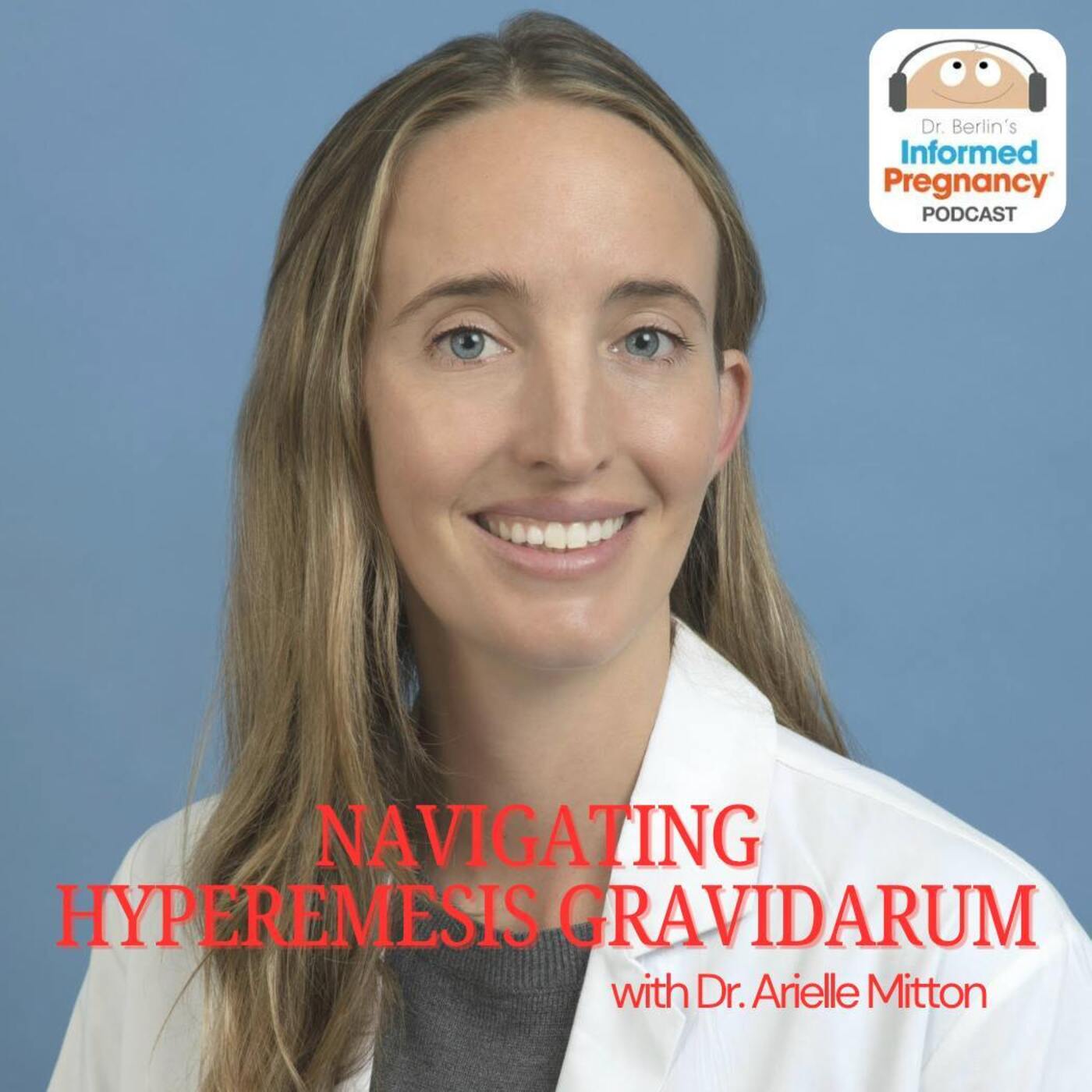
February 20, 2025 · 34 minutes · Episode 447
About this episode
Dr. Arielle Mitton is an internal medicine physician and board member of The HER Foundation (Hyperemesis Education and Research). She discusses the unexpected hurdles in her own pregnancy, including secondary infertility, which led her to a deep desire help others navigate hyperemesis gravidarum.

Connect with the guest:
Documentary: Sick: The Battle Against HG on IP+
The untold story of women experiencing Hyperemesis Gravidarum (HG), a terrible pregnancy sickness that affects 3 million women leading to thousands of abortions of wanted children and 9 months of hell. HG campaigner Charlotte Howden challenges the medical profession and explores women’s politics, secrets, loss, and reveals new scientific breakthroughs in HG research.
Key quotes
“That's exactly what I said. I said, I can't believe this is happening, you know, currently in America treatment wise for hyperemesis and this is just not right.”
“I mean, I think if it was in a different situation, like if, you know, it was before modern medicine, I probably would have died.”
“And he said to me, well, do you want to have a baby or do you want to be pregnant? Like, that was his question to me.”
“But I also think that your mind has proven capable to do what a lot of other people's minds can't do. Which is what? Power through, find a way.”
“And she said, I don't think you failed. She said, you're a survivor. You've already done two, you've completed two and you know, now you're not giving up. You know, you're having a baby despite all the hurdles coming your way.”
Related episodes
- Ep. 435 Jackie Amézquita: After Birth
- Ep. 426 Mia Rigden: After Birth
- Ep. 443 Jessica Zadeh: After Birth
- Ep. 442 Jessica Zadeh: Before Birth
Transcript
AI-generated transcript with speaker labels — may contain errors, especially names and medical terms. Dr. Elliot Berlin, DC appears in blue; Dr. Arielle Mitton in orange.
Download PDF of the Transcript
Dr. Elliot Berlin, DC [0:36] Welcome to the Informed Pregnancy and Parenting podcast. I'm your host, pregnancy-focused chiropractor Dr. Elliott Berlin. My guest today is someone with an incredible story and unique perspective on pregnancy and parenting. She's an internal medicine physician and board member of the Her Foundation, Hyperemesis Education and Research. She's dedicated to helping others navigate the challenges of this pregnancy condition, Hyperemesis Gravidarum. From dreaming of becoming a doctor when she was just three years old, to balancing a demanding medical career with her own deeply personal parenting journey, her experiences span the joys and complexities of growing a family.
[1:13] Along the way, she's faced unexpected hurdles, including severe nausea and complications with her pregnancy and secondary infertility, leading to transformative decisions and lessons about care advocacy and resilience. Dr. Ariel Mitten, welcome back to the podcast.
Dr. Arielle Mitton [1:29] Thank you for having me again. Nice to see you after so many years.
Dr. Elliot Berlin, DC [1:33] Yes, we had you originally because this is how it all went down. I interviewed Amy Schumer together with my wife in episode 154, and we promised her we would do some investigating about hyperemesis. She had a terrible case of hyperemesis, and you kindly came onto the podcast with two other doctors from the Her Foundation and really shared a lot of information about what we know about hyperemesis and unfortunately what we don't know about hyperemesis and some of the ways to mitigate a pregnancy with hyperemesis, to realize that you even have it, to support people around you that have it, and like the others on that podcast, you had it as well. So you guys came on, that was episode 168, and then on episode 384, we had Charlotte
[2:20] Howden, who is the documentarian who made the film Sick! The Battle Against Hyperemesis Gravidarum, which is also streaming on Informed Pregnancy Plus. So it's been quite some time since I saw you last.
Dr. Arielle Mitton [2:32] And there have been advances, actually, from one of the two other people that was on the show with me, she's done a lot of research that have actually advanced the field of hyperemesis.
Dr. Elliot Berlin, DC [2:41] Yeah, so that's my first question, what's the latest?
Dr. Arielle Mitton [2:44] So Marlena Fezzo discovered the GDF15 gene as the likely main cause, so basically in pregnancy a rise in this GDF15 level is what is thought to cause the severe hyperemesis that some people get, so just like their body's not used to the level and it goes up rapidly, so there is some thought, now this is not, like I'm not saying people should go out and do this yet until there's more research, but there is some thought that if you increase your GDF15 level before pregnancy, if you know you have a history of hyperemesis, it maybe could help. So for example, metformin is thought to increase GDF15 level, so some people are thinking, oh, what if we pre-treat with a medication like metformin?
[3:24] So I think we're on a pathway, you know, I don't know what the ultimate results will be.
Dr. Elliot Berlin, DC [3:27] Is the issue that it goes down?
Dr. Arielle Mitton [3:30] No, that it goes up.
Dr. Elliot Berlin, DC [3:31] It goes up, so if you pre-raise it, then you're sort of conditioning the body?
Dr. Arielle Mitton [3:36] Yeah, exactly, like your body's not shocked by the major increase that you have.
Dr. Elliot Berlin, DC [3:40] Is that a satiety related?
Dr. Arielle Mitton [3:42] Yeah, I mean, it can cause sort of like the picture that you get in hyperemesis, just, you know, like low appetite, yeah, kikexia. Yeah, and your body just doesn't want anything else. Yeah.
Dr. Elliot Berlin, DC [3:53] OK, tell me about you and the work that you do.
Dr. Arielle Mitton [3:56] You mean my professional work or my hyperemesis foundation work?
Dr. Elliot Berlin, DC [3:59] Both.
Dr. Arielle Mitton [4:00] OK, so professionally, I'm trained in internal medicine. I did a fellowship in geriatrics and then I had my first child in residency and my second one in fellowship. So I decided after everything was done schedule wise to work in urgent care because I liked the schedule better having kids at home. So I was doing urgent care when we last spoke. Now I'm actually working remotely telemedicine from home. So I found a way to make my physician world fit with my goal of parenting right now. Yeah, so it's been working out really well. And then I was also at the time I spoke to you, I was a board member of the Hyperemesis Foundation because I was hit with really hard hyperemesis,
[4:38] very severe with my second and third pregnancies, so debilitating that I couldn't get out of the bed to go pee. I lost over 20 pounds. I like to start. I weigh 120. So I was, you know, it was probably 700 pounds during pregnancies. Well, I just felt like I was dying, you know, up until 24 weeks. It was pretty hard. I would say almost impossible that I can't believe I made it through those. But I had a really great care team for those ones. It kind of made me decide to look around what was out there. And when I saw Hyperemesis Foundation, I said, well, I have to reach out and see what I can do to help. So that's how I became involved with them.
Dr. Elliot Berlin, DC [5:11] I would just say for listeners who think that they may have hyperemesis or want to learn more about it. What does the foundation offer?
Dr. Arielle Mitton [5:17] Oh, the Hyperemesis Foundation offers resources for both practitioners and patients, people that are experiencing hyperemesis and family caregivers. So when you go onto our website, hyperemesis.org, you can find a plethora of resources. So if you're looking for yourself, there's treatment protocols that you can print out and take to your doctor to share with them. There's support groups for doctors. There's resources about how to treat properly, since it's not something that's well taught in medical school or residency, even OB-GYN residency.
Dr. Elliot Berlin, DC [5:45] Right. So I have patients who went to the resources of the Herve Foundation and then brought that to their doctor to be like, I don't think this is nausea and vomiting or pregnancy. This is something else. And that's how they were able to educate their doctor on what's going on.
Dr. Arielle Mitton [5:59] Yes, that's true. And, you know, personally, I was very lucky with my first two hyperemesis pregnancies that my doctor was, you know, aggressive and supportive and all the things that a doctor should be, you know, when dealing with a hyperemesis patient. But I learned the hard way that not all doctors are like that. And, you know, I have a very sad story about what happened with my attempt to have a fourth and final pregnancy, which would have been my third hyperemesis pregnancy. And I was at a different hospital system and did not have a doctor who believed in hyperemesis and just didn't want to treat me and ended up in a very terrible situation because of that.
Dr. Elliot Berlin, DC [6:32] And that's crazy because you are a doctor.
Dr. Arielle Mitton [6:35] Yeah.
Dr. Elliot Berlin, DC [6:35] Right. But if you have that problem, how does the rest of us get by?
Dr. Arielle Mitton [6:39] That's exactly what I said. I said, I can't believe this is happening, you know, currently in America treatment wise for hyperemesis and this is just not right.
Dr. Elliot Berlin, DC [6:46] But to recap your first few pregnancies, you didn't have hyperemesis on the first one.
Dr. Arielle Mitton [6:52] I had what I would call severe nausea, vomiting of pregnancy. So I lost about six pounds. There were limited foods I could eat and I was still able to go to work. But, you know, to me, it was starkly different than my second one where like it hit me like a train and I couldn't get out of bed. I couldn't eat anything. Like I take one bite of yogurt or one sip of apple juice and a vomit 30 times afterwards and just had no, like you just have no energy because you can't take anything in. And so I couldn't stand up. I was weak. Yeah, everything was terrible.
Dr. Elliot Berlin, DC [7:19] Which is also just an important take home lesson because you don't have it as bad in one pregnancy doesn't mean that you're not going to have full blown hyperemesis in another pregnancy.
Dr. Arielle Mitton [7:28] And for me, it seems to get worse each pregnancy.
Dr. Elliot Berlin, DC [7:31] Right. So that your second pregnancy, did it kick in early?
Dr. Arielle Mitton [7:36] Six weeks.
Dr. Elliot Berlin, DC [7:37] Wow.
Dr. Arielle Mitton [7:38] That's like how I knew I was pregnant. Oh, I started vomiting and I can't get out of bed. I'm pregnant.
Dr. Elliot Berlin, DC [7:43] Wow. And how did you treat it along the way? How did you care for it?
Dr. Arielle Mitton [7:47] So, um, home health, IV fluids, I was doing daily, like, you know, I know some guidelines will say, you know, every or three times a week, but I was having to do at least two liters daily because I really was having no PO intake. So we were doing D five half normal saline and then doing, you know, IV multivitamins. So I would get my thymine and my folate and all those things that I was missing by not eating. I mean, I avoided getting a pick line with that one. I just, you know, had peripheral IVs that we would change all the time. But with my subsequent pregnancy, I ended up doing a catheter, like indwelling catheter just because it was too much to change.
Dr. Elliot Berlin, DC [8:21] That's a lot of poking.
Dr. Arielle Mitton [8:23] Yeah.
Dr. Elliot Berlin, DC [8:23] Exactly. Yeah. So with that, it sounds like you're still miserable, but getting enough nutrition to sustain the pregnancy.
Dr. Arielle Mitton [8:32] Yeah. The babies were healthy when they were born. I was surprised. They came out at nine pounds. I was not expecting that, but you know, I was down to, like I said, like seven hundred pounds and I looked like a skeleton. So.
Dr. Elliot Berlin, DC [8:43] Wow. But it's incredible that your body was able to give them the nutrition to be that.
Dr. Arielle Mitton [8:49] I mean, I think if it was in a different situation, like if, you know, it was before modern medicine, I probably would have died. I mean, you know, there were points where my potassium was, you know, 2.7, like before I started the IV treatment and you know, that can cause cardiac arrhythmias, you know, heart problems. So I, you know, I do think that it's only because of modern medicine that people can make it through, you know, otherwise I think it's a deadly condition.
Dr. Elliot Berlin, DC [9:10] Right. For either you or the baby.
Dr. Arielle Mitton [9:13] Right.
Dr. Elliot Berlin, DC [9:13] Potentially both.
Dr. Arielle Mitton [9:15] Exactly.
Dr. Elliot Berlin, DC [9:16] In your third pregnancy, you had it again.
Dr. Arielle Mitton [9:18] Yes. And I knew what to do this time and I had the same insurance. And so, you know, we knew how to treat it basically.
Dr. Elliot Berlin, DC [9:25] Was it a planned pregnancy? Was it hard to say I'm going to do this again?
Dr. Arielle Mitton [9:29] No. Like I knew how much I suffered, but I also had a strong maternal desire, which was stronger than my suffering remembrance, if that makes sense.
Dr. Elliot Berlin, DC [9:39] No, it makes sense, but it's again, it's incredible is the only thing that comes to mind. Like how strong really women are. I mean, when everything goes great, it's such a task, you know, it's such a commitment. It's almost a sacrifice that you make to bring babies into the world when everything's just fine. Yeah. And then when something like this happens, it's magnified many times over.
Dr. Arielle Mitton [10:03] And then in addition to just the medical treatment, something else I will say for somebody who is known to have hyperemesis and is, you know, considering another pregnancy, just as important is just like family or external support, because like I had two kids at the time and I knew I couldn't get out of bed.
Dr. Elliot Berlin, DC [10:18] Right.
Dr. Arielle Mitton [10:18] So beforehand, like I had my plan for like my mother-in-law, my mom, babysitter, you know, we had all those plans for like different time periods that people would be with the kids. So I think that's also something to consider too. It's not just the medical treatment. It's just, you know, support for your life too.
Dr. Elliot Berlin, DC [10:33] All right, let's take a little break. When we come back, we'll find out what happened after the third pregnancy and how things really changed for the fourth. We'll be right back.

Dr. Elliot Berlin, DC [10:54] Welcome back. We're talking to Dr. Ariel Mitten. Okay. So third baby, a little complication at the end.
Dr. Arielle Mitton [11:01] Yes, at delivery. Yeah.
Dr. Elliot Berlin, DC [11:03] What happened?
Dr. Arielle Mitton [11:04] So I had, I had adherent placenta in my second pregnancy or my first hyperemesis one where the doctors had to reach in and remove the placenta, but it came out fine when they did that. But then with my next pregnancy, same thing happened, but, you know, it didn't come out after 30 minutes. So they were going to remove it manually. Started coming out in pieces and I was losing a lot of blood. And over the course of that day and the next day in the hospital, I had had to receive six units of blood total. So I had lost, you know, over half of my blood volume.
Dr. Elliot Berlin, DC [11:33] Wow.
Dr. Arielle Mitton [11:33] I don't even remember what my blood pressure was, but my hemoglobin was, you know, like around six or just less than six. And so I think it was scarier for my husband than me because he actually saw what was going on where I was sort of out of it. And then on the third day they had to do a DNC just to remove everything, make sure everything was gone.
Dr. Elliot Berlin, DC [11:49] Wow. So not a lot of bonding with your baby at that time, I imagine.
Dr. Arielle Mitton [11:53] I actually still did. I mean, it happened so quickly, I will say. So I probably don't remember the times that I wasn't with her.
Dr. Elliot Berlin, DC [12:00] Well, that's for the best.
Dr. Arielle Mitton [12:01] Yeah.
Dr. Elliot Berlin, DC [12:02] And is that something that you think is connected to hyperemesis or totally separate?
Dr. Arielle Mitton [12:07] I wonder. That's the same question I have. I mean, there's no real data for that, but in both my pregnancies where the placenta didn't come out, those were the two hyperemesis pregnancies and the one where it did come out was just my normal kind of nausea, vomiting pregnancy. So I have to assume there's a connection for me personally, but I don't know if that would be across the board for everyone.
Dr. Elliot Berlin, DC [12:26] After a pregnancy like that and a delivery like that, how long does it take you to recover?
Dr. Arielle Mitton [12:31] Yeah, it took me probably about two years, honestly, to feel fully strong again, where I could go for runs. I mean, I was recovering slowly every day. I would say with my pregnancy where I didn't lose blood, I was up and walking the next day, walking around the neighborhood by day three. But with this one, I remember like being in bed for the first two weeks, just kind of feeling a little bit weak from all the blood loss.
Dr. Elliot Berlin, DC [12:53] But yet you decided maybe we should do this again, a fourth day.
Dr. Arielle Mitton [12:57] Yeah, I told you, I think I have too strong of a maternal dose or whatever hormone it is causing me to feel that way.
Dr. Elliot Berlin, DC [13:04] And so what happened when you started trying for your fourth?
Dr. Arielle Mitton [13:08] Well, first I consulted with my trusted doctor and then an MFM specialist just because of my delivery history. You know, I had said I don't want to do this if I'm going to die. Like I did have some reason, I guess, reasonable thoughts there. But the MFM did clear me and gave me specific instructions for what I would do during pregnancy to monitor and during delivery. Should the monitoring show the placenta was the same way again? You know, and the worst case scenario, what they said would have been a C hysterectomy, so C-section with a hysterectomy, which I know is not easy. So it's also can be a difficult surgery. But they made me feel confident enough
[13:42] that I didn't feel like I was being stupid getting pregnant and risking my life. So they said, you know, we can handle this. You know, we're a special center for this. We do this all the time. And then I tried to get pregnant and I didn't get pregnant for about a year. And it turned out I had adhesions from my DNC after delivery. So I had to have those removed and then I got pregnant about two months later.
Dr. Elliot Berlin, DC [14:00] Is that the first time you struggled to get pregnant?
Dr. Arielle Mitton [14:02] Yes, like usually it would take me one month, two months.
Dr. Elliot Berlin, DC [14:06] And then after the adhesions were removed,
Dr. Arielle Mitton [14:08] it came fairly quick. Yeah, it came pretty quickly, but we had changed jobs in between all this time. And so I had different insurance. And when I tried to make an appointment and told the nurse on the phone about my history and I need an early appointment, they said, OK, you can have an appointment with the doctor at 12 weeks.
Dr. Elliot Berlin, DC [14:25] Oh, you were already having the hyperemesis symptoms?
Dr. Arielle Mitton [14:28] Well, not yet, but I knew my history. So that's why I was trying to be proactive, right?
Dr. Elliot Berlin, DC [14:33] Yeah.
Dr. Arielle Mitton [14:33] And then their standard in that system is 12 weeks. Yeah, it was an HMO system. They just, you know, I guess didn't have the same staffing or something, but they said 12 weeks will get you in. I said, oh, that's not going to work for me.
Dr. Elliot Berlin, DC [14:44] Wow. And so what happened?
Dr. Arielle Mitton [14:46] So I got predictably sick around six weeks and just kept getting sicker. And I had to go to their walk-in clinic, OBGYN walk-in clinic. I went there and unfortunately, the doctor I saw that they didn't really believe I was as sick as I said I was like, I don't know. They didn't believe in hyperemesis or they thought I was faking it or something like that, because it was me arguing with the doctor. I remember calling Kimber from the Hyperemesis Foundation on the phone, you know, crying on the phone because this doctor wasn't believing me.
Dr. Elliot Berlin, DC [15:13] Wow. And this is recent.
Dr. Arielle Mitton [15:15] End of 2021.
Dr. Elliot Berlin, DC [15:16] Yeah, beginning of 2022.
Dr. Arielle Mitton [15:17] Exactly.
Dr. Elliot Berlin, DC [15:18] When we already have a lot of information about it and have been publicizing and publishing data. That's crazy.
Dr. Arielle Mitton [15:25] Yeah. I mean, you have to be specifically looking for the hyperemesis data. I think it's not widely taught, you know.
Dr. Elliot Berlin, DC [15:31] Right. But again, when you walk in and you're a medical doctor and you're saying I have this condition and a medical doctor on the other side doesn't listen to you. It's kind of mind boggling. What I said at the beginning of the podcast is how does someone who's not a medical person get listened to? If you can't. And so.
Dr. Arielle Mitton [15:51] Well, I ended up going to the ER that time, which I never had to do with my other pregnancies because I was so supported and treated. I ended up going to their ER.
Dr. Elliot Berlin, DC [15:58] And did they treat you there?
Dr. Arielle Mitton [16:00] They did. They did treat me there. And actually I got steroids there, which I was nervous about because I know you're not supposed to give before 10 weeks, you know. And I mean, it probably would have been fine, but I felt great from the steroids. But then the problem was when I got discharged, I went back to the care of that doctor and I didn't continue the steroids and I hit rock bottom quickly again after the steroids wore off.
Dr. Elliot Berlin, DC [16:19] And then what happened after that?
Dr. Arielle Mitton [16:22] So I was afraid of dying, right? Because like I wasn't getting my weekly labs, I wasn't getting, you know, the treatment I was supposed to get. And talking to that doctor, I ended up doing a termination. So I was scared I was going to leave my other kids motherless. I wasn't feeling supported, you know, by my medical team. And I chose that route, I guess, because out of desperation, when I look back at it.
Dr. Elliot Berlin, DC [16:43] I guess two questions. First of all, it's not hypothetical. People die from hyperemesis.
Dr. Arielle Mitton [16:49] Yes.
Dr. Elliot Berlin, DC [16:49] Mothers and babies die from hyperemesis when it's untreated, especially. And so for you to have that feeling, seemingly both your neocortex, where you have all this training and your old limbic system telling you this is not going to end well and pushing you, despite your incredible maternal drive, to have babies.
Dr. Arielle Mitton [17:12] I mean, I think because of that maternal drive, like the day after, I just mentally broke down.
Dr. Elliot Berlin, DC [17:16] How did that manifest?
Dr. Arielle Mitton [17:18] Luckily, never experienced, you know, depression in my life. But I think this was the first time I did. I was like, I couldn't get out of this. And, you know, once I was physically getting better, it was like I wasn't connected. I felt like disconnected for my life. I felt disconnected from my kids. I just felt guilty about what had happened, even though, you know, it was, you know, not my fault. I was blaming myself for it. It took a lot of time to feel better.
Dr. Elliot Berlin, DC [17:42] How many weeks were you when you terminated?
Dr. Arielle Mitton [17:45] I think about eight weeks.
Dr. Elliot Berlin, DC [17:47] So you already saw a heartbeat.
Dr. Arielle Mitton [17:49] Yeah. It's really hard.
Dr. Elliot Berlin, DC [17:51] Yeah, it was really hard. Yeah. After your termination, it sounds like you weren't done having kids yet. So where do you go from there?
Dr. Arielle Mitton [17:59] Exactly. So, I mean, in my head, I envision like that pregnancy was going to be my completing pregnancy, like my final one. You know, I kind of envision my family with the four kids and that was it. And so I think because of that, it made the termination extra hard on me, you know, because I wasn't able to get to my goal, you know, and I'm a driven person, right? Like I'm a goal oriented person. So we actually ended up leaving Los Angeles at that time. You know, it wasn't because of what happened, but that was probably a factor. We had other reasons to leave that we had been talking about for a few years. So maybe it was like the final straw type of thing.
[18:34] So we moved up to Washington State. And so I said, OK, now we're in a new location. You know, let's research. Let's find really good doctors. And maybe we can, you know, do this and complete our family and just make sure we have really good care before we get pregnant, you know, since we learned a hard way from our experience. So I took my time. I like met with some OBGYNs, found some that I really trusted and liked. And I said, OK, let's do this. And then again, you know, wasn't getting pregnant, which wasn't unexpected because after my termination, I had unexplained uterine fluid. And when I was still in California, we were trying to work it up,
[19:05] but we couldn't figure out the cause of it. So I wasn't surprised that I wasn't getting pregnant when I started trying. And so then I continued the work up here in Washington for this unexplained fluid and found a couple of things. I found that I had new adenomyosis, which we think happened from the DNC. And then I had adhesions again.
Dr. Elliot Berlin, DC [19:26] What is adenomyosis?
Dr. Arielle Mitton [19:28] So adenomyosis, they say it's like the sister of endometriosis. But instead of having growths, endometrial tissue outside of the uterus, you have it in your myometrium. So it just kind of invades deeper into the uterus.
Dr. Elliot Berlin, DC [19:40] So does that prevent implantation?
Dr. Arielle Mitton [19:43] It can. It's one of those things that if you ask a fertility doctor, they'll say it might, it might not. Like a lot is not known about it, but it can.
Dr. Elliot Berlin, DC [19:51] OK. And is that from previous uterine trauma?
Dr. Arielle Mitton [19:55] We think so, in my case. That's what we think it's from. You know, some women can have it just from having babies in the past, too. They usually have more mild cases, those women.
Dr. Elliot Berlin, DC [20:03] Got it. OK. So is there a treatment to try to overcome it?
Dr. Arielle Mitton [20:08] So I did do lots of treatments. So I mean, I had a hysteroscopy, laparoscopy to remove adhesions and just look for signs of endometriosis, which was not there. And then I had this really difficult medical treatment called Lupron. So basically it just suppresses the estrogen because it's thought that adenomyosis and endometriosis feed off of estrogen. So estrogen worsens the disease and then makes it harder to get pregnant. So the idea is you suppress estrogen and then it's supposed to suppress the disease, like shrink the disease.
Dr. Elliot Berlin, DC [20:37] OK. Is that similar to the injections people do for IVF?
Dr. Arielle Mitton [20:41] Well, it's an injection. It's a monthly injection.
Dr. Elliot Berlin, DC [20:44] OK. A monthly injection.
Dr. Arielle Mitton [20:46] But it's horrible side effects. It's like you're going through menopause. You get night sweats. You get bone pain, joint pain, headaches, insomnia.
Dr. Elliot Berlin, DC [20:55] Why do bad things happen to good people? Keeps running through my mind as you share your story.
Dr. Arielle Mitton [21:01] Yeah. So it was definitely an interesting journey, I will say. Yeah. So my doctor asked me at one point. So I ended up seeing an REI doctor because my OB-GYN and my minimally invasive surgeon said, I think you should see a REI doctor at this point.
Dr. Elliot Berlin, DC [21:15] That's a reproductive endocrinologist.
Dr. Arielle Mitton [21:17] Exactly. OK.
Dr. Elliot Berlin, DC [21:19] A specialist, a fertility specialist.
Dr. Arielle Mitton [21:21] Yeah. Well, it was good. He was really caring and I felt listened to and heard. And he said to me, well, do you want to have a baby or do you want to be pregnant? Like, that was his question to me. Well, so it was a great question now that I look back. I think at the time I was shocked. But I mean, I said, well, obviously, I just want to complete my family with a baby. Like, you know, why are you asking me this question type of thing? You know, type of answer.
Dr. Elliot Berlin, DC [21:45] Yeah. So what was his recommendation?
Dr. Arielle Mitton [21:48] Well, he recommended that I start looking into surrogacy. So, you know, he didn't want to force it on me. Like, you have to do surrogacy. But he was like, look, you have severe infertility, uterine factor infertility. You have severe hyperemesis, right? He's like, that alone is enough to just qualify you for surrogacy. You know, you don't need to have all these other things, you know. And, you know, you have a postpartum hemorrhage. So he's like, you have three reasons that you should consider a surrogate.
Dr. Elliot Berlin, DC [22:12] Sure. And one of them to the point where you kind of had to terminate the pregnancy. So who knows, like, if you were able to get pregnant again, how that would go. Exactly.
Dr. Arielle Mitton [22:21] So we did one round of making embryos and I luckily got seven good embryos. So I did while I was looking for a surrogate, because that's a long, long process to find a surrogate. I did try to transfer, I think, two of them on myself without success.
Dr. Elliot Berlin, DC [22:35] OK. I mean, so far to this point, crazy journey. Yeah. And I bet you're one of those people who just when you see your kids and when they're screaming in the middle of the night, you're just super happy to hear those little screams and voices.
Dr. Arielle Mitton [22:49] Yes, it's true. And even more so now. Yes. Yeah.
Dr. Elliot Berlin, DC [22:53] So let's take a little break. When we come back, we will talk about what it was like to have your fourth baby by surrogate. We'll be right back. Welcome back. We're talking to my new hero, Dr. Ariel Mitten. Incredible. You know, I say this sometimes that I did not appreciate either my mother or my wife nearly as much as I needed to until I started working with the pregnancy clientele.
Dr. Arielle Mitton [23:28] It's never too late.
Dr. Elliot Berlin, DC [23:30] Yeah, I'm trying to make up for it. But again, that's just like with regular pregnancy, watching what women do. And when I talk to someone like you, you know, who never gives up, despite the intense pressure against you, you know, resistance. I find it inspiring. So thank you. Last segment, we're going to talk about your fourth pregnancy. All has failed. You decided to have your fourth baby via surrogate. What's the process like of finding a surrogate?
Dr. Arielle Mitton [23:56] Yeah. So, I mean, the first was just us opening our minds to it, which maybe took a year or a year and a half, I think, to like fully. And then once we started it, there's different ways you can find a surrogate. You can either pay an agency and like you're stuck to that agency and they find you your surrogate, but you pay them up front of deposit. There's other agencies where it's like you don't pay us anything until we match you as somebody. So you can look at multiple agencies like that at the same time. Or you can, you know, use social media and word of mouth to have your friends, you know, through their friends for you. And there's also like Facebook meeting groups
[24:29] where surrogate and intended parents can meet each other.
Dr. Elliot Berlin, DC [24:32] What did you do?
Dr. Arielle Mitton [24:33] I did a combination of two and three. So I would peruse the Facebook meeting groups. And I also reached out to some of those agencies where they don't charge anything up front, because I think we were still on the fence about it. You know, we weren't like sure enough to like pay a deposit for it.
Dr. Elliot Berlin, DC [24:48] How did you find your surrogate?
Dr. Arielle Mitton [24:50] Well, before I found her, this is part of the story about finding her. I was presented with about six or seven other surrogates from those agencies. And I did zoom interviews with them. And there was just either, you know, something with their medical history or we didn't have that connection. I didn't know if I could trust them. So we didn't move forward with any of those people. And we kind of felt like we're about ready. So this was, you know, maybe December 2023. We're like, I don't know if we should continue. I don't know. But then kind of took a break from it for a month or two. And then in end of November, I was just going to bed one night
[25:21] said, I'm just going to look one more time on that Facebook group to see what happens. So I was scrolling it and I go, oh, this ad looks interesting for this surrogate. It was posted by an agency about her. I said, I'm going to message them. I didn't hear back for two weeks. And then I got a response. So I said, oh, she's probably taken. She looked too good. And then I got a response saying, oh, she's available still. Do you want to talk to her on Zoom? Sorry. You know, we were out of town and we missed your message. I said, yes, yes, I would. So we know the dates of December 3rd, 2023. We get on Zoom and, you know, she's where you are right now
[25:49] on the top portion. I'm on the bottom. But we just look at each other. And our first response is we just start laughing like both of us. At the same time, we must start laughing. It's because we look like sisters. I don't know. We had this like weird connection right away. And then we talked for three hours straight nonstop.
Dr. Elliot Berlin, DC [26:03] Had she ever done it before?
Dr. Arielle Mitton [26:04] No. She had thought about it for years and never done it.
Dr. Elliot Berlin, DC [26:08] Well, and you know, we've talked about this. We're going to tell the story quickly. Yeah. And it's going to leave me for sure thirsty for more details and probably the audience as well. But we're going to bring both of you back and do a much more in-depth episode about what it was like for both of you. That will be the best story to tell. I guess from the time you met, there's a lot of details to work out even once you decide to do it. How long did it take to like work out the details and start the process?
Dr. Arielle Mitton [26:37] I think we were blessed in the fact that we're both open communicators. She also was in her early 40s, which I think, you know, a lot of people overlooked her because of that. But she had a really clean OB history. And I think that maturity just, you know, helped also move things along. But for us, I think it was probably quicker than most surrogate and independent parents. But we talked for three hours that first time and worked a lot of details out. And then over the month of December, we worked a lot more out. And I think we started to do our contract and we both knew what we wanted. We telling the lawyers, this is what we want. And so we went through it pretty quickly.
[27:11] So I think maybe if the lawyers are fast, you can do it in two weeks. But maybe most lawyers probably do it in like four to six weeks.
Dr. Elliot Berlin, DC [27:18] And when you move forward with it, was it with an embryo you had already made?
Dr. Arielle Mitton [27:23] Yes. So it is safer for all parties to make sure the intended parents have embryos first, right? Otherwise, it could waste people's time. Because what if you can't make embryos, right? Then you're paying someone and then you can't do anything. So, yeah, we had embryos frozen first.
Dr. Elliot Berlin, DC [27:38] And did the first one take?
Dr. Arielle Mitton [27:40] Yeah, we were very lucky.
Dr. Elliot Berlin, DC [27:42] OK, that's the first sigh of relief, I suppose.
Dr. Arielle Mitton [27:45] Yeah, I mean, you're always nervous the whole time. And she's nervous because it's not her baby and she wants everything to be perfect. But we had to, you know, calm ourselves, calm each other and just keep going forward.
Dr. Elliot Berlin, DC [27:53] What kind of involvement did you have through the pregnancy?
Dr. Arielle Mitton [27:57] Like, she's not in the same state as me. She's in Indiana. I'm in Washington state. But despite that, like we either texted or phone called or FaceTimed every day. So, you know, she wanted me to be as connected as I could. Every appointment she had, I was on FaceTime. And so I knew the doctor when I went to Indiana to delivery. Like, you know, I felt like I knew him and he knew me already. So she made me feel really connected.
Dr. Elliot Berlin, DC [28:19] What was it like sort of growing a baby not inside you?
Dr. Arielle Mitton [28:24] So there's positives and negatives, and I'll go into more details next time we talk. But in a weird way, it helped me heal from all the trauma of what happened with my attempted fourth pregnancy and the loss that I had. It made me realize how much suffering I had done for my other babies that I had hyperemesis with and then the scariness for my husband of delivery. And the fact that this time I was able to actually enjoy it and not, you know, be in bed for six months and miss out on life for six months. And when I was going into the delivery room, my husband wasn't worried that it was the last time he was going to see me. So when I realized these things, it actually brought a lot of peace and
[29:02] helped me, I think, move forward.
Dr. Elliot Berlin, DC [29:04] For delivery, did she come to you or did you go to her?
Dr. Arielle Mitton [29:07] I went to her. And it's usually done that way, you know, because you're not supposed to travel when you're that pregnant.
Dr. Elliot Berlin, DC [29:12] Towards the end, yeah. Did your husband go too?
Dr. Arielle Mitton [29:15] So we'll touch on this in the other episode, but we had a unique situation during our surrogacy journey where escrow stole our money, which is unheard of. But because of that, we tried to keep costs low because we're having to do double payments now to the bank and to her. And so I went by myself and he stayed with our other kids.
Dr. Elliot Berlin, DC [29:33] Wow. OK. And then delivery.
Dr. Arielle Mitton [29:37] Delivery. Yes. It was like textbook perfect. I mean, this was her fifth delivery. She has four kids of her own. She's one of the four kids club. Yes. Yeah. So it was amazing. It was magical. I caught my baby because the doctor didn't make it in time. So the nurse and I caught the baby together.
Dr. Elliot Berlin, DC [29:53] Oh, wow. That's sweet.
Dr. Arielle Mitton [29:56] Her friend was taking photos. So I have really great documentation of me holding my baby, like just coming out of, you know, the uterus and just really special moments. Did you breastfeed your other kids? I did.
Dr. Elliot Berlin, DC [30:08] Were you able to produce milk for the fourth?
Dr. Arielle Mitton [30:10] I'm glad you asked me. So right before Joy and I was here with my med box, taking my Dom Peridone and my other herbs and things. So I'm trying and I'm making a little bit right now. Like there's something called an SNS where you like put a tube. Yeah, so I've been feeding her through there and then I'll be pumping also when she's not feeding. And so I don't know exactly how much I make because I know she's getting some when I feed, but when I pump, I'm only getting about one ounce right now on each side. So I'm making a little and I'm hoping it will increase.
Dr. Elliot Berlin, DC [30:36] So with the SNS, you're able to latch though. Yes. And get all the benefits for both of you of latching and you're making some milk, we know.
Dr. Arielle Mitton [30:44] So I'm hoping it will increase, but we'll see.
Dr. Elliot Berlin, DC [30:46] She could be getting more from you than the pump does.
Dr. Arielle Mitton [30:48] Exactly. Exactly.
Dr. Elliot Berlin, DC [30:50] How old is the baby now?
Dr. Arielle Mitton [30:51] Four weeks. She was born December 17th.
Dr. Elliot Berlin, DC [30:53] Wow. Congratulations. Thank you. It's a powerful story. It feels like a happy ending. Yes. To me. Does your family feel complete now?
Dr. Arielle Mitton [31:04] It does. I mean, she was definitely a missing piece. I think I'll always have some sadness over the fact that my body can't do what other people's bodies do and just have a normal pregnancy. You know, it's sad to know that I suffer so much during pregnancy and it kind of takes away choices from me. I think that's the hardest part to deal with.
Dr. Elliot Berlin, DC [31:24] I totally hear that. But I also think that your mind has proven capable to do what a lot of other people's minds can't do. Which is what? Power through, find a way. And again, even just the second hyperemesis pregnancy and going for a third hyperemesis pregnancy and then moving over to switch gears for the surrogacy. It's a lot of mental resilience and stamina.
Dr. Arielle Mitton [31:50] And I think we're always harder on ourselves than we need to be because I remember a discussion with a friend who also did some work with the Hyperemesis Foundation and I was saying, well, I failed. You know, I failed myself. I didn't make it through that one. And she said, I don't think you failed. She said, you're a survivor. You've already done two, you've completed two and you know, now you're not giving up. You know, you're having a baby despite all the hurdles coming your way. So she said, I don't think you're a failure.
Dr. Elliot Berlin, DC [32:13] I couldn't agree more. Doc, we've talked about your work, not just your experience, but your work with the Hyperemesis Foundation, the Her Foundation. Where can we find that online?
Dr. Arielle Mitton [32:22] Yeah, so just go to hyperemesis.org and that's where you can find all the resources and contact us there.
Dr. Elliot Berlin, DC [32:28] I appreciate you joining me again and sharing your deeply personal and very inspiring story. And I look forward to having you back and digging really deep into what surrogacy was like, both for you and your surrogate in the coming episodes.
Dr. Arielle Mitton [32:45] I can't wait for that and I'll leave you guys with one little tidbit here about that. So we were told by the nurses that they've never seen a surrogate and intended parent so close after delivery.
Dr. Elliot Berlin, DC [32:55] Wow, there's a teaser.
Dr. Arielle Mitton [32:57] Exactly.
Dr. Elliot Berlin, DC [32:59] At home, thanks for listening to the Informed Pregnancy Podcast for more pregnancy and parenting information. Just like this, visit us online at informedpregnancy.com.
Want more pregnancy + parenting? Start your FREE TRIAL of Informed Pregnancy+ and get access to all our curated pregnancy and parenting content — original series, iconic birth films like The Business of Being Born, prenatal workouts and more.
