
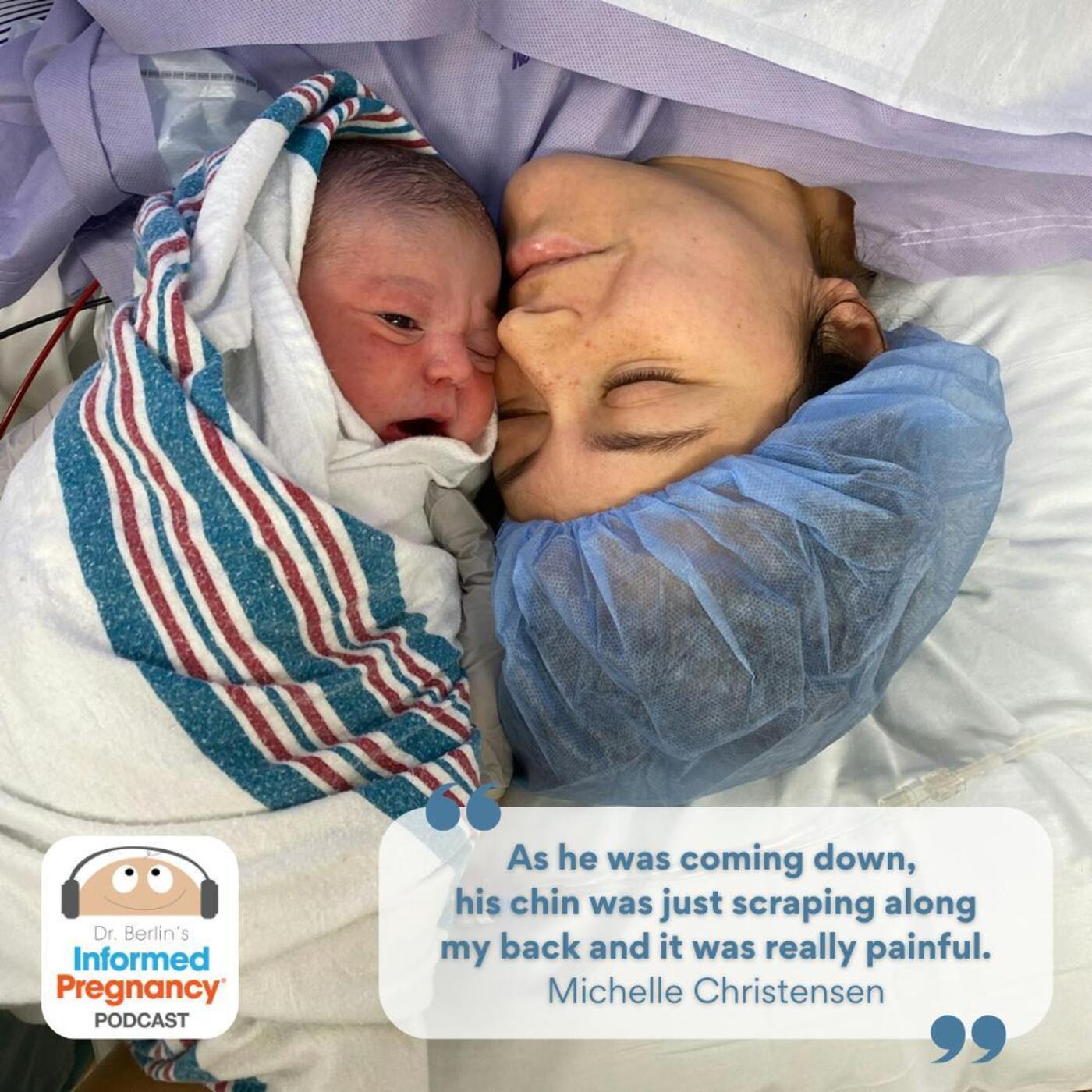
May 23, 2024 · 45 minutes · Episode 408
About this episode
Sound healer and women’s circle facilitator Michelle Christensen returns to tell the birth story of her first child.

Key quotes
“And I felt good about making the decision because I knew that I had done and tried everything. And there was nothing else I could do at this point.”
“So the second they gave me that it was like a switch. Like I was just so foggy and out of it. Yes, the shaking stopped looking back. I would have rather been shaky than how I was feeling.”
“And for me personally, me holding the baby while she's laying on an operating table, the furthest from her plan, and I'm trying to be happy and smile and enjoy me holding my baby for the first time, was the hardest thing probably I've ever had to do.”
“You know, I couldn't bond with my baby just because I'm sure all the drugs I was on and how I was feeling and just, yeah, that was hard. Not being able to bond with my baby after birth, like I had envisioned.”
“No, no, because I feel like we did everything. Even like, I'm glad we tried to do the ECV. You know, when we tried to turn him, I'm glad we tried to do that because I probably still would have wondered what if we tried that? Would it have worked?”
Related episodes
- Ep. 407 Michelle Christensen: Before Birth
- Ep. 397 Rachel Gerrol: After Birth
- Ep. 406 Count the Kicks with Kimberly Isburg
- Ep. 405 Birth Stories with Valia Skiani
Transcript
AI-generated transcript with speaker labels — may contain errors, especially names and medical terms. Dr. Elliot Berlin, DC appears in blue; Michelle Christensen in orange.
Download PDF of the Transcript
Dr. Elliot Berlin, DC [0:12] Welcome back to the Informed Pregnancy and Parenting Podcast. I'm your host, Pregnancy Focus Carpenter, Dr. Elliot Berland. Today we continue the second part of our episode featuring Michelle Christiansen, who has now welcomed her first child into the world. Last time, Michelle shared her anticipations and how her plans had significantly evolved due to circumstances out of her control. She was preparing for a breech birth. In this post-birth episode, Michelle was joined by her husband, Jason, to help tell the complete birth story. Together, they'll share insights into how their plans unfolded and the experiences they encountered along the way. Michelle and Jason, welcome to the podcast.
Michelle Christensen [1:15] Thank you. Thanks for having us. We also have Little Hudson here with us. Little Hudson was with us last time.
Dr. Elliot Berlin, DC [1:23] He was. So if you hear him, yes. Yeah. Well, nice to meet you on the outside, Hudson. All right. Last time we spoke, Michelle, you were telling me that you had plans that you're, in life, a more naturally focused person, in your pregnancy, a more naturally focused person, and in your plans for birth, a more naturally focused person. And things were just turned around as your baby was breech, which is pretty limiting if you can't encourage them to naturally turn. And here in Los Angeles, there still is the option for the idea of a vaginal breech birth, which was going to the podcast, what you were aiming for. Well, congratulations, the baby's out. How did the rest of your pregnancy go and
Michelle Christensen [2:06] how did birth begin? Okay. I guess we'll just start from the beginning. I think I was like 38 weeks when we last talked. I can't remember, but my water broke when I was 40 and two days. And it's not like when you see in the movies where it like gushes out of you. It was like, and did my water break? Like, or am I just leaking maybe a little bit of pee? I don't know. Just for context. Yeah. What time of day is this and what were you doing? So it was a Friday evening. We were going to go get sushi and it was like 5 PM. I was getting ready to leave and I went to the bathroom and I was like, oh, this feels like this might be more water than urine. And I told Jason and I texted Nina, my dual and I was like,
[2:56] I think my water may have broken. She's like, oh, okay. Just go about your day. Just do whatever you're doing and we'll check in later. So just went about the rest of my night. We went to sushi, went to Sugarfish. If you live in LA, you know Sugarfish. And we ended up leaving. Jason was a little anxious that my water had broken and was like, we need to pack for the hospital and do all these things. She had told me for about a month to have a hospital backpack and just have all my eggs in the basket. So you would speak and I had none of that done. So I was a little anxious and going on the stuff that I was supposed to do. Both my midwife and dual were like,
[3:40] no, get some food. Don't go home. But I knew the bordering sushi and we just came home and we're going to play the waiting game and see what happened. And so came home, went to bed. And because I was GBS positive, like we talked about last time, you know, it's kind of like, okay, your water broke. So kind of have to start figuring out what your next steps are. So decided to wait to tell my OB the next day that my water broke because I didn't want to feel rushed to come into the hospital. So my midwife, because she was still in the picture, even though I was having a hospital birth with an OB, ended up coming the next day to give me antibiotics because I was GBS positive.
[4:25] And the next day we still kind of were playing the waiting game. Nothing was happening, no contractions. So my OB was totally fine with my midwife coming over, giving me antibiotics so we could wait a little bit longer to go to the hospital. And he said, you know, you're still not having contractions, come into the hospital by Saturday night. And, you know, we'll try and get the ball rolling. Oh, did castor oil. I totally forgot about that. We did the whole castor oil smoothie, did two rounds of those. Nothing happened. What's your recipe? The recipe. Okay. So the castor oil, obviously. And then it was like some kind of fruit juice, like a mango fruit juice. You made it for me. Was that an ice? Peanut butter. Peanut butter
[5:09] nice. Couldn't taste it. Went down easy. And I was like, I've heard kind of four stories that it could really get things into gear and get things going. Nothing happened. Oh yeah. Pumping to try and like, you know, get some contractions going. Nothing. So we headed to Cedars around, I don't know, it was like eight and 10 PM, something like that. Still nothing was happening. Dula met us there and nothing was happening for a while. And finally they were like, okay, let's try and get some contractions going. So we ended up going with pitocin, which was something I did not want to do, obviously, but we want to try and get some contractions going. So I think we did that around maybe Saturday morning. Yeah. Yeah. We
[5:57] waited. So water broke Friday and nothing had happened up until Saturday morning. No, Sunday morning. Wow. Sunday morning. So got the pitocin going, which I was very reluctant to do, but we needed to start getting some movement going. And my OB, he was totally cool throughout this. He was like, okay, cool. We'll play the waiting game, you know, no stress. He wasn't like trying to force me into doing anything. He was like, let's just try and get this baby out. I got two questions. More antibiotics when you go to the hospital? Yes. Okay. Yes, of course. Yeah. So they wanted me on antibiotics. So yeah, I just continued every four hours to give me
[6:33] antibiotics. And did the pitocin do anything? Did you start to feel surges? Yes. So it kicked in pretty quickly and they're very strong and his heart rate would drop a lot with the pitocin. Every time they try and up the pitocin, his heart rate would drop and, you know, there were certain positions that I would get in. You know, we were doing all the things and, you know, getting in, trying to do a mile circuit, you know, where you're in the different positions to try and get things going. And at this point, no pain medication? No pain medication. Okay. So I forgot to mention there was also meconium. That was the main reason why we went to the hospital. I forgot about that. Oh, you saw meconium in
[7:14] the water. Yes. Okay. So you've got GBS plus, you've got meconium, you don't really have contractions. So you're kind of inducing the contractions. Yes. As you have contractions, sounds like the stronger the surges are, the baby's heart rate is not tolerating them. Yes. Okay. So we were playing this like teeter totter of like going up in pitocin, baby wasn't tolerating it well. So going back down and they're trying to get me different positions. And then the contractions got pretty strong and there was a lot of meconium coming out of me Sunday night. Yeah, by Sunday night, they were getting very strong. And I was having very intense back labor, but it was high in my back. So my doula thinks that
[7:59] his chin was like stuck on like my like was up like they call it stargazing, I think. So as he was coming down, it was like his chin was just scraping along my back and it was very painful. And I was really trying the epidural wasn't even in my like mindset, like I was so against the epidural. But I think they could tell that I was in a lot of pain. And so my doula was like, I'm just gonna mention this to you once and you know, you let me know if you want to. And if not, I'm not going to mention again. She's like, the epidural might be that idea to help relax things a little bit, maybe help him come down. And at this point, I'm still not progressing. I think I'm still like one
[8:37] centimeter like nothing is happening. And she's like, you're not even an active labor yet. You know, you're obviously in a lot of pain. And I was like, no, I'm not there yet. I have a question. Have you had a conversation with your OB with your whole team with yourself
Dr. Elliot Berlin, DC [8:53] about what kind of things would lead you to continue to change course away from the vaginal birth, which I know is the farthest thing from what you had planned for.
Michelle Christensen [9:04] I don't think I really talked about like alternatives. Like I think I was just like, we're going for the vaginal birth and this is what's happening. And I know we didn't really talk about like, okay, what if we need to go off course a little bit? So kind of was just kind of going with the flow and just letting it unfold. Yeah. Okay. So Nina's like, let me just put out there maybe an epidural. Yeah. Yeah. And coming from her, like in my birth plan, I was very specific. Like I do not want, you know, any pain medication, but coming from her and her bringing it up to me felt a lot better than like a nursing, like, Hey, you're obviously in a lot of pain. Do you
[9:42] want the epidural? Like I trust her. And so for her to be like, it might be a good idea for you to get it at this point. Like, you know, these are pretty strong surges and you're obviously in a lot of pain. And this might just give you a little bit of relief and allow him to, you know, start making some progress and dilating. And at first it was a hard no. And then 10 minutes later, I was like, okay, let's have this conversation. Like what will that look like if I do get the epidural? So I ended up making the decision to get the epidural just in hopes that it would help my body relax and allow him to drop down a little bit more and give me that vaginal birth that I was hoping for. Got the epidural, which I
[10:23] think I hated it. I hated the feeling of like the numbness in your legs. You can't move. Like I was not a fan of epidural, but I felt so much relief. So that was nice that that back pain was not happening anymore. And we were still playing the waiting game. So that was late Sunday night that I got the epidural. Yeah, something like that. And at this point, we've been at the hospital since Saturday night. He's on no sleep. I barely slept. Nina's been with us there the whole time pretty much for my doula for like more than 24 hours. And so Brock came in, my OB kept coming and checking in with me, you know, totally cool with a cucumber, no stress. And he was like, okay, if we don't have a baby by
[11:07] Monday morning, I think, you know, we need to start talking about a C-section. And that was like my biggest fear. And I think I might have mentioned that when we talked last time, you and I, that was my biggest fear. Like I did not want to have a C-section. But at this point, I think I was a little bit more open to it because the way things were going, I was ready to just be done and have him out of me. And I think I knew that he was under a lot of stress, the baby, and I just wanted him to still no dilation either. I think the furthest I got was three centimeters. And my water had been broken for 48 hours at that point. So after doing all the things late Monday night, actually, you know, probably around 7pm, Brock
[11:53] came in and he was like, okay, they checked me three centimeters. And they're like, okay, I think it's time for a C-section. And I was ready at that point. We're going to take a little break. But before we do, this is something that you said in the
Dr. Elliot Berlin, DC [12:05] first episode, you said in response to questions about just your plan going from own birth, peaceful, serene, surrounded by your environment, surrounded by loving, nurturing people and, you know, your own steam, already changing to you said I tried everything, chiropractic adjustments, the Webster technique. You said you did spinning babies. You did the external version. And it was a tough call. But you met with an obstetrician who was experienced in vaginal birth delivery. And that gave you some comfort. It wasn't the plan you wanted, but the safest choice for the circumstance. And then you also said, there were days I felt so frustrated and scared, like my body was somehow failing me, but
[12:50] I kept focusing on the end goal, which was a safe delivery for my baby, no matter how that had to happen. So definitely on some level, you were open to birth. Anyway, it needed to happen. It might have been deep in your consciousness. But it seems like once again, just at this point in the story, and things are just unfolding, like you again gave it every possible shot. I can't really even think of anybody who would have been more open, more patient, more willing to try things to help this baby come out healthy vaginally before saying, you know what, guys, we need to consider calling this a cesarean. And it also sounds like by that point, you were ready to hear it.
Michelle Christensen [13:36] Yeah. Yeah. We'll take a break and we'll continue.
Dr. Elliot Berlin, DC [13:38] We'll take a quick break. We'll come back. We'll find out what happens next.

Dr. Elliot Berlin, DC [15:11] and brand D four times. Welcome back. We are talking to Michelle and Jason and little baby Hudson, who remembers everything that happened. And at this point, you've gone to the other end of the spectrum. I always say that birth is a flow chart. The birth plan on page one is the most natural birth that you kind of picture yourself wanting to have. And you go through all the different stages of if this happens, let's go that way. If this happens, let's go that way. You sound like you're at the end of the flow chart. What happens next?
Michelle Christensen [15:44] So they start prepping me for C-section and that happens so quickly. It's like you make that decision and they're in there and they're prepping you. You got to get your stuff out of that room. We're packing. It happens very quickly. And to be completely honest, it was very emotional for me. And I think I was very strong throughout this. Like making those decisions like the toast and epidural was like, yes, let's just do it. Like I felt confident in those decisions. And once I got to the C-section, that was very emotional for me because that was the last thing I wanted to do. And it wasn't even the idea of getting a surgery. It was just so far from like my natural plan. And I just kind of know how it
[16:21] happens the way that they pull him out and how things just blow after that. It just wasn't my ideal birth. So I was just more upset for the birth that he was having. But like you said, I had tried everything. This was the last resort. And I felt good about making the decision because I knew that I had done and tried everything. And there was nothing else I could do at this point. So we went into C-section and I was very shaky. Like it happens very quickly. The surgery is very quick. So much adrenaline was pumping through my body. I was very just shaky. What's the physical preparation for the Caesarian like? Oh gosh. Like what did they do to me? Yeah. And was Jason allowed to be there?
[17:05] Jason wasn't allowed to be there. He wasn't allowed to be there when they prepped me. They take me into a whole nother room. And honestly, I don't quite remember everything like happened so fast. They were hooking me up to things and I think pumping more epidural through my IV and checking to make sure I can't feel down there and asking me questions. And it's honestly kind of blurry by this point because it just happened so quickly. But Jason was allowed to be there. Jason was allowed to be there for all of that prep or after the prep? After the prep. So they made him wait outside the room while they prepped me. I don't know if you want to share your experience with that. Yeah.
Dr. Elliot Berlin, DC [17:46] Yes, I had to wait outside for probably 10, almost 15 minutes, kind of just pacing back and forth. And finally they let me in. And the way I had to walk in was I walk in where I can see the entire operating table and they were pretty much started at that point. So I literally walked by where everything was going on. And then you just go behind a curtain and there's her head. And I kind of just lost it. It was really hard for me. And if we want to get to my emotional effects this had on me, we can do that. But I'm curious what it was that came up for you at that point. See, I hadn't slept for probably two days at this point, maybe an hour or two here and there. So my emotions were high. I mean, this whole experience at
[18:31] the hospital was difficult for me. I was an emotional wreck. She was actually the strong one. I lost it when she decided to do pitocin because I knew she was not wanting to do that from the get go. I lost it when she decided to do the epidural. I couldn't be in the room so I had to leave the room and that was hard for me. And then I really lost it when we chose to do a C-section and I just cried so much because like she said, they come in, it's so quick. There's no comfort really. It's like you have a doctor come in and she starts explaining all the side effects right away. They tell you to pack up your stuff. You don't get a moment to just really process it. So I just lost it and I just
[19:05] went down and I hugged her and I told her how strong she was and how proud of her I was. But to the operating room, that was pretty difficult because you're just behind a curtain and she's there and she was kind of in and out of consciousness. Like she was there but not really at the same time. Like her eye contact was never really on me. It was just kind of
Michelle Christensen [19:24] in outer space. So that was good. You want to say something? No, I was going to say I think that because I was so shaky and they had asked me like, oh, do you want something? And I was like, sure. Not really thinking what they were giving me. And I figured out later that I think they gave me morphine to calm down from all the shaking. Sometimes they give you an anti-anxiety drug.
Dr. Elliot Berlin, DC [19:47] No, that was not anti-anxiety.
Michelle Christensen [19:49] Also sometimes give you a little amnesia drugs that make you. I don't know what they gave me because I think someone had said that they saw that.
Dr. Elliot Berlin, DC [19:58] I saw a tag that said morphine on her eye.
Michelle Christensen [20:00] Oh, okay. So you were also getting morphine at the very least.
Dr. Elliot Berlin, DC [20:02] That could have been hooked up prior. So that might not have been for your anxiety or shaking.
Michelle Christensen [20:07] So the second they gave me that it was like a switch. Like I was just so foggy and out of it. Yes, the shaking stopped looking back. I would have rather been shaky than how I was feeling. I was so out of it. I felt so tired. And I remember when they pulled little Hudson out and I heard him crying and I hear, you know, Jason, oh my God, babe, he's so beautiful and all of these things. And to be completely honest, in that moment, I could care less because of how I was feeling. I was so out of it. Yes, I was so happy that my baby was out of me, but just the way that I was feeling, I was just exhausted and the morphine just totally had me in another world. And I remember them like bringing him up to me and I was so happy.
[20:51] But at the same time, I was just like, I don't know, it wasn't how I pictured like, you know, seeing my baby for the first time. I don't want to put words in your head, but as just a listener,
Dr. Elliot Berlin, DC [21:01] it sounds like it was an out of body experience. Like, oh, totally looking at yourself like,
Michelle Christensen [21:06] oh, this baby's on my chest. Oh, happy. Yeah. I didn't get to get him on my chest. They brought him up to me and like held him up to me and he wasn't allowed to be on my chest. And Jason, you know, went and while they cut the umbilical cord very quickly, all the things I didn't want, you know, wipe down all the vernix, all the things I didn't want. And all of that stuff was out of my control at that point. Okay. So you're physically numb from physically numbing medications. You're possibly
Dr. Elliot Berlin, DC [21:34] sort of consciously numb from other medications and everything is unfolding in all the ways that you didn't want, but we're open to if necessary for healthy delivery. And then Jason, if I'm hearing you right, I mean, it sounds like you both had visions and plans for how things would go and how it would be like a very conscious and bonding experience for all three of you. And obviously each step of the way that became less of reality. But it also, what I heard you say was like for each of those checkpoints, it was emotional for you because you know, it wasn't what Michelle wanted.
Michelle Christensen [22:07] Yeah. You know, we had taken birth classes with Nina and we just spent so much time
Dr. Elliot Berlin, DC [22:12] envisioning and myself included, I was a hundred percent on board with this home delivery and I believed it every step of the way. And I had envisioned it as well, just like she did about this beautiful, you know, we were hoping it was just going to be her and I in a room, in a tub, wherever it may be. And just this connection that you can't describe. And that's really what I was focusing on. I had vision that it was so far from it that every little step of the way, every checkpoint, like you said, was just so emotional for me because I knew that this impacted her and her plan, which was hard for me. And then, you know, you get to the C-section and, you know, they pull the baby out and
[22:51] they pull the curtain down and they say, Oh, take a video, take a picture. So I had my camera ready and what you see, it's so disturbing and it was so disturbing to me. And it was hard for me to just like be happy and be in the moment because I'm not going to go too into detail, but it's just not what you envision. It's not beautiful. And then they have me walk around to go meet the baby in the little heat incubator. And again, you walk right by the surgical table where it's just not pleasant to see. And then you go over there. And like she said, the umbilical cord's cut. I had no saying that. So that's cut. And then your baby's sitting there and you don't even have control
[23:29] and you can't pick him up. And you're just staring at this baby while the doctors are doing all these things to him and he's crying and screaming. And then they have me hold him and bring him back to her. And for me personally, me holding the baby while she's laying on an operating table, the furthest from her plan, and I'm trying to be happy and smile and enjoy me holding my baby for the first time, was the hardest thing probably I've ever had to do. And just seeing her and knowing that she just can't connect right now, how am I supposed to connect as a father? So I tried my best to just be happy and be in the moment, but it was very, very difficult. That moment was very hard. And we know other couples who
[24:12] have had C-sections, some planned and some like more planned than ours. And they were happy. They were smiling. They have videos. We were so far from their experience.
Michelle Christensen [24:22] And again, just as an observer, a couple of observations might be this was the end of a
Dr. Elliot Berlin, DC [24:29] very long flow chart for you of things not going the way you wanted for plan for work, very, very hard for, and you're a healthy couple. Michelle, you're a healthy person with a healthy body. You take care of yourself. So each one of those was its own frustrating letdown. Your water broke like three days before this or something. And all the different stages that you went through there with your delicious cocktails and home antibiotics and getting to the hospital and, you know, just under regular circumstances, when you're getting pitocin, you're feeling those surges and you don't have the medication and you're not progressing. And then the worry of why are the contractions making the baby's heart rate drop and how are
[25:12] we ever going to progress? You know, just the pure lack of sleep, 180 on your birth plan, sort of at the end, rushed into the last straw for yourselves. You can't compare that to a C-section for A, someone who wants it and where everybody's well rested, had their coffee, maybe not her, but, you know, where the baby hasn't been, you know, through this long journey with you, it's just different. You know, you're right. How could you possibly? I don't even know how you could stand on two feet and hold the baby, to be honest, at that
Michelle Christensen [25:45] point. Me, no. No. Jason. And then the other thing I just wanted to say, I mean, you said
Dr. Elliot Berlin, DC [25:52] you don't want to get into too much detail when they lowered the curtain or when you walked
Michelle Christensen [25:55] around, Michelle, on what you saw, but are you just referring to looking at your wife surgically in the middle of abdominal surgery? That too, but it was more of… Just to lighten the mood for a quick second, you should share when they took him out and
Dr. Elliot Berlin, DC [26:08] like your thought because he was briefed. Well, I'll get to that next. But yeah, just the way you want to meet your baby for the first time is not through a curtain with, you know, four or five, six sets of doctor hands trying to wake your baby up ways that you just don't understand as a parent. And it was just a shock to me what they were doing to him. It was almost like he was a, I don't know, a human pinata of some sort trying to wake him up. And it was very difficult. I mean, it's not how you want to
Michelle Christensen [26:35] see your baby for the first time. So that's what I'll say about that. I see. What were you saying that I should talk about? Well, cause he was briefed when they took him out.
Dr. Elliot Berlin, DC [26:44] So when I first walked over to the little heater, he obviously was briefed. His body was folded in half is basically his heels and his feet were out of his ears, but they were crisscrossed and I could see his hips and his butt and it just looked like he was on hinge. And I was, and I, my first thought was like, Oh my gosh, my baby's paralyzed. Like, Oh, my mom went there and I asked the doctor, I was like, Oh my gosh, is my baby going to be like this forever? And he laughed and we're like, no, eventually unfold. Yeah. But that probably lasted for a little while though. Don't have at least a few days. Yeah. A few days. Definitely. Oh yeah. Yeah. Yeah.
Michelle Christensen [27:21] Folded up in half. Okay. I mean, I'm breathing better knowing the baby's out. Okay. I mean,
Dr. Elliot Berlin, DC [27:27] I already knew because I'm looking at all three of you sitting there, but it was still kind of
Michelle Christensen [27:31] a tense moment. However, I get the sense it's not the end of the story. So let's take one more break and come back and find out what happens next. Welcome back. We're talking
Dr. Elliot Berlin, DC [27:51] to Michelle, Jason and Hudson and the baby's out. You're exhausted in every possible way,
Michelle Christensen [27:57] but you're holding the baby. Jason, what happens next? So we're holding the baby and it's probably
Dr. Elliot Berlin, DC [28:03] another half hour at least for them to stitch her back up, clean up. And I'm holding the baby the whole time. And it's nice. I mean, after a while you're like, Oh my gosh, this is my beautiful baby boy. You know, it's the process is over. It's done. And you can finally let your mind relax and go to the next stage of where, you know, you're about to be a new parent. So we sat there for a while and she got stitched up and then they rolled us into, I guess, a recovery room. Yep. Pack you. And a funny story. Well, not funny, but through this whole process in the hospital, I would go on little walks through the hospital when she was sleeping or when I couldn't be in the room and I'd walk by the OR room,
[28:47] you know, the sign I wouldn't be in, but there's a sign that says, you know, operating room to the right. Then it said, pack you to the right. And I'd walk by and there was nobody in the hallways. And it's almost eerie in a sense. And I'd walk by and I'd be like, wow, people have to stay here after they have C sections. And in my mind, I never thought that we would be in there, but I always walked by and I was just like, I feel bad for people in those rooms. Sure enough, we ended up in those rooms. So just how that foreshadow. Yeah, exactly. So that's how it ends up in those rooms. Yeah. Yeah.
Michelle Christensen [29:20] So we're in the recovery room at this point. And something started happening with him because this is very blurry for me. So you're going to remember better than I will. Something was wrong with him. Yes. And what were they trying to do? No, they were just taking his measurements, checking his heart rate. But the second they laid him down on the heat table, he started like kind of having little jitters and jitters means low blood sugar. Well, also with like, and you have like something in his throat and that's when
Dr. Elliot Berlin, DC [29:52] Abby came in. So the second they gave him to me in the OR room, I noticed his breathing sounded like he had something in his lungs almost or his throat and the whole time. So I was worried I asked the nurse like, is this okay? She's like, oh, that's totally fine. So by the time we got to the PACU, I had called our midwife, because I wanted her to come in and make sure she was there while they check the baby and everything. And I wasn't in the room.
Michelle Christensen [30:18] So I don't know what she did. But I think they were a little like, worried about his lungs and everything. And our midwife came in to just, you know, help me and help the baby just make sure everything was okay. And all she did was literally just like stick her finger in his mouth just so he could like swallow whatever, you know. That's right. She stuck her finger and just had him swallow and that was it. And he went to like, oh my gosh, we got to check his lungs and do all this. Yeah, they wanted to like go off of all these things. And Abby was just like, I'm going to stick my finger in his mouth and he'll swallow whatever is stuck and that's it. So, you know, that happened. And we're trying to get the baby to latch
[30:56] him and I are doing skin to skin and all of these things. And then beautiful moment. Yeah, of course. At this point, it's like, we're just we're done with it. We're just so happy that he's here and, you know, he's healthy and everything's good. And so then we go into our postpartum room, you know, wheel us over to the postpartum room. And at this point, I start kind of going downhill a little bit. I remember being in the room. It's very blurry, but I remember being in the room and I'm like, perfusely sweating. Like that room felt like it was 90 degrees in there. And I start getting very nauseous and I can't see straight and there's like five nurses in there. And it was just overwhelming for me. And I remember like
[31:38] calling my midwife. It's probably like 2 a.m. at this point, calling my midwife and my doula. I'm like, I'm not feeling well and no one like was helping me. Like Jason was like, was my wife okay? Like I'm throwing up at this point. We're trying to get the baby to latch us. We can, you know, get some colostrum, all of the things. And I was just not okay. And things started going downhill a little bit. Also with him, he was getting jittery, which means that he has a low blood sugar. So what were they having you do?
Dr. Elliot Berlin, DC [32:08] So they had me every hour take him into the nursery, they call it, where it's basically like a mini NICU where they take care of your baby if something's wrong, but not quite the NICU. You can still go in there and be with your baby. And so I had to go in there every hour. He had to get his heel pricked and checked for low blood sugar. And then I'd have to go back to the room and I'd have to feed him in order to get his blood sugar up and feed him with formula right at this point.
Michelle Christensen [32:37] So they didn't introduce formula until maybe the third try. So like the third hour in. We were trying to give him colostrum. I had to come in, put him on your breast, give him colostrum. While I'm throwing up and so noshed at this point.
Dr. Elliot Berlin, DC [32:50] Yeah. So we'd spend the first half hour, 45 minutes taking care of Michelle, trying to just get her to hold her boob in his mouth. And then by, you know, 10 minutes left, we'd have to throw some formula in his mouth and go. I would go and get his heel pricked, his blood sugar would be low. We'd have to do it again. And this happened for eight hours, I would say until about 10 a.m. So I had slept for three days at this point and every hour trying to feed a baby who I've never fed a baby, I have no clue what I'm doing. No one's really helping me. She can barely hold herself up. So that was the next 10 hours.
Michelle Christensen [33:25] Wow. But what about you, Michelle, going downhill?
Dr. Elliot Berlin, DC [33:29] Like, did we figure out what was going on?
Michelle Christensen [33:31] No, no, no, no, no.
Dr. Elliot Berlin, DC [33:34] We called the head nurse in because they were sending other nurses in that really didn't know anything. So we were like, we called the head nurse and she came in and finally offered her some nausea medication. And I think that probably kicked in eventually after like a couple hours.
Michelle Christensen [33:47] Right.
Dr. Elliot Berlin, DC [33:48] I don't even remember getting out.
Michelle Christensen [33:50] You got some nausea medication.
Dr. Elliot Berlin, DC [33:52] But you were still throwing up this whole entire time. You threw up for 10 hours.
Michelle Christensen [33:55] I think it wasn't until the morning time, around like eight o'clock in the morning, that I kind of finally came to. And I was feeling better and I stopped throwing up. And I was able to drink water. I remember every time I would drink water, it just would come right up. So by this point, you know, his blood sugar isn't getting better. And the baby was crying and I had to take care of him. And you were laying in the bed, you know, the feeling that you said. I don't even remember. You told me a few times. What did I say? How you like, you didn't even want to take care of him. Oh yeah. I mean, obviously I was so out of it. And I remember him, like little glimpses of him in the middle of the night,
[34:32] feeding him and taking care of the baby. And I just couldn't be a mom in that moment. You know, I couldn't bond with my baby just because I'm sure all the drugs I was on and how I was feeling and just, yeah, that was hard. Not being able to bond with my baby after birth, like I had envisioned. But yeah, so at this point it's the morning and they're starting to talk about bringing him into the NICU. And I remember being in communication with my midwife because I trust her and I wanted her to help us with these decisions. And Jason and I were a little reluctant because we just felt like he was just stressed from the birth. That was a lot for the baby.
[35:12] And, you know, there was just a lot going on and a little overwhelming. These nurses and doctors telling you all these things that's potentially wrong with your baby. And it was definitely overwhelming and we're lack of sleep. So eventually, you know, after they do all these tests on his brain and, you know, all these things and trying to figure out what's wrong with him. And our pediatrician actually came to the hospital and she was amazing. And, you know, we're trying to help him and figure out what's wrong with him. And he ends up being brought into the NICU, which was really hard for us after everything we just went through. Now our baby's going into the NICU and going back a little bit when he was
[35:50] still in the nursery before he went into the NICU and they're doing all these tests and they wouldn't bring me up to the nursery. And I remember calling and texting Jason like, they need to bring me up there. At this point, I'm feeling better. I'm like, I'm ready to be a mom. And I'm like, I need to be with my baby. Like, whatever's going on, like I need to be a part of this. I'm in my postpartum room by myself. And I'm like, send a nurse down here to bring me up. And they're like, we need to get clearance from your doctor. And I'm like, get clearance from my doctor to bring me to my baby up in the nursery. Or you're bringing that baby back down to the room with me.
[36:23] So finally they bring me up. And our pediatrician was like, wow, it was just so crazy how the second you walked into the room, Hudson really just like, you know, just came to and really just brightened up once you came into the room. And we're all like, well, yeah, I'm his mom. Like, you know, of course I'm all he knows for nine months. And we've been apart for so long at this point. So yeah, he ends up going into the NICU and he was there for about five days while I was still in the hospital recovering. So I guess a small plus side of me getting a C-section was that I was able to be in the hospital for a little bit longer than if I were to have vaginal because we could be there while he was just,
[37:06] you know, a floor above us in the NICU. So we would go every two hours for his feeding and, you know, spend some time with him in the NICU. And so during that time, we were able to breastfeed him. We were doing breastfeeding. Yes. While also doing some formula, which we try to do donor milk too. And that wasn't helping. And we just needed to get his blood sugar numbers up. And so by the end of it, we were just having him on formula because that's what would get his sugars up. And we were like, we just need to get this baby out of the NICU and my breast milk or colostrum, whatever it was at that point. And donor milk just wasn't cutting it. So he ended up just doing a little bit of breastfeeding
[37:44] in the beginning of his feedings. And they give you like 30 minutes. So they're like, okay, you got 30 minutes to feed this baby before we check his blood sugar. So we would do a little bit of breastfeeding just to establish that. Finish off with some formula and then check his sugars. And they would check it every couple of hours. Yeah, no, you'd have a half hour
Dr. Elliot Berlin, DC [38:03] because they'd check his sugars three hours later. So you'd have a certain amount of time between the feed and the blood sugar in order for it to be the most impactful. So they only give you a half hour to feed and then you basically lay there with him and then they check the sugars three hours later.
Michelle Christensen [38:19] Oh, man.
Dr. Elliot Berlin, DC [38:20] I guess they don't have a little newborn continuous glucose monitor. I mean, it seems like it would be a great thing for this particular scenario.
Michelle Christensen [38:31] Oh, really?
Dr. Elliot Berlin, DC [38:31] Yeah.
Michelle Christensen [38:32] He probably had, I don't know, three dozen pricks on his heel. His heel looked like he had blocked it. Yeah, poor little baby. But I guess the end of the story is that, you know, he's healthy. And, you know, so he was born on a Monday. We got sent home Friday night, which was really hard to leave him. But we got to come back and pick him up Saturday morning and take him home. That was the best day. Going, I remember driving back to the hospital to go pick him up and being so emotional because we were able to take him home. And I remember coming home and it was just the best day. So, yeah, there is a happy ending to this long, long story. And he's healthy and he's doing great.
[39:09] And he's a big boy. Every time we take him for a checkup, every nurse is like, wow, that's a big baby. He's nice and healthy. And it'll be five weeks tomorrow. And everything is all good. Oh, my gosh.
Dr. Elliot Berlin, DC [39:21] So weirdly, in all my doula births that I've ever been to, I usually am pretty weepy at the end. Big, hairy, weepy guy in the corner. Thankfully, no mascara or it would always be racetracking down my face. And you just told your story like in such a way that I feel myself tearing up like I was on the journey with you.
Michelle Christensen [39:45] You were on the journey with us.
Dr. Elliot Berlin, DC [39:47] I was on a lot of it. But just that happy ending just made my heart melt. So thank you so profoundly. You guys are great. And I'm sorry for all the struggles that you had. And I'm just grateful that you do have that really beautiful postscript here. But just to recap. So it sounds like from on the health journey on the way out after the baby was out that he was generally doing OK, but in the operating room having difficulty swallowing until Abby helped him swallow.
Michelle Christensen [40:22] Yes.
Dr. Elliot Berlin, DC [40:22] And then in the pack you starting to have some jitters indicating blood sugar issues, which led to a few days in the NICU until that settled.
Michelle Christensen [40:34] But does that mean his Apgar scores were good right when he came out?
Dr. Elliot Berlin, DC [40:37] They were like four points below what they wanted them to be. And then it's like every hour they need to be higher and they weren't increasing partly because he wasn't getting food because we were feeding him every hour and he was having trouble breastfeeding. But yeah, I think they were a little low. And I told Abby and Abby was like, oh my gosh, that's nothing. Just like rub some plosum on his gums and let him absorb it. So I'm sitting there rubbing his gums, which we probably could have just threw a bottle in his mouth the first time and probably would have shot up. But that's fine at first.
Michelle Christensen [41:08] Michelle, for you then the recovery that we talked about in the hospital
Dr. Elliot Berlin, DC [41:12] was your pack you experience was just weirdly full of nausea, vomiting, weakness, spaciness. It sounds like it took the better part of a day to kind of start to subside until you felt like yourself again. How did the recovery from the surgery go now you're five weeks out?
Michelle Christensen [41:31] I think it's crazy that they just throw around C-sections like they're nothing because it's an intense recovery. I remember being in the hospital for that week and I couldn't sit up. He had to help me get out of the hospital bed. I'm in and out of a wheelchair. And that was very hard because, you know, obviously we had to go visit our baby. And so I had no other option. It's a very intense recovery. And five weeks later, it's still hard for me to go for a couple block walk. And I definitely still feel like I got a major recovery. And everyone's different, you know, some people recover quickly, but it's been a hard, you know, recovery for sure.
[42:09] I think observationally two things may have gotten you
Dr. Elliot Berlin, DC [42:13] because you are more fit, healthy, and in tune with your body. One is that feeling of numbness and disconnect from your body with the epidural seems to affect more active people in a more profound way. And then also the recovery from the cesarean because you're so used to your body, you know, just being able to do and go and pushing.
Michelle Christensen [42:33] Yeah.
Dr. Elliot Berlin, DC [42:34] And now like to have to caution your walks, just a regular walk around the neighborhood is probably a startling contrast for you.
Michelle Christensen [42:43] Totally. Yeah, it's hard mentally. I'm like, I want to go for a walk with him and our dogs, but you know, I know that that time will come. I do want to add though, and you and I had talked about this, my OB told me afterwards that the reason why we think that he was breech and he wouldn't progress and all of those things was because I have a heart-shaped uterus. Ah, okay.
Dr. Elliot Berlin, DC [43:05] First of all, you read my mind because that was going to be one of my last two questions.
Michelle Christensen [43:09] Uh-huh.
Dr. Elliot Berlin, DC [43:10] So the heart-shaped uterus, understandably, those babies stay in the Frank breech position. A heart-shaped uterus meaning at the top it's not rounded, but there's a divot that comes down in the middle, a little septum that can be little or big actually. And the head will be on one side of that septum, the legs will be on the other side, and it's very hard for them to turn because neither one can get past it. Not sure why that would cause the decelerations or why the baby couldn't come down. Maybe I just made that up. Maybe he didn't do that.
Michelle Christensen [43:39] Okay, but also that stargaze where their head is back.
Dr. Elliot Berlin, DC [43:44] I mean, you didn't even get to this point, but sometimes they caution about the birth when that baby's stuck in that position because the head can get stuck on the pubic bone on the way out. So, I don't know, oftentimes they know. They know that the best way for them to come out is going to be that abdominal birth and they make it happen.
Michelle Christensen [44:01] So I guess my last question was
Dr. Elliot Berlin, DC [44:04] now that you have all the information that you have, right? And maybe it's too soon or maybe you don't know, but are there things looking back that you would have wanted to do differently?
Michelle Christensen [44:14] No, no, because I feel like we did everything. Even like, I'm glad we tried to do the ECV. You know, when we tried to turn him, I'm glad we tried to do that because I probably still would have wondered what if we tried that? Would it have worked? And I wouldn't have gotten, you know, I would have gotten the home birth. So looking back, we did everything that we could. Even those horrible chiropractic visits. I mean, that was the best part. Maybe did you one favor. Yes, exactly. But, you know, Dr. Brock, our OB, he's like, you can have four more vaginals after this weekend. So I will definitely try for a VBAC after this and there'll be a little bit more room in there.
[44:55] So maybe, you know, maybe I'll get that vaginal birth that I'm hoping for one day. I certainly hope so. And yeah, he can't retire. That's when I thought I was like,
Dr. Elliot Berlin, DC [45:05] I got to get that second baby before he retires.
Michelle Christensen [45:08] Yeah, come on. We're already five weeks out.
Dr. Elliot Berlin, DC [45:10] Yeah, a couple more years, hopefully.
Michelle Christensen [45:13] You guys are amazing.
Dr. Elliot Berlin, DC [45:14] I appreciate you so much for coming and sharing your story just as it was and inspiring. I'm inspired by you both in your strength and your resilience and your ability to change course as hard as it was multiple times and the strength that it sometimes, when all of your instincts are saying, I don't want to do this to do it because you know that that's what's necessary for the baby and for the healthy outcome that you got. Congratulations.
Michelle Christensen [45:40] Thank you. Thank you for having us
Dr. Elliot Berlin, DC [45:41] and allowing me to share my story from beginning to end.
Michelle Christensen [45:46] I'm honored to do it.
Dr. Elliot Berlin, DC [45:47] And our audience is, I'm sure at this point, weepy like me. Thanks again for sharing and at home. Thanks for listening to the Informed Pregnancy podcast. For more pregnancy and parenting information just like this, visit us online at informedpregnancy.com.
Michelle Christensen [46:14] I got it.
Want more pregnancy + parenting? Start your FREE TRIAL of Informed Pregnancy+ and get access to all our curated pregnancy and parenting content — original series, iconic birth films like The Business of Being Born, prenatal workouts and more.
