March 31, 2022 · 58 minutes · Episode 275
About this episode
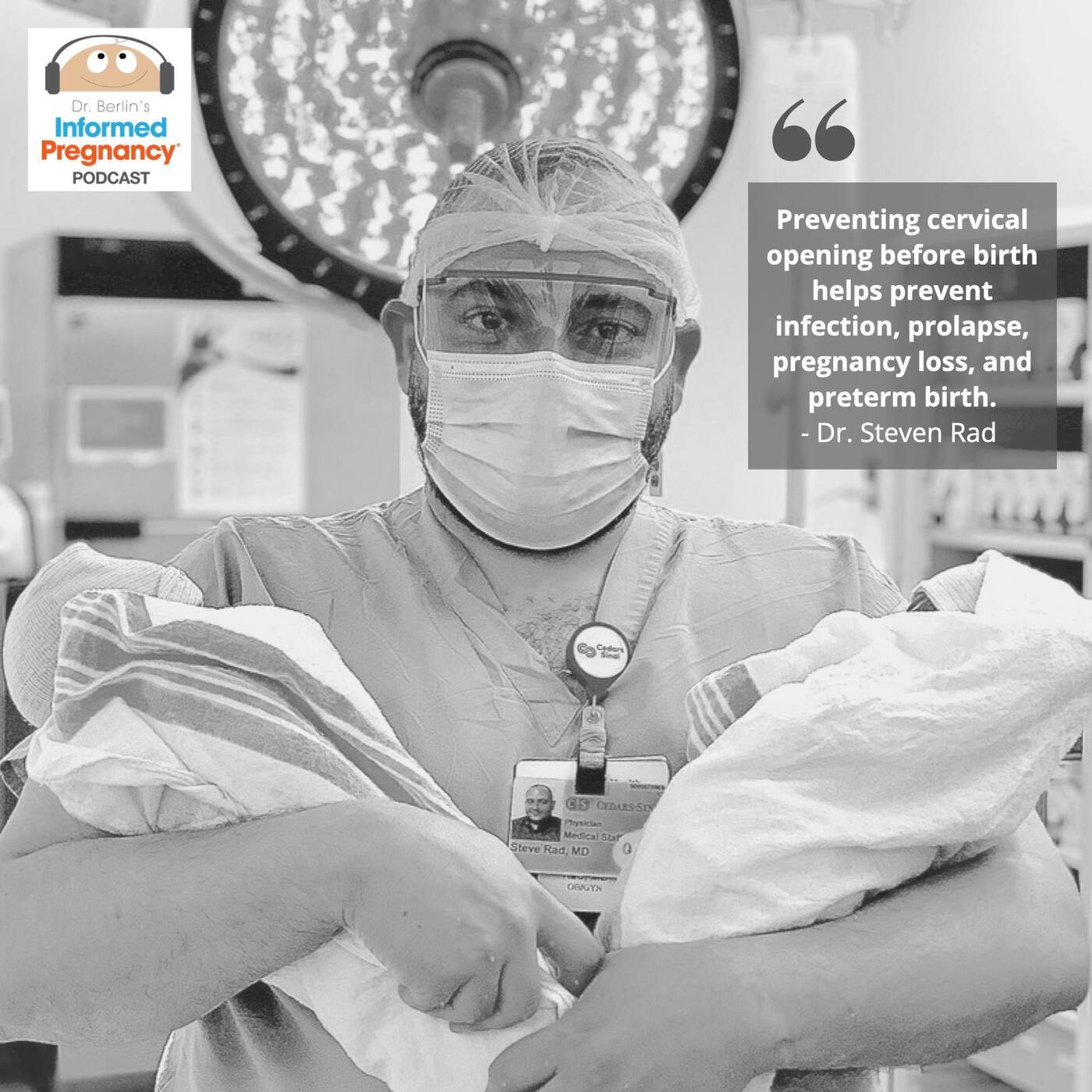
High risk pregnancy doctor and obstetrics expert Dr. Steven Rad returns to talk about cervical cerclage. What it is, when it’s needed, how it works, side effects, risks, the different kinds of cerclages, and how this procedure helps birth outcomes.

Learn more about your ad choices. Visit megaphone.fm/adchoices
See Privacy Policy at https://art19.com/privacy and California Privacy Notice at https://art19.com/privacy#do-not-sell-my-info.
Key quotes
“And so cervical insufficiency is when you have painless cervical dilation, it's when your cervix opens up without you even feeling it. So there's no bleeding or there's no labor, what we call placental abruption, there's no reason. The cervix just opens up on its own. You don't feel it until it's too late.”
“So before the canal opens and dilates, and we get into the dilation that we were talking about, the first change is for the cervix to shorten, or efface, or melt from being like this long hot dog into basically as thin as paper thin.”
“But it's always still a very special and holy time and time stops. You have two people's lives in your hands, and we don't take that responsibility lightly.”
“And so, I even will get a marker and mark where I'm going to put the stitches. Yeah, I have a purple or black marker, it's erased with the surgical markers. And I mark, you know, my four spots that I'm going to do it in after I observe for someone I'm very careful that I make sure my you know I'm not getting into the bladder I'm far away from the bag.”
“important thing is I like to add is that patients always ask what happened when the cerclage comes out and the baby just fall out. And no, so generally about 10% of women will deliver in the next 48 hours, but the majority will go into labor within the next two weeks.”
Related episodes
- Ep. 247 Pregnancy & Birth After Spinal Cord Injury – Part 2
- Ep. 254 Anastasiya Kukhtareva – After Birth
- Ep. 468 Transformative Prenatal Care with Carrie Haverty
- Ep. 363 Dr. Steven Rad: The 20 Week Anatomy Scan
Transcript
AI-generated transcript with speaker labels — may contain errors, especially names and medical terms. Dr. Elliot Berlin, DC appears in blue; Dr. Steven Rad in orange.
Download PDF of the Transcript
Dr. Elliot Berlin, DC [1:13] Welcome to the informed pregnancy and parenting podcast. I'm your host dr. Elliott Berlin today I'm happy to have a returning guest with me He's an expert in obstetrics gynecology and maternal fetal medicine and high-risk pregnancies is double board certified With many rigorous trainings from around the world and has received numerous top doctor awards He has multiple practice locations with a main office located in the Cedars Sinai Medical Towers right here in Los Angeles. Dr. Stephen rad. Welcome back to the podcast. Thank you very much
Dr. Steven Rad [2:08] it's always an honor and privilege to be on the podcast and to catch up with you and to see you and Hello to all our guests
Dr. Elliot Berlin, DC [2:15] Hashtag neutral. It's always great to see I always learn so much when we chat and Anybody wants to check out one of the other very popular podcasts that we did a very formative Podcast that we did together the episode is on gestational diabetes Today we're gonna talk about sir. Clash and just by way of a little background Over time we've had patients have this medical procedure during pregnancy called having a sir Clash put in and Recently I had Brianna Henry and you go check out her episode She was particularly concerned about having a sir Clash put in and taken out And she asked me all these questions and I had no idea but I said I know who to ask and so here we have
[3:00] Dr. Steven grad. All right. Let's start at the beginning doc. What is a cervical sir Clash?
Dr. Steven Rad [3:07] Well, first of all regarding your introduction actually the timely topic for me too because I just removed a sir closet place last year this past Sunday and I just had a patient this morning that needed to go to the hospital and Needed a rescue emergency sir Clash. So a sir Clash What is a cervical sir? So a sir Clash is a procedure in which you suture the cervix and you essentially close the cervix and reinforce the cervix and increase its tensile strength to prevent from opening and in turn preventing adverse events like pregnancy loss or the Prolapsing of the fetal membranes through the cervix into the vagina infection preterm birth
Dr. Elliot Berlin, DC [3:59] Okay, let's back up just a second. So first of all sir Clash, is there ever a reason to do it outside of pregnancy?
Dr. Steven Rad [4:07] Yeah, so there is a type of sir Clash called a trans Abdominal sir Clash that's done sometimes pre-pregnancy Pregnancy But there is not a reason to do a sir Clash other than for preventing Pregnancy a poor outcomes of pregnancy. Okay, so
Dr. Elliot Berlin, DC [4:28] Anatomically the cervix is located at the bottom of the uterus
Dr. Steven Rad [4:33] Yeah, so I think we can back up and explain that very carefully So the cervix is the opening of the uterus So the lower part of the uterus at the top of the vagina Depending on which direction you want to think of it from and some people would call it like the mouth of the uterus It's through which if you have a vaginal delivery Where baby is born when we check if you're dilated for example, they're checking to see if your cervix is dilated And the goal is to get to 10 centimeters during the vaginal birth. So it's the birth canal through which babies are delivered. And you don't want the purpose of the sacroiliac is to prevent that from opening early.
[5:12] So if the cervix were to open early, then you can lose the pregnancy or the bag of water can prolapse out of the uterus into the vagina.
Dr. Elliot Berlin, DC [5:22] Okay. So that's the doorway between the uterus and the birth canal, the vaginal canal, and it's supposed to be closed and not let anything in or out during the pregnancy.
Dr. Steven Rad [5:33] Yes. So none of those are allowed to let the bag out, let the baby out, and also helps prevent infection.
Dr. Elliot Berlin, DC [5:39] Okay, great. The cervix opens to 10 centimeters, you said, just for a visual, because I'm not on the centimeter system. You're holding it up. Nobody can see. But Cheerio is about one centimeter, a Ritz cracker, somewhere around three centimeters. The diameter of a can of soda is about seven centimeters and a bagel is 10 centimeters, which is why whenever I'm at a birth, now I get hungry for carbohydrates.
Dr. Steven Rad [6:05] Yes.
Dr. Elliot Berlin, DC [6:06] My kids once called me like, dad, are you coming home soon? I'm like, yeah, I'm somewhere between a Ritz cracker and a can of soda. Okay. So that cervix has to stay closed. It's circular the way it opens up. And why would you stitch it closed? What would be an indication that it needs to be sutured?
Dr. Steven Rad [6:28] You know, to answer your question, really, you're asking what are the indications for a cervical sacrage. And basically, there are three basic categories, women who would need a sacrage fall into either, they would need a history indicated sacrage, and that's when you have a history of one or more previous second trimester pregnancy losses related to cervical insufficiency. And so cervical insufficiency is when you have painless cervical dilation, it's when your cervix opens up without you even feeling it. So there's no bleeding or there's no labor, what we call placental abruption, there's no reason. The cervix just opens up on its own. You don't feel it until it's too late.
[7:13] And you essentially lose a pregnancy that typically happens in the second trimester, somewhere between like 14 and 24 weeks. And so women in this group who unfortunately have a pregnancy loss due to cervical insufficiency would require a history indicated sacrage. And for all future pregnancies, they would require a sacrage. So if you have a history of cervical insufficiency or you previously had a sacrage due to cervical insufficiency, then you would need a sacrage in the future. So that's one kind of group of women who need sacrages. The second one is a physical exam, that's if you have this cervical insufficiency or painless cervical dilation, you're lucky enough that it was cut during your pregnancy
[8:01] and not historically indicated. So unfortunately, a lot of women have to have a loss first, an episode of cervical insufficiency and lose a pregnancy before they know they need to have sacrages in the future. But if you're lucky enough that for whatever reason, either because of an ultrasound prompted your doctor or you had some spotting or didn't feel right or some pressure, then you do a physical exam and you notice the cervix is dilated, then you would have a physical exam indicated sacrage. It's sometimes called a rescue sacrage. And then the third type of group is an ultrasound indicated sacrage. And that's in women who have a history of a prior preterm birth, generally less than
[8:45] 36 weeks, and they're followed in their future pregnancy with monitoring of their cervix length every two weeks, starting at 16 weeks. And when you know that the cervix for those women are shorting, we usually use a cutoff of 25 millimeters before 24 weeks of gestation. Then they would be a candidate for a sacrage as well. So those are the kind of three categories, history indicated, physical exam and ultrasound indicated.
Dr. Elliot Berlin, DC [9:13] So the third one, you're saying this is not their first pregnancy. And in a previous pregnancy, they had a healthy baby, perhaps, but just early.
Dr. Steven Rad [9:22] Exactly. It's a lot of people don't know that. You don't have to have just cervical vision. You could have simply had a preterm birth in a previous pregnancy. And your future pregnancy is at risk for short cervix. So we cut off to 25 millimeters or 2.5 centimeters. And you're also a candidate for sacrage in that situation.
Dr. Elliot Berlin, DC [9:41] Okay, when you talk about the cervix shortening, what does that mean?
Dr. Steven Rad [9:48] Great question. So back to what the cervix is in the mouth, the cervix in dilation. So you've talked about the cervix as different kinds of foods or the kind of Because I think of a cervix is a hot dog. Okay. Every time I do an ultrasound, I think of the cervix as a hot dog. So for me, the cervix is a long kind of tunnel through which the middle of it opens up. Prior to it opening up, this hot dog melts, so to speak, or effaces, as it's called, and shortens before it dilates. So before the canal opens and dilates, and we get into the dilation that we were talking about, the first change is for the cervix to shorten, or efface, or melt from being like this long hot dog
[10:33] into basically as thin as paper thin.
Dr. Elliot Berlin, DC [10:37] Oh, really thin.
Dr. Steven Rad [10:39] So there's different degrees of effacement and shortening, and you don't want it to get that hard. So that's the way I think of what a short cervix is. Your cervix should be long and thick, literally like a hot dog, and as it's shortening, if you're having a short cervix issue, it's getting thinner and thinner and thinner. And that's-
Dr. Elliot Berlin, DC [11:01] So you see that on ultrasound?
Dr. Steven Rad [11:02] You know, like into like a Cheeto puff size.
Dr. Elliot Berlin, DC [11:04] Oh, a Cheeto puff. So you see that on ultrasound?
Dr. Steven Rad [11:07] Yeah, and you can see it on ultrasound. You can see it shortening, and before it gets too short is when you would do the circlage.
Dr. Elliot Berlin, DC [11:13] The long, healthy cervix, the full-size hot dog, how big is that?
Dr. Steven Rad [11:18] Typically, I would say at least like three to four centimeters long.
Dr. Elliot Berlin, DC [11:23] Okay, and then your cutoff is, if it falls under 2.5.
Dr. Steven Rad [11:27] Yeah, if it's someone who had a previous preterm birth, we use 2.5. And a patient doesn't have that, and usually they'll use like a cutoff of two or one and a half centimeters in case you want to do what's called a rescue, or you start thinking about an exam indicated circlage, and someone who doesn't necessarily have a history. But yeah, so for someone who has a history, we use 2.5 as a cutoff. Normally, it should be three to four, more than four centimeters.
Dr. Elliot Berlin, DC [11:58] Yeah, you're talking about like one of those mini hot dogs now.
Dr. Steven Rad [12:02] Yes.
Dr. Elliot Berlin, DC [12:03] Yeah, so just because there's a lot of different terminology and numbers here, the food that I talked about is when the cervix dilates, when it opens up. But we're talking about things that happen before that now, which is the shortening of the cervix and then the thinning of the cervix. And the shortening is measured in either millimeters or centimeters. So normally about 40 millimeters or four centimeters. And then if it gets under 2.5 centimeters, which is 25 millimeters, then we start to get concerned. And then the effacement is different. That's just measured on a scale of zero to 100%, how soft the cervix is, right?
Dr. Steven Rad [12:45] Yeah.
Dr. Elliot Berlin, DC [12:46] Okay, all right. Well, that's a lot of good information already. Oddly hungry for dinner, but okay. What are the risks? I mean, you're talking about the risk of not putting in a sirclash, being that either the bag of water, the membranes can prolapse, which just really means come through the cervix into the birth canal, or the baby can come through, in which case at that stage of pregnancy, becomes a pregnancy loss. So those are some pretty big risks of not doing the sirclash. What are the risks of doing it?
Dr. Steven Rad [13:22] I love doing this podcast with you because you're so smart and I love listening to you and you explain things so well.
Dr. Elliot Berlin, DC [13:29] Oh, thank you.
Dr. Steven Rad [13:29] Yeah, everything you said is correct. When you're weighing the risks and benefits, the risks of not doing it are loss of the pregnancy, essentially. The risks of doing a sirclash, depending on how long and what the cervix, if the cervix is already dilated or if it's open, or if it's closed and how long it is, you are placing a suture with a needle through the cervix. And if the cervix is already dilated or open, talk later on the technique of sirclash, but you're trying to put the sirclash as high as possible close to the top of the cervix or the bottom of the uterus, the internal off, which is the beginning of the cervix or the bottom of the uterus.
[14:10] And you can break the bag of water if your needle goes through the bag of water and pops it.
Dr. Elliot Berlin, DC [14:16] Oh wow, are you guided by ultrasound?
Dr. Steven Rad [14:19] Some people do, some people don't. Every sirclash I do, I do it with under ultrasound guidance so that I can see where we're placing the needle and we're very careful to see how close the bag of water is to where we're placing our suture. So that's one risk. You can get into the bladder. The bladder is at the top of the uterus and at the top of the cervix. So you wanna make sure that you know where the bladder line is and there's different techniques, which we can talk about to understand and know where the bladder is so you don't by mistake puncture the bladder.
Dr. Elliot Berlin, DC [14:51] Is the bladder in front of that anatomy?
Dr. Steven Rad [14:54] If you think of the cervix as a clock or the hot dog as a clock, the cervix is basically… from 10 p.m. to about, you know, one or two p.m. at the top of the cervix. The same way, you know, everyone's goal is to put their sirclad as high as possible. And the same way you by breaking the bag of water, you can also go too high that you get into the bladder because it's literally attached to the cervix. It's almost the distinction between the cervix and the bladder. It's just continuous. So you have to be really careful and know your anatomy in order to avoid getting into the bladder. And likewise, depending on the type of sirclad and how far back, you go around
[15:36] six o'clock on the bottom. When you're placing your stitch, you can also get into the rectum. So you want to make sure you don't damage any adjacent organs, namely the bladder and the rectum, and of course the vaginas all around you. You can cause bleeding anytime you put in a needle. There's definitely bleeding. Usually, fortunately, the bleeding stops pretty quickly once you're done. And you can also cause an infection. So just because while you sterilize the vagina and the cervix, you are putting a foreign body into the cervix and you're leaving it there for the duration of pregnancy, sometimes even after and this foreign body can be a site for
[16:14] infection. Or you can cause an infection to go up into the uterus that's not already there. So those are things are infection, breaking the bag of water, bleeding, adjacent organ injury. And all of these things can also themselves lead to pregnancy loss and preterm birth. So you have to carefully pick your candidate, pick who you're going to do a sirclad on and not do sirclad on people that it's not necessary for. And also do your technique carefully. So always weigh the risks and benefits. And of course, we talked about the risk of not doing it was just losing a pregnancy. So
Dr. Elliot Berlin, DC [16:52] this almost sounds like when I'm watching TV late at night, which almost never happens. But if I am, and then all of a sudden, a commercial comes on for a medication, let's say this medication is to help you don't feel anxious, ask your doctor for this medication. And then there's like two minutes of don't take this medication if you're allergic to this medication, this medication may cause you to become severely depressed and commit suicide, this medication will probably cause some diarrhea and upset stomach and your breath will be foul for the rest of your life. What the odds of those things happening? Generally,
Dr. Steven Rad [17:25] low, especially in someone who's experienced being so cautious. And if you're using ultrasound guidance, and you're careful, the chance of those things happening is very low, maybe on the order of one or 2%, if even that. The risk of not doing it is not just a solid, meaning a significant consequence, but a higher statistic. I mean, it's almost like 100. I don't ever say 100. But in your stakes are very high of losing your pregnancy, you don't do it. This is like a risk of like, you know, the surplus risk is like 1%.
Dr. Elliot Berlin, DC [17:58] Right. Okay. All right, let's take a break. When we come back, we're gonna learn a whole lot more about sir clash.

Dr. Elliot Berlin, DC [20:25] Welcome back to the Informed Pregnancy Podcast. We're talking all about sirclash with Dr. Stephen Rad. Okay, we talked about what a sirclash is. We got a lot of visuals on what the anatomy of the cervix is, and then why somebody would get a sirclash, what are the risks of getting it and not getting it. Now, there are different types of sirclash. Can you talk a bit more about that?
Dr. Steven Rad [20:54] Yeah, absolutely. So there are basically three kinds of sirclashes. Two of them are transvaginal vaginal sirclashes, and the third kind is transabdominal. The majority of sirclashes are placed by the transvaginal approach. The transabdominal approach is more invasive and it's either done laparoscopically or robotically, or you literally have to do like an incision, a fan incision, like a C-section. And I'll talk about the abdominal really quickly. First, the abdominal sirclash allows for higher placement of the sirclash because you're getting literally at the top of the cervix at the internal off, which is the ideal place to place a sirclash as
[21:40] high as possible, right, where the uterus and cervix meet. So the transabdominal approach is reserved for women who have had previously transvaginal sirclash and was unsuccessful and unfortunately did not work. And they despite having a transvaginal sirclash placed even early on, and we'll talk about timing too, still had a pregnancy loss and the transvaginal sirclash didn't work once or multiple times, then we would offer a transabdominal sirclash to those women. The transabdominal sirclash, there are not many OBGYNs in the country who are knowledgeable and skilled in placing a transabdominal sirclash. And so usually they're referred to a surgeon
[22:31] in a different city or a different state even in order to get their transabdominal sirclash. So this is not a readily available sirclash. Unfortunately, in California, in the Los Angeles and Southern California area, we have some providers that are able to do it. Again, it can be done laparoscopically, robotically, or through an abdominal institution.
Dr. Elliot Berlin, DC [22:51] Is it also removed abdominal or can it be removed eventually?
Dr. Steven Rad [22:55] So the interesting thing about transabdominal sirclashes is that they're essentially permanent. Most people, if not all, will leave it in forever. It doesn't do anything.
Dr. Elliot Berlin, DC [23:06] So it's a little hard to picture because the whole point of it seems to be to stitch the cervix closed. How does the baby get out?
Dr. Steven Rad [23:13] You would need a C-section usually and you leave the sirclash there for future use.
Dr. Elliot Berlin, DC [23:17] Oh, so it's always a cesarean? Okay, gotcha. Now it makes sense.
Dr. Steven Rad [23:22] With the vaginal, you can remove the sirclash and have a vaginal delivery. Okay. With the transabdominal one, we usually leave it in forever. And because it's such a hard thing to do, it's not a lot of people do and you leave it there for future use. So with regards to the more common sirclashes that we're used to are the vaginal ones. There's two kinds. There's a McDonald's sirclash, which is the most common and the Sherrod Park sirclash. Both of these sirclashes are placed vaginally. The McDonald's sirclash is when you place a suture around the cervix, what we call in a purse string manner circumferentially. So you start, you know, around the clock or on the hot dog at
[24:06] the top around 12 o'clock and usually go counterclockwise to about 10 or nine o'clock and then throw one stitch there and then you do another the next throw about nine o'clock to about six or seven o'clock and you go around the cervix about usually about four, maybe five times and then you're back at 12 o'clock and you tie the suture or the sirclash suture at the top at 12 o'clock and by going in and out like this four or five times, you create what's called a purse string. Some women have these purses where you like pull it up.
Dr. Elliot Berlin, DC [24:45] Oh, yeah. And everything bunches.
Dr. Steven Rad [24:47] Yeah, everything bunches up. So you're like, exactly. Everything bunches up in this. Exactly. You shut the cervix closed and you tie it at 12 o'clock. So that's the most common kind is called that's called the McDonald's Sirclash. The type of vaginal sirclage is called a shiradkar sirclage. And the shiradkar sirclage is placed pretty similarly around circumferentially around the cervix. The difference with that is the surgeon will dissect or remove the bladder at the top at 12 o'clock and the rectum posteriorly at six o'clock will dissect the bladder and rectum off of the cervix so that they can get a little bit higher than you can with a McDonald's sirclage.
Dr. Elliot Berlin, DC [25:28] That sounds like, if I don't know anything about medicine, I'm just listening to you talk, especially if I have a cervix. That sounds intense.
Dr. Steven Rad [25:37] It is a little bit more invasive.
Dr. Elliot Berlin, DC [25:41] When you say dissect, what does that mean when you dissect the uterus and bladder?
Dr. Steven Rad [25:45] The cervix and bladder, like we said, are closely opposed and are kind of, the tissue is continuous. So dissect means you find the separation between the bladder and the cervix around 12 o'clock and you carefully separate and undermine the tissue under the bladder and separate the bladder and the cervix from each other.
Dr. Elliot Berlin, DC [26:05] Okay, so they're not really connected other than the fact that they're very tight neighbors.
Dr. Steven Rad [26:10] Correct.
Dr. Elliot Berlin, DC [26:11] And then they get so tight as neighbors that it's like, I don't know where you end and I begin. And then you guys go in there and you find where the separation is and just gently move them apart from each other.
Dr. Steven Rad [26:23] Move them apart, split them apart from each other and then that's where you place in this new separation area you've created. You place your shiradkar striklars. The purpose of doing that is that you can get a little bit closer. So with the McDonald on, you're not doing any dissection. It's going in and putting in your suture around right below where the bladder ends. And with the shiradkar, you're moving the bladder and the rectum a little bit away, a little bit higher up so that you can put your stitch a little bit higher up closer to the top of the cervix.
Dr. Elliot Berlin, DC [26:52] First of all, that sounds a lot better than dissecting, but does that change the function at all with the bladder and rectum?
Dr. Steven Rad [26:58] No, they heal nicely. And it's just like the edge of it. You're not getting into the organ, just the outside wall of them. You're kind of separating and it doesn't affect them at all.
Dr. Elliot Berlin, DC [27:09] Okay, that's very helpful.
Dr. Steven Rad [27:12] And the reason to do one or the other, just part of it is how you were trained. If you are trained in the McDonald approach versus the shiradkar, I would say it's probably one of the biggest differences of who puts which kind. And in theory, if you do the shiradkar, you can get a little bit higher placement than you can with the McDonald. But the literature, body of data shows that there's not really a significant difference in the pregnancy outcomes between the two procedures. There hasn't necessarily been any like randomized trials directly comparing them, but there's been like observational studies. And with the shiradkar, they tend to be a little bit higher birth weight,
[27:53] newborn some studies showed, but overall there's no significant difference in the pregnancy outcomes. Again, I'm sure the people who do the shiradkar versus the McDonald are more biased and I'll give you more bias twist to it, but they're pretty similar. And in general, there's not a difference in outcomes. So I think it comes out to how you're trained and what the surgeon feels most comfortable with.
Dr. Elliot Berlin, DC [28:18] Okay, speaking of training, I'm just in my head training picture. How do you teach somebody how to do this? How do you learn?
Dr. Steven Rad [28:26] So as a resident, your goal is to see as many procedures as possible. And on your high risk pregnancy or your gynecology rotation, you try to attend to as many of these surgeries. So like with all surgeries, you watch some, and then after your attending your professor feels comfortable, they may let you do one of the stitches.
Dr. Elliot Berlin, DC [28:47] How do you watch someone stitch a cervix? Like how could you even see what's going on?
Dr. Steven Rad [28:52] Oh, so usually you need more. So one person is doing the stitching and there is an assistant who needs to help retract and show you and give you visualization. So you have to kind of move out if you're in a teaching setting and you have a resident with you, then you will have to give them room in order for them to watch. As they're trying to show you and give you room and retract for you, they're watching what everything you're doing.
Dr. Elliot Berlin, DC [29:19] Okay, we'll talk more about how the procedure is actually done, what the experience is like in the third segment. But is it nerve wracking doing your first surcharge?
Dr. Steven Rad [29:31] So that's what I didn't get to say earlier, but doing a surcharge or an amniocentesis or a CVS is one of the most, kind of like a holy time. And any kind of surgery really, once you're in that position, everything, time stops. Actually, time also stops when I'm doing podcasts with you. My phone is now with me and I have no idea what's going on in the outside world right now. But anyways, time kind of stops. You have two people's lives in your hand. And. You know, like we said, there are some risks of procedure and they can lose a pregnancy while you're trying to save it if you break the bag of water, for example. And so you are incredibly careful. And, of course, the beginning is very nerve wracking and you're very nervous and after you've done several you get more confident and over the years you get more confident.
[30:21] But it's always still a very special and holy time and time stops. You have two people's lives in your hands, and we don't take that responsibility lightly. And when I'm doing this or cause we talked about we have someone doing ultrasound, watching everything we have someone retracting. And then I take my time I mean I just sit there and stare at the cervix for a while I look at the bladder I look at the rectum I look at the vagina I look at all the distance that they have. And so, I even will get a marker and mark where I'm going to put the stitches. Yeah, I have a purple or black marker, it's erased with the surgical markers. And I mark, you know, my four spots that I'm going to do it in after I observe for someone I'm very careful that I make sure my you know I'm not getting into the bladder I'm far away from the bag.
[31:15] And I literally mark where I'm going to go.
Dr. Elliot Berlin, DC [31:18] Which ones do you do, because you mentioned three kinds.
Dr. Steven Rad [31:21] I personally do the McDonald's. I was trained and I've had amazing outcomes with them. And so, I have colleagues that do the charade car and we have some colleagues that are few and far between it. Thankfully know how to do the abdominal work.
Dr. Elliot Berlin, DC [31:36] So, let's just talk about timing, the timing for the surplus to go in and the timing, if you're going to take it out for the surplus to come out.
Dr. Steven Rad [31:47] So yeah, the timing, the history indicated ones those are the pro what we call the prophylactic or the prevent, you know, or based on your previous history and those are the preventative one, so to speak, are generally done between 12 and 1314 weeks. And the earlier the better before you start getting you know history in here so these are women who have the history of cervical insufficiency and pregnancy. So you don't want to wait too long to happen to them again and usually that happens after 16 or higher weeks. So we placed it at generally 12 to 1314 weeks the latest. And those are the history indicated ones, the ultrasound indicated one. Those are the women who have a history of preterm birth and you're monitoring their cervix for short cervix and ultrasound we talked about the 2.5 centimeter cut off.
[32:42] You're doing those cervical length monitoring between 16 and 24 weeks so that's when those are usually placed. And then the exam indicated one that's when your cervix is dilated and sometimes even the bag is coming out a little bit and you are lucky enough that you was caught in time before you lost the pregnancy. Those are women who have cervical insufficiency going on live in front of your face, who don't have a previous history yet, and you're able to try to do this exam indicated or rescue Sir Clark. Those are generally also done between 16 and 24 weeks because that's usually when these things happen. You don't want to do it after 24 weeks, though some people do up until 28 weeks and in some countries, even in the US and some cities and some providers will do it after 24 weeks.
[33:32] But we generally avoid doing it after 24 weeks because after that, that's when the fetus is considered viable. And if you do get into bleeding or you cause the bags to break or cause them to go into premature delivery, that's like preterm labor, then they can have a premature, very preterm delivery at like let's say 25-26 weeks and there's, you know, poor outcome in the NICU in those situations. So you want to avoid that period 24 to 28 week period, though there are some providers in some countries that technically will do it later. And then after 28 weeks, you wouldn't really do a Sir Clark because outcomes for neonates in the NICU are much better after 28 weeks.
[34:14] And also then you're getting into situations that are really preterm labor and not really cervical insufficiency.
Dr. Elliot Berlin, DC [34:21] Okay, so up until 24 weeks, you haven't hit the age of viability. So should the baby come through, they're not going to make it. And so there it's really important to have the Sir Clash.
Dr. Steven Rad [34:33] Correct. And you don't want to play it for the patient or yourself in a situation where, God forbid, you're doing a Sir Clash and then something goes wrong or they or they deliver soon after and have a very preterm baby.
Dr. Elliot Berlin, DC [34:44] Okay, and then between 24 and 28 is the gray area because those babies, they might survive birth. It's not ideal by any means and they might not survive. But then the risk benefit analysis becomes more narrow. Because the risk of doing this or collage, even though it's a smaller risk of creating a problem, you're up against the fact that if the baby's born because of the weak cervix, then that baby might survive. So it's a bit more now. And then after 28 weeks, those babies generally do OK with a lot of make you help, depending how soon, but they generally do OK. So then it makes no sense to take the risk of doing this or collage.
Dr. Steven Rad [35:28] Yeah. And then you get into like, you know, these are women are having preterm labor, not really cervical efficiency. Circulation is not a cure for preterm labor, which often comes up as a question for some women who are in preterm labor. You do not do a search for that.
Dr. Elliot Berlin, DC [35:42] OK, let's take another break. And when we come back, we'll talk about the experience of what someone can expect if they're going to have a search, but then we'll be right back. Welcome back to the Informed Pregnancy Podcast. We're talking about Sir Clash with Dr. Stephen Rad. OK, we talked a lot about why someone would get a Sir Clash, when they would get a Sir Clash. In this segment, I want to talk about what the experience is like. But one thing we didn't talk about that we jump back on is when does the Sir Clash come out?
Dr. Steven Rad [36:21] Yeah, absolutely. So we left off like, when do we place it? So when do you remove it? It's generally moved at 36 weeks before you turn 37 weeks, or by the time you hit 37 weeks in anticipation of labor. You want to remove the Sir Clash before the onset of labor, because one, if you go into labor, then your cervix starts shortening and effacing as we talked about and starts dilating. Then you risk the Sir Clash stitch, which is really tightly placed and tied, ripping through or lacerating the cervix. And that can cause a lot of bleeding and injury to your cervix. Or you can even sometimes leave, there's also risks of uterine ruptures. You go into labor, you have your Sir Clash there and your body is going into labor and having all these contractions.
[37:09] And the Sir Clash is kind of blocking things from moving the baby from coming out. You can also cause a uterine rupture, though rare. So anyways, you want to remove the Sir Clash before you go into labor. So the latest possible before that, and so that's at 36 weeks.
Dr. Elliot Berlin, DC [37:25] Okay, that's helpful information. Let's talk about the procedure from the patient point of view. Someone is told that they might need a Sir Clash, they have a discussion, they make a decision to do it. And what happens next? Where is it done? Is it done in the hospital or in the office?
Dr. Steven Rad [37:45] So done in the hospital, you are either scheduled or if you're having a exam or ultrasound indicated Sir Clash, they're generally urgent or emergency procedures. So you're either going to be scheduled for your procedure based on your history, and then you have your scheduled time. You come to the hospital. If you are having an urgent or emergency Sir Clash place, you're probably being sent directly from your OB or your high-risk OB's office directly to the hospital or the emergency room.
Dr. Elliot Berlin, DC [38:17] You do it in the emergency room or you do it in the emergency room?
Dr. Steven Rad [38:19] No, I mean, you know, you're being sent through the emergency room.
Dr. Elliot Berlin, DC [38:22] Through the emergency room, yeah.
Dr. Steven Rad [38:24] So as you arrive to the hospital, you're supposed to not have anything to eat or drink at least eight hours before. You're taken to the preoperative area, consented, prepared, etc. You're taken to the operating room. The preferred type of anesthesia is the spinal or epidural. And so a lot of women are awake for their Sir Clash procedure and they can hear everything that's going on. So you could be asked to be sedated as well. And it can also be done under general anesthesia, but that's a little more.
Dr. Elliot Berlin, DC [38:57] Could you just talk about quickly the difference between a spinal and an epidural?
Dr. Steven Rad [39:03] So the basic difference is, you know, they're placed in different layers of the spine, so to speak, but in any case, the spinal is like a one-time shot and lasts anywhere about like two to three hours. An epidural, you place a catheter and that catheter remains kind of like an IV in your back, remains in your back until it's removed.
Dr. Elliot Berlin, DC [39:26] Okay, is there a reason why somebody would choose one or the other?
Dr. Steven Rad [39:30] So an epidural, you know, you use it, for example, during labor because you can continuously infuse pain medication for hours and hours. So if you're in labor or you're anticipating a very difficult defection, then you would use an epidural. If you're doing, like in this case, a sir Clash or a routine C-section, you usually will get a spinal, the one-time shot, it lasts for like two to three hours and should be plenty of time for your procedure to be done.
Dr. Elliot Berlin, DC [39:55] Okay, and the difference between being sedated and general anesthesia?
Dr. Steven Rad [40:00] So there's general endotracheal anesthesia where you have like a tube down your throat and sedated you're just put to sleep. You're still breathing on your own, not with the help of a machine, but you are sedated to the point that you are kind of sleeping and you don't remember the events that are happening. You don't feel you don't remember it.
Dr. Elliot Berlin, DC [40:22] So why would somebody want to go for general?
Dr. Steven Rad [40:25] They're really scared of staying awake during the procedure and they just can't handle that feeling of not feeling their legs, for example, or being kind of strapped in the band. They don't want to be part of it. And there's some anesthesiologists that prefer that and they'll go over the risks and benefits with you.
Dr. Elliot Berlin, DC [40:41] OK, all right. Does anybody just do it with a local?
Dr. Steven Rad [40:45] No, not that I know of. Too intense. You need the ability to retract and take your time. And I think not anyone that I know of has generally done it.
Dr. Elliot Berlin, DC [40:55] Well, I mean, it makes sense the way you described, especially how you do it, just to kind of looking at everything, surveying what's where and the risk of accidentally hitting something makes sense to me. That would be better.
Dr. Steven Rad [41:10] You need them to not feel anything. If they're doing it local, they would feel you. And where is off in the middle of your procedure is not good. OK, so you don't want them to feel anything. And if you're doing local anesthesia, the risk of it wearing off or even them feeling the slightest bit, this is a very sensitive surgery. You don't want them either to be in pain or traumatized or anything like that. So I don't think anyone would prefer to have whether it's a patient or the surgeon and want to be doing it under local.
Dr. Elliot Berlin, DC [41:41] OK, so so far we said no food or drink unless, you know, if it's an emergency, you've had what you've had. You go to the hospital, get prepped in an operating room. You get some kind of anesthesia, whether it's a spinal, an epidural or some kind of lighter, deep, general sedation or anesthesia, then what happens? Like if they're awake, you know, and they can hear everything going on, they can't feel it, but they can hear everything going on. What's the rest of the procedure like?
Dr. Steven Rad [42:09] Yeah, so we you place a speculum, there's different kinds that help you look inside the vagina and find the cervix, either speculum or retractors. And that's your assistant's helping you as well. You locate the cervix, you locate the bladder. Some surgeons prefer to empty the bladder and some like to keep it full. And if you like to empty it, you would use what's called the Foley catheter. And you place that through the urethra to empty the bladder. And some surgeons may just do an in and out catheterization where you just empty the bladder and others may leave the Foley catheter in place for the duration of the procedure. Some people like the bladder to be full because it can help push the amniotic sac
[42:57] or the membrane away from the cervix where you're doing surgery. And then you can also see where that bladder cervix separation is more clearly. And some people want the bladder empty because they don't want it to be bigging in the way and they enter the bladder by mistake. So then you have some before placing a stitch will have ultrasound guidance, watching where they're putting their stitch so they don't puncture the amniotic sac as we discussed. And you plan out where you're going to put your stitches. If you're doing the charade surcarge at this point, you would separate the bladder and rectum from the cervix. If you're doing a McDonald's, then you would just proceed with the surcarge.
[43:37] And we talked about you start at 12 o'clock and go kind of clockwise. It's usually about four stitches or four times that you go in and out and create this purse string. And then you started at 12 o'clock and then you end again at 12 o'clock and your two ends of the stitch like the purse string of the purse, you pull on it and you very beautifully pull up on the bunch of the cervix and then you tie it with multiple knots at 12 o'clock.
Dr. Elliot Berlin, DC [44:06] Prior to doing these types of procedures, have you sewn anything else like not on a person? Can you fix a teddy bear at the seam?
Dr. Steven Rad [44:13] Oh, yeah. I mean, I'm very good at sewing. There's any holes in things or putting buttons back on. We're very good at that. And you practice a lot.
Dr. Elliot Berlin, DC [44:24] That's why I was wondering, do you practice sewing?
Dr. Steven Rad [44:26] Earlier you asked me, do you watch? And yeah, you practice on it could be a teddy bear. Some people use pieces of chicken or meat or have like plastic models also and they practice doing all kinds of stitches, including sirloin.
Dr. Elliot Berlin, DC [44:42] OK, so they shouldn't feel anything?
Dr. Steven Rad [44:44] No, they shouldn't feel anything. By the way, at this point, some surgeons place two sirloins. We didn't talk about that. Again, the body of data has not shown any benefit in placing two. But one of the benefits in terms of outcome is one of the benefits those. Sometimes you'll place your first cerclage and you may feel that you can get a little bit higher because you have a little bit of traction now in the cervix and you can use your first cerclage to pull on the cervix a little bit more and get a little bit higher. And some anecdotally believe placing two cerclages is stronger and they'll place two cerclages. So again, I think it's by experience and
[45:24] training what your preference is. But the body of data doesn't necessarily show there's a benefit to placing two. But many of your surgeons and your OBs out there might place two, so don't be surprised. I will confess, I place two cerclages.
Dr. Elliot Berlin, DC [45:38] Oh, you do. You're a two-circlage kind of guy.
Dr. Steven Rad [45:40] Yes. I mean, I've done it. It's worked beautifully for me and I've had great outcomes that continue to do it. But the body of data doesn't necessarily show that there's a benefit. I do know that on my second stitch I get higher always than my first one. So I don't necessarily do it because I think tying it twice helps. I do it because I know I can get higher and the higher you are, the better.
Dr. Elliot Berlin, DC [46:01] I mean, that leads me to a couple of questions. Number one, is it a choice? Do you let them know the options and they pick?
Dr. Steven Rad [46:09] Yeah, I mean, I let them know beforehand that we place two because I go exactly, we're going to the podcast except I can show them pictures. I will explain the procedure step by step to them so especially they're going to be awake so they know what to expect. And I tell them I'm going to place two. Because I also we monitor the cerclages after and they always look on ultrasound. We look for both cerclages. We're watching them. You know, somebody only wanted one, then so far, no, you know, they try. That's the way I prefer to do it. No one personally told me, you know, they always trust that this by that point, if you're putting someone on cerclages, I'm sure that
[46:43] you've gained their trust. And I mean, they're going based on what you think. You know, I mean, of course, everyone has the option. And of course, there's so many asking to place the one I would place one in there. I'll be done faster.
Dr. Elliot Berlin, DC [46:54] Yeah, you talked about how there's not really a body of data showing that two is more effective. But I just wondered, does two create more opportunity for trouble? Like for
Dr. Steven Rad [47:05] you have to be careful, you know, you're putting two foreign bodies, you're getting a little bit higher. But no, I mean, in terms of the data, we've not seen any in reality and theory. Yes, there's a higher risk. Now you're doing it twice. So, you know, you didn't get the bag the first time you're putting yourself at risk of doing it the second time. But no, the bio data also just to get an initial benefit has not shown necessarily harm.
Dr. Elliot Berlin, DC [47:28] Additional risk. Okay. When somebody's anesthesia wears off after this procedure, assuming not abdominal, since it seems to be the rare one, but from either of the vaginal cerclages, what will they feel when the anesthesia wears off?
Dr. Steven Rad [47:44] Either nothing. They may have some mild cramping, or light bleeding or some vaginal discharge or brown discharge for a few hours or a day or two. But you don't really feel the cerclages.
Dr. Elliot Berlin, DC [47:58] So is there any, like when they go home that night? I mean, they may not feel the cerclage, but I guess is there any pain from having the tissue pain?
Dr. Steven Rad [48:07] Very minimal, maybe some cramping, some irritation from the procedure. But generally, you don't literally feel anything like in your cervix or pelvis, no.
Dr. Elliot Berlin, DC [48:18] I mean, once it's in, do we all take a deep breath and relax, like not worry that the hot dog was becoming shorter?
Dr. Steven Rad [48:25] Depending on the situation, you're doing the history indicated one, the cervix is nice and long, and you're doing it 12 weeks and everything is perfect versus you're doing an emergency one. Once it's in, you're definitely like you do take a deep breath, but there's still a possibility of it being unsuccessful. And that's also one of the risks. You know, we talk about breaking up water and bleeding and all, but one of the risks is that if cerclage doesn't work, and you have to accept that risk that it may break through and you might start going into labor, whether a few days later, a week later, that reminds me. So one of the things I, as we were talking, I
[49:02] wrote a little note to myself to bring up is an amniocentesis. So that is our emergency, cerclages are placed when there's already cervical dilation. And one of the possibilities is cervical insufficiency. But if there is an infection in the amniotic sac, your body may also be trying or genetic abnormality in the baby or structural abnormality in the baby, the fetus, your body may be trying to deliver or remove this pregnancy from your body. And that's why your cervix is dilating. Though generally in those settings, you'll have contractions as well, not just like painless dilation it's more characteristic of cervical insufficiency. But there may be an
[49:45] underlying infection and that's why you're having your cervix dilating. And so in some instances, depending on how the patient presents or some surgeons routinely will do an amniocentesis. before doing a emergency circlage to make sure there's no infection or bacteria in the amniotic sac. What if there is? Then you do not place a circlage because you're tying in infection. That can spread to the mom, so for now it's contained in the bag but it'll get to the uterus and again to the mom's bloodstream and it could be post-sepsis and it's a very, and pretty rapidly, it's very dangerous. So with that kind of infection in the amniotic fluid, can the pregnancy last? So a lot of those cases either there was an infection
[50:31] beforehand and you didn't know or you don't routinely do an amniote or didn't have a fever, you know, didn't get to the mom yet and then in a week or two it's spread and then they'll go into labor and deliver. You have to remove the circlage for the last rate of the cervix. So no, those pregnancies generally your body will continue to want to eject. You cannot treat the infection, that's what I'm wondering. The answer to that question is no.
Dr. Elliot Berlin, DC [50:56] Okay, while a circlage is in, are there restrictions on what they can do?
Dr. Steven Rad [51:02] Okay, so it's also controversial. I generally will say no intercourse for the rest of the pregnancy and no strenuous activities, no heavy lifting and no strenuous exercise, especially for those emergency ones in case there is an underlying infection. They're very high risk. The cervix was already dilated and the vibe was almost effective, unfortunately, and you don't want to have intercourse all of a sudden. Or you don't want your circlage, this foreign body that's there to get infected, so we don't recommend intercourse. And then there's some physicians and surgeons who believe that, no, we knew it was like especially with the history indicated ones, it was done prophylactically, not under emergency
[51:46] settings. The cervix is still long and closed and they allow intercourse. So there has been surveys done and we've asked around and everyone has different practice patterns about intercourse, particularly and exercise and all that. So I'm on the more conservative side. I say no intercourse. Even with the double circlage? Again, it's just because you get higher up.
Dr. Elliot Berlin, DC [52:17] Okay. So my question is like this. Sometimes people need the intimacy and need the exercise to stay sane, not just fit, but sane or healthy emotionally and healthy in the relationship. Are there things that they can do? I get that in your recommendation or intercourse is out, but are other types of intimacy allowed? Are other types of exercise
Dr. Steven Rad [52:42] allowed? Yeah, honestly, like I said, there's not necessarily evidence that like exercise or intercourse causes labor or miscarriage or pregnancy loss. And so technically they can and the question that comes up like, can you stop an orgasm and do foreplay or do other types of sexual activities or light exercise? And I think at that point, if your patient's telling you that they need this, stay sane, you can just go through the risks and benefits with that. And moderation is always best. And we come up with a happy medium that works
Dr. Elliot Berlin, DC [53:19] individually for each patient. Sounds logical. Okay. When they have the circlage out, when you take a circlage out, what's the experience like for the
Dr. Steven Rad [53:29] user, for the patient? Yeah. Okay. So circlages can be removed either in your office or in the hospital. I generally prefer the hospital setting. Some people do it fine in the office. It's like, you know, you just place a speculum, you have good lighting and nice retraction and assistance. And you find the circlage and you know, you know, where you kind of placed it, but usually you tie it at 12 o'clock. Occasionally you'll tie it at 6 o'clock. But anyways, you find your knot and you cut beside the knot. Generally patients don't need pain medication. They don't need any kind of sedation or epidural. And it's just done pretty quickly. It takes about like five minutes or less. And they usually tolerate it. It's
[54:17] like getting pop strings. And it sounds more complicated than it actually is in reality.
Dr. Elliot Berlin, DC [54:22] Okay. Does that not needing medication or something for the pain? Does that both with
Dr. Steven Rad [54:29] the McDonald's and the charade car? The charade car is a little bit more difficult to remove since I don't place the charade car. To be honest, I'm not a hundred percent sure, but I believe in those cases you may require anesthesia or sedation. Those are generally, I think, done more in the operating room. I like for my McDonald's, I like to remove it in the hospital setting. They have beautiful lighting just in a regular labor and delivery room or in the operating room, but they don't necessarily need anesthesia. And I like to have extra tools and extra help. in case of the bleeding or anything, I could be in a safe place, but it's generally a very
Dr. Elliot Berlin, DC [55:04] simple procedure to remove it. Okay, so once it's removed, presumably now at 36 weeks or beyond,
Dr. Steven Rad [55:11] do all of the restrictions go away? Yeah, so our goal is to get, you know, to this early, late preterm, early term period and the risk of delivery at that point in prematurity are so low, or you're already at term or early term, that yes, all your restrictions are off and you can have intercourse and do whatever you need to do. Of course, it's hard, you know, to start exercising at 37 weeks, but yes, your restrictions are out, you're done. Okay, and then is the cervix changed after the procedure? Does it affect future pregnancies? Does it affect any other type of cervical health? No, so it doesn't impact, it generally does not cause any like long-term change in the shape or damage to the cervix unless, you know, I guess you wanted to
[56:03] labor and there was a laceration, but in general, no, there's no long-term impact, there's no impact on fertility, there's no impact on the actual length of the, you know, outside of pregnancy, the actual cervix. Yeah. The hot dog repairs itself. Correct. The sutures are very small and they get healed really fast. Once in a while, you'll leave a little, you can kind of tell where you placed your cerclage, but generally it heals itself in here.
Dr. Elliot Berlin, DC [56:30] Final thought here. Everything we talked about is with a singleton pregnancy. Is it different
Dr. Steven Rad [56:36] with multiples? Yes. So traditionally, cerclages were thought to not be effective in twins or higher order multiples like triplets. There is more recent data that's come out and continue to come out that shows that cerclage can be beneficial in certain settings with twins. So it's becoming a little bit more acceptable. It used to be a big no-no and now it's more acceptable. I think, you know, if you find a patient who's having a short cervix or exam indicated kind of emergency situation, those are more commonly a situation when you would put it in twins or these like short, you know, cervix that you find are an exam indicated emergency rescues requires. And there are some providers that are proficient in doing
[57:25] it in higher orders, multiples like triplets. I have to say that in some countries, all triplets, for example, get a cerclage. Not in the U S but there are some countries that everyone who's with triplets get a cerclage and there's some countries that everyone with twins get a cerclage just routinely. Believe it or not, regardless of your history of pregnancy loss or not, you have twins and you have triplets, you all get a cerclage. So one important thing is I like to add is that patients always ask what happened when the cerclage comes out and the baby just fall out. And no, so generally about 10% of women will deliver in the next 48 hours, but the majority will go into labor within the next two weeks.
[58:12] They're already, you know, you're taking out at like 36 weeks and usually they will deliver within the next two. The baby doesn't just fall out once the cerclage is removed and sometimes they'll even get past their due date.
Dr. Elliot Berlin, DC [58:24] Sounds like it would be an angry patient. I mean, just having to go through the cerclage to keep the baby in and then having to worry about the baby, you know, having to induce let's say to get the baby out. Yeah, it happens sometimes. Yeah, yeah. Okay. Dr. Rapp, do you have any final thoughts on cerclage?
Dr. Steven Rad [58:43] Thank you for asking. I think we went through a lot of the important topics. One thing that I thought about as we were talking here at the end is about progesterone. A lot of patients who start out with a short cervix and end up with an emergency cerclage. When your physician noticed that your cervix was getting short, you may be placed on vaginal progesterone before you progress the needed emergency cerclage. And oftentimes in those situations, the vaginal progesterone is continued concurrently with the progesterone.
Dr. Elliot Berlin, DC [59:12] Concurrently with the cerclage? Yes. So these are vaginal suppositories?
Dr. Steven Rad [59:17] Correct. We talked about not having intercourse now, but fortunately there doesn't seem to be an increased risk. I've never had a patient get infected because they were placing their
Dr. Elliot Berlin, DC [59:25] progesterone. Oh, gotcha. So you recommend to your patients that they continue the progesterone
Dr. Steven Rad [59:31] after the cerclage? Yeah, a lot of them especially. So if they were on the progesterone, then they got an emergency cerclage or, you know, vaginal progesterone has been also shown to be very beneficial. Sometimes as effective as a cerclage and some instances especially in history indicated situations as well. Some providers may tell you to do both. Vaginal progesterone and cerclage double up because we don't know which one's going to work better or they can both work synergistically. So I just wanted to throw it out there. For some women, not to be surprised if their physician is recommending to do both at the same time, you may encounter that as well.
Dr. Elliot Berlin, DC [60:07] Makes sense. Dr. Redd, thank you so much for joining me again on the podcast. Always a joy to talk to you and really the information that you share is invaluable and your way of kind of putting it all together and explaining it so we can understand it is super helpful. So thanks again for being here. Where can we find you online?
Dr. Steven Rad [60:29] Thank you very much for having me. It's always a pleasure and I hope this episode is helpful for women who have questions about circlage or have a history and unfortunately have to even have to deal with this and for others if they know someone that this can be helpful for, I think they can share it. You can find us probably easiest on Instagram at Dr. Steve Redd or you can call us and you can find our number at drsteveredd.com. My office is at the Cedar Sunday Medical Office powers and the East power just adjacent to the hospital.
Dr. Elliot Berlin, DC [61:02] All right. I'm Dr. Steve Redd and we're also on Instagram at Dr. Berlin, but ours is spelled out D-O-C-T-O-R-B-E-R-L-I-N.
Want more pregnancy + parenting? Start your FREE TRIAL of Informed Pregnancy+ and get access to all our curated pregnancy and parenting content — original series, iconic birth films like The Business of Being Born, prenatal workouts and more.