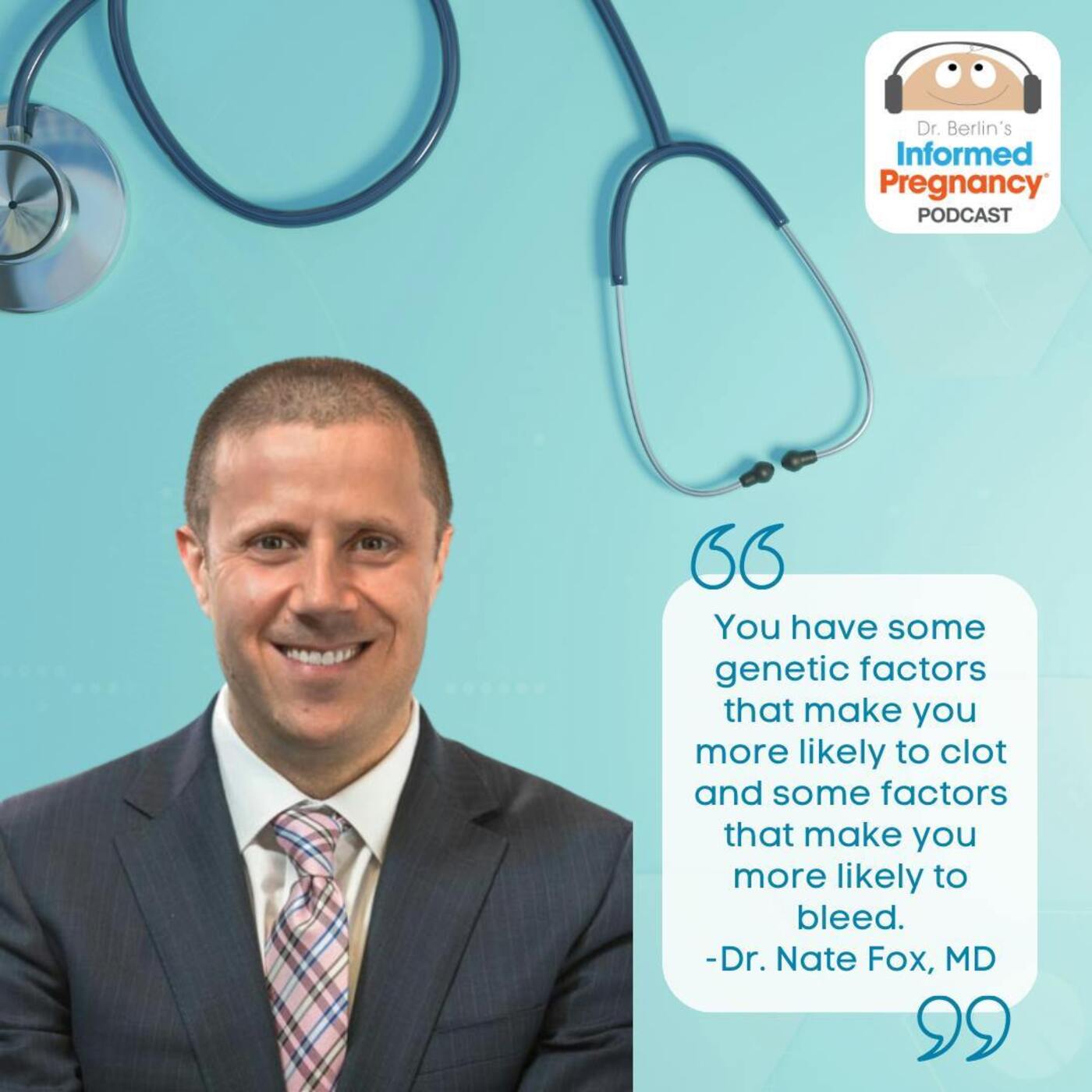
February 2, 2023 · 53 minutes · Episode 325
About this episode
Board certified OBGYN and maternal fetal medicine specialist Dr. Nate Fox is here to talk about thrombophilia, a condition where the body forms blood clots too easily. Learn the causes, symptoms, treatments, and how this condition relates to pregnancy and childbirth.

Connect with Dr. Fox online: https://www.mfmnyc.com/team/nathan-fox/
Keep up with Dr. Berlin and the Informed Pregnancy Project online!
www.instagram.com/doctorberlin/
www.facebook.com/InformedPregnancy
Learn more about your ad choices. Visit megaphone.fm/adchoices
See Privacy Policy at https://art19.com/privacy and California Privacy Notice at https://art19.com/privacy#do-not-sell-my-info.
Key quotes
“Yes. So the ones in the legs, generally the signs are pain, swelling, and inflammation. So someone comes in and they say, you know, my right leg, you know, sort of a between the knee and my hip, I have a lot of pain in the back of my leg, it's red and it's swollen, that would be concerning for a blood clot in”
“I mean, we try not to freak everyone out and worry about blood clots all the time. But on the other hand, we try not to ignore them because there are people are going to get them. And so really, it's one of these, you know, arts of medicine to try to be appropriately cautious without terrifying everybody at all times.”
“Yeah, I mean, it's difficult, but at least it's always interesting. And one of the really fascinating things about this topic is it really needs to be individualized. This is not something where like I could just like, you know, throw up a table or a chart and say, if A then B or if B then C, it's really each person we have to take into account their own risk factors, their own genetic predispositions, their own situation, and then decide, are we”
“Yeah, a lot of gray, a lot of gray with rhombophilia as it really is. Even for those of us who do this all the time. And when I go to conferences and we talk about how to manage this, it's not uniform. There's a lot of variation here because there's so much gray how to interpret it.”
“I would get a second opinion with either a maternal fetal medicine specialist, like, you know, someone like me, because this is something we do a lot of, we take care of pregnant women who have blood clotting issues, or a hematologist with a lot of experience with pregnancy.”
Related episodes
- Ep. 331 The Umbilical Cord with Dr. Emiliano Chavira
- Ep. 438 Postpartum Preeclampsia with Dr. Jamie Barstein and Dr. Nathan Fox
- Ep. 329 Valentina Trentini: After Birth
- Ep. 366 Dr. Erica Rozmid: A Personal Experience with Microcephaly
Transcript
AI-generated transcript with speaker labels — may contain errors, especially names and medical terms. Dr. Elliot Berlin, DC appears in blue; Dr. Nate Fox in orange.
Download PDF of the Transcript
Dr. Elliot Berlin, DC [1:36] Welcome to the informed pregnancy and parenting podcast. I'm your host pregnancy focus car factor. Dr Elliott Berlin the topic of this episode is thrombophilias or conditions in which blood clots are formed too easily in the body We'll explain these conditions in general and then discuss them specifically in relation to pregnancy and childbirth My guest today is a board certified OBGYN with a subspecialty in maternal fetal medicine He's a clinical professor in the department of obstetrics gynecology and reproductive science at the icon school of medicine at Mount Sinai He's been on the podcast several times in the past Give me as great insight into topics like gestational anemia and thrombocytopenia
[2:18] the turning procedure for rich babies the ECV and Very helpful descriptions of the medical test done throughout pregnancy. Dr. Nate Fox. Welcome back to the podcast
Dr. Nate Fox [2:30] Thank you very much. Thanks for that. Very exhaustive intro. I love it. I almost need to take a break for some
Dr. Elliot Berlin, DC [2:38] Good to see you good to see you good to hear you. Let's jump right in we're talking about thrombophilias or hypercoagulability Mm-hmm. What are these? These are blood clotting disorders. Tell me more about them
Dr. Nate Fox [2:51] Yes, so basically the premise is that for all of us our blood is maintained at a certain thickness right, so our blood can be very thin or it could be more thick and It's maintained in that way through a very delicate and intricate system What we call homeostasis which basically means balance and why would you want your blood to be thin or thick? Essentially normally you want your blood to be pretty thin so it can sort of travel through the blood vessels easily You know perfuse all of your organs and your muscles and your brain, you know, and if you're pregnant the placenta However, there are times when you want it to be the opposite So for example, if I get a cut on my arm
[3:35] So my skin is open and I start to bleed right because the blood is thin and it goes out the open hole what I want my body to be able to do is number one recognize that there's a cut and it's bleeding and Number two at the site where it's bleeding to start sending things like platelets and fibrin What not to that area to sort of clot and block off that hole So I stop bleeding and then you want the body to shut that system off Otherwise, I'm gonna clot off my whole arm and my arm is gonna fall off and so it's not that easy to achieve and the body has you know hundreds probably thousands of proteins and factors That are involved in this process And so normally our blood is maintained at a certain level unless it has to get thicker or clot
[4:22] The concern is that there are some people who have either genetic predispositions or they have certain medical conditions that can cause their blood to go one way or another when someone bleeds too much their Blood is too thin and they can't clot we call that Hemophilia the reason it's called that is hemo is like from blood a heme and Filia means like or have an affinity towards and That's sort of one set of problems But what we're talking about today is the other set of problems where people could have either a genetic or maybe a medical predisposition to clotting which is what we call thrombo filia thrombus the word for clot in medicine. And so people who sort of like to clot and that's the concern.
[5:06] And we're going to talk about that in general and obviously related to pregnancy and childbirth.
Dr. Elliot Berlin, DC [5:11] So people who like to bleed versus people who like to clot, exactly sort of the thin versus the thick. Okay. When you say that the body has sort of a homeostatic level for the thickness of blood, is that sort of like pulse and blood pressure where there's a normal range for everybody, like that we all have a certain thickness that we should be striving for, that the body strives for, or is it just different from person to person? And can you measure it? So those are two good questions that are definitely
Dr. Nate Fox [5:41] related. The first question is, yes, sort of similar to things like blood pressure, pulse, you're sort of best off being at a certain place normally. And then again, sometimes you want your blood to be thinner. Sometimes you want your blood to be thicker. We don't have as much control over it as potentially our blood pressure or pulse. It's not like something like, well, if you exercise a lot, your blood will be at the right thickness or thinness. It doesn't work so much that way. It's more a sort of behind the scenes, physiologic stuff. There are some ways we can test for it. There's certain blood tests that can be run that can indicate as someone's blood is too thin or too thick, but they're not
[6:19] great because most of the blood tests either measure certain factor levels. You want a certain factor that's involved in blood clotting to be at the right place and if it's too high or too low, but that doesn't always correlate with your actual clinical risk of bleeding or clotting. There are some tests that sort of take your blood and put it in the lab in a petri dish and check how fast does it clot or how slow does it clot. That is one indicator, but they don't tend to be as easily measured as something like blood pressure or pulse. We could just, you know, get one, two, three.
Dr. Elliot Berlin, DC [6:52] Okay. That makes sense. And then also just so curious here, does the body have a system because when you think about a clot or an injured blood vessel that needs to clot so that it doesn't bleed, does one have a mechanism as a whole thickening or thinning the blood or just at sites of injury?
Dr. Nate Fox [7:12] So a little bit of both. I mean, sites of injury are unique in that they're not really trying to thicken your blood. They're trying to plug a hole. And so the things that happen is there's sort of this signaling mechanism. Again, I'm not a hematologist. This is not my area of expertise, but just, you know, I did go to medical school and we deal with this in pregnancy, but the body has a signaling system to sort of say, Hey, there is an injury here or Hey, there's sort of an opening here and it sends things that would plug a hole. There are times when your body is overall going to be sort of thicker or thinner blood. One of the interesting ones, and this is definitely relevant for today's pregnancy.
[7:54] So during pregnancy, the entire body goes onto a more thick blood status, which is why when you're pregnant, you're more likely in general to get blood clots when you shouldn't. We don't know exactly why that happens. The thought process is the theory of why that happens sort of from an evolutionary perspective is one of the main reasons women would die in childbirth is from bleeding too much. And so the thought is that if during pregnancy, women adapted their bodies or their bodies adapted for them such that they were not sort of bleeders, but more clodders, it would, you know, help prevent deaths at the time of childbirth. However, it can also present some challenges during the pregnancy if their blood is more prone to clotting.
Dr. Elliot Berlin, DC [8:43] So it's kind of insanely amazing that we have so many vessels running through the body. And when one of them becomes injured, your body has a way to signal, Hey, there's a problem here. And your body has a way to send relief or repair itself. You know, like I'm sort of picturing a self-sealing tire that has a puncture and all of a sudden it can plug itself and keep driving. And that is just an incredibly intricate process with a lot of different
Dr. Nate Fox [9:17] steps. Yeah, a hundred percent. The more we understand, the more we realize how complex this is and how little we actually understand how it is that 99% of our lives, our blood vessels are, you know, wide open and traffic is moving and blood is flowing beautifully. And pretty much the second there's any injury, our body's able to recognize and fix it. And you also realize how many things could possibly go wrong in that it's just infinite. And the fact that it doesn't go wrong in all of us is absolutely amazing. I mean, listen, I say the same thing about pregnancy and childbirth every single time I'm there and I deliver a baby, the fact that it goes right is the amazing thing, you know, and it's just unbelievable.
[10:00] believable that almost always goes right when there's so many things that could possibly go wrong. It's literally miraculous.
Dr. Elliot Berlin, DC [10:05] Whoever made this thing, the body, they knew what they were doing. Okay. So the issue then becomes that sometimes in today's, since we're talking about thrombophilia, sometimes your body's too excited to clot and that can create different problems. We're going to talk in the second segment about the different types of thrombophilia. And then we'll talk in the third segment about how that relates to pregnancy specifically and things that you can do about it, how you test for it and other things like that. But in the moment, what I would love to know, are there certain people who are at greater risk for thrombophilic diseases?
Dr. Nate Fox [10:44] So in general, just in medicines are not related to pregnancy or not specifically related to pregnancy. The issue with having increased clotting potential or thrombophilia or thrombogenesis is essentially if you get a blood clot that's not supposed to be there, it'll block up that blood vessel. It'll sort of act as like a pipe in your house that gets blocked. And that could be really problematic. So if you get a blood clot, frequently where they happen is like in your legs, the leg can get very inflamed. It can get swollen. And that's problematic and it's annoying. That itself is not particularly dangerous, but those blood clots, once they're formed, they
[11:27] can travel through your blood vessel system and sort of end up in your lungs. And if they end up in your lungs, that's called a pulmonary embolism, which can be very dangerous, can be life threatening. And sometimes they can even travel and end up in your brain. And that's one of the causes of stroke. And so that's sort of the problem. If you have a blood clot where it shouldn't be. And there are people at risk for that because the main causes for getting a blood clot where you shouldn't are either you have a predisposition to it. So that's number one, which could be genetic. It could be due to a medical problem. Certain times you have infections. It could also be due to what's called stasis,
[12:07] where the blood is sort of sitting still, like it's not moving. And that makes a lot of sense. Like if you're, you know, making something thick, you want to keep stirring it like on the stove, because if you don't, it clumping. And so blood should be moving to stay thin. And so people at risk for that, sort of people who are put on prolonged bed rest, people who have surgery and are lying in bed for a long time, people with, you know, orthopedic injuries and orthopedic surgery where their legs or whatever is immobilized. So that would put someone at increased risk. And the third is an injury to the blood vessel. So injuries to the blood vessel can happen from inflammation, for example, that can also happen after
[12:44] surgery. So anyone who has those would be an increased risk. In terms of the predisposition, the thrombophilias, there are a lot of genetic ones that you do inherit from your parents. Again, this is one of these blame your parents things. A lot of the reasons people would have a predisposition to clotting sort of just themselves would be they inherited a genetic mutation from one or potentially both of their parents.
Dr. Elliot Berlin, DC [13:09] Okay, so if you're starting to develop a clot that overgrows, are there signs before it gets to be an emergency before little pieces break off and you know, cause a major issue with the brain or the lung, or some other organ? Are there signs that oh man, you got a blood clot growing, you need to take care of this before it becomes dangerous?
Dr. Nate Fox [13:31] Yes. So the ones in the legs, generally the signs are pain, swelling, and inflammation. So someone comes in and they say, you know, my right leg, you know, sort of a between the knee and my hip, I have a lot of pain in the back of my leg, it's red and it's swollen, that would be concerning for a blood clot in the leg. A blood clot in the lung, usually symptoms related to your lungs, you know, shortness of breath, chest pain, coughing. And there are tests you can do to diagnose them in the legs, it's pretty easy, because it's just an ultrasound of the blood vessel of the leg. And you can sort of see the clot there. The ones in the lungs are a little bit more complicated,
[14:13] because they're in smaller blood vessels there. And so you can't do an ultrasound of the lungs, you have to either get, you know, usually it's a form of a CAT scan with some dye to figure it out. But those are also not always as easy to diagnose, because in the lung, if you have a very big clot in the lung, you're going to see it, but you're probably going to be very, very sick. And if these little tiny clots in the lungs, they're sometimes harder to see.
Dr. Elliot Berlin, DC [14:36] Okay. So if you're feeling redness, pain in the back of your leg, don't wait too long before checking it out.
Dr. Nate Fox [14:45] Yeah, correct.
Dr. Elliot Berlin, DC [14:46] Amazing. Now that we know a little bit more about blood clotting disorders, let's take a little break and we come back and we'll find out more specifically what the different types are. We'll be right back with Dr. Nate Fox.

Dr. Elliot Berlin, DC [16:26] Welcome back to the Informed Pregnancy Podcast. We are talking about blood clotting disorders with Dr. Nate Fox. Okay, now we understand how blood clotting works on a very, very basic level. Let's talk about what can go wrong and the different types of blood clotting disorders that one might find.
Dr. Nate Fox [16:44] Okay, so there's two different types in general, right? There's congenital and acquired blood clotting disorders. Congenital meaning that it's present at birth and acquired meaning you get it sometime after birth, usually later in life.
Dr. Elliot Berlin, DC [16:58] Does congenital, the fact that you have it at birth, mean that you got it hereditarily?
Dr. Nate Fox [17:04] So as a broad definition, something that's congenital, as you said, means you're born with it. It does not necessarily mean that it is genetic or inherited from your parents. Sometimes people use congenital, genetic and inherited interchangeably, but they mean different things. Congenital just means you're born with it. So that could be, you know, like a birth defect could be congenital. You're born missing a finger, right? So that's congenital. Genetic means the cause of it is something related to your genes and inherited means it's something genetic you got from your parents. So for these thrombophilias that we're talking about, they're all three, right?
[17:46] You're born with them. It is from a genetic defect and it is something you got from your parents almost all the time. For example, you know, your listeners might be thinking, hey, what would be genetic that you don't get from your parents? Actually, most genetic diseases or many genetic diseases, I mean, you don't get from your parents. Example, you know, Down syndrome is a genetic syndrome where you have, you know, an extra 21st chromosome, but neither of your parents have an extra 21st chromosome. It's something that happened during the process of reproduction. But what we're talking about here, these congenital inherited genetic mutations are ones that almost always your parent has and passed on to a child.
[18:25] So if you know that one or both of your parents has one of these conditions,
Dr. Elliot Berlin, DC [18:31] does that automatically make you a greater risk for having it yourself?
Dr. Nate Fox [18:35] Yes. So most of these are inherited in what we call an autosomal recessive fashion and that your parents, either one of them can have this. And, you know, if you go back to high school biology with that pun in square, the big A and the little A, and I know a lot of people listening might be getting palpitations and sweats right now from that. But conceptually, you know, most of these are such that someone can have one of the two copies. I mean, you have two genes and one of them being abnormal. You might have some form of a thrombophilia, which is sort of how most people are. If you had two, then you tend to be much sicker, have a much bigger problem.
[19:11] But either way, you're going to inherit it from your parents. So, yes, if you know, for example, if I found out I've never been tested for these, let's say, and I find out my mother has one of these mutations, then I know that I'll have a 50 percent chance of having it myself. If I know that both my parents have this mutation, which is not typical, but if that were the case, then I have a much higher chance of having inherited from one of them.
Dr. Elliot Berlin, DC [19:35] Okay. And also not related to pregnancy, if somebody has one of these conditions, would they necessarily even know?
Dr. Nate Fox [19:46] No, most people don't know. If you sort of went around and let's say you went into, I guess, you know, you're in California, if you went to a Chargers game, right, and the six people who go to the Chargers games, and they're in the stands. No, if you go to a Phil Chargers game, You test every single person there or you test 50,000 people, run a panel of genetic thrombophilias, these mutations that put you at increased risk for getting a blood clot. Probably about 5% to 10% of people are going to test positive and find out they have one of them. But the vast majority of those 5% to 10% of people have never had an issue with it. They've never had a blood
[20:21] clot. They've never had a blood clot in their lungs. They never had an issue with pregnancy if they were pregnant. And so most of them are silent. However, they have an increased chance compared to the person sitting in front of them who doesn't have one of them of getting a blood clot. So if your chance sort of a baseline is, I don't know, let's say it's one in a thousand, and if you have this, now it's three in a thousand. All right, you're three times higher, but you're still less than 1% chance. I'm making these numbers up, but it's just sort of conceptually, I'll give you the number. I'm not making up as 5% to 10%. 5% to 10%
Dr. Elliot Berlin, DC [20:51] of the population has one of these things. Okay, so if 5 to 10%, so 5 to 10 out of 100 people would test positive for these congenital thrombophilias, but only a small fraction of them would ever have a clotting issue. Correct. Only a small percentage of them would ever manifest it, right? They all have quote unquote the issue and that they have a higher risk of getting a blood clot. But the majority of them will never get a blood clot in their entire lives. Right. Okay. We're on the same page. So of the congenital issues, you have a couple of different types. One is where you overproduce the factors that clot,
Dr. Nate Fox [21:29] the clotting factors. Yeah. I mean, essentially sort of the way the homeostasis works is you have some factors that make you more likely to clot and some factors that make you more likely to bleed. So if you have too much of the factors that cause you to clot, or you have a mutation that makes them more active, you know, sort of stronger, then you're more likely to clot. Or for the factors that make you more likely to bleed, the opposite. If you have too few of those, then you're going to be more likely to clot. Or if they're mutated such that they don't work so well, you're going to be more likely
Dr. Elliot Berlin, DC [22:06] to clot. Okay. That makes it clear. So you have clotters and clearers. Yeah. And if you have overactivity on the clotters, then you're going to be more likely to clot. So which are those?
Dr. Nate Fox [22:20] I mean, essentially the list of common, what we call thrombophilia is the inherited thrombophilia is the most famous ones or something called factor five Leiden. Factor five is one of the factors. It's a mutation. Essentially you get thrombophilia because it makes you resistant to something called protein C, which is something that makes it thinner. These are really sort of complicated how they work in a mechanism pathway. I could say when like I lecture medical students or residents on this, there's all these like clotting cascade pathways you could put up that gives everybody a heart attack when you see this because there's arrows pointing in 65 different directions and backfilling. And
[22:57] it's really complex, but the ones that people have probably heard of at their doctor may have ordered there's that factor five Leiden. There's something called the pro thrombin gene mutation. So those are pretty common. Then there's deficiency in protein S like Sam or protein C like Charlie or something called anti thrombin deficiency. These are sort of the big five that people test in terms of genetic predispositions. There's another gene that a lot of people get tested for called MTHFR, which is actually erroneously tested. A lot of doctors test it, but they really shouldn't because it's not truly a clotting issue. And the issue is potentially unique folic acid, but that's sort of the one that
[23:41] a lot of people get tested for and freak out because that is something that it's not five to 10% of the population, but that's like 10 to 50% of the population have that mutation. So it's really ill-advised to test that unless there's a real specific reason to.
Dr. Elliot Berlin, DC [23:56] So I was, first of all, factor five Leiden forever. I was just curious about the medical term Leiden and then I found out it's just a town in Holland.
Dr. Nate Fox [24:06] Yeah. A lot of times if you discover something, they'll either put your name on it or for some reason the town it was discovered in, I guess that they didn't like the person so they picked his or her town. I don't know.
Dr. Elliot Berlin, DC [24:18] So factor five really just means that you have overactivity because of factor five. And these factors are just a huge chain of reactions that take place that are very complex to cause a clot or to clear a clot. And along that pathway, something doesn't work properly because of, in this case, a mutation. The factor five is not made quite right. And again, we're only talking now
Dr. Nate Fox [24:41] about the inherited mutations that cause you to clot more. There's also inherited mutations that can cause you to bleed more. We're not talking about those today, but there's a whole pile of those as well. Again, since that pathway is so complex, there are so many ways it can get messed up from a genetic perspective. And it explains a lot of the variability in people who say, Oh yeah, I always bleed a lot or I don't bleed that much. And, you know, a lot of the variability is just normal variability, but it's sort of some of the mutations can lead to obviously more of a complicated or a diseased state because you really bleed too much or you're really
[25:16] caught too much. Yes.
Dr. Elliot Berlin, DC [25:17] Okay. So really just suffice to say there are different types of the congenital. Like you said, factor five lighten per thrombin, which is also sometimes called factor two mutation. Right. Am I right in the sense that those tend to be more mild?
Dr. Nate Fox [25:32] Yeah. I mean, all of the ones that we mentioned tend to be mild. And most of those people again, we'll go their whole lives without knowing they have it anti thrombin deficiency. The last one I mentioned is a little bit more rare than the other four and is a little bit more severe than the other four, so they're lumped together, but that is one that is not as common and tends to be a little bit worse. But the most common ones would be factor five, pro thrombin, protein C and protein S and each of them has a prevalence of like one to 3%, which is sort of how you get the five to 10% for having any of them.
Dr. Elliot Berlin, DC [26:06] I can't believe we said clumped together.
Dr. Nate Fox [26:09] Well, you know, you gotta stay on point.
Dr. Elliot Berlin, DC [26:12] The clock thickens. Okay. Factor five and factor two are per thrombin are where you have overactivity of the things that make you clot and then protein C protein S and the anti thrombin or will you have a deficiency of the things that break up clots?
Dr. Nate Fox [26:33] Right.
Dr. Elliot Berlin, DC [26:33] Or the things that stop you from clotting.
Dr. Nate Fox [26:34] Exactly.
Dr. Elliot Berlin, DC [26:36] Okay. There's that moving away from those you also have acquired, which means it wasn't present at birth. It came sometime later on. Does that mean it's not necessarily genetic?
Dr. Nate Fox [26:46] Right. So this is really an interesting one and it's actually a much more significant medically cause it's more severe. So acquired is you don't have any genetic predisposition to clotting or if you do, it's a coincidence, but this is a condition called anti-phospholipid antibody syndrome, which is a mouthful. We sometimes abbreviate it as APS or APAS and essentially it's an autoimmune condition, which is something where your body sort of attacks itself. So there's a lot of autoimmune conditions people can get. Lupus is an autoimmune condition. Crohn's is an autoimmune condition. You know, uh, my senior Gravis is a lot of autoimmune conditions, but
[27:25] this one, your body attacks the inner lining of your blood vessels, which puts you in a significantly higher risk of getting blood clots and other complications, you know, strokes and a lot of pregnancy complications, and you're not born with it typically if it's going to develop, it's going to develop in your twenties, thirties and forties. And it's more common in women than men, which is true for most autoimmune conditions. Most autoimmune conditions happen in your twenties, thirties and forties and are more common in women than men. Why that is, we don't exactly know. And so this is something where if there is any sort of family linkage, it's just sort of like general family disease state that
[28:06] we don't really understand. Like, you know, if someone has parents who have autoimmune conditions, they're more likely to have an autoimmune condition, but you can't map it out sort of like with the square that you could do for a real inherited genetic defect and say it's 25% or 50%. This is just, well, you probably have a higher chance of somebody else, but it's hard to quantify exactly how much of a higher chance.
Dr. Elliot Berlin, DC [28:28] That you'll have an autoimmune condition at all, or you'll have that specific autoimmune condition.
Dr. Nate Fox [28:33] Both. There tends to be sort of clustering of autoimmune conditions in families, but they can vary which condition, because it's probably an issue related to the immune system, not related to the specific organ that gets attacked, but I think it is more common to get the same organ, you know, in families. Again, these are not well mapped out and it's hard to say for anybody, if they have a family member or a parent who has an autoimmune condition, exactly what their percent chance is getting one themselves is a lot of other variables. We call it multifactorial, which means we don't know. And so essentially it's a fancy way of saying, we don't know.
[29:08] There isn't like a gene that we can identify and test for. It's just like, well, I mean, similar to most things. If your parents have heart disease, or if they have diabetes, like you're more likely to have it yourself. But why that is, is not exactly clear. There's genetic factors. Probably there's environmental factors, probably the sort of similar habits that you have with your parents, probably there's so much overlap between those. It's hard to really tease it all out.
Dr. Elliot Berlin, DC [29:33] Okay. If you have a P a, a P a S or why don't we just go simple and call it APS done 25% less in the title here, but if you have this antiphospholipid syndrome, so are there any signs of it outside of plotting?
Dr. Nate Fox [29:51] So generally not for most people who are not pregnant. It's something that will usually present with blood clots or also arterial blood clots. We've been talking mostly about blood clots in the veins. When you get a clot in your leg, it's in your venous system. But sometimes people get clots in their arms, in an artery in their arm, or in their chest, or even sometimes in the brain. And this is something, if someone has a very unusual or rare clot or happens very early in life with no risk factors, definitely they should be worked up for antiphospholipid syndrome. There are other more unusual presentations that people can have with this. Sometimes
[30:29] they'll have little platelets, which is sort of odd why that might be,
Dr. Elliot Berlin, DC [30:32] and there's other sort of strange things. So with the antiphospholipid syndrome, it can be primary or secondary, meaning if you have another autoimmune condition, right, like lupus, then you're more likely to have antiphospholipid syndrome?
Dr. Nate Fox [30:48] Yeah, you're more likely to have it if you have other autoimmune conditions. But I would say most people who have it don't have other autoimmune conditions.
Dr. Elliot Berlin, DC [30:57] Just primary, this is their thing. Yeah. And the mechanism here is what what's happening exactly to cause that clot. It's different than
Dr. Nate Fox [31:05] the congenital ones. It's mostly injury to the blood vessel because your body's sort of attacking the blood vessel from the inside out, leading to sort of inflammation, injury, and then clotting inside the blood vessels.
Dr. Elliot Berlin, DC [31:17] Okay. Let's take a little break. We come back where you can get real specific to pregnancy. Don't go anywhere. We'll be right back. Welcome back to the Informed Pregnancy Podcast. We're talking to Dr. Nate Fox, and we've learned a tremendous amount. And as always, Doc, when you're on this program, I learned a ton. And the feedback on these is that, wow, thank you for putting them into language that I can understand from our audience. Right now, we've built up to the point where we understand a little bit more about the clotting system in the body. We understand where it can go wrong. And specifically in this episode, where it can go wrong and create too much clot. Now we want to talk about pregnancy.
[32:06] That's our main thing. So how do these blood clotting disorders manifest themselves in
Dr. Nate Fox [32:11] pregnancy? Yes. So it's interesting. For most of them, actually, our main concern is risk to the mother of getting a blood clot herself during pregnancy, like in her leg or in her lungs. And the reason is pregnancy itself, as we said earlier, is a time when women have an increased potential to clot. Sort of naturally when you get pregnant, some of your factors change like that protein S actually goes down when you're pregnant. That's number one. Number two, you have an increase in some of your pro coagulation factors. And number three, pregnant women obviously have a lot more, what we said before, venous stasis, where the blood is sort of sitting still because A, they have that uterus compressing their blood vessels in
[32:58] their abdomen. And so everything below that has a harder time sort of traveling north towards the heart and the brain. So it sort of slows down a little. It's the same reason women get swollen legs frequently in pregnancy. So it's the same concept. And also, unfortunately, a lot of pregnant women are recommended to be on bed rest in pregnancy, which we don't typically recommend. And one of the reasons we don't is it increases the risk of a blood clot. So someone has, you know, they're pregnant, so they have an increased risk of getting a blood clot. And on top of that, they have either a genetic or sort of an autoimmune predisposition to blood clots. One of our concerns is that she might get a blood clot herself in her leg
[33:36] or her lungs. And so that's sort of a lot of it. But then there are certain pregnancy complications that either are associated with these or people think are associated with these. We spend a lot of time trying to dispel that myth. And so the things that sort of are potentially associated with these that people talk about are early miscarriage, late miscarriage, or fetal death even in the third trimester, and then early onset preeclampsia or fetal growth restriction or placental abruption. These are like severe, significant pregnancy complications that have been linked with some of these thrombophilias to varying degrees. And so that's another reason why we sort of focus on them. And there is a lot of focus on them in pregnancy.
[34:21] So number one, the health of the mother, number two, potential risk of complications to the pregnancy or to the baby. Okay, so in terms of health to the mother, same thing as we were talking about before with that blood clot, the signs and symptoms would be the same signs and symptoms would be the same. Sometimes it's difficult because again, pregnant women frequently have symptoms like swollen legs, painful legs, shortness of breath. These are normal pregnancy symptoms. So trying to differentiate the normal pregnancy symptoms from abnormal can be challenging. And so it's something that we try to figure out either from other symptoms or risk factors.
[35:00] factors, or sometimes we're a little bit more likely to recommend a test like an ultrasound of the legs in pregnancy, just because the risk is higher. But it's not easy sometimes.
Dr. Elliot Berlin, DC [35:08] Yeah. I mean, I sometimes randomly find them in our office when someone comes in with like a pain that seems like it's a pubic pain or something in that area, like you said, between the knee and the hip. And then you kind of get in there and you're like, that doesn't look like a muscle spasm. So you go send them in to be safe. And of course, you don't really want to massage it if it was a blood clot and break off a piece and cause a problem.
Dr. Nate Fox [35:32] I mean, we try not to freak everyone out and worry about blood clots all the time. But on the other hand, we try not to ignore them because there are people are going to get them. And so really, it's one of these, you know, arts of medicine to try to be appropriately cautious without terrifying everybody at all times.
Dr. Elliot Berlin, DC [35:48] Yeah, it's tough because you never want to have medical complication for the mother or the baby. Right. But then there's like, how many people do we need to treat for something to save one? And what are the downsides of treating all those people that didn't need it? Yeah, which is why I'm so happy that you're you and I'm me. I mean, you just have an insanely difficult job to do.
Dr. Nate Fox [36:10] Yeah, I mean, it's difficult, but at least it's always interesting. And one of the really fascinating things about this topic is it really needs to be individualized. This is not something where like I could just like, you know, throw up a table or a chart and say, if A then B or if B then C, it's really each person we have to take into account their own risk factors, their own genetic predispositions, their own situation, and then decide, are we going to do nothing about it? Are we going to do something small about it? So we can do something pretty aggressive about it. You know, who to test and who to treat are really controversial topics. There are some
[36:48] guidelines for this that most of us follow, but they're not perfect. And the data is not perfect for any of this either. So who should get tested for all of these genetic things or inherited things as well as the acquired? And if you have one of them, who should get treated with like blood dinners? Again, very controversial. It's going to be hard to sort of give very precise recommendations on a podcast, because again, it's so individualized. But we can go over sort of general concepts and sort of more sweeping statements that might be helpful.
Dr. Elliot Berlin, DC [37:17] Yeah, well, let's do that. I mean, if you have those things, if you have an early miscarriage or a later loss of the pregnancy or a silent birth, those are things that everybody wants to prevent. And if the reason it happened was, you know, a blood clot that could have been prevented, who wouldn't look back and say, I wanted to know that ahead of time, I wanted to know that I had that issue, I wanted to be treating to prevent this from happening. It's very understandable. So you would sort of wonder, and we haven't even talked about what the treatment is yet. But you would sort of start to wonder why not test everybody. And even like you said, five to
[37:57] 10% might come up positive, but a much smaller number would actually have a problem. Isn't that something that someone sort of deserves to know? Or if you wouldn't choose to test them for the reasons you're about to say why we don't test everybody? Is that something that somebody can say, I want to know for myself, can I request that test, even if you're not recommending it?
Dr. Nate Fox [38:19] Yeah, I mean, that gets into a lot of issues like ethics and autonomy and whatnot. And I don't personally have a problem if someone wants to know if they have any of these genetic predispositions. I mean, I don't mind testing them for it. But it's sort of how you're going to interpret them. I mean, the issue is, there have been very large studies where they took women at the beginning of pregnancy, and drew blood on all of them. There was a big study looking for factor five Leiden and a big study looking for pro thrombin gene mutation, and they didn't tell anyone the results, they just have it hidden. And then they went back after the pregnancies
[38:50] were over. And they were talking about, you know, 5,000 women and they looked, they said, all right, what percentage of them have this mutation? And did they do worse in pregnancy than the ones who didn't? And ultimately, they found, you know, two, 3% have this mutation, and their outcomes were exactly the same. And so if you take someone at the beginning of pregnancy with no specific history of anything, and you just test them for it, and you find it, the data shows that you're not going to be better off by treating them for it than if you didn't, because the outcomes are the same. So that's one factor that you need to take into account. So if someone says,
[39:25] hey, I really want to know if I factor five Leiden, I could test them for it, that's fine. But if I find it, you know, I'm going to be talking to them that, you know, probably we don't need to do anything about it, we can just sort of watch and wait. And so the reason there's recommendations sort of, you know, not to test, is not because we want to hide information from people, it's that if you start doing that, not everyone, not every doctor, not every person who sees his results is going to know enough to know that you don't need to be treated. They're gonna say, oh, you have a problem of a mutation, I'm going to treat you and the treatment for these that's really
[40:00] If you need a treatment, the effective treatment is an injectable blood thinner. You have to inject yourself once or twice a day with a blood thinner that is A annoying, B painful, C potentially expensive, and D makes your blood thinner than it is at baseline. So you could have complications from bleeding. Like if you are walking down the street and fall and cut your knee, instead of having a little bit of bleeding, you might have a lot of bleeding. Or if you have to go to the hospital for emergency surgery, or if you show up in labor unexpectedly, you may have more bleeding. So these treatments aren't benign, and that's the issue. You have to be very cautious in who you treat, and you want to be highly confident
[40:41] that it's going to be helping someone and not potentially harming someone. And so that's why it's really tough with this. And for example, with miscarriages, miscarriages are so common, unfortunately, as you know, so many pregnancies miscarry. And the early miscarriages are almost always due to a genetic abnormality in the embryo that was present at the second they conceived. And so whether you do or don't give them blood thinners is not going to fix that. And most of the inherited blood clotting disorders have actually not been linked with early miscarriage. And so I see so many people who come to my office early in pregnancy on a blood dinner from another doctor because they had a miscarriage or because they have one of
[41:25] these genetic predispositions. And I'm essentially recommending to come off it. I spend a lot more time taking people off of blood thinners than I do putting people on blood thinners. The one exception to that is the antiphospholipid, which has been associated with early miscarriages. So if someone has a late miscarriage or several unexplained early miscarriages, that's someone who usually would test for antiphospholipid. And if they have it, we would treat them. But that's generally the exception. The other ones, not so much.
Dr. Elliot Berlin, DC [41:57] So if somebody knew they had antiphospholipid, would that alone be someone that you might recommend the injectable treatment for during pregnancy?
Dr. Nate Fox [42:08] But the answer is yes. But what we actually didn't mention is in order to have antiphospholipid, you need to have, number one, the blood tests for these antibodies be elevated. And number two, you actually have to have had a bad complication already. It's an interesting sort of backwards diagnosis. If someone just randomly is perfectly healthy, never had any issues whatsoever, and you happen to test these antibodies and find they're elevated, we don't generally recommend treatment for them other than maybe like a baby aspirin or something, because we don't know. Again, there's a portion of people walking around this earth with these antibodies who don't have any complications from it.
[42:47] So this is usually a diagnosis that's made backwards. Someone has multiple miscarriages or they have an unexplained pregnancy complication, or they have a blood clot, and then you test them and you find these antibodies, boom, they have the diagnosis and yes, moving forward with probably every pregnancy, I'm going to recommend something aggressive.
Dr. Elliot Berlin, DC [43:05] Okay. If somebody wanted, if they had the elevated antibodies without the confirmation from a clot or a complication, so then you wouldn't naturally treat them with injectable blood thinners.
Dr. Nate Fox [43:17] It's hard to answer that question because it depends on which antibodies, exactly how high, how many, you know, what is there other risk factors? It's a long conversation. The short answer is no one knows. That question has not been studied appropriately, which is someone with elevated antibodies for antiphospholipid syndrome, but no problems in the past. What would you do? There was one study that was published on this and it's not really a study. It's actually fascinating where basically like someone asked a bunch of hematologists, Hey, what would you do? Like, you know, show of hands, raise your hand. And literally that was a study. And the majority of them said they would give them baby
[43:52] aspirin and that's it. So that's sort of what we do, but it's literally based on no data. That's just sort of what a bunch of experts thought would be the best way to go. So it's a conversation. And so again, I'm not opposed to putting them on a blood thinner. If I think it's the right thing for them or they really wanted it, but usually it'd be someone had like really high levels of antibodies that were pretty terrifying, but it's only like slightly high levels and they've never had an issue, probably blood thinners are going to cause more problems than they're going to fix. And so I would generally discourage it in that situation.
Dr. Elliot Berlin, DC [44:22] Yeah. That's something that's important to keep in mind that these interventions have a downside and you might first cause a problem with the treatment that wouldn't have happened without it.
Dr. Nate Fox [44:32] Yeah. I mean, if the intervention we're talking about is let's say a baby aspirin, right? So baby aspirin is really benign. I actually recommend it to all my pregnant patients now pretty much. And so if that's what we're talking about, then the stakes aren't very high. Take it. Don't take it. You want to take it. Don't take it. That's fine. But when you're talking about injectable blood thinners, that's next level. That's serious stuff. I'm not trying to scare people who need to be honest because many, many people are on it in pregnancy and they do fine. and it's safe and it's safe for the baby and we monitor it, but it's not nothing. And there can be issues with it and they can be significant.
[45:07] And so you really don't wanna do that unless you need it.
Dr. Elliot Berlin, DC [45:10] Right. Like I said, delicate balancing act because nothing is black and white.
Dr. Nate Fox [45:16] Yeah, a lot of gray, a lot of gray with rhombophilia as it really is. Even for those of us who do this all the time. And when I go to conferences and we talk about how to manage this, it's not uniform. There's a lot of variation here because there's so much gray how to interpret it.
Dr. Elliot Berlin, DC [45:30] But at the same token, when you have the complication and the outcomes that are devastating either for the mother or for the pregnancy, you always wanna look back and say, I should have done that. And hindsight is so clear. It just, it's not easy. I wanna just end by talking about, let's say delivery. So you mentioned somebody who is gonna treat for these is gonna have an injectable blood thinner that they self-inject at home every day. And how does that affect birth? How do you do birth if you're on blood thinners?
Dr. Nate Fox [46:07] Yeah, so the concept is we generally don't want people on blood thinners or having thin blood at the time of birth because number one, I love you mentioned very early on the podcast, people can bleed. I mean, they do bleed at birth. And if you're on a blood thinner, you're gonna bleed a lot more and that could be pretty dangerous. And number two, if someone is hoping to get an epidural in labor, if your blood is too thin, most anesthesiologists are not gonna place an epidural because there's a risk of bleeding near your spine where that needle goes in, which can be very dangerous in terms of compressing your spine and paralysis and whatnot. So generally, if someone's looking for an epidural,
[46:46] they don't wanna be on a blood thinner when they show up in labor or even if they don't want an epidural, but they have an unexpected need for a cesarean in labor, same concept. The anesthesiologist is not gonna give them anesthesia like a spinal in their back, they're gonna have to put them to sleep. So those are the reasons you don't wanna be on a blood thinner when you're in labor or when you show up in labor. And so what we do about that is either later in pregnancy, we sort of switch them from one blood thinner to another blood thinner. The second one is a little bit harder to administer because it's twice a day versus once a day. And you have to sort of,
[47:19] it doesn't come pre-filled and this and that. And so you have to sort of draw it up yourself, but it's shorter acting. So generally, if they're on it, they come in labor, it's shorter acting. There's a blood test you can send that'll result usually within an hour and tell you if your levels are okay. And then assuming that's the case, you can get an epidural or you can labor without worrying about bleeding too much. So that's one option is to switch to that sort of shorter acting blood thinner. The other option is if someone either needs to have a scheduled induction of labor or cesarean or someone wants to have a scheduled induction or cesarean, you can just stop the medication
[47:55] 24 hours in advance. Sometimes if someone's on a tremendous amount of blood thinners and it's really dangerous for them to be off it or we don't think we can switch them, we will say you are the person who we need to like be induced so we can stop your blood thinners 24 hours in advance. But that's actually the exception. Those are people who are on a very high dose of blood thinners. Most people on a low dose of blood thinners do not need to be induced because of it or do not need to have a C-ception because of it.
Dr. Elliot Berlin, DC [48:22] So in the three sort of blood thinners that you talked about, the low dose aspirin, does that have to stop also as you get closer?
Dr. Nate Fox [48:30] Generally, no. You can continue that. Although sometimes people do just in case one of the anesthesiologists doesn't get grumpy about that, but it's not considered a risk factor for complications.
Dr. Elliot Berlin, DC [48:39] Okay, so that one's not an issue. Then is Lovenox the one you?
Dr. Nate Fox [48:42] So yeah, Lovenox is a brand name for anoxaparin. It's a form of what's called low molecular weight heparin. It's sort of a form of heparin which is the most traditional blood thinner and the reason it's sort of a nice one is because you can do it once a day and the dosing is a little bit easier. You don't always have to do it based on the weight of the person getting it. And also when you get it from the pharmacy, it's pre-filled. It's like easier, just sort of logistically easier, but that's also longer acting. So that's the one you don't wanna be on if you show up in labor. Whereas heparin which is also called unfractionated heparin or UFH is something that usually you get a bottle and a needle
[49:18] and you have to draw it up yourself and you have to do twice a day and you bruise a little bit more, but it's shorter acting. And there's a blood test you can get that'll tell you right away when you're on heparin if your levels are okay. There is not a blood test if you're on the Lovenox that'll tell you right away what your level's on. It takes like a day to get that result back. So that's not very useful if you show up in labor.
Dr. Elliot Berlin, DC [49:39] So when you're treating this way for the bulk of the pregnancy, it's Lovenox easier to administer and longer lasting. And then as you get towards the end, swap over to heparin.
Dr. Nate Fox [49:50] Right, or stop the Lovenox, whatever. Some people need a C-section or need an induction and you can just stop at 24 hours in advance.
Dr. Elliot Berlin, DC [49:57] Okay, my last question is in terms of. people trying to gather information and make these difficult choices. I know you mentioned that these injectable blood thinners could not, not by way of scaring people, but just by way of being aware that the injectable blood thinners could also cause complications.
Dr. Nate Fox [50:15] Yeah.
Dr. Elliot Berlin, DC [50:16] What are those complications and how common are they in sort of trying to weigh out, I know it's not even measure, but way out. So like, let's say I have the factor and I want to treat it, you know, way out the pros and cons of taking them or not taking them.
Dr. Nate Fox [50:32] Yeah. I mean, I would say two things in general, the complications we're talking about are bleeding, right? If you thin your blood, you're going to have a higher chance of bleeding and pregnancy. That could be vaginal bleeding. That could be bleeding from a cut or wound. It could be, you know, anything related to that in terms of how to weigh this, you know, this is one of those situations where a lot of times it's really important to get a second opinion on this because, you know, what frequently happens in my experience is someone either has a complication or doesn't have a complication. They see a doctor, they run a whole panel of tests and the results come
[51:08] back and somebody says, Oh, you have to do A, B and C and they might be right, that might be true, but frequently it's not because it's not something they do every day or they don't see pregnant patients, you know, either they're doctors who deal with like, they're like hematologists who deal a lot with sort of blood clotting disorders, but don't see a lot of pregnant patients and don't know what to do specifically there, or sometimes they're, you know, general OBGYNs or internal medicine doctors who sort of might see pregnant patients, but don't know a lot about thrombophilias. Again, they might, and they might have gotten it perfectly right,
[51:38] but might not, and this is really, you're someone who either has been recommended to take blood thinners or you were recommended to not take them, but you think maybe you should be on them. I would get a second opinion with either a maternal fetal medicine specialist, like, you know, someone like me, because this is something we do a lot of, we take care of pregnant women who have blood clotting issues, or a hematologist with a lot of experience with pregnancy. I work with certain hematologists who see pregnant women every single day, and so that's something either to ask the hematologist, you see a lot of pregnant women, if the answer is yes, then they
[52:13] probably will have a good working knowledge of what to do, or a maternal fetal medicine specialist, and this is something that generally a consultation like this can be even sort of like remotely, like telehealth, because generally all I would need to do is speak to them and review their blood work results. It's unusual. I'd have to do any sort of examination to make a decision about what to do.
Dr. Elliot Berlin, DC [52:33] That's very helpful. Thank you. My last, last question is when somebody does have a thrombophilic condition and has had the pregnancy complications recurring early miscarriage or a late loss, how effective are these treatments?
Dr. Nate Fox [52:48] So if the problem is antiphospholipid, it's very effective. It tends to work. If there's sort of a borderline call, you know, they have miscarriages and they were diagnosed with factor V Leiden, since most of the data suggests factor V Leiden wasn't the cause of it, it's not clear that the treatment's going to be effective. That's part of the complexity of this is that for a lot of these, the link between the thrombophilia and the complication is not as strong. And so we're not as confident that doing treatment is going to prevent the pregnancy complication. And that's part of the reason these usually involve long discussions about what to do.
Dr. Elliot Berlin, DC [53:27] Dr. Fox, thank you so much for joining me and helping me and our audience understand and become informed and empowered to be a part of the conversation in their healthcare choices. Where can we find you online?
Dr. Nate Fox [53:41] So if you want to find me online, probably the best place is through my podcast, which is healthful woman. That's the word health, H E A L T H full F U L woman in the singular. That's my podcast, or you can go to my website for our practice, which is www.mfmnyc.com M F M like maternal fetal medicine and Y C like newyorkcity.com, or you can just walk about Northern New Jersey or the Upper East Side of Manhattan and look for the guy with the Cubs backpack. That's me.
Dr. Elliot Berlin, DC [54:14] And occasionally baseball camp.
Dr. Nate Fox [54:16] Yeah.
Dr. Elliot Berlin, DC [54:16] All right. Thank you again at home. Thanks for listening to the informed pregnancy podcast for more informative and empowering pregnancy, birth, postpartum and parenting content, check out our brand new streaming channel at informed pregnancy.tv.
Dr. Nate Fox [55:00] Oh
Want more pregnancy + parenting? Start your FREE TRIAL of Informed Pregnancy+ and get access to all our curated pregnancy and parenting content — original series, iconic birth films like The Business of Being Born, prenatal workouts and more.