
March 13, 2023 · 38 minutes · Episode 334
About this episode
Systems engineer turned nurse Dr. Angela Lang chats about how the company Medela brings science into care, nurturing generations and specializing in evidence based care. Dr. Lang gives insight into all stages of breastfeeding and how the baby’s and mother’s systems work together.

This episode is sponsored by Medela.
Check out Medela online: https://www.medela.us/breastfeeding
Follow Medela here: www.instagram.com/medela_us, https://www.facebook.com/MedelaUSA/, and https://www.tiktok.com/@medela_official?lang=en
Keep up with Dr. Berlin and the Informed Pregnancy Project online!
www.instagram.com/doctorberlin/
www.facebook.com/InformedPregnancy
Learn more about your ad choices. Visit megaphone.fm/adchoices
See Privacy Policy at https://art19.com/privacy and California Privacy Notice at https://art19.com/privacy#do-not-sell-my-info.
Key quotes
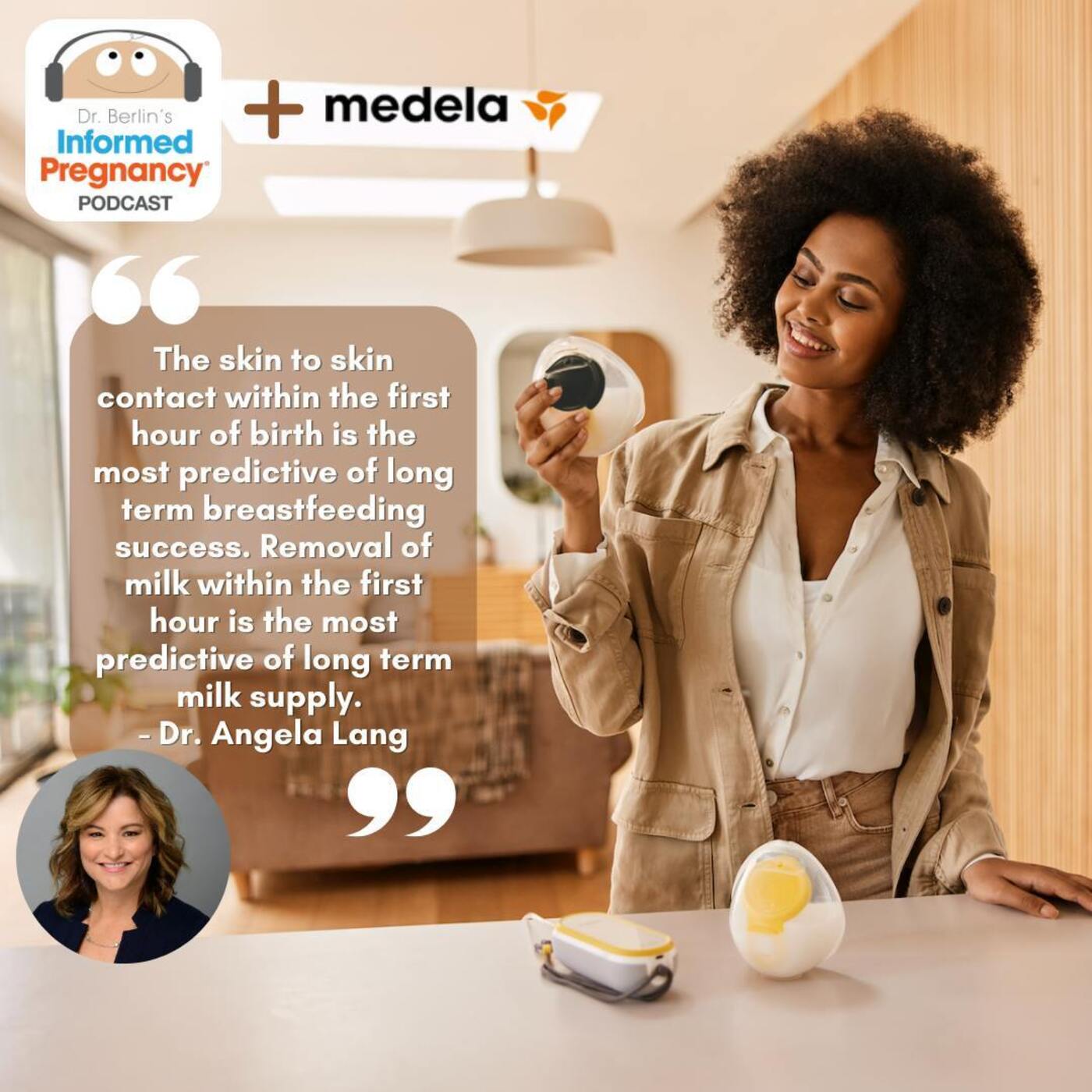
“I think the most important part of a breastfeeding journey is setting things off right. So initiation of breast milk is the most important part of your breastfeeding journey. So as I said before, that skin-to-skin in the first hour is the most predictive of long-term breastfeeding success. Removal of milk in the first hour is most predictive of long-term milk supply.”
“firm believer in supporting women in all of their choices, whatever they are. I just want them to be informed choices, and so the imperative of human milk is really important,”
“they're so amazing. They are way smarter and stronger than we think they are. You know, people always think that babies need to be supported. When you watch a baby skin-to-skin and they lift their head up and go straight for the nipple, it's like the greatest thing ever. You just are so amazed with how talented and smart they are right from the beginning.”
“So that first three days, that milk, you know, I've heard people say, well, I'm going to wait till my milk comes in before I feed the baby. I just think, oh my gosh, that's the best milk that you're missing. Like you don't want to miss the colostrum.”
“So for example, if I'm breastfeeding at the breast and say my baby's in daycare, my baby's exposed to a lot of different babies, a lot of different healthcare workers that are coming in and out the baby's saliva actually sends a signal to the body and says, this is what's going on in my environment. The mom then makes an antibody for that and transfers it to her milk.”
Related episodes
- Ep. 332 Square Baby Part 3: The Stages of Baby Nutrition
- Ep. 366 Dr. Erica Rozmid: A Personal Experience with Microcephaly
- Ep. 329 Valentina Trentini: After Birth
- Ep. 331 The Umbilical Cord with Dr. Emiliano Chavira
Transcript
AI-generated transcript with speaker labels — may contain errors, especially names and medical terms. Dr. Elliot Berlin, DC appears in blue; Dr. Angela Lang in orange.
Download PDF of the Transcript
Dr. Elliot Berlin, DC [1:36] Welcome to the informed pregnancy and parenting podcast. I'm your host pregnancy focus carp actor. Dr Elliott Berlin in today's sponsored episode I have the pleasure of speaking with a true expert in the field of breastfeeding My guest is a former systems engineer turned nurse who now serves as the senior director of lactation education and professional development for Medela a company specializing in breastfeeding products and advice She's here to impart valuable knowledge for expectant parents and to showcase the various product services and resources Offered by Medela. Dr. Angela Lang. Welcome to the podcast. Good morning. Thank you My pleasure. I'm very excited to learn more about Medela and the products and services that they offer
[2:21] Our patients and my wife and family members for years have been using Medela products And you know Medela's really set itself aside as the leader in quality products for lactation support So let's start at the beginning. What's your background? Where you from? I
Dr. Angela Lang [2:39] live in Wisconsin, so I'm really close to the McHenry, Illinois office. I Started out as you said a systems engineer and changed my career to nursing I'm an international board certified lactation Consultant and I also as a doctorate as a clinical nurse specialist in maternal infant. Wow
Dr. Elliot Berlin, DC [3:00] I just want to say that I as a kid 17 years old I trained to be an EMT and I started to work at 18 in New York City in Ambulances and emergency rooms and even from then from very early age It was so clear to me that in the hospital setting nurses make the world go round and that only Became clearer over time as we had babies in the hospital as I supported other people in labor in the hospital and recently when I had Pretty bad case of kovat nurses are the true heroes of the medical establishment. So thank you so much for that
Dr. Angela Lang [3:34] No, I appreciate that and it's very true in the hospital setting the nurses are what makes the whole thing work
Dr. Elliot Berlin, DC [3:40] And that's before you even specialized into this really necessary Specialty of care that you're doing now. So for you what pushed you into Lactation, how did you get into lactation?
Dr. Angela Lang [3:53] So as I said, I was a systems engineer working for a software company I had my first baby and I really felt like I didn't get evidence-based care in the hospital I had read the womanly art of breastfeeding from the LHA league and I really believed my baby didn't need to be supplemented in the hospital and I really felt pressured to give formula the whole time. I was there and even longer into my baby's life, you know when my milk supply went down at six months my Pediatrician gave me a big tin of formula and sent me home So I felt that most of my experiences with health care professionals were just the easy solution of formula And it took me two more babies and a lot of convincing to my husband to let me change my career
[4:44] Stop everything and go back to school to be a nurse So my first degree actually is in lactation and that was a great degree for me I worked a lot with the baby friendly hospital initiative and then moved on to nursing and some graduate work as a clinical nurse specialist and maternal infant. You know, I had really done a couple years of graduate school as a midwife because I thought that was how I was going to change everybody's life. I was going to be a great midwife and help everyone, but I quickly realized that my scope of influence would only be on an individual and with the clinical nurse specialist role, I could impact the whole hospital or even the whole hospital system
[5:26] and have the right policies and procedures in the hospital to support mothers, not just in breastfeeding, but of course that's my love, so that's always where I focus on, but in all kinds of better health care and the better nursing services we could provide
Dr. Elliot Berlin, DC [5:42] when women are at the hospital. Wow, so many things going on from my head. First of all, you would have been an amazing midwife and anybody would have been lucky to be under your care that way, but I totally understand the drive to affect as many people as possible and how the same hour for hour you can have an impact on supporting lots more people through the work that you're doing now. Two other things that come to mind. First of all, you mentioned the Baby Friendly Hospital Initiative. Can you talk a little bit
Dr. Angela Lang [6:09] more about what that is? So the Baby Friendly Hospital Initiative is a part of an international program to create what they call the 10 steps of successful breastfeeding, and that's really to empower hospitals to have the right policies and procedures that support breastfeeding. So for instance, one of the big things in the Baby Friendly Hospital Initiative that I spent my entire career doing, probably educated more nurses than I could even think of, is doing skin-to-skin in the first hour. So what I love about your program, Dr. Berlin, is you have a whole audience of people that actually care about learning about things for pregnancy and how they can prepare for birth, and I would say that's my number one best thing,
[6:54] top tip, is making sure you get that first hour skin-to-skin because it's the most
Dr. Elliot Berlin, DC [6:59] predictive of long-term breastfeeding success. Wow. Dr. Lane, so based on your own personal experience where you felt like the hospital, you know, there are easy solutions for anything that came up with feeding your baby was to give formula, and now your advocacy for helping people succeed in breastfeeding, it feels like there's a dynamic where you support breastfeeding and were frustrated at formula. Can you tell me more about that philosophy in your mind?
Dr. Angela Lang [7:28] Yeah, I mean, definitely. I think what most hospital practices kind of set women up to have to supplement in the hospital, whether it's being separated from the baby or it's just in some ways the easier answer for nurses and for physicians. If things aren't going well, like, let's just give the formula and we know that the baby will eat and then the baby will go home, and the problem is we're not looking at that kind of holistically, right? The best nutritional setup for a baby and the mother really is long-term breastfeeding, so really giving the support to moms when they're in the hospital so they can be successful is, I guess, my one and only thing that I focus on every day of my life.
Dr. Elliot Berlin, DC [8:12] And, you know, it's important to say formula has come a very long way, and there's a lot of nutritional goodness in formula for babies, and that you are an advocate for informed choice, just like I am. We don't judge anybody for their choices that they make. What we're trying to do is make sure that there's clear information about pros and cons of all the options available, and sometimes in the hospital, well-intentioned people are just like, oh, that baby's not eating well. Let's give formula without thinking about other options, and so… Yeah, 100%. I am a nurse. I'm a
Dr. Angela Lang [8:50] firm believer in supporting women in all of their choices, whatever they are. I just want them to be informed choices, and so the imperative of human milk is really important, and formula is good, and I'm not going to say that it doesn't have a place because when a baby does need to feed, I'm not the kind of lactation consultant that doesn't say, oh, formula never. I just try to maximize the breastfeeding success so that we don't have to use formula, but I absolutely use formula in my practice. It's an important part of babies and also moms, right? Because all moms want to feed their babies, so it's just the balance. How do we make sure that we're maximizing her milk potential, and then we're
Dr. Elliot Berlin, DC [9:36] also feeding babies? Yeah, that's really well said. You're with Medela. How did you guys
Dr. Angela Lang [9:42] connect? How did you come to work with Medela? You know, it's a great question. Medela's been a part of my life for probably the last 25 years. I was a breastfeeding mom who used Medela products to make sure I could maintain my milk supply when I was separated from my baby. All I really wanted to do was be able to breastfeed my baby. So interestingly enough, I had my first baby in 1997 and the first pump and style came out in 1996. I just learned this recently and I think it's funny because I just thought, well, this is what everybody does. They go get a pump and style at the store and then they just start breastfeeding and pumping. Um, so I just learned that.
[10:21] I thought it was pretty cool that I was really a trailblazer at the time I didn't even know. And I really trusted Medela as a mother, but I also trusted the products in the hospital. You know, we have our products in 6 million hospitals and homes. It's a trusted tried and true research based product that I always felt comfortable in my professional practice using, it was kind of like the main stay and because of the evidence and research that Medela does on their products, we absolutely knew that they could bring in good milk supplies for mothers and babies. And I guess for me coming to work for them, I really was aligned with the mission and vision of the company.
[11:07] And you know, the first line of the job description is spearhead the company's mission of enabling moms to successfully initiate breastfeeding for their babies and sustaining that feeding of breast milk throughout the least, the first 12 months of life. And that fundamentally at my core is who I am. You know, I became a clinical nurse specialist to save the lives of babies. I really focused on infant mortality and Medela really works in that area. This is a life-saving measure in many other countries. We're in a hundred different countries around the world. And so for me, I'm so honored to work for such a great company.
Dr. Elliot Berlin, DC [11:47] What specifically are your goals there in your position?
Dr. Angela Lang [11:50] So my goals, I really have the greatest job ever, to be honest. My goals are really to keep our lactation professionals up to date with evidence-based information. So one of the things that we do, which we've always done as a big history of the company, as we provide webinars, in-person meetings that we help with lactation education, we have some of the world's most renowned researchers in lactation that we support. And, you know, we support that research because it helps us make better products, but we also share that information. So one thing that's really important to us is a lot of lactation consultants now don't even work in the hospital.
[12:32] They work in the community. And that's been a big shift really over COVID. I've seen just a kind of complete change with that. So we make sure that the research that we publish is also free and available so that you don't have to be in a big academic setting to read the research and then really my job is kind of bridging that prenatal mom and lactation consultant and other healthcare providers to research based products, enable moms to successfully breastfeed. So I feel like I have the greatest job ever.
Dr. Elliot Berlin, DC [13:03] Wow. And I know because I work with your clients all the time, Medela consumers, that the support that you're able to give them, you know, I once heard a lactation consultant say that everybody who successfully breastfeeds for three months or more has thought about quitting seriously at least twice. And so the support that you give and figuring out how to help people overcome those hurdles and roadblocks is incredible work. Let's take a quick break. When we come back, we'll continue learning more about Medela and the products and services because there's been a lot since the pump and style we'll be right back with Dr. Angela link.

Dr. Elliot Berlin, DC [15:22] Welcome back to the Informed Parenthesis Podcast. We are talking to Dr. Angela Link of Medila. Okay, we said at the end of the first segment, Medila's come along way since the pump and stall. There's lots going on. Tell me about some of the different things that the company offers.
Dr. Angela Lang [15:38] Well, I see the main things that we offer are our products, right, our research-based products. We provide a lot of education and a lot of services. So for example, our products really are intended to support the patient's entire breast milk-feeding journey. So prenatally to postpartum, we have the hospital-grade pumps that are in the hospital, and they have a specific patent and technology to initiate milk. So they try to mimic the first two weeks of milk-making similar to a baby. So nothing is better than a baby at the breast to bring in a full milk supply. And I would tell your audience, don't pump in the first two weeks unless you need to.
[16:23] So the baby's gonna bring in the best milk supply on its own, and really what happens in that first two weeks, we're creating what we call all the milk-making cells. And over time, that two week of programming is gonna be your long-term milk-making production. So if we don't get it right in that beginning time, we're gonna actually maybe not have as much milk over three or six months or nine months down the road. So the first two weeks are critical. And then I would say you could add some personal use pumps, but the first two weeks, if you are pumping, you're gonna be telling your body that you have twins. And that sounds like a great idea, but it creates all kinds of other things.
[17:07] So we use the symphony in the hospital when we have babies in the NICU or we have some other kind of prenatal risk factor. So things like PCOS would be a big reason why I would ask moms to pump in the hospital just for some insurance pumping.
Dr. Elliot Berlin, DC [17:25] So PCOS is polycystic ovarian syndrome. How does that affect breastfeeding?
Dr. Angela Lang [17:30] Well, breastfeeding really is influenced by hormones. And so any kind of endocrine disorder is going to influence your milk-making production ability. So you need all of hormones like insulin. So diabetes is another thing that might impact your milk-making ability over time.
Dr. Elliot Berlin, DC [17:52] So in those cases, although the general rule is if you're able to breastfeed regularly, don't pump in those cases, the additional pumping might be helpful.
Dr. Angela Lang [18:01] Yes, we used to in breastfeeding say, if a mom has risks, don't tell her because that's gonna make her feel like she can't produce milk. But really in the last, I would say five or six years, the focus on breastfeeding has been proactive management of milk. So if I had a PCOS mother, I would say, hey, feed the baby and then we're gonna do some pumping. And it also gives me clinically an idea of how much milk she has. And one time I had a mom who on D3, the baby had like a 13% weight loss and she was pumping after every breastfeeding and not getting any milk, not even a drop. And she was so committed to breastfeeding. And I said, you know, I really think we need to give your baby
[18:48] a little bit of formula right now. And I mean, crying, just hysterical. And I was like, wow, this is so hard to deal with, you know, cause I felt so bad for her that that baby really needed to eat. So I use it a lot prenatally. We sometimes ask moms to do some antenatal expression and then in the hospital. So the Symphony pump really works to help sustain initiation. So it has this patented initiation technology. And then we also have the breast pumps that we use at home, the maternity and nursing apparel. So we have bras and tank tops. We have all of our storage solutions, which you probably know about since you've had babies. And then we have cleaning products
[19:32] and sanitizing products and even pacifiers. We have the whole gamut. And then really for the education piece, that's where my focus is in the corporation.
Dr. Elliot Berlin, DC [19:42] Wait, wait, before we get there, can you tell me about some of the innovations and changes of pumps or newer pumps that have come out over the years?
Dr. Angela Lang [19:52] Well, our newest pump is the Freestyle Hands Free. And this is kind of a revolutionary pump in the market. place. So there's been hands free pumps available for a number of years, but we've really taken the time to do research on the product. So we have done dozens of scans of breasts, specifically lactating breasts. And so the cups that fit in the bra are really anatomically designed to kind of have like a teardrop shape. They're a little bit different. And what we found with that is that because they complement that breast shape, they really optimize the flow for removal of milk and faster than traditional pump shields. They're also really cool because you can see
[20:37] through them. And so that can help you look and see if the nipple is working well and see if your milk's flowing. So it's a really cool new product.
Dr. Elliot Berlin, DC [20:46] Nice innovations. And then also Medela has products that help with troubleshooting or solutions when there are products like the SNS.
Dr. Angela Lang [20:58] Oh, yeah, this SNS is a great product. I used it a lot in my practice. We just came out with a new SNS that is available in the commercial line. So I used it all the time as a lactation consultant in the hospital. But there's a newer one with a better design that's available for parents in like Target or regular retail stores. What's cool about an SNS is because really, we just want babies to be at the breast and breastfeeding, right? And so we don't use a bottle then we're really helping the baby learn the flow while they're at the breast so they get that nipple stimulation also works really great for people who maybe are chest feeding or want to have that experience of breast
[21:44] feeding, but maybe doesn't doesn't have a full milk supply.
Dr. Elliot Berlin, DC [21:47] Yeah, so SNS stands for supplemental nursing system. And can you just describe briefly how it works?
Dr. Angela Lang [21:54] Yeah, so we have the milk container and it's attached to a tube and that small little tube will either tape like really close to the mother's nipple, or sometimes we'll use a nipple shield to hold it in place. And then we have the baby breastfeed. So we use this a lot in regular practice and then make you maybe the baby's first time at the breast. And we're helping the baby with some milk flow to kind of get the baby interested. The reason we're using the SNS is to preserve breastfeeding instead of giving a baby a bottle where the milk is flowing super, super fast. We're kind of regulating the flow of the milk, but giving the baby the same central cues of being at the
[22:38] breast. And it could work really great for people who are chestfeeding or maybe don't have a full milk supply. It's a way to kind of keep breastfeeding going.
Dr. Elliot Berlin, DC [22:48] Awesome. So in addition to the pumps and to solution products like the SNS and the bras and the parts and the nipple balms, you also have education. Tell me about Medela's education programs.
Dr. Angela Lang [23:03] So the education piece is really the highlight of my job and where I spend the most part of my time. And really what we're trying to do is continue the path of everyday amazing mother's milk. So we offer clinical education for health care professionals. If you go on our website, there's like a little button for health care professionals. We have things like webinars we do every month. We have in-person speakers. We have some of the greatest lactation minds and researchers that we have at our sessions. People like Paula Meyer and Diane Spatz, who have been the leaders in lactation for many, many years.
Dr. Elliot Berlin, DC [23:45] Icons.
Dr. Angela Lang [23:47] Icons. I call them lactation legends.
Dr. Elliot Berlin, DC [23:50] I like that.
Dr. Angela Lang [23:50] I say that to Diane all the time. She's a lactation legend. And really one of the things that we do is because we're so research-based, we really understand the mother's needs and the baby's behavior. So we spend a lot of time looking at baby behavior with universities, hospitals and research institutions around the world. And that gives us insights and discoveries that help us advance our technology and breastfeeding solutions.
Dr. Elliot Berlin, DC [24:18] It's really cool work. It's amazing. And it kind of shows how Medela is so committed, not to just products, but to the entire experience and to providing the well rounded complement of support to ensure and promote success.
Dr. Angela Lang [24:33] It's a huge part of our DNA. And honestly, it was one of the reasons that I became really intimately involved with Medela because we used to go to a lot of their education.
Dr. Elliot Berlin, DC [24:43] All right. Let's take a little break. When we come back, we're going to have some practical information and tips for anyone who is about to have a baby or just recently had one. We'll be right back with Dr. Angela Lange. Welcome back to the Informed Pregnancy Podcast. We're talking to Dr. Angela Lang of Medela. Okay, let's talk about some facts that would be helpful for someone who is about to embark on a breastfeeding mission or somebody who's just embarking on one now.
Dr. Angela Lang [25:24] I think the most important part of a breastfeeding journey is setting things off right. So initiation of breast milk is the most important part of your breastfeeding journey. So as I said before, that skin-to-skin in the first hour is the most predictive of long-term breastfeeding success. Removal of milk in the first hour is most predictive of long-term milk supply. So those two things that happen in the first hour where it's dizzy and there's a million things going on in the OB room, we really want to keep the mom and baby together and allow that baby to find the breast on its own and initiate its first latch. And you know what? These babies,
[26:09] they're so amazing. They are way smarter and stronger than we think they are. You know, people always think that babies need to be supported. When you watch a baby skin-to-skin and they lift their head up and go straight for the nipple, it's like the greatest thing ever. You just are so amazed with how talented and smart they are right from the beginning. It's so incredible to watch that. It is. It's my favorite thing to do in a day, honestly. And to watch the mother when the baby finds the breast on their own and she always is like, oh, my baby wants to breastfeed. So if we just let her have that moment, it'll, you know, kind of change the way she feels about breastfeeding. Instead,
[26:55] a lot of times we take them away, we weigh them, we clean them, we move them around, we give them shots, we do all kinds of stuff. So the best thing is to have that first hour, what we call the golden hour, and keep the babies right there with their mommies. And you know, skin-to-skin is a really amazing intervention because the body is actually reading the temperature of the baby and is putting more blood in the chest of the mom than even is in her brain. So that's how important the body thinks the baby is. And if you had two babies, each side of the breast would be a different temperature to warm the baby that it's regulating, which is unbelievably fascinating. It doesn't work
[27:40] with three babies, but if you have twins, it'll still work.
Dr. Elliot Berlin, DC [27:45] Wow. That's a fascinating tidbit that I didn't know, but it's just so incredible. You know what? I sometimes show our patients also this elephant birth on YouTube where this elephant gives birth and she labors all by herself. There's nobody around her and she like squats and does all these positions and she's quiet and focused. And then the baby comes out and she immediately turns around and starts doing neonatal care. And she uses her trunk and she's like assessing the baby and the baby is not breathing right away. And all of a sudden she starts doing interventions. She sort of like starts kicking the baby, kind of what we would do if we slapped their bum or tickled their foot.
[28:25] Baby's still not breathing. And then she wraps her trunk around the baby's tiny little trunk, lifts the head and yanks on it. Almost like she's doing a chiropractic adjustment. I'm like, what? And then the baby starts breathing. And I am like, how does this woman elephant know? Like she didn't go to medical school. She didn't take a class, read a book, listen to a podcast, watch a documentary. How does she even know that she needs to do neonatal care and assess that the baby's not breathing and realize it's a problem and have solutions. And you just realize when you watch something like that, it is all hardwired and encoded in your nervous system, in your DNA for you.
[29:07] And from the baby, from the very beginning, when they come out, there's this incredible interaction going on that you can't necessarily see, but you see clues at the surface. And that's one of them. And it's just an incredible thing how the body just knows. Like a woman's body is incredible in its ability to grow a baby, deliver a baby, feed a baby, and how a baby who's just been born knows what to do.
Dr. Angela Lang [29:31] I love that story. I hope you send me the video.
Dr. Elliot Berlin, DC [29:34] Oh, absolutely. I will. I will. So the first thing that comes out is different, right? The colostrum that comes out is different than what will come later. Tell me about colostrum.
Dr. Angela Lang [29:45] Well, colostrum is a fascinating part of milk, right? And we used to divide it as colostrum and then the milk coming in, but it's still milk. And we have this small amount of milk that's super sticky and viscous for the first three days, but it's super intentional. As you just said, the body knows exactly what to do for this baby. And we kind of monkey with it. But the reason why it's so thick is it's like a mucus and its purpose is intentional. It goes into the body and it binds all of the mucus membranes. And what that's doing is actually creating a barrier in the baby's body. So if bacteria comes in, it just kind of slides right through. And we see that through research, the bacteria is like kind of not even untouched
[30:34] when it's in the diaper of a baby. And it also is imparting all the immunity to the baby. So you think about this, the baby comes out, it's a completely vulnerable infant, and all of a sudden it's in a new world. And so the body's creating all these antibodies that it's giving it. And the body even knows from the mother, what's going on in their environment. So we'll be giving what's relevant to what's going on here. COVID, RSV, we're going to provide that protection for that baby. So that first three days, that milk, you know, I've heard people say, well, I'm going to wait till my milk comes in before I feed the baby. I just think, oh my gosh, that's the best milk that you're missing.
[31:21] Like you don't want to miss the colostrum. And you also want to make sure you're doing frequent eating during that time because frequent removal of milk makes the best long-term milk supply.
Dr. Elliot Berlin, DC [31:33] So the first bite of the apple.
Dr. Angela Lang [31:35] Yeah.
Dr. Elliot Berlin, DC [31:35] I mean, colostrum is just so fascinating. I love it. And then milk changes over time. And it was kind of like you were saying how the body regulates the temperature to the baby. The body also takes cues from the baby's needs.
Dr. Angela Lang [31:50] Yes. So what happens over time when we're talking about immunity? And I think that's one of the big things when we're talking about formula. Formula is good nutrition for babies. They can eat it, but babies need more than that. So for instance, if we look at a baby a month after birth, it's formula fed versus a breastfed baby. The breastfed baby's thymus where all the antibodies are stored is twice as big as that of a formula fed baby. And so this protection is specific. So for example, if I'm breastfeeding at the breast and say my baby's in daycare, my baby's exposed to a lot of different babies, a lot of different healthcare workers that are coming in and out the baby's saliva actually
[32:38] sends a signal to the body and says, this is what's going on in my environment. The mom then makes an antibody for that and transfers it to her milk. So one of the things I didn't know when I first started breastfeeding, I would just pump the milk and I'd put it in the back of the freezer. And then I just bring the first food forward is the freshest milk is the most relevant to the baby. So we want to give the fresh milk that we pumped that day, because that's what's going to protect them in their environment and then store milk that we didn't use right to be used later. There's nothing wrong with that milk. It's still great milk, but the fresh milk is the one that is most
[33:20] designed for the baby at the moment. And it's going to give them the most protection. It's really fascinating how that works.
Dr. Elliot Berlin, DC [33:26] It's insane. All right. I had a patient a few years ago who had triplets and breastfeeding was extremely important to her. And then she fell ill and couldn't feed her kids. And we started because it was so important to her that they got human breast milk. We've started this campaign of milk donation and to a lactating mom. Understandably, it's like liquid platinum. It's hard to give it away, but these moms came out in full support. I would go around on Thursday nights, I ran the city with a cooler in my front seat and pick up bags and bags of milk for people. And those triplets got primarily breast milk for the first three months. And it was just an amazing program.
[34:20] So I know that recently Madeela started a program and you guys have this hashtag moms unite for milk, the number four moms unite for milk. Tell me more about the program.
Dr. Angela Lang [34:32] Well, you know, last year we had a pretty significant formula shortage. And we also had a donor milk shortage, kind of at the same time, you know, it was COVID things were happening and Madeela saw the need to help moms access safe milk sources to feed their babies. So one thing that donor milk does different than what you were doing with your community based, you know, sourcing of milk is donor milk pasteurizes milk, so we support a lot of milk banks throughout the country. And with the Moms Unite for Milk, we did a pumpathon and an education campaign encouraging moms to donate breast milk to these nonprofit milk banks. And then we gave them educational resources about pumping and milk donation.
[35:15] And right now we still do this campaign, by the way, it's still going on. But we have more than 55,000 ounces of milk donated to help families in need. And I think I love your story because women love to help other women, right? And so when we did this campaign, we saw that people came out, right? They wanted to donate their milk. And honestly, over the years that we've had donor milk, we had a milk depot in my hospital. That hospital now has two large freezers because they get so many donations. And so moms know when they breastfeed, they understand the importance of this milk and they want to give it to other babies. Usually that milk goes to preterm babies in the hospital, but it's being used more and more for even term babies.
[36:07] So it's really amazing. And we love being a part of that, helping moms help each other.
Dr. Elliot Berlin, DC [36:13] Wow, that's huge. Like I said, it's liquid platinum. It's an extremely valuable resource and you can't replicate it. You can't replicate it. That's 55,000 ounces, almost 500 gallons of donated milk.
Dr. Angela Lang [36:26] I love that you can be the math.
Dr. Elliot Berlin, DC [36:29] Google helps.
Dr. Angela Lang [36:32] It's really a part of our DNA. Medela has another arm called Medela Cares, and that is really our social responsibility arm. And I know for patients and parents, social responsibility of companies is really important. So we do a lot of things for our environment. We signed the UN Sustainability Complite Pledge. So all of our new product packaging is all cardboard, doesn't have plastic involved in it. And we partner with organizations like the Ronald McDonald House, the March of Dimes, Good Plus Foundation, and donate a bunch of our resources and products for families and babies and needs. And, you know, the Ronald McDonald House is really important.
[37:15] A lot of times moms and babies are separated from their babies in the NICU. This allows them to be able to pump when they're back home at the Ronald McDonald House. So it's a great partnership that we have. And, you know, another thing I just wanted to mention, because it's really at the top of mind, we just got the Pump Act passed legislation, which requires employers to provide workspaces or lactation spaces for pumping moms. It's been many, many years that we've been working on that. And we have a program that we partnered with Momava. It's called KIN, and it allows employers kind of like a ready-made lactation services support so they can provide those lactation rooms.
[37:57] Have you ever seen those lactation rooms that are in the airport?
Dr. Elliot Berlin, DC [38:00] Yeah, the pods.
Dr. Angela Lang [38:02] Yeah, those pods. So some places don't have room that they can give up. Like I worked at a hospital where it was tight. I mean, there wasn't any place to like find an extra room somewhere. And so we brought in a Momava pod. So we had places for people to pump. And it was really nice because it was actually more in the lobby area. So visitors pumped there all the time, too, and our nurses. So it was pretty cool.
Dr. Elliot Berlin, DC [38:26] That's incredible. You are a wealth of information.
Dr. Angela Lang [38:30] Thank you.
Dr. Elliot Berlin, DC [38:31] And Madeela is a wealth of valuable support in services and products. And I learned a lot today from you. And I thank you for that.
Dr. Angela Lang [38:40] This was really fun. I really appreciated learning from you as well. It's spiritual.
Dr. Elliot Berlin, DC [38:46] OK, so where can we find Madeela online?
Dr. Angela Lang [38:49] So the United States has Madeela.us. And then Madeela.com is our overarching global company. Also, we have a Madeela family app that you can get in the app store. And that's a great product that helps moms keep track of their milk supply. It also Bluetooth connects to our smart pumps. So really a great tool for moms. Our Instagram is at Madeela.us. And we do do a lot of fun TikTok videos. I'm old, so I'm not really into TikTok videos. But we have really good people that do that. And that's at Madeela.official.
Dr. Elliot Berlin, DC [39:25] Awesome. OK, Dr. Lang, I appreciate you again. And to our listeners, thanks for listening to the Informed Pregnancy Podcast. If you like our program, share us with your friends, leave some feedback in your podcast app, and visit us online at InformedPregnancy.com.
Want more pregnancy + parenting? Start your FREE TRIAL of Informed Pregnancy+ and get access to all our curated pregnancy and parenting content — original series, iconic birth films like The Business of Being Born, prenatal workouts and more.
