
April 13, 2023 · 40 minutes · Episode 342
About this episode
Debra Flashenberg is a childbirth expert, doula, prenatal yoga instructor, and host of the podcast ‘Yoga | Birth | Babies’. She talks about her personal birth experiences, life transformations through yoga, and her podcast which connects all of her passions.

- Connect with Debra and the Prenatal Yoga Center online: www.instagram.com/prenatalyogacenter and https://prenatalyogacenter.com/
Keep up with Dr. Berlin and the Informed Pregnancy Project online!
www.instagram.com/doctorberlin/
www.facebook.com/InformedPregnancy
Learn more about your ad choices. Visit megaphone.fm/adchoices
See Privacy Policy at https://art19.com/privacy and California Privacy Notice at https://art19.com/privacy#do-not-sell-my-info.
Key quotes
“community is really at the foundation because I see the isolation and when I eventually had my own kids, even though I had a community, it still felt isolating at times.”
“it's hard in the moment to educate yourself. And if a care provider says here are your options and they don't explain what that really means or maybe even not your options, here's what we're going to do.”
“all right, I needed to soften things up and strengthen other things up in order for my body to be more balanced.”
“respect that all the work you do is never in vain and that baby may have its own ideas of how it needs to be born.”
“I never care what people make of their choices. I had my births. I want them to have their births.”
Related episodes
- Ep. 361 Rachel Mans: A Mother's Journey Through Pregnancy, Adoption, and Birth Work
- Ep. 399 All About VBACs with Meagan Heaton
- Ep. 419 In Conversation with Trainer Natalie
- Ep. 418 Exploring Freebirth with Catalina Clark
Transcript
AI-generated transcript with speaker labels — may contain errors, especially names and medical terms. Dr. Elliot Berlin, DC appears in blue; Debra Flashenberg in orange.
Download PDF of the Transcript
Dr. Elliot Berlin, DC [0:55] To the Informed Pregnancy and Parenting podcast, I'm your host, Pregnancy Focus Chiropractor Dr. Elliot Bergman. My guest today is a pre and postnatal yoga and exercise specialist, childbirth educator, certified doula, and founder of prenatal yoga center in New York, as well as host of the Yoga Bird Babies podcast. Deb Flaschenberg, welcome to the podcast.
Debra Flashenberg [1:58] Thank you so much. I'm really excited to be your guest and have a chance to chat.
Dr. Elliot Berlin, DC [2:02] I don't know how your business card must be enormous.
Debra Flashenberg [2:06] I think it's pretty much just as founder and director of prenatal yoga center. And I have a bunch of letters, but but your wealth of experience and information
Dr. Elliot Berlin, DC [2:15] is enormous. So that's what I'd love to tap into today. Let's start at the beginning. Where are you from originally?
Debra Flashenberg [2:21] And over Massachusetts, right outside of Boston.
Dr. Elliot Berlin, DC [2:24] Is it like you go one block out of Boston and you don't talk like that?
Debra Flashenberg [2:29] For whatever reason, I did not get the Boston accent. And then I also went to theater school. So any sort of lingering regional accent, they kind of pounded out of me.
Dr. Elliot Berlin, DC [2:39] I think we have a lot in common, but you're much cooler. I also was a drama major.
Debra Flashenberg [2:43] Oh, where?
Dr. Elliot Berlin, DC [2:44] In the University of New York.
Debra Flashenberg [2:46] Oh, amazing.
Dr. Elliot Berlin, DC [2:48] And then I somehow ended up on the pathway to not yoga. I do yogurt, mostly frozen. But all the other things are things that I do, too. So I'm like looking in a very cool mirror.
Debra Flashenberg [3:00] Yeah, actually, I lived up when I first moved to this today, lived not far from Yeshiva University. So I know exactly where that was.
Dr. Elliot Berlin, DC [3:06] Oh, in the Heights.
Debra Flashenberg [3:07] Exactly. Yep. Washington Heights.
Dr. Elliot Berlin, DC [3:10] That's where I landed. Okay. So I do have a lot in common. All right. See, no accent. Does your family have the accent? I don't know why that's important.
Debra Flashenberg [3:18] No, it's funny. My dad, he grew up in Massachusetts. My mom was from Brighton Beach. So yeah, she has a little bit of a Brooklyn accent. I don't really hear it, but other people tend to.
Dr. Elliot Berlin, DC [3:29] Yeah. Yours is totally tofu. I don't hear any accent at all. And I'm sensitive to accents. All right. Moving forward. So all these things that we talked about that you do now, you're the founder and director of Prenatal Yoga Center. What was the pathway? I mean, if you were in theater, that doesn't sound like you were aiming for the director of the Prenatal Yoga Center.
Debra Flashenberg [3:50] No, actually not. I was introduced to yoga from a choreographer. I really enjoyed it. And I was very much on the theater path. I was doing a tour, the tour of Carousel, and someone's like, okay, I have to meet this person. I think you'd get along with them. So I met this woman, Donna, who did Bikram yoga. Now at the time, Bikram, the main studio was right in the theater district. So it was great for a lot of theater folks were there. It was very much great community, great warmup for auditions and dancing. And the more I got into yoga, the less I wanted to perform. I'm like, oh, should I take a ballet class or should I go to yoga? And the yoga started to win out.
[4:28] And then after doing that particular training, I realized it was not the right fit for me because if anyone knows Bikram out there listening, it is very much a monologue, which is fine. I don't mind doing a monologue, but there's just no interacting with the people in your class. You can't say, all right, what do you want to work on? And it felt really stifled. And so I was talking to- Literally. Literally, it's hot and it's stifling. I was talking to some folks and someone mentioned prenatal yoga. Now, this is back in 2000. So this was a minute ago. video. And it wasn't quite the thing it is now. And my mom who did marketing at the time, she was so excited. She's like, people are always pregnant. They spend money on weddings
[5:09] and babies and pregnancy. And so she was all into that idea of taking a turn. And so at the time there wasn't a ton. So I made that jump to look for a good training program. But there was a big turn in really becoming passionate about yoga and prenatal when I observed some births. I don't know if you want me to go into what that was all about. Sure, absolutely. But at this time you don't have kids. No, I didn't have kids until much later. So I was in my mid 20s. Yeah, mid 20s when all this was going on. So in the city, performing, having fun. None of my friends were thinking of having kids because we were performers and you know, being pregnant, you know, at least
[5:52] in New York in your 20s was not going to be conducive to hitting the road to doing a show. Right, not the fast path. So when I decided kind of oddly sporadically that I would open a yoga center. So I came back from doing my prenatal teacher training and I think I was 27 and I basically kind of hung a shingle. I'm like, I'm going to teach prenatal yoga. Who wants to join me? And people showed up. And then the space that I was teaching the Vikram studio, because renting from them, they turned my room into a dressing room. So that's when I got together with a couple people. I'm like, who wants to open a yoga studio with me? And it's still in my 20s with a degree in musical theater. And
[6:36] some of us were like, sure. And so I had a couple partners and we rented a space near where I was already teaching. I bought them out eventually, but we just kind of opened a yoga studio thinking how hard can this be? Very hard. It certainly was. And again, degree in musical theater, not business. But what was really interesting is about maybe a year or two into that one of my students was doing her fellowship at one of the teaching hospitals. And she asked me if I wanted to see some births. I was maybe like 28 at this point. And so I went up and she dressed me, it's probably highly illegal what she did, but she dressed me up in scrubs. And she told everyone as a med student. And so I saw and I participated in
[7:23] some births. And it was seeing the hospital system that really shocked me and kind of lit a fire that what I was doing in the yoga room wasn't enough because it was a little not to sound over dramatic, a little horrific the way that it seemed like a system, like get people in and the way people were being treated. And so I left that experience really sad and angry and fiery, that I was just teaching modifications for yoga. And that's not what they needed. My students needed to know what was going on behind the curtain in the labor room, so that they can be prepared to advocate for themselves. And they can be prepared to have conversations with their care provider. So that's when I
[8:08] decided to become a doula. So that was one of my my accreditations, but really one of my passions for using the time in the yoga room as an opportunity to teach, inform and inspire for the students to take a closer look at what do they really want for their births? And do they have a team that's going to support that? Well, that was a really long answer to a basic question of how did I get involved?
Dr. Elliot Berlin, DC [8:30] Oh, so your parents don't have accents?
Debra Flashenberg [8:33] No.
Dr. Elliot Berlin, DC [8:35] Okay, so it explains you it was an important story, I think, to hear because first of all, the way you described your big room yoga in the middle of the theater district kind of sounded like theater yoga version of prenatal yoga, like where all the theater pals get together and sort of have a village and community. Yeah, but that's really to a degree what prenatal yoga is because you don't have that kind of support the way we used to from family members,
Debra Flashenberg [9:05] especially in New York City, where a lot of folks show up for a purpose, you know, a job or whatever or a dream. And there's like the rare actual New Yorker that grew up there. And most of us are transplants.
Dr. Elliot Berlin, DC [9:18] Yeah, I grew up in New York, but I don't talk like that either anymore. So yeah, the people are away from their families away from their village. And when it comes to pregnancy and birth, lots of people have zero data, zero experience, zero exposure to what just normal pregnancy, birth and postpartum can look like. So any kind of community with resourceful information is very valuable. So that progression for you being able to go there and see kind of what birth has turned into for a lot of people, I guess, spark you to become part of the solution.
Debra Flashenberg [9:59] Yeah, and something that's really important at my studio. So we're built on what I call our three-prong theory and community is really at the foundation because I see the isolation and when I eventually had my own kids, even though I had a community, it still felt isolating at times. You added more training. Oh, I added. Yeah. So I did the doula training and I really loved going to birth. I don't do them anymore. It's just with my family now. It's just too much. I have two kids, but then I continued and part of it was my thirst to keep educating myself and part of it was because people would say to me, well, you haven't had kids. How can you know what's going on? And so
[10:39] that sparked me to then do my Lamaze childbirth educator certification. And that was exciting because when I could take that knowledge and marry it with the actual going to births and look at what is the evidence-based information with Lamaze childbirth educating teaching us, but what am I also seeing in birth and fold? I really liked how they informed each other. And then I did a brief midwifery assistant program down at the farm with the farm midwives. In Tennessee? Yeah, in Tennessee. It was my first time really in the deep down South, being from the New England in a tri-state area. That was interesting. And then I just kept adding. So like, like so many of us birth workers,
[11:22] I'm a lifetime learner. I want to keep adding. So I did a pelvic floor of teacher training. I did babies. Yep. Pelvic floor yoga, teacher training, spinning babies, parent educator. So the more I can keep adding, because it's also exciting to learn new information because I've been doing this for over 20 years. I want to keep looking at things from a different lens and keep adding to my knowledge. I had a patient just a couple
Dr. Elliot Berlin, DC [11:47] weeks ago who was breech and she asked me other things she can do besides what we're doing. I said, check out spinning babies. And then she wrote back, I don't know, a few days later, I give her a run my email. So she wrote back, I'm having a hard time finding a shaking babies website. I'm like, no, no, no, not shaking the baby. Don't shake the baby. When you did your farm midwifery course, I feel like I could do a whole episode about that. But just one quick question, was that a thought of going into midwifery or midwife assistant?
Debra Flashenberg [12:18] It was for like a hot second. I wanted just to kind of dip my toe in and see what that would be. I hadn't taken a science class since like the 10th grade. Before I went to Boston servitor, I went to Bard College where I was a theater dance major. So like, I thought, could I even dip into the sciences that way? And it was funny because when I came back from that experience at the farm, I, as a doula ended up supporting a precipitous birth that basically between the client calling me saying, okay, come on over, I'm just going to jump in the shower. And I said, okay, I'm on my way. It was like maybe 15, 20 minutes. Get to the door. And I had like a snack as I was getting there. And her husband's like,
[13:01] she's on the floor giving birth. And I'm like, so I'm like, did you call 911? And so luckily EMT was on their way, but I was actually able to use some of the knowledge that I got from being at the farm to support as the head was being birthed. Because I was like, this is not my scope as a doula, but you know, probably also some of the knowledge.
Dr. Elliot Berlin, DC [13:25] Yeah, it was interesting. Very fascinating. I want to learn more. And I also want to learn about your birth experiences. Let's take a quick break and we'll be right back.

Dr. Elliot Berlin, DC [15:06] Welcome back. We're talking to Deb Flash from Birth. You have two kids.
Debra Flashenberg [15:15] I do. Yes. Two very different kids, two different births.
Dr. Elliot Berlin, DC [15:18] I always wonder how well they correlate. Tell me about the two experiences.
Debra Flashenberg [15:22] Oh, they are so vastly, vastly different. So my first one was about 42 hours of labor and birth, and my second one was roughly four hours. And it's so similar to how they are as people, too.
Dr. Elliot Berlin, DC [15:38] Very interesting that we, again, parallel because our first one was literally 42 hours and our second one was just under three. I mean, I wasn't the one giving birth, but similar birth experiences. Okay. So for the first one, how did you prepare for your own birth? How was your pregnancy and how did you prepare for your own birth?
Debra Flashenberg [15:57] I had really great pregnancies. I felt great. I did, in hindsight, I did too much and I really did some course correcting for my second birth. So I was already a doula. So I think I was a doula for about 10 years at that point. One thing I focused a lot on was making sure I had a team that felt really supportive and respectful. And I sat back and thought, where do I feel the safest to birth? Now, having already worked in the New York City hospitals at that point, I did not want to birth there. I saw, and this is just my opinion. I don't want listeners to feel like, oh my gosh, not a hospital birth. I totally respect people that say where they feel safest is the hospital.
[16:42] But when I had to really sit with where do I feel safest, if I could have painted the perfect picture, I would have liked to use the birth center. The one that we had, it's now called Mount Sinai West, but at that time it was called St. Luke's Roosevelt. I had been a doula and I supported people there, but it was more often than not that they weren't well staffed or for whatever reason, it was really hard to actually birth there. I'd say out of the 10 births a year that wanted the birth center, maybe one got in there. So I wasn't feeling great that my, maybe two, but so many of the times we would end up in L&D. And I saw in L&D, it just didn't feel spacious and private and a lot of
[17:26] strenuous people coming in. You have to wear the gowns. You have monitors on you. The room is physically cold and it wasn't where I wanted to have that opportunity to birth. So I didn't think the birth center was going to work out. I didn't really want L&D unless I had to for a reason of my safety or baby safety. So I interviewed home birth midwives and I found someone that after going through all my questions really resonated with me and I really respected her background. And I already knew who my doula was going to be because she was my mentor. I was really lucky to have an amazing doula mentor. So I had those folks figured out and then we did a childbirth education
[18:05] class. And the funny thing was I was always the backup because my doula was also our childbirth educator. And she's like, I have to go to a birth. Can you teach the class? I'm like, there's no way I can get up and teach my husband the childbirth education. I need to go as a couple. I can't be like you over there. Are you paying attention to this? So we went to a childbirth education class. I was still doing yoga. But here's where I now look back was probably not my smartest choice at the time. So this was my son is almost 12. So this is 12, 13 years ago. Understanding the pelvic floor. I don't think was as strong as it is nowadays. There's so much social media about it.
[18:42] You know, since then, I've done a pelvic floor teacher training, but I don't think I really understood. I was a big cyclist. All my spinning and weight training was doing. Yeah. So now, you know, to my pelvic floor, to my psoas, I already had scoliosis, my core. I'm a very flexible body. So we know that a lot of flexibility can lead to pelvic floor tightness. So things were super tight and everyone was saying, but you're a yoga teacher. You're really flexible. And yes, I have hypermobility, but we know that's not going to equate to the pelvic floor being balanced. So I thought I was doing all the right things. And I ate really well. I was beyond super active.
[19:25] I was well-educated. I have a great team. But as my birth started and it was really slowly puttering along, I was like, okay, something's not right. So I had to try to get out of my doula head and trust my team. And they also recognized it was slow moving. And then probably around five or six centimeters, things really start to slow down. And so we figured out that my son's head was a little asyncletic, which again makes total sense if we know that internally there's a lot of tension. Yeah, he's not going to, you know, smoothly come right down.
Dr. Elliot Berlin, DC [20:04] For people who don't know, it's synclitic.
Debra Flashenberg [20:06] Oh, sure. It means that the head is slightly tipped, so the ear is moving more towards the shoulder. So instead of the smallest part of the baby's head pushing the cervix open. So if we think about the cervix and the head, kind of like a turtleneck sweater, the uterus is pushing the baby down and the baby's smallest part is pushing the cervix aka turtleneck sweater open. So if the head is to the side, you don't get the smallest part pushing it open. So imagine putting a turtleneck sweater on, like sticking your head to the side or sticking your face up. You know, it's not going to open so smoothly. I hope that was a good definition.
Dr. Elliot Berlin, DC [20:39] No, yeah, perfect. I'm afraid to wear a sweater, but yes, otherwise perfect.
Debra Flashenberg [20:43] So it was starting to get obvious that things were dysfunctional. Now, what I did have the privilege of having was my midwife was still in contact. So I have a great relationship. I still do with my OB, who I was literally seeing since I was like 23. And he knew I was going to do a home birth and he volunteered that if I needed to transfer to the hospital, he would come in and take over. So my midwife and doctor, they had a relationship going. And while I was laboring, I found out later that my midwife and doctor were talking about what I need to transfer because things were going slowly. And my midwife was saying that the baby's heart rate was great.
[21:20] My blood pressure is great. Water hadn't broken, no fever. So let's keep seeing what we could do at home. So my midwife and my doula and my husband are trying to help reposition the baby. So I was doing all sorts of things to open the pelvis and I was doing side lunges. I was walking stairs. They at one point had me at this angle. So the midwife and doula pulled out a robozo. I think my husband must have been holding my feet. I don't even remember exactly how I got upside down, but my shoulders and head were down. The midwife had one side, the doula, the other, they had it under my hips. They were shaking my hips while I was inverted. And I think my husband must have had my feet like over his shoulders so
[22:03] that I was at this angle. So they were trying to dislodge the baby to help rotate. And then I did like a butt up child's pose for like 40 minutes. They did a lot of shaking of the hips. This was theatrical. This was theatrical. They had me in the shower to try to soften the ligaments. It was a lot. And eventually around eight centimeters, I think that's when my water broke. And I think she tried to have me start to push. And then that went pretty quickly. But then there was a lip to the cervix because his head was asyncletic. So she was trying to have me push and move that little bit of cervix over his head. And then I think I was just exhausted.
[22:45] I think I yelled out, can't you just pull it out? That's when we took a break. And she said, just labor and let's see if that lip goes away. And I remember walking in to my kitchen just in total despair and tired because at this point, it was well into 30-ish hours. And I just looked at her. I'm like, should we just go to the hospital and have them just take him out? And she's like, is that what you want to do? And I just looked at her and I was like, no, I don't. I mean, part of me did. But part of me is like, let's just keep going. And I think part of it was maybe this is a lot of pressure I put on myself. I felt like I was a bit of a leader in my community.
[23:24] And I felt like if I just threw the towel in, what was that saying? Now, in hindsight, would that have been a bad thing for my body and probably my mind? Probably not because continuing to go through that type of labor was such stress. It really did a number on my pelvic floor because I pushed for five hours. So think about like that downward pressure. So as a doula, I had seen people have these long labors. And an epidural actually was helpful because it relaxed the muscles. Like, I never want to demonize medicine. And I think I did in my own mind that I'm like, no, I can't do this. Let's keep going. And it could have done a great thing to relax my pelvic floor
[24:07] and my ligament so that maybe his head would have turned. So we kept going. And eventually, I birthed an eight-pound baby, remarkably without any tearing. Like, my pelvic floor was kind of a hot mess after. No tearing at all. And as I was working with a pelvic floor physical therapist to rehab, that's when I really got an insight into how all that activity can. I think activity is great. And I'm not trying to say never cycle. But I think I took it too far. And I didn't support my body in what I was doing. So for baby two, I saw a chiropractor. I saw a physical therapist. I worked with a pelvic floor PT just to make sure that everything was really well-balanced because we know that when things are more
[25:00] and balanced internally, it can make it easier for baby to be born without obstructions. So I learned a lot from that birth and it really actually changed how I taught because it gave me a new focus about body balance and the importance of it. But it was a tough birth. It was a really tough birth and he's a tough kid. My 11 year old is a tough kid.
Dr. Elliot Berlin, DC [25:22] Well, it's interesting on a couple of different levels. I always sort of, when I talk about musculoskeletal health, I talk about duct tape and WD-40. So where things are too stiff, tight, rigid, not moving as well as they should, you need some WD-40, something to loosen that up, release the excess tension, restore motion either in soft tissues like muscles and tendons or joints between the bones. There should be good movement. That's me. That's what we do in our practice. But then the other side of that is duct tape where you do things that take areas that are too weak or unstable and strengthen them up, tighten them up, shorten them up together. And sometimes super athletic-y people just do a lot of duct tape
[26:06] and not enough WD-40. So you end up in the mess. No worries. That's the other thing is that if I can get into flexible poses, then I must not need any WD-40.
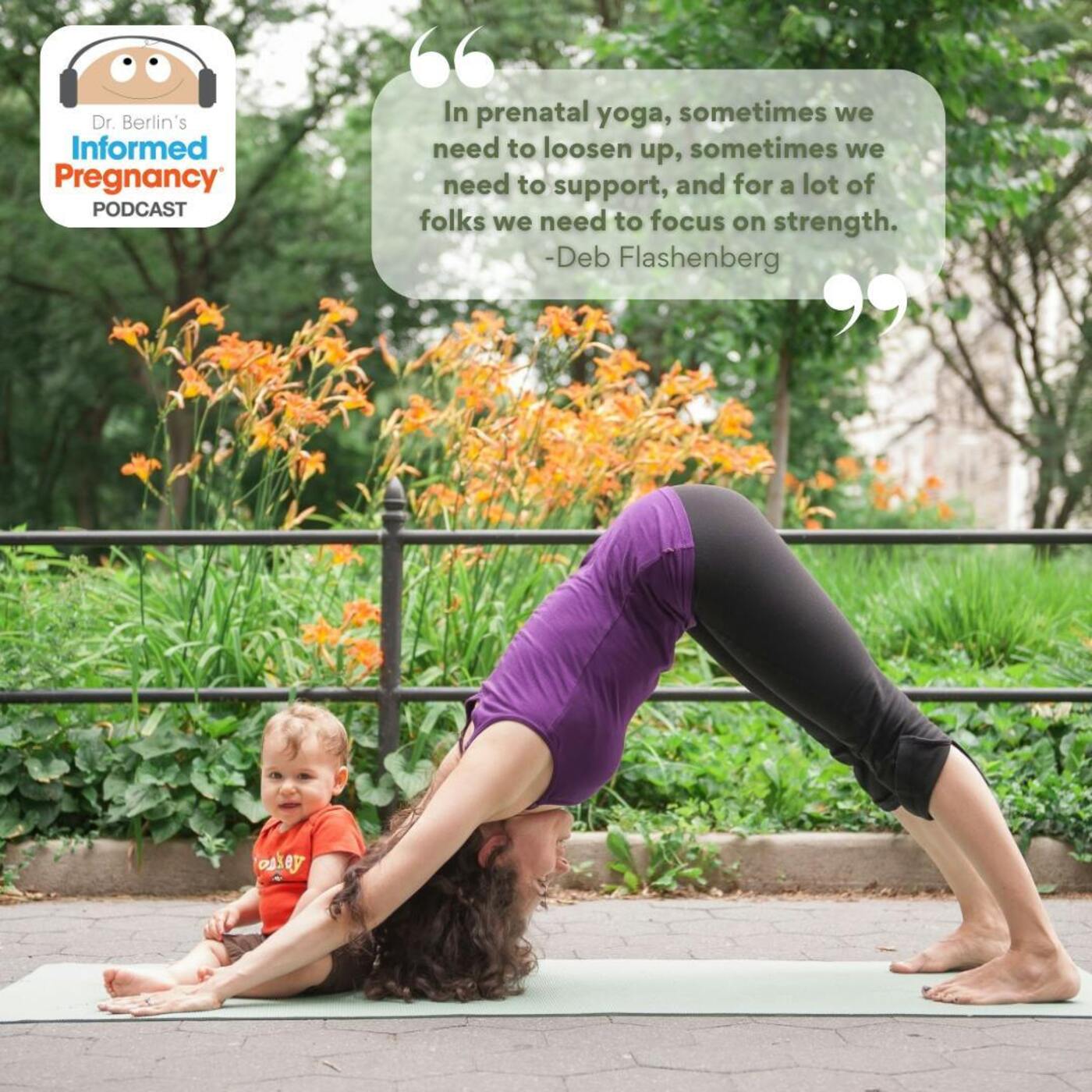
Debra Flashenberg [26:19] It was way, way too rigid, way too tight. And that really informed me of the importance of strength. And as someone that came from a dance background, it was a lot about flexibility. I had stamina, I had strength. But now when I teach, it's so much more about, like you said, the duct tape and WD-40. Sometimes we need to loosen up and sometimes we need to support. And for a lot of folks, we need to have stronger hip muscles and pelvic, like in the glutes and like all that, where a lot of us are like, oh, let's just stretch, stretch, stretch, stretch, stretch. So it really informed my teaching and it informed how I went into my whole second pregnancy
[26:57] because I didn't want to repeat that. That one was almost delightful because it was intense. Don't get me wrong. It was very intense. Like I remember that day, my son was in preschool and it was a block from our house, our apartment. I was living in New York at the time. And I dropped him off that morning. I'm like, this could be labor. So I went to get myself a nice big salad for lunch. And I just let everyone know that, I don't know, maybe I'm in labor. I don't know. And when I picked him up at like 12, 30, I'm like, okay, I think labor is starting. I still wasn't a hundred percent sure. And then I needed to get him down for a nap. So I think by two o'clock, I had him down for a nap. And that's when labor,
[27:41] it was talking about my body connection. I'm like, body, you cannot go into strong labor until this kid is down. And then I can call in the team. So I called my husband. I'm like, come home. It went pretty quickly. And I started to feel a little overwhelmed at one point after my doula showed up around like four, four 30. And my midwife got there and she was like, are we in for another long one to have? I'm like, Nope, I don't think we are. So around, I think when everyone showed up around four, four 30, things turned again in a much stronger direction. Now remember at one point, my doula, when I was starting to get angry at the contractions and everyone around me,
[28:20] she's like, let's switch you up and get you into the shower. And I was like fighting her. I'm like, I'm not moving. I hate everyone. This is awful. And she's like, we're getting in the shower. I reluctantly went in there and it was the best thing possible. It was quiet. No one was bothering me. I was vocalizing every contraction. My midwife's hand would just poke into the shower with the Doppler and just listen and then go away and just poke in and poke out. And then at one point, maybe like 15, 20 minutes later, my doula moved me to the bed. Of course I was reluctant about that. And I had one contraction on the bed saying this is awful. And then all of a sudden
[28:56] I started to feel something coming out. And in my head, I'm like, it doesn't really hurt. What can it be? And it was the bag of water. Cause my water hadn't broken yet. So the midwife was starting to walk out of the room and they yelled, something's coming out. And she turned right around. Cause I was in my bed. She lifted the sheet and she's like, yep, something's going on. And at that moment, or around that moment, she's like, do you want to push? And I'm like, I think so. And my water broke. And I think it was like two pushes later, about six minutes later, my daughter was born. And I do remember saying, thank God you're out. I'm never doing that again. And then they handed her to me and I kept my promise,
[29:44] but it was just such a different birth experience. And I know that statistically second time births are quicker, but I really think a lot of it had to do with my emotional scarring from my first labor. and the preparation of how I did things so differently with my second that I really learned that, all right, I needed to soften things up and strengthen other things up in order for my body to be more balanced. I already knew having scoliosis that my pelvis was a little bit wonky. My sacrum was a little off, it was a little sticky. So, you know, kind of a little clunky. So I needed to have more mobility there. So I worked with an amazing chiropractor in the city.
[30:27] I worked with an acupuncturist. I made sure that my body was ready to open in a way that I didn't with my first. And it did its job. It opened up quite quickly.
Dr. Elliot Berlin, DC [30:38] Yeah, it's incredible. One of the things we do in our podcast is before and after birth stories. But also interesting is first birth, second birth stories, which is what we just have. Reason we do before and after birth stories is we're trying to get what can someone learn from the birth that they couldn't have or struggled to learn without having gone through it. And could we learn from that? But also here are very powerful lessons from first birth versus second birth on someone who did go into birth with a lot of knowledge and experience and exposure. So thank you so much for sharing that.
Debra Flashenberg [31:13] Thank you.
Dr. Elliot Berlin, DC [31:15] Let's take a little break and when we come back, we will talk a little bit more about the work that you're doing and your podcast. Don't go anywhere. We'll be right back. Welcome back. We're talking to Deb Flaschenberg. Okay, one thing that sticks in my mind is how was your recovery from your second birth?
Debra Flashenberg [31:44] My second birth recovery was much better. My first birth recovery was long and arduous from all the physical therapy. But yeah, the second birth was better. I still saw a pelvic floor PT just to check in. I did end up getting a hernia and diastasis from I believe my first birth and I think from all the pushing, all that inter-abdominal pressure. So I eventually ended up having hernia surgery soon after my daughter was born, my second child. But besides that, the recovery was a lot easier. I also think knowing parenthood a little bit better and having been there for a couple of years gave me a little more confidence about handling a newborn. So I think with the first,
[32:29] the anxiety of like, oh my gosh, this baby is ours to take care of with the pressure of my pelvic floor just really being a problem and just my body feeling kind of trash. So I think that was hard. But yeah, my second one, and we had different support because at that point, my older one was in school, we also had a babysitter. So I just think it was a different support system set up.
Dr. Elliot Berlin, DC [32:49] Have your experiences changed your approach to your childbirth education at all?
Debra Flashenberg [32:55] Childbirth education and the yoga work. I think it's more about whole body preparation in the fact that from a physical standpoint, I wonder if I had the knowledge of pulling back from all the exercise. Again, exercise is great, but balancing the exercise with body work like chiropractic work, which I believe so much in. I think things would have been different. So I absolutely have changed in my aspect of how we prepare our bodies and mind for it. Again, it goes back to that body balance as well as really making sure that your team is really there. I felt so fortunate that both times I had a team that believed in me and I really sat with questioning,
[33:40] where do I feel safest? And it's something I really want my students to think about for themselves and education in general, because I was so surprised the other day, it was after class, one of after our prenatal classes. And one of our students was talking about, she was looking on it, we have a big chalkboard of all of our workshops and she's saying, so which ones do you think I absolutely need? I'm like, well, all of them. And she's like, I think 34, 35 weeks pregnant. And she was like, oh, that childbirth class just doesn't fit in my schedule. I guess I'm not gonna take one. And I'm like, oh, well, do you have a doula? She's like, no, but it will be okay.
[34:15] I trust my body and it's gonna be okay. And I tried not to get into a rant and I think it succeeded, but I just kindly and lovingly said, it's hard in the moment to educate yourself. And if a care provider says here are your options and they don't explain what that really means or maybe even not your options, here's what we're going to do. It's hard in the moment to be able to make decisions because one's in labor and you're not gonna pull out your phone and start Googling things. So it's really heightened my degree of sharing with people that having a team that believes in you and knowing your choices, even if they unfold differently than you had expected,
[34:54] there's more satisfaction if you're a team player. So it's really important to me to. bring out that I never care what people make of their choices. I had my births. I want them to have their births. But it's just so important to have that foundation so they can feel part of the decision-making, that informed choice.
Dr. Elliot Berlin, DC [35:12] Yeah. I mean, I always, as a doula myself, I've done a lot of doula work in watching the difference between someone who's just sort of swept along with the current versus someone who's, you know, in the driver's seat.
Debra Flashenberg [35:25] Absolutely.
Dr. Elliot Berlin, DC [35:26] It's quite different. And truthfully, I learned over time that not everybody wants to be in the driver's seat. And that's okay, too. That's your conscious choice. So yeah, those are great lessons learned. And I guess the ultimate final piece to your educational journey when it comes to, although you said you're always a lifelong student, but on top of everything else that you had leading up to. And I love also doulas who don't have any kids and just get so passionate about the whole thing beforehand. Those doulas turn out to be such great, invaluable resources. Let's talk about your podcast, Yoga Birth Babies. What inspired you to start a podcast?
Debra Flashenberg [36:09] I started blogging a long time ago when it was popular. And then someone on my team was telling me, he was like, you should do a podcast. I'm like, I don't know. Can I do that? I don't know. It's so technical. I'm not that great with that. And she's like, no, no, no, I'll do the editing. And her boyfriend is a sound engineer. She's like, all you have to do is talk to people. And she's like, can you do that all the time? And I'm like, okay, I can do that. So it's kind of almost like how I start most things. Someone makes a suggestion. I'm like, can I do it? And then I jump in and I'm like, let's see where it goes. So I think I've had my podcast for maybe seven or seven and a half years. And it's been amazing.
[36:51] And if you're a podcast, you know, it's how amazing to be able to talk to people that are passionate about what they do. And as someone that loves to learn, I get to research people and researching the questions. And then I have whoever I'm excited to speak with, I had them to myself for like 45 minutes to an hour. And so I can ask them stuff that I want to learn as well.
Dr. Elliot Berlin, DC [37:13] That's a great perspective. And that's the whole thing. Like I'm just a student in podcasting. I'm learning from you right now, together with the audience. But you know, I get to direct like some of the conversation and sort of fulfill my curiosity. But it's been incredible as a podcaster just to be able to go to the source of the people who have the education, the experience, the information and can really package it together in a very digestible way. And I wonder for you, what are some of your favorite episodes of your podcast?
Debra Flashenberg [37:47] Oh, my gosh, one of my favorites, Penny Simpkins. I could not believe she said yes. And I was such a dork. I'm like, you're like my John Lennon. Like I literally said that. I really, really enjoyed that because I mean, talk about going to the source. She just has so much knowledge. I really enjoyed Penny Simpkins. I also had done a couple with Gail Tully from Spending Babies. It's something I've been studying. And I found her fantastic. Dr. Rachel Reed, I think I did two with her. She's from Australia, if you don't know. She's a midwife. Oh, my gosh, she's fantastic. I'll do an intro email if you guys want to connect. She's amazing. She did one on
[38:32] induction and she did one on protecting your perineum. She's just fascinating and fierce. And I think another one of my favorite was from my pelvic floor yoga teacher Leslie Howard, because she taught me so much. So again, it goes back to the ones that I keep coming back to what you said, like go to the source of I'm excited about the topic and I want to learn. I want to be able to ask the questions that linger in my head as well. Because if they're in my head, they're probably in the listener's head and in my students head as well. And not everyone gets the opportunity to talk to those folks. So I think those are some of my favorite podcasts.
Dr. Elliot Berlin, DC [39:08] Well, now I have a list of ones that I'm going to go listen to. Do you have any final thoughts to share with our audience?
Debra Flashenberg [39:16] Couple I guess the main thing is when someone is pregnant, don't drive yourself crazy with preparing, find out what feels best for you. I'm always going to come back to body balance and mental preparation is important. But then also respect that all the work you do is never in vain and that baby may have its own ideas of how it needs to be born. So even if birth doesn't unfold, as you envisioned, you still spent mindful time connecting to your body and your baby and mindful choices. And then to also respect how baby wants to be born and moving with a sense of grace and kindness for yourself through pregnancy, birth and definitely parenthood.
Dr. Elliot Berlin, DC [39:58] Incredible. of wisdom. Thank you. That last piece that you just said reminded me of something. We have a film on our streaming site in Foreign Pregnancy Plus called Prenatal Memory that comes from Japan. And this doctor's been researching what do babies remember from their time in the womb. And it's kind of fascinating what they seem to really remember. So what you just said, everything that you do prenatally is not just you, it's you and your baby, the time that you're spending together. And until I saw that film, I see a lot of people, and for sure me as a male partner, I didn't really have any connection with the baby during that time. And a lot of people don't, but just plow through work
[40:39] and it's in there and they're with you and you're aware of them, but you're not really spending time together. And I just had this thought one day, what if the baby came out and, you know, they were there, but we just left them there for nine months, you know, made sure that they got food and whatever, but didn't really bond with them or have experiences with them. And that's something that you can do from like day one and pregnancy. Absolutely. So great advice to leave us with. Deb, thanks for everything today, all your information and personal experiences. Where can we find you online? You can find me at
Debra Flashenberg [41:13] PrenatalYogaCenter.com. We've got in-person classes, we have online classes, we have people tuning in from all over the world for our classes. It's amazing. And we have a teacher training. So if anyone out there is listening and they want to learn more about our methodology of teaching, we have a teacher training online twice a year. In fact, we just finished one that had someone from Australia at Blesser Heart because I think she was like 16 and a half hours time difference. I know she was amazing. We've had people from Dubai and from South Africa, all parts of Europe. So all that is on our website at PrenatalYogaCenter.com, our Instagram PrenatalYogaCenter, our
[41:48] YouTube PrenatalYogaCenter. My podcast is Yoga Birth Babies. So that is everywhere you can find me.
Dr. Elliot Berlin, DC [41:55] Awesome. We'll find you there. And for more pregnancy and parenting information from us, visit informedpregnancy.com.
Want more pregnancy + parenting? Start your FREE TRIAL of Informed Pregnancy+ and get access to all our curated pregnancy and parenting content — original series, iconic birth films like The Business of Being Born, prenatal workouts and more.
