
April 20, 2023 · 34 minutes · Episode 343
About this episode
Author, mother, start-up founder, and podcast host Kaitlin Solimine discuss her three unique birth experiences, how they have shaped her life’s work, and how she is redefining “productivity” in caregiving and art.

- Connect with Kaitlin and her podcast online: https://www.instagram.com/soliminewriter and www.instagram.com/postpartumproductionpodcast
Keep up with Dr. Berlin and the Informed Pregnancy Project online!
www.instagram.com/doctorberlin/
www.facebook.com/InformedPregnancy
Learn more about your ad choices. Visit megaphone.fm/adchoices
See Privacy Policy at https://art19.com/privacy and California Privacy Notice at https://art19.com/privacy#do-not-sell-my-info.
Key quotes
“giving birth at a birth center is just giving birth at someone else's house.”
“you do all of those things and then you're in the birth and most of it flies out the window, but like, there's one thing that just sticks and you have no idea which one it's going to be.”
“I had this amazing on-call collection of humans that were supportive, that were knowledgeable, that trusted me even when I didn't trust myself.”
“we really have no control, we have no control over who our children are, who they become, what sort of challenges they have, what sort of challenges we have.”
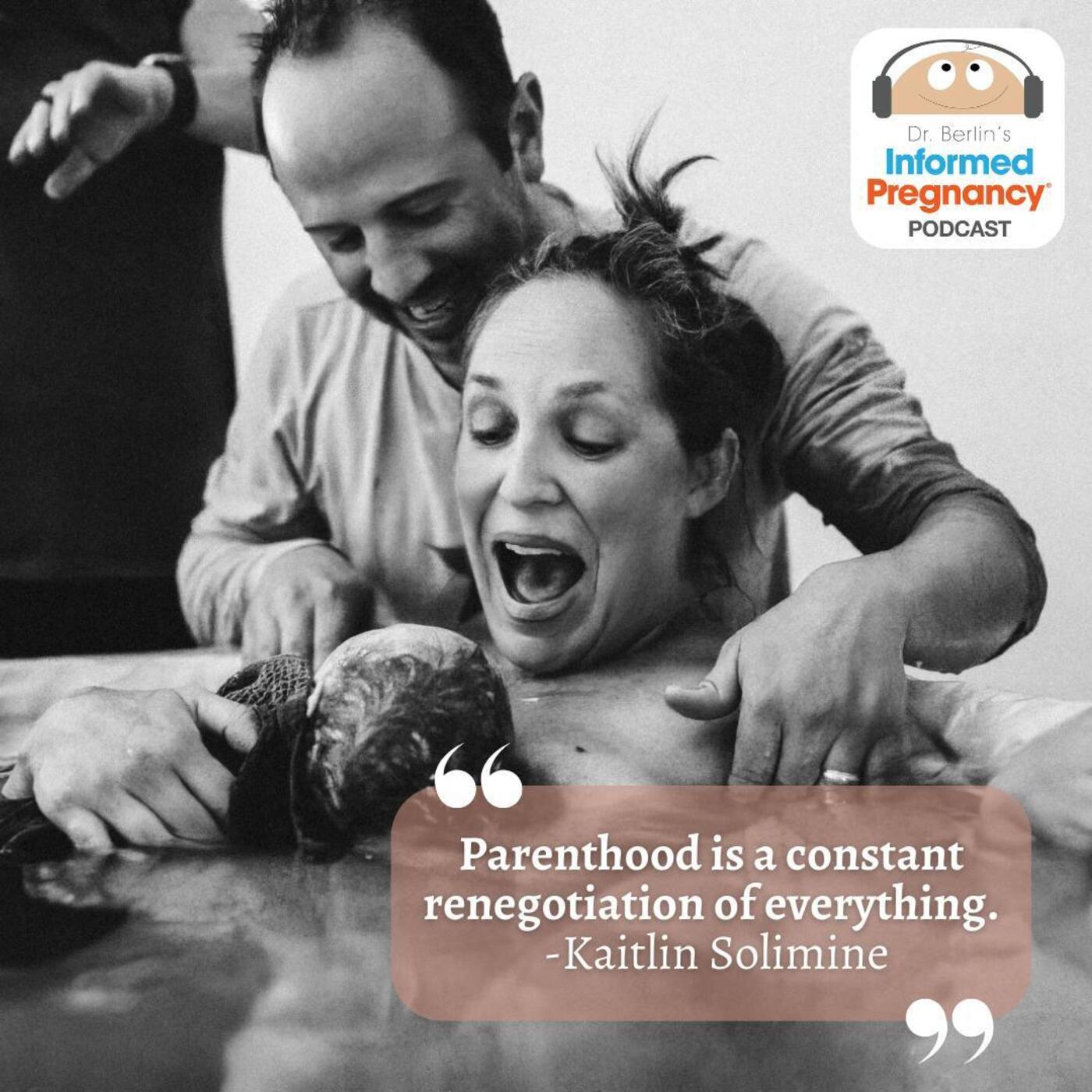
“I think parenthood was just this constant renegotiation of everything. Like I still don't know that I know how to parent, like it's just constantly in process.”
Related episodes
- Ep. 403 BellydanceBirth® with Maha al Musa
- Ep. 402 Perinatal Mental Health with Dr. Jill Garrett
- Ep. 345 Selah Victor: After Birth
- Ep. 422 Pregnancy & Yoga with Caroline Bagga
Transcript
AI-generated transcript with speaker labels — may contain errors, especially names and medical terms. Dr. Elliot Berlin, DC appears in blue; Kaitlin Solimine in orange.
Download PDF of the Transcript
Dr. Elliot Berlin, DC [1:13] Welcome to the import pregnancy and parenting podcast. I'm your host pregnancy focus carpractor. Dr. Elliot Berlin My guest today is an accomplished author currently working on a collection of essays about home birth and parenting in 2022 she launched the postpartum production podcast which explores the intersection of postpartum Experiences in creative practices with a focus on redefining productivity in caregiving and art We will discuss her three pregnancy and birth experiences and how they have influenced and inspired her life and her work Caitlin Salamini, welcome to the podcast. Hi. Good morning. Good morning You're such an interesting person with such a rich background and so many birth experiences to talk about
[2:21] Let's jump right in. Where are you from originally? Oh, originally originally
Kaitlin Solimine [2:25] Hmm, I was born in Michigan haven't never really been back there, but I grew up in New Hampshire and Have lived in China, Singapore, Costa Rica, France and Los Angeles. Oh, how'd I forget Los Angeles? And now I live in San Francisco, okay, who has the best food? Oh Singapore came to mind first. So I guess I have to say Singapore even though China I mean, you know
Dr. Elliot Berlin, DC [2:52] All right, we got to go with the gut literally I'm putting Singapore in our travel list Like why all that travel what prompted all of that trouble? Okay. Well China
Kaitlin Solimine [3:04] was primarily because I had started studying Chinese in high school and Then lived there by way of a program called school year abroad Which is incredible and any high school student in the US can attend and it's a program where you go and you live For a semester with a family and do a homestay, you know during your school year So that kind of launched my time in Asia I would say and then I went back a bunch in college and after college and Worked on a book and a whole bunch of different stuff. I mean you just really liked it Yeah, I think I've always really liked living outside my comfort zone, which may be why I lived in LA But yeah, so China was
[3:49] Obviously, it was the mid 90s. So it was very very Different from anything I had experienced as a teenager in the US, you know we barely had the internet or email or definitely didn't have smartphones and so it was like Really really far away. It just felt like a totally different experience and yet I felt really connected to the family I lived with so I ended up feeling at home in a place that I didn't anticipate feeling at home Yeah, and so I just kept going back and I actually I took my daughter the last time I went was in 2018 I took my firstborn who was my only child at that time and I had just published my first book in 2017 and I had a few events through a festival there
[4:33] So I took my daughter to Shanghai and Beijing in 2018 So that's the last time I've been and then you know pandemic beat the language. I do yeah
Dr. Elliot Berlin, DC [4:43] Wow, you could speak and read
Kaitlin Solimine [4:47] Yes
Dr. Elliot Berlin, DC [4:50] Language to learn um
Kaitlin Solimine [4:52] Weirdly, I think the written language is I find it easier to speak maybe just because I started so long ago I find it easier to speak and learn Chinese than I do romance languages because I hate conjugation and Chinese is really rational. And the structure of a sentence is very easy to understand for me. Obviously the tones and the words themselves are completely different. Whereas in French or Italian or Spanish or something, you can kind of work your way around things. Add a suffix. Right. But then the little letters to write them. Yes. Characters. Yeah. It seems like you need to be an artist. Yeah. The cheat now on phones and the computer is that once you learn pinyin, which is the transliteration of it, like if
[5:37] you know what it looks like without having to actually write it out by hand, you write the pinyin and then it pulls it up for you. Well, very nice. Yeah. Well, I'll
Dr. Elliot Berlin, DC [5:45] be in Singapore anyway for the food, but, uh, okay. So you're a writer. How
Kaitlin Solimine [5:51] did you get into writing? Probably by way of the same, what I was just talking about in China, I felt like I had to write about the experience to process it myself. You know, you always hear about writers saying, Oh, when I was a kid, I was always writing. And yeah, I was, I was always writing little poems or wanting to write all through high school. But I think it was through that experience that I felt like I had to process living in China, you know, through China's growth and adolescence as well. And the home stay that I had the family that I had lived with, I had a really, really deep and meaningful relationship with. So it felt like I had to process that in
[6:25] some way. And your genre that you write is literary fiction. Yes. Yes. That's fine. Literary fiction. Oh, thank you very much. Yes. I hope you had a coffee. No, I haven't. I've had water with lemon and honey. So my voice is a little off today. Um, literary fiction I'd say is, well, it's like all the books that, you know, you have to read in high school. Just kidding. I mean, all fiction is fiction, right? But it's literary fiction, I think, is trying to speak to other books that have been written in the world and doing so in a way that's thinking about so many different facets of writing. So that could be like structure and plot and being experimental or not, or being able to situate yourself in a historical
[7:17] moment. And so it's any book, I think that really makes you think in a way that you didn't potentially think about a subject matter before.
Dr. Elliot Berlin, DC [7:26] And is the subject of your first book China?
Kaitlin Solimine [7:29] Yes. Yeah, pretty much. So it's about an American woman who's lived in China, not me, but because I get that question asked a lot. It is fictional and it's about one family's and have more modern history in China and her relationship with that family.
Dr. Elliot Berlin, DC [7:47] And writing your first book, I mean, people describe it as having a baby.
Kaitlin Solimine [7:53] That comes up a lot. Yeah. I mean, I can't think of them in the same way at all, to be honest. Like I think that for me becoming a parent and giving birth was obviously a very bodily experience. I think writing a book is bodily and it should be probably more bodily, but it's also so heady. But it is yeah, it's hard. There's just too many other people involved, I think, in deciding. Well, one could argue, I guess that happens in birth too. I was going to say in deciding when and how your book comes out. So yeah, maybe that is an apt metaphor.
Dr. Elliot Berlin, DC [8:35] Okay. You have three kids. This is a good segue into making babies. You have three kids. Where in your travels did you meet your partner?
Kaitlin Solimine [8:46] I met my partner in college. So just before actually I had lived in China in college, I met him then. So we've been together for 20 something years.
Dr. Elliot Berlin, DC [8:56] You've been on together for a long time. Yes. Did it get serious quickly?
Kaitlin Solimine [9:01] Uh, as serious as a relationship can get in college, but he moved to China with me after college. So yeah, I guess it was pretty serious.
Dr. Elliot Berlin, DC [9:12] It's not like going out for Chinese food.
Kaitlin Solimine [9:16] I mean, it is, but every day on the extreme.
Dr. Elliot Berlin, DC [9:23] Wow. Okay. And then in your relationship was starting a family,
Kaitlin Solimine [9:27] having kids, something you discussed. Yeah, I think that I always knew that I wanted to have children early on. I had this dream of being sort of untethered and you know, I was living abroad a lot. So it was like, I just didn't really know where my life would take me, but I definitely knew I wanted to have children. Yes. It took us a while. I'd say we got married in our early thirties and then started to try to have children, you know, the old fashioned way, and that didn't work so well. So we actually. tandemed an adoption process while we were also going through some fertility stuff and then ended up the adoption process. It's a much longer story than this podcast could handle, but
[10:11] did not work out. We had a child that we had accepted their file. It turned out that their medical needs were much beyond what we could really handle as a family and then got pregnant. So that was our path.
Dr. Elliot Berlin, DC [10:24] A familiar story. Yeah. Wow. Okay. But still intense. Do you know what the struggle was
Kaitlin Solimine [10:31] on natural fertility? I actually don't. When I was in Singapore, I ended up getting referred by a friend to a wonderful doctor there, Dr. Christine Yap. I actually don't even know if she's still practicing, but she just went in and I knew that one of my tubes was clogged. I don't know what the technical term for that is, but she went in and did a procedure where she actually, not just the HSG, not just checking it, but actually went in and somehow surgically cleared it a bit. And it still took six months and Clomid and an IUI to get there. So I don't know if it was just that. It wasn't like, oh, after that, then suddenly I could get pregnant on our own. But yeah, so I don't know. And in fact, then our second child
[11:20] was also the same process, Clomid IUI, and our third was none of it. So that's interesting.
Dr. Elliot Berlin, DC [11:27] Yeah. Our first pregnancy turned out was fertility. It turned out to be twins, but they were in early miscarriage. And then we went down the whole scale of fertility treatments, assisted reproductive technology, and then gave up and then got pregnant four times. These little creatures. So I would love to learn more about your pregnancies and birth experience. Why don't we take a quick break and we'll be right back.

Dr. Elliot Berlin, DC [13:19] brand C four times, and brand D four times. Welcome back. We're talking to Caitlin Salamini. Okay. So a long time to get pregnant. Did you do any of the natural things to try to
Kaitlin Solimine [13:35] boost for good? Oh gosh, of course. Lots of acupuncture, lots of herbs, lots of weird things brewing on my countertops, yoga, meditation. And I found that frustrating, honestly, because, you know, I think there were a lot of people that, oh, if you just relax, you know, and if you just, if you just do this, if you, oh, have you tried that? And of course I had tried a lot of things. So I don't know. I don't know what it was that worked the third time. We were in Hawaii for almost two months. It was towards the tail end of the pandemic, you know, it was around those times. So I don't know. Did you do them with your third? Good question. I was doing a lot of yoga.
[14:13] I was in Hawaii. I felt so good. I felt really healthy. We were not actively trying to get pregnant. We knew that we'd never gotten pregnant on our own before. So we were just sort of like the door is ajar. And if it happens, that's a miracle. And it did. So now things are different now that we're definitely done having children. So I'm like, oh, okay. This is what it's like to just get pregnant and have to think about that.
Dr. Elliot Berlin, DC [14:41] Yeah. The different process. How was your first pregnancy?
Kaitlin Solimine [14:45] Wonderful. Yeah. That was one interesting intuitive feeling that I had. I felt like I would have trouble getting pregnant. For some reason I didn't surprise me, but I felt like my pregnancies and births would be really healthy.
Dr. Elliot Berlin, DC [15:00] So you felt good during your pregnancies?
Kaitlin Solimine [15:03] Yeah. I mean, you know, the usual stuff, acid reflux, uh, gosh, what are those ligament, like the ligament, ligament pain, no sciatica, thankfully. And I was pretty active. I did a lot of yoga, a lot of all that, like spinning babies stuff, you know? And yeah, the second pregnancy I did have almost not placenta accretive, um, uh, yeah, it was like not fully covering the cervix, but very, very close. So they kept tracking it. And then over time, as it does, often it moved.
Dr. Elliot Berlin, DC [15:40] With, uh, first, did you have a vision or intentions for birth? How you wanted your birth to go? Also, where were you?
Kaitlin Solimine [15:48] I was in Singapore when I got pregnant, as I said, with Dr. Yap, and then we had moved to San Francisco and it was very in between. And in Singapore, I plan to birth my child at a hospital because that was just sort of what I knew. And I did find a doctor that had midwives in his practice and doulas. And it seemed really great. Then moving here, I looked online at hospitals and the closest hospital to me, honestly, just had, it looked awful. I was like, I don't want to give birth in a room like that. It just, it made me feel cringy. And I always feel like hospitals are wonderful places for emergencies. And I just didn't feel like my births were emergencies.
[16:31] And so I knew of a lot of people, my husband's mother had four birth center births and his sisters had a Hall Ed birth center births. My mother had hospital births without any interventions. I mean, she didn't have IVs. She didn't have monitors. They didn't do anything really. You went into a hospital and if you chose not to get any medication, I don't know, she didn't have an IV. Yeah. So I ended up reaching out to birth centers. They were full cause we were late and then got referred to my midwife. And she said to me, quote, giving birth at a birth center is just giving birth at someone else's house. I was like, okay. So she's like, so you should just give birth at home.
[17:11] If that's what you're comfortable with. So we did. And that was that. And then I was a home birther.
Dr. Elliot Berlin, DC [17:19] How did you prepare for it?
Kaitlin Solimine [17:21] Oh gosh, such a good question. I did a lot. And I tell people that, I mean, it's like preparing for a marathon. Like what did you as a person have to do to do that thing? So what does that mean? Whether it was therapy, yoga classes, partner's yoga. Oh my gosh. Hypno birthing with Rachel Yellen. I don't know if you know her work, but she was actually in person at the time in San Francisco. Now she lives in Asheville and she's all virtual, but that class was just everything to me. And it sounds like I hate to say hip number thing, cause I think it sounds like something that people think, but when you actually are doing it, it's really very different from what it seems like it's really just meditation.
[18:03] Yeah. Meditation around birth.
Dr. Elliot Berlin, DC [18:06] Yeah, exactly.
Kaitlin Solimine [18:07] Meditation birthing.
Dr. Elliot Berlin, DC [18:09] Yeah. I mean, it sounds like someone's like, you will like holding Oh, the hypnosis element. It's, it's self-hypnosis, which is meditation, right? Right, right. Okay. I see what you're saying. It's funny. That's true. The first time I heard about it, that was my vision too, but into so many hypnotists, um, good distinction there. Okay. I mean, it sounds like you found those things helpful.
Kaitlin Solimine [18:32] Yeah, I did. I mean, I think for me and I've had other friends say this, you do all of those things and then you're in the birth and most of it flies out the window, but like, there's one thing that just sticks and you have no idea which one it's going to be. You know, like I had a friend who was like, I went to a yoga class and then I gave birth the next morning and like this one thing the teacher said was just like with me and it was enough to just, that was it. But you sort of don't know in that moment, which thing you're going to pull from or at what moment in the birth, right? There'll be different parts that work and that don't work. So I feel like you need that arsenal of tools.
Dr. Elliot Berlin, DC [19:04] Like a well stocked tool belt. Right. Right. Okay. So you became a home birther and did you do all three at home?
Kaitlin Solimine [19:13] Yes. Yep. After that, I mean, it was sort of like, as long as everything was healthy and I had the midwifery support, you know, I was always tandem seeing obese more just so that if I had to transfer, I had a care team that I felt comfortable with. But yeah, it just seemed at that point, I'd done it once. Why not do it again?
Dr. Elliot Berlin, DC [19:34] Sure. Um, okay. And then let's talk about mothering. I mean, I think we focus a lot on birth, but then there's this whole thing that happens afterwards for like the rest of your life.
Kaitlin Solimine [19:46] Well, and one could argue when you're pregnant, you are mothering. I mean, I felt especially as I got larger and felt really vulnerable. I think that like vulnerability and that just like instinctual need to protect was there. I just remember walking in the world, very pregnant in a city and feeling like, oh, wow, I'm really not my own body right now. There's another body here too. And so yeah, I feel like so much of the activism that I do now around birth and postpartum comes from the midwifery care that I received and that directly influenced my mothering as well, because I had this amazing on-call collection of humans that were supportive, that were knowledgeable, that trusted me even when I didn't trust
[20:37] myself. So it just empowered me in a way that I had never felt really in kind of anything before. So it's just like so transformational in that sense, because I just had care providers that actually cared.
Dr. Elliot Berlin, DC [20:50] Whoa, sorry, what a novel idea. Well, I mean, it's kind of interesting. Also in America, the term health care seems like a misnomer. It's mostly disease care.
Kaitlin Solimine [21:02] Exactly.
Dr. Elliot Berlin, DC [21:03] The system's a little interesting. I mean, I think every system probably has its ups and downs, pros and cons. But you know, when you zoom out a little bit and see the bigger picture, there's a lot of room for improvement. Uh, anything like your vision of parenthood compared to how parenthood actually is going?
Kaitlin Solimine [21:25] Gosh, I don't know if I had a vision, to be honest. I think I was so obsessed and maybe this is why I wasn't getting pregnant. I was so obsessed with getting pregnant that like, I didn't think much beyond that. I mean, I don't know, I had a nursery and a crib and all that stuff set up logistically that I never used. So there's that. I mean, just like this sense of like what it would be like to have a baby. But I do think again, like the birth process and going into that feeling not only supported, but also like whatever happens is okay. And I truly felt that because I had the support that I knew was the appropriate team. So like, I knew that if my midwife said you're transferring, you
[22:08] know, you are having a cesarean section or you're doing whatever it was. I knew that I trusted her opinion and the opinion of those like in my doula and really my partner as well, because we had done so much work. I felt just okay. And then because of that, I think parenthood was just this constant renegotiation of everything. Like I still don't know that I know how to parent, like it's just constantly in process.
Dr. Elliot Berlin, DC [22:31] So literally was just having that thought the other day. I'm like, well, like imposter syndrome. I'm like, I'm out of these kids. Like, do they know? They do. They do. They're like, yeah, we know. I did not go to school for this. I just stepped into the role. All right. I want to find out about the work that you're currently doing. Let's take one more break and we'll be right back. Welcome back. We're talking to Caitlin Salamini. So first of all, you have all this work going on now that you're doing and it seems to have taken, I think for a lot of us, once you start having kids, it kind of infuses into your work. So tell me more about what you're doing now.
Kaitlin Solimine [23:21] That's a really good point. So I'm working on a novel that I've been working on for about five years that does look at midwifery childbirth. Uh, it's based in new England. It's, I don't know what it is. I don't know if I'll ever finish it, to be honest. Like, I don't know. It's just this wacky project. It's literary fiction.
Dr. Elliot Berlin, DC [23:40] Exactly.
Kaitlin Solimine [23:41] And then I am also, as you mentioned, I'm working on, I'm kind of always working on a bunch of different essays in and around home, home birth, parenting. And I have this podcast that started last year. That was something I never thought I would do. I don't know about you, but I casually listened to podcasts. I was never like, I want to be a podcaster.
Dr. Elliot Berlin, DC [24:02] I just great voice for it. Really? Oh yeah.
Kaitlin Solimine [24:06] Interesting. I had never thought about that. I just hear myself say like, and you know, a lot when I listen to the record, like, oh, oh, yeah, exactly. No, it's fine. Um, why do you sound so clean? Podcasts. So yeah, I was six less. I don't know. I was a couple of weeks postpartum and was just feeling like I actually had a lot of creative impulses. I was just sort of sitting around with the baby a lot. And I thought about other caregivers in that position in early parenting and how hard it is. And that also like how generative it can be like that. It isn't always just a sort of negative vacuum of creative space, but that it can have creative potential.
[24:51] And like you said, that it infuses into our work. And so I reached out to a few people and other friends who are in the writing world and in other creative spaces and everyone got really excited about it and wanted to talk to me. At first, I thought it would be either like an anthology of work or something written. And then a former babysitter that I had spoken to said, that sounds like a podcast. She's young. So maybe that's why. And then I happened to see a friend from China, of all things, a friend that I had lived with in China in 1996, has a podcast. It's called Breathing Wind and it's about grief. And she had a newsletter and she was doing more production work.
[25:26] So I saw that and I said, hey, this is sort of like in my head, like, could you help me with this? And she was like, yes. And she just sort of ran with it. And then it felt like once I put it out there, there was so much interest and there were so many like universe sort of things happening that just said, do this. So I did. It was probably poorly timed in terms of, you know, having a newborn.
Dr. Elliot Berlin, DC [25:47] Well, I mean, appropriately named, it's the postpartum production podcast.
Kaitlin Solimine [25:53] Yeah, exactly.
Dr. Elliot Berlin, DC [25:55] What's the format?
Kaitlin Solimine [25:56] Well, it started as interviews, as I said, with who I kind of consider practitioners. So like someone who is a caregiver and also has some kind of creative practice, whether that's filmmaking, music, dance, art, writing, et cetera. And then this season, we're actually looking a little bit more, well, we're extracting a bit and looking more at like an expert level view of postpartum, of creativity, of like all the topics that we looked at in the first season and then bringing that to the second season. And we will have some sprinklings of practitioners as well, and we're going to continue to do that. But I just sort of wanted to take a pause and examine things in a slightly different
[26:38] way. And we'll continue to do that moving forward as well, have different seasons. Like I would love a season on birth and art, for example. And there's so many other iterations of that that we could do.
Dr. Elliot Berlin, DC [26:50] I love sprinklings, all sprinklings. So I sometimes don't, this might be a horrible analogy, but that's what popped into my head. I don't love roller coasters. And I remember one time distinctly being in a theme park and my kids wanted me to go on a roller coaster. And I would stop people who were coming off that roller coaster and grill them for everything I can learn about what that experience was going to be like. Now, I think that for many people, the foray into parenthood, whether it be fertility, pregnancy, birth, postpartum, feeding a child, relationships as they change when babies enter the world, is a bit of a roller coaster anticipation.
[27:34] And if we could possibly stop somebody who's been on that ride and ask, what did you learn from going through it that you perhaps couldn't have learned previously? I would say you might be a wealth of information and then through your podcast and interviewing other people, even a greater wealth of information. So if I really want to tap into that, we're going to have to go listen to the postpartum production podcast. But could you, for the sake of this episode, share a few things that you learned that maybe you didn't know ahead of time or that you learned by going on that ride?
Kaitlin Solimine [28:12] The first thing that popped in mind was let go, which is probably also a good roller coaster metaphor for the roller coaster.
Dr. Elliot Berlin, DC [28:19] First of all, there's no steering wheel and there's no brake pedal.
Kaitlin Solimine [28:22] Exactly. Although I was thinking you want to make sure that roller coaster is like not super rickety and old. And you know that it's the right role. You know, you're at the theater, but you know, it's good insurance. Like you've done there. So, you know, it's just like set yourself up with what you need. And I say that again, coming from a place where I was able to do that for so many structural reasons in terms of privileges that shouldn't be privileges, right? But I think that if you can, you know, look at the ways in which you can resource yourself, that's an important lesson for me is just continuing to do that and to seek resources that feel appropriate to you.
[29:07] And then letting go, of course, because at the end of the day, despite all of that, like we really have no control, we have no control over who our children are, who they become, what sort of challenges they have, what sort of challenges we have. And that's definitely easier said than done. Obviously, like that's not to say that I'm definitely not a person that's like, you know, let's go with the flow. In fact, my husband would say I'm probably the opposite. So it's funny that I'm even saying that.
Dr. Elliot Berlin, DC [29:31] Wait, so you don't just throw your hands in there and go, woo. On a roller coaster?
Kaitlin Solimine [29:35] I do, but life a little bit less. So I don't know. In birth, I kind of do. I know for some reason, birth to me feels generally okay. I was saying something to my husband recently and now I've completely forgotten it. Oh, it was because I had to get like a mild surgery recently and I was so anxious about it. And I said, yeah, with birth, I do have an anxiety, but it's kind of like a roller coaster anxiety where it's like. excited to and I just for some reason feel like birth I didn't have that same fear or if it was there I just found we I don't know it just was different and I know that's not a normative American experience especially but yeah I'm really grateful for that.
Dr. Elliot Berlin, DC [30:17] I feel like you're not a normative American.
Kaitlin Solimine [30:20] No I feel like that too which is why I can I go with you on your trip. I'm about to go to Italy.
Dr. Elliot Berlin, DC [30:28] No we're trying to figure out how to become Italian but that's like you know the whole naturalization of my great-grandparents and all that but that's another story. Oh so many more things that we can handle on one episode. Maybe there's a future for us to do more. As we're winding down I know you mentioned birth activism. What other things are you working on? In birth activism or another?
Kaitlin Solimine [30:51] In birth activism. So I mean I guess through the writing that I do obviously in the podcast there's a form of activism there. I've been trying to support I mean you know I have three little kids so it's hard. There's an organization I love called Birth Future Foundation and they started up pretty recently I feel like during the pandemic and it's a collection of a lot of midwives, doulas, and birth activists who are working to create more equitable access especially for midwifery care and they do amazing grant making to different you know whether it's like a birth center, a midwife around the country so they're doing really incredible work. So I've been trying to find ways to support them.
Dr. Elliot Berlin, DC [31:33] It's kind of fascinating because I can't tell you how many times I hear from patients yeah I wanted to do a home birth but it was too expensive. I'm like wait a second. I literally with my patients sometimes labor at a hotel across the street from the hospital and expensive hotel across the hospital and it is not even close to how expensive the hospital is for the same night stay right the service is so much nicer at the hotel and it's expensive compared to most things that I do in life but not like that hospital and then home birth there's no facility involved and practitioners are generally less expensive overall than the hospital staff and it's not covered.
[32:14] It's just so even from a straight business perspective and insurance companies are always cutting costs wherever they can the fact that they won't cover that for so many people is really mind-boggling and a huge issue so can you say the name of the organization again sure birth future foundation birth future foundation I'll definitely check it out.
Kaitlin Solimine [32:35] Yeah they're great and they're growing and they're doing a lot of really wonderful work and there are a lot of organizations too you know I think at that intersection that are doing incredible work yeah so I wish of course I could do more I think that you know right now given what's going on in the world I'm also trying to get more locally involved in a lot in relating to gun violence you know gun control so that's been another sort of more parenting related work that I think I've been doing but you know it's hard it's hard to balance like being a present parent and doing work and I think that's kind of what the system wants in some ways like the system perpetuates because you know our caregiving is
[33:17] not supported and it's not compensated in the way that this capitalist system compensates us so I just feel like for so many people it's really hard to do the good work of really present and I don't want to say involved it's not about being involved but I think it's just about you know showing up for your children and yourself in a way that's going to actually make a difference in the world so that's my other struggle it's just that like in an ideal world I would do that I would do that and it would feel valued and I'd be able to get sort of like juicy intellectual support and it would just feel important and it doesn't feel important to me in this moment in this world well it feels important to me everything you've done
Dr. Elliot Berlin, DC [34:04] making humans and all of the other work that you're doing to help other people around you
Kaitlin Solimine [34:08] so I appreciate you yeah thanks I feel that way for everyone else that I know what it feels like
Dr. Elliot Berlin, DC [34:15] you know the system as a whole so we need to figure out how to fix well not fix it I think build an entirely new one but okay thank you for joining me on the podcast where can we find
Kaitlin Solimine [34:28] you online oh goodness so the podcast is at postpartumproduction.com also on you know apple spotify etc my website's my name which is gatelandsolomini.com and my books are everywhere that books can be sold oh twitter instagram and all that stuff sure that's at let's go kato instagram is at solomini writer and also at postpartum production podcast all right well
Dr. Elliot Berlin, DC [34:56] thank you again for joining us thank you so much very interesting and learn a lot from talking to you. And I'm gonna visit you over there on all those social spaces and keep following the great work that you're doing.
Kaitlin Solimine [35:09] Well, I love your podcast and I love listening. So I'm very honored to be a part of it now and we'll continue to support what you do and hope that we actually have an occasion to meet in person sometime.
Dr. Elliot Berlin, DC [35:21] It's gonna happen. I know it's gonna happen. To our audience, thank you so much for listening. If you'd like to find us online, visit us at informpregnancy.com.
Want more pregnancy + parenting? Start your FREE TRIAL of Informed Pregnancy+ and get access to all our curated pregnancy and parenting content — original series, iconic birth films like The Business of Being Born, prenatal workouts and more.
