
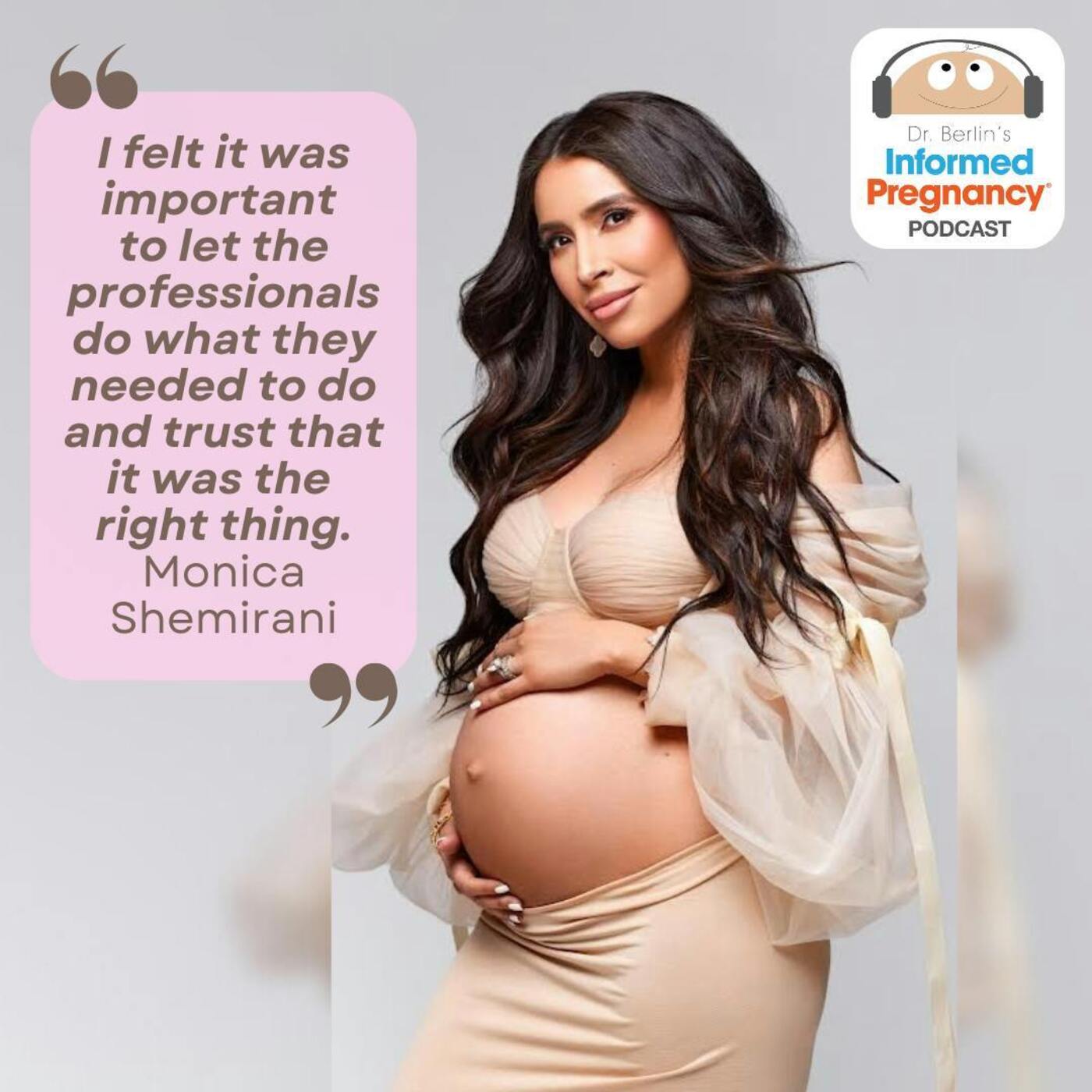
May 4, 2023 · 32 minutes · Episode 347
About this episode
Just 4 weeks after welcoming her second baby, medical professional Monica Shemirani is back to tell her cesarean birth story.

- Want to hear about more cesarean birth journeys? Check out our newest show Empowered Mama on Informed Pregnancy Plus. Start your FREE TRIAL and search “Empowered Mama” to start streaming today: https://www.informedpregnancy.tv/
- Check out Monica’s husband Dr. Nima Shemirani’s post about pregnancy and plastic surgery on the Informed Pregnancy Blog: https://www.informedpregnancy.com/single-post/plastic-surgery-pregnancy-when-is-it-safe-to-get-work-done-eos-rejuvenation-sponsored
Keep up with Dr. Berlin and the Informed Pregnancy Project online!
www.instagram.com/doctorberlin/
www.facebook.com/InformedPregnancy
Learn more about your ad choices. Visit megaphone.fm/adchoices
See Privacy Policy at https://art19.com/privacy and California Privacy Notice at https://art19.com/privacy#do-not-sell-my-info.
Key quotes
“in a position where I just literally and figuratively, I let Jesus take the wheel.”
“the world can be on fire. I will never cancel my nail girls ever. They know that. So”
“And, you know, 30 minutes later, I had a baby.”
“I could tell you right away that I would definitely have a C-section,”
“you can walk, you're breastfeeding, you're happy, and you're going to be okay.”
Related episodes
- Ep. 346 Monica Shemirani: Before Birth
- Ep. 378 Traci Burk: After Birth
- Ep. 350 Ciara Whaley: After Birth
- Ep. 383 Caitlin Wilder: After Birth
Transcript
AI-generated transcript with speaker labels — may contain errors, especially names and medical terms. Dr. Elliot Berlin, DC appears in blue; Monica Shemirani in orange.
Download PDF of the Transcript
Dr. Elliot Berlin, DC [0:12] Welcome to the Informed Pregnancy and Parenting podcast. I'm your host, Pregnancy Focus Chiropractor Dr. Elliot Berlin. You've tuned into the after episode of a before and after birth story, and we're talking to Monika Sharma Rani. Welcome back to the podcast.
Monica Shemirani [0:51] Thank you for having me.
Dr. Elliot Berlin, DC [0:53] Just by way of recap, so congratulations. You had your second baby.
Monica Shemirani [0:57] I did. I had my little boy almost four weeks ago, and I'm so happy. I finally get to hold
Dr. Elliot Berlin, DC [1:04] and kiss him. And I'm so happy for you. And the journey was interesting. Your first birth was intense. You had a fear of birth and pregnancy was intense. Birth was intense. Postpartum was weirdly intense when you stopped feeling your legs and couldn't walk, and then eventually went away, but left you with even a deeper fear of birth. And you didn't want to have another baby. You don't want to deliver, carry and deliver another baby, but you did it. And you decided along the way that, you know what, I can do this again. I'm going to do a vaginal birth. And then your baby sort of threw some curve balls at you. First, a low lying placenta that lifted, and then a breech baby. And you did all sorts of
[1:45] things to try to get that baby to turn. I think that's where we left you around 37 weeks. I was working with you doing chiropractic work, doing massage work. You were doing Chinese medicine. You did hypnotherapy for breach in particular. What was that like?
Monica Shemirani [2:02] You know, I did the Chinese medicine. I feel like it really helped get the baby moving from the position that he was at, but ultimately it did not help him move out of the breach position. I also did the external sephalic version at the hospital, which unfortunately also failed. What was that process like? Oh man. It was very pinchy. There was a lot of discomfort during the procedure. I don't want to scare anyone out of it because I feel like it does work for some people. And I think that ultimately, if you want to do a vaginal delivery, this is a great way to do it. But unfortunately it did not work for me. I did hypnotherapy for breach. The best thing that I could have gotten from that was that
[2:53] I really was able to connect with myself after the therapy session and really just put myself in a position where I just literally and figuratively, I let Jesus take the wheel.
Dr. Elliot Berlin, DC [3:10] Yeah, no, me too. Oh, so it helped you surrender.
Monica Shemirani [3:14] It helped me surrender. And I told myself, like, God, you know, you do what you need to do. And as long as the baby comes out healthy, everything else is secondary.
Dr. Elliot Berlin, DC [3:25] Okay. And not only that, you had done literally everything I could think of. You're doing positional exercises. Like we said, you did the chiropractic, the massage, the Chinese medicine, the hypnosis for breach, the external sephalic version. You know, it's not like giving, you know, a plus plus for effort. And then it's just kind of interesting because at the beginning of the pregnancy, you sort of wanting a cesarean birth.
Monica Shemirani [3:49] Right. You know, it all kind of came full circle at the beginning. I wanted the cesarean. I was really pushing for it. I even had my date scheduled when I was like in my first trimester. I told my doctor, this is the date I want. You know, it's happening this date. And, you know, he's just like, okay, Monica, sure. Like, put yourself on the schedule. Let's see what happens. So after all the fails, nothing really worked. The baby said, I'm not moving. Yeah. He said, I'm not moving. And I had my date on the schedule and this was one Sunday. I went in for like my routine nail appointment, my religious every two week nail appointment, and I'm sitting there and I'm texting my husband.
[4:34] I think I'm going into labor. This was before the C-section date. But I also thought, you know, I'm being dramatic. This is a total fluke. I'm not going into labor, but let me just pull his leg a little bit. Right. And long story short, I was going into labor. Thankfully, I was in Beverly Hills and I was supposed to deliver at Cedars. So I go into the hospital and I'm with my son, my three-year-old and my husband.
Dr. Elliot Berlin, DC [5:07] Wait, your son was with you at the nail appointment, at the religious nail appointment?
Monica Shemirani [5:11] Yeah, it was like self-care Sunday. I was getting my nails done and the boys were supposed to get haircuts.
Dr. Elliot Berlin, DC [5:16] Okay. Wait, so was your son with your husband?
Monica Shemirani [5:19] Yeah, he was with my husband. They were getting haircuts.
Dr. Elliot Berlin, DC [5:22] Okay, so your husband and son are getting haircuts. You're getting your nails done. And when you say you felt labor starting, I mean, you had labor with your first and delivered vaginally with your first. So what were you feeling?
Monica Shemirani [5:36] So I felt like they were contractions, but I would get them every like 10, 15 minutes.
Dr. Elliot Berlin, DC [5:43] So like a cramping or?
Monica Shemirani [5:45] Yeah, it was like an intense cramp. But mind you, I was getting Braxton Hicks for months before.
Dr. Elliot Berlin, DC [5:51] So how are these different?
Monica Shemirani [5:53] These were like more debilitating. They radiated from my back all the way down to my toes. And they were coming every 10 to 15 minutes. And typically the Braxton Hicks, there was not much pain associated with it. It was just like, you know, your stomach would do this like weird, it would turn into a weird shape. You would feel a little bit of pressure, but it would ease off. And I just felt like very crampy, very like my back hurt a lot.
Dr. Elliot Berlin, DC [6:23] Oh, curiosity. I know your baby was breech at this point. What position specifically
Monica Shemirani [6:29] was the baby butt down or feet down or? Oh, he was feet down. Yeah, both feet. Yeah.
Dr. Elliot Berlin, DC [6:35] Standing on your cervix.
Monica Shemirani [6:37] He was standing on my cervix. He was just pushing.
Dr. Elliot Berlin, DC [6:40] And you had that also like a lot of intensity. You had pubic pain.
Monica Shemirani [6:44] I had the pubic symphysis, which let me tell you, as soon as I got that baby out of me, it went away.
Dr. Elliot Berlin, DC [6:51] Yeah. So it goes. I mean, the good news is that anybody listening, if you're pregnant and you're having intense pain that you did not have before pregnancy, I'm sure you wonder at some point, is this forever or is this ever going to go away? I cannot think of one case really where it stayed and it usually goes away very quickly and, you know, slower cases to go away. We're talking about 10 days to two weeks, but usually right away. All right. So these contractions start happening. You guys go to the hospital, all three of you, all four of you with the baby inside, I guess. Yeah.
Monica Shemirani [7:24] So, yeah, all four of us go to the hospital. We get to the hospital and somehow the security lets us up with our three year old. Oh, nice. OK. And, you know, we get to labor and delivery and they're like, you know, we said the three year old wasn't allowed. And I'm like, oh, no, like, we don't have child care right now. My mom is in Orange County and I told my husband, you know, you have to call the neighbor. And he says, oh, I'll drive our son to our house. But mind you, we live like 30, 45 minutes away from the hospital.
Dr. Elliot Berlin, DC [7:58] Oh, and a neighbor would come over. Was that the idea?
Monica Shemirani [8:01] Yeah, the neighbor would come over to watch him. But he had the bright idea to actually call the neighbor to come to us. So, you know, thankfully, our neighbor, Cindy, came to pick up our son from the hospital. And I kid you not, from the moment that I got in to the moment my husband was able to make it back to my labor and delivery room, him and Dr. Finky almost got there at the same time.
Dr. Elliot Berlin, DC [8:28] Well, OK, a couple more questions. Where is this in relation to the scheduled cesarean date?
Monica Shemirani [8:34] This was five days before. Oh, wow.
Dr. Elliot Berlin, DC [8:37] OK. And was that scheduled cesarean date still the date you had picked in the first trimester?
Monica Shemirani [8:42] That was the date. Yeah.
Dr. Elliot Berlin, DC [8:43] Wow. OK. So then almost a vaginal birth again. I know. And then during the time between when your husband took your three-year-old to meet your neighbor and the time that he and almost Dr. Finky arrived together, was anybody with you?
Monica Shemirani [9:00] I was alone and I was with the pre-op nurses. They were doing all the intake and, you know, my vitals and checking if I was dilated.
Dr. Elliot Berlin, DC [9:09] Oh, were you dilated?
Monica Shemirani [9:11] You know, yeah, I was. I was four centimeters dilated.
Dr. Elliot Berlin, DC [9:15] Oh, man.
Monica Shemirani [9:16] I was in definite active labor.
Dr. Elliot Berlin, DC [9:18] Were they nervous about that with the fetal?
Monica Shemirani [9:21] Oh, yeah. I could tell. They were like, you're most likely having the baby today.
Dr. Elliot Berlin, DC [9:27] Most likely.
Monica Shemirani [9:28] That was before they checked my dilation. They're like, most likely we're going to plan for you to have the baby today. And as soon as the midwife came in, she checked the dilation. She comes back in. She's like, Dr. Finky will be here in 15 minutes. You're having the baby now.
Dr. Elliot Berlin, DC [9:43] OK, let's take a little break. When we come back, we'll find out what happens next.

Dr. Elliot Berlin, DC [11:24] Welcome back. We're talking to Monica Ciamaroni. In our story, you're five days before your scheduled C-section because the baby is breech and you're at the hospital pretty much alone with the pre-op people. And it's also important to say like you and your husband are surgery
Monica Shemirani [11:41] people. That's what you do for work. Yeah, we are definitely in the medical field. I understand all the lingo. So as soon as I heard them, you know, because people talk, they're going to talk in the room. And I understood the severity of things. And it wasn't an emergency at that very second, but it could have been an emergency if we would have waited, I don't know, 30, 45 minutes, maybe an hour. And, you know, thankfully my doctor, Dr. Finkie, by the way, it was the day of the LA marathon.
Dr. Elliot Berlin, DC [12:14] Oh, really hard to get around the city. Yes. Why did you even go for your,
Monica Shemirani [12:19] I guess it's a religious appointment, the nails. Listen, the world can be on fire. I will never cancel my nail girls ever. They know that. So yeah, I left an hour and a half before to make it to my nail appointment.
Dr. Elliot Berlin, DC [12:34] Yeah. It's crazy here. And Cedars-Sinai is very close to the root, oddly enough. So tell me a little bit more about pre-op. I mean, I know it's a process you're familiar with, but what were they doing during that whole time?
Monica Shemirani [12:46] Well, you know, that birth plan that everybody has. Yeah. We didn't go by that birth plan. I'm extremely OCD about showering and germs and whatnot. So that day, and I'll say it, you know, I had not shaved. I had shaved that morning, but I, you know, ideally in my mind, I'm like, okay, I want to do a full body shave before I give birth. Like this is number one on the list of priorities, you know? And I get to the hospital and I'm like, oh my God, like, this is just not the ideal-
Dr. Elliot Berlin, DC [13:22] Mortifying for you?
Monica Shemirani [13:24] Yeah. Because, you know, you want to look pretty, you want to smell great, you want to be like freshly shaved. And, you know, I get there and I'm like, can you just give me like two minutes? I'm like, where's the shower? There's no shower. They were like, you know, all the, there's no way you could take a shower right now. Like this is kind of an emergency situation.
Dr. Elliot Berlin, DC [13:47] Is this because, specifically because not just breach, but footling breach?
Monica Shemirani [13:52] Yes.
Dr. Elliot Berlin, DC [13:52] Fear that either the cord will come through or the foot will come through.
Monica Shemirani [13:55] Yeah. He was just so low, like immediately she did the vaginal exam. She's like, I feel his feet. His feet are like right here. So there was no time-
Dr. Elliot Berlin, DC [14:05] That's also so crazy just on the other side of the coin, that you're like halfway to being, you know, open enough for those feet to just come out with the rest of the baby.
Monica Shemirani [14:14] I know. So wild.
Dr. Elliot Berlin, DC [14:15] Like the door is open. The baby's right there, just pointed in, you know, In the wrong direction.
Monica Shemirani [14:22] Yeah.
Dr. Elliot Berlin, DC [14:23] Okay. And so no, like, I don't know these things, to be honest, my hair treatment takes about 15 seconds. So how regularly would you shave? Meaning, is it an everyday thing for you or is this something you meant to do before?
Monica Shemirani [14:38] Oh, no. Baby. And it had been building up. I'm just crazy and I shaved twice a day. And I understand that's completely not normal. I think like the average person, I think maybe every two days.
Dr. Elliot Berlin, DC [14:51] Okay. And you're saying literally twice a day?
Monica Shemirani [14:54] Yeah. Yeah. Morning and night for sure.
Dr. Elliot Berlin, DC [14:56] So this is a big deal for you.
Monica Shemirani [14:58] This is a massive deal. But you know, you have to do what you have to do. I mean, I was uncomfortable, but it wasn't terrible.
Dr. Elliot Berlin, DC [15:07] Okay. What are they doing in terms of pre-op?
Monica Shemirani [15:10] Um, we're starting an IV. We start the spinal tap. We do a spinal tap anesthesia. That was interesting. It feels like your body is just so heavy. You cannot even move your toe. You become completely incapacitated.
Dr. Elliot Berlin, DC [15:31] Spinal versus epidural.
Monica Shemirani [15:33] Yeah.
Dr. Elliot Berlin, DC [15:34] I mean, with epidural, you can move.
Monica Shemirani [15:36] Yes.
Dr. Elliot Berlin, DC [15:36] And this is a shot basically.
Monica Shemirani [15:39] Yeah.
Dr. Elliot Berlin, DC [15:39] Not a continuous strip.
Monica Shemirani [15:41] Not a continuous strip. They do it.
Dr. Elliot Berlin, DC [15:43] And I assume it's like the lower back.
Monica Shemirani [15:45] I wasn't, I wasn't looking obviously.
Dr. Elliot Berlin, DC [15:48] Okay. And they numb you first. So did you feel anything?
Monica Shemirani [15:51] No, no, and you know, at this point you switch nurses. So I had my intraoperative nurse who was just an angel. She was holding my hand. She's like talking to me about random things. We're literally cracking jokes and the OR everyone's just having a great time. And, you know, I'm making jokes and stuff, but in my head, I'm like, all right, this is, this is real. This is happening.
Dr. Elliot Berlin, DC [16:20] Are you still alone at this point?
Monica Shemirani [16:22] I am still alone. My husband joined us. You know, they don't let the husband in when they're doing the spinal or the anesthesia portion. I guess after they do the timeout, you know, during the timeout, they identify the patient, the area that they're operating on. And then before they start making any cuts, they invite the husband back. So they invited my husband back. He forgot how to put his gown on, even though he wears a gown.
Dr. Elliot Berlin, DC [16:51] Yes.
Monica Shemirani [16:52] He wears a gown daily, but he was able to manage. To put the gown back on. Yeah. And, you know, 30 minutes later, I had a baby.
Dr. Elliot Berlin, DC [17:03] Wow. Okay. Let's walk through the 30 minutes. Like what happens during that time? Your husband comes back. You're prepped.
Monica Shemirani [17:11] I'm prepped. Yeah. They start making cuts and jokingly, not really, actually it wasn't a joke. I literally thought they had not locked the bed, the OR table, because I felt so much tugging and I felt like I was falling off the bed. So I asked, I said, you guys, did you forget to lock the table? And they start laughing and they're like, of course you would ask that. No, the table is locked. We're just moving you from side to side to get your baby out.
Dr. Elliot Berlin, DC [17:43] First of all, I guess you have the option to have a drape that you could see through.
Monica Shemirani [17:47] Yeah. You could do like a half sheet, but I did not want to see anything.
Dr. Elliot Berlin, DC [17:52] Okay. Where's your husband position while this is happening?
Monica Shemirani [17:56] He's at the head of the table. He too did not want to see it either. Yeah. And also, you know, another thing, Dr. Berlin is we don't want to make anybody uncomfortable. I think during this setting, it's really important to just let the experts do what they need to do and trust that they're doing the right thing and I fully trusted every single person in that room without being overly observed, right, right. Because then people start panicking and you know, consciously, I mean, you're
Dr. Elliot Berlin, DC [18:28] literally being cut open multiple layers of tissue. It sounds like you're saying you felt pulling.
Monica Shemirani [18:34] Yeah. I felt a lot of pressure and pulling and a lot of movement, but not once did I feel pain. Okay.
Dr. Elliot Berlin, DC [18:41] What was going through your mind? Were you excited, anxious? Like, was it surreal?
Monica Shemirani [18:46] Like maybe, you know, I'll be honest with you. I was really scared, but I was praying to, you know, my late uncle, Valentin and my grandparents, which I consider my guardian angels. And I was thinking about them and praying like for them to help me through this situation. And anytime I felt scared, I would just pray to them and think about them. And it would bring peace to the situation. And I was also yelling, are you guys almost done? How much longer? Do you know that they pull the baby out of your belly feet first?
Dr. Elliot Berlin, DC [19:24] No. Curious if they ended up turning the baby first. He, no, they, I don't know that, but I do know that, you know,
Monica Shemirani [19:32] when they pulled them out, he peed on me two times. Oh, my doctor is that one. He's very excited. My baby was so excited.
Dr. Elliot Berlin, DC [19:46] Okay. I mean, that seems healthy. Do you have like a clear sort of conscious memory of that moment of the baby coming through you into the world?
Monica Shemirani [19:54] Yeah, I do. And I was fully aware, fully awake and it was just magical seeing him for the first time, because the anticipation for His birth was really just a lot, because of the different scenarios that were happening. And, you know, finally when I saw Him and, you know, I got to hold Him, everything just came full circle, and I was very thankful. And it was just a beautiful and magical experience.
Dr. Elliot Berlin, DC [20:19] I'm really happy for you. When they took Him out, were they able
Monica Shemirani [20:24] to put Him up, not just see Him, but could He be on you? You know, He was on me for about maybe two minutes, and they suddenly took Him away. I didn't think anything of it. At this point, it's not that I was losing consciousness, but I was definitely heavily medicated. And now that I think back, they were putting a CPAP machine on Him, because He was having a hard time breathing. But, you know, once they got the machine and they were able to push, you know, whatever they needed to push through His little lungs, He was okay.
Dr. Elliot Berlin, DC [21:01] Okay, so He stayed with you?
Monica Shemirani [21:02] Yeah, He stayed with me in the room, but they were giving Him, I don't even know if it was like rescue medication or what they gave Him, but they gave Him something and everything.
Dr. Elliot Berlin, DC [21:11] A little help for breathing?
Monica Shemirani [21:12] Yep.
Dr. Elliot Berlin, DC [21:13] Okay, and then does He come back to you after that, or not until the arrow?
Monica Shemirani [21:17] Yeah, He came back after His little treatment, and I was with Him ever since. And yeah, He's glued to Mama.
Dr. Elliot Berlin, DC [21:26] Why wouldn't He be?
Monica Shemirani [21:28] I know.
Dr. Elliot Berlin, DC [21:29] All right, well, then, you know, my curiosity moves to sort of next steps. Let's talk about, so then you have to get sort of closed up, right? What was that experience like?
Monica Shemirani [21:42] You know, it was the same, like, it felt like it was taking forever, but it didn't. I think it was like 45 minutes long, the entire procedure. I was really nervous and I was getting nauseous, but, you know, I made it through and Dr. Fiecki was great. He did the whole operation within 45 minutes, including closure. But, you know, everything after the baby was completely fine. Just a little nervous, but of course that's to be anticipated.
Dr. Elliot Berlin, DC [22:08] Yeah. Were you strapped down?
Monica Shemirani [22:12] I was strapped down. Yeah, I had an IV, everything. And I don't know if this is TMI, but when you have a C-section, they make you butterfly your legs. So even though you're having a C-section, to put the catheter, and I think it's just maybe to open the area more of where they're taking the baby out of. So yeah, I was definitely stuck on that bed and it was locked.
Dr. Elliot Berlin, DC [22:41] And it was locked. We know that it was locked.
Monica Shemirani [22:43] Yes.
Dr. Elliot Berlin, DC [22:44] Okay. Let's take a little break and we come out, find out what postpartum was like after the second birth. Welcome back to the podcast. We're talking to Monica Ciamarone. Okay. So overall, it sounds like you had a great caesarean experience.
Monica Shemirani [23:10] I had the most perfect caesarean experience, you know, in anticipation for this interview, I was thinking, like, I'm going to start a movement to normalize C-sections. But then I thought, oh, that's going to get a lot of pushback. But, you know, I think when you're pregnant, and so many things can go, you know, different directions, I think it's important to really just go with the flow and trust that your baby is going to be here in the way that he or she wants to make his or her entrance to the world.
Dr. Elliot Berlin, DC [23:51] I mean, that's absolutely true and well said. I think that maybe a movement to not demonize caesarean birth is possible. I mean, look, I think that caesarean section inherently is an excellent thing. It's a medical marvel, the idea that we can very predictably and very safely have an alternative way to get the baby out than what nature devised is inherently a wonderful thing, because sometimes you need to, and sometimes you want to. And that's, I think, fantastic. What is not great is when caesarean birth is sort of pushed on people or they're coerced into it, people who don't want it and don't need it. And that seems to happen a lot where access to a vaginal birth is hard to come by sometimes. And so I think the demonization
[24:45] of caesarean birth really comes from there, the overuse of it, especially the pushing of it on people who don't want it and don't need it. However, you know, that can also kind of scare people out of it who need it. And that's also dangerous. I think one of the worse things, perhaps worse than being pushed into a cesarean that you don't need and don't want, is not having access to one when you do need it.
Monica Shemirani [25:08] Yeah, that's absolutely true. You know, not having access to it when you need it is awful. I'm so, so thankful for, you know, Dr. Finke for being there for me. And you know, any physician can, I guess, dismiss you as a patient or simply, you
Dr. Elliot Berlin, DC [25:28] know, nobody has to treat you. And he allowed me to be his patient. He was there
Monica Shemirani [25:34] for me. He gave me all the facts and was essentially a coach to me and gave me all the options and allowed me to make the right decision that was right for me and for our baby. Of course, he was so supportive of doing all the extra things and giving it my best shot. But ultimately, if that failed, we had
Dr. Elliot Berlin, DC [25:57] Yeah, he's a phenomenal guy. And one of the things I love about him, there are many, but is he doesn't really have an agenda other than that you have a safe birth where you're a key decision maker. And we support the choices that you make. That's really special. I mean, it should be the norm, but I don't feel like it is. It makes them extra special. Speaking of coach, I know that you had a doula lined up for your birth until it went cesarean. Was it a conscious choice not to have the doula for the cesarean birth or
Monica Shemirani [26:24] they don't allow it? You know, I did try to push for my doula Lindsay, Lindsay Ray to be there for the birth, but the hospital just doesn't allow it. I'm happy that you brought it up. I actually did placenta encapsulation with Lindsay. And as soon as I was going into the operating room, we started texting her like, you know, this is happening. Please be here within the next, I don't know, 45 minutes to an hour. She was there to pick up my placenta and encapsulated it for, you know, postpartum use.
Dr. Elliot Berlin, DC [27:00] Yeah. I wish that you could have your doula for cesarean birth. I know the policies vary widely from place to place. Even within the hospitals, at least pre-COVID, sometimes you could have them. It sort of depends on the doctors in the room. But I think that sometimes at a cesarean birth, it's even more necessary to have that kind of support, the support that a doula provides. And I don't fully understand why they're so opposed to it. I'm sure there's logic and reason behind it. But I wonder if there's a way to accommodate their logic and reason and still, you know, make it possible for you to have that kind of support when you're having a cesarean birth. I have two questions. One is, it sort of sounds
[27:40] like the concept in passing of, oh, maybe we should make a normalization of cesarean birth. Does that mean, I mean, I know it's hypothetical. You're not planning to have a third. But if you were, do you know which way you would lean on wanting to deliver an early birth?
Monica Shemirani [27:56] I could tell you right away that I would definitely have a C-section, only because it was way easier for me. I did not have a positive experience giving birth vaginally. So it would be a definite no-brainer that I would have another C-section if I would have a third child, but definitely not considering it.
Dr. Elliot Berlin, DC [28:16] I know you're not considering it, but that sounded less definitive than last time I talked to you. I mean, yeah.
Monica Shemirani [28:24] Hey, you never know. I don't know.
Dr. Elliot Berlin, DC [28:27] Okay. So the recovery. Now you have a newborn and a toddler and are recovering. Look, last time you were recovering from a vaginal birth and you couldn't walk. So I guess there's no comparison. But what was the recovery like from the surgery?
Monica Shemirani [28:41] It was great. I could tell you that I have had worse surgeries before. I'm not a stranger to surgery. This was the least painful surgery that I've had. And I only took a narcotics for three days after that. I was on Motrin, but I was so positive. My mentality was like, you can walk, you're breastfeeding, you're happy, and you're going to be okay. So anytime I would feel any kind of sadness or pain or anxiety, I would just go back to that. And, you know, I felt great and I continue to feel amazing. I feel great.
Dr. Elliot Berlin, DC [29:21] I'm so happy for you. I mean, I was sort of inspired by you several times during your pregnancy, just the horrible situation that happened after your first birth and the fear of going to birth again and to pregnancy again, and then overcoming that and then sort of opening your mind up to various modes of delivery, sort of leaning towards a vaginal, but then dealing with the curve balls that came at you and really working diligently and leaving no stone unturned and trying to give the baby an opportunity to turn, and then being able to pivot again, sort of like you said, Jesus, take the wheel. someone who's OCD and germy and whatnot, going into that surgical environment and, you know,
[30:06] having that kind of surgery. It just takes a lot of strength, which I've always seen in you, but I think sometimes you don't see it the way I see it. So…
Monica Shemirani [30:13] Yeah, I think, you know, you were definitely a key player in my journey. And I think you and your wife, Alissa, have really empowered me and given me the tools to be strong and be confident in the way my pregnancy journey was headed. And, you know, I couldn't be more thankful and more proud that I'm your patient.
Dr. Elliot Berlin, DC [30:37] Oh, that means the world to me. And I know Alissa too, we're both super honored to play a small role in your epic journey. Do we know in the end why the baby didn't turn?
Monica Shemirani [30:47] No, but my guess is that my baby knew that this was the easiest and less painful way for him to make his entrance and-
Dr. Elliot Berlin, DC [30:56] He stood his ground.
Monica Shemirani [30:58] He did. And today I was talking to him and I said, you know, thank you. Thank you for not giving, you know, mom so much pain because it could have been a really tough, you know, recovery otherwise. And mind you, I'm still running a practice and a surgery center. I have not stopped working. So yeah.
Dr. Elliot Berlin, DC [31:20] Wow, you're a beast. Well, any final thoughts?
Monica Shemirani [31:24] Final thoughts. I wish everyone that is listening to this podcast to have a very easy, healthy, and wonderful, magical delivery. If you are pregnant, if you're planning on it, I wish the same for you. And for all the listeners, I thank you for listening this far and listening to my story.
Dr. Elliot Berlin, DC [31:45] And I thank you for sharing your story. Can you in closing just tell us a teeny bit more about the surgical center that you and your husband have?
Monica Shemirani [31:57] Yeah. So my husband and I own a wellness facility. We specialize in facial plastic surgery, more so rhinoplasty, revision rhinoplasty. He is a nose expert and we do all things face.
Dr. Elliot Berlin, DC [32:11] Where can we find it online?
Monica Shemirani [32:13] So you can go to eosrejuvenation.com and our Instagram handle is drnima underscore MD. It's D-R-N-I-M-A underscore MD.
Dr. Elliot Berlin, DC [32:25] All right. Thank you again for coming here and for sharing your story so open and honest. And I'm so thrilled and delighted that you had a great experience. And who knows, maybe there will be another one.
Monica Shemirani [32:39] Who knows?
Dr. Elliot Berlin, DC [32:40] We'll check you out online. And for our listeners, if you want to find us, we have all of our different media and resources at informedpregnancy.com.
Want more pregnancy + parenting? Start your FREE TRIAL of Informed Pregnancy+ and get access to all our curated pregnancy and parenting content — original series, iconic birth films like The Business of Being Born, prenatal workouts and more.
