
July 6, 2023 · 53 minutes · Episode 362
About this episode
Mother, doula, and documentary filmmaker Rani Khanna joins the show to chat about her early film career, her focus on birth and postpartum work, and her newest film More Than Blood, a short documentary about postpartum hemorrhage.

- Connect with Rani Khanna online: https://www.youandeyefilms.com/
- Read about More Than Blood on the Informed Pregnancy Blog: https://www.informedpregnancy.com/single-post/ip-filmmaker-spotlight-rani-khanna
- Start your FREE TRIAL of Informed Pregnancy+ and watch More Than Blood here: https://www.informedpregnancy.tv/more-than-blood
Keep up with Dr. Berlin and the Informed Pregnancy Project online!
www.instagram.com/doctorberlin/
www.facebook.com/InformedPregnancy
Learn more about your ad choices. Visit megaphone.fm/adchoices
See Privacy Policy at https://art19.com/privacy and California Privacy Notice at https://art19.com/privacy#do-not-sell-my-info.
Key quotes
“But I was not a doula. I was just being a sister. I was just being a mother, a woman.”
“it felt a bit like, you know, becoming an animal and like a mammal. And I can understand how animals, mammals, their need is to go into a dark space on their own where they feel safe. And I felt the same. This is what I felt. So I felt my animal instinct”
“And I think that's the important part to remember is that if you have a woman who's there for you and who's not gonna leave you, who's not gonna disappear, you can hang on to that safety, trust.”
“This is very strong in the African sort of psyche of women. So they kind of expect it. And it's kind of honored. And it's also celebrated. You have a baby, you've begun this strong mama, and the whole community celebrates, you know, not just the family, everyone.”
“What he was saying is what happens with the oxytocin, what happens with your brain if you're using, I can't remember if it's the left or the right side, which the side which is the rational logical one is the one that you don't want when you're giving birth. You want to surrender and let go of that.”
Related episodes
- Ep. 361 Rachel Mans: A Mother's Journey Through Pregnancy, Adoption, and Birth Work
- Ep. 355 Rumer Willis: Before Birth
- Ep. 356 Rumer Willis: After Birth
- Ep. 381 Super Scar with Lauren Aboulafia
Transcript
AI-generated transcript with speaker labels — may contain errors, especially names and medical terms. Dr. Elliot Berlin, DC appears in blue; Rani Khanna in orange.
Download PDF of the Transcript
Dr. Elliot Berlin, DC [0:12] Welcome to the Informed Pregnancy and Parenting Podcast. I'm your host, pregnancy-focused chiropractor, Dr. Elliot Berlin. Today, I am excited to interview a mother, doula, and documentary filmmaker whose film More Than Blood is currently streaming on Informed Pregnancy Plus. Rani Khanna, welcome to the podcast.
Rani Khanna [0:56] Thank you, Elliot. Thank you very much for having me with you today.
Dr. Elliot Berlin, DC [0:59] Rani, I want to get into your film More Than Blood because it's a powerful film, has an important message. But let's start at the beginning. Where are you from originally?
Rani Khanna [1:10] So I am half French, half Indian, born in France, but I have spent most of my life in London.
Dr. Elliot Berlin, DC [1:18] Ah, so first of all, half French, half Indian, my head explodes with what the flavor possibilities could be in your home cooking.
Rani Khanna [1:27] Ah, yes. I grew up with the best cuisine, the French and the Indian. And so my palate and my taste buds have kind of got a pretty high… High standards.
Dr. Elliot Berlin, DC [1:37] Yes, exactly. I'm used to it. Ah, that sounds amazing. And then why London?
Rani Khanna [1:44] My parents met in London. My father came from India. My father's an artist and a writer. My mom came to learn English from France, and they met in a little cafe in London. And that's the beginning of their story. And when my mom gave birth to me, she wanted to be in France with her family. So I was born in France and spent the first five years of my life there. Oh, wow. So what do you speak? My mother tongue is French, and then English and Italian. And I'm learning Spanish right now.
Dr. Elliot Berlin, DC [2:16] Wow. That's amazing. OK, so you're a filmmaker now, but what was your trajectory to getting there?
Rani Khanna [2:25] So my trajectory was a bit unusual in the sense that I didn't really plan to become a filmmaker. In hindsight, I see how everything was connected. You know, like I see it now, but at the time it didn't really appear that way because I had no clue what I wanted to do after having the initial desire to be an artist and paint. So I used to paint. I studied art. I studied photography. And then I really wanted to go in fine arts. And wherever I applied to go to study fine arts, I got rejected. And I got very frustrated and very unhappy by the fact that nobody wanted to take me in. So in the end, I gave up. I decided not to apply anymore. And I continued painting on my own. But after the birth of my kids, both my daughter
[3:15] and my son, I found it really difficult to keep up painting and raising two little children. So one day I decided, no, I have to stop painting. I can't do this anymore. It's not working for me. Soon as I stopped, I had no clue what to do. I really, it was a big blank. And it's only because I met a woman in a bus and she was a mother of kids who were going to the same nursery school as my kids. And she asked me, what are you doing? And I said, nothing, you know, I've just stopped painting. And then she said, well, we need an art director on this docu-drama production. Can you come in? And initially I said, no, I can't do this. I've never worked on a film. I don't even know what an art director is.
[4:01] Anyway, she insisted. She's the one who pushed me without even knowing me. And that's how it started. Because as soon as I worked on that production, and when I saw the crew and I saw the cast and they were working together and I had this moment of epiphany was like, this is what I want to do. This is what I want to do.
Dr. Elliot Berlin, DC [4:18] Wow. It is quite an orchestra that comes together.
Rani Khanna [4:22] Yes, absolutely.
Dr. Elliot Berlin, DC [4:24] I think like with any orchestra, no matter how big or small your piece, the finished puzzle wouldn't be the same without one piece of the puzzle. So I've worked on production a bit and it's kind of, you know, some people like to work solo. But when you're working with a group of people like that, there's this, I don't know, this cumulative production that comes out of it that can be greater than the sum of each of the parts. And so you can sort of elevate your capabilities by joining a team like that. How was your experience with
Rani Khanna [5:00] pregnancy, birth and postpartum? So my personal experience of my giving birth was, I would say, really amazing and beautiful and special, and I would say spiritual. And I was very young at the time. I was in my early 20s, so I didn't really know much. And all I knew is that I had to protect myself from the outside world. That's all I knew. And my partner also told me, he was older than me, and he said to me, you know, women give birth all over the world. They've done this for millions of years without anything, without any help, without assistance. So that image, I just felt like I could imagine a woman in China or in India or in Africa giving birth in a field, going back to work immediately or
[5:47] a few days after. And then I thought, well, if they can do it, surely I can do it. Do you know what I mean? That's how I logically looked at it.
Dr. Elliot Berlin, DC [5:56] You know, I sometimes wonder about that too, because when I was like, I don't know, 12 years old, and I found out how babies come into the world, I was like, thank goodness, I'm a dude. But having been in birth work, I sometimes switch the other way around and think, wow, that's the coolest thing ever that we don't get to experience. But even when I was terrified of it, the thought in the back of your head is everybody got here the same way, you know, and, you know, the world's been going on for quite some time. So the sort of micro-rational part of the brain is like, how is that even possible? And then the macro part of your brain is, obviously it's possible because
[6:35] it's just nature. Nature has the wisdom that is sometimes innately so intelligent that our educational wisdom is pale in comparison. What we're able to imagine and what we're able to learn in the time that we have here is nothing compared to what we're programmed with, hardcore programmed with. I want to get a little bit deeper into that experience that you had, but just to finish up what we were saying before. So once you got into film, you caught the bug? Well, you know, when I initially
Rani Khanna [7:06] went to film school, I thought I was going to make fiction films. That was the intention to begin with. And I don't know the same woman who, when she heard about my birth stories, she encouraged me to talk to other women about my birth stories, but I didn't follow her advice. I just felt at the time, why should I do this? Like I really did not see any need to do that. That same woman, because she's a pediatrician working at WHO, she then taught me when I was at film school, she said, there's a guy in India, in Mumbai, and he's the first guy who's come out gay. He's a lawyer and he's doing a lot of work around HIV AIDS, which was a big crisis in the nineties in India. And so I went to India with a crew of women students
[7:59] and made this film called Gay Bombay. And this was my first documentary in my second year of film school. And all my tutors really loved the film. So they kind of said, well, you know your direction now. This is you documentaries. So that's how I chose documentary or how documentary chose me in a way. I don't know. But I see my understanding of this now is that I think I needed to make documentaries in order to understand the world, in order to understand different realities, as opposed to painting, which is so subjective. And it's so much inwards that the world that are you the creative process. And it's more to do with the imagination and the feelings. And it's not to do with reality. Well,
[8:47] for me, it wasn't. Whereas documentary filmmaking placed me more in the reality of life and the world and trying to understand it and make sense of it. And to help us understand it and make sense of it. Exactly. And to help others and also to give a voice to those who are not heard and who are not seen. That was very important. So powerful. Let's take a quick
Dr. Elliot Berlin, DC [9:11] break. When we come back, we'll get a little bit deeper into your experiences with childbirth and becoming a doula, and then how perhaps that meshed together with your filmmaking career in progress. We'll be right back.

Dr. Elliot Berlin, DC [11:03] Welcome back. We're talking to Ronnie Kana. Okay, what an interesting, I say sometimes on the podcast that in my life too, it's sort of like when I watch my son playing video games and he doesn't know where to go. And all of a sudden a big arrow pops up and says, go this way, go this way. And then he goes that way. He's like, oh, look, there's a whole new world here. That's definitely happened to me several times so far. And it sounds like you as well, like you're going down this path of what you know of art and fine art. And the bigger arrow comes up and says, yeah, go this way, you know, on a bus. I got to start taking the bus more often. Sounds like good things can happen on there. And so you end up
[11:42] in filmmaking and then documentary filmmaking. And then along the way, so you have these kids. And you started to say in the first segment that you just knew it was possible. You knew people do it. People go in the field, give birth and they're fine. So how did that translate into either what you were planning for your own births and or how they actually went?
Rani Khanna [12:06] So for the birth of my daughter, my first born, my feeling and my recollection is that if I heard any negative stories around me, I had to just keep away from them because I knew that unconsciously I could pick up things and I didn't want that. So I kind of made a big conscious decision. I'm on my own with this and I don't really need anyone and I want to be experiencing it for myself without any fear. And the reason I didn't have any fear, I think, is one because I was very naive and young and I didn't read all the books that everybody's reading. I stayed away from information. I stayed with the basic information and that's all I needed. And my partner, I feel, was like my doula
[12:58] because I trusted him and he was so calm and he didn't speak. And for me, that was the best thing because for me, it was about going inwards and not having the distractions of what happens outside, whether it's in a hospital setting or with people or midwives. I had 45 minutes in hospital before my daughter was born for my first. So she almost was born at home. And so for my second, for my son, I made the decision to have a home birth because I don't really like hospitals. So it kind of felt like, well, if everything was fine with the first one, it's going to be fine for the second one and I'm going to be at home. And that's what happened. And for me,
[13:42] it felt a bit like, you know, becoming an animal and like a mammal. And I can understand how animals, mammals, their need is to go into a dark space on their own where they feel safe. And I felt the same. This is what I felt. So I felt my animal instinct took over me. And the logical, rational side of thinking or talking, it just disappeared. I didn't want it. It disappeared. So I didn't even open my eyes. I had my eyes closed. And I think having my eyes closed helped me to go more inwards and not to pay attention to anybody in the space.
Dr. Elliot Berlin, DC [14:22] I mean, you just said a few things that are so powerful, but that's again, it's sort of going back and trusting the innate hardwired intelligence of the body knowing what to do versus us thinking about what should we do next in the consciousness. But also you said something that just connected a dot for me, which is we have another film on the platform called prenatal memory from Dr. Akira Ikugawa in Japan, an OBGYN who studies what do babies remember from their time in the womb. And, you know, he became aware of the fact that they have a consciousness before they're born. They're aware of things that are happening, and they have memories. You can do, like, regressive hypnotherapy and kind of go not only back
[15:09] to their youth, but to before they were born. But what's interesting to me is what you were just saying is that you deliberately did not want other people's stories to come into your birth experience. When people would talk about their experiences, you kind of close it out and just want to have your own. But that's really interesting because you're right, we're surrounded by it so much. People's stories or dramatized stories that you see on television and movies. And now I'm sort of thinking, how does that also affect the baby, not just the mom? You know, and sometimes you see these babies that inexplicably don't want to come down while they're in labor. Right. And I wonder,
[15:49] you know, how much of that is like fear from things that they became aware of.
Rani Khanna [15:54] There's a lot, there's so much fear around birth in our society today. That contributes, I feel, a lot to women being disconnected from themselves and the trust in their own bodies. Most of the films they've seen, Hollywood films, TV films, whatever, when you see a birth, it's a very dramatic experience. But there's a lot of howling and rushing and panic. You never see the peaceful, beautiful, kind of more natural births depicted in any movies. You see artificial drama. Birth,
Dr. Elliot Berlin, DC [16:25] I think, is dramatic, but, you know, can be quite beautifully dramatic on its own. Like you said, that primal experience that you have. And that's almost the other thing. Like I think how you said that animals look for quiet places and darker places to give birth. I think if you took an animal that was in labor and then just rush them into a hospital with bright lights on them, start poking them and other things like that, they probably would not take too well to it and probably would hold off on giving birth. So not to say that there aren't some incredible benefits to modern medicine and technology and the things we can do to help sometimes. It's finding
[17:06] that balance, I think, of how do we benefit from what we have without taking away from what we had.
Rani Khanna [17:12] I agree with you. It is the balance. Having a balance. But I think we've
Dr. Elliot Berlin, DC [17:17] gone over that balance in many ways. Well, sure. In just a tiny period of time in the history of the world, birth has changed extremely dramatically. And at least here in the US, it seems to be slowly trickling back towards some kind of middle ground, but very, very slowly. And it's challenging because when you have that new technology, you don't know in which cases applying it will be more helpful or less helpful. And, you know, I think there's an excitement to say, hey, we can do this now. Let's do this for everybody. And then some time goes by and you realize, oh, wait, there's a big downside to doing that. So we're learning. We're collectively learning.
[17:59] OK, so after you started having kids and worked on that initial production, you said you sort of got into documentary film. What kind of films were you working on?
Rani Khanna [18:10] So most of my films in the beginning, what to do with human rights, minority rights and equally health issues. So from gay Bombay, I then went on to make a film in North America about an indigenous tribe, the Lummi tribe, and looking at women from this tribe and how they adjusted to being from living in a reservation and moving into the city, how that affect their identity. Then I did a lot of work in India, equally working on Amazons in Saris is probably one of my most powerful films because it's due with the Dalits, the Untouchables. Again, looking at women who were fighting to defend themselves from the atrocities from the upper caste in the state of Bihar,
[18:56] which is in the northeast of India. And it's a really awful backward state where there was a lot of violence and curfews. So when I made that film and I made it on my own, I had no crew. I went on my own to make. Oh, wow. And I went twice. I must have again been quite naive, but I had such a strong belief that I had to do something about this because I'm half Indian and I felt so much ashamed to be half Indian when the caste system is still operating in India. And, you know, you have two hundred million Dalits, two hundred million. That's the population of like three European countries put together. And they are oppressed, completely oppressed,
[19:36] completely disrespected, completely treated like shit. And for me, it was like, I cannot tolerate this. I have to do something about this and find the women from this caste, from the Untouchables, who are also doing something about it, wanting to defend themselves and taking up weapons, but in self-defense. So this film Amazon's in Saris, which took me like four years. to make. When I completed it, I just felt like, well, if I can do that on my own, I can do anything now. I can go to the Amazon forest and survive it somehow. Because I didn't realize how risky it was. But I think that sometimes to make a documentary, if you were thinking about everything,
[20:18] you probably would never make it. It would stop you because it just would stop you. You would look at all the obstacles and all the challenges and everything, as opposed to just believing you have to do it. You just have to do it. And if you don't do it, I mean, why that subject particularly? Because 200 million people are affected by this. And for no fault of theirs, for just how they were born, born in a caste. So the caste system for me is like apartheid, but it's happening in India, which is meant to be the world's biggest democracy. That's not so. So anyway, that was one film, which was a very important film for me. And after that, in the UK, I got commissioned to do a film about sickle cell disease. And that was the first time
[21:03] that I was collaborating with an animator. And then I really enjoyed and found the work with animation so beautiful and so freeing because you could do anything you wanted, whatever your imagination could create. You could just do it with animation. So that was the beginning of looking then afterwards, mental health with bipolar disorder and working on a series called Mad for Dance, and then looking at a woman who was using dance to help herself go through bipolar disorder. Wow. This is such an incredible topic to tackle. Well, this is where I think that was, you know, in hindsight, after when later on, when I became a birth doula, I think that there were a lot of crossovers between the two
[21:48] and how I'm approaching people or how people let me in, because the trust is at the basis of it all. Trusting that, first of all, it's about really listening to what is the message, you know, what is needed, what is needed for the mother, what is needed for the participant, what is needed for the story. How do I get that? What is the best way of getting people to care about something which they might never care about? You know, like in this film, postpartum hermitage was a big challenge. How do I make people care about this in countries where it really doesn't take place anymore? In the UK or, you know, in Europe or in America, in North America, it's very little cases of women dying of
[22:32] postpartum hermitage. You know, that is like the challenge. How do you make people care?
Dr. Elliot Berlin, DC [22:38] Right. In our system, it's so foreign. The idea is so foreign that you wouldn't think it's happening anywhere in the world. And it's sort of interesting what you're saying about the crossover too. Over the years, I've had two different patients. One of them was a doula and became a corporate lawyer. What? Really? And the other one was a corporate lawyer who became a doula. Not at the same time. A few years apart, but both of them blew my mind. I'm like, really? And the one who was a doula that became a corporate lawyer explained to me that there's a lot of similarities. Like you have a client and you're there to support your client, counsel your client, advocate for your client,
[23:18] hear what your client's needs and wants are and go to bat for them. And I was like, oh, that kind of makes a lot of sense. And she's like, but one of them pays the bills and one doesn't. So when she had kids, she needed to pay the bills. Yeah. So do the
Rani Khanna [23:34] work. I mean, what was your training like? Yeah, this is a funny story. Again, the doula work, the same woman that I told you about who was telling me, tell your story after I gave birth to, because she said so many women need to hear positive stories, but I didn't act on that. I didn't do anything about this because I just thought, no, I'm into filmmaking and and then my sister became pregnant. And when she had her first, well, her only child, I had this huge desire to be that present for her, but I didn't know anything about doulas. I hadn't even heard of them. I asked her, I said, could I be there for you when you give birth? And she said, yes. So I accompanied her on her birth for the birth of her son.
[24:17] And I actually really helped her without knowing intentionally what to do because I just had the experience of me being a mom. But my sister had muconium that came out in her waters or in her shoe. I can't remember now. So the hospital was kind of really eager for her to come in, to stay there, not to move, not to do anything. And they were really kind of putting pressure on her in some ways that there was a problem or it could be dangerous. So after a while, I just asked the hospital, I said, is it OK if we just use the bathroom? If you've got a bathtub, then we'll just put my sister in the bathtub. And I did that. I ran a bath for her and I stayed with my sister.
[25:00] for maybe an hour, because she had not dilated or anything. And I just stayed with her. And I just breathed. And I just guided her. And then she was dilating during the whole time. So when she came out, she was ready to give birth. But I was not a doula. I was just being a sister. I was just being a mother, a woman. And it's only years after this that when I read about doulas, that when I read an article in the press, I thought immediately, I can do that. I know how to do that. But I didn't want to be a doula. Again, I said, no, no, no. I'm a filmmaker. I'm not going to be a doula. It's like I was putting off something which was really present, but I couldn't really see it
[25:43] yet. And it's only when years later, I went to a private view where there were a lot of artists, important artists. And I really did not want to introduce myself as a filmmaker. I was a bit bored of talking about myself as a filmmaker. And so I decided that I could take on any identity because no one knew me. So I told everybody I was a doula when I wasn't. So I had a great time talking about being a doula. And then the next day, I told a friend about it. And she said to me, Rani, there's a need for doulas. Why don't you do it? Why don't you become one? And then initially, no, no, no, I can't do that. And then I did some online research. And I came across Michel Audon.
[26:28] And Michel Audon, as you probably know, is a very well-known French obstetrician who's written many books on birth. And I happened to have met him many years ago because he was like the doula for a friend of mine who had a home birth. And that was the only person I knew who had given a home birth before I had my own home birth. But I didn't really know who he was when I met him. I just thought he was this French man. And I was talking to him in French. But when I saw his name for the course, for the training, I just thought, right, I have to do this with him. I have to do it with him.
Dr. Elliot Berlin, DC [27:03] Wow. So you trained with Michel Audon?
Rani Khanna [27:05] Trained with Michel Audon. And when I did my training with him, and he was in his 90s or late 80s, he's such an amazing, amazing person, human being. Very, very inspiring and knowledgeable. And I realized, I understood through my training with him, why and how come my births had been so easy. Why my daughter, both of them were born like in 45 minutes. I didn't have to do much. And the reason being, and he explains all the scientific part of it, which I didn't have or didn't know, because I'm not really scientifically in tune. I'm not after those answers so much. But it made sense. What he was saying is what happens with the oxytocin, what happens with your brain if you're using,
[27:56] I can't remember if it's the left or the right side, which the side which is the rational logical one is the one that you don't want when you're giving birth. You want to surrender and let go of that. So he helped me understood what had happened to me when I gave birth. And then I was then able to then, through that understanding, how to help mothers and women to access this, to let go of being in control or wanting to be in control, letting go of using the logical rational side of the brain and really going inwards in the body, going more and more inwards and trusting the body and feeling safe and respected during that process. So he helped me understand what I had gone through.
[28:44] And after my training with him and his partner Liliana, I then had to find some mothers to help support with their birth before I could become a certified doula. And that again was a funny process because the first woman I met, her name is Dawn. And Dawn is an anthropologist. And the woman that I had met, Michelle O'Don, her name is Dawn too. She's American, she's an anthropologist too. And her daughter is called Tara. And my first doula client, Dawn, gave birth to a little girl and she named her Tara. So I had like a part of the story. Yeah, so it was like, you know, it just felt like this is meant to be. I got a big arrow coming in saying, go this way.
[29:33] Yeah, when I had no, you know, I had never really looked at it seriously or thinking I was just doing it, you know, for my sister to help my sister. But then it was like, no, I need to do this, take it seriously. And so since then, I think the film that I have made more than blood, the reason I applied for the fellowship at the University of Birmingham, they wanted a filmmaker to be addressing the research done on postpartum hemorrhagy led by professionals. Arun Arikumar Thrasami, who's from Sri Lanka. When I saw this, I just felt this is me. I have to do this. This is meant for me. This is like combining filmmaking, birth. And I really felt I have to apply.
[30:15] I have to get it. I have to go for the interview system. You know what I mean? I have to get this position, basically.
Dr. Elliot Berlin, DC [30:19] All of your worlds coming together.
Rani Khanna [30:22] Exactly. And it's very rare for that to happen, very rare.
Dr. Elliot Berlin, DC [30:25] So I want to get into that next, but just one thought about the things that you said is that we always had doulas. And the way you described it, you said, I wasn't a doula. I was just a woman being there for my sister. But I think that's what doulas always were. And we took that away in the modern birth system.
Rani Khanna [30:46] Exactly.
Dr. Elliot Berlin, DC [30:47] And when you got up and said, I'm a doula, it's absolutely 100% true. The idea of a trained professional doula is very new, but the idea of women supporting women in labor is quite old.
Rani Khanna [31:00] I think it's so ancient, women being present for each other. And the word doula comes from the ancient Greek, a female servant. So at that time, they were surrounded by women, whether they were servants or not servants, but they were of service, in service to the women. And I think that's the important part to remember is that if you have a woman who's there for you and who's not gonna leave you, who's not gonna disappear, you can hang on to that safety, trust. And it's always been that. And you're right. Everything now is validated through training or diplomas or this, that, or the other. But birth is not about that. Women midwives in the ancient days,
[31:45] they were seen as, at one point, they were seen as witches because they had the power, the knowledge to understand a lot of things through intuition, through herbs and plants and the cycles, the elements, all of it connected with Mother Earth to understand that. And it's the, I'm sorry to say, the patriarchal system which took over and disempowered the women because they were afraid. They were afraid. And you know what, Elliot, what is really shocking in this country, in the UK, is that when the midwives in this country who had their first association of midwives of the UK, guess who was the president?
Dr. Elliot Berlin, DC [32:28] A guy.
Rani Khanna [32:29] Exactly, a guy. You know, this was at the beginning of last century. Things have changed since then, but it just shows that things have been, I guess, manipulated, distorted, disconnected. And we're doing all the work to reclaim, go back to the source and to the roots of what is really important and meaningful. And that's always been there really from the beginning.
Dr. Elliot Berlin, DC [32:56] Yeah. I mean, I think that that comes back to we do have this modern technology and we are able to help a lot of people, a lot of babies, but we don't wanna do that at the expense of giving up all the great things that we had. And so it's, I think, currently about trying to find the balance. I really wanna get into your film.
Rani Khanna [33:23] Okay.
Dr. Elliot Berlin, DC [33:24] Let's take a quick break and we'll be right back to discuss it. Welcome back. We're talking to Rani Khanna and everything's making sense about how you came to make the film more than blood. And it sounds like what you were saying is when you found out about it, you just had to go for it. Tell me about the process.
Rani Khanna [33:52] So the process for applying, I applied to the university, I then got selected and I was very happy, but big problem was the pandemic. COVID happened, pandemic happened, which meant that I could not travel to any of the countries where the research being done about postpartum hemorrhage was happening in Tanzania, Kenya, Nigeria, South Africa. So then I had to think, how am I gonna make a film without going there? How am I gonna show the women, the mothers? How can I interview anyone? How can I do anything? That was number one problem or challenge. So then I thought, okay, this is not a documentary commission for television as such. This is like, I could do what I wanted
[34:40] for the university. And so I decided it's gonna be a combination of animation to show Africa and bring Africa to life. And then it's also gonna be me finding women filmmakers in some of these countries and direct them to get some of the footage I needed. wanted. So I did that. However, there were limitations around that, because the hospitals where they were doing the trials, and I believe there were like over 80 hospitals where they were doing the emotive trial for the emotive study, it meant that had I been there on site myself, I would have been able to go to villages or rural areas and access women who were not part necessarily of these trials, and who could have told me their stories,
[35:33] and could have told me things which the women who are part of the trials cannot really say because they're signing documents through the hospital where they can't say, if they say certain things, they're going to get sued basically. So that I discovered this politics is part of the whole thing. But when you discover all these things little by little, I had to get people outside of the trials outside of the projects that they were running in those countries. And I think talking to the anthropologists, medical anthropologists was very useful. One talking to them, and the one that I interviewed in the film through Zoom, so I use Zoom to be able to connect with the different people I was working with, and equally reading a lot of
[36:19] literature, and I would say fiction books written by African authors, to understand different cultures, and how the role of women and the role of mothers was perceived in these different cultures. And that was really very interesting, very interesting, because in the film they say, you know, a woman is only a woman if she feels that pain of giving birth. This is very strong in the African sort of psyche of women. So they kind of expect it. And it's kind of honored. And it's also celebrated. You have a baby, you've begun this strong mama, and the whole community celebrates, you know, not just the family, everyone. And then it was like, well, how do I bring Africa and more of this into the film when
[37:09] I'm not there or can't be there? And it's like the proverbs, the use of proverbs that they have in Africa, and it affects many different countries, you know. It's like a universal language, I would say, that's African, that everybody understands and they use it. So it was felt to me like, I need to use that, I need to find the proverbs that make sense, that give meaning to the different chapters in the film.
Dr. Elliot Berlin, DC [37:33] Yeah, it's only in retrospect that I would even think, oh, this film was made during COVID. Like, until you just said that, it was not a thought in my mind. But the way you wove together all those elements—the animation, the proverbs, the film, the footage you were able to get remotely by finding local filmmakers, the interviews over Zoom—brilliant how you kind of put all that together with so much limitation on what you were able to do during that time in the world. And it's a beautiful finished piece, and it's powerful, and it's important. Like I said, in the modern system that I operate in here, I wouldn't think of postpartum hemorrhage. You see now what could have been, you know, some serious tragic cases,
[38:20] but we have all this technology to intervene and to save the day. But there are parts of the world where that doesn't exist anymore. Do you want to talk a little bit about what the
Rani Khanna [38:30] emotive study is? Yeah, the emotive study is really looking at how midwives—and it's to do with a hospital setting, to begin with, and not a rural setting. In a hospital setting, how midwives can have access to a bundle of care of different elements that they can try to prevent a woman dying from postpartum hemorrhage. So they have a special drape that they would use to measure how much blood she's lost, for example, because otherwise maybe they don't know exactly how much blood she's lost. They would have access to drugs that—the problem, because there are so many problems and challenges in the hospital setting itself. You know, if you don't have a fridge,
[39:12] electricity power to keep things at the right temperature is another—but there are so many little things like that. But it was a bundle of care, and which is explained in the film from each step that the midwife could look at. Each letter stands for one of those steps, and it's about preempting and avoiding, and for midwives to have more power to determine if a woman is going for postpartum hemorrhage, and then what to do about it straight away. So then you don't need to call the obstetrician or the doctor, because there's a shortage of them. There's a shortage of so many things there, but this is to do with a hospital setting. So they've been doing—right now, I think the results of all the case studies that
[39:56] they've been doing, the trials in 80 hospitals, they're— doing. Now the information is being gathered and the results from all this are going to come out soon. I haven't got access to them myself right now, but I know that they're coming soon. So it takes time, it's taken time for the midwives to come to understand this, to provide it to other midwives through the training that they're doing. And I think, as I tried to explain in my film is that there are so many other obstacles and factors to consider. And for me, what was important about looking at postpartum hemorrhage in Africa is that while it's not just to do with the medical interventions, you need more than that. You need to connect
[40:37] all the dots between education for girls, transport. Transport is a huge one. If you're living in the middle of nowhere, and you have no money to pay for transport, what do you do? You know, so this is why you can't just think, oh, we need more midwives or we need more medication. No, the problem is like the circular one where you have to look at the women themselves. What do they want? Well, actually, they would prefer not to travel to Nairobi or whatever, because when they get to a big city, first of all, they're completely traumatized by the city, then the hospital. You know what I mean? And then not with their families. Often, their families are not allowed to be in there with them. So
[41:20] they're on their own at the mercy of midwives. Some of those midwives are underpaid, overworked. And so of course, they get frustrated and angry and sometimes just lose the patience and the care and the respect for the mothers. The stories come out, creates another problem. The women don't want to go to the hospital, because they think they're going to get abused. So you have to understand so many things to get it right, to make it really work.
Dr. Elliot Berlin, DC [41:48] Right. There's no simple solution.
Rani Khanna [41:50] There's no simple solution. There's a lot of complex layers to overcome. Exactly. I wanted to show a little bit of that. In a short film, I wanted to say this is a great idea, you know, and what Professor Ari Kumarasami is doing is amazing. It's really inspiring. But there are so many other components to think about and to take into consideration. And I think Hadidza from Nigeria speaks about this very well. She articulates this, because a lot of the time, women die in hospitals too, you know. So you have to look, the hospital is not the solution. It's part of the solution. And I think something that I discovered later on, which is not in the film. So for example, there's a hospital in
[42:36] Kenya, outside of Nairobi, I think, where they understood that a lot of the women from the Maasai tribe, for example, are used to giving birth in a birth hut, what they call the birthing hut. So these women wanted to give birth in the birthing hut and not in the hospital. So the hospital then decided to create one of these birth huts on their grounds, which meant that if the woman had a problem, she could easily just go into the hospital. But if she didn't have a problem, she was really happy to be in the birth hut with the traditional midwife and give birth to her. So that's a great solution.
Dr. Elliot Berlin, DC [43:14] Right. Best of both worlds.
Rani Khanna [43:17] Exactly. The best of both worlds in one place. And if they could think that way, you know, do these things in all the countries or similarly in Nigeria, in a village, they didn't have transport and all the women chipped in money to buy a car. And that car is the only car to take all the pregnant women into hospital.
Dr. Elliot Berlin, DC [43:38] Wow.
Rani Khanna [43:38] You know, and it's about, you need to be creative around this, you need to kind of think outside of the box. And this is why I think WHO guidelines, which a lot of hospitals and medical establishments follow, they need to think things through. They can't expect that these guidelines can be applied everywhere in the world. Universal. It doesn't work.
Dr. Elliot Berlin, DC [44:04] It doesn't work. What is your goal with the film? What would you like to see?
Rani Khanna [44:10] I think for me, the goal of the film, I mean, I have to mention something which I've never mentioned really until now, is that when I was born, I was born in France and my mother had postpartum hemorrhage. He almost died and I was her first born. And so, of course, I recognize that had she not been in a hospital, she probably would have died. And so I'm not dismissing the medical interventions necessary for this. And I think, as you say, it's about a balance. And I want the film to highlight maybe, you know, the people who have the power to change things, to fund things, to make them see and understand that it's complex. There are complexities, but despite the
[44:58] complexities at the end, of the day what is really important is to be able to hear what the mothers want themselves and to really listen to that who is going out into the villages to ask them who is going out there to listen to them understand them so we're looking at the humanisation of birth and the safety of birth and for me that is key so one of the beautiful things that nobody knows about but I'm going to reveal this to you about the film is that whilst I was making this film I got the news the amazing news that my son and his wife were expecting their first baby so my first grandchild and I was so happy and excited and so emotional and moved that most of the time when I was
[45:49] telling all the women that I was interviewing on zoom in Africa they were so happy for me they were rejoicing on the you know for zoom they were even in tears I was in tears you know I was like like I was so emotional and so happy to share this with them and the African women have this really down-to-earth way of looking at it and sharing it and talking about it which I really appreciated it so when I got the first scans of my granddaughter I have a granddaughter called Sola Runa I used the scans I used some of those scan images at the end of the film the film ends with a message the message about you know how birth is so sacred and women should really be supported and held and respected and heard during that time for me that's the
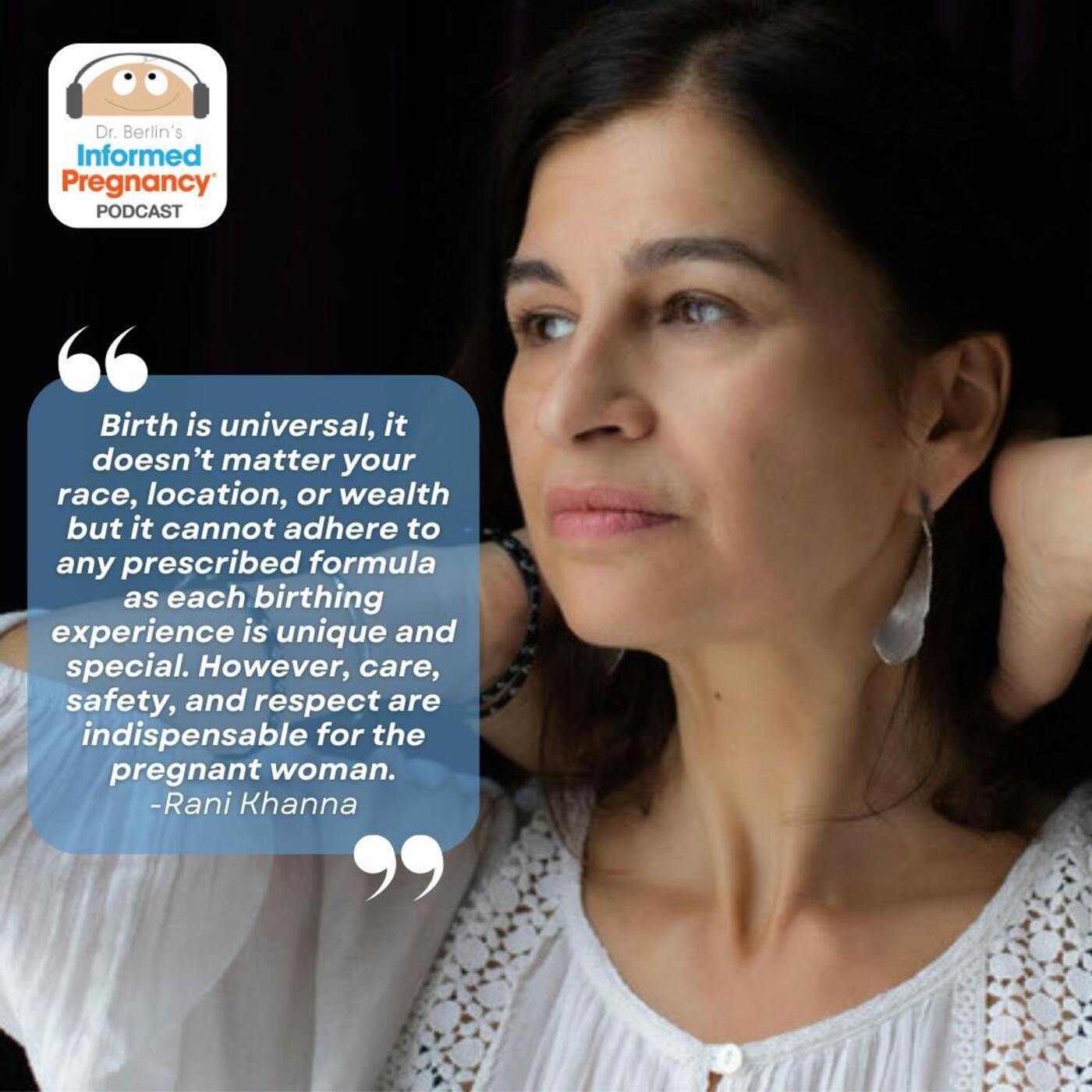
[46:43] important bit you know like wherever you are in the world it doesn't matter where you are it doesn't matter if you're rich if you're poor if you're black if you're white it does not matter because at the end of the day all women are going through the same experience when they're giving birth you know it's different it's unique and special for each woman but birth is universal we all understand it we all celebrate it we all look to it as a source of not just a new life but the miracle of life and so it was very special to include my little granddaughter at the stage when she wasn't even born yet in the film so it kind of for me I have to rewatch it it was coming full circle with me as a filmmaker as a mother becoming a
[47:30] grandmother and honoring the women honoring the women who also lost their lives and honoring my mother in a way where I felt that in a way she should have had a doula she could have done with a doula because she was on her own she had been abandoned by my father and her sister on that day because it was mother's day in france and there was a beautiful meal that they wanted to go and have lunch for so they dropped her off at the hospital and they went back home to have the meal without knowing what had happened to her wow so i think it leaves marks on this unconsciously it left marks and i think that unconsciously i've picked up on it and i think that's why i became a doula wow that is your whole life story
Dr. Elliot Berlin, DC [48:22] is so powerful and how it all came together there yeah before we go a couple of things
Rani Khanna [48:30] one is what's coming next from ronnie kana okay and then two is where can we find you online okay so what's coming up next is a crazy new adventure that my granddaughter is responsible for in some ways because she was born in columbia because her mother's columbian so i went to columbia for the first time a year and a half ago and i spent five months out there fell in love with columbia and i was there to be the doula for her birth and to support my son and his wife in the beginning of their life with a new family but then i went off on my own to travel and when i did my own little traveling i went to the sierra nevada by the coast and when i was there i met i don't know how this happened but
[49:21] on day one that i got there i met a shaman and a mammo from the arrako tribe one of the indigenous tribes living in the sierra nevada and to cut a long story short because it really is a big adventure they both asked me the mammo so the mammo is a spiritual leader and they don't speak a word of english so i was this was all in spanish i did a bit of filming for them so he asked me basically he asked me for my help to meet the pope in rome oh yeah and yes and i was like yes exactly oh what do i do like i do not know the pope personally and just text him? Yes, exactly. I'm going to put a Facebook message and, you know, see who responds. But because, I don't know, I felt such a connection. This was so special to be
[50:11] in this beautiful part of the universe, which they call the heart of the world. So it's the heart of the world. And because I have been working with indigenous people in India, in the northeast of India before that, so I have a real connection with indigenous knowledge, wisdom. I feel that this is what is missing in the world. I want it to be rebalanced and connect with this and give them a voice because they are being completely suppressed. So he wants to meet the Pope because he wants to ask the Pope for some money in order for them to buy back the land that has been stolen from them in Desira Nevada. And this is sacred land with sacred sites. So when he told me about this, the first thing that came to my mind really was
[50:56] like, well, would you be happy if I made a film about this, a documentary, because it could be an amazing story? So that he said yes. So my project at the moment is to make a documentary about him and his community and his grandson, one of his grandson, he's got 15 grandchildren, 10 kids, 15 grandchildren, and his little grandson is Nelde who's 10. And I really fell in love with this little boy. We were hiking together on mules going up into the Sierra Nevada to meet other Mamos and going into villages where there's no electricity, no bed, no nothing. Okay. I'm just like in the hammocks, sleeping in the hammocks and trusting again the process. And this little boy is the one who really wants to learn from
[51:44] his grandfather. And I want to make a film about them. And equally, I've helped the Shaman to buy a piece of land in the Sierra Nevada to build the first university of ancestral medicinal plants and to bring the four tribes together to unite them and to bring healing and for people to come and learn through the Mamos themselves directly. So we have the land and it's called Nikuma. So anybody who is wanting help to help, to learn, to whatever, be involved because we really need a lot of help with Nikuma. We need a lot of help with both projects, but Nikuma is for the universe because this is what is going to be looking into the future of the planet, looking at climate change, the environment, and those who are
[52:35] the custodians of this earth, all the indigenous tribes of the world. So both those projects are my current projects. And if people want to reach out to me, I guess the best way is through email, my email rani kanna at mac.com or my website, which is youandifilms.com. And you and I is you and the visual I. E-Y-E. Yeah, E-Y-E, you and I, E-Y-E, films.com.
Dr. Elliot Berlin, DC [53:08] Beautiful. Wow, such important work, powerful work. I can't wait to see the new films. And of course, for our listeners, you could see Rani's film More Than Blood at informedpregnancy.tv or informedpregnancy plus apps for Apple, Android and Roku. Rani, thank you so much for joining me and for sharing your work and your passion.
Rani Khanna [53:32] Thank you very much for having me and giving me this opportunity to spread the word, I guess, about the work and the future and maybe help mothers in the USA, in your forum, who might need to know something about this. And around the world. We're all in it together.
Dr. Elliot Berlin, DC [53:51] Yes, absolutely. We are together and we're doing whatever we can. Every little bit counts. A hundred percent. And then to our listeners for other pregnancy and parenting related information and media, visit informedpregnancy.com.
Want more pregnancy + parenting? Start your FREE TRIAL of Informed Pregnancy+ and get access to all our curated pregnancy and parenting content — original series, iconic birth films like The Business of Being Born, prenatal workouts and more.
