
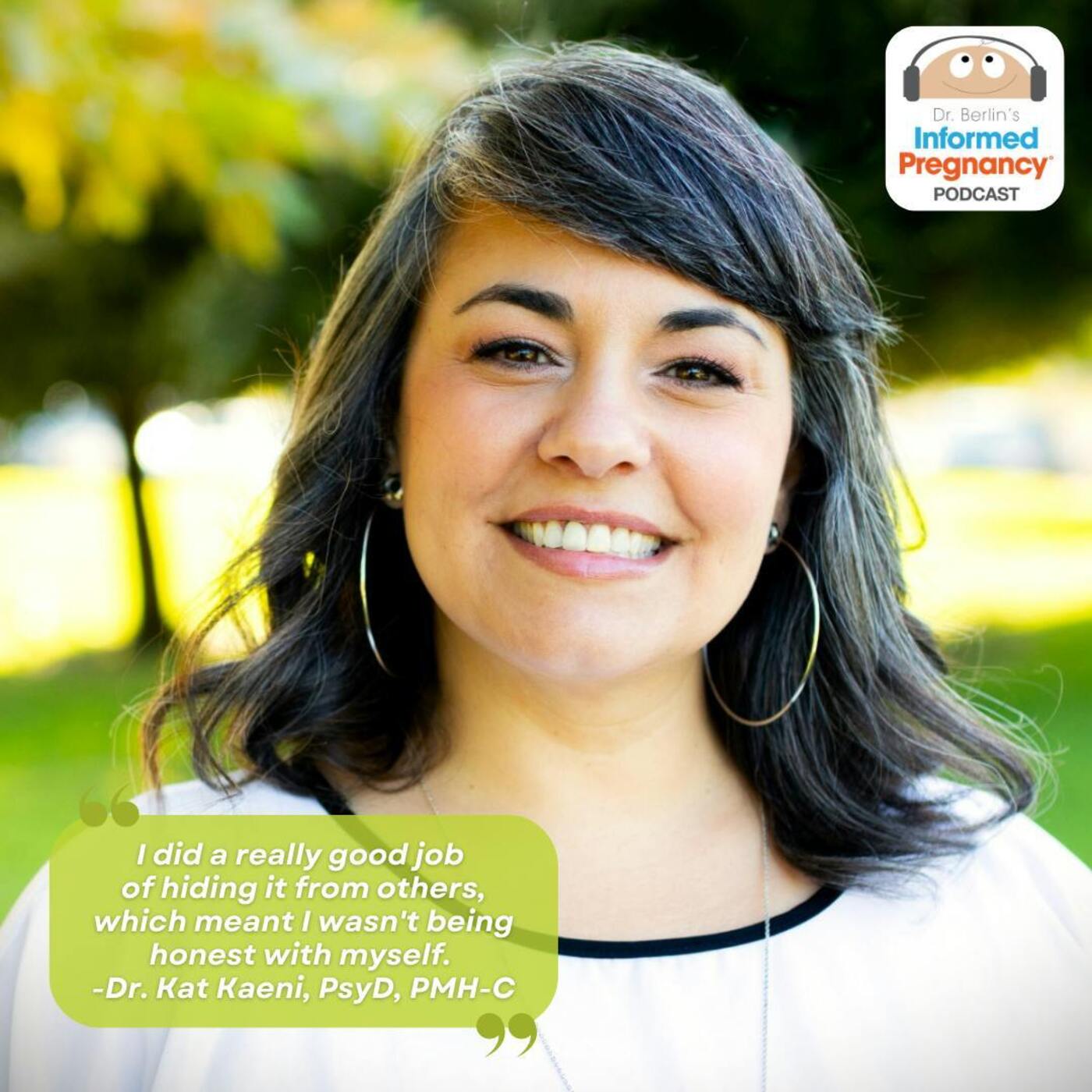
June 22, 2023 · 38 minutes · Episode 360
About this episode
Perinatal psychologist, mother of two, and host of the Mom & Mind Podcast Dr. Kat Kaeni, PsyD, PMH-C shares her deeply personal experience with a perinatal mood disorder as well as tips for handling and recognizing perinatal mood disorders.

- Connect with Dr. Kat Kaeni online: https://wellmindperinatal.com/ and https://www.instagram.com/momandmind/
- Check out the Mom & Mind Podcast here: https://wellmindperinatal.com/momandmindpodcast/
- Learn more about Postpartum Depression on the Informed Pregnancy Blog: https://www.informedpregnancy.com/single-post/how-i-fought-for-myself-amid-postpartum-depression-by-julie-thomas-sponsored
- Start your FREE TRIAL of Informed Pregnancy+ and enjoy more content about the perinatal period: https://www.informedpregnancy.tv/you-are-not-alone
Keep up with Dr. Berlin and the Informed Pregnancy Project online!
www.instagram.com/doctorberlin/
www.facebook.com/InformedPregnancy
Learn more about your ad choices. Visit megaphone.fm/adchoices
See Privacy Policy at https://art19.com/privacy and California Privacy Notice at https://art19.com/privacy#do-not-sell-my-info.
Key quotes
“So after I figured out what was going on, I was really just sort of floored that I had never really had any training in it.”
“My love for her was through the filter of anxiety first.”
“protect your sleep at all costs because it really is the first medicine.”
“If it's longer than two weeks or if it's feeling much more intense than like a mild mood shift or like a mild PMS would, then that would be like a first tip that something is going on.”
“Sharing concern in a loving way is really, really powerful.”
Related episodes
- Ep. 361 Rachel Mans: A Mother's Journey Through Pregnancy, Adoption, and Birth Work
- Ep. 362 Filmmaker Rani Khanna: More Than Blood
- Ep. 382 Caitlin Wilder: Before Birth
- Ep. 372 The Business of Birthwork with Kyleigh Banks
Transcript
AI-generated transcript with speaker labels — may contain errors, especially names and medical terms. Dr. Elliot Berlin, DC appears in blue; Dr. Kat Kaeni in orange.
Download PDF of the Transcript
Dr. Elliot Berlin, DC [0:12] Pregnancy and parenting podcast. I'm your host, pregnancy-focused chiropractor, Dr. Elliot Brinkley. My guest today is a perinatal psychologist, board chair of Postpartum Support International, and host of the Mom and Mind podcast. She's a mom of two, and she's joining us today to share her experiences of both having and treating perinatal mood disorders. Dr. Kat Kayani, welcome to the podcast. Thank you so much for having me. Love that you're
Dr. Kat Kaeni [1:04] shining a light on perinatal mood and anxiety disorders. It's so important. I feel incredibly
Dr. Elliot Berlin, DC [1:10] under discussed and not enough people doing what you do. Also, my wife is deeply seated in that environment. She sure is. I love that there are great people working on it. Let's broaden the conversation, but let's start with the beginning. Where are you
Dr. Kat Kaeni [1:25] from originally? Oh, born in Oregon, the United States. However, I am first generation on my dad's side. My dad immigrated from Iran when he was around 20, and my mom was a Midwestern white lady and had my brother and then me. Oh, you're the youngest. I am, yeah, by four years. Oh my gosh, I'm the youngest by four years as well.
Dr. Elliot Berlin, DC [1:52] Oh, nice, nice. It wasn't hard at all, I'm sure. It's like looking in the mirror. We are twins. Okay, so as I mentioned, your work is perinatal psychology, and you also have a podcast. How did you get into all that work?
Dr. Kat Kaeni [2:09] So long, long story short, I've always known that I wanted to be a psychologist from age 12, pretty much. So fast forward, I graduated and got into-
Dr. Elliot Berlin, DC [2:19] Well, that's a huge fast forward. I mean, who at age 12? Not even everybody knows that there is a psychologist at age 12. Were you seeing a psychologist?
Dr. Kat Kaeni [2:30] No, I became a peer support counselor at my junior high. There was an opportunity to do peer counseling, and so kids who were having a hard time would need to step out and just talk to a friend. And also bonus, I got out of class sometimes, but it was like a win-win, yes. But it was such a cool feeling to be able to help people and to just know that I could support somebody in that way. And yeah, so it just like hit me at that time and apparently
Dr. Elliot Berlin, DC [3:04] stayed. Wow, that's really cool. I also feel sometimes life has these little signs that pop up like in the video games. Go this way, and then you follow it. Because it's a big green arrow. And also, I mean, I've only known you for 10 minutes, but you are very easy to talk to.
Dr. Kat Kaeni [3:23] Well, thank you. I guess it started way back then.
Dr. Elliot Berlin, DC [3:26] I could see how people would feel comfortable opening up. So at that point, I assume you didn't know perinatal.
Dr. Kat Kaeni [3:32] Gosh, no. I had these other weird feeling. Well, weird, I guess, for a young kid is like, how can I make a difference in the world as one person? So anyhow, now I'll fast forward to being a psychologist. I started working in major hospital system, but I was still a generalist. Some things still didn't feel like fully like I was doing what I was supposed to do yet. And then after the birth of my daughter developed postpartum depression, anxiety, and OCD, and my whole world blew apart and took about a year for me to figure out what was going on. So even though I was a psychologist, I was versed in mental health, or so I thought, I didn't know about this. And it wasn't in any
[4:17] training or really anywhere other than this like mention of something that people can develop. So after I figured out what was going on, I was really just sort of floored that I had never really had any training in it. And also it lit a fire in me to make sure that nobody felt this way ever again. And then there you go. There's my, how do I help as many people as possible?
Dr. Elliot Berlin, DC [4:45] Wow. Okay. What a powerful, again, chain arrow saying go this way, go this way. I want to get, I have so many questions about that and want to get into the details of it. But before we get to postpartum, how was pregnancy for you?
Dr. Kat Kaeni [5:00] Yeah, I had a relatively easy pregnancy planned, didn't take too, too long to get pregnant thankfully and it was fine. I didn't have much in morning sickness, a little bit, it faded after some time. It started to become a little bit more difficult in the later parts of pregnancy where I developed a really painful carpal tunnel and I had so much swelling in my body that that pain was nearly unbearable and the digwurveins thing that happens in the back, yes, exactly. Those were very painful, but still everything was fairly easy and actually easier than when I wasn't pregnant because I finally had a break from the massive hormonal changes and difficulties that I experienced with premenstrual and menstrual cycle that was
[5:59] really difficult for all of my life. So I didn't have that anymore. I didn't have the hormonal ups and downs and so it was this like wonderful relief.
Dr. Elliot Berlin, DC [6:07] Wow. So in some ways more comfortable pregnant than not pregnant.
Dr. Kat Kaeni [6:12] Yes.
Dr. Elliot Berlin, DC [6:13] Okay. During your pregnancy, did you have any anxiety?
Dr. Kat Kaeni [6:18] Looking back on it now, I know that towards the end I started to develop some, but It was still relatively mild and no more difficult to manage than anxiety I had felt at any other point in my life. And just side note, that is a risk factor of having anxiety or depression already prior to pregnancy and postpartum is a risk factor for developing it during and after. And that was true for me. I had depression and anxiety earlier on in life, but it was still relatively mild.
Dr. Elliot Berlin, DC [6:50] Had you done things to care for it earlier on in life?
Dr. Kat Kaeni [6:55] Yeah. Therapy. I had tried medication at some point earlier on, like in teen years. There's another contributing factor, which is I've had three concussions, one of which was at age 15 and they were all like sports related. So that kind of, you know, messes with your brain a bit.
Dr. Elliot Berlin, DC [7:16] Literally. They always told me, you know, just sports, it's so healthy for you. And I'm like, no, you have to watch TV. You never get a concussion. Solid advice. Pay attention, kids.
Dr. Kat Kaeni [7:29] Right, right, right. So I had done a couple of things to help manage anxiety and depression and it was managed at that point.
Dr. Elliot Berlin, DC [7:37] Okay. And did you have any specific plan for birth?
Dr. Kat Kaeni [7:42] Yeah, I was deep, deep living in San Francisco. So very well surrounded by a lot of holistic practitioners. And so that was the goal is to have an unmedicated birth. I had a doula that I picked quite early on and she helped with a lot of meditative visualizations and things like that. I put together a vision board, you know, what I wanted to be looking at during birth.
Dr. Elliot Berlin, DC [8:10] What sent things on the vision board?
Dr. Kat Kaeni [8:12] Oh, like a flower, an open flower. Like pictures of women being sort of strong, not meaning like physically weight lifter strong, but just showing strength and those kinds of visualizations that reminded me of my strength and my capacity.
Dr. Elliot Berlin, DC [8:30] Amazing. And how did your labor start?
Dr. Kat Kaeni [8:33] Well, it was a Friday night and I was craving donuts and I had my first contraction at that point, fairly late at night. And I had slowly inched towards birth from that point. So Saturday I was in sort of like a pre-labor state. I decided that I was going to make cookies for all of the nursing staff as a way to stay on my feet and stay active. So I made cookies all day Saturday.
Dr. Elliot Berlin, DC [9:02] Wow, so far I'm loving birth donuts and cookies. This is my speed.
Dr. Kat Kaeni [9:06] Right, right, right. So anyways, that was part of the plan, is to try and figure out something to do to stay on my feet. And I was in touch with my doula the whole time. And it was just like a very slow progression. And then Sunday morning, finally, we went to the hospital, a hospital birth, and it was still a very slow process. And my daughter didn't come out until Monday, about 1130.
Dr. Elliot Berlin, DC [9:35] Oh my goodness.
Dr. Kat Kaeni [9:36] Yeah. And it was three hours of pushing.
Dr. Elliot Berlin, DC [9:39] Pushing, wow.
Dr. Kat Kaeni [9:39] Yeah, so I had back labor. And that is like the most pain I had ever experienced up until that point, for an extended period of time.
Dr. Elliot Berlin, DC [9:49] And you still learned medicine?
Dr. Kat Kaeni [9:51] Correct.
Dr. Elliot Berlin, DC [9:52] Wow.
Dr. Kat Kaeni [9:52] Yeah, the doula was there with me and she was helping. We tried showers. We tried baths. We tried the bouncy balls. pressure points and all of that stuff. And it wasn't progressing very quickly. So the pain was very intense for a long time. And I felt stubbornly determined to continue in that fashion. And they let me, which is not always the case in hospital births. True. But that's why the baby came out. Yes, she did. She sure did. She came out and she had just a tiny aspirated a little bit of meconium. But that was enough to set off my anxiety because what I saw, she had coughed up a little bit of stuff that was like green after she was all wrapped up and everything. And in that moment,
[10:43] like my vigilance became so hyper-focused on watching her all of the time. And that lasted
Dr. Elliot Berlin, DC [10:51] four months. Oh, wow. So like no calm. Not really. Wow. Okay. I want to find out because I think what happens next is what you're saying is a very difficult postpartum transition for yourself. Let's take a little break

Dr. Elliot Berlin, DC [12:39] four times. And Brand D, four times. Welcome back. We're talking to Dr. Chet Kayeni. Okay. So long unmedicated labor, hence pain, and then a little bit of Makoni that set off your anxiety. What were you expecting postpartum to be like, if anything? And then how did your
Dr. Kat Kaeni [13:04] actual postpartum turn out? Yeah. Well, unfortunately, I had subscribed to the idea that this baby comes, you have all this intuition that just gets automatically downloaded from the universe or wherever it comes from. And you know everything that your baby is going to need and you're happy and fulfilled and you feel great and you're so in love and blah, blah, blah, you know, all this stuff. What I know now is that that is not always the case and it wasn't the case for me. And although I felt intense love for her, you know, just this really deep care. My love for her was through the filter of anxiety first. So I felt anxiety in every act of love for her. Okay. So can you give them some specific examples of that?
[14:00] Obviously, nobody wants anything to happen to their baby. But the intensity that I experienced, you know, the anxiety, not wanting anything bad to happen to her turned into, as an example, she was co-sleeping next to me. So literally arm's reach and I had the monitor on next to her was the receiver and next to my ear was the speaker. So even though she was literally right next to me, I was so worried that I wouldn't hear her if something happened or if she needed me or that she would stop breathing that I needed to have it on as loud as I could tolerate next to my ear. Wow. And did you realize in the moment that that is atypical either for you or for postpartum? No, no. So I didn't have really any…
[15:00] other examples of postpartum around me. I was I think one of the first of my friends or at least close by that had babies and weren't really talking about this stuff. So I knew that I was worried about her but it didn't register as anxiety. It just felt like motherhood is just this hard and I have to make sure that nothing bad happens to her. So, you know, it's hard cause now I know of course I was incredibly anxious but at the time it just felt like I was in the storm of it.
Dr. Elliot Berlin, DC [15:35] Did you talk about it with anybody?
Dr. Kat Kaeni [15:37] Nope.
Dr. Elliot Berlin, DC [15:38] Nobody?
Dr. Kat Kaeni [15:39] No, so this is the other super messed up part about this idealized version of motherhood is that you're supposed to love this and you're supposed to be fulfilled and, you know, all of these other lovely things. And for some people that's true. And while I felt some of those things I also felt like I was supposed to know what I was doing and that all of this was supposed to come naturally. So saying anything to anybody about being super anxious although it didn't register as anxiety for me. So I couldn't articulate to anybody that I feel anxious. Anything that would have, it felt like at the time, this is anxiety and depression talking, anything that would have come out of my mouth at the time
[16:25] would have felt like I'm not doing a good job, I'm not being a good mom, I don't know what I'm doing and any number of other things that inherently are shameful, you know? So why would I wanna tell anybody this when I already feel ashamed enough?
Dr. Elliot Berlin, DC [16:45] Ouch. Super messed up. And you're practicing psychologist at this point.
Dr. Kat Kaeni [16:52] Oh yeah. So at some point in this process I knew that something wasn't right but I also knew that I didn't wanna know that because as a psychologist I'm supposed to know what's going on. I'm not supposed to be dealing with mental health stuff. That was what I told myself which obviously isn't true, people are people. So I did a really good job of hiding it from other people which also meant kind of not being honest with myself unfortunately.
Dr. Elliot Berlin, DC [17:24] And it sounds like you went on for a long time.
Dr. Kat Kaeni [17:27] About a year.
Dr. Elliot Berlin, DC [17:29] What changed it out of here?
Dr. Kat Kaeni [17:31] Well, it got much worse. What I mean by it got a lot worse and I just wanna be sensitive to your listeners and kind of give a little sensitivity, heads up warning. I'm not gonna share specifics about what my intrusive thoughts were at this time but I would like for people to know that what I am about to share might be hard for some people to hear or they might not have even ever heard that this happens.
Dr. Elliot Berlin, DC [17:57] Sure, yeah.
Dr. Kat Kaeni [17:59] So an intrusive thought I'll just say is a thought that kind of pops into your head all of the sudden. It could come out of nowhere or it could be related to something that is happening around you or in front of you. Typically the thought is an unwanted thought. It can feel scary and it can feel overwhelming. So the type of intrusive thoughts that I began to have were of a sexual nature that somehow I would accidentally do something to sexually harm my daughter. And this made me feel absolutely bonkers because I knew that I would never want to do anything to harm my daughter. As a matter of fact, I was so scared of these thoughts that I started to do avoidance type behaviors.
[18:47] So I would have a hard time changing her diaper so I'd do it very quickly. After some time it started to go into worry that my husband would do something and I know that he wouldn't, like I know him very well. That's not anything he would do. But the anxiety was such that, and this is OCD at this point, my anxiety, the obsessive thought was that I would do something to hurt her on accident, not that I wanted to. And the compulsive part of it was the avoidance behavior. So I would try and avoid changing her diaper or I would have to do that very quickly or I would look away while doing that. And the worst that I can remember, my husband and I would take turns doing bath time.
[19:33] So it was his turn to do bath time and I was so incredibly worried that something was going to happen to her or that somehow he would do something to her. Again, like one part of my brain knows that that would never happen. But the anxious part of my brain was so wrapped up in worry about it that I was pacing back and forth in front of the bathroom door, putting my ear up to the door, like making sure I could hear her and she was okay and I could hear them. talking and then I would just like go knock on the door like hey it's everything okay do you need any help in here like pretending like I was just trying to be nice and helpful but it was really
[20:09] because I needed to know that she was safe because in my brain my brain was just playing these horrible tricks on me making me think that something bad was gonna happen and then I totally just lost it I ended up crying in the kitchen in the corner like really really felt the lowest I had felt and so I tried to be more honest with myself and as a therapist again I was actively working at this time hiding this from everybody I would give this depression screen which is called a phq9 and it lists all the symptoms of depression and I decided to give it to myself and be as honest as possible and to see the sort of score the screening score to be in the moderately severe range was me coming to terms with what was really going on
[21:04] wow so you were your first middle client for sure that's exactly right that's exactly right what did you do for help well I went back to a therapist who unfortunately wasn't trained and when I shared with her that I thought I was depressed she told me that I wasn't and I just it's such a missed opportunity didn't ask what was going on for me that made me think that that was the case and so I shut down I shut down and I decided to go other routes I went to a naturopathic doctor I went to an energy healer I you know was like buying crystals and like whatever I could think of that I felt like could help me I was trying to ground myself
Dr. Elliot Berlin, DC [21:54] in other types of healing were you talking still to nobody were you talking to your husband
Dr. Kat Kaeni [22:00] at that point I know I didn't explicitly state stuff to him and I want it to be clear that it's not because he wouldn't be able to hear it or handle it it's just part of my own like trauma that it was hard for me to talk about stuff so no you know it would come out in little bits and pieces here and there where I would share stuff but that was me really kind of testing the waters with people how did you eventually find help effective help well a lot of the things that I was doing to try and help myself was part of what was helpful but I also got some books and started learning and reading and taking courses so that I could learn about perinatal mood and anxiety disorders and being able to hear and see my experience
[22:56] reflected back to me from people who didn't know me at all was one of the most powerful experiences for me to be able to see oh what I'm feeling is written in this book what I'm feeling is what these people are talking about and that really allowed me to come to terms with what was happening have context for what was happening and cut myself some slack like bring in some compassion to this and find meaning in what I had been going through and then eventually at some point I got back into therapy and you know that helped
Dr. Elliot Berlin, DC [23:35] for sure so powerful to be reading and you know the I guess validation the yeah exactly realization that this happens and it's not you right it's so powerful it's so simple too all right I want to take another little break and when we come back find out also about your second birth and then a little bit more about what you've learned through your personal journey and the work that you're doing and you know give people at home some tips on you know how to identify maybe what's typical versus atypical and what are some things you can do to get help if you're concerned we'll be right back welcome back to the podcast we're talking to dr kat kaini and okay you had a very very powerful a
[24:38] personal story and it's just so crazy that you were from age 12 listening to and helping other people and eventually really had to listen to and help yourself and now I've learned a lot from that and are helping others which is amazing I want to get a little deeper into the work that you do but you also know
Dr. Kat Kaeni [25:00] baby. I did. How was that pregnancy and birth? It was very different. So by the time I had my son, three years later, almost the same month, three years later, I had done a lot of work and try and understand what was going on for me. So I had a lot of stuff in place to protect and support my mental wellness along the way. I got my same doula for birth and pregnancy again was similar. It was fine, except that I had a really, really horrible pelvic shearing. During pregnancy or during the birth? During pregnancy. Oh, wow. Yeah. Yeah. It was a horrible pain. So I went to a perinatal chiropractor who helped a lot and really tried to get me in the best kind of physical shape position as possible to help with birth. How did that go?
[25:56] So she helped a lot. The chiropractor helped a lot. This birth with my son was very different than the one with my daughter. It came on very quickly and all of the sudden, it was 1030 at night, water broke, labor started so fast and the contractions were so intense that I was physically shaking every time one would come through because it almost felt like lightning was ripping through my body the whole time, which was very different from my daughter. Was it a lot faster? A lot faster, a lot faster. We got to the hospital. I had to have my husband stop the car every time I was having a contraction because I couldn't deal with the car moving. I got to the hospital. He had to go park the car and I must have had so
[26:42] much fluid because every time I had a contraction, more fluid would come out. So this happened all the way to the labor room and I was like, oh, he's going to be able to find me because I just left a trail. All behind me. But yeah, it was really, really intense and my plan was the same, to have an unmedicated birth and with no interventions. But because the contractions were so intense and I went into this labor tired, which was a big factor too. It is. I was like, no, I'll take that epidural and luckily I had enough time to have an epidural. So let's see. Water broke at 1030. I had him at 430.
Dr. Elliot Berlin, DC [27:25] Oh, wow. Okay. Yeah. As a birth worker, you sometimes see those labors that are a lot faster almost look like concentrated orange juice, like all of the intensity of the full labor is just happening over a short period of time. That's exactly right. There's a train barreling through you. Mm-hmm. How was postpartum?
Dr. Kat Kaeni [27:45] Much better. I sort of jokingly, if you want to call it that, call it like my postpartum light because I still had anxiety and depression, but it was much easier to manage. I knew what was happening. I knew how to get help. And I knew for me, because I'm so sensitive to sleep loss, that protecting my sleep was the number one thing. And like, this is your first tip, anyone who's listening, protect your sleep at all costs because it really is the first
Dr. Elliot Berlin, DC [28:15] medicine. Yeah. I think the opposite also, meaning without it, it's like really destructive. Things start to fall apart quickly. Yep. Okay. Well, since you brought up some tips, you as a professional didn't realize what was going on. How does somebody who has a baby and comes home, and because there are, there's so much transitioning happening at the same time, physical, emotional, relationship-wise, it's stressful. Transitions are stressful, and this one's not only no exception, but maybe even more than typical transitions. So how does somebody start to recognize, okay, this is more than the typical stress that somebody would feel, the blues that somebody would feel? What are some of the signs?
Dr. Kat Kaeni [29:02] Sure. And this is super important. So first of all, up to about 80% or so people experience baby blues. It is very typical. It feels like some ups and downs, you might be tearful, but for the most part, you can still kind of maintain your sense of self and feel like yourself aside from the tearfulness or some relatively mild ups and downs in mood. But if that is either one, lasting longer than two weeks, or if in those first couple of weeks, it's more intense, meaning like it's impacting your ability to do daily functioning things. You know, we all know it's already hard to sleep, but like if you're given the opportunity to sleep and you can't, that's like a sign or a tip. A bit of a flag. Oh, yeah. Yeah,
[29:55] for sure. It is a bit of a flag. Or if there are other things like you're appetite changes in a big way, either you don't have one or you have a bigger appetite than normal. And again, this is like little hard to judge because if you're somebody who is able to or willing and wanting to nurse, your appetite might have changed anyways. So you know, it can be a little bit hard to distinguish, but the real thing we're looking for is intensity of symptoms and duration. If it's longer than two weeks or if it's feeling much more intense than like a mild mood shift or like a mild PMS would, then that would be like a first tip that something is going on.
Dr. Elliot Berlin, DC [30:37] And aren't there things that maybe a partner might recognize?
Dr. Kat Kaeni [30:41] Sure. Again, like tearfulness is fairly common. I call like between three and six days, you know, after birth, I call it the flood because, you know, you're leaking from everywhere. You might be tearful if you're nursing, your milk is coming in, you're still, you know, bleeding and your body is releasing sweat. So that period of time is one of the more vulnerable times to notice if like how intense that shift, that hormonal shift is for somebody. And there's quite a range of symptoms and intensity of symptoms. So for a partner, if they are noticing like crying a lot, having a down mood, low mood, feeling like really low energy is one. Again, we're tired, so you're going to have low energy.
[31:31] But this is kind of like dragging energy, which we associate a little bit more with a depressed mood.
Dr. Elliot Berlin, DC [31:38] Yeah. And that's something that a partner might just see out of character for their partner?
Dr. Kat Kaeni [31:45] Yes.
Dr. Elliot Berlin, DC [31:46] Right.
Dr. Kat Kaeni [31:47] It would be out of character. Thank you. So it can also look like somebody who can't sit down, like they're kind of up and doing stuff. And again, given the opportunity to rest, are not really able to like fidgety, maybe even feeling agitated or irritable. And there can be quite a range there as well. But again, to your point, it would be out of character.
Dr. Elliot Berlin, DC [32:10] You mentioned earlier that having anxiety before pregnancy or before birth is sort of a risk factor. Are there other risk factors that one might say, hey, I should keep an eye on myself because I have these?
Dr. Kat Kaeni [32:25] Yes. So any type of personal mental health challenge that you've had is a risk factor. But also if you have a family history of any kind of mental health disorder, whether it's diagnosed or not, that genetics do play a part here. Another one is, as I alluded to before, is if you have a sensitivity to hormonal change already. So if you have difficulty around PMS or menstrual changes, you have a higher likelihood of being sensitive to the hormonal changes that are happening during pregnancy and postpartum. And there are other sociological factors, psychosocial factors. So those are the bigger categories of risk factors we're looking for. What can be difficult to know is if your family has a history of mental health challenges
[33:16] or difficulties, specifically if they are related to postpartum, because, you know, it's only very recently we're talking about mental health in terms of knowing what we're dealing with. There are generations of people who might have been depressed or anxious or been dealing with any number of mental health conditions and not known that that's what they were dealing with. So if you're digging around and trying to find out what their experiences were like, they might not be able to say, yes, I had depression. It could be something more like, oh, yeah, after so-and-so was born, I cried for three months or, you know, something like that. So if people are wanting to understand their family history a bit more, sometimes
[33:57] the clinical terms aren't really that useful.
Dr. Elliot Berlin, DC [34:01] That makes sense. When either a person or somebody around them starts to see some of the signs and gets concerned, what would you say the next step should be? How do you react to that?
Dr. Kat Kaeni [34:15] Yeah, absolutely. I first go to the person who you're concerned about and ask them how they are doing, ask them how they're really doing. Sometimes, like, for instance, in my case, it was hard to be honest with people about how I was really doing. You know, so people could come back with the first answer as like, I'm fine, I'm doing fine. But you can also gently tell them what you're noticing, that you're seeing that they don't seem to be themselves or acting like themselves or that you're concerned about them. Sharing concern in a loving way is really, really powerful. To be able to sit with somebody and tell them that you're concerned and then
[34:55] also listen. Listening is really, really crucial. So, if you're going to ask somebody how they're really doing, let them talk. Let them say what their experience is. Why it's so important is because oftentimes people are talked out of how they feel. So, oh, you'll be fine, or oh, you're just tired, or oh, it'll be okay, you know, in a week. So the person who might be on the verge of talking about something could feel shut down. So listening, talking, listening, and then looking into resources for the person you're concerned about. I don't know who came up with this, like pull yourself up by your bootstraps business, but this is not the time for that at all.
[35:39] The person who's suffering can't also be the person who's entirely responsible for getting themselves out of it, although it happens a lot that they do. It is super powerful to have somebody that can go and look and find the resources and offer them gently to the person who's suffering or having difficulty. It doesn't always have to be mental health. It can be, you know, would you like me to hold the baby so you can sleep? Or I'm bringing food over and like becoming the village, so to speak, for the person who's suffering and just stepping in and helping without making the person who's suffering figure out how to tell you to help them.
Dr. Elliot Berlin, DC [36:21] Right. Just offer something.
Dr. Kat Kaeni [36:23] Just do it.
Dr. Elliot Berlin, DC [36:25] Yep. OK. This has been an incredibly informative and helpful conversation for me, even just as a practitioner, you know, working with people in the space and I'm sure for people listening, you have a podcast.
Dr. Kat Kaeni [36:42] I do.
Dr. Elliot Berlin, DC [36:43] Why you started the podcast and what you talk about on the podcast.
Dr. Kat Kaeni [36:48] Yes. The Mom in Mind podcast in June will be seven years old.
Dr. Elliot Berlin, DC [36:53] Oh, wow. Happy birthday.
Dr. Kat Kaeni [36:55] Thank you. Thank you. I really as a practitioner and clinician, I got so much information out of going to conferences and trainings and learning about all of these things. And I realized one day that this is great. We can all come to these trainings and it's awesome and we need this. But what about the person who's sitting at home? How do they get this information? And that's kind of where it came from is really wanting to create a space and a platform for people to hear what it's like to experience a perinatal mood or anxiety disorder, what experts know about these conditions. And so that's what the podcast is. The Mom in Mind podcast is my podcast.
[37:39] And it is a collection of personal stories, people talking through their experiences, what happened to them and how they got help or got better. And also expert interviews, people talking specifically about what is postpartum anxiety or what are intrusive thoughts and ways that people can cope and heal from them. So the podcast comes out weekly. And what I love about it is that, and you know this about podcasts too, of course, is that it's a resource that people can listen to when they have time or when they have space or when they want to or need to and at their own pace. So I find it to be really a powerful way for people to learn and reflect
[38:30] on their own experience while they're hearing somebody else's lived experience. And being able to have that moment where they can say, oh yeah, that's how I feel. That's what happened to me. And hopefully be that lifeline to getting the support that they need.
Dr. Elliot Berlin, DC [38:47] I have no doubt. Dr. Kat, thank you again for joining me. Where can we find you online?
Dr. Kat Kaeni [38:53] Yes, you can go to momandmind.com or my practice, wellmindperinatal.com. Both of those will take you to my podcast and the courses that I offer. And also on Instagram at momandmind.
Dr. Elliot Berlin, DC [39:09] Perfect. To our listeners, if you'd like to find more information about pregnancy and parenting, just like this, visit importantpregnancy.com.
Want more pregnancy + parenting? Start your FREE TRIAL of Informed Pregnancy+ and get access to all our curated pregnancy and parenting content — original series, iconic birth films like The Business of Being Born, prenatal workouts and more.
