
March 14, 2024 · 38 minutes · Episode 398
About this episode
Placenta encapsulation specialist and mother Valerie Rosas discusses everything you need to know about your placenta options including raw versus steamed, the process and the benefits, and how she got into the profession.

Connect with Valerie online: @feelgoodplacenta
Learn more about placenta encapsulation services by Valerie: The Feel Good Company Placenta Encapsulation
Key quotes
“That's a great question, and I've never had that question. Actually, it's the first time I've heard it, and I haven't had an experience where I felt like it was not good for someone. I think the only circumstance that I could”
“So raw method of encapsulation does tend to yield more energy than the steamed method. So not to say that the steamed method won't render energy. It just seems to be more of a mellow type of energy. Whereas with raw method, it can really provide a pick-me-up. I've had moms compare it to taking a shot of espresso or drinking a cup of coffee.”
“That's a great question. If it's put on ice, placenta can be on ice indefinitely, as long as the ice is replenished. So I'll have families who want me to be there like”
“I think the only thing that I would like to add is that I love placenta. I love encapsulating placentas for moms. There is just nothing better than checking in with moms, just hearing like how happy they are, how much energy they have, how much milk they have.”
“this is why I do what I do. It's just so cool.”
Related episodes
- Ep. 401 A Birth Story with Stephanie Devlin
- Ep. 405 Birth Stories with Valia Skiani
- Ep. 408 Michelle Christensen: After Birth
- Ep. 399 All About VBACs with Meagan Heaton
Transcript
AI-generated transcript with speaker labels — may contain errors, especially names and medical terms. Dr. Elliot Berlin, DC appears in blue; Valerie Rosas in orange.
Download PDF of the Transcript
Dr. Elliot Berlin, DC [0:12] Welcome to the Informed Pregnancy and Parenting Podcast. I'm your host, pregnancy-focused chiropractor Dr. Elliott Berlin. My guest today is a passionate mother and a placenta encapsulation specialist. We're going to delve into her remarkable journey to motherhood and how it led her to her fascinating career, and we're going to discuss everything you want to know about placenta encapsulation, including its potential benefits, why it's becoming a choice for many expectant mothers. Valerie Rosas, welcome to the podcast.
Valerie Rosas [1:06] Hi, Elliott. Thank you so much for having me. I'm very excited to be here.
Dr. Elliot Berlin, DC [1:11] My pleasure. You are the guru. You've been doing this for a while, and I want to just jump right in and ask you everything that I get asked about placenta encapsulation all the time.
Valerie Rosas [1:21] Yes, I have been doing it for a long time. I've been doing it for now 10 plus years, and so, yes, go for it. I want to answer all the questions.
Dr. Elliot Berlin, DC [1:29] People hear about it while they're pregnant, perhaps, and then there's a million questions. The questions I get are like this. Are there any specific benefits to it? Are there people who it's better for or not as good for? Are there any downsides or risks to it?
Valerie Rosas [1:47] Why don't we start with those? Okay, yeah. So, the main three benefits that are reported are going to be, number one, by far, will be energy. I feel like this benefit is reported by most moms, especially if raw method of encapsulation is chosen. Number two is going to be hormone stabilization, mood stabilization, and number three will be lactation, so helping milk come in a little bit sooner and just get that milk supply going a little faster with placenta than without. At least that's been my experience with the moms that I have worked with.
Dr. Elliot Berlin, DC [2:26] And also, anecdotally, I can report the same. I think the number one thing that I also see that people report after they take their placenta pills are energy and help with milk production, lactation. So, those are things that are helpful. In the postpartum time, those are two things that are highly coveted. And then you said also hormone balance. Are there people who placenta encapsulation would not be a good choice for?
Valerie Rosas [2:55] That's a great question, and I've never had that question. Actually, it's the first time I've heard it, and I haven't had an experience where I felt like it was not good for someone. I think the only circumstance that I could possibly think of is if someone smoked cigarettes during the whole duration of their pregnancy or if there was substance abuse, alcohol abuse, in those types of scenarios, I wouldn't recommend mama consuming her placenta.
Dr. Elliot Berlin, DC [3:32] So, if there's concerns of toxicity within the placenta itself?
Valerie Rosas [3:37] Most definitely, yeah. I mean, we breathe in toxins that are in the air. And actually, a small research team out of the University of Las Vegas, Nevada, they tested for different carcinogens that are in the air. And they found after testing placentas that they were not of any high-risk levels, you know, if mama's consuming their placentas, like re-ingesting those carcinogens back into their body, they were of such low levels that it wasn't deemed as something that would be unhealthy for mom to consume. And of course, that's going to vary city to city, state to state, if you're living in a city versus living somewhere…
Dr. Elliot Berlin, DC [4:25] On a dream farm. Right. Exactly. Out in the woods, in the wilderness. What about if during the labor they develop an infection, a placental infection?
Valerie Rosas [4:37] Oh, yes. This would definitely be a reason why mom cannot consume placenta. So, if the fever goes over 102 degrees, this is a for sure sign that placenta is infected, and it is not suggested to consume placenta. It's not recommended.
Dr. Elliot Berlin, DC [4:57] Okay. And do you know of any downsides or ill effects reported from having, like we know that there's some positive effects reported from having placenta, but do you know of any people who are sensitive to it, allergic to it, or have like negative side effects from it?
Valerie Rosas [5:13] No allergies to it. I've had a few reports here and there where mom said, oh, I felt like it just didn't quite agree with me. Or I've had moms that I've worked with more than once where, oh, the first placenta I felt a little bit better with it than this one or vice versa. So, I've had reports like that, but no illness, nothing to be concerned about, certainly. The one thing that I always tell all of my mamas that I work with is the downside or the negative is going to be that it may not work. So, if mom is going into this hoping that she doesn't get postpartum depression or that she will have a healthy milk supply, those benefits can't be guaranteed. Or if a friend of mom's had a certain experience, can't guarantee that
[6:11] this person will also have the same experience, right? So, the things that are in the placenta that are going to make each placenta different, even if it's the same mom, two, three, four different placentas, is hormonal content, which the baby is the driving force of the hormonal content. And since each baby is its own individual, hormonal content will be different from placenta to placenta, as well as nutritional content. So, how mom is eating during the pregnancy is going to impact the nutrition of the placenta. So, that's why you can get varying results. I wonder, does anybody test them to see what's in them? You know, as I was mentioning earlier, this small research team out of the University of
[6:55] Las Vegas, Nevada, they were doing it, you know, while they were doing their trials. But outside of that, I don't test them. I wouldn't even know who to contact. I've always wanted to do that. Several years ago, I had a mom that I had worked with that was going to put me in touch with a doctor at Cedars who was very interested, and she wanted to take it a step further and like test them. And this person was supposed to put me in touch with them, and I don't know what happened. And I kept checking in and kept checking in, and nothing ever came about it. But I would love to be able to test them to actually know.
Dr. Elliot Berlin, DC [7:37] You know, it's interesting. I don't know if you know the company Lactation Lab, but it was started by a mom and you know, her baby, she was making milk and she was breastfeeding, but her babies weren't growing. And she wanted to have her milk tested to see what the nutritional content of her milk was. And there was no lab in the United States that was set up to test breast milk. The data wasn't compiled on what the normal levels are, and she started a lab for testing breast milk. So I wonder if it's possible to do something similar for placenta, because I'd be really curious to know more about what's in there. And as you mentioned, how it varies from person to person, even the same person from pregnancy
[8:16] to pregnancy. Val, you mentioned something, you said a cold preparation of the placenta, which makes me think there are multiple ways to prepare placenta. Can you elaborate on that?
Valerie Rosas [8:26] – Yeah. So that cold preparation, we call it raw method of encapsulation. And then there's the steamed method of encapsulation. So there's two different ways. So with the raw method, there's no cooking or preparation of the placenta prior to dehydration. Placenta just goes into the dehydrator raw. I personally dehydrate at 165 degrees. Bacteria can no longer survive at that temperature. Oftentimes I'll get a question like, is raw method safe since it's not being cooked? And yes, it is because of the dehydration temperature. So then with the other method of encapsulation, the steamed method, it can also be called the traditional Chinese medicine method or the TCM method.
[9:15] And this is where placenta is steamed prior to dehydration. Depending on the thickness of it, I will steam it anywhere between 10 to 20 minutes. I still leave it raw in the middle. So the purpose of the steamed method is not really to cook it, but rather to bring heat back to the placenta. So being in alignment with traditional Chinese medicine and the sitting for the 40 days, which is bringing heat back to the body, healing to the uterus. So we stay in alignment with that. Once it's done being steamed, then it's sliced and dehydrated as well at 165 degrees.
Dr. Elliot Berlin, DC [9:59] When you steam it, do you add anything to it?
Valerie Rosas [10:02] I don't. I do not. It's a light steam. It goes into a steaming basket. So it's steamed by the vapor of the water below. There are some encapsulators that may add lemon, ginger, or a hot pepper. I would rather just leave it plain, just because when it comes to acupuncture and traditional Chinese medicine, you have to know if somebody runs hot or cold. And if they run hot and you're adding a hot pepper to it, that's increasing the heat of it. So someone who's already running hot, that might not agree with them. So I try to keep it as neutral as possible so that we don't bump up against any problems along the way. I just want moms to have the best recovery that they have with
[10:55] those little mishaps due to placenta. Aside from the raw and steamed, are there other preparation methods? Oh, yeah. There's the raw placenta smoothie. Yeah, you're either in or you're out. There's like, no, let me think about it. At least that's what I've seen. So a small piece of raw placenta by the thumb-sized portion goes in with frozen fruit and the liquid of mom's choice and made into a delicious fruit smoothie. I've made hundreds of them and mamas love them. They just absolutely love them. Okay, so that's really raw. That's really raw. That is, you know, the purest way to consume it. And I always ask, even though I already know what the answer is,
[11:45] I always ask, you know, can you taste the placenta? And the answer is always the same.
Dr. Elliot Berlin, DC [11:50] No, no, I can't. Okay, so I was only one time I saw somebody taste the placenta. Maybe they use too much placenta. I don't know. And also they're both kind of a healthy couple, but he who made the smoothie is really, really green and he didn't put any of the fun stuff in there. There's no fruit. There's no chocolate, no peanut butter. It was all greens, not even a green apple and some placenta. And when she took a drink of it was an hour after she gave birth, she just made a weird face and she's like, ew, this is really gamey. That is the only time I've seen somebody even notice that it was in there, you know, flavor-wise.
Valerie Rosas [12:28] Yeah, I mean, that's what I tell mom. There are some moms, they want to get real funky with their smoothie and I just tell them absolutely not. I don't like to say no to moms, but this is the one time that I do. I say two things. It needs to be cold. It needs to be sweet. And the color needs to look appealing because many of us eat with our eyes first. And if you have a smoothie that turns green or like, you know, poopy brown, like why would you want to drink that? You know, especially right after you've given birth, you want something cold, you want something nourishing, you want something replenishing. So my favorite recipe to make for mamas for their smoothie is banana, strawberry, blueberry, blackberry, raspberry
[13:22] with either coconut water or some type of nut milk or even cow milk is fine. But then, you know, the smoothie looks purple. It's delicious. It's creamy. Moms will down it before I even leave. So then you have super raw and steamed. Yes. There is another way. I've never done this for anyone. I have set aside raw placenta for family, you know, to give to them for them to prepare, but that is to actually like cook it in a meal. Oh, interesting. Yep. I had a family who wanted to make like a meatball with it. You know, I kind of draw the line at the raw placenta smoothie, to be quite honest with you, because I mean, when you smelled steamed placenta, you just kind of know like this is
[14:12] not going to taste good, like preparing it to eat it. It's different in a capsule form powder, you know, like a vitamin. It's easy that way, you know, but needless to say that dad, I was told, could not get it down. He could not finish the meatball.
Dr. Elliot Berlin, DC [16:18] So you mentioned now three different types of preparation, the fourth, if you include the meatball. And what I'm wondering is how do people choose? Are there different benefits to
Valerie Rosas [16:29] the different types of preparation? So as far as the methods of encapsulation, which is the most popular way of consuming placenta, there sometimes can be different reasons for choosing different methods. And there can be times where I may not be able to give mom a choice as to method of encapsulation. So first, let me start off with the one benefit that really distinguishes the two methods from each other is the energy. So raw method of encapsulation does tend to yield more energy than the steamed method. So not to say that the steamed method won't render energy. It just seems to be more of a mellow type of energy. Whereas with raw method, it can really provide a pick-me-up.
[17:23] I've had moms compare it to taking a shot of espresso or drinking a cup of coffee. It just really gets them going or saying something like, oh, I didn't have to drink my coffee in the morning because I can just take my placenta pills and that's enough for me to get going for the day. Or that afternoon dip, that's a nice little pick-me-up just to uplift everything. So as far as the methods, that is going to be the big difference. Now, why someone would choose one method over the other? Well, raw is definitely more popular than the steamed because of the energy. Now, why would someone then choose the steamed? Oftentimes, it could be for cultural reasons. Someone who's following traditional Chinese
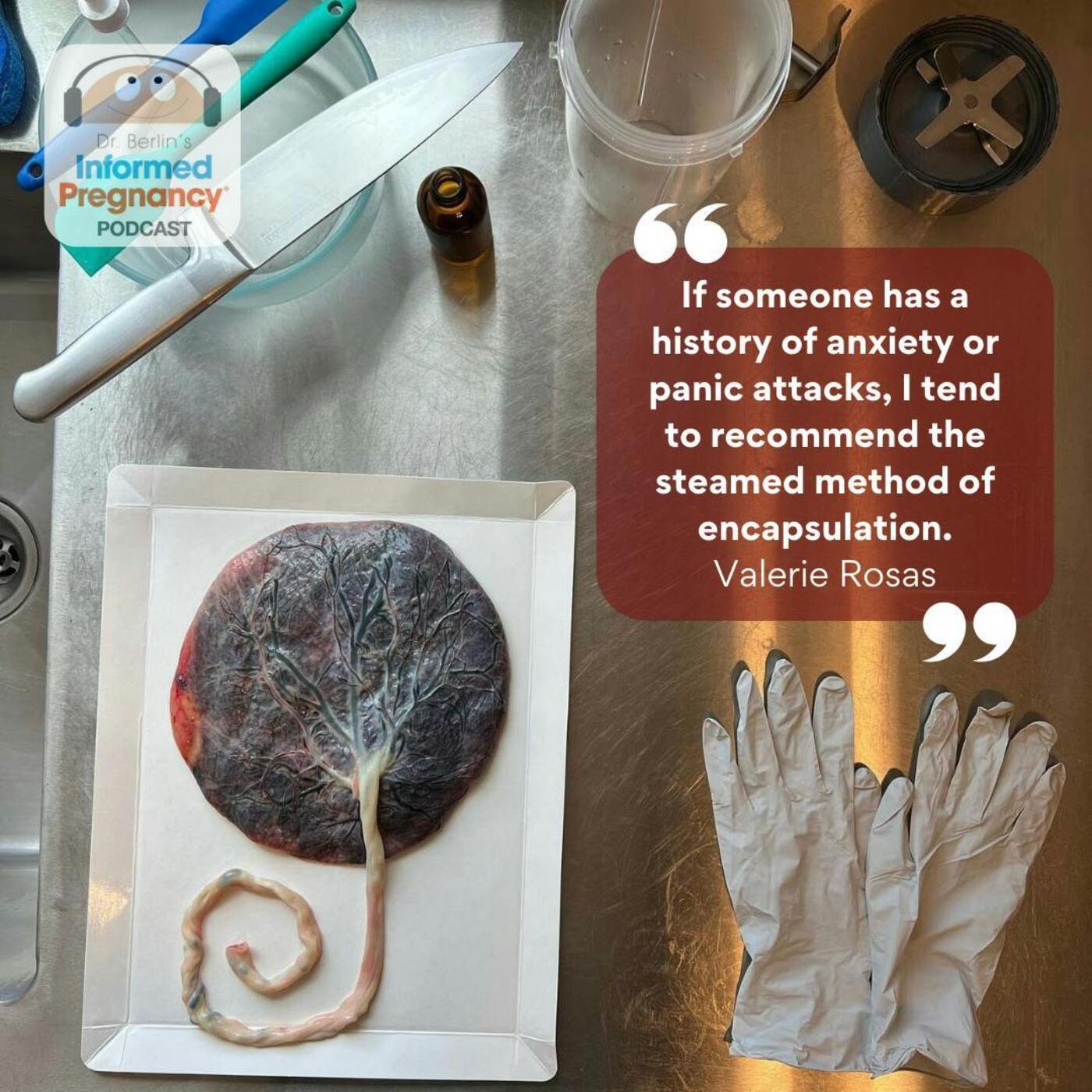
[18:14] medicine postpartum ritual and wants to stay with just consuming warm hot foods and liquids may choose the steamed method. If someone has a history of anxiety or panic attacks, I tend to recommend the steamed method of encapsulation because that energy boost that the raw method of encapsulation can provide for some moms who are very sensitive to stimulants. It can lead to anxiety for them because it can be a significant boost.
Dr. Elliot Berlin, DC [18:47] Interesting.
Valerie Rosas [18:48] It is interesting. I find it to be quite fascinating. When I first started working, my recommended suggested dosage was a lot higher than what it is now. And I was just getting so many reports of either it interrupting sleep in the middle of the night or feeling like that jittery feeling like you just drink too much coffee. I was getting so much of it that I just completely restructured the suggested dosage and lowered it and always let mom know. If you need a little bit more, you can always introduce an extra capsule because there are some moms, especially type A personality moms who are on the go and like to get a lot done. Those moms like to have a little extra boost. You can just add a little extra
[19:37] capsule and then boom, you're ready to go.
Dr. Elliot Berlin, DC [19:39] I've seen a few times now where the capsules are flavored. I mean, I've had the pleasure of smelling some bottles of placenta capsules and it's not like I get addicted to like, how am I going to keep myself away from that? I can see how some people would have trouble getting it down. Although I take other supplements that also don't have the greatest aroma to them, but I still take them because they help me. Have you heard about using flavored capsules?
Valerie Rosas [20:08] Yes. I get asked for it, not often, maybe like once or twice a year. It's definitely not a popular thing. Although I've met other encapsulators where the folks that go to them is requested constantly. For me, I think, I don't know, berry flavored placenta, placenta powder. Again, it being completely raw in a smoothie is just different than once it's been like powderized. Yeah. It's more like lemon. Or lemon. Yeah. To me, it doesn't sound appealing and it doesn't really matter, right? How I feel about it. It's all about mom. But I always say if you have a problem getting it down because of the smell, wrapping it up in a little bit of honey or a little bit of peanut butter, drinking it with juice, you can open up the capsules
[21:03] and sprinkle the powder into the smoothies. So there's ways of getting around maybe the little unpleasant smell, but I've had so many moms say, I feel so good. I don't care what it tastes like.
Dr. Elliot Berlin, DC [21:17] Yeah. That's what I'm saying. Same with my supplements. Yeah. I take a lot and some of them you wouldn't take it unless you really thought it was doing something good for you. And I feel the difference. So I take it. It's not that you can't get it done. It's just options. What about the tincture?
Valerie Rosas [21:32] Oh, yes. The tincture is a great addition to the capsules. It's something that I include in most of the bundles that I offer. It's a way to extend the life of the placenta. So placenta capsules, they start to lose their potency around the two-year mark. And there are other reasons why mom may choose to want to consume her placenta later on down the line. Like when she starts to transition back into having her menstrual cycles, or even as an extreme example, she could save it for menopause and it could help during that hormonal transition that she's going through. So the way to save it for that length of time is really through the tincture. With your capsules, you can't do that. Two years. And I like to say use them up in the
[22:20] first year and a half to maximize their potency.
Dr. Elliot Berlin, DC [22:22] How many do you get?
Valerie Rosas [22:24] Well, it depends on the size of the placenta, for sure. But I put a very large range, 75 to 200 capsules. It could definitely be more than 200 capsules. 75 is like if somebody has a preemie. So average size placenta yields 140 to 160 capsules. Raw method actually yields more than the steamed method, about 15 to 20% more.
Dr. Elliot Berlin, DC [22:53] Hmm.
Valerie Rosas [22:54] That's another reason why moms like to choose raw method because they know they'll get more capsules. And I've also had it happen. I actually just had it happen very recently where a mom had chosen the steamed method of encapsulation, not for any particular reason. It just seemed to resonate with her more than the raw did. And when I got the placenta, I felt like it should be prepared in raw method. So I just called her and had a quick conversation with her about it. I wanted to maximize the amount of capsules for her. And it felt like if I steamed it, she wasn't going to have as many. So after a brief conversation with her, we chose to switch over to the raw method.
Dr. Elliot Berlin, DC [23:36] Let's talk about some of the mechanics here. First of all, how do you get somebody's placenta to prepare it?
Valerie Rosas [23:44] Yeah. So hopefully mom or dad will contact me prior to labor. I like it if they contact me a month beforehand, or maybe even a little bit before. But last minute can work as well. And then we just set everything up through a consultation. If we have the time, we'll set up a consultation. And during that consultation, we'll talk about how the pickup is going to look like. So I do require a little bit of communication throughout the labor just so that I can get to placenta in a timely manner. And depending on the bundle that the family chooses, I'll go to the hospital and either dad will bring me down the placenta, or I will go up to the labor and delivery room and pick up the placenta from there.
[24:32] And that's just basically how it works. I mean, it's pretty simple and really easy.
Dr. Elliot Berlin, DC [24:38] How soon do you need it from the time it comes out?
Valerie Rosas [24:42] That's a great question. If it's put on ice, placenta can be on ice indefinitely, as long as the ice is replenished. So I'll have families who want me to be there like right away. And those families really on top of their communication with me like during labor, so I can really be ready for them. So then I'll just be off to pick it up right away. And then there could be other families that they may wait a few hours. Again, as long as placenta is on ice, it's totally okay. Placenta can be in room temperature for up to four hours before it becomes questionable whether it can be consumed or not. So there's a nice little window of time. But most hospitals and nurses, they're really on top of it. As
[25:26] soon as the placenta comes out, they're ready to package it up and get it ready for release.
Dr. Elliot Berlin, DC [25:32] What about after cesarean birth? Does it make a difference?
Valerie Rosas [25:36] Nope, not at all.
Dr. Elliot Berlin, DC [25:38] And if you have multiples with separate placentas, can you prepare them both?
Valerie Rosas [25:43] Yes, most definitely.
Dr. Elliot Berlin, DC [25:45] Okay, but now aren't you curious like I am, if the two have different nutritive qualities?
Valerie Rosas [25:50] Well, yes, definitely. I know, I just made a note. So I'm going to reach out to them and see how they started their whole thing. But yeah, so when it's multiples, if the placentas are separate, then I will encapsulate them separately. The capsules will not be mixed in together. The only time they get mixed in together is if the placenta is one large placenta, or if the placenta fused somewhere along the pregnancy and became one placenta.
Dr. Elliot Berlin, DC [26:23] Interesting.
Valerie Rosas [26:24] But if it's separate, it's two separate placentas, I will encapsulate them separately, you know, in the same dehydrator, but just separate encapsulations and the bottles will be
Dr. Elliot Berlin, DC [26:34] labeled. Okay, now you get the placenta and you take it to your facility. And let's talk about the different methods. So you touched upon the two capsulation methods, right? For one of them, you just slice and dehydrate. For one, you steam slice and dehydrate.
Valerie Rosas [26:53] Mm hmm.
Dr. Elliot Berlin, DC [26:54] How do you make tincture?
Valerie Rosas [26:56] Tincture is made before placenta is put into the dehydrator for the raw, and before it's steamed for the steamed method. So a small piece is cut off and then put into the tincture bottle, and then along with a hundred proof drinking alcohol.
Dr. Elliot Berlin, DC [27:13] Oh, and that's what it is? The placenta just sits in the alcohol almost indefinitely?
Valerie Rosas [27:19] Yep, it ferments. So the tincture is not for immediate use. Capsules are for immediate use. They can be consumed as soon as they're brought back to mom, delivered back to mom. The tincture has to ferment for at least six weeks. So it is ready after six weeks.
Dr. Elliot Berlin, DC [27:37] So interesting. I'm glad I asked.
Valerie Rosas [27:40] And one other interesting note about the tincture as well is it needs a minimum of six weeks. And the longer you let it ferment, the more potent it will become. So I like to suggest to let it ferment for up to six months.
Dr. Elliot Berlin, DC [27:54] Wow. That's so cool. Val, thank you. This is such useful information. I'm learning a lot, and I know the audiences, and I know they have questions because I get them all the time. Let's take a little break. And when we come back, I want to find out how you got into placenta encapsulation and what the process is like for people who want to learn how to do it or to train how to do it, and also your own experience that got you into it in the first place. Let's take a little break. We'll be right back.

Dr. Elliot Berlin, DC [28:30] Welcome back to the Informed Pregnancy and Parenting Podcast. We are talking to Valerie Grossis about placenta encapsulation. You've taught me so much already about some of the benefits of placenta, some of the contraindications of placenta, and the different methods of preparation and some of the pros and cons of each of those methods of preparation, and the mechanics of how does somebody get their placenta to you and get it encapsulated. Now I'm curious about going back in time. How did you get
Valerie Rosas [28:58] into this in the first place? It's wild because I had never heard about placenta encapsulation. I didn't really even know what a doula was, even though we got one at the very tail end of the pregnancy. But that is when we learned about placenta encapsulation was through our doula. And it just made sense. She just told me it can help you with postpartum depression. That's all that she told me. She didn't really even know too much about it. And I was like, well, yeah, that makes sense to me. So why doesn't everybody do this? Is what I thought. But she did not share with us that there are people in the world that encapsulate placenta professionally. She gave us a recipe
[29:42] and said, here, encapsulate your own placenta. And I kind of looked at her like, hmm. But then my husband was like, yes, I've got this. I can do this. I mean, he is a chef. So, you know, totally. And he was beyond excited. I think he was a little too excited to be doing it. But yeah, that's how we learned about placenta encapsulation. And he was the one that encapsulated my placenta from my daughter and I. And I do not encapsulate placenta in that way now, or since I've been encapsulating. It was very gorilla. We had absolutely no idea what we were doing. We didn't even have a dehydrator. We used the oven. Parts of my placenta were thrown away just because we didn't know the anatomy of the
[30:44] placenta, which I thought was small, but I think it was a lot bigger. But like I said, a lot of it got thrown away. It gilled like 80 capsules. But I felt like it really helped me with mood stabilization and hormone stabilization. I felt like that was the one benefit that really came through from my placenta. I didn't feel the energy benefit and I didn't have the lactation benefit, but I definitely felt a big shift like mood wise and hormonally when I would take my capsules. So how do you learn to prepare it non-gorilla style? Yeah. So my husband had a friend at the time who was a midwife and he was sharing with her that he had encapsulated my placenta and that he was thinking about just doing it for family
[31:40] and friends. And she shared with him that there are organizations that certify people to learn how to encapsulate placenta properly. And that's how we learned about that. So that was probably like two years after I had my daughter that we learned that you could be certified. And at that time there were two organizations. There's one out of Las Vegas, Nevada called PBI. And there was another one that was based out of Orlando, Florida. And at that time her business is called Full Circle Placenta Encapsulation and Certification. I ended up going with the second one only because she used to travel around the United States and hold actual in-person workshops at the time. And that was really appealing to me.
[32:38] The other thing that I really liked about her certification was she taught both methods of encapsulation. The other organization only teaches the steamed method. And I wanted to provide people with options because what works for one person doesn't always work for someone else. And so that's where my journey began. That was like in October of 2012. I encapsulated placenta guerrilla style because that's all we knew at the time. And then that's when we learned about the certification. And it just so happened that this woman was going to be in Los Angeles in three months. And so I was like, oh, let me just do this. I was just a stay at home mom at the time. And I was trying to figure out
[33:28] what I was going to do with myself. But I had gone to school for and what I knew how to do wasn't really working. So I was in a space of trying to figure things out. And I said, well, let me just try this out and see what happens until I figure out something else. And then it just turned out to be like what I do. How many placentas do you know? Do you have an account? I do. I do have a count, but I have to look because I can't remember right off the top of my head. But it's probably right around 2,500. I wonder if I've hit that. That is a lot of placenta. It is a lot of placenta. There was a period of time too where I was like, okay, I think I'm kind of ready to move on to
[34:18] doing something else. And nope, the universe just kept sending me placenta. So I think it's just what I'm supposed to be doing. I know you said you have different packages.
Dr. Elliot Berlin, DC [34:31] Can you say roughly what the cost of placenta encapsulation might look like for somebody?
Valerie Rosas [34:39] Yeah. I mean, I have a pretty wide range. So for me, it can go as low as $2.75 and as high as $9.95. What are some of the different options? Yeah. So with the least expensive bundle, which is a bundle of joy, the family needs to bring me the placenta or they need to find someone to bring me the placenta and pick up the encapsulation when it's ready. It would include a placenta print, umbilical cord keepsake in the shape of a heart and their capsules.
Dr. Elliot Berlin, DC [35:12] Oh, that's so sweet.
Valerie Rosas [35:15] Yes. I love making the keepsakes. We didn't know about the keepsakes when we encapsulated my placenta. So I really love making them for people because I wish we would have made it for mine. I have a crazy picture of my husband with my placenta. I've always wanted to post it, but I'm like, Oh man, I don't know if this would be offensive to people. Oh, we definitely want it. He looks very guerrilla like in this picture with my placenta.
Dr. Elliot Berlin, DC [35:47] Well, after all the description, we need to get a visual.
Valerie Rosas [35:51] So just to go back really quick about how many placentas I've encapsulated. 2544. Wow. And I'm going to have 45, hopefully tomorrow because she's been in labor for a couple of days.
Dr. Elliot Berlin, DC [36:08] Wow. That's amazing. I think that we asked and answered the questions that are in people's minds. Is there anything you wanted to add that I didn't touch on?
Valerie Rosas [36:19] I think the only thing that I would like to add is that I love placenta. I love encapsulating placentas for moms. There is just nothing better than checking in with moms, just hearing like how happy they are, how much energy they have, how much milk they have. I mean, just even very recently, I had this one mom, I was a little concerned for her, just of her emotional state prior to her having her baby. And I thought to myself, man, I don't know if placenta encapsulation is even going to be able to help her because she was not doing so hot. And the very first check-in that I got from her was so unexpected and so beautiful. And she was so happy and feeling so great. And I was just like,
[37:16] this is why I do what I do. It's just so cool.
Dr. Elliot Berlin, DC [37:19] You know, it's really amazing. There's I think now a recognized major lack of support in the postpartum period. And while I see more support brewing in the pregnancy and birth space, and still a lot of work to be done, I don't see it picking up as fast in the postpartum time. And it's such an important time, transitional time, challenging time, beautiful time. And I just think any kind of support that someone can get is going to make a big difference. So I can tell why you love it. I feel your passion for it. And I know that you have helped over 2,000 people have a better postpartum transition. And it's amazing. Kudos to you. Thank you. Yes, it's really a privilege and an honor. And this is very,
[38:08] very cool, for sure. I thank you again for joining me. My last question is where can we
Valerie Rosas [38:13] find you online? Oh, yes, online, you can find me on Instagram, I'm most active on Instagram, because I used to be a photographer. So I like taking pictures. Oh, sweet. What's your handle? My handle is feel good placenta. I'm also on Facebook, although I'm not very active on Facebook. But everything that you see on Facebook is just from Instagram. So yeah, Instagram is the main place to find me. And then of course, my website that has a lot of information. And I also offer a free q&a session every Wednesday at 8pm. But my website
Dr. Elliot Berlin, DC [38:49] is feelgoodplacenta.com. Amazing. Feel good placenta is such a perfect name for it. Valerie, thanks again. And at home, thanks for listening to informed pregnancy podcasts. For more pregnancy and parenting information, visit us online at informedpregnancy.com.
Want more pregnancy + parenting? Start your FREE TRIAL of Informed Pregnancy+ and get access to all our curated pregnancy and parenting content — original series, iconic birth films like The Business of Being Born, prenatal workouts and more.
