
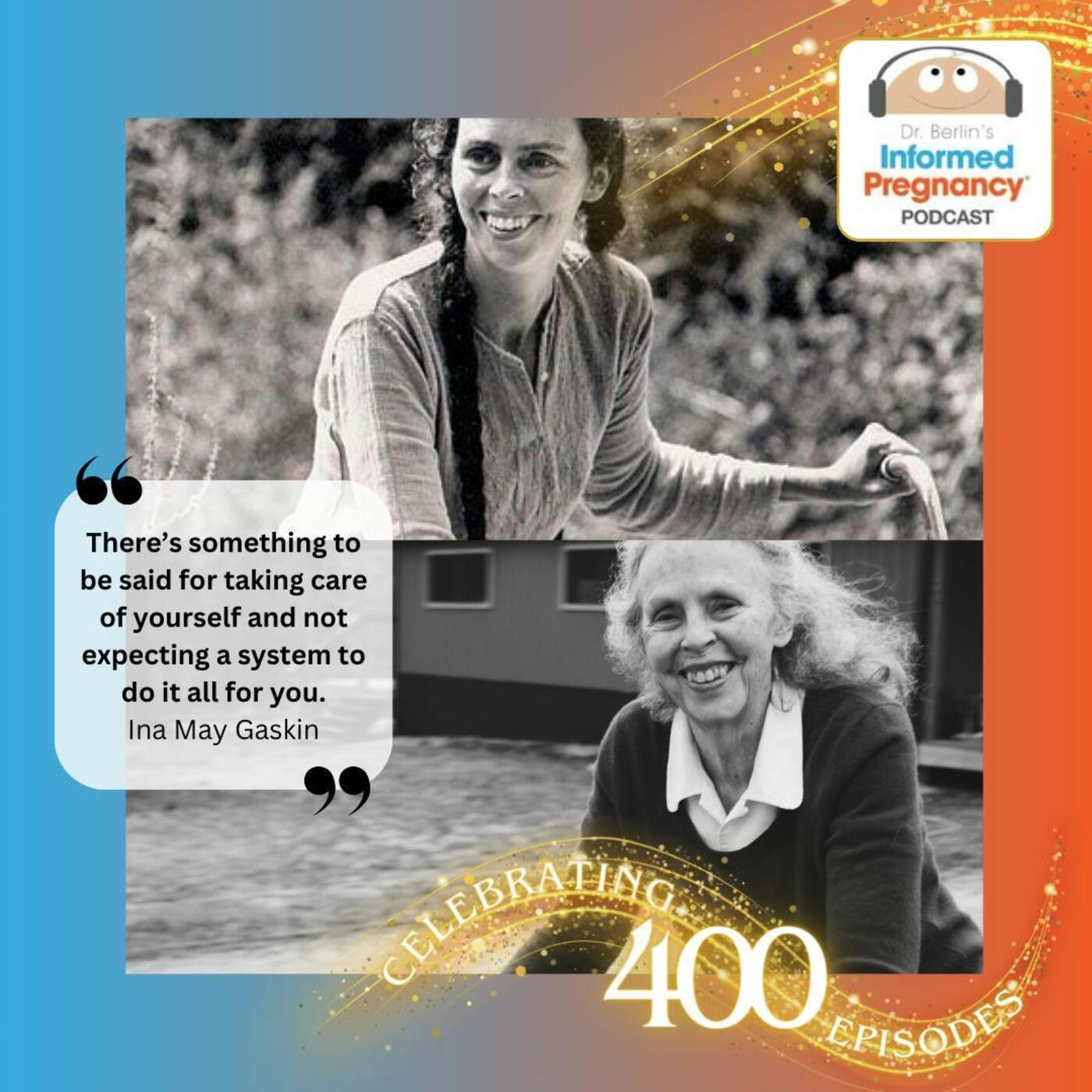
March 28, 2024 · 64 minutes · Episode 400
About this episode
Author, educator, mother, and grandmother Ina May Gaskin joins the podcast in celebration of our 400th episode! She single handedly resuscitated the practice of modern midwifery, founded and directed The Farm Midwifery Center in Tennessee, and retired only after 44 years of attending births. We are honored to have Ina May here in conversation.

A special thank you goes to Sarah Culver on Ina May’s team for her tireless assistance in helping us produce this episode! We appreciate you!
Connect with Ina May Gaskin online: Ina May on Facebook
Learn more about Ina May: National Women’s Hall of Fame
Reach Sarah here: @stead.at.home.mum
Key quotes
“You wanted to be informed and it wasn't good to be afraid. We have the phrase, you're rigid with a fear. Obviously that's not going to help if you're rigid with fear.”
“Babies are very flexible and we tend to forget that. And they're beautifully designed just as the mother is beautifully designed for birth.”
“So that taught me about the power of the word.”
“Well, we've got a fear-based system, it seems to me, and fear is something that can be overcome. If you read the Old Testament and you read the new, it says, "Fear not. Don't be afraid. Be courageous.”
“I've always said, "I didn't invent it. I did not invent it," but I became, I guess you would say, the messenger for it.”
Related episodes
- Ep. 405 Birth Stories with Valia Skiani
- Ep. 399 All About VBACs with Meagan Heaton
- Ep. 401 A Birth Story with Stephanie Devlin
- Ep. 402 Perinatal Mental Health with Dr. Jill Garrett
Transcript
AI-generated transcript with speaker labels — may contain errors, especially names and medical terms. Dr. Elliot Berlin, DC appears in blue; Ina May Gaskin in orange.
Download PDF of the Transcript
Dr. Elliot Berlin, DC [0:36] Welcome to the Informed Pregnancy and Parenting Podcast. I'm your host, pregnancy focused chiropractor, Dr. Elliot Berlin. My guest today is a renowned author, educator, mother, grandmother, and the resuscitator of modern midwifery. She was the founder and director of the Farm Midwifery Center in Tennessee, now retired after 44 years of attending births. And Mae Gaskin, welcome to the podcast.
Ina May Gaskin [1:02] Oh, it's my pleasure to be here today.
Dr. Elliot Berlin, DC [1:04] I would not be more excited and I don't want to waste a second. I want to squeeze everything I can out of you. One thing though is I hear your name pronounced many different ways. What's the correct pronunciation?
Ina May Gaskin [1:14] It's Ina Mae, and I get called Ina Mae, of course, in Europe, but my maternal grandmother, I'm named for her and that's Ina Mae.
Dr. Elliot Berlin, DC [1:23] Ina Mae Gaskin. Okay, so let's start at the beginning. Where are you from originally?
Ina May Gaskin [1:27] I'm originally from Iowa, lived in a small town, 20,000, pretty near the center of Iowa. We were sort of on the edge of town, had a paper route there. We lived next door to a librarian and you'd call her a nurse practitioner, but she was called a visiting nurse. She was the reason that I never saw a doctor outside of church for my whole growing up period. She got us through scarlet fever. When my brother had it, he was a couple years older than I, and measles and all these stuff. She advised what to do and basically was how to stay out of the hospital. So I just remember getting a jab for smallpox at seven or something, and that was it. I have tonsils.
[2:17] And that was just two years older than my brother had to have his out, and I think he probably missed them. We didn't have medicine in our house. To take an aspirin was a big deal.
Dr. Elliot Berlin, DC [2:32] I remember in school growing up, everybody, it just was a matter of when are we going to take out your tonsils, not if.
Ina May Gaskin [2:38] Yeah, you get over it, but you eat well. My mother was a home ec teacher. My dad was raised a farmer, then he went to town, but he sort of didn't know how to live in town as well. It took him a while.
Dr. Elliot Berlin, DC [2:51] You've had a legendary career in birth and in midwifery. What were the earliest stages of that development?
Ina May Gaskin [2:58] Okay. Well, like I said, bookworm, never saw anything born, never saw a picture of anything born, let alone a movie, a video or anything like that. But I knew where they came out because you just sort of couldn't be on a farm and not know. Not that I ever saw it, I didn't, but I was a clean slate. And then I went to the library. I was probably 16 and I found Grantley Dick Reed's Childbirth Without Fear. And I thought it made so much sense and a few things stuck with me. You wanted to be informed and it wasn't good to be afraid. We have the phrase, you're rigid with a fear. Obviously that's not going to help if you're rigid with fear. And I asked my mother about it and I didn't know my mother had been informed at home or my father.
[3:56] I didn't think about it. Home birth was unthinkable by nighttime. I was born in 1940. And I asked my mom, I said, "What do you think about this book I read, Childbirth Without Fear?" And she said she had four and she said, "Some people yell and scream, but they don't really need to." And I used to kick myself because I didn't follow up and say, "Well, tell me more." And she passed away when she was in her mid – 60s when I hadn't expected that would happen. So she didn't have the twilight sleep, copalamine, morphine combo that was sort of going on in some places. And I don't believe she had general anesthesia, but again, I don't know.
Dr. Elliot Berlin, DC [4:41] So when was the first exposure to a birth scene?
Ina May Gaskin [4:45] Well, I had a friend and we're still friends. They're still alive that we have corresponded since we were seven or eight years old and used to pretend we were riding horses and we were Jesse James and Cole Younger and all that. But she goes, "No, if you're really young, you'll have no idea what I'm talking about, I'm sure. Just live with that." But she got married right out of high school and had her first of her five kids. And I remember she said, "Well, it wasn't a picnic." See, that's how we talk in Iowa. Understatement. Anyway, and I babysat and then I had a paper route and that took me to other people's houses because I was always curious about how other people lived.
[5:29] And there was a crossroads and you had the Elam Lutheran Church, the Catholic Church, the other Lutheran, the Trinity or something like that, and the synagogue were all in a corner and then a block away from the Methodist church. And then you got the Christian scientists. They're all grouped up in this one little place. And for some reason, my brother liked Hebrew school better than the Methodist. And so I got babysitting jobs with some of the Jewish families in town.
Dr. Elliot Berlin, DC [5:59] Wonder if they had better food.
Ina May Gaskin [6:01] I liked going to other people's houses and seeing how they lived. And so there's quite a variety. And the first time I saw breastfeeding was a Jewish family. They went knock, knock, knock on the door. And I go, "Is it boy or girl? Male or female?" I said. "Oh, it's just a paper girl. "Okay, let her in. And that was the first time I saw breastfeeding.
Dr. Elliot Berlin, DC [6:20] Oh, wow.
Ina May Gaskin [6:21] So I learned just by getting around to being curious and kind of snoopy.
Dr. Elliot Berlin, DC [6:27] Snoopy pays off.
Ina May Gaskin [6:29] Yeah, it does because I was a bookworm. My brother taught me to read. We read comics, Alcap, Cats and Jammer Kids and things that you're probably not old enough to remember. So I read everything. I read every magazine that came in the house ranging from my dad's field and stream hunting magazines to my mother's. She was a home economics teacher, so all the recipes and you have to learn how to sew and stuff like that. And then my brother's sports stuff, so I knew and I could identify cars because we had competitions about that. If you get up to the late 50s, I'm lost. But before that, I can recognize the car in the make because he trained me.
Dr. Elliot Berlin, DC [7:14] Wow. I love the curiosity for knowledge, the passion for knowledge and all the interesting ways that you were able to sneak it in. I assume you were reading those newspapers too, not just throwing them on the front door.
Ina May Gaskin [7:25] Absolutely. I learned all kinds of things. I mean, that's how I learned about the Chang and Eng, the Siamese twins. And of course I researched that. They were born at home and they were connected at the chest by broad blank of ligament. And the mother said it was a really easy birth.
Dr. Elliot Berlin, DC [7:45] Oh, wow.
Ina May Gaskin [7:46] I puzzled on that one for a while, but I think I understand it, but we don't even have to go there.
Dr. Elliot Berlin, DC [7:52] That one, maybe that was a picnic.
Ina May Gaskin [7:55] She said it was her easiest birth and she'd had several, but they were very athletic, those guys were. So I think they upended themselves and they came out as one very long baby. Babies are very flexible and we tend to forget that. And they're beautifully designed just as the mother is beautifully designed for birth. So why wouldn't that persist if it's been going on for centuries and centuries and centuries? Why is it that we have so much difficulty today? Well, I think we've come to just depend on the medical advancements without forgetting how you prepare yourself for something that can be very easy to do or very hard to do.
Dr. Elliot Berlin, DC [8:38] And
Ina May Gaskin [8:39] All of that's normal.
Dr. Elliot Berlin, DC [8:40] And what a major change from, I think you said your grandmother was a rural midwife.
Ina May Gaskin [8:47] A great-grandmother. Yeah.
Dr. Elliot Berlin, DC [8:48] A great grandmother.
Ina May Gaskin [8:48] And I never met her. Never met her. But did she go to midwifery school? I seriously doubted. I don't think that women that grew up on a farm and they lived in a 12-foot square log cabin where it gets 40 degrees below zero in the winter, they're tough. And sometimes when you go through, you have to work to live and all those trees had to be cut down in order to build that cabin and then clearing the land and raising all your food, you didn't have grocery stores. And so when you work hard and life isn't just spent on a couch or in a bed, you're going to be more fit in having a baby. So there's something to be said for taking care of yourself and not expecting a system to do it all for you.
Dr. Elliot Berlin, DC [9:43] I imagine at her time people were still giving birth at home. And by the time that you became exposed to childbirth, it sounds like almost nobody was giving birth at home or at the hospital.
Ina May Gaskin [9:54] It was unusual. It was unthinkable. And yet, so my mother was 30 when I was born, and I think she automatically went to a hospital, but I didn't even know what the word obstetrician meant until I got into my mid – 20s and came back from being in the Peace Corps. And the country had changed so much from that time, and I didn't differentiate because of course my mother saw a general practitioner and he was this kindly man. And I thought all doctors agreed. I thought there was consensus about birth because wasn't it about science? You see, that was my assumption. And because every doctor that I'd ever met was a very kindly person, I thought they all were.
[10:41] And so that's how I had my experience. I had a wonderful labor, a Grantley Dick Reed type labor because I said, "I don't want any drugs." And when I had all four of my wisdom teeth had to come out, I was really happy I had to have back wisdom teeth and the molar above because my wisdom teeth on the lower side were growing forward instead of up. Small jaw, normal size teeth and small jaw. And so they didn't give you a gentle introduction to the Xylocaine or whatever they put in your mouth, lidocaine. They just jabbed the whole thing in back there and that hurt. But I was also happy to get it and I survived it. See, so there's a difference between that where I was happy to have anesthesia, but I didn't want to be knocked out.
[11:32] And that's really what I was about with having a baby. I thought, why would I do that when my grandma and her grandma and her grandma and grandma and everybody, we just didn't think that we had to not feel any pain. You felt pain, but it didn't last forever. And I didn't even know of anybody who'd had a cesarean in the whole world until I was maybe sitting at somebody's house and they had a movie magazine and I learned that Elizabeth Taylor had had a cesarean. And I though, I wonder if that's because she's famous and an actress and is in Hollywood. Maybe it was.
Dr. Elliot Berlin, DC [12:12] By the time you had your first pregnancy and baby, were you already involved in birth work?
Ina May Gaskin [12:20] Oh, not at all. Not at all, but I read A Lot. So of course I read The Ernest Hemingway, what is it, Farewell to Arms and She Dies. But I didn't get scared by that because I just thought the bodies seems to be made right. There were no birth horror stories at all in my family, either side. My other grandmother, the one that I didn't live with, but Grandma Middleton, was the oldest of 13. And her mother who'd come over from Wales was distraught when she went into menopause after having her 13, because she didn't think she'd be able to stand up straight if she wasn't pregnant. I mean, that's a whole different outlook, isn't it?
Dr. Elliot Berlin, DC [13:06] How do you transport them around?
Ina May Gaskin [13:08] Yeah. And nobody wore a corset. People get into odd fads, like what a woman's supposed to look like and what her clothes should be. And I remember my next door neighbor when I lived in Malaysia said, "Now when you're carrying," that's how they said it, "If you are pregnant, don't wear high heels." He was really emphatic about it, and I thought, "Okay, I probably won't. It does tend to be hard on your posture."
Dr. Elliot Berlin, DC [13:37] I guess good for the chiropractor.
Ina May Gaskin [13:38] People can do it. They do it all the time, but it must hurt.
Dr. Elliot Berlin, DC [13:42] Yeah. Yeah, definitely good for the chiropractor. Idame, let's take a quick break and when we come back, we'll find out the evolution of your career and birth in our society. We'll be right back.

Dr. Elliot Berlin, DC [15:31] Welcome back. We are talking to Ina Mae Gaskin. So let's move into your birth work. How did you find yourself involved in midwifery?
Ina May Gaskin [15:42] Well, the first baby, they ganged up on me basically after I'd had a wonderful labor and I went, "I'm not ever quick about having a baby, at least 12 hours of labor." And let me tell you that his regime, I should have known better, you see, but I though here I was going in all innocent and I accepted the advice of getting an obstetrician rather than a general practitioner. Probably in those days that would've been a better choice. But he said, "You're halfway through your pregnancy and you have already gained 12 pounds." He put me on a diuretic and a 1,200 calorie diet. So I starved myself the second half of the pregnancy, and I was too cheap to call my dad and let him know we were poor.
[16:31] And he would've said, "Fire them and get another one," I'm sure, because he's used to raising animals. You wouldn't ever do that to an animal, a diuretic. So anyway, but I said I didn't want anesthesia, so they left me alone. And there was a horrible nurse on that night, so she just didn't come back very often, and that was good. I began having beautiful visions of, I looked like I was in a cathedral with the sun coming through the stained glass windows, and I was seeing things on the walls that weren't there when I walked in there. That was the effect of the hormones. And I was in a euphoric state, and then the sinister part started and ended up with a forceps delivery.
[17:14] And it was a high forceps. I never felt the urge to push, and I felt so let down by that, and also didn't see my baby for another 12 hours, and that made its own problems. But I learned from it, you see, and when we come to California, there I am meeting people who had been through the same thing, and then they decided to have a home birth the next time. And I thought first I was horrified, but then I thought about it some more and I thought maybe that's the way to escape more forceps because that's what was being used in the cesarean section rate was low then. So I saw I was not alone. It was just a lot of people were having the same thing. And I though, I'm going to have a home birth the next time.
[17:58] It would be good. And I think I want to be a midwife, but it would be good if I saw a birth. And so then the opportunity came and you'd have to read spiritual midwifery or midwifery if you'd like to get the whole story there. I don't want to do the whole thing right now because I want to talk about some other things. But the first one I saw, it couldn't have been better. It was in a very small school bus. I mean, I don't know, 16 feet long, maybe like a little tiny school bus in November, right about in 1970, Northwestern University parking lot, and she didn't want to go to the hospital and he was going to catch the baby, but then he got cold feet and he wanted Steven to come and Steven was to be in the auditorium.
[18:46] And so I said, "I'll go." I volunteered and it was just the most perfect birth. I thought it was a miracle. That's How It got started.
Dr. Elliot Berlin, DC [18:56] What year are we talking about?
Ina May Gaskin [18:57] I'm talking about November 1970. And the cesarean rate then was 5%, and the forceps rate, I looked it up, 66 to 67%.
Dr. Elliot Berlin, DC [19:10] Wow.
Ina May Gaskin [19:11] Okay. And why was that? Because that obstetrician learned from somebody who had read a book in which some of the obstetricians didn't want there to be such a thing as midwives. So then you had the revolt that just started to happen. People started attending births like me that got pulled into it because I went, "Oh, it's what I thought it should be like." And then another birth and another birth. See, I had a master's degree in English and well, we end up in Tennessee and that was a good choice because we're traveling around. There's about 250 of us by the time we get around the country, and we have babies at rest stops and in national parks and things like that, and learned amazing things and got help from the highway police, from a local obstetrician who came over and taught me how to resuscitate a baby and how to deal with the cord wrapped around the neck and equipped me to deal with a postpartum hemorrhage and did all that in a little school bus and then drove on.
[20:15] And we didn't get birth certificates for those kids for many months afterwards and had to have little conferences to go, "Where were we? Where was that rest stop?" Then we get to Tennessee and it couldn't have been a better place to decide to pull our money, buy a big piece of land. And then we were pioneer seed. So a local family doctor happened to have been helping Amish people for 16 years previously. He got over any fear he had about home birth. He also knew horses and there are animals that just don't labor when humans are there observing them. And there's a lot of women that are like that as well. He also knew as a man that you don't go into a laboring woman's room until the women say, "Now's the time to come."
[21:05] You sit out in the kitchen and eat pie. And he also learned not to be afraid of infection in those days. And I'm talking about the '70s, they closed neonatal nurseries all the time because infections would sweep through. All right, so that's how I learned basically. And I kept data as I learned what to look for, and I got a little handbook, the kind that an obstetrics resident would have, and I studied it and then, well, we had to deal with things. So hyaline membrane disease, preemies, you didn't have any medication for that in the early part of the '70s. In the '70s was the decade when the cesarean rate quadrupled in a 10-year period and our C-section rate was 1%.
[21:58] So how did that happen?
Dr. Elliot Berlin, DC [22:00] Yeah, how did that happen? But also the farm, was it a piece of land that you bought for your community to just live on or was –
Ina May Gaskin [22:08] It was a cattle farm and it was heavily forested.
Dr. Elliot Berlin, DC [22:12] Was the intention for people to come in from other areas?
Ina May Gaskin [22:16] No, we picked up people on the way. So you had people that had gone to California in the '60s, and then they would go to this class that Steven was running in San Francisco. And then he got this idea, well, why don't we just do… He put out a book that was very popular, and then people from different universities and churches along different parts of the country had heard him speak. They said, "How about a speaking tour?" And he said, "Okay, well, we'll get out of the apartment. We'll live in a school bus and blah, blah, blah." And then a lot of other people did the same thing. So 200 or so went with us, and a bunch of them were pregnant. So that's how that started.
[22:58] And then we picked up people along the way. Of course, we were in the news, so that's how it got going. Then came back and why don't we go back and buy a piece of land because it was getting crazy in California. The '60s happened, and by '70s, it was getting kind of hard to be there, so why don't we go buy some land, raise some food, raise these children? So we bought land for, ready for this, $70 an acre. We bought the first thousand acres, and then we bought the adjoining 750 acres for maybe twice that amount per acre. But there was no roads. There was one house with electricity, so it was primitive time. And Steven had been, he was a Korean war vet and a Marine, and he knew how to do things.
[23:50] And so people started to learn from the neighbors because somebody had carefully taken care of some sequoia tree saplings with the idea that they were going to grow in Tennessee. They're going to plant sequoia trees in Tennessee. Didn't work. And so then it was also going to be vegetarian, so that was part of it. And then did we have any money left over to do anything like buy food? No. So you had to grow it, and then you ate what you grew because there was no money left over. And so we were some of the poorest people. And in that way, we were land rich, you could say, but for the rest of it, forget it.
Dr. Elliot Berlin, DC [24:35] So during this time period, you have a 1% cesarean rate and the national cesarean rate quadruples. What do you attribute that to on both sides?
Ina May Gaskin [24:44] It was because people started putting up a fuss. I remember one woman who had a tantrum, and tantrums are kind of common these days. We hear about it all the time, but you didn't used to have that before the '60s or early '70s. And hers was, "I'm not going to have this baby till you let my boyfriend be their baby's father." And one couple, and this made the obstetrical journals in the editorial page, a couple went in and they had handcuffed themselves together and didn't have the key with them, so that's how he got to attend the birth. So that's how people pulled that kind of tricks to get fathers in. And then those were recognized in the obstetrical journals and they went, "We're going to have to figure a way to let fathers in."
[25:34] And that's why forceps went out the window because forceps not done well is kind of awful to look at. And so that's why the cesarean rate went up. It also had to do with the widespread use of electronic fetal monitoring. And then we also have to remember how few nurse midwives there were, and they weren't actually at the birth receiving the baby. That wasn't their job. They did prenatal care in those days. So you just wouldn't find a midwife giving you care in the hospital.
Dr. Elliot Berlin, DC [26:07] I mean, there seems to be a massive divergence at that time where medicine is becoming very clinical, very sterile, very controlling. I mean, the fact that you can't even have your partner if you want to have your partner with you is sort of unthinkable today. Although during the pandemic, the hospitals became extremely controlling again. But the divergence that I see happening, I mean, you were doing something sort of looking back to See Ahead, and they were sort of looking forward to Sea Ahead is how it appears to me as technology started to evolve, like you said, the fetal monitoring and we don't necessarily know how to use it or we overuse it and then we start to over-intervene.
[26:50] And at the same time, you're having these great outcomes without a lot of that technology and without the need for the cascade of interventions. Was there a moment where you're like, wait a second, we need to make this not just available to our little community, but to everyone?
Ina May Gaskin [27:08] Well, I didn't think of writing a book right away, but one of the first things we did was somebody got an inheritance and put that money into buying a used printing press. So we were going to be loud mouths because of some of the people that came along with us were inclined in that direction and so was Steven. And so I just was very dogged about what I was seeing with birth. And you see, I was an English major. I had a master's degree in English and stuff. And I remember being skeptical when they said the power of the word, but then I learned in that first 10 births already what the power of the word could be because I went, oh yeah, the. It actually turns out that the is very important and most used word in English, but I won't go there.
[27:59] It's about how had two instances of something that I didn't know would happen was that a woman labored very well, very bravely, very sweetly, she gets to seven centimeters. And of course I'm learning how to do an exam and assess cervical dilatation. And then she stays at seven centimeters while all the others just went ahead and they went seven and they went eight and they went nine and they started pushing their baby out. But she stayed at seven. In one case, it was about 12 hours and I kept checking the fetal heart with my little fetal scope and checking her blood pressure and all this stuff. And she was fine. She was still strong, but she started to get a little bit disheartened.
[28:40] And then somebody comes along and knocks on the bus door and says, "Hi, has she told you about her mother yet?" And I feel this, somehow I just felt this chills all over me. And I invited this lady in and she put her arm around the mouth and she said, "Well, she's afraid that she was adopted and she thought her mom died in childbirth." And just hearing that story changed everything. She went dilate eight, nine, 10, pushed the baby out. And then that happened a second time, couple, three births later. And this woman had labored for… These were first babies, mind you. She labored for three days. Now, eating and drinking, of course, but I'm checking, staying awake all that time, two little naps sometimes.
[29:23] And I said, "Is there anything bothering you?" She said, "Well, yeah, I keep thinking of our marriage ceremony. We got married in Golden Gate Park, and I wanted the traditional vows." And he didn't like the part about till death do us part. I got that same feeling again. Oh, I didn't know what to do about this. Went over and discussed it with Steven. H says, "Well, I know the traditional vows. Ask if they will go ahead and say them now and I'll act as their pastor." So he came over and did that, and as soon as they got through the vows, that baby was Born within an hour or so. So that taught me about the power of the word. It also taught me about why people do promise to stay together and how much commitment works, how important it is because sometimes a woman is feeling insecure and the guy's just lukewarm about it and then it's going to be out of there or is he going to take responsibility and be a father, you see?
[30:23] And so those were powerful. That's just a couple of the kinds of things that I learned. I also learned farther on that a woman who has dilated and is well ready to push the baby out, but she doesn't feel the urge, she can go, "This happened to a good friend and another first time baby. She was doing very well and we just joked and laughed a lot. And then she lost her sense of humor totally. And I was going to have to go make a speech up in Nashville that day. And I was starting to get worried that I wasn't going to be there." And I said, "I noticed that you're not laughing as much." Because I went and checked her and found that she was no longer fully dilated.
[31:05] She was back to less than seven centimeters. I said, "I did not know you could undilate."
Dr. Elliot Berlin, DC [31:11] Go backwards.
Ina May Gaskin [31:12] She went backwards. I did not know that was possible. And then I stopped and thought about it for a moment. I said, "Well, the difference that I see is that you are just real serious now and you don't have a sense of humor anymore. We'll try to make you laugh and why don't you just laugh, okay?" And that's what she did. And she dilated again and had that baby, you see? So when something like that happens, you never forget it. Okay?
Dr. Elliot Berlin, DC [31:36] Yeah. I do standup comedy on the side. Do you?
Ina May Gaskin [31:41] Yeah. Oh, I didn't know that.
Dr. Elliot Berlin, DC [31:43] How about having kids?
Ina May Gaskin [31:45] Yes.
Dr. Elliot Berlin, DC [31:46] We call it kidding.
Ina May Gaskin [31:47] That's right. That's good.
Dr. Elliot Berlin, DC [31:49] Thank you.
Ina May Gaskin [31:49] It is. It is.
Dr. Elliot Berlin, DC [31:50] But I'm a chiropractor and a massage therapist, so oftentimes I'm invited into somebody's labor to do body work with them, which could have, for some people, have a relaxing effect on the mind and body and to allow her to just let go. And then once things kick in and the fear is gone, it's a beautiful thing. But sometimes I've had people say, "Wait, I need you to come make some jokes so that I could just laugh. And my body, it knows it's not in danger when I'm laughing."
Ina May Gaskin [32:19] That's right. And it'll go, "Oh, well, that can't be true." Well, try it. Try it. And I'll try to be funny. I mean, I have said some weird things to people working with somebody that I didn't know yet. And oh, she was so, so grumpy and I'd never met her before, but she was doing fine. And I thought, okay, now I know they've got a great long bathtub downstairs and you're going to be able to stretch out. Let's just go down there and try that. And I thought, now you got to do it right. You got to know how deep she is in misery. So she goes down there and I said, I'm not going to say a thing because I could get on the wrong side real easy here because her mother is terrified of her and her husband is also terrified.
[33:11] So I hear her sigh and I say, well, it's times like this when you start to think that it's a little bit better than hell. There was a start. So I was just testing a little bit. So she comes upstairs, now she's feeling a little Bit Better. And I said, times like this that you kind of wish that maybe the baby could be born, the bones would form later on and that they would just be all kind of soft when they come out so it wouldn't be such a hard thing there. But then of course you'd have to carry them around in a bowl for a while. They wouldn't be very cute. And she just said, okay, you got me with that one. Then she starts making jokes, you see?
Dr. Elliot Berlin, DC [33:54] Yes, it's contagious.
Ina May Gaskin [33:55] I remember the one that I met, she was the young lady from Memphis and she came over and she said, now I learned this when I was a kid. I was terrified of flying. And she says, so I learned when I was a kid that I just would giggle and if I would giggle, then I wouldn't be scared. So taking off and landing and I was always embarrassing the family. And so she learned that then and she did that in labor. And so she was easy.
Dr. Elliot Berlin, DC [34:25] I want to get more tips from your 44 years of attending births for someone who's listening to this and maybe looking at their first birth coming up or maybe they hadn't experienced that they want to try something different for their next birth. Let's take one more break and when we come back, we're going to make it really practical with advice and tips from Iname Gaskin. We'll be right back. Welcome back. We're talking about Ida Mae Gaskin and the good news is you've authored three books that I know of and –
Ina May Gaskin [35:05] I think it's four.
Dr. Elliot Berlin, DC [35:07] Four? Okay.
Ina May Gaskin [35:08] But no, no, no. I'm working on another one and I've got a couple more in line after that one. So we'll see, God willing.
Dr. Elliot Berlin, DC [35:15] In mind. Okay. So I'm going to try to use my questions judiciously because one thing I know is the birth stories that you've shared in Idame's Guide to Childbirth are very popular. Some of the stories are aging, but still quite meaningful and quite popular today. And I want to talk a little bit about birth stories and why they're important to you and how they can be helpful to someone who's trying to get ready for their own birth experience.
Ina May Gaskin [35:45] Well, the stories are so varied. What people don't know about birth is what is normal is. I've known women that had… Okay, I'll tell you about my next door neighbor when I lived in Iowa City and we were in a trailer park, a real short little trailer. And then on one side you had a lady who was about five feet tall and had a husband who was about 6'6", and I got to watch her all through her pregnancy. And on the other side, he was going to inherit his dad's mortuary. So I had birth on one side, life on one side, and then I had death on the other side, not right in between. So somehow that was appropriate. And then there was cows in the backyard with a fence between us.
[36:26] So I would go have coffee with her every morning and followed her all through that pregnancy, this little bitty lady. And she got so, so big. I mean, of course I'd only had the friend that had said it was in a picnic. That was about what I knew besides what I could read in historical novels and Ernest Hemingway or whatever. So there we are and it was August, it must have been 61 or so, 1961 that is. And she says, "I'm going to go in and see the doctor in his office and maybe he can tell me when this baby's going to come." No ultrasound in those days, nothing like that. And so she went in to see him and about two and a half hours later, here she comes and she's holding her baby.
[37:17] Here's her birth story. She got up on the table, the exam table in his office, and I don't know exactly what prompted labor to start. Maybe he did a vaginal exam, possible. She had that baby out in 20 minutes. She said, "I couldn't even get my socks off and they got all wet. Oh, you poor thing." I mean, she was laughing about it. And then what did he do? Now this was 1961 in Iowa City, Iowa. And what did he do? He didn't take her to the hospital. That would've been an insane thing to do. You could get an infection if you took her to the hospital. He drove her home and that was it. And that let me know, first pregnancy, impossible looking to me.
[38:07] But of course I didn't share that with her and go, "Oh, you're so big. Are you having twins?" Or the comments that uncompassionate people sometimes make. I just admired her. And then to see that that was the same way to handle that. Now, he wouldn't dare do that now. He would lose his license over that, you see? And that's what a family doctor could do in those days. Now put that together with the woman that had the three-day labor. They're both normal. One of the toughest ways to learn how to be calm enough that a woman could labor in your presence is to have been a farmer, or maybe you raised goats, or maybe you raised cattle, or maybe you had a grandma who told happy birth stories.
[38:57] There's a lot of in Italian culture, urban Italians of my generation and maybe the one after, where giving birth at home was something that folks did. And I can remember in New York City, a Dutch midwife who worked in the very early days of Israel, she remembered Puerto Rican families that were giving birth in New York City when she was a new midwife. And so it hasn't been that long. I mean, okay, I'm still alive. Thank you that I'm still here to witness so much change in such a short time. And then to find out the word midwife was actually removed from people's… They didn't know what it was anymore, most of the people. And then we revived it again.
[39:46] Now it's a verb, but it doesn't mean that we have very many midwives. We ought to have a lot more midwives than we have. And if you live in a time when there are very midwives when you're greatly outnumbered by obstetricians, then you're in trouble because you don't have enough saying in the culture, "You know what? Your body probably works well, but you got to treat it right. If you're a smoker, you probably ought to stop that for the sake of your baby. You have a better chance of not hemorrhaging if you don't smoke." And I could see that. We didn't have any money left over, so nobody got tobacco when they came. And then guess what? Sometimes babies arrange themselves.
[40:29] Some are real stubborn. They're going to come out with their feet first or the butt first.
Dr. Elliot Berlin, DC [40:35] Yes, let's play stuff with this.
Ina May Gaskin [40:36] And that happened. So I had all of these stories in spiritual midwifery that were breach births and the outcomes were great. And so what was the difference if somebody goes, "Oh, the feet are first. Oh, you're going to have your C-section scheduled at 35, 37 weeks, whatever." Maybe I'm exaggerating there, yes. But instead, the first one happened and the feet came and somebody went, "Oh, that's so cute. I'm going to go get a camera." Well, now the mom is not going to seize up and clamp down because she's not committed the crime of having a breached baby. They're admiring her and that baby just slides out. So once that happens and you have a bunch of witnesses to it, the baby's dad, the other midwife students, well then they know something that most obstetricians have never had a chance to see.
[41:30] So I met some wonderful obstetricians and I learned from them, you see, but they were guys that were born on a farm. Dad raised pigs and one obstetrician from Louisiana. Well, he had to go in and sometimes help with the first pig with his little eight-year-old hand, which wasn't very big. And he used to tell residents, a guy comes in, he's got a hand as big as a baseball net, and he says, "You're in the wrong branch of medicine here, my friend. Women look at your hand and they're going to be scared and keep that baby." You see?
Dr. Elliot Berlin, DC [42:07] So you've attended a lot of bridge birth.
Ina May Gaskin [42:10] Yeah. Yeah. And we did it just, we had twins, you see? So that was all in the first book, plus it had the statistics because the state of Tennessee didn't require me to get a license. They just said, oh, they saw how many pregnant people were walking around and they wanted us not to pollute the water supply of the nearby town. See, that's why they came to visit us when almost 300 of us settled there. So they had a problem on their hands and I said, "Oh yeah." They came back a couple of days later and gave me birth certificates to sign. And I though, "Well, the least I could do is be very religious and diligent about giving you the data." And so I've always included the statistics.
[42:54] And then I met people in other parts of the world who had done the same thing and they met so closely. I had to say, "That's science, you see?" When a general practitioner, Dr. John Stevenson in Australia working with midwives that would've been called lay midwives as if that's a crime. Well, that's how most people in the world have ever been born into the hands of what you would call a lay midwife. I mean, how long have there been hospitals? Not that long. And now we're closing them and we have things that they call obstetric deserts and we wonder why the maternal mortality and neonatal death rates are higher than they ought to be. Well, we've got a fear-based system, it seems to me, and fear is something that can be overcome.
[43:44] If you read the Old Testament and you read the new, it says, "Fear not. Don't be afraid. Be courageous. And also get off the couch. Don't take the escalator or the elevator. Walk up those stairs. If you gain too much weight, expect it's probably going to be more difficult to give birth than if you know when to slow down your intake a little bit. I'm not talking about 1,200 calories, but you don't need 5,000 calories a day in order to grow a baby.
Dr. Elliot Berlin, DC [44:16] Just in my coffee.
Ina May Gaskin [44:18] Yeah.
Dr. Elliot Berlin, DC [44:19] What's the Gaskin maneuver?
Ina May Gaskin [44:22] The Gaskin Maneuver, that's an interesting story because I remember a couple of the midwives said," Oh, the baby came out and was stuck, shoulder dystocia, and we got the baby out. The Apgar scars were good, but we had a broken humerus, broken upper arm. "I said," You did good. You did good because you got that baby out and that baby's going to heal up real quick and it's not going to be a big problem. But yeah, I know you felt bad about it. Yes. All right. So then part of what we did was the sort of hippie peace score went off to Guatemala after a very terrimoto, really bad earthquake that rearranged the landscape and a lot of broken bones, a lot of trouble there.
[45:09] And we had ham radio operators that went down there. So we went there a few times and we get on an old travel bus, big greyhound bus, and equipped it to go down and send people down there to do work. And I met a midwife there named Eta Willis, and she was British trained. She was from Belize, which is an English speaking, and she had seen spiritual midwifery and she knew some English and I had my little high school Spanish, so we communicated well. And she told me, now she was the director. She was a supervisor of the Komodoronas was the name they used for the midwives. They were Hyland Maya, and they were illiterate. Not one of them could read in any language.
[45:56] She said they knew better what to do about shoulder dystocia than I did in my British style training, which was pretty good in a lot of ways. She said, "They just get them on their hands and knees." And that's all I heard about it. So I came back and a couple of months later I had one and I used it and it worked. And then a few weeks later, another one, and this one, this was a big old baby, two, three pounds bigger than the previous child had been. And I had one of our family practice docs to come and be there with me because I thought she might have a little bit of a tough time here because that was a big increase in the size of the baby. We didn't do any ultrasound.
[46:41] I learned how to… We did a game about how big is this baby? See who can get just by the heft of it, put your hands on it and how much force do you… The same way that a baker knows how you don't have to weigh every little bit to know what it is. So we did it with her, worked again. I thought, okay, we got something going. And then we had one where we videoed it and that scene is relieving because we weren't cutting any episiotomy or anything like that. We never had an injury after that. So I started that registry and my co-author, Dr. Anna Meenan, she's a family practice doc, and she was a professor up in Northern Illinois, and she came down and visited me.
[47:25] She saw the video, and then she went back up to where she was teaching residents, and they had one, and this was a big woman, very big woman on a narrow delivery table. She got her to turn over. She said she did it. She was pretty agile. She hadn't had an epidural. And so all the nurses that were there saw it, it worked, and then they did one, and so it spread in that hospital. And then she says, "Okay, this needs to get into the family practice literature." So we've stayed in touch all this time, and so it expanded to a larger registry because I said, "Okay, let's start a registry here." Because meanwhile, there was something called the Zavanelli maneuver, and that was getting into the OB literature, obstetric literature.
[48:18] And this was about, okay, the baby comes out, and now you're going to push the baby, you're going to rotate it back, and you're going to push the baby back into the uterus and then do a C-section. I thought it was a satire. I thought it was a put-on. Then I realized, no, this is for real. I thought this is very weird. So that's when I added to it. Well, still working on that. She and I are trying to get a letter in now to a journal, and we're hoping and praying that they'll let it in because we –
Dr. Elliot Berlin, DC [48:51] I love that you never stop. You never give up.
Ina May Gaskin [48:53] No, I can't stand to because it's so simple. And you can have a very large baby. You see, I go to church down the road from where I live, and it's a very small congregation, ranges between 25 to 30 people. But they know that of 14 pound babies of non-diabetic mothers that were born, and they've got these stories, everybody… It's true, it's true, it's true. It's 14 pounds born on February the 14th in 1914, and then no baby's that big. I didn't personally be there, but our sheriff in the county that we used to live in over there by where the farm is, I'm in West Tennessee now in case you haven't picked up on that, but 14 pounds. And where was the baby born?
[49:43] On the kitchen table. Now, why would it be on the kitchen table? Well, she didn't want to mess up her bed. And also, she probably didn't want to be in a… Maybe they had a feather bed. I don't know what they had in 1914. I know that my Iowa relatives would've had a feather bed. You had goose feathers, and if a goose died, guess where the feathers went, and they're very soft and nice, but you wouldn't want to be messing that up with a birth. And now what happens when you get on the table? Are you going to lie on your back? Why would you do that? No woman in her right mind would do that, you see? So women left to their own bodily promptings, they're almost always going to get on their hands and knees or be on their knees, something like that.
[50:29] They might lift one leg or they might take a step forward. So the worst thing you can do is get on your back. Hardly ever is that the right thing to do.
Dr. Elliot Berlin, DC [50:39] I have two closing questions for you. One is, in the time that you've spent in this field, any particular learning experiences, I don't want to necessarily call them regrets or mistakes, but things that you learned from the hard way, and then after that, just where you see midwifery heading and where you'd like to see it heading moving forward.
Ina May Gaskin [51:03] Okay. All right. Well, I learned that it's really good to get the laboring woman, the person that she most wants to be there. I learned it shouldn't always be me, and if she had her heart set on someone else, it's going to work a lot better if I'm sent to do that, and then she'll love me for doing that, and she might not if I don't pick up on that. So I really try to get to know her. I remember a story, I used to go do grand rounds pretty often over in North Carolina, and North Carolina has winters. You get icy roads, you've got curry mountain roads, and they used to have all these small hospitals, and then they started closing them. So what did that get them?
[51:50] Because everything had to be, you had to have a NICU or it wasn't safe to be born in. I thought the stories that I heard, it was you go down on the icy road and the curvy mountain road, and you get in a car wreck, and now you've got a medical emergency for not just the mom, but everybody else in the car who's injured and stuff. So there's so much fear surrounding birth and there's so much money to be made off of. So as I say, easy to scare women about birth. And so just something as easy, as simple as being free to move around, and you're better off a lot of times. Now, I've had to have cesarean, and there are certainly times when it's necessary, but if you can do without it or turn it down so that you're not strapped to having the monitoring going on, it's possible to listen to the baby's heart rate with a Doppler and do it off and on, and then you could turn down that epidural so that you'd be able to move.
[52:55] And if you're really, really heavy, it's especially necessary to do it because if you weigh three, 400 or more pounds and people actually have trouble helping you roll over, you're really better off to just don't have to have a weightlifter to help you move. And you have to think about what it's like taking care of the baby. You almost have your… Would you like to have the pain really during the labor or maybe not be in pain after because what's not a picnic is healing up from a cesarean. I noticed, because I watched a lot of cesareans on television, and I've been in the room with them too, and it often comes as a shock to the mom that she's going to have to get up and walk around right away because you don't want her to have a pulmonary embolism.
[53:45] That's not a nice way to go through or to die from, you see? So being in training for birds, I say walk stairs a lot, plan your life so that you do that. If you are well overweight, don't glory in it. Don't starve yourself, but you don't have to gain. You can clean up your diet because you're going to do that better if you don't gain a lot and also less likely to have a shoulder dystocia, but yeah.
Dr. Elliot Berlin, DC [54:13] But then we don't confuse your maneuver.
Ina May Gaskin [54:16] Oh, and I want to tell you how that name came about. That came when Joseph Brunner, obstetrician at Vanderbilt, and I was up there doing grand rounds and I showed the video and he said, "Let's get this ad. You've got this registry that you've been working on," and we added to it because I was publishing a quarterly magazine at the time, and so I put out the word that way, and we got up to 82 cases, which is a lot more than what the Zavanelli folks were doing with the baby back in. They said, "You know what? You can't call it the Guatemala maneuver because nobody can access it if you do that." I went back to Guatemala and I asked the midwives, how did they learn?
[54:58] They said it was a message from God from Dios. So that's how that came about. He said, "You got to call it the Gaskin Maneuver because then they'll know who to talk to." I've always said, "I didn't invent it. I did not invent it," but I became, I guess you would say, the messenger for it.
Dr. Elliot Berlin, DC [55:18] Oh, that's exactly right. Anime, where would you like to see birth and midwifery go in the future? What's the vision?
Ina May Gaskin [55:27] Okay. I would like to see a lot of things done the way they used to be done. I would like to see, not everybody wants to live in a city. There's a lot of land out here. If you had to say, I can't give you the percentage, but half the country probably lives in what is called an obstetric desert. And how do you drive to get prenatal care when you have one car in the family or maybe no car and there's no public transport out here? You should have a smaller hospital. Not everybody has to have a NICU. That's how we made it for most of the 20th century is that you had smaller hospitals and you weren't just closing them and requiring such high, high standards.
[56:14] You can have high standards because people can use their hands for diagnostic tools. They can know how to do the old maneuvers using hands. It seems to me when you had HIV come in that people were always gloved and people didn't touch people anymore. I'm not saying don't be unsterile, but at the same time when you see people are growing their fingernails hugely long, they're not listening to… You can cut through gloves when you have claws rather than cutting your nails short. And that used to be the sort of thing that we did if you were in nursing or obstetrics. I want to see family practice doctors doing cesareans and getting that training.
[57:00] They've been closed out of it. I want to see obstetricians realize that it's important to learn from midwives, especially midwives who work in birth centers and at home because we notice things that you all don't have a chance to notice because of the limitations that are imposed on you by how many people want your attention all the time and how much time you are alert on sort of high adrenaline call for genuine emergencies. Obstetricians are supposed to be there for pathology, not for the healthy pregnant women. And midwives are supposed to be there and general practitioners, family physicians know something about all the physiologic systems, so not just the reproductive system.
[57:48] And so we know how to teach you a healthy lifestyle and to hopefully motivate you to want to have that for yourself. And I include chiropractors in that too because to have… I remember the chiropractor, I'm hoping to find her name again, but she realized with her first labor, and she was in her late 30s, I believe, and she showed me how she thought she had an OP baby, an occiput posterior, and that means you're going to have the baby come out pushing more against your sacrum. It's going to be more painful and it's a little larger diameter. And she got herself into a plank position as if you're going to do a pushup, and then she whirled her body down and she flexed one knee and she went this way, and then she did it again.
[58:39] And so slow move back, but then she goes forward and she actually got her baby to turn because the waters were intact. Baby switched from the OP position. There's also a wonderful, I'm going to call it cloth technology that comes from Central America. It's practiced in, as you use the Herboso, which is a long shawl, and there are various ways to wrap it around the woman, and you can turn a baby with that. You can do all sorts of wonderful things that I can't tell you all about it, but stay tuned. I'm going to be teaching and getting a little bit more active now. I have grandkids. I'm not a great grandmother yet. I'm a grandmother of toddlers, so I have to keep fit.
[59:27] And that means now that I'm in my 80s, I do a lot of stairs. I do burpees. I ride stationary bike. I lift weights. My son helps me with that. I used to be rather crippled because I had a messed up ankle that happened long ago and I had a lot of pain from it. So I know a lot of stuff about how to get better with arthritis, and it is to be active, love your joists, wonderful. They're a little bit fat in the knuckles, but they work and you have to bless all parts of your body not wish that you had somebody else's because that's a way of cursing it and it actually changes your hormones, your inner chemistry. So you need to laugh a lot. Also, I learned out by accident that some women actually reported to me when I made a survey because I wanted to know how they dealt with labor and some of them said, "I had an orgasm."
[60:22] "Oh, really? You did? You were so quiet and sweet. ""Well, I didn't think I should just announce it because it might freak the doctor out." And I though, okay, that's cool. Okay. So kissing in labor, if you can stand it. And also husbands actually have to know that I watched a woman do that. She just grabbed him and he went along with it and she dilated very quickly and she was one of those. So you can learn things accidentally.
Dr. Elliot Berlin, DC [60:51] Yeah. Well, Aname, thank you for all the work that you have done and for taking it and sharing it in the various forms through which you teach both practitioners and the rest of us. And thank you for joining me here for this hour. Again, so honored. A little starstruck.
Ina May Gaskin [61:14] Oh, well, I'll tell you what, if I ever get to LA again, it's been a long time, but I'll come and listen to one of your –
Dr. Elliot Berlin, DC [61:22] Comedy. Oh yeah, you tell me.
Ina May Gaskin [61:24] Tell me when you're
Dr. Elliot Berlin, DC [61:25] Coming.
Ina May Gaskin [61:26] I love people that make me laugh and I'm sure that God has a sense of humor or else how would we have one?
Dr. Elliot Berlin, DC [61:33] Well, I'll tell you this. Literally, we don't usually give away the date, but today is November 10th, 2023, and there's a brand new TV show coming out on Showtime. I know you're not a big fan of sitting on the couch, but it's called The Curse with Emma Stone and Nathan Fielder. And I play a role in that show, Moses the Male Doula.
Ina May Gaskin [61:58] The male?
Dr. Elliot Berlin, DC [61:59] Doula.
Ina May Gaskin [62:00] Oh, the male doula. Okay. All right, good. All right. I can relate to that.
Dr. Elliot Berlin, DC [62:05] If you want to laugh, I think the show's hilarious. Anyway.
Ina May Gaskin [62:09] I love it.
Dr. Elliot Berlin, DC [62:10] If you come to Los Angeles, I would love more than anything to host you. Anything you need while you're here, I'd be honored to –
Ina May Gaskin [62:17] Oh, that's great. Thank you.
Dr. Elliot Berlin, DC [62:18] Accommodate you and help you out. And for sure we'll put together a show.
Ina May Gaskin [62:22] And you just reminded one other thing. Let's not forget singing.
Dr. Elliot Berlin, DC [62:26] Oh
Ina May Gaskin [62:26] Yeah. Singing. Yeah. So there's stories about women and the opera singers and singing because if you're a singer, you're going to breathe just right. And you open your throat, that helps you below as well. So yeah, these are the good things to do. So thank you so much. This has been a joy.
Dr. Elliot Berlin, DC [62:45] My pleasure. And may as you continue in your 80s to spread the gospel, if you will, where can we stay in touch? Where can we follow you?
Ina May Gaskin [62:56] Oh, okay. Well, I'm going to be working this little weekend. I have to get going with my social media. I have a public figure page. It's just been hibernating for quite a while, but I'm going to do a few choice book reviews. I can't do too much of it because I'm writing on the other side too. But if there are things that I think that we really have to share, I'm going to put something up there and I'm going to collect more shoulder dystocia cases and outcomes. I'm also studying languages and I'm fond of Dutch right now because I get along with Dutch people well. In fact, this is one of my gifts that I was given by Dutch midwives a few years ago, and it's got all these nice little Dutchisms.
[63:40] That's beautiful. So this is like instead of having a certificate on the wall, I have this. Yeah, there's a lot of good memories. I'm wearing things that I've had for a long time and I keep learning, keep learning.
Dr. Elliot Berlin, DC [63:54] Where's your public page? Do you know where we can find it?
Ina May Gaskin [63:57] Ina May Public Figure.
Dr. Elliot Berlin, DC [63:59] Okay. I'll post it with the episode.
Ina May Gaskin [64:01] Oh, that's very good of you. No, we'll hustle and try to get it active again because I have to have a lot of help with the electronics. I'm pretty good at old-fashioned things, and so I'm learning as I go.
Dr. Elliot Berlin, DC [64:14] It changes by the minute.
Ina May Gaskin [64:16] Indeed. That's one of the things I find frustrating. But then James says, "Consider it pure joy, my brothers and sisters, when you face trials of many kinds because having your faith tested produces perseverance. Let perseverance continue its work so that you will be mature and complete, not lacking anything." That was the brother of Yeshua.
Dr. Elliot Berlin, DC [64:43] Yeah, you definitely persevere. I don't know when you have time for you, but even though you're not a great grandmother yet, I bet that you are a great grandmother.
Ina May Gaskin [64:55] Oh, how sweet.
Dr. Elliot Berlin, DC [64:57] Thanks again for being here at home. Thanks for listening to the Informed Pregnancy Podcast. For more pregnancy and parenting media, visit us online at informedpregnancy. com.
Want more pregnancy + parenting? Start your FREE TRIAL of Informed Pregnancy+ and get access to all our curated pregnancy and parenting content — original series, iconic birth films like The Business of Being Born, prenatal workouts and more.
