
April 25, 2024 · 46 minutes · Episode 404
About this episode
Solar company co-owner, virtual NASA field trip leader, and mother of three Alex Lopez discusses overcoming difficult labor, finding success with a midwife-attended home birth, and having a surprise breech twin!

Connect with Alex online: @tandem_tribe and Tandem Tribe
Key quotes
“I wanted it to be unmedicated. My mom gave birth to me and my three sisters unmedicated. I was a huge 10 pound baby. I was her first baby, so I never thought I couldn't do it. I said, "My mom can do it." My grandmother actually has twins. She gave birth to them back in the 1970s, unmedicated. So I come from a line of superhero moms and I knew I could do it as natural as possible.”
“When we did the tour of the hospital, they showed us the beautiful delivery room and they said, "This is where you're going to have your golden hour with your baby. Right after they come out, they get put on your chest. We don't do any weights or measurements. It's just you and your baby for that golden hour, and we do as much as we can. As long as baby's healthy, you can keep that baby on you for that golden hour." And sure enough, as soon as I pushed her out, they did put her on me, on my chest, which was wonderful, and I cherished that moment.”
“You cannot let the baby sleep on your chest. She needs to sleep in the bassinet. You cannot hold her on your chest." And that was just so frustrating to me and my husband at that point. We're like, "Can we leave? Please, why do we have to stay here? Do whatever test you need to do. We need to go home with this baby because I need sleep and I'm going to hold my baby on my chest at home and sleep with her because that's what I need and that's what she needs right now."”
“So baby B did come out footling breech. She was also a girl, and she was not in her body when she came out. She was a hundred percent limp, and she took a minute, and my husband still caught her, and the midwife told him to squeeze her body and talk to her, and he's squeezing her body and he's talking to her, and she gets the oxygen mask and puts two pumps of oxygen, and then boom, she woke up. So it felt like a scary 30 minutes, and looking back on the birth video is a scary five seconds, but it did take her a little bit to come into her little body.”
“Yeah, mommy and daddy in bed with their two baby sisters there, and it was so magical. I got to take a little shower. The babies took a very long first sleep. My mom right there in the kitchen made me a nice batch of warm pancakes. I was able to have a cup of coffee. I didn't have these nurses coming in, checking the babies, doing all the things, the monitors worried about me sleeping with the babies on my chest. It was a day and night difference. It truly felt like, oh my gosh, this is how birth should be so much better.”
Related episodes
- Ep. 401 A Birth Story with Stephanie Devlin
- Ep. 405 Birth Stories with Valia Skiani
- Ep. 408 Michelle Christensen: After Birth
- Ep. 399 All About VBACs with Meagan Heaton
Transcript
AI-generated transcript with speaker labels — may contain errors, especially names and medical terms. Dr. Elliot Berlin, DC appears in blue; Alex Lopez in orange.
Download PDF of the Transcript
Dr. Elliot Berlin, DC [0:36] Welcome to the Informed Pregnancy and Parenting Podcast. I'm your host pregnancy focused chiropractor, Dr. Elliot Berlin. My guest today is a solar company co-owner, virtual NASA field trip leader, and mother of three. She has a fascinating story about overcoming a difficult hospital labor and finding success with a midwife attended home birth, including a surprise breach twin. Alex Lopez, can't wait for this. Welcome to the podcast.
Alex Lopez [1:06] Hi, Dr. Berlin. Thank you so much for having me today.
Dr. Elliot Berlin, DC [1:09] My pleasure. Thanks for coming on and thanks for sharing your personal story. Let's jump in. Okay, so you have three kids and one then two.
Alex Lopez [1:17] One, and then I got the double whammy for the second pregnancy.
Dr. Elliot Berlin, DC [1:21] I assume if you have another pregnancy, it'll be triplets just by doing the SAT patterns. Okay, moving on. So your first pregnancy, were you ready to have the baby? And if so, a difficult conception, easy conception?
Alex Lopez [1:35] No, I got pregnant relatively quickly with my first. My husband and I, we got married. We kind of took a year off for trying, and then right around when we were like, "Let's try," sure enough, it was pretty quick and fast and yeah, got that positive test really quickly.
Dr. Elliot Berlin, DC [1:53] Okay, that's wonderful. And then how was the pregnancy for you?
Alex Lopez [1:57] It was an outstanding, super simple pregnancy, no complications. I did go with a hospital birth. I did go the hospital route. Now, I did see you a few times in my pregnancy because we both have a mutual friend, the wonderful midwife,
Dr. Elliot Berlin, DC [2:15] Alex. Yes, Alexandra.
Alex Lopez [2:17] Yes, Alexandra. My sister is actually –
Dr. Elliot Berlin, DC [2:19] And you're also Alexandra?
Alex Lopez [2:21] That's my full name. Yeah, she spells it a little differently.
Dr. Elliot Berlin, DC [2:23] She's with a KS and you're with the X.
Alex Lopez [2:25] Correct, correct. Now my youngest sister, she actually nannied for Alex for many, many years. So my sister would always come home with these wonderful birth stories and it always fascinated me. But for my first pregnancy, I wasn't quite ready to take that route, but she did recommend that I see you because I had had some hip issues. I played softball pretty much my whole life, so I've actually had operation on both of my hips. They were very tight and I was really concerned about that going into this first pregnancy that I would be too tight. I definitely didn't want a cesarean. I wanted to have the most natural birth possible. So that's why I went and I saw you and I started listening to your podcast.
[3:06] But other than that, very uneventful pregnancy.
Dr. Elliot Berlin, DC [3:09] Okay. So you said your plan was to give birth at a hospital, although it sounds like more of a natural mindset.
Alex Lopez [3:17] That's correct. Yep. I wanted it to be unmedicated. My mom gave birth to me and my three sisters unmedicated. I was a huge 10 pound baby. I was her first baby, so I never thought I couldn't do it. I said, "My mom can do it." My grandmother actually has twins. She gave birth to them back in the 1970s, unmedicated. So I come from a line of superhero moms and I knew I could do it as natural as possible.
Dr. Elliot Berlin, DC [3:42] I think we all come from a line of superhero moms. I haven't met one who isn't a superhero, but I see what you're saying in terms of the childbirth and the natural childbirth on their own steam. So it sounds like you wanted to give birth at the hospital, ideally unmedicated. What are the things that you did to prepare for that or on a mind level, body level, and who was going to be with you?
Alex Lopez [4:10] So to prepare for that, I kind of do my own research, but also with the help of our friend, Alex, Alexandra, she got me in touch with Brita.
Dr. Elliot Berlin, DC [4:20] Bushnell, yeah, from Transformed by Birth. And she's been on the podcast a couple of times too. Really, really brilliant and unique childbirth educator, PhD in mythology, and just really blends all of that together into a phenomenal way of getting your mind ready for the unknown.
Alex Lopez [4:37] Absolutely. So we were lucky enough to attend her class in person, which was just like the title of the book, Transformative. She's incredible. Definitely prepared us, got us in that right mental mindset for birth and the last bit of pregnancy. Now, as far as who was going to be in the room, when I first got pregnant, my mom actually just retired from being a nurse and she decided to move forward to become a doula. So she went through all of that. She attended a few births, so she was nice and ready and prepared for me. She was able to work with Alex a little bit as well. So in the room, my mom was going to be there as my mom, but also as my doula and my husband and my birth photographer.
[5:20] I did have Brianna Garcia as my birth photographer in there as well.
Dr. Elliot Berlin, DC [5:25] Also sort of doula-esque in her own way.
Alex Lopez [5:28] That's right.
Dr. Elliot Berlin, DC [5:29] Okay. So how does labor begin for you?
Alex Lopez [5:32] Labor began, I ended up seeing my midwife right, I believe on the 40 week mark, and she offered to do a membrane sweep, and I made it to the 40-week mark. I was still feeling pretty good, but ready to be done with the pregnancy. So I said, "Sure, go ahead. Let's do that membrane sweep." And sure enough, that was able to get my labor started within 24 hours of getting that sweep. And it just kind of felt at night, some contractions, couldn't really go to sleep, some tightening. So my husband and I, we went on a few walks around our home. We took the dog out, and this all was kind of happening at nighttime. And then I started getting incredibly sick.
[6:14] I just could not stop vomiting, and it just kept coming up, coming up. Soon after my mom, my doula, she ended up coming to the rescue, and she was a little concerned because I was having such intense contractions and the vomiting, but it was just so early on. She didn't think I could be transitioning, but maybe it was transitioning. So we ended up calling over Alex to just come check it out, and Alex thought I was still really, really early on in my labor. Then the sun came up and labor started to slow back down again. I was able to hydrate, get some fluids down. And then as nighttime rolled around again, those contractions amped back up. They started getting stronger and stronger.
[7:00] So eventually I decided I am exhausted. I can't stay up another 24 hours. I can't stay up another night. So I decided I am going to the hospital and I am getting an epidural. Now, this was about a 24-hour period where I just kind of said, "I need some help here. I can't keep fluids down." I kept vomiting as the night progressed, and we ended up going to the hospital, which was about a very, very painful 20-minute drive.
Dr. Elliot Berlin, DC [7:28] Okay. And where were you in the car during the drive?
Alex Lopez [7:32] I was able to sit in the front seat. Now, I did have this sensation, and I think what made this labor so incredibly painful is, have you ever gone in the car and you're in the back row and you try to scoot over and you accidentally sit on the belt buckle?
Dr. Elliot Berlin, DC [7:50] Oh, yes.
Alex Lopez [7:51] That's exactly the pain. I try to explain this pain to many people, but that's the pain I was getting with every contraction. And I just assumed I'm just getting some really bad back labor because with every contraction, I would just get this zing in my tailbone. I had just sat on the belt buckle. And so it was incredibly painful, but I was able to sit in the front seat and just kind of hug like a pillow. I brought my own pillow and I was just kind of leaning over it.
Dr. Elliot Berlin, DC [8:18] Okay. So when you get to the hospital, how does that go?
Alex Lopez [8:22] When I got to the hospital right away, I just said, "I need an epidural. I have been doing this for 24 hours. I'm exhausted." And pretty quickly they were able to get the anesthesiologist in there. They asked if I wanted to be checked, and I said yes. I was only at a four, which was a bit unfortunate, but even more solidified my reasoning to get that epidural because I had a long way to go and I was incredibly exhausted after those 24 hours. I really wanted to get some sleep because I know the marathon of motherhood was only going to start after that baby comes out.
Dr. Elliot Berlin, DC [8:56] Yeah. And you had wanted a natural birth. A, were you kind of open-minded to, but maybe I'll in the moment want something different or need it? And then B, in the moment, were you okay with that decision? Was it hard for you to make or was it like, this is definitely the way to go?
Alex Lopez [9:12] It was incredibly hard decision to make. I felt so disappointed in myself and my mom and my husband and I, before this labor all started, we kind of came up with a little code word to let them know that I'm at my wit's end, I am done. This is not the point where you keep encouraging me to keep going. I really, really mean it. I really want that epidural, not like talk me out of the epidural, but I'm done. And I definitely reached that point, and I can't recall my code word, but we got to that point and I was disappointed. There were some tears. I felt like I was kind of letting my mom down, but she was ultimately just so excited to meet her future grandbaby and everybody was ultimately so excited and happy and thinking, okay, this is it.
[9:58] We're going to get this baby here soon.
Dr. Elliot Berlin, DC [10:01] So how did things go once you got the epidural?
Alex Lopez [10:04] Once I got that epidural, no one could be in the room while I got that little procedure done. The nurse was very helpful. I was a little concerned because I was having the contractions and you're always worried when they put that needle in your back that it's going to hurt and what if you have a contraction? But ultimately, the anesthesiologist was very quick and very efficient and within 10 minutes or so, ultimately numb from the upper stomach down. And right away I was so much more relaxed and comfortable and I was able to pretty quickly take a very long and much needed nap.
Dr. Elliot Berlin, DC [10:39] Oh, that sounds nice considering how you were describing what happened right before that.
Alex Lopez [10:43] Absolutely.
Dr. Elliot Berlin, DC [10:45] Okay. And then?
Alex Lopez [10:46] So about maybe three or four hours into that nap, I did feel a sensation. It felt like a water balloon had been crushed inside of me, and I pressed my little nurse button. I'm like, "I think my water broke." And sure enough, they came in. I think they used some type of pH sticks to test, and she said, "Sure enough, my water did break, that I did have that sensation, and that's what it felt like." And after that started progressing, I think I got checked around that time and I was about at a seven, and so I just went back to sleep. I tried to get a little bit more rest, still had some movement to go. Now, when you get an epidural, you have the ability to press the button and get a little bit more of that medicine in.
Dr. Elliot Berlin, DC [11:30] Give me more button.
Alex Lopez [11:31] Yeah, I tried my hardest. Once my water broke and I knew I was kind of getting closer and I knew getting closer to pushing, I didn't want to have as much of the medication. I wanted to try to feel as much as I could. So I really tried to get as much sleep as I could, but I also tried not to push that button unless I really needed it. So that was just something I tried to do. Now, after that, pretty quickly, they did do a nursing change in the morning, which I felt like I was actually at a 10, and a doctor may even come in and said, "Sure enough, you're ready, you're complete." And I was initially in this triage room and they didn't transfer me over to the delivery room until I was complete.
[12:10] And that kind of over a nursing change that happened, so it seemed like I probably could have had her a little bit earlier, but just because there was a nursing shift, it took a little bit longer for them to wheel me over to the actual delivery room. But once I was in the delivery room, I think that they offered to take down the epidural as well, and I was on board for that because I wanted to feel as much as possible. They did. They came in, they were just asking if I was having any sensation to push, and I wasn't having too much of a
Dr. Elliot Berlin, DC [12:42] Sensation,
Alex Lopez [12:43] But with some coaching, they were able to help me. And I think in less than an hour I was able to push her out.
Dr. Elliot Berlin, DC [12:50] Did you feel her coming through?
Alex Lopez [12:54] And that kind of goes into the next part of the story, but I didn't feel very much. They really had to coach me and tell me how to do it. And unfortunately, because they were coaching me and I didn't feel, I did tear a little bit in the process.
Dr. Elliot Berlin, DC [13:08] Right. So you're not feeling the baby come out, which is not exactly what you wanted, and then you had some tearing. And then we said in the introduction that you had a challenging first birth experience. So far, I think most people would describe what you experience as typical, so I have a sneaking suspicion what happened next wasn't exactly what you had in mind. Let's take a little break and when we come back, we'll see what happened right after birth. We'll be right back.

Dr. Elliot Berlin, DC [15:07] Welcome back to the Informed Pregnancy Podcast. We're talking to Alex Lopez. Okay, so you wanted a hospital birth and that's what you had. You wanted it to be more natural, but you surrendered to the fact that in the moment you wanted or needed more, and it seemed to be going well, and then the baby came out. Did you have a plan for what would happen next?
Alex Lopez [15:32] I did. I did give my nursing team the birth plan that my husband and I dutifully created and took time to create. And unfortunately, I feel like it wasn't honored, and that was a big disappointment. So when the baby did come out, we were hoping… Actually, we were told by the hospital that they have a golden hour policy. When we did the tour of the hospital, they showed us the beautiful delivery room and they said, "This is where you're going to have your golden hour with your baby. Right after they come out, they get put on your chest. We don't do any weights or measurements. It's just you and your baby for that golden hour, and we do as much as we can.
[16:11] As long as baby's healthy, you can keep that baby on you for that golden hour." And sure enough, as soon as I pushed her out, they did put her on me, on my chest, which was wonderful, and I cherished that moment. But pretty soon after she was taken away, her lovely vernix wiped off very quickly, and they took her away to do the weight and height and all the other things. The pediatrician was in the room, along with many other people in the room, and I initially wanted the cord clamping to not occur as quickly. They did say that they would honor that, that they don't cut the cord right away, but it was hard to tell in the moment because there were so many people in the room, but looking back at my birth video, it doesn't seem like they waited at all to cut the cord or let my husband cut the cord.
[17:00] So that was really hard. We did have some wishes such as that golden hour and not cutting the cord that we didn't feel were honored in the hospital.
Dr. Elliot Berlin, DC [17:09] Did you advocate for it in the moment or did somebody with you advocate for it in the moment or was it just too promotionally?
Alex Lopez [17:15] In the moment, there were so many people, especially looking back on the video, there were so many people in that hospital room, and I think my mom, this is kind of where the line of doula and mom get a little blurred. She was just so excited to meet her grandbaby, and dad's just enthralled, and he's following her around the room wherever they take her to measure her. So I think in that moment, everybody just forgot about the wishes, and then I'm being sewn up, and I think they're kind of pushing my stomach to get the placenta out, and yet nobody's really communicating any of this to me. I just do and do and not communicating what's happening.
Dr. Elliot Berlin, DC [17:55] I'm sorry for everything that you put into and wanted from that moment and didn't quite get it. I'm sorry, I can hear the frustration in your voice, the letdown in your voice. It's hard. Did that take some processing?
Alex Lopez [18:08] It definitely did, and I would say it even continued once you're out of the delivery room and you go to the postpartum ward. Another thing that just kind of nailed the hospital in the coffin for me was at some point I had fallen asleep with the baby on my chest, with my daughter on my chest, and a nurse came in the room, and they're coming in the room every hour to do these checks, and you just want to get some rest, and they know you need to get some rest, and you're trying to get the lactation going, but yet they come in every hour checking, checking, checking. And on this particular check, I'd finally fallen asleep. I had my baby secure on my chest.
[18:45] I'm not really sleeping. I mean, as much as you can sleep when you have a newborn, and the nurse just says, "Oh, you cannot do that. You cannot let the baby sleep on your chest. She needs to sleep in the bassinet. You cannot hold her on your chest." And that was just so frustrating to me and my husband at that point. We're like, "Can we leave? Please, why do we have to stay here? Do whatever test you need to do. We need to go home with this baby because I need sleep and I'm going to hold my baby on my chest at home and sleep with her because that's what I need and that's what she needs right now." So that was incredibly frustrating as well. And yes, I think it did take some time to process what had gone on and really think about when we wanted to have children again after this and in what setting we were going to have that.
[19:32] So just talking it over with my husband and my sisters and my mom and going over and listening to other births, you are right. This is a very typical birth in America, I feel like right now, and hearing these stories is helpful.
Dr. Elliot Berlin, DC [19:46] Yeah, and thank you for sharing yours. Okay, so at some point you decide, okay, we're going to do it again. And was it before that that you thought through how you'd want to do birth differently?
Alex Lopez [19:58] No, actually I'd say pretty early on, maybe even initially right after. I just was not happy with how that birth process went. I just felt very disrespected and I didn't feel good. I didn't feel good about how I handled the birth process, and I just wanted to do better next time. So I always knew whenever I got pregnant again, I was going to do it way differently, and pretty much leaving that hospital, I had that mindset.
Dr. Elliot Berlin, DC [20:21] So before you got pregnant a second time, had you developed that plan any further?
Alex Lopez [20:26] Not too much, other than I would say I was more about 70%, "I'm going to have a home birth. I'm not going to do that hospital route again." Yeah, I was pretty much had both feet on the route of home birth at that point.
Dr. Elliot Berlin, DC [20:38] Second baby, was that also quick and easy conception?
Alex Lopez [20:43] I breastfed my daughter until she was about two and a half, and we wanted to try to have another closer to her or start trying when she was closer to two. But when you're nursing, my menstrual cycle was taking a while to come back to a regular fashion, so I had to wean her off a bit more to get my cycle more regular, and then that took about a six-month process. So we ended up getting pregnant with the twins when she was about two and a half. So it took about six months, but also throw in there that we are weaning a two-year-old from breastfeeding.
Dr. Elliot Berlin, DC [21:19] Yeah, and then twins, but I guess everybody always asks the old-fashioned way?
Alex Lopez [21:25] Yes, they were conceived naturally. No in vitro.
Dr. Elliot Berlin, DC [21:30] And what was that like, finding out there was dose?
Alex Lopez [21:34] So my husband is a twin. He has a twin sister, and my mom has a twin sister and brother. My grandmother had twins. My maternal grandmother had twins. So my maternal grandmother had twins, and she always told me, since I was a little girl, "Twins in our family skips a generation. You are going to have a twin." She always told me that. Me and my sisters, I should say, but she always said, "You guys are always going to have twins because it skips a generation." My mom and my aunt and my uncle, they didn't have any twins, so she knew it was going to be me. So I always thought it could be that. And I know my husband being a twin shouldn't genetically matter, but it kind of just made things a little bit more exciting.
[22:18] And when I initially found out I was pregnant, just in the bathroom peeing on a stick and it was positive, I feel like as soon as I peed on that stick, I was so sick, so sick. And I said, "This pregnancy is different." I knew it from the get-go. When I got pregnant with Luna, I had no morning sickness. I had so much energy. I felt great. But with this pregnancy, I was so lethargic, sick, did not feel good. So I said, "This is either going to be a boy or this is twins because this is way different. Something is different." So my husband and I, we go to the first appointment with the OB – GYN about nine or 10 weeks, and my husband being him, he comes into the hospital and he tells the OB – GYN, "I'm here to see my twins."
[23:03] He told me that OB – GYN is, and she's like, "Oh, what do you mean?" And he tells her the story, how he's a twin, and he's like, "This is it. We're going to have twins. I know it." So then she asked all the regular questions, "How are you doing? When was your last period?" And after we go through all this questioning and she said, "Do you want to see if we can hear a heartbeat today?" I said, "Yeah, I love it." So they did the vaginal ultrasound, and sure enough, she turned the screen and she said, "You're right. There's two in here."
Dr. Elliot Berlin, DC [23:37] Wow.
Alex Lopez [23:37] So it was incredible.
Dr. Elliot Berlin, DC [23:38] Okay. So you felt it, the difference, and you knew it was always an increased chance for you, and your husband sort of felt it, predicted it, and you guys were right. What was twin pregnancy like? I mean, it sounds like the beginning was a little bit more intense than the singleton. How was it once you got out of that first trimester?
Alex Lopez [23:58] The pregnancy was incredibly rough. Now, at that very first initial visit with the OB, this was the same hospital I delivered my first at. This is all in California, and her demeanor changed. Initially, I said, "Can I still do this with midwives? This is before we know it's twins. Can I do this pregnancy with midwives again?" I did like seeing midwives throughout my pregnancy, and even giving birth, a midwife was present during the delivery for my first. And she said, "Yeah, yeah. After you see me at this initial visit, you can see the rest of your care with a midwife. That's fine." But as soon as we found out it was twins, the whole storyline changed.
[24:37] She said, "I was now a high risk pregnancy. I had to be seeing all of my appointments with the OB – GYN, so I couldn't go to the clinics that were closer to my house. I had to go all the way into the hospital. They wanted to do more ultrasounds, more scans to make sure that they were going to be okay. She changed my due date. Instead of being a 40-week due date, she changed it to a 38-week due date. We even talked a little bit about how I could deliver these babies. I said," My first was a very successful vaginal pregnancy, vaginal birth. Could I do that again with twins? "And she said," Yes, but it's going to be in the operating room just in case we need to do cesarean.
[25:18] "So we already know the operating room is not a very birth friendly place with all of those lights. So I already felt at 10 weeks pregnant that there was this huge weight on me and that this pregnancy was going to be a lot more different. So in the back of my husband and I's mind, we were already thinking that we were going to move to Texas. I have some family out here, and when I found out that in California, you cannot do a home birth with twins.
Dr. Elliot Berlin, DC [25:46] But not with midwives.
Alex Lopez [25:48] Yes. You can't do a home birth with midwives in California. That changed my demeanor and made us lean even more into moving to Texas. So I did a shout-out to my midwife friends, and I asked them if they could recommend some midwives in Texas who are familiar with twins and breach twins if possible, because I knew breach is very common with twins, and I got some numbers and I made some phone calls. So by the time I was 19 weeks pregnant, we made the move over to Texas. Now, during that second trimester, I did start feeling a lot better. You do just feel so much bigger with twins. You already feel so much more pregnant. You get bigger. When they do those measurements, when they measure from your pubic bone up, you are already measuring when you're only 25 weeks along, so you're just a lot bigger and a lot more weight.
[26:40] Your hips just feel so much more open. And I did end up getting some pups towards the end, that very, very itchy –
Dr. Elliot Berlin, DC [26:48] Oh, itchy, itchy.
Alex Lopez [26:49] So itchy, so swollen, even with the belly band, just feeling so big. But ultimately, we did make the move over to Texas, and I was able to find a midwife that was going to be in the Dallas area. Her name is Christine Taywater. Not only did she have so many twin births under her belt, but she had a tremendous amount of breach deliveries under her belt. She felt comfortable helping us with delivering if both of twins were breach, not if just baby B was breach. So I felt very, very comfortable with her, and she definitely normalized twin home birth for me and helped me feel confident in my ability to have these twins at home.
Dr. Elliot Berlin, DC [27:32] So you're all poised. I mean, you moved out of state. You're going to have the plan to deliver your twins at home. When you talk to your midwife about that, I mean in the hospital, as you mentioned, they like to do it in the operating room, even if it's going to be a vaginal birth. Are there certain considerations to take into account when planning a home twin birth?
Alex Lopez [27:53] Honestly, she said she was going to have a few more midwives present. She did want one midwife present for each baby, so two midwives, possibly a third, and she was going to have a student midwife there, if possible, as well, taking notes. So she wanted four professionals in the room, and other than that, she asked that there be two heating pads, some just essential items, but nothing really. She just felt so comfortable in doing this. She never made me feel like this was out of the norm or that any other special precautions needed to be in order.
Dr. Elliot Berlin, DC [28:30] Okay. I mean, the first time you didn't feel comfortable giving birth outside the hospital, now you're having twins outside the hospital. Are there, as you get closer, any second thoughts?
Alex Lopez [28:42] So with this pregnancy, I did reflect back on some of the things I did with my first and things I could do different with this second pregnancy. And the first thing I really changed in my first pregnancy, I did a lot of strength training, a lot of weightlifting, stuff I did back in my softball days, and I just kind of continued it throughout that pregnancy. So I felt incredibly strong in my first pregnancy, but I think that was actually a deficit in the end because I felt like I was too tight with that first birth and pregnancy. So going into this one, number one, I was so tired I couldn't really do the strength training, but ultimately I went into this thinking I was going to do something different.
[29:22] So I did a lot more yoga and Pilates and tried to really focus on my core and stretching and just staying really open and not doing too much cardio, but doing a lot of walking, so a lot more gentle exercises with this pregnancy. And I started reading a lot more books. I got Ina May's books. I read –
Dr. Elliot Berlin, DC [29:40] That's your childbirth?
Alex Lopez [29:41] That's right. I read those positive birth stories. I got the holistic guide to twin pregnancy. There's not very many resources to a holistic twin birth and twin pregnancy because I just feel like it's so polluted with these unfortunate stories of cesareans. Having them so early. So it's really hard, but you can find some positive birth stories out there with twins. And that was my go-to. I just try to keep finding these positive home birth stories and just listen to them and reading these positive stories. And then I just felt incredibly comfortable and confident in my ability. I felt not as strong, but a little loose and more open and my body felt like it was in a good position to give birth.
Dr. Elliot Berlin, DC [30:26] Well, that sounds good. Well, let's take one more break and when we come back, we'll find out how your twin birth went at home. We'll be right back. Welcome back. We are talking to Alex Lopez. And in our story, you are pregnant for the second time, you are carrying twins for the first time and planning for a home birth. How does your labor begin?
Alex Lopez [30:59] So during that 38th week, I held off from being asked to be checked. And at the 38-week mark and something days, I asked my midwife if she would check me because I was having so many Braxton-Hicks. I would say that's a big change from the first pregnancy. So many Braxton-Hicks starting about the 20-week mark with the twins, just constant and even more as I got closer to the later half of the pregnancy. So I had her check me and I said, "If you're in there, could you just try to do a membrane sweep because it worked with my first. Let's see if it works again. This is summer. It is Texas. I am not wanting to be pregnant. I have pups. I heard as soon as you have the babies, pups goes away.
[31:43] I'm so done. I'm done with these twins." So she goes in and she says, "You're at a four." And I did the membrane sweep. Let's see if anything happens. At this time, I'm also seeking co-care with just a traditional OB – GYN in Texas as well, just because I want to have my bases covered.
Dr. Elliot Berlin, DC [32:02] So just to be clear, you're seeing an OB – GYN who is comfortable doing co-care with your midwife, knowing you're planning to deliver the babies at home.
Alex Lopez [32:10] That's correct.
Dr. Elliot Berlin, DC [32:12] And then he would be a backup doctor. But where are you when you're having these sweeps? How many weeks are you?
Alex Lopez [32:19] So I had my first one with my midwife at about 38 weeks and two or three days. And then I had a planned appointment with my OB – GYN at 39 weeks.
Dr. Elliot Berlin, DC [32:31] Okay. So yeah, I mean pretty liberal-minded compared to, I would say, most OB-GYNs in many ways so far, but still at the end of his comfort rope. And so he does a second sweep and you're already five centimeters, so what happens next?
Alex Lopez [32:46] So sure enough, after that sweep, labor still did not start. And so I ended up going to get in an induction massage. I'm doing all these Chinese medicine kind of trigger points on my feet at night. We are trying intercourse and we're just trying everything. I end up going four more days. So I went 39 weeks, four days, and I get up, a typical thing with twin pregnancy and any pregnancy, go up to use the restroom at about one, two in the morning, and my water broke while I was sitting on the toilet. And I know that sensation because I had it with my first. That's right. I felt that water balloon.
Dr. Elliot Berlin, DC [33:25] Through the epidural.
Alex Lopez [33:26] Yes.
Dr. Elliot Berlin, DC [33:26] Yeah. So not to TMI you, but 39 week intercourse pregnant with twins and pups.
Alex Lopez [33:35] That should just tell you how much we wanted to be done. I was like, "I need these babies out."
Dr. Elliot Berlin, DC [33:40] Yeah. Right. Okay. Moving on. So water breaks and what happens next?
Alex Lopez [33:45] So water breaks. Contractions don't start right away, surprisingly, but I text my midwife because initially she was only about 20 minutes away from me. But during the pregnancy, her and her family moved to about 45 an hour away from me.
Dr. Elliot Berlin, DC [33:59] Oops.
Alex Lopez [34:00] So I texted her and I said, "Hey, my water broke." She knows that I know what that sensation is. But I said, "Contractions haven't quite started yet, but my husband and I, we're going to get the bed ready. We're just going to probably be up and I'll text you when things start going on." She says, "Okay, no problem. I'm going to just start getting ready anyway." Within about 30, 40 minutes, we prepped the bed to get it ready for the birth. And my mom and dad had flown in and my sisters had flown in from California to be there again with me. So at some point, I think my husband went and got my mom. She's sleeping upstairs and I start having some contractions and I feel like they just came on real fast and hard.
[34:42] But I feel like the Braxton-Hicks really did prepare me for what these contractions would feel like. I was so used to just having them all day every day that when these came on and they were way harder and stronger, I wasn't as surprised or shocked. So I decided to get in a bath because I thought I need to slow this down. I need to give my midwife some time because I know these are different. These contractions are very productive contractions. Something's going to happen here.
Dr. Elliot Berlin, DC [35:11] Haven't you started at least at five centimeters?
Alex Lopez [35:14] Yes. And knowing that I'm already halfway there. So I put a group message, my midwife, my birth photographer and my husband in a group message and I say, "Hey guys, I got to focus on these contractions. This is my husband, this is my birth photographer. You guys are all in this group text message. I will no longer be looking at my phone." And I don't know, I just put it down. I don't ever look at my phone. I think I put a birth playlist on and I'm just sitting in the bath and just trying to enjoy the water and feeling good. This is just a regular bath, not a birth pool or anything. So my mom's down with me at this point and I get up and I said, "Mom, I think I have to use the bathroom."
[35:50] And she's like, "I don't know about that, sweetheart. You probably don't have to use the bathroom. They're probably ready. They're probably here." I'm like, "No, mom, I got this. I just got to go to the bathroom. Let me just go on the toilet."
Dr. Elliot Berlin, DC [36:03] You felt like you had a poop or pee?
Alex Lopez [36:05] Yep. I felt like I just had to have bowell movement. Exactly. So I sit on the toilet and then I feel like, oh, whoa, this is not a bowel movement. This is something. And I told my mom I need to get my birth ball and I felt like I couldn't move. So we're in my bathroom. It is Texas and we have a very large house. There's plenty of room in there. It's the size of a bedroom, so there's a lot of room in there for people. And I get my birth ball and I just go hanging over my birth ball. So my chest is laying on top of it. I put a blanket. And initially, I don't think I have anything underneath me, but at some point my husband does put some pillows underneath my knees and some towels get put underneath, but I'm just hanging over my birth ball.
[36:45] At this point, my birth photographer gets there and she can tell that this is going quickly and that I am ready to push. So she starts telling me, blow like you're blowing out a candle. We need to slow this down. Your midwife is not here. And we were planning on three midwives and a student midwife being at this birth.
Dr. Elliot Berlin, DC [37:04] Oh, right.
Alex Lopez [37:05] Yeah. And my midwife –
Dr. Elliot Berlin, DC [37:07] Just for context a little bit, at a birth, there's usually at least a midwife and a midwife assistant because after the baby comes, there's potentially two patients, care receivers, whatever you want to call them. But in your case, there would be three. So skimping on the team could be extra impactful. Okay, moving on.
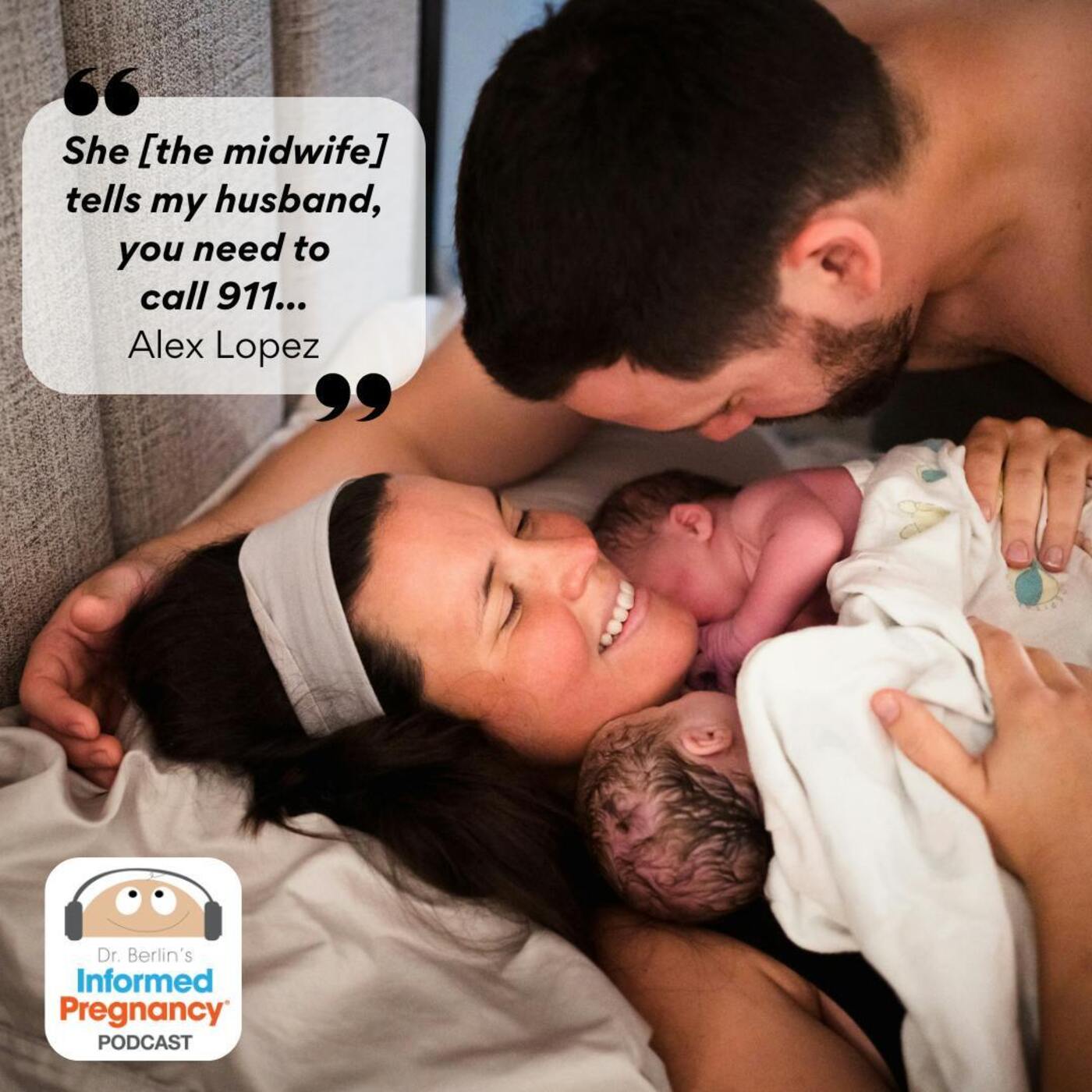
Alex Lopez [37:26] So at this point, my husband has the midwife on the phone saying she's ready, she's pushing. Where are you? How far away? She's close, but she's not there yet. She tells my husband, "You need to call 911. You need to tell the dispatcher that you're having a home birth, you're expecting twins, and baby B is in a breach presentation, and I will try to get there as soon as I can." So within a few minutes, the fire department is half a mile away from us. We have a whole house full of firefighters and paramedics. I don't know this, I find out later, but one of the paramedics comes into the bathroom with me, and he's a sweet southerner, sweet guy from Texas, and he's just, "Hey ma'am, what's your name?
[38:11] How are you feeling?" And I'm just deep in my birth mode. I'm in my cave, and I just give him these death eyes like, "Don't talk to me right now." And I turn my head. I don't talk to him. I don't say anything to him. I turn my head on the other side of my birth ball and I don't even look at him. And my husband's like, "Get out of here. What are you doing?" So luckily, within a few minutes after that, the midwife, Christine, she arrives. None of her teammates were able to arrive. Apparently there were quite a few births that night in Dallas, so she makes it there. By the time she makes it there, I'm pushing. I don't even think she has time to get the Doppler out.
[38:54] She's just basically coaching my husband on how to catch this baby. My baby A comes out head down, comes out screaming, and I was able to feel everything. That ring of fire was excruciating.
Dr. Elliot Berlin, DC [39:07] Oh, man. How long did it last?
Alex Lopez [39:09] Probably minutes. It felt like it wasn't very long. The whole labor was only about three hours, so all of this happens very, very quickly. And the ring of fire in the moment felt like forever, but ultimately, I think it was only maybe probably two or three pushes till I could finally push her out. But it was just that burning sensation. Exactly. Ring of fire is the perfect word for that.
Dr. Elliot Berlin, DC [39:31] Description?
Alex Lopez [39:32] Yes. So I push her out. My husband's so happy to catch her and we find out it's a girl. So I'm on my hands and knees and we do have to do another baby. So my cord is a little bit short and the midwife asks me, "Is it okay if we cut the cord so you can see her since she is behind me?" And my husband cuts the cord and brings her to me, and I'm able to see her for a few moments and hold her for a bit. Now, the plan going forward was my mom was going to take baby A and give her skin to skin, and my husband was going to help me labor with baby B, which was good because just a few moments after baby A comes out, I start feeling the contractions come back hard and fast again with baby B.
[40:13] Now at this point, the midwife, after baby A came out, she told the paramedics, "Thank you guys. Appreciate it. I'm here. You guys are good to go." But she does get her Doppler out at this point, and I'm feeling these contractions. And then I hear her say, "Actually, do you guys mind staying until this one comes out?" And that kind of made my heart stop a little bit and got me a little bit out of birth mode because that terrified me. And she said that Baby B was still breech, and I don't know if her heart rate was dropping. She didn't really share too much information, but she just kept saying, "Alex, you got to push. You got to push right now."
[40:53] And she was really encouraging me to give my hardest, even though I was pretty exhausted. I just pushed out a baby. Now I have to do it all over again, and this one is coming out feet first. So I'm pushing and pushing. I'm feeling the need to push, but it's a little bit more challenging. And she says, "Alex, I'm going to help you out. Do you mind if I help you out?" And I'm not really sure what she did, but it kind of felt like she may have just put her hands up inside me a little bit and kind of tugged a little bit to help her come out. So baby B did come out footling breech. She was also a girl, and she was not in her body when she came out.
[41:33] She was a hundred percent limp, and she took a minute, and my husband still caught her, and the midwife told him to squeeze her body and talk to her, and he's squeezing her body and he's talking to her, and she gets the oxygen mask and puts two pumps of oxygen, and then boom, she woke up. So it felt like a scary 30 minutes, and looking back on the birth video is a scary five seconds, but it did take her a little bit to come into her little body.
Dr. Elliot Berlin, DC [42:01] Sure. Meaning five seconds before the first breath?
Alex Lopez [42:04] Yes.
Dr. Elliot Berlin, DC [42:05] Okay. And then it took a little bit after that for her to fully start to apgar.
Alex Lopez [42:10] Some color. Yeah.
Dr. Elliot Berlin, DC [42:12] Yeah. Okay. Were the paramedics still there?
Alex Lopez [42:14] So they were because she requested at that last moment, she just kind of said, "Hey, hang on." But I mean, I never saw any of them, so at some point they left.
Dr. Elliot Berlin, DC [42:24] I've seen so many thousands of people and lots of twins, not as many triplets and only two sets of quads, and only one set of quads that went all the way through. But I can generally get a great idea of positioning on a singleton baby. But once we get up to twins, and it's not my training and I don't do it medically, I'm not like, "Okay, this is where you are." But sometimes for entertainment purposes only, someone will be like, "Hey, what's this or what's that?" And after years and years of working with pregnancy, you get the hang and midwives show you some tips and tricks along the way. But when it comes to just twins even, I have no idea. There's four balls in there, two heads and two butts, and there's eight limbs moving around.
[43:05] There's 12 pieces that are… It's just a jumble. I can't even tell which parts are attached to which baby. But you're also seeing an obstetrician. So was baby B head down on ultrasound towards the end?
Alex Lopez [43:17] Both my midwife and my OB didn't do any ultrasounds on me, and they both felt around. And the whole time they said Baby B was breach the entire pregnancy, and we confirmed it. At the very end, my midwife said at about 36 weeks, she said, "Let's go ahead and get an official ultrasound by the fetal medicine doctor just to give us a nice solid picture of what we have going on here." And sure enough, baby B was breach. And because of that, actually both of my twins are being seen for hip dysplasia just because when you're born breach and breach the entire pregnancy, there's a higher risk for having some hip dysplasia. They don't have it right now, but they're just being monitored and just some extra care.
Dr. Elliot Berlin, DC [44:03] Okay. So was it then not a total surprise that the baby was breech?
Alex Lopez [44:08] No, we knew from pretty much since I've been seeing her, and that's why I specifically asked her all the questions about her being comfortable with breach birth. I did get one ultrasound in California at 19 weeks, what would've been the 20-week anatomy scan. That was my last ultrasound in California, and they already saw in that scan that baby B was breach. I kind of knew that I make kind of big babies. I didn't think that there was going to be much room for them, so I had a feeling she was going to stay breach, and sure enough, they were yin and yang the whole time she stayed breech.
Dr. Elliot Berlin, DC [44:42] If you think about it, it's kind of a good fit for them in terms of space efficiency. Well, okay. Outside of that scary moment, it sounds like you had the birth you were hoping for.
Alex Lopez [44:52] So beautiful, so perfect. I'm so happy I got to experience it.
Dr. Elliot Berlin, DC [44:56] And the after birth, we were able to have what you wanted there?
Alex Lopez [45:00] It was perfect. Now, my friend had twins and she had to be in the hospital. She had a singleton before, and she was away from that singleton while she had the cesarean for multiple days. I was concerned about that because my daughter has never spent any time away from me. So knowing if I had hospital birth, she'd be away from me. So this was absolutely perfect. I had them at five in the morning. So when she woke up in the morning at seven, she came downstairs and boom, she was mommy.
Dr. Elliot Berlin, DC [45:29] Oh, that's the craziest.
Alex Lopez [45:31] Yeah, mommy and daddy in bed with their two baby sisters there, and it was so magical. I got to take a little shower. The babies took a very long first sleep. My mom right there in the kitchen made me a nice batch of warm pancakes. I was able to have a cup of coffee. I didn't have these nurses coming in, checking the babies, doing all the things, the monitors worried about me sleeping with the babies on my chest. It was a day and night difference. It truly felt like, oh my gosh, this is how birth should be so much better.
Dr. Elliot Berlin, DC [46:01] Well, I'm really glad that you got to have that experience the way you wanted it and that you felt supported and heard, and hopefully were able to, if there were any remaining feelings of your body letting you down or anything like that, that you were able to reconcile your relationship to the fullest and beyond.
Alex Lopez [46:21] That's right. Thank you.
Dr. Elliot Berlin, DC [46:23] You're welcome. All right, Alex, thank you so much for coming and sharing your stories with us. Every birth story is like a snowflake. I've been to so many and no two are exactly the same, but yours are quite unique and it's really helpful to hear them, is the feedback we get all the time from people who are currently pregnant or recently had a baby. So really, thank you so much for sharing. At home, thanks for listening to the Informed Pregnancy Podcast. For more pregnancy and parenting information just like this, including our blog, our newest podcast that's coming out soon, One Way or Another, and our streaming service, visit informedpregnancy.
[47:10] com.
Want more pregnancy + parenting? Start your FREE TRIAL of Informed Pregnancy+ and get access to all our curated pregnancy and parenting content — original series, iconic birth films like The Business of Being Born, prenatal workouts and more.
