
May 5, 2022 · 37 minutes · Episode 280
About this episode
Kayleigh Harrigan is back to share the final chapter of her pregnancy and the challenges and triumphs of her labor and birth story.

This podcast has been brought to you in part by LMNT electrolyte drink mix. You can get a free sample pack with every order at drinklmnt.com/berlin .
Learn more about your ad choices. Visit megaphone.fm/adchoices
See Privacy Policy at https://art19.com/privacy and California Privacy Notice at https://art19.com/privacy#do-not-sell-my-info.
Key quotes
“I don't know. I got to really know all of the varieties of curbs in my neighborhood. It was fine. I felt kind of ridiculous doing it. But I was hoping that people looking at me were like, Oh, I know what she's up to. Yeah. Yeah. Yeah. So there was no catalyst. And of course, there never really is a catalyst. It was just nudges.”
“I think, you know, knowing that this is pro drama labor. Hey, this sometimes happens. Hey, you know, these might not be producing cervical change, but maybe they're bringing the baby down. Maybe they're facing you. Like none of this is for nothing.”
“It was something I had to work on and work through the entire pregnancy. In the beginning, I was kind of like home birth or die. And I know that that's not realistic. We can influence birth, but we can't control it. And that's something that we'll often share with my clients.”
“Throughout the entire experience, I felt so cared for and held and supported. And I really hope that that's something that I can provide for my own clients. I hope that I can make people feel the way that I did, not only prenatally, but in the birth as well.”
“Like, you know, it was very painful. It was the most intense sensations I had ever felt, but, you know, eventually I got a little bit floaty and the endorphins kicked in and, you know, there was that medicine there and I had a good time.”
Related episodes
- Ep. 279 Kayleigh Harrigan – Before Birth
- Ep. 293 Michele Maturo – Before Birth
- Ep. 277 Kelly Kilmartin – After Birth
- Ep. 297 Alessandra Torresani – After Birth
Transcript
AI-generated transcript with speaker labels — may contain errors, especially names and medical terms. Dr. Elliot Berlin, DC appears in blue; Kayleigh Harrigan in orange.
Download PDF of the Transcript
Dr. Elliot Berlin, DC [1:36] Welcome to the informed pregnancy and parenting podcast. I'm your host prenatal focus carb director dr Elliott berlin my guest today is a midwife in training And a brand new mom returning to share the rest of her pregnancy and labor returning caley harrigan. Welcome back to the podcast
Kayleigh Harrigan [1:51] Hello
Dr. Elliot Berlin, DC [1:52] I think we're just talking about how my life is about the same as it was last time we talked Yeah, and mine is significantly different yours is significantly different Thank you You have a kid. So just as a reminder to listeners, you're from canada a Yes, and you were a doula and then you said I gotta get deeper into the action started training as a midwife But you started your caring for children when your parents had four other kids. Yeah After you you're the first of five And I think the last time we talked to you you're 39 weeks Wow Wow feels like just yesterday and also a lifetime ago. I can imagine it moves very fast and very slow You had a suspiciously wonderful pregnancy, yeah
[2:43] And I don't know how you did it but your back pain went away And you had midwifery care and we're planning to deliver at home With a midwife midwife assistant doula slash photographer and two out of your four dogs because the big ones are too nervous Yep, and last but certainly not least your partner you're doing this all from memory, right? Total memory. Yeah Remember every detail. I do remember our predictions, but i'll get to them at the end Okay, let's talk about the end of your pregnancy was 39 weeks. How long did you end up going?
Kayleigh Harrigan [3:18] Um, I went to 41 weeks when I started labor for the first time. Okay, so I was running that prediction Uh
Dr. Elliot Berlin, DC [3:27] Labor for the first time
Kayleigh Harrigan [3:29] Yeah
Dr. Elliot Berlin, DC [3:30] I mean, that's a can of worms. Well, let's start with the first time. What did you experience?
Kayleigh Harrigan [3:36] So the evening that I was 41 weeks around 11 pm. I started contracting and they were pretty You know significant it kind of started with a bang and they were happening every five minutes or so lasting for about a minute They were intense enough that I had to like, you know vocalize and ambulate to get through them Not enough that I needed my husband to be awake with me But they were happening and I was under the impression that this was happening and I was was it
Dr. Elliot Berlin, DC [4:05] What what's your vocalization of choice?
Kayleigh Harrigan [4:08] Um a lot of kind of like open jaw groans
Dr. Elliot Berlin, DC [4:13] Open jaw groaning lower register
Kayleigh Harrigan [4:15] Yes, certainly
Dr. Elliot Berlin, DC [4:18] Yeah
Kayleigh Harrigan [4:19] Okay, and you thought this was it I thought this was it because it was 41 weeks
Dr. Elliot Berlin, DC [4:25] You know in the more holistic the world, I guess it's always a personal choice. Had you been Checking your servants
Kayleigh Harrigan [4:32] um Yes after About at 39 and five we started checking. I still couldn't reach by that point But alex could and it was about one so there wasn't a lot Happening and he was still we know the sex now He was still really high too. So that thing I was running two predictions um, so that kind of made us kind of want to nudge things a little bit in the direction of the baby being born because it didn't really look like he was coming anytime soon based on what was going on in my body. So lots of herbs happen lots of, you know, curb walking some mile circuit. So just gentle, gradual nudges to guide him in the direction of out of my body. herbs like there's so many different kinds of herbs.
[5:21] Yeah, genre herbs, blue and black cohosh and cotton root. Oh, yeah. And then I you know, I did the soft and fluffy. Yeah, yeah, they were quite nice. You know, I was doing acupuncture, some moxibustion, all of the things to kind of get a rolling, get a rolling. Yeah, I was curb walking for you. Did you feel
Dr. Elliot Berlin, DC [5:44] like it was productive? Was it weird to do?
Kayleigh Harrigan [5:47] I don't know. I got to really know all of the varieties of curbs in my neighborhood. It was fine. I felt kind of ridiculous doing it. But I was hoping that people looking at me were like, Oh, I know what she's up to. Yeah. Yeah. Yeah. So there was no catalyst. And of course, there never really is a catalyst. It was just nudges.
Dr. Elliot Berlin, DC [6:09] Okay, so not just and then you said, What else do you do the herbs and you did the curb walking and
Kayleigh Harrigan [6:15] smile circuit. Okay, which is like a series of three exercises that are supposed to kind of encourage base get into the most optimal position. And position was a big thing that I focused on for a pregnancy. So I did receive chiropractic care, as you know, and I never like was on a recline, I always kind of sat upright, lots of sitting on the ball, just to make sure that you know, he didn't get op and that he was ideally left occiput anterior, which he was for the entire duration of my pregnancy. But spoiler alert, not for the birth.
Dr. Elliot Berlin, DC [6:51] Oh, no. Okay, so you're doing all this mile circuit, which
Kayleigh Harrigan [6:57] three exercises. So there's an exaggerated sideline, which I did with a peanut ball. And then there's like open knee chest. So you're kind of like, chest to the floor and butt in the air. And then I have mom brain. What's the last one? Oh, and then the last one is just kind of sitting on the ball. And you kind of go through each of those things for about 30 minutes each. So I was doing that, you know, a few times a day.
Dr. Elliot Berlin, DC [7:21] You know, it's really weird. What? I think I have mom brain. Really? Yeah, it might be contagious. It could be like an occupational hazard, like very high exposure to all those hormones that you guys pump. Okay, so it started with a bang, and then
Kayleigh Harrigan [7:39] and then you know, we went through the night. So from about 11pm to 7am, it was going and then as the sun started to come up, it started to taper and slow down and get a little bit slower, farther apart, less intense. And it probably didn't fully stop until like 2pm or so. And then I went into the OB's office to have a non stress test done, just to check on babe. And that was already scheduled. That wasn't tied to the labor that had happened.
Dr. Elliot Berlin, DC [8:11] How was your non stress?
Kayleigh Harrigan [8:13] It was great.
Dr. Elliot Berlin, DC [8:14] Was it non stressful?
Kayleigh Harrigan [8:16] It was non stressful. It was nice to hear the babe and you know, I got proud that he scored really well on it. You know what I mean? Yeah, proud mom. Yeah, I'm putting him to the test, but he did great. And that also gave me reassurance, not that I had doubts, but reassurance that he would tolerate labor.
Dr. Elliot Berlin, DC [8:36] Okay. And was the doctor concerned at all with you being fairly over your due date?
Kayleigh Harrigan [8:42] No, but she was happy that we were trying to get him nudging.
Dr. Elliot Berlin, DC [8:47] Any additional sources of nudge?
Kayleigh Harrigan [8:50] She did do a membrane sweep, which is intense. And who knows what it did? Because Thursday night that night, we started again, almost immediately after I got home.
Dr. Elliot Berlin, DC [9:06] Oh, really? Okay. Your membrane sweep was intense. Like, can you describe the intensity?
Kayleigh Harrigan [9:12] It was just invasive and uncomfortable, you know, and I have done one before too. So, you know, you're trying to kind of really get in there. So I don't think they're ever supposed to be really that comfortable.
Dr. Elliot Berlin, DC [9:24] That amazing. Nobody goes to Burke Williams and they're like, Hey, can I get the membrane sweep treatment? Were you still one centimeter then?
Kayleigh Harrigan [9:32] I was about two, like one and a half to two. So, you know, I was excited about that because, you know, the eight hours plus of contracting had produced some cervical change. So I was off to the races and happy.
Dr. Elliot Berlin, DC [9:46] Okay. Then you get home and it's on again. Yeah. What time of night is this?
Kayleigh Harrigan [9:53] We got home, we had dinner, and then it kind of started right after that. So probably like six p.m. And it was kind of like a gradual build and it was again like enough that I was vocalizing and moving and I just told my husband though to go to bed because it was nothing to write home about just yet. And because the night before we had both been up quite a bit for this chapter of the labor because I was so tired from the night before I was able to sleep in between contractions. So I would like lay down in my bed, fall asleep, and then spring up and start rocking and rolling and then get through it and then go back to sleep, which was something to those
[10:38] little rapid chargers actually give you energy or are they not annoying every four minutes? Yeah. Yeah. I don't know. I guess it was helpful. I did it for the rest of the night. It did feel a little bit different. Like on the evening before, like as I knew they were coming, as they were starting to build, you know, I would start like getting into my groove and swaying and kind of gently go into them. Whereas Thursday it was like, hello, like I was springing out of bed needing to move immediately.
Dr. Elliot Berlin, DC [11:09] I could see your eyes just pop open fully. I have a really important question. What did you have for dinner?
Kayleigh Harrigan [11:16] I don't remember.
Dr. Elliot Berlin, DC [11:17] Oh, so important. Don't remember.
Kayleigh Harrigan [11:19] I can get back to you on that.
Dr. Elliot Berlin, DC [11:22] It's okay. It's a blur at this point. It's always weird to watch somebody who has experience as a Dula playing the role of midwife, you know, be on the other side of the table, the other side of the sofa, the other side of the birth pool. You get it. At this point, is there any of that going through your head, like your experiences as a provider while you're the client?
Kayleigh Harrigan [11:46] Yeah. I think, you know, knowing that this is pro drama labor. Hey, this sometimes happens. Hey, you know, these might not be producing cervical change, but maybe they're bringing the baby down. Maybe they're facing you. Like none of this is for nothing. Like I really had to remind myself as I was going on, you know, like hour 16 of labor that was intense enough to need to actively cope to get through it. But that I knew it wasn't time for me to call the Dula or the midwife. I knew we had a long way to go still.
Dr. Elliot Berlin, DC [12:20] Huh. Okay. But the Dula and the midwife were already there with you?
Kayleigh Harrigan [12:25] No, in my heart, yes, but they were not at home.
Dr. Elliot Berlin, DC [12:28] I just mean you. Oh, yeah. See what I did there? Okay. I feel like it's an awesome time for a break. And when we come back, we'll find out what happens next. Welcome back to the informed pregnancy podcast. I'm talking about Kaylee Harrigan. And first there was a night of labor that turned out to be not really labor. Then you get a check with the doctor. NST is all good. Membrane sweep, go home, have mystery dinner, and then labor starts again and you're laboring all night, but this time more of a pop with each search. Okay. What happens next?
Kayleigh Harrigan [15:25] And then the sun comes up and same thing as the day before. The things start to kind of taper off, but they're still there a little bit, but it's, you know, it's going away. It feels like I had just repeated the night before with a little bit more sleep the second time. So then I was really hoping that they had produced cervical change. You know, I was able to kind of talk myself off the ledge, you know, prodromal labor is not for nothing, blah, blah, blah. And then Friday morning I was like, I better be dilated. And so I could check myself at that point though. So, you know, there was change. He did come down. I was able to touch his head, which was so cool.
[16:06] Yeah. And I was four. So, yeah, so something had happened. So I was elated and I got on the phone immediately and called Alex, my midwife and said, Alex and Peking Castor. I'll be getting this show on.
Dr. Elliot Berlin, DC [16:20] Wait a second. But at this point, are any of the dogs around you?
Kayleigh Harrigan [16:24] That's a good question. I think on Thursday after the night of labor, he brought the two big dogs to the sitters and the one dog, Frida, never left my side for the entire thing. And Frida's the doula dog. She's the doula dog. Every single photo from the labor, it's like fine Frida. She's in there somewhere. Photo bone Frida. Yeah. And then even now she doesn't let the baby go out of her sight.
Dr. Elliot Berlin, DC [16:52] How old is Frida?
Kayleigh Harrigan [16:53] We think she is like maybe four, but she's a Chihuahua pug. Oh, yeah. Yeah. I didn't know her story when we applied to adopt her, but she was actually a homeless dog and had puppies on the streets. Yeah. So I feel like Frida right now is like reliving or like reclaiming her postpartum experience and she is just basking in it and loving it. Wow.
Dr. Elliot Berlin, DC [17:21] That's such a cool story. All right. And you have a cool story too. So you make the phone call. We're darn it. Taking this castor oil. Did you take the caster?
Kayleigh Harrigan [17:30] Alex said, I'm not telling you what to do, but I'm also telling me what to do, do not take castor oil. This labor is coming. And I'm really happy that she said that because by about 1 PM it had started again and this obviously the sun was up, it wasn't like this nighttime thing that it had been the days before. And it was probably more intense than both of the other nights. And you know, as time went on, I needed my husband to double hip squeeze, which was something new. Like I needed a support person to get through them, but I was elated. I was so, so happy because this is what I wanted. And this is what needed to happen.
Dr. Elliot Berlin, DC [18:09] If you remember, were you feeling the surges more in the front or in the back or both?
Kayleigh Harrigan [18:14] Completely in the front, super localized sensation in the front. And it almost felt like a small portion. And this was refreshing. I think labor hurt less than I thought it would.
Dr. Elliot Berlin, DC [18:26] Oh, okay.
Kayleigh Harrigan [18:28] Yeah. Like, you know, it was very painful. It was the most intense sensations I had ever felt, but, you know, eventually I got a little bit floaty and the endorphins kicked in and, you know, there was that medicine there and I had a good time.
Dr. Elliot Berlin, DC [18:43] Dare I say it really, you're, you're enjoying the ride.
Kayleigh Harrigan [18:49] I think so. Yeah. I'd do it again.
Dr. Elliot Berlin, DC [18:51] So does that mean, cause you said it was also intense and painful. So is it pain and pleasure at the same time?
Kayleigh Harrigan [18:57] Yeah. I think so. And if you asked me right now to like, remember exactly how it felt though, I cannot like put my finger on it. It's weird. So there's a little bit of birth amnesia there, but I cannot put into words, exactly the sensations. I'll have to ask Alex.
Dr. Elliot Berlin, DC [19:15] Yeah, Alex isn't there yet.
Kayleigh Harrigan [19:17] Oh, so I'll have to ask her husband or Rita.
Dr. Elliot Berlin, DC [19:22] Okay. So you're having a good time. You feel yourself progressing. It's intense, but oh, that's another interesting. Point though, is that as it progressed, it became even though more intense, more tolerable at the same time.
Kayleigh Harrigan [19:34] Certainly.
Dr. Elliot Berlin, DC [19:35] All right. What happens next?
Kayleigh Harrigan [19:36] And so by about six, my husband's arms were noodles and we had the doula come over to, you know, give him a little break and also, you know, it seemed things were going. So contractions were maybe every two to three minutes lasting for about a minute and a half. And as soon as the doula got there, it seemed like it got even more intense. And I think within about an hour. She said, I think it's time that we call the midwives and they got there, you know, maybe half an hour or 45 minutes later. And at that point I asked to be checked and I was still forced on him.
Dr. Elliot Berlin, DC [20:14] No!
Kayleigh Harrigan [20:16] I wasn't defeated in that moment though, because I was like, this is true labor, it's not gonna stop. There's no way this is gonna stop.
Dr. Elliot Berlin, DC [20:22] A moving train.
Kayleigh Harrigan [20:23] Right, it was a moving train, there was no stopping it. And so Alex sent my husband to bed because he had been working hard for a long time. And this is where things kind of get blurry. I remember being in my bed, I remember being in my bathtub, in my shower, in my living room. I remember like feeling kind of like an out of body experience, which was quite cool. And like minor, mild visuals if my eyes were closed. So it was kind of psychedelic, it was cool. It was all the good things that you hear about labor. I feel like I was able to experience.
Dr. Elliot Berlin, DC [20:57] That's awesome. Were you then not really aware of time?
Kayleigh Harrigan [21:00] No, time had no meaning. Yeah, and just like, you know, the plus product of the season has been long and short. That's kind of how labor felt as well.
Dr. Elliot Berlin, DC [21:09] Long and short. Yeah. The long and short of it.
Kayleigh Harrigan [21:12] Yeah, that check happened at about 6.30 going back to time.
Dr. Elliot Berlin, DC [21:16] So it's 24 hours after you really started your second set of labor.
Kayleigh Harrigan [21:21] Yeah. Yeah.
Dr. Elliot Berlin, DC [21:23] And there was a break before your third set started in the afternoon, okay.
Kayleigh Harrigan [21:26] Yeah. And then by nine or so, I asked Alex to check me again. They were probably like every minute, still a minute and a half, very, very intense. I was seven, so great. We had changed in a relatively short amount of time for someone who was having their first baby. So again, delighted to hear that. And then maybe an hour later, it was the uncontrollable urge to bear down. It was like the beat is coming out, going back to the freight train thing. It was like, this child is coming. So I said, do you want me to check you just to confirm there's no lip or there's no cervix left at all? And I said, yes. And I was only eight with this urge to push.
Dr. Elliot Berlin, DC [22:08] Yeah. Wow. That can be tricky.
Kayleigh Harrigan [22:11] That was really tricky. And then she also said, I think that he is asyncletic and I think that he is OP.
Dr. Elliot Berlin, DC [22:18] Let's break this down, okay. Yeah. Urge to push and you're eight. So the concern there is what? That you still have cervix that's in the way, but you're pushing against it. Yeah.
Kayleigh Harrigan [22:30] And then it will swell up and start to close.
Dr. Elliot Berlin, DC [22:33] Exactly. Problem number one. Problem number two, asyncletic means not quite lined up with the runway. Yeah. So that a lot of the intensity pushing down isn't really making forward progress. It's kind of pushing into something else. Yeah. And then OP is where the baby's occiput, the bone in the back of the head, the back of the skull is P against the posterior surface of your body. So against your back. So the baby's hard part of the skull is against your hard pelvis. Yeah. And harder to move down, right? If the hard part of the skull is against the fleshy part of your belly, it's easier to wiggle through. Okay, so three conundrums.
Kayleigh Harrigan [23:13] Three conundrums. So there was a little bit of defeat there. Those are three things you'd never really want to have happen and there they all were presenting together. But we just got to keep going. We've got to get the baby out. So we continued.
Dr. Elliot Berlin, DC [23:29] The midwives have any recommendations on how to handle any of those three issues?
Kayleigh Harrigan [23:33] So we continued on our course and we put me into some weird positions to try and help him rotate. So like very exaggerated on the peanut ball. And at this point, this is when I became aware of time. Like it was like, okay, let's do seven contractions on the left and then seven surges on the right. And I was counting the seconds because to try not to push, it felt like I was like, had to vomit from my butt. And you know how it feels when you have to throw up. Like there's- You can't stop it. You can't stop it. So trying to blow out the candles and cope with that sensation was a lot. That was the most unpleasant part of the entire experience. That at this point,
[24:18] I stopped having a fun time. No more trippy psychedelic orgasm. Orgasmic high. Yeah. And now it felt like, oh, this isn't great. So that was about 10 PM when that happened. And I asked Aks to check me at 12. Same thing. Nothing had changed. So we kept doing different weird positions, trying to get my butt way high in the air to kind of get the pressure off of my cervix to kind of reduce the urge to push. Nothing seemed to really help. You know, I got in the birth tub. That helped a little bit, but again, it was-
Dr. Elliot Berlin, DC [24:53] It helped with the urge to push or it helped with the intensity?
Kayleigh Harrigan [24:56] A little bit. Most of the intensity. The urge to push never really- excited at all, unfortunately. And then at about two 30, she teched again and I could just see on her face that nothing had changed. And in that moment, I said, I'm calling it. This baby's not coming out at home.
Dr. Elliot Berlin, DC [25:16] Oh boy. We better take a break. Yeah. That is I need a break at this moment. Yeah. We'll be right back to find out what happens next.

Dr. Elliot Berlin, DC [25:36] Welcome back to the informed pregnancy podcast. I'm talking about Kaylee Harrigan. Oi, we went from a very trippy, psychedelic, levy, earthy, birthy experience with, you know, slow progress, but slow and steady until three things hit you. The constant urge to push against your cervix that was not fully dilated and posterior baby that has not lined up well with the runway asyncletic, and after hours and hours, you're not making forward progress and you're ready to throw in the towel. What does that mean for you?
Kayleigh Harrigan [26:11] It means I'm getting in the car and I'm going to get an epidural. When I was trying not to push, I could feel myself clamming. I could feel there was no relaxation. There was no softness in my body at all. It was just tension. And I was grateful that we have access to these tools like epidurals because sometimes that's just what it takes to have someone kind of let go, soften, relax and release. So that's what we did. I do remember I only had two contractions in the car in the 12 minute drive. So I was here again. I'm aware of time and, you know, my husband had to drop me off at the emergency room and then go park the car. And this is kind of a funny story.
[26:56] This is something I kind of look back at and laugh. And this man who was wheeling me up to L and D, I swear it was his first day. He was wearing an entire bottle of cologne. I managed to hit every single bump and every like elevator doors were closing on me. Like he had to like take a run at it to get over the little like bump in the road. I was like, sir, I can walk, but no, I had already have a bump. Right. So there's a little comic relief in that. That was probably, you know, you know, a funny part in hindsight. So we get to L and D, you know, I go on the monitors. Here's another side note. The nurse was having a hard time finding the baby, the baby's heart.
[27:42] It probably took her 25 minutes to find the heartbeat, but I was able to feel the baby. So I wasn't even concerned and I wasn't paying attention to what was going on. But meanwhile, my dual and husband are sitting here with this nurse, unable to find the baby. So they were freaking out, but I, yeah, I had the consciousness to know he was there, but didn't share with them that knowledge because it was even crossing my mind. So yeah, that happened. And so from when I got to the hospital, I think it was about three. The epidural finally came up 5am.
Dr. Elliot Berlin, DC [28:14] Why the two hour delay?
Kayleigh Harrigan [28:16] I don't know.
Dr. Elliot Berlin, DC [28:17] Um, that whole time you still had the urge to push and you're still having the intense. Oh, wow.
Kayleigh Harrigan [28:22] Yeah. And, but now he's in this crummy hospital, but, but so be it. You know, the epidural came, it felt like I was at the dentist, very tingly, and then I told everyone I was going to sleep and I would see them soon. And that's just what I did. And, you know, oftentimes that's just what you need. Just a little nap, a little recharge, a little relaxation, and the baby comes up, um, at 1pm. We checked eight centimeters. Nothing had changed. So at this point in time, I'm like, okay, I've surrendered to, you know, the change in plans from the home birth. Now do I surrender to having a cesarean birth because, you know, we were exhausting all of the options and it didn't really seem like anything was happening.
[29:10] And the OB said, we're not calling it yet. And I said, can I have a little bit of pitocin? And she said, I think that's a great idea. So let's get these contractions even stronger and see if we can give baby a little extra oomph to, you know, corkscrew down and out. So that's what we did. I decided I would go back to sleep and turn my brain off. And at about four 30, we checked again and I was nine centimeters and he was LOA. So yeah, he was in the perfect position. He was lined up. So I was delighted. I'm okay. We'll just continue to hurry up and wait.
Dr. Elliot Berlin, DC [29:46] And you didn't have the urge to push anymore because you had the up door, right? What the epidural that sensation completely three of your obstacles are out of the way. Yeah.
Kayleigh Harrigan [29:56] Yes. And so OB leaves the room. Kind of roll onto my back. I had been alternating, still using the peanut ball, switching side to side. And there was that urge to push again, but I was okay with that because I had just been nine centimeters and so I like get her back and it had been about one contractions and she had last checked and I was in fact,
Dr. Elliot Berlin, DC [30:22] it's a big difference when you're lined up with the runway and not against the bone on the bone. Yeah. Oh, wow. That's amazing.
Kayleigh Harrigan [30:29] Okay. Yeah. And the pressure was definitely there and I could almost like ask, well, I'm getting ahead of myself, but I had a really good epidural that it was still able to feel a lot of things without intense discomfort.
Dr. Elliot Berlin, DC [30:44] So for you, the best of both worlds, some active participation and sensation, but enough to help you loosen up and relax. Yeah.
Kayleigh Harrigan [30:54] And so at four 44, we started to push, which interestingly is like when my wedding video accidentally starts. So it just sounds like a special time for us. And that was, you know, completely random that that had happened and started pushing, I was sidelined. The OB suggested that we do a tug of war after about, you know, maybe 10 pushes or so, and that felt really good and helped me really kind of hone and like channel all my energy down.
Dr. Elliot Berlin, DC [31:22] You're pulling on a sheet or something like that?
Kayleigh Harrigan [31:25] It was smaller than a sheet. I don't know what. It wasn't a robozo. No, I had my robozo with me and wanted to include it in the labor, but. So it's something in between the sheet. Yeah. Yeah. So we're doing the tug of war. She's like, why don't you try rolling onto your back? And I'll go, okay. Last time I rolled onto my back, I was complete. So rolled onto my back and within one push, my child was born. So it went, yeah, it went from nothing, like maybe a little bit of a head was visible. Like keyhole, but we were supposed to call the NICU because there was meconium, um, she didn't, you know, suit up and put her splash guard gear on. No one thought the baby was coming out, but then the baby launched out.
[32:10] Yeah. Yeah.
Dr. Elliot Berlin, DC [32:13] What was that like for you at the moment?
Kayleigh Harrigan [32:16] It was so cool to feel him rotate, like do the cardinal movements. And then she kind of like held him out. So I was able to grab underneath his arms and pull him up onto my chest. And I was able to see that he had a penis and tell my husband that he had a penis. Yeah. And it was the most delightful thing I've ever felt. It was, yeah, it was completely magical. And after a few seconds, I could see like, he wasn't coming into his body completely. And so I was, you know, kind of like stimulating him, like rubbing his back, rubbing his feet, talking to him, letting him know like, Hey, you're here, you're safe. We're so happy. We're so grateful to meet you, which was cool.
[33:02] It felt like I was still an active participant, you know? And then I could see he was flaring his nostrils a bit and like grunting a bit, and he was having retractions at his chest, which are all things that suggest that the baby isn't breathing as effectively as they could be. So then I was able to kind of lift him up and turn him to do postural drainage, to help kind of have the fluid that was built up in his lungs, kind of drain and release. So I, yeah, I felt like I was there with him and it felt like my midwifery skills, I was doing them on my own baby, which was really kind of cool. Yeah. And I think it was nice for him to have someone familiar kind of helping
[33:43] him through this kind of, assumingly scary, scary movie moments.
Dr. Elliot Berlin, DC [33:48] Yeah, could be a movie one day. Oh, wow. Oh my goodness. Congratulations. What a journey. I have a few questions here. Number one, were you prepared from the beginning for the fact, I know you had a backup doctor, so you're prepared at some level for the fact that maybe, you know, as my dream is to have this baby, my preference is to have the baby at home, but if I need to go to the hospital, I'll go. If I need intervention, A, B or C, I'll get it. If I need intervention C specifically, I'll get it. Was that your mindset from the beginning?
Kayleigh Harrigan [34:22] It was something I had to work on and work through the entire pregnancy. In the beginning, I was kind of like home birth or die. And I know that that's not realistic. We can influence birth, but we can't control it. And that's something that we'll often share with my clients. So I had to really kind of process and go through the possibility of him not coming out at home. And interestingly, anytime I would imagine or visualize the birth, I couldn't see which room in my house it was born in. I couldn't see what position I was in. I could never see the birth happening at home. But that being said, I could never see the birth happening in the hospital
[34:54] either, but that was something that I was aware of and I packed a hospital bay. not, you know, I was like, am I manifesting? And I was like, no, I'm just prepared. So it came up a lot throughout the pregnancy.
Dr. Elliot Berlin, DC [35:09] Your mom and I predicted you would have a girl and your husband was like dreaming of having a girl.
Kayleigh Harrigan [35:18] Yeah.
Dr. Elliot Berlin, DC [35:19] So obviously we were all misdirected to your next pregnancy, I suppose.
Kayleigh Harrigan [35:26] Right, right.
Dr. Elliot Berlin, DC [35:28] Because you have a boy, I predicted eight and a half pounds.
Kayleigh Harrigan [35:31] Yeah, he was 7'11".
Dr. Elliot Berlin, DC [35:34] So smaller than everyone. Smaller than I thought, even though it was later than I thought, because I thought you'd go to just 40 in a few days. But your actual birth was 41 in a few days?
Kayleigh Harrigan [35:44] Yeah, 41 in three or four.
Dr. Elliot Berlin, DC [35:47] Yeah, it was off by a week. Well, I'll keep working on my tarot cards.
Kayleigh Harrigan [35:52] Don't quit your day job.
Dr. Elliot Berlin, DC [35:53] Yeah, I don't plan to. A lot of angry people, if I do that. Yeah, so my last two questions are this. Number one, going through the experience personally and quite an experience, do you feel like that changed you at all as a budding midwife?
Kayleigh Harrigan [36:16] That's a good question. Throughout the entire experience, I felt so cared for and held and supported. And I really hope that that's something that I can provide for my own clients. I hope that I can make people feel the way that I did, not only prenatally, but in the birth as well.
Dr. Elliot Berlin, DC [36:35] And my last question is, in your pregnancy with a girl coming up, are there any things you would do differently for birth?
Kayleigh Harrigan [36:46] I don't think so. Maybe I would let go of trying to do all of the things to achieve the birth of my dreams because it didn't really work. Or maybe was this the birth of my dreams too? I don't know if I might feel more bad-ass having had a tumultuous labor versus like, oh, I labor for 12 hours and my baby came out. I don't know, I don't know. It's something I'm kind of processing and working through.
Dr. Elliot Berlin, DC [37:10] And also it's not like it didn't work, meaning you didn't have the baby at home. But all that work that you did to get the baby down and then going in and being able to relax, that takes strength and courage too to say, I want to be here, but I know that I'm not going to be able to stop pushing this baby in the wrong position. So I need that epidural. And then having the strength to get it and trusting that it's going to work, like not being mad at the epidural because you had to get it. I really think stories like yours, which I see a good number of them, everyone's totally unique. And I see inspiration in all of them. And I think that one of the cool things
[37:50] that you mentioned is something that I try to impress on my patients as well during pregnancy, which is that I don't think there's one intervention that is bad. I think they're all incredibly good if they're used in a way that is going to be sparing, meaning not pushed on you when you don't want it and don't need it. So if, you know, the only thing worse than someone who's forced in my mind and forced into a C-section that they didn't want or didn't need is somebody who needed one and didn't have access to it. Right, certainly. So, yeah, I think it's like a great demonstration of the fact that you have that weird thing where your just body is telling you push, push, push,
[38:32] push, and you can't let go, but it's not time to push it and you're not in a good position yet. And that epidural really helped you out. And a patient doctor. And a patient doctor, yeah.
Kayleigh Harrigan [38:42] He said, we're not calling this yet. We can do this.
Dr. Elliot Berlin, DC [38:45] Yeah.
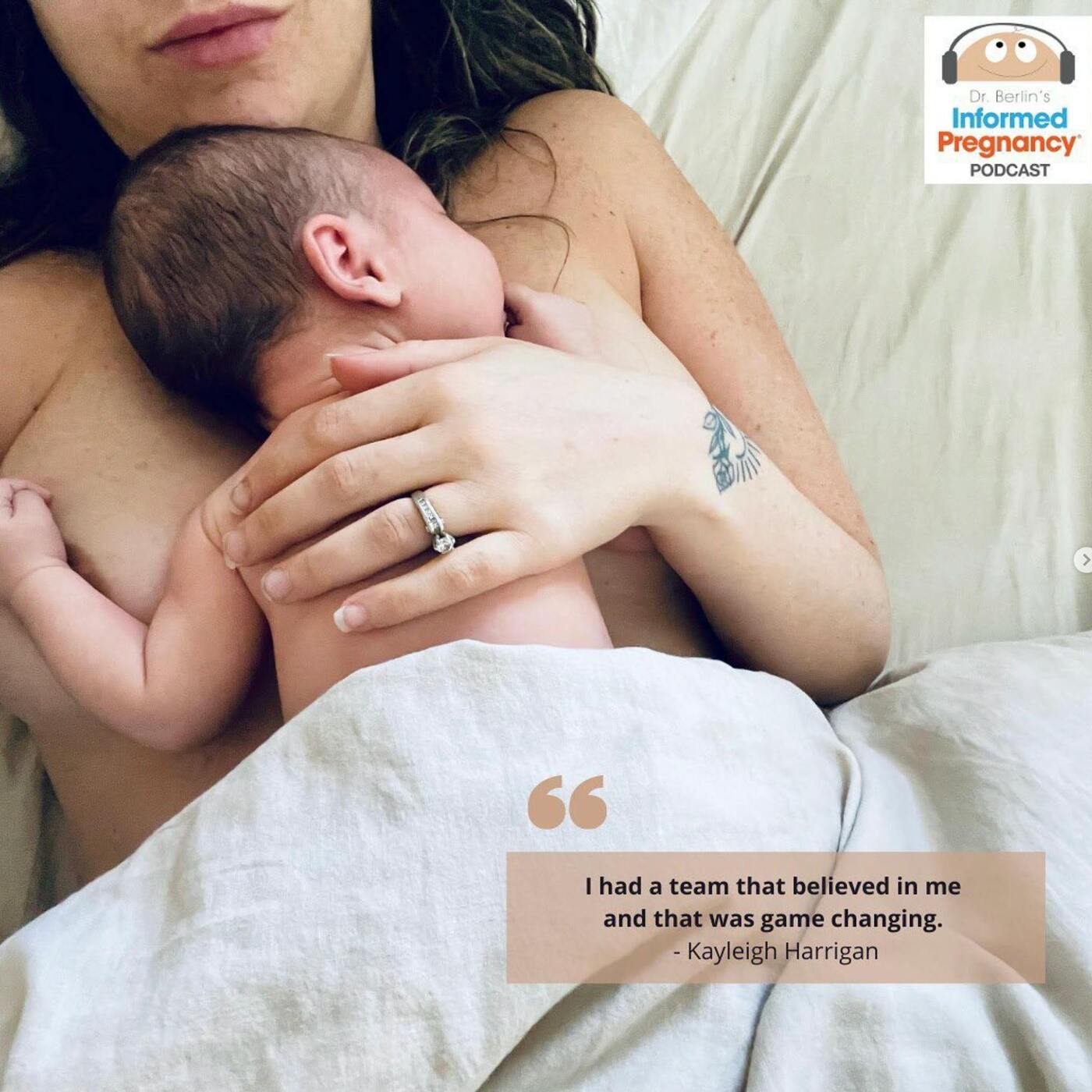
Kayleigh Harrigan [38:46] That's really cool too. Yeah, yeah. I really had a team who believed in me. And that, you know, went a long way.
Dr. Elliot Berlin, DC [38:52] I believed in you. I was just home sleeping. Kayla, any final thoughts about your journey?
Kayleigh Harrigan [38:58] I don't think so. I can't believe I didn't cry.
Dr. Elliot Berlin, DC [39:01] Oh, I'm a terrible host. I should be able to move you better than that. Yeah, I was actually almost this close to tears actually at points in your story. So I had to mute my microphone to sniffle. Anyway, you're an amazing human. I'm so grateful to the universe for bringing you into my life for just a little moment there and to have a tiny role in your journey to help you at least get comfortable and somewhat prepared for your birth in terms of your body function. And, you know, I'll always be here for you, even in between now and your baby girl pregnancy, but certainly this. Thank you so much. It's been such a pleasure.
Kayleigh Harrigan [39:40] Ah, hashtag mutual.
Dr. Elliot Berlin, DC [39:42] Where can we find you online?
Kayleigh Harrigan [39:44] On Instagram, my handle is mothership underscore birth. And that will have all of the links to my website and things like that.
Dr. Elliot Berlin, DC [39:53] I will find you there. And we are on Instagram as well at Dr. Berlin. It's D-O-C-T-O-R-D-E-R-L-I-N. I gotta
Want more pregnancy + parenting? Start your FREE TRIAL of Informed Pregnancy+ and get access to all our curated pregnancy and parenting content — original series, iconic birth films like The Business of Being Born, prenatal workouts and more.
