
October 19, 2023 · 47 minutes · Episode 377
About this episode
At 38 weeks pregnant, Traci Burk is sharing the lessons she learned from her first birth and the unforeseen challenges she’s faced with her second pregnancy. Her story is one of strength and adaptability while planning for the upcoming birth of her second child.

Connect with the guest!
- Connect with Traci on social: https://www.instagram.com/traci.xoxo
Keep up with Dr. Berlin and the Informed Pregnancy Project online!
- Read about postpartum depression on the Informed Pregnancy blog: https://informedpregnancy.com/single-post/so-i-had-postpartum-depression/
- www.informedpregnancy.com
- www.instagram.com/doctorberlin/
- www.facebook.com/InformedPregnancy
- www.twitter.com/doctorberlin
Learn more about your ad choices. Visit megaphone.fm/adchoices
See Privacy Policy at https://art19.com/privacy and California Privacy Notice at https://art19.com/privacy#do-not-sell-my-info.
Key quotes
“Yeah, that was kind of the golden trimester for me. I felt amazing”
“intensity in the hospital? I think I went in a little naive. I just didn't really let myself think about that part. I just was like, I've got this. I have a very high paid tolerance. I figured it would be fine. And I think”
“I thought about getting a doula for a hot second. And my husband was like, that's silly. I'll be the doula. I've got it covered. So I think we just kind of went in thinking like, he'll help me through it. It's temporary. I'll push through. And I didn't really put too much thought”
“And I'm planning to go unmedicated and no pictosa in as natural as possible. And we're planning to create kind of the vibe and the environment to be as close to my home and a home birth as possible in the hospital.”
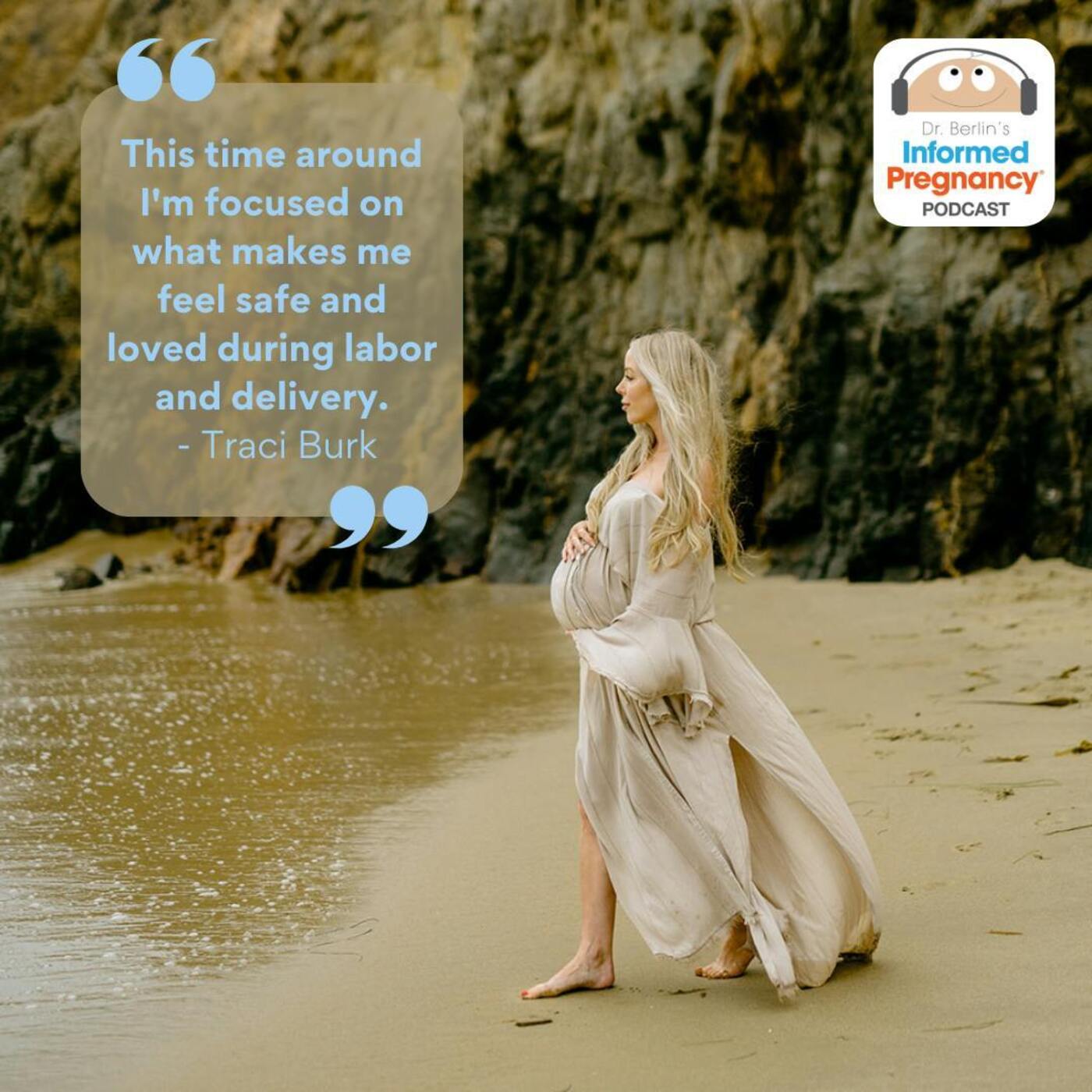
“I mean, I just think that this pregnancy has taught me that nothing really, and last pregnancy too, labor and delivery, you can have a plan, but pregnancy can go very unexpected and just like having the love and support of your partner and focusing on being optimistic and focusing on the best outcome is kind of what got me through these unexpected, false positives and unexpected results. And now I'm just looking forward to having the baby.”
Related episodes
- Ep. 378 Traci Burk: After Birth
- Ep. 336 Natalie Dreyfuss: After Birth
- Ep. 383 Caitlin Wilder: After Birth
- Ep. 382 Caitlin Wilder: Before Birth
Transcript
AI-generated transcript with speaker labels — may contain errors, especially names and medical terms. Dr. Elliot Berlin, DC appears in blue; Traci Burk in orange.
Download PDF of the Transcript
Dr. Elliot Berlin, DC [0:12] Welcome to the Informed Pregnancy and Parenting Podcast. I'm your host, pregnancy-focused chiropractor, Dr. Eliad Berlin. My guest today is 38 weeks into her second pregnancy. Although she leads a fairly natural and health-oriented lifestyle, her first birth didn't go as naturally as she had imagined. Today she'll be generously sharing insights from her first pregnancy and birth and giving us a glimpse into some of the unforeseen challenges she's faced during this current pregnancy. More than just anecdotes, these are lessons in strength, adaptability, and the ever-evolving plans for her impending birth. Tracy Birx, welcome to the podcast.
Traci Burk [1:15] Hi, Dr. Glenn. Thank you for having me.
Dr. Elliot Berlin, DC [1:18] Thank you for joining me. Thank you for coming to share your stories. Let's start at the beginning. Where are you from originally?
Traci Burk [1:25] I am from a small town in Alberta, Canada.
Dr. Elliot Berlin, DC [1:29] And you don't have the accent?
Traci Burk [1:31] Yes. Most people don't notice it. The odd word comes out, but usually no accent.
Dr. Elliot Berlin, DC [1:35] Is it boot? Is it a boot?
Traci Burk [1:37] Not that one.
Dr. Elliot Berlin, DC [1:38] I think sorry. Oh, sorry.
Traci Burk [1:40] Yeah.
Dr. Elliot Berlin, DC [1:41] What about the last letter of the alphabet?
Traci Burk [1:46] I have been very Americanized. I say Z now. I know. And when I'm in Canada, I say Zed.
Dr. Elliot Berlin, DC [1:51] Oh. Oh, you're adaptable. Chameleon of the last letter. But you said bean. I've been in America. So the random word does come out. Okay. How did you meet your partner?
Traci Burk [2:04] We actually met in Las Vegas right after I had finished my master's degree. I went for just a fun vacation and met him at a pool party in Las Vegas.
Dr. Elliot Berlin, DC [2:14] Wow. Okay. Back when that used to happen. So master's in what?
Traci Burk [2:21] Human ecology.
Dr. Elliot Berlin, DC [2:22] What does that mean in English or Canadian?
Traci Burk [2:25] It's the study of how we humans interact with our different environments, so there's different focuses. I focused kind of on the more localized environment, so family, parent-child, workplace, but you can go really broad and do more of like the political environment, economical environment. It's pretty broad. It's kind of like a strain of psychology in a way.
Dr. Elliot Berlin, DC [2:45] It sounds like psychology. So after that, do people normally go into some sort of psychological practice?
Traci Burk [2:51] Most commonly, most of my peers went into counseling, therapy, social work, things like that. A lot go into sales as well.
Dr. Elliot Berlin, DC [3:00] Does you understand what the person needs to overcome to make the purchase?
Traci Burk [3:05] I think there's a lot of psychology in sales, and that's kind of where my career path
Dr. Elliot Berlin, DC [3:09] took me. Interesting. Okay. So we'll get to that. Now you're at this pool party in Vegas, but not living there.
Traci Burk [3:16] Not living there. I was there for four days. Was he living there? No. He was not living there either. He was just there for a fun weekend as well. Okay. So where were you each living? I was living in Canada. He was living here in Los Angeles. It was kind of like love at first sight. We spot each other. We ended up hanging out together the whole rest of our trip. And then we both parted ways, kept in touch, and spoke every day. And I think it was like three weeks later, I actually flew out to see him and we started dating. And I don't think we spent more than four weeks apart. We did long distance for actually a long time, but we were together since we met
[3:54] in Vegas.
Dr. Elliot Berlin, DC [3:55] It sounds like you started dating the first time you met.
Traci Burk [4:00] Pretty much.
Dr. Elliot Berlin, DC [4:01] Yeah. And then how is that? It's an international long distance. Which part were you on? Eastern Canada? Western Canada?
Traci Burk [4:07] Western. It's kind of midwest. So not terribly far away. No. It's like a three hour flight directly north. It was fun. It was a lot of fun at first. I was young and I traveled for work at the times and so did he. So we would meet in different cities or he would come to Canada or I would come to LA as well. So it was a lot of fun. We did that for four and a half years or five years. Wow. And then what changed? Well, we got engaged about four and a half years in and then I moved here to LA
Dr. Elliot Berlin, DC [4:35] shortly after. Okay. And the relationship sounds like it was getting pretty serious with the engagement. Was kid something that you guys talked about?
Traci Burk [4:46] We both knew. We have a little bit of an age gap. So he's 11 years older than me and we both knew that we wanted children. We didn't really go into details about exactly when or exactly how many. I think it was like two or three one day. It wasn't very specific.
Dr. Elliot Berlin, DC [5:00] Okay until after we got married and how long from that point of engagement to you got married
Traci Burk [5:06] So got engaged four and a half years and I moved here about five years into the relationship And then we got married a year later, so we've been married actually just had our four-year anniversary last week
Dr. Elliot Berlin, DC [5:16] Congratulations. Thank you. So it's been ten years together four years married and about to be two kids in yes Okay, so I said in the intro that you live a fairly natural Health oriented lifestyle. What does that mean to you? So I try to Avoid taking you know any medications or antibiotics whenever possible. I eat as natural healthy as possible
Traci Burk [5:41] I don't eat a lot of processed foods. I don't eat red meat. I'm mainly as for protein. Just eat chicken fish Organic and I try to do yoga exercise Just in general. I'm not really crazy about it. But in general try to live as natural as possible
Dr. Elliot Berlin, DC [5:57] And is that since an early age what instilled that in you?
Traci Burk [6:01] Yeah, so I grew up in a very small town on an acreage actually about 20 minutes from that town The town had two stoplights a thousand people my mom put everything from scratch I think I had McDonald's for the first time when I was a teenager So she would make all of her food even like pizza She would make her own pizza dough pizza sauce The cows for the meat would be like a cow that was butchered at a local butcher shop Like everything was completely from scratch. So I think I kind of had that ingrained at a very young age Well, and then I always was just really into like health and fitness as well So I kind of did my own research a little bit as I got older as well
[6:38] And then when I moved off for college kept up with it I definitely did not get my mom's gene of cooking everything from scratch. I have a very busy life So I wish I had time to do that I love when she comes to visit but I order a lot of my food and purchase a lot of food But I'm very cognizant of where it's coming from and how it's made feels like a very
Dr. Elliot Berlin, DC [6:58] Natural time to plug my wife's cookbook plated by dr. Alyssa Berlin The whole idea is cooking on a busy lifestyle, but still being able to cook fresh and healthy. Okay, glad I did that Your husband is he of similar mind
Traci Burk [7:15] Actually pretty different I think so he grew up here in the US. He grew up on the East Coast and moved out to LA He's a TV producer. He moved out here when he was 17 And I think he grew up eating a lot of like packaged foods fast foods that sort of thing And he did not cook at all when we met he still doesn't cook at all Like when he was 18, he had his first Brussels sprout. Yes
Dr. Elliot Berlin, DC [7:39] Okay, so when you were pregnant you continued that pretty healthy lifestyle with your first baby What were your thoughts or plans or how did you imagine birth would be?
Traci Burk [7:51] So I Again wanted to try to keep everything as natural as possible starting from when I found I was pregnant I was really conscious of what I was putting in my body and exercise and things like that Although the first trimester was really rough for me. So it was at that point kind of whatever I could get to stay down a Lot of nausea. Yes nausea and vomiting for the first I think was about 14 weeks Yeah, nausea every day vomiting like every other day Feeling like I couldn't drink water. So it was which is tough. I love drinking water I drink a lot of water normally but when I'm pregnant it's a struggle for me And I'm not usually a good juice drinker or sugary drinks
[8:28] But the first half of my pregnancy's I do have to drink like other beverages just to stay hydrated
Dr. Elliot Berlin, DC [8:34] Did you pick up any tips over the two pregnancies on like how to mitigate some of that nasty feeling?
Traci Burk [8:41] Yeah, so I found what worked best for me was eating first thing in the morning the second I got up I would have some crackers or something with carbs and then also protein really helped as well But just not letting my stomach be completely empty And that was probably the worst and then trying to drink on an empty stomach would cause instant nausea and vomiting So definitely keeping my stomach somewhat full and then drinking small kind of sips of water frequently
Dr. Elliot Berlin, DC [9:04] How do you work when you feel that way all the time?
Traci Burk [9:08] You know the first pregnancy it was very strange. It was almost mind over matter I would only throw up in the morning when I was being ready or the second I walked in the door after work I'd never throw up at work or on my commute or anywhere strange. It was always at home in a convenient time So yeah, I was almost like I got to work and was able to put it aside
Dr. Elliot Berlin, DC [9:28] Wow, that's kind of fascinating The times I'm nauseous. I'm gonna have to throw up. There's no stopping it Okay, so then first pregnancy second trimester after about 14 weeks It sounds like things got a little more comfortable
Traci Burk [9:43] Yeah, that was kind of the golden trimester for me. I felt amazing second trimester No more nausea was loving my growing belly and just was really excited and We're able to like resume exercise. Yeah, I think I actually did work the first trimester as well. I would kind of push myself through. I stayed really active that whole first pregnancy through all trimesters. I was hiking and doing yoga at home. I do like weightlifting at home as well. I love to go for walks. I was doing all of that. I mean how'd your body feel like in that second almost third trimester with the workouts? Good. Towards the third trimester I started to get some kind of aches and pains the bigger I
[10:25] got, which is when I met you and started coming to see you, which really helped a lot. But I think in general being very active that pregnancy helped just feeling good up until the end. So as you got closer to the end, did you explore options for labor and birth? So with my first pregnancy I did not. I just planned to deliver at the hospital. I chose the closest major hospital to my work and same with my OB at the time. So I was going to you know I was going to be in my work and the hospital she delivered at is like the biggest hospital here. I think the most popular for births I believe. So that was just kind of what my plan was. But I did plan to go in
[11:07] unmedicated and try to keep everything you know as natural as possible in the hospital setting. In line with how you do your general life, right? Yeah. I didn't plan to have anything artificial. I did not want to have
Dr. Elliot Berlin, DC [11:20] pitocin or an epidural or anything like that. Okay. Did you do any
Traci Burk [11:24] classes or read any books? Watch any documentaries? Listen to an amazing podcast? Anything like that? So your podcast is probably my number one source of information. Wait till you hear this episode. Wow. I looked into that on my daily commute. And then I did watch a few movies. Business of Being Born. I did watch that one. I love the idea of a home birth but with it being my first birth and my husband was definitely more comfortable with me being in a hospital as well. We never seriously considered a home birth. It was always the hospital. I can't remember if I read any books at that time. I was gifted the What to Expect When Expecting book. I
[12:00] think I flipped through that. But just got a lot of information from your podcast and friends that had gone through their own pregnancy. So no class? No classes, no. It was also during COVID so there was a lot of restrictions. Everything was online. I did do some hypnobirthing podcasts and tracks but no actual classes. Did you have any concerns about the intensity or did you have any plans on how you might cope with that intensity in the hospital? I think I went in a little naive. I just didn't really let myself think about that part. I just was like, I've got this. I have a very high paid tolerance. I figured it would be fine. And I think I thought about getting a doula for a hot second. And my husband was
[12:45] like, that's silly. I'll be the doula. I've got it covered. So I think we just kind of went in thinking like, he'll help me through it. It's temporary. I'll push through. And I didn't really put too much thought into how intense it would actually be. Okay, let's take a little break
Dr. Elliot Berlin, DC [13:01] when we come back. We'll find out how this labor and birth went down.

Dr. Elliot Berlin, DC [14:42] Welcome back. We're talking to Tracy Burke, pregnant 38 weeks into her second pregnancy. We just found out the first birth, you entered that one a little bit in your words, naive, underprepared, I suppose. So the plan was go to the hospital, have your baby with no drugs, no interventions and your was your New York East Coast not-so-healthy-diet husband?
Traci Burk [15:05] That is pretty correct. Good recap! Okay, so how does labor start, and when? So my water actually broke two days after my expected due date. Where were you? I was at home. I think I had woken up. It was around 7.45 in the morning. I woke up to go use the restroom, and at first I'm like, am I peeing, or is this my water? And it was just kind of a trickle that wouldn't stop. Soon realized it was definitely my water. It kept on going. I woke up my husband, and it was pretty exciting because it was a couple days after the due date, and we were worried about having to do an induction, which I really didn't want. Was your doctor, did they give you some kind of timeline?
[15:48] Yeah, my doctor had actually wanted to induce me, I think. I want to say she had suggested inducing right on the due date. I really didn't want to do that, so we kind of came to a middle ground, and I had induction actually scheduled for 41 weeks plus one day. Okay, so you're just a few days away from that. Well, almost a week away from that. Yeah, but I was kind of doing everything I could. Not everything I could, but my husband was giving me deep tissue massages, I was doing a lot of walking. I think the night before I actually tried the breast pump to get things going, bouncing on the ball, eating all the dates, the raspberry tea, everything I could do to kind of get things started.
[16:22] Romance? Oh, yes, we tried that too. I honestly think what happened the night before was no romance that night. It was the deep tissue massage and the breast pump, I think is probably what might have happened. The morning combination? Yes, also my baby, he was just very strong, and I don't know if this is possible, you might know better, but I would not be surprised if he kind of kicked the water open because his kicks were so strong.
Dr. Elliot Berlin, DC [16:45] Well, he comes from you. Yeah. And you're like 89% muscle. Thank you.
Traci Burk [16:52] So that's kind of what happened was the water broke, and then I did call my doctor's office, and they suggested or they said I need to go in the hospital right away for possible infection risk, which is at that point from your podcast I'd already known that, you know, if my contractions don't start, they are going to want me to go on pitocin to get things moving. And I was feeling perfectly fine, no contractions at all. So I kind of really took my sweet time. I had a shower and got ready. We packed our bags. The hospital was about 45 minutes away from us, so we drove over there. We went for a nice lunch at a restaurant near the hospital. I think it was about eight hours later
[17:29] when we finally went and checked in.
Dr. Elliot Berlin, DC [17:31] Eight hours after your water broke?
Traci Burk [17:32] Yeah.
Dr. Elliot Berlin, DC [17:33] Okay. So yeah, just to avoid any confusion, you picked a hospital that's very close to where you work.
Traci Burk [17:38] Yes.
Dr. Elliot Berlin, DC [17:39] Not super close to where you live.
Traci Burk [17:40] Correct, yeah.
Dr. Elliot Berlin, DC [17:41] Okay, so that's why the 45-minute ride there. Okay, so you don't feel anything. One question, before this happened, had your cervix been checked?
Traci Burk [17:51] I did have a membrane sweep, I want to say probably about five or seven days before that. And I think I was maybe a half centimeter, or once a mirror at most.
Dr. Elliot Berlin, DC [18:01] Ah, only nine and a half to go. Yeah. We like to say. Okay, so you get to the hospital and what happens there?
Traci Burk [18:09] So I'm still feeling great. My husband and I are, you know, laughing, joking, having a good time. When we go to triage, get checked in, they were going to check my dilation, but realized, yes, your water has definitely broken. And they said it was not safe to check at that point just for infection risk. So I had no idea where I was at in dilation points. And then they immediately said, I need to go on pitocin since I wasn't feeling any of the contractions. They could see them on the monitor, but it wasn't anything that I was actually feeling. As you know, I did not want that. So they basically said, we'll give you another hour and a half to two hours
[18:42] if you're still not picking things up, then we'll have to do the pitocin, which is what happened. I think about an hour and a half to two hours later, I was moved into labor and delivery room, still not feeling anything that was remotely painful. So I did get connected to pitocin. Had you had any pain relief medication at that point? Nothing, no. I wasn't in any pain at all, actually. I wasn't feeling any contractions. I was still feeling really good.
Dr. Elliot Berlin, DC [19:08] Yeah. Sometimes though, before they start the pitocin, they recommend that you get an epidural.
Traci Burk [19:14] They had offered the epidural, but it wasn't something that I had planned on doing at all. So I turned it down.
Dr. Elliot Berlin, DC [19:18] Okay. So the pit usually starts in increments. Did you feel a change?
Traci Burk [19:23] Yeah, pretty instantly I started feeling the contractions and the nurses would come in, I want to say every like 30 minutes and keep cranking it up. It got very intense very quickly. And I labored that way for about six hours with the pitocin. Do you have a memory of what the intensity felt like and where? It was all in the front for me, lower front. Like right over your pubic bone or down into your cervix? I wouldn't say that low. It was kind of just all my entire uterus, like my entire front abdomen. The lower belly. Lower belly, yeah. No back labor, but yeah. And it kept getting more and more intense. and my contractions were over a minute long coming like every minute. It was like I would
[20:05] barely catch my breath and they would keep on coming. At that time, do you remember if there was anything that helped you stay calm or sort of mitigate the intensity or the pain? My husband was trying to help with just distraction with squeezing my shoulders and my neck just really strong. That really helped. We didn't really know a lot about the hip squeezes, so we didn't try that. So he was mainly focusing on my neck and shoulders, which is where I naturally carry a lot of tension. I think it definitely helped and I was trying to focus on my breath and remain calm. But when I look back, I know I was really kind of tensing up and letting it kind of get to me. And they would come in every hour or two or every 30 minutes
[20:42] offering the epidural. And the more they would come in, the more tempting it sounded, you know, the worse things got. So eventually about six hours in, I think that was when the first time they came in and said, okay, we're going to check where you're at. And I found out I was only six centimeters dilated, which now I feel like that's actually really great. But at the time it felt like I was only, you know, halfway there. And I'm like,
Dr. Elliot Berlin, DC [21:05] I can't do this for another several hours. It's funny when you said only six centimeters. I was like, why is that only? It's more than halfway. But also the first half is like pushing that boulder up a cliff. But once you go over the edge, it tends to move fairly
Traci Burk [21:19] quickly. Now I know that. And I kind of wish I had to give it a little bit more time or realize, you know, how far along actually was. But at that point, I just kind of made the decision in the moment that I didn't think I was feeling really exhausted and really drained. And it was just getting really, really painful for me. So I opted for the epidural. And it was one of those things where it couldn't come fast enough once I'd made that decision.
Dr. Elliot Berlin, DC [21:42] Sure. Yeah. Do you remember the process of getting it?
Traci Burk [21:46] Yes. I want to say it probably took about half an hour for the anesthesiologist to come. He had me sit on the edge of the bed and kind of curl into a ball as tightly as I could. And then I think it was in between contractions. I honestly didn't even feel the needle. I know a lot of people are scared about that, but nothing compares to the contractions. So that was kind of a breeze getting the actual epidural. Okay. They inject you with numbing
Dr. Elliot Berlin, DC [22:09] medication first before they put in that bigger needle. And then they numb the path all the way from the surface down to as deep as the needle needs to go. So once it goes in, people don't usually feel much. Yeah. Okay. So did it have the desired effect?
Traci Burk [22:24] It did. Yeah. So pretty quickly, I pretty much took most of the pain away. I could feel a little bit of pressure and I can tell when I was contracting, but I did take most of the pain away. I was able to sleep. Both my husband and I were able to get a few hours of sleep in. At this point, it was like one in the morning. So we did get some sleep in. And then my actual OB ended up being out of town that weekend. So there was Dr. Goldberg was actually the one on call. He was a little angel. Yeah, he was amazing. So he was our doctor on staff and he came in and had met with us. And then the nurses had came and checked me again. I want to say at seven in the morning, I found out I was 10 centimeters,
[23:03] called him. He kind of casually strolled in and was like, let's get this baby delivered. And everything went really smoothly from there. The pushing was only, I want to say 40 minutes. Okay. And were you able to feel it? Did they tone down the epidural? You know, I wish it had been toned down a little bit more. I could kind of feel a little bit of pressure, but I would say like, I was completely paralyzed from the waist down. Like I really couldn't move my legs at all. And it was really not a lot of feeling.
Dr. Elliot Berlin, DC [23:31] It sounds like you wanted to be more in it.
Traci Burk [23:34] Yeah. I mean, I guess I can't complain with everything went very smoothly. The pushing was yeah, 40 minutes, no tearing, no complications, aside from having to get the pitocin and the epidural, which I had not really wanted at all. Everything did go smoothly from there. How was your recovery? Recovery was actually really great. It did take a while for me to be able to feel like I could walk with a few hours after the epidural and the recovery room was tiny, but we were there for two days. Our son had a little bit of jaundice. So he was under the lights at the hospital for a couple of days. And I felt great. I think it really helped with the exercise and everything I'd been doing beforehand. Yeah. I mean, fit people recover
[24:22] obviously better. And no tearing as well, which was really a blessing too. That's amazing. Yeah. And I think postpartum wise, like I had my parents had flown in from Canada. My husband actually took a few months off from any work. So it was kind of like a blissful postpartum period. And how was breastfeeding for you? In the hospital, it was actually really stressful. He wasn't really getting a good latch. We couldn't figure out why. And they actually had me supplement with some formula they had, which is also something I hadn't planned or wanted to do. But he seemed really hungry, but just wasn't able to latch properly. So that was really defeating I had actually met with.
[25:00] a lactation consultant at the hospital and it just didn't seem to be working out well for me. But the second we got home, my milk came in and everything changed and we actually had a really great breastfeeding journey for 11 months. We breastfed until he kind of self-weaned. Oh, amazing. Is there looking back at that hospital experience with the breastfeeding that you learned from it that you would do differently this time? You know, I don't know what it was that was causing him to not feed properly at the hospital. But honestly, the second we got home, everything changed. Maybe it was just like the environment. Maybe I was feeling too stressed or there was just too much going on there and
[25:36] we came home and it was very quiet and peaceful. I don't know what it was or maybe it was just my milk came in. Yeah.
Dr. Elliot Berlin, DC [25:43] Yeah. Is that Canadian to say milk? Like it's, I mean, okay.
Traci Burk [25:47] Maybe.
Dr. Elliot Berlin, DC [25:49] Okay. So now pregnant again with baby number two, your plans for birth. I mean, you learned a lot through the experience, right? So from the things that you learned at your birth experience that you didn't know before with your second pregnancy, had you made any changes in planning for the second birth?
Traci Burk [26:13] Yes. So when I first found out, I actually went back to the original OB that I had been seeing with the first one just to make sure everything was good and find out there was only one baby, all that stuff. But I actually had planned and wanted to do a home birth was what I was initially thinking. My plan was kind of to keep seeing the OB and then start interviewing midwives and then maybe, you know, halfway through the pregnancy, completely switch over to the midwife. I didn't want to completely let go of the OB at the beginning until I knew everything was okay. And then we started getting, as you know, a lot of surprises coming up. But yes, I have always kind of dreamed about that dreamy home birth at home
[26:52] with my husband. Well, surprises are not what you want in pregnancy. Let's take another break
Dr. Elliot Berlin, DC [26:58] and we come back. We'll find out what happened. We'll be right back. Welcome back. We're talking to a very pregnant Tracy Burke. Okay. So second pregnancy, you're like, okay, now I get it. I want to deliver this baby at home. I want to feel it. I want to be in it. I want the more intimate setting, but you're holding onto an OB for the first half of the pregnancy.
Traci Burk [27:28] And then surprises happened. What happened? So I had the NIP test done at around 10 or 11 weeks, which checks for the most common chromosomal disorders. I think there's about 12 disorders it checks for as well as the gender of the baby and got surprising results back from that. My OB called me actually with bad news. Basically she asked if I was sitting and said that my test had came back as basically a possible positive for Turner syndrome, which is rare and severe chromosomal disorder that can only happen to female babies. So I found out that we were expecting a girl. Our first one was a boy, but the bad news was that it came back possibly having Turner's. She did tell me that there was a 50-50 chance that it
[28:16] was a false positive and that that specific disorder has a fairly high chance of having a false positive, but it was devastating to hear. I was at work at the time. It was really
Dr. Elliot Berlin, DC [28:27] traumatic to hear that. Wow. Well also 50% chance of false positive. I don't even know
Traci Burk [28:34] how to ingest that in the moment. Does that sound amazing or does it sound awful? I mean, the news to me was awful, but I kind of hung on to the 50% of the positive.
Dr. Elliot Berlin, DC [28:46] Okay. So the NIP test is that NIPT. Then we can do non-invasive prenatal testing for a bunch of different things. And Turner syndrome is a sex chromosome disorder where a female baby only has one X chromosome instead of two, and there's no cure for it. Okay. So then you had to call your husband. Yeah. So before we got off the phone, I actually asked her what was like the
Traci Burk [29:13] worst-case scenario. I had never heard of Turner syndrome. I didn't know what it was. She told me that if it was a true positive, that 1% of true Turner syndrome babies make it to birth, that they would typically end in miscarriage and that she would recommend a medical termination.
Dr. Elliot Berlin, DC [29:29] That's what she had told me. Wow. Yes. And then- How far along were you when you got those news? I think 11 weeks. Okay. So then you call your partner.
Traci Burk [29:41] Yeah. I called my husband. I didn't want him to stress as much. So I don't know if I maybe sugar-coated it a little bit for him, but told him the good news and the bad news. Good news, we're having a girl. Told him the bad news, but also that it's a 50-50 chance that everything could be perfectly fine. The next step was that we see a fetal medicine- specialist. So I think I got in to see this doctor less than a week later. He did an ultrasound and everything looked perfect on the ultrasound. He told me that he, you know, strongly felt that I was one of those, you know, people who was falling into the false positive, but we weren't able to do an actual diagnostic test until 16 weeks when we could do an amniocentrisis.
[30:21] So we had about six or seven weeks of really not knowing, but just hanging on to the hope that everything looks good on the ultrasound and this does have a high chance of a false positive.
Dr. Elliot Berlin, DC [30:31] That sounds horrifying, like the mind. How do you stay calm?
Traci Burk [30:36] It was really difficult. We didn't tell anyone at that point that we were pregnant, so none of my family or friends knew. And we decided we didn't want anyone to know until we knew that everything was healthy and safe either. So yeah, it was a really challenging month and a half of waiting to find out. And we did have a couple of options from the fetal medicine
Dr. Elliot Berlin, DC [30:54] specialist. We could do chorionic sampling. Oh, CVS.
Traci Burk [30:59] Yes, that was the one which we could do sooner, but it wasn't as accurate or we could wait for the amnio for the fluid test at 16 weeks. And it has less of a risk of causing miscarriage or anything like that. So we ended up opting to wait a little bit longer for the amnio based off the recommendations from the doctor. Wow. I don't know how you got through the minutes,
Dr. Elliot Berlin, DC [31:19] the hours, the days, and the weeks. My heart is racing, and I know that in the end, that wasn't even the diagnosis. So what was the experience of the amnio like?
Traci Burk [31:31] I wasn't too worried, but I did a lot of research beforehand. And the doctor that I was seeing, the specialist was really calming and kind of walked me through it. My husband came with me. He did an ultrasound to find out exactly where the baby was and make sure there was a good pocket of fluid away from the baby. There's no risk of the baby. He numbed my stomach. So basically there's two options depending on where the baby is located. And you can either go through your stomach or vaginally based off the position of my placenta and where the baby was. It was through the stomach, which I think is a preferred location anyways. So he had a good spot there. He kind of had the ultrasound tech pressing pretty
[32:08] hard with the ultrasound machine to make sure the baby stayed on the one side of my uterus. And he numbed the area where he was doing the needle. And then it's almost like a blood draw, but he's taking out amniotic fluids. So it was pretty quick, really not painful aside from the pinching from the numbing. And they do recommend that you stay off your feet and rest and relax for the 24 hours after. And we didn't even talk about it, but how was your nausea, your first trimester symptoms the second time around? Oh, yes. So that was another ball game too. So I had really intense vomiting and nausea, much worse than first pregnancy. The vomiting and nausea lasted for me until about 18 weeks
[32:50] with this one. And it was every day, didn't matter where I was. I had a bucket in my car and mastered driving down the freeway when having to throw up. So that was really rough.
Dr. Elliot Berlin, DC [33:03] I did say at the beginning, resilient and vibrant. And now we can all see why. I mean, how you're feeling inside and how you're feeling outside. And on top of that, that you don't really take medication to numb at all is incredible. Okay. So you finally get the results.
Traci Burk [33:22] Yes. It took about 10 days for the true results to come back. And it came back. The baby was perfectly fine. No turners. Okay. So now you're halfway through your pregnancy. Yes. And is the plan still the same? Like, okay, fine. Now I'm going to switch to a midwife and have a home birth. So at this point, it was a huge relief. We announced to all of our family and friends and we allowed ourselves to finally be excited. And the reason I hadn't actually started interviewing midwives or anything was because I didn't know what was going on with this possible diagnosis. So I started to allow myself to think about that coming labor and delivery. I started interviewing midwives and really going down the rabbit hole of do I want
[34:01] to go to birth center or be at home? And what's the best option for me? I contacted a lot of different like midwives and birth centers in the area. Okay. So I did find a couple of midwives. I really liked everything was going well. I was kind of, you know, about to make my decision and plan. And then I went in for routine ultrasound with my OB. I think it was at 30 weeks and she noticed that the bowels or the colon were brighter than normal. It's called an ecogenic bowel, I believe. So she referred me back to the same fetal specialist that I thought I was done with. So I went in to see him. He was actually pretty dumbfounded. He'd never seen this before. He did say that this could be completely nothing. It might be
[34:44] a variation of normal was the term he had used and might be absolutely nothing. But he did say he was going to send my ultrasound to all of his renowned colleagues for their opinion. And we also did a blood test to rule out any sort of possible infection I could have that could be causing that.
Dr. Elliot Berlin, DC [35:00] He's very, very experienced, seasoned and well-respected as a leader in his field. So the fact that he looked at it and A, was dumbfounded. I don't know if that feels good or bad, but the fact that he thought it was probably nothing seems like reliable.
Traci Burk [35:16] Yeah, it didn't feel very good. I was having flashbacks the first trimester and in my head, I'm like, did they mess up the Turner's result? Like what is going on? So he ended up calling me back to his office a couple of days later. He was like, I think we know what it is. All of my colleagues are on the same agreement. So I go back in thinking worst case scenario. He tells me what he thinks it is, is something called cystinuria, which is a predisposition for kidney stones. So I personally didn't know a lot about kidney stones. Nobody in my family has ever had kidney stones. Same thing with my husband. Apparently when people have kidney stones, there's about 10 different types of stones that you can get. I think it's
[35:56] about 8% of these stones can be caused from cystinuria, which is basically your body isn't able to break down cystine, which is like an enzyme in the urine, which can develop stones over time. So it's not a severe life threatening condition. It's just more of a nuisance that our daughter will likely have to deal with kidney stones in her future. People with cystinuria usually have their first stone in like teenage or young adult years. And there are medications that you can take to help minimize the risk of it. And also diet wise, like a low salt or low animal fat, animal meat diet can help minimize that as well. So basically on the ultrasound, the glowing of the bowel could be the cystine
[36:35] that her body's not breaking down. He was pretty confident that that's what it is. We were very relieved actually to find this out. LARSON Especially with the collaborations with all of his existing colleagues who research and write on this topic. Yeah. And just knowing that it's not life altering, life threatening condition, the reason they don't test for it is actually genetic. So basically my husband and I both have one of three genes. We ended up doing some genetic testing after this to find out, but my husband and I both have one of three possible genes that can be a factor of causing cystinuria. So that's another reason they're pretty confident, but that's
[37:11] what it is. But it's not something that's routinely checked for just because it is not like a serious condition. So we were pretty relieved to find that out. I've done a lot of research. However, that was not the last of the surprises. So about a week later, I had done the blood tests initially to rule out any possible infection. I did get a positive result back for toxoposmosis, which is something I also was not familiar with. Turns out that that is a very common infection to get as an adult from changing cat litter or eating undercooked meats are the most common ways to get it. And it usually doesn't cause any symptoms in adults, but if you do
[37:50] contract it while pregnant, it can be very severe, even for the baby life threatening.
Dr. Elliot Berlin, DC [37:57] Yeah. It's a parasite. Yeah. Infection. Yeah. But you don't have a cat.
Traci Burk [38:03] I don't have cats. I don't eat red meat. I definitely don't eat anything raw. I was just thinking, how can this be? I must be the most unlucky person in the world if I'm getting this from, I hardly any meat at all. And there is a rare chance of getting it from underwashed fruits and vegetables. So I'm thinking that had to have been from where I had got it. I'm thinking worst case scenario at this point, because it can cause brain damage, blindness, really severe outcomes. So the specialist did tell me that the next step, there's only one lab in California that actually does a diagnostic test for this. So I had to do another blood test. We sent it off to the lab in San Francisco,
[38:39] waited about a week for the results. And this is also another test that I was told has about
Dr. Elliot Berlin, DC [38:44] a 50-50 chance of being a false positive. The first test you did for general infection.
Traci Burk [38:50] The toxoplasmosis. Yeah. The general infection. I don't know exactly what was all checked
Dr. Elliot Berlin, DC [38:54] for. What toxoplasmosis was one of the infections among other things. Right. So that test had a 50% false positive for toxo. And then you did a test for
Traci Burk [39:04] conclusive finding. Yeah. So there's one lab in California that can actually do a conclusive test and we had to send the blood off there. It was a little bit of, you know, time consuming because it was Friday when I found out about this, we couldn't send the blood work until Monday. It took about a week to get the results. And that was also another intense week and a half of thinking, you know, I have a severe infection that could be harming
Dr. Elliot Berlin, DC [39:25] my baby. By this point, did you already know that the shiny bowel was most likely stones
Traci Burk [39:31] oriented? They had already told me that they were thinking. So this is the last piece. So now we're like, okay, it's probably not that. And it's probably could be toxoplasmosis too. But luckily the results came back negative. So as my second false positive result during this pregnancy, the results from that came back negative. So I did not have toxoplasmosis and that was another big sigh of relief.
Dr. Elliot Berlin, DC [39:55] Yeah. There's one lab in California for 44 million people can only imagine. in like smaller states and towns, like where they have to send it out to.
Traci Burk [40:05] You know, both my doctor and the specialist said that they had never had a patient actually be positive for toxoplasmosis. You would have been my first too. Yeah, and they did say that they have had several false positives. So apparently it's quite common.
Dr. Elliot Berlin, DC [40:19] You're my first false positive. Okay, so then how far along into the pregnancy was all that happening? So I think I found out at 30 weeks with the ecogenic bowel. So I think that was around like 33 weeks.
Traci Burk [40:34] So really just five weeks ago. Yeah, yeah, it was about 32, 33 weeks. During this time with all the stress, my husband and I actually decided that it would be best for us to just deliver at the hospital again, just with kind of all of these scenarios and unknowns that had popped up throughout the pregnancy. So as much as I was really wanting the home birth, I ultimately decided that I feel more comfortable with this pregnancy delivering at the hospital again. But I have some other plans to make it a little bit more in line with what I'm looking for. But we kind of kiboshed the home birth. The out of hospital birth.
Dr. Elliot Berlin, DC [41:09] Yeah, so what are those plans look like?
Traci Burk [41:11] So we are delivering at the same hospital. I have the same OB, but I've hired an amazing doula who you actually recommended, Stacey. She's our doula. And I'm planning to go unmedicated and no pictosa in as natural as possible. And we're planning to create kind of the vibe and the environment to be as close to my home and a home birth as possible in the hospital. I have a lot more tools this time around to really hope that that can happen.
Dr. Elliot Berlin, DC [41:37] We have two people now, your doula and your husband giving different types of love and support and encouragement and I don't know, helping you find your feeling safe and feeling empowered. What other tools?
Traci Burk [41:51] So different massage, the hip squeezes, different massage techniques is what Stacey and my husband are both planning to do. We have a playlist. We have different scents and essential oils we're using. She'll be bringing candles and lighting, just kind of really setting the environment.
Dr. Elliot Berlin, DC [42:08] I feel like one big thing, what did you wear the first time? Were you in the hospital gown?
Traci Burk [42:12] I was in the hospital gown. So this time I am not planning to wear that. I have a different, well, I'm not planning to get the epidural. So I actually didn't order the hospital gown because it has a little hole in the back. I have like a different kind of comfortable nightgown I'm planning to wear, kind of for before and after. And then while I'm actually in labor, I'm planning to be in water, whether I get a room with a shower or a tub. So I'm probably planning to just wear a sports bra.
Dr. Elliot Berlin, DC [42:35] Yeah, I find out that a lot of key people when you wear something that you would wear like to the gym, obviously not something super tight around your waist, but you catch yourself in the mirror and you see someone who's strong and healthy and vibrant and who can push herself physically and mentally versus when you see yourself in a hospital gown, that is all the signs of I'm not well. I need help. I can't do things for myself. People have to do them for me. And that just makes a huge difference like to your nervous system.
Traci Burk [43:06] Yeah, exactly. I think it's a lot of these little things that I've kind of overlooked the first time that I think will help play a factor. We went over some exercises with like what my preferred kind of things are for all the five senses and what makes me feel safe and loved and different things like that. I'm doing the hypnobirthing tracks again as well for just meditation, relaxation and breathing. My OB is aware of my birth plan as well. And I'm actually planning to do no IV at all. So just not even having like that option of having the IV in and getting the Pitocin.
Dr. Elliot Berlin, DC [43:40] Probably gonna be a little bit of a struggle when you get to the nurses. Just their comfort zone is for you to have the IV. So you're saying not even a HEP block?
Traci Burk [43:50] So my doctor did say that they will probably really try to push for the HEP block, which is just when there's the port that is in but you're not connected, right? Yeah, yeah. But I'm going to try to turn that down as well. So we'll see what happens. But, you know.
Dr. Elliot Berlin, DC [44:05] Oh, a little suspenseful cliffhanger here at the end. But also you live far away still. You still live where you lived and you're delivering where you delivered. So is there any thought on laboring someplace nearby the hospital before you actually go to the hospital?
Traci Burk [44:22] So my deal is recommended that we kind of wait until the contractions. Hopefully I have contractions this time before my water breaks. But the plan is once they're about five minutes apart for about an hour or less, we're actually thinking it could be obviously a little bit quicker with this being my second baby. We're going to hop in the car and just meet her at the hospital and kind of get checked in and labor. Turn the labor and delivery room into my little cocoon. We have a plan of rotation through either the tub or the shower, the toilet and the bed. We're planning to kind of rotate through all those. And she is also going to make sure that we don't have anyone unnecessary in the room,
[44:57] that sort of thing as minimal. intervention as possible. Even the monitoring, we're doing the wireless monitoring, hopefully. So that's something that hopefully they have it available.
Dr. Elliot Berlin, DC [45:07] Yeah. I mean, they always have wireless monitoring, but the technology is not always cooperating. But I don't know if I mentioned to you, like back in my doula days, in your scenario, we used to bring people to a hotel right across the street from the hospital. And then just the labor there in rooms that have a big tub and a shower just much more closely matched to your home setting than the hospital setting.
Traci Burk [45:31] You did mention that actually before, and that is an option. I guess it depends how quickly things are progressing. Like I feel it's like it's happening really quickly. Then I probably will skip that, but if it feels like things are going a little slow, then we're definitely gonna consider that option. Womb service.
Dr. Elliot Berlin, DC [45:46] Yes. Okay. Well, I'm excited for you. I'm glad after all those crazy emotional hurdles and some physical hurdles that you sound amazing, you look great, and you seem very well-prepped, learning a lot from your last experience and gracefully sharing it with us so other people can learn from it too. Any final thoughts before we talk to you again?
Traci Burk [46:13] I mean, I just think that this pregnancy has taught me that nothing really, and last pregnancy too, labor and delivery, you can have a plan, but pregnancy can go very unexpected and just like having the love and support of your partner and focusing on being optimistic and focusing on the best outcome is kind of what got me through these unexpected, false positives and unexpected results. And now I'm just looking forward to having the baby.
Dr. Elliot Berlin, DC [46:40] Well, I'm sending you the juiciest of positive birth vibes. And I know that all the work that you've done, mind and body and otherwise to get ready for this birth will pay off. And I look forward to talking to you on the other side in just a couple of weeks, see how it all went down. Before we go, Tracy, where can we find you online?
Traci Burk [47:01] So if anyone has any questions about anything you know we talked about, I am on Instagram at Tracy with an I, T-R-A-C-I dot X-O-X-O.
Dr. Elliot Berlin, DC [47:11] Ah, that's why it was already taken, Tracy dot X-O-X-O. Thanks again, Tracy. And at home, thanks for listening to the Informed Pregnancy podcast. If you'd like more pregnancy and parenting information, check out all the Informed Pregnancy media, the podcast, the blog, and the online streaming site at informedpregnancy.com.
Want more pregnancy + parenting? Start your FREE TRIAL of Informed Pregnancy+ and get access to all our curated pregnancy and parenting content — original series, iconic birth films like The Business of Being Born, prenatal workouts and more.
