
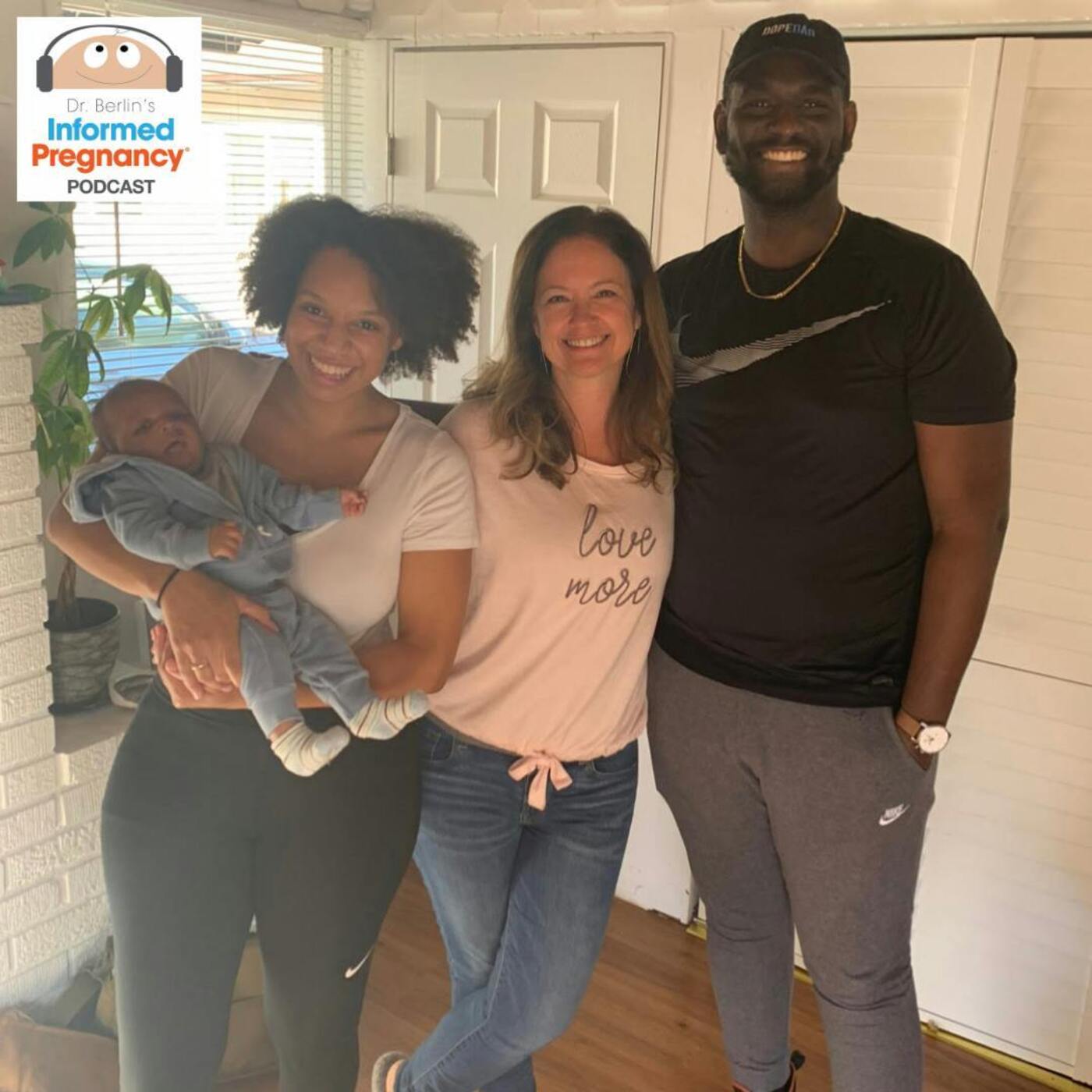
December 10, 2020 · 42 minutes · Episode 205
About this episode
Leslie, a talented poet, writer and fitness specialist and her husband, poet, singer and ‘Hamilton’ cast member Carvens just welcomed their first child. They join us to share their home-birth story together with their with midwife Blyss Young.

Enjoy special offers from our sponsors https://www.doctorberlin.com/sponsors .
Learn more about your ad choices. Visit megaphone.fm/adchoices
See Privacy Policy at https://art19.com/privacy and California Privacy Notice at https://art19.com/privacy#do-not-sell-my-info.
Key quotes
“So I played praise and worship music and then the top hit of hip hop music and just was dancing in my living room, trying to encourage myself and get myself hype and just keep my spirits up because maybe there would be baby tonight, maybe not, but I still wanted to have good energy and just really an open spirit and get excited for him to come whenever that would be.”
“It feels like a big wave and literally my movement was just like a sway side to side, facing the wall with my eyes closed and just really taking deep breaths and saying the words on the wall, which was like breathe the release.”
“And yeah, she laughed herself into active labor.”
“She's just done so much of that work on her own as a woman and as an artist that it didn't make it necessarily easy, but it was different, but it felt like territory that she's been in, which was like, "I must go through this thing in order to get the miracle that's on the other end of it."”
“And then the reality is it's a little bit harder work to get your baby out sometimes, but that moment that you got to grab your baby and bring your baby to your chest is such a beautiful moment.”
Related episodes
- Ep. 193 Leslie and Carvens Lissaint Before Birth
- Ep. 219 Mandy Moore – After Birth
- Ep. 223 Anna Prager – After Birth
- Ep. 214 Richelle Monae – After Birth
Transcript
AI-generated transcript with speaker labels — may contain errors, especially names and medical terms. Dr. Elliot Berlin, DC appears in blue; Carvens Lissaint in teal; Blyss Young in purple.
Download PDF of the Transcript
Dr. Elliot Berlin, DC [1:36] Welcome to the Informed Pregnancy and Parenting Podcast. I'm your host, Dr. Elliot Berlin, and today we're catching up with an amazing power couple who joined us during the pregnancy to talk about pregnancy and plans for birth. Now they've had their baby, congratulations. And they're super creative and talented in amazing ways that they've talked about. But we are joined not only by them and their little guy, Judah, but also by their midwife. Four of them know exactly how the birth went. I'm the odd man out, but I can't wait to find out and take you our audience along for the ride. Leslie and Carbon Lausanne and midwife Bliss Young, welcome back to the podcast.
Leslie Lissaint, Carvens Lissaint, and Blyss Young [2:13] Thank you. I say welcome back to Bliss too because she's no stranger. She's been on here several times and Bliss is like everything. She's like my mentor in many ways and I don't know, my little birth buddy that everybody should have.
Blyss Young [2:28] I love being with you. Thank you for inviting me.
Dr. Elliot Berlin, DC [2:32] But of course. Okay. So let's jump right into it because I know there's some juicy stuff to talk about here.
Carvens Lissaint [2:38] I said literally.
Dr. Elliot Berlin, DC [2:39] Oh, literally juicy. Yes. Yes. Okay. So here's the scoop. We are still, you've had your baby now for a little bit. How old's the baby?
Leslie Lissaint, Carvens Lissaint, and Blyss Young [2:46] Two months. Wednesday.
Dr. Elliot Berlin, DC [2:48] Two months. Congratulations. And you don't look tired at all, which is great.
Carvens Lissaint [2:53] Man.
Dr. Elliot Berlin, DC [2:54] At least it's just audio for the listeners. And we're still in a pandemic, news flash, that hasn't changed. And a lot of people after they have the baby like to stay in the house for 40 days, you don't have a choice. So there you go. Couldn't have worked out better. How was the end? So you couldn't really do… At the end of pregnancy, people usually do baby showers and things like that. Were you able to do anything like that?
Leslie Lissaint, Carvens Lissaint, and Blyss Young [3:17] Yeah, I did a virtual baby shower on Zoom with close friends and family from afar. I did one with family and I had a friend hosted and I did one with my friends from New York all over the different states. And then I did a third one, which is more like a woman's circle where it was more like a prayer circle and just affirmations for me for my birth that I use in the birth room where Judah's nursery is. I put all the affirmations up on the wall.
Dr. Elliot Berlin, DC [3:44] Oh, that's super cool. So only three then. You didn't have a big Orthodox Jewish chiropractic gathering. We should have done that for you. I feel bad. I wonder if that's going to stick now, because you were able to include so many more people by being virtual. No, you prefer the real thing.
Carvens Lissaint [4:00] Terrible. No, it's terrible. It's a terrible choice. Virtual, everything is awful. It sucks. I'm a people person. I'm in the business of people, so I need it. I actually didn't want to do any of it because it hurts more than it actually feels good to connect with people. Leslie's great. She's the look on the Bright Side kind of gal. I'm like, this is awful and I'd just rather sit and play video games than eat Oreos, which I did anyways.
Dr. Elliot Berlin, DC [4:24] Yeah. I mean, if you think about it, eating Oreos virtually is horrible.
Leslie Lissaint, Carvens Lissaint, and Blyss Young [4:29] Yeah, it is.
Dr. Elliot Berlin, DC [4:29] Yeah.
Leslie Lissaint, Carvens Lissaint, and Blyss Young [4:30] I just think it would have been nice to do it in person. It'd make the list smaller, but I do think there was something about having a lot more people available and different people sharing their thoughts, giving their wisdom. It was really cool to see my grandma on there and stuff like that. So there were some benefits of having a Zoom baby shower.
Dr. Elliot Berlin, DC [4:47] Any concept of a baby moon?
Leslie Lissaint, Carvens Lissaint, and Blyss Young [4:51] We did do that. We did a babymoon. Yeah. Wasn't what I dreamed of, but we went to… We did Airbnb Palm Spring.
Dr. Elliot Berlin, DC [4:59] Oh,
Leslie Lissaint, Carvens Lissaint, and Blyss Young [4:59] That's fun.
Dr. Elliot Berlin, DC [4:59] I though you were going to be like, "Yeah, we went to Trader Joe's."
Carvens Lissaint [5:04] We did go to Trader Joe's.
Dr. Elliot Berlin, DC [5:06] See? Because it was open. Yeah.
Carvens Lissaint [5:09] That was nice. We got to connect there. That was really nice. I actually appreciated that. We got to connect and talk and we spoke about our childhoods and we talked about how we want to parent. It was really beautiful to connect that way.
Dr. Elliot Berlin, DC [5:23] It's like the calm before the storm. In retrospect, I really love that moment before our first born was born because it was really like the three of us, he's fully formed in there and hanging out and it's just everything's an autopilot. So you don't really have to bathe him and dress them and feed them. At least I didn't have to. And then they come out and it's just like, wow, how did everything get taken care of yesterday? Because today it seems like a lot of effort. So it's nice that little calm before the storm.
Carvens Lissaint [5:55] LA. LA? Yeah. Being from New York, just being in a place that has good weather and makes it feel like it's vacation, but really no, it's not vacation. You do regular life things. So then when we did the babymoon, I was like, "Oh, we actually aren't doing anything." Before we thought we weren't doing anything just because the weather was nice, but really we were actually doing much.
Dr. Elliot Berlin, DC [6:15] Yeah. You run around a lot. How was the end of the pregnancy the last month or so for you, Leslie?
Leslie Lissaint, Carvens Lissaint, and Blyss Young [6:23] It was challenging once I hit 38, 39. I stopped teaching my classes. I had low energy, waddling a lot, and I felt like it was really hard to sleep. I was tossing and turning. I ended up start sleeping in our pullout bed because our bed was just uncomfortable for me. I think once I hit 40 weeks and then past the flexible date, I think that's when it got challenging mentally. I know that people, first time moms, they're usually a week late, but once that Friday, Saturday, and then I seen Bliss on Sunday, once that day hit, I was like, "Is he coming?" And then I think fear kind of started creeping in like, "What if I have to transfer? What if I have to get induced?"
[7:10] And I think 40 was eating ice cream, trying to do all the oxytocin things. I ate a lot of cold stone and walked and then 41 hit and it was like fear started sinking in and I really had to do a lot of mental work to get out of that place.
Dr. Elliot Berlin, DC [7:27] 41, when you were 41, I was still eating cold stone and just trying to help you out any way I could. You're welcome. Why is that? I mean, I know that the pressure's not coming from you.
Blyss Young [7:41] No. Good old California state legislation.
Dr. Elliot Berlin, DC [7:45] Oh right, because explain what that means.
Blyss Young [7:48] Yeah. So a few years back, the law changed in California and they limited the parameters of what they considered normal. And so my clients can only deliver out of the hospital with a midwife from 37 to 42 weeks. So unfortunately before this law, midwives were left to use their own discretion to make sure and monitor and make sure that the pregnancy was progressing normally and let labor begin on its own. But now that we have this date, I think it does put women into concern because they've worked so hard and planned to have this beautiful home birth and now they have a week. It's like seven days to make the baby come out. So we have lots of tools and tricks that we can use to help, although that wouldn't be my first choice, but we do have a lot of things.
[8:38] But if I'm remembering correctly, we didn't need to do anything. Is this true?
Leslie Lissaint, Carvens Lissaint, and Blyss Young [8:44] Correct.
Blyss Young [8:46] Correct.
Dr. Elliot Berlin, DC [8:47] Well, we need to surrender. Oh, little yum yum.
Leslie Lissaint, Carvens Lissaint, and Blyss Young [8:53] It literally was a week to the date or day after.
Carvens Lissaint [8:56] Yeah,
Leslie Lissaint, Carvens Lissaint, and Blyss Young [8:56] One day after.
Carvens Lissaint [9:02] Let the people here. Let the people here.
Blyss Young [9:04] That's right. We've done other podcasts with babies.
Dr. Elliot Berlin, DC [9:07] Yeah, but the babies doesn't bother me at all.
Blyss Young [9:09] No, me neither.
Leslie Lissaint, Carvens Lissaint, and Blyss Young [9:12] I was very fortunate that I didn't have to do any of the tricks. I just walked a lot. I think that was something, I think before as a personal trainer, I love to sweat. I want to really work out, do some intensive running. So walking during pregnancy, that was new for me. And so I went trying to walk for an hour. Then I got so tired, so I'm 41 weeks that it was like 30 minutes in the morning, 30 minutes maybe in the evening. So I broke it up because it was so challenging to just walk and it was also really hot. And I just remember one of the things I did when I was discouraged, as soon as the sun went down, that's when mentally it was really hard for me.
[9:50] And I started setting alarms at six o'clock and having a dance party. So I played praise and worship music and then the top hit of hip hop music and just was dancing in my living room, trying to encourage myself and get myself hype and just keep my spirits up because maybe there would be baby tonight, maybe not, but I still wanted to have good energy and just really an open spirit and get excited for him to come whenever that would be.
Dr. Elliot Berlin, DC [10:16] I'm curious, Liz, had the baby not come, what kind of tricks are you talking about as a side point?
Blyss Young [10:24] We have homeopathy, herbs, castor oil, stripping membranes, using a foley bowl. There's just a lot of things that we can do.
Dr. Elliot Berlin, DC [10:33] That sounds like quite an evening. I'm glad you guys didn't have to go down that path.
Blyss Young [10:39] Me too.
Dr. Elliot Berlin, DC [10:41] So I guess labor started spontaneously after one of these dance parties, but that is an excellent place to take a little break. We're going to be right back and find out how things got started. Don't go anywhere.

Dr. Elliot Berlin, DC [13:15] Welcome back to the Informed Pregnancy Podcast. We're talking to Leslie Carvers and Judah Lasant and midwife Lis Young. So you didn't have to do anything crazy to get your labor started. And you said you one week late, which also makes me kind of a little crazy because it seems to me like you were right on time.
Leslie Lissaint, Carvens Lissaint, and Blyss Young [13:36] Yeah, no, true. True.
Dr. Elliot Berlin, DC [13:38] I think that's part of the reason you go so nuts at the end is because you feel like you've passed the expiration date and you're late and something should have happened that didn't happen, but truthfully, not really. And it's not the expiration date. If anything, anything at all, it's just the sell by date and you still have two weeks to eat it.
Blyss Young [13:58] At least.
Dr. Elliot Berlin, DC [13:59] At least. At least. Otherwise we'd be throwing out all the eggs and cheese for no reason. So how did things get started?
Leslie Lissaint, Carvens Lissaint, and Blyss Young [14:08] I think it was after one of my dance parties, like five or six o'clock, I believe. I just remember being in the living room, kitchen area, talking to Carvins and Carvin started telling jokes. So one of the things we spoke about as we prepared and when we took Liz and Hayes's innate journey class, we talked about how do you prepare during early labor? What are some things, activities you can do? And one of the things Carvins and I broke down was jokes. Something that has really been healing for us during this pandemic time is to watch standup comedy. And so Carvenz literally did Dave Chappelle and Kat Williams comedy.
Carvens Lissaint [14:48] I memorized some portions of their and I just put on a show.
Dr. Elliot Berlin, DC [14:52] That's amazing.
Carvens Lissaint [14:54] That was around like 8:20 PM on that Tuesday, September the 29th. And yeah, she laughed herself into active labor. It was crazy. Quite literally. She was like literally that's what happened.
Dr. Elliot Berlin, DC [15:16] I wish we had some video of that standup comedy hour.
Carvens Lissaint [15:19] Yeah, it was pretty good. I can't do it here because of copyright, but you know.
Dr. Elliot Berlin, DC [15:23] Right. Yeah. It probably put me into labor anyway. So just as a quick side point, right before this pandemic happened, ironically, I was doing our standup comedy show and had a mutual client and she was there and she was at the table and this guy was making jokes. I though he was okay. He wasn't on fire that night. And all of a sudden you'd hear this one person go, "Ah, ah." And I'm like, "Wow, she really doesn't like that joke." And it was a little fine. Then a few minutes later, he's making another joke and she's like, "Ah." I'm like, "Who comes to a comedy club if you hate comedy?" And then after literally, I don't know, about almost an hour of that, she turns around and she comes up to me and she's like, "Hey, Dr.
[16:09] Berlin, your show's really great and so super funny, but I'm in labor and I got to go home." I buy into laughing yourself into labor.
Leslie Lissaint, Carvens Lissaint, and Blyss Young [16:18] It really happened. I remember stopping and I was like, "Oh, this feels different. This isn't just like Braxton Hicks." And I remember everything became movement. I couldn't walk. I would just stop right in the middle of a surge, not a contraction for us. I think that really helped changing the language just mentally. So I'm like, "Surge." And I would raise my hand and then let it go around and then stop. And then that's when they knew to time it, because it went from 15 minutes apart and then –
Carvens Lissaint [16:46] It started out for about four hours. They were probably about 20 minutes apart. And then around 12:20, they started getting a little closer. And then from 12:20 to 1:30, they were five minutes apart for that hour. And then I knew from our class that the 511 rules where we get popping, which is interesting because in the class, Bliss, you told us and that's when we called. And I called you and you were like, "No, no, honey, that's not…" And I kind of was a little hot because I'm like, "Wait a minute. I was going to say, in your class, you told us." I said, "Okay, I'm going to trust Bliss." Call the doula. It's active labor. So from 8:20 PM to about 1:30 AM, we were just laboring, watching Leslie labor.
[17:39] It was quite beautiful and difficult. That first hour was really rough because we didn't figure out our language yet. She's trying to figure out what movements she needed to do for us to be able to time the surges.
Leslie Lissaint, Carvens Lissaint, and Blyss Young [17:54] Yeah. I was grabbing their hand, pushing them.
Carvens Lissaint [17:56] She was grabbing,
Leslie Lissaint, Carvens Lissaint, and Blyss Young [17:57] Pushing – Time, go, go.
Carvens Lissaint [18:01] The funny story is, so Leslie's very words of affirmation. She used to be like, "You're doing great, girl. Girl, you killing it, girl." And she wants people to breathe with her. So she's breathing and we're breathing with her, but she can't really hear us. So she's like, "I can't hear you." But I was breathing so I almost passed out.
Dr. Elliot Berlin, DC [18:19] You were hyperventilating.
Carvens Lissaint [18:20] I'm like, "I'm about to pass out.
Leslie Lissaint, Carvens Lissaint, and Blyss Young [18:22] I'm
Carvens Lissaint [18:22] Breathing."
Leslie Lissaint, Carvens Lissaint, and Blyss Young [18:22] It felt like I was breathing by myself and part of what I had expressed was that I would like people to breathe with me.
Carvens Lissaint [18:30] Audibly though.
Leslie Lissaint, Carvens Lissaint, and Blyss Young [18:32] Audibly.
Carvens Lissaint [18:32] So then I kind of started lying. I just started doing this with my mouth. So she felt like I was breathing.
Leslie Lissaint, Carvens Lissaint, and Blyss Young [18:38] Yeah, funny. But I was very surprised of how out of body experience it felt. I was telling someone when they asked what it felt like to have a surge or was it like a menstrual crime? And I was just like, "No, it feels like out of body." I was saying that the only thing I could think of is at church when people say they catch the Holy Spirit, it literally feels like your body is not jerking, I don't know the right word, but just your body is telling you to do something and you got to roll with it. It feels like a big wave and literally my movement was just like a sway side to side, facing the wall with my eyes closed and just really taking deep breaths and saying the words on the wall, which was like breathe the release.
[19:25] Your body was made for this. You can do this. I had Carvins make a playlist, but we never even got to it because I was like, "I don't want to hear anything but instrumental worship. Please don't play nothing." And I couldn't believe that after all the hours of labor, that's all that played. And I was just swaying back and forth.
Dr. Elliot Berlin, DC [19:47] So it sounds like you didn't have too much of a difficult time getting out of your head. Am I reading into that or?
Leslie Lissaint, Carvens Lissaint, and Blyss Young [19:53] I would say in the beginning,
Dr. Elliot Berlin, DC [19:55] Yeah.
Leslie Lissaint, Carvens Lissaint, and Blyss Young [19:55] I felt like once I felt like I had a rhythm, I felt like I could sink into it. Yeah. When it was rhythmic, like that five one, I felt like I had a rhythm and I could sway and breathe into it and I could sway and breathe into it. Carbons was helpful, like guiding my hips. I had my best friend Camille was there as well. Our doula Karen Fields was there and she was really help guiding and –
Carvens Lissaint [20:16] Shut off the camera.
Leslie Lissaint, Carvens Lissaint, and Blyss Young [20:17] Yeah. I felt really supported when all the lights were off. And I was surprised that I didn't have that frazzle feeling like, oh my God, the baby's coming. I felt very much like in the zone.
Carvens Lissaint [20:32] I think it was a mix. I think it was nuanced because I think they were like –
Leslie Lissaint, Carvens Lissaint, and Blyss Young [20:35] In the beginning.
Carvens Lissaint [20:36] Yeah, in the beginning. I think that's where the work as an artist comes in. And I think that really, really benefited Leslie in the situation where, I mean, as an artist, her job is to investigate the human condition. Her job is to go through tension and what people would call pain and not run away from it. She's just done so much of that work on her own as a woman and as an artist that it didn't make it necessarily easy, but it was different, but it felt like territory that she's been in, which was like, "I must go through this thing in order to get the miracle that's on the other end of it." Yeah. So it was very transformative to watch sort of that experience.
[21:18] And then really to watch this sort of community of mothers and women around her. Every time someone else entered this space, it just added something. Her best friend Kamia was here and she was incredibly helpful just serving –
Leslie Lissaint, Carvens Lissaint, and Blyss Young [21:33] Kid in the water.
Carvens Lissaint [21:34] Yeah, just serving. And when Karen, our doula came in, she had a certain sensibility where I felt enough confidence to be like, "You know what? I can actually step back and do what I need to do for this moment because I too am overwhelmed and have her take over." And then just having bliss as a midwife and building our relationship throughout this pregnancy, just already feeling that confidence so that when she came in, I'm like, "All right, cool. Another advocate. It's cool." Hey honey, you have to breathe. Those simple words already do a lot. And then Hayes came. Hayes has the Shakespearean deep resonant voice that just vibrates the back of your spine where she'd be like, "Yes, mama.
[22:18] Ladies come in mama." Just real theatrical and resonance. So yeah, it was really powerful to watch women support my wife in ways that I couldn't. And it was awesome. It was great. And then for me to surrender to that, I'm like, "Oh yeah, I got that." It's one thing for me to say, "Hey, Leslie, relax. Breathe into that thing." It's one thing for me to say. It's another thing for three women around you who've had three children to say that, where it resonates a little bit.
Dr. Elliot Berlin, DC [22:53] Yeah. But first of all, that was by far the best bliss and his impressions I've ever heard. I mean, spot on. Spot on.
Blyss Young [23:01] That's funny. I didn't like mine so much.
Dr. Elliot Berlin, DC [23:04] Oh, no. Yeah. You don't like listening to your own voice because that was exactly…
Blyss Young [23:11] I want to interject something. I want to highlight how special this couple is to me and what a journey that we went on together. We were all going through obviously a really challenging time, but they always were so curious and interested and deep and introspective and were so interested in this being a really transformative moment for their family. And I was so touched by that. And I knew that Leslie asked me a bunch of times like, "So what's it going to feel like when it starts?" She was just like, "How am I going to be?" When I walked in, and we usually come when labor is very active and they've already created a rhythm and a pattern with their support people.
[24:00] And so I kind of try and quietly come in and set up and listen to baby and do vitals. And I haven't been moved to tears walking into a labor like that in a very long time. And just to witness her, she had it. Her support team was there, but she was on top of it and around it. And I was just so elated to watch her becoming a mother. We've become so close. So this was a very, very special moment for me as well. Just want to say that.
Dr. Elliot Berlin, DC [24:33] You can cry. You do feel like the incredible energy. Yeah. And Carvin, the way you just sort of pictured and took in so much detail of what was going on around you, I think that also a lot of partners are a little out of body and not totally aware of everything that's happening, but the way you saw each of those puzzle pieces coming together and what role they played is kind of amazing. My wife is a doula and I'm a doula and we had a doula for all four of our births because there's a lot of people who could play the role of doula and there's only one person who can be that partner, that loving partner. And so we chose for me to be the partner role and to have somebody else be the doula.
[25:24] Let's take another quick break. We got to find out. I feel like we're hitting the climax of the story. That's a great cliffhanger. We'll be right back. Welcome back to the Informed Pregnancy Podcast. We are nearing the highlights of this story, although it's just literally already such a beautiful story and it's always hard to tell these epic journeys in 35 minutes, but what happens next? If Bliss comes, I mean it usually means things are moving along. That's
Leslie Lissaint, Carvens Lissaint, and Blyss Young [25:56] What we though, right?
Dr. Elliot Berlin, DC [25:57] No.
Leslie Lissaint, Carvens Lissaint, and Blyss Young [25:59] Set up the pool. I was having a lot of back pain. They were giving me counter pressure. I was very excited to get in the pool.
Carvens Lissaint [26:06] Well, even before that, Leslie had a moment where she was like, "Bliss, can you check me because I need to know where I'm at. I just need to know where I'm at." And then Bliss, "Do you want to do an exam?" Leslie's like, "Yeah." Leslie jumps on the bed, pops open her legs, and Bliss goes in and Liz said, "Hmm." And I was like, "Hmm." And she was like, "Yeah, that's the head." And when I see Bliss have urgency, that's why I'm like, "All right. It's about to go down." So we were like, "Oh, that's the head. Let's get this popping. Then the pool was set up."
Leslie Lissaint, Carvens Lissaint, and Blyss Young [26:37] Then the pool came and I got in there and everything slowed down.
Carvens Lissaint [26:41] Oh.
Leslie Lissaint, Carvens Lissaint, and Blyss Young [26:43] Now, I would say that mentally I was prepared for this because other people had expressed that this happened. And I just sat there and I tried trying to feel the contractions in, push and breathe in and out. And then I was just like, "I got to get out of this." Now, what I didn't know, Carv said it was like four hours or something. I don't know how long it was.
Carvens Lissaint [27:05] That started at 4:00 AM. She was in the 6:18, so it was about almost –
Leslie Lissaint, Carvens Lissaint, and Blyss Young [27:10] I don't remember. I just remember like, "I need to get out of this." And then it was so interesting. So out of the pool and then somehow physically I got into pushing down, like squatting in our hallway and getting a lot of counter pressure. My back was in a lot of strong sensations and I needed counter pressure. And I don't know, somehow I was just trying to squat and trying to lower down my body. And then that's when I hit the place of really discouragement and mentally I was very discouraged. In my head I was like, "Okay, Bliss, I'm about to be a transfer." But out loud, I was like, "Come on, baby. Let's go. Can't wait to meet you." I was literally cheering myself out loud.
[27:53] I was telling the team like, "Okay, give me affirmations. Okay. Please tell me I got this." Because that was the hardest part, the hallway. It felt like he wasn't going to come. It wasn't happening in my head, but out loud I was holding everybody's hand, pushing. I was like, "Keep trying, breathing, following the contraction."
Dr. Elliot Berlin, DC [28:15] Bliss, when you checked Leslie on the bed before all this happened, do you remember where things stood?
Blyss Young [28:22] No. I assume if we said the head and set up the tub, then she was either complete or close to complete. But from a midwifery perspective, just because you're dilated doesn't necessarily mean that it's time to push. We really allow the mom to follow her instincts and to do what feels right to her. We have better outcomes in general. The baby transitions better, better in terms of tearing, better in terms of bleeding, all of that. So it's more about following the mom's rhythm and obviously Leslie was doing what felt right for her body at the time. I wasn't concerned about how long it was taking, but I know that sometimes when we have an expectation or a desire to be done, that can be discouraging.
[29:05] So I think that's the process that she was moving through during that time.
Leslie Lissaint, Carvens Lissaint, and Blyss Young [29:10] And then I was going to say it was helpful because then Leslie gave me… I forgot what it's called on my back.
Blyss Young [29:15] TENS unit.
Dr. Elliot Berlin, DC [29:16] Oh, TENS, electric stimulation.
Blyss Young [29:19] Yeah.
Leslie Lissaint, Carvens Lissaint, and Blyss Young [29:20] That was good. And then I went to the bathroom and just hunkered over and napped for I don't even know how long.
Carvens Lissaint [29:28] For about an hour. That was about 6:30 to about 7:30. Yeah.
Dr. Elliot Berlin, DC [29:31] You're a great timekeeper.
Carvens Lissaint [29:34] Yeah, yeah. Yeah.
Leslie Lissaint, Carvens Lissaint, and Blyss Young [29:38] I have no concept of time. I just remember like, "Am I really going to be able to fall asleep?" And then it really helped. It really, really helped.
Dr. Elliot Berlin, DC [29:46] Just sitting?
Leslie Lissaint, Carvens Lissaint, and Blyss Young [29:47] No, the 10.
Dr. Elliot Berlin, DC [29:49] Oh, the TENS.
Carvens Lissaint [29:50] Yeah.
Dr. Elliot Berlin, DC [29:50] Yeah. All right. So an hour there.
Leslie Lissaint, Carvens Lissaint, and Blyss Young [29:54] And then back into the tub.
Dr. Elliot Berlin, DC [29:57] Oh.
Leslie Lissaint, Carvens Lissaint, and Blyss Young [29:57] And then I think I was just trying Kind of push. I can't really remember, but what I do remember is Bliss is like, okay, you got two options. We can continue to be in the pool, give you some hydration, get you some snack, you can lay back down. Or two, I can give you these herbs and they could help onset your contractions. And I was like, get this baby out. And I remember drinking it like a shot, hopping out the pool, and I was ready. I remember going down, continuing the motion of squatting and pushing and everyone was around and helping. I don't know how long that was, but I do remember I reached a point where I was very discouraged and I said it out loud and I was crying.
[30:42] I was like, I'm very discouraged. Where is he? I felt defeated. And then literally, well, hold on. I got to back up a little bit. Bliss gave me a birthing stool, right? Yes, yes, yes.
Carvens Lissaint [30:55] Bliss saw that you were doing these deep squats. She was like, I think the birthing stool is where the cake is at. This might help. Yeah, yeah. Also did not know what the birthing stool was and I'm like, what is this metal thing? I didn't know what it was. I'm like, what is this? What contraption is this? And then the birthing stool.
Leslie Lissaint, Carvens Lissaint, and Blyss Young [31:16] Yeah. And then the birthing stool and that was really great. So yeah, I was on the birthing stool. I had that moment of discouragement. And then right after that, it was a couple pushes and then it was like the mirror she said, look. And then I remember just reaching down and pulling him up.
Carvens Lissaint [31:34] The small details within that frame that I found to be powerful were the different pushing techniques that Hayes and Bliss were telling Leslie to do. The way they had her hunkered down, the way they had her breathe, visualizing, yo, act like you take it in a dump, do that. That's the sensation that we want. I was holding Leslie's back. I have chronic back injuries. I've had three herniated discs, so I know a lot about just back pain and I can feel just pushing against her sacrum, the difference of what her back felt like during these different breathing techniques. So I felt like what it was before and then when she used this new technique, I literally felt her sacrum open up.
[32:16] So I knew things were moving forward given what I was feeling from her back. I couldn't see anything from the front. So I though that was really important when that happened. Yeah, when she was screaming out that she was just discouraged, that was when it was hardest for me, but I had to keep it together, but I'm behind her just weeping, crying, but she can't really see. The most powerful line out of all of this was Bliss saying, "That's your baby. Reach down and grab your baby." It was just so empowering to hear someone tell my wife, "That's your baby. Reach down and grab it. You're good." And then to hear his first cry.
Leslie Lissaint, Carvens Lissaint, and Blyss Young [32:56] Yeah. It was just in awe. I couldn't believe that I reached down and pulled into my chest. I just couldn't believe it.
Dr. Elliot Berlin, DC [33:04] Yeah. Her first cry never gets old, huh?
Blyss Young [33:07] No, never.
Carvens Lissaint [33:09] Listen, I don't know what you felt or what you saw on your end. I'm curious. You've been in the game for a long time, but I'm curious. I'm just curious.
Blyss Young [33:20] For a midwife, it can take a long time for a first time mom to push her baby out. So it's always so individualized during that time of reminding her that this is normal and that she is going to have her baby and that it's coming at any time. And that stool can be so effective. And I just was watching her work so hard and I knew that the baby was right there because I had the vantage point obviously of being able to see the crowning and all of that. And Elliot, as I was mentioning before, a lot of times we try and help moms follow their own instincts, but sometimes you need a little bit of direction. So giving some guided pushing and helping with that process can be really helpful.
[34:09] And I think that those little tips and tools, sometimes we visualize the home birth being in the water and la, la, la. And then the reality is it's a little bit harder work to get your baby out sometimes, but that moment that you got to grab your baby and bring your baby to your chest is such a beautiful moment. I love being in the front row seat. It's the best.
Dr. Elliot Berlin, DC [34:36] I've been to home birth with you, Belissa. One of them sticks out in my mind as I don't think anybody, and she had a big kind of cast of characters. I don't think anybody ever once told her how to push or when to push. Of course it was the second baby, but she just found her instincts and when she was ready, she pushed. The other cool thing was the head came out on one of the pushes and you were just sitting there, some kind of yoga pose quietly, never saying anything. I kind of feel like when we see the hospital, there's this big rush where somebody grabs the head and tries to yank the baby out. You were just chill. So she was chill. We were all chill and next one or two surges, the rest of the baby came out and it was just so peaceful and calm.
[35:17] And again, no real coaching, but like you said, sometimes it does call for coaching. So if somebody asks for coaching, then you are there with some good tips and tricks. That birthing stool… Well, two questions. Were you planning to give birth in water?
Leslie Lissaint, Carvens Lissaint, and Blyss Young [35:32] I would say in the early part of my pregnancy, "Yeah, I want to have a water birth. Yeah, yeah." Then as I talked to more moms, it was like, "You should be open to the possibilities that you could birth anywhere." And so I think I changed my mindset and even during the time when I would be walking around the house just praying and thinking about the birth, I would walk around all the parts so I could just be ready. Maybe it's here, maybe it's on the stairway, maybe it's in the hallway, maybe it's in the bathroom. And that was another reason why I put my affirmations in the bathroom in the hallway because I wanted to be open to the possibility of wherever I would give birth that I would be comfortable and just be open to that.
Dr. Elliot Berlin, DC [36:08] Yeah, that's so smart. And then that birthing stool, so that specifically helps with kind of squatting? Is that the goal?
Blyss Young [36:17] Yeah. I mean, it opens up the pelvis, but also you can kind of pull on it too with your hand. So it's a little bit different than just sitting on a toilet. Sometimes I feel a little bit like a mechanic underneath paying attention to the perineum and working on things. But in a hospital, the position of being on your back with your feet in the stirrups is all about being comfortable for the provider. That birth stool is definitely more about the mom than it is about us because we are definitely not in a good position in terms of our bodies, but it's very effective and it's got some downsides. It's not my first choice. Sometimes we have more tearing and bleeding on a birth stool, but you have to kind of weigh out.
[37:00] As Leslie was saying, she was getting discouraged and feeling a little defeated. And so it's one of those things that when you're at that point, you know that you can usually get the baby to really move down in that position. So you just have to use the tools that you have in the ways that work for each individual situation.
Dr. Elliot Berlin, DC [37:20] Actually reminds me of another birth I did with you, Bliss, where I was the birth stool.
Blyss Young [37:25] I remember that.
Dr. Elliot Berlin, DC [37:26] That's her fifth baby. She just dropped down where she wanted to give birth and I was behind her, which was kind of cool coverage that you said you can feel how the sacrum was reacting to the different things that Leslie was doing and what was helping her open up and relax and helping the baby move down. I've been through a lot of births where I'm holding onto the sacrum and it took me a long time to really get a good feel for those things. So you got some really good intuitive touch and acting doesn't work out. We always have a spot in the office for you.
Carvens Lissaint [38:00] I'll take you up on that because it is a pandemic.
Dr. Elliot Berlin, DC [38:03] Yeah, absolutely. And when we get back into 100%, when we get back into doing our comedy show, I have a slot for you.
Carvens Lissaint [38:12] Well, thanks. We're saying that my comedy onset births out.
Dr. Elliot Berlin, DC [38:17] You'd be a birth comedian. All right. We only have a few minutes left. Let's talk about parenthood. How's it going for you guys? Two months in.
Carvens Lissaint [38:25] This sums it up. Leslie gave birth to the baby and we're in bliss. We're just in awe. I'm like, "Bliss, can I help you bring all this stuff to your car?" She's like, "Sure." She pulls around and bring everything to the car. Bliss looks at me dead in the eye and she goes, "Carlos, how do you feel?" I'm like, "Man, I just feel so…" I don't even remember what I said. "I just feel so blessed and crazy. It was one of the wildest rides that I've ever been on. "She looked me dead in my eye. She says," It's only the beginning. "I'll never forget it because that was only the beginning. It's crazy. You prepare so much for this moment, this climactic moment as you should, right?
[39:07] Because you can't end game. You can't go," Well, this is how I'm going to treat the fourth trimester. "You got to have the baby, right? There's so many things that can happen when you're dealing with something of this magnitude, but man, the birth versus a newborn, woo, it's different.
Leslie Lissaint, Carvens Lissaint, and Blyss Young [39:25] It's a challenge.
Carvens Lissaint [39:26] That's something we say in the hood, that's different.
Leslie Lissaint, Carvens Lissaint, and Blyss Young [39:30] It has been a challenge. I think it's layered with being isolated at home, away from family because of the pandemic. So it feels different. No one's coming to give you those congratulation cards and the balloons and coming to visit. So I don't know. Everything feels magnified. One cry feels like 10 cries, one hour in your arms. So it's like, man, was he there for three hours? Everything kind of just feels magnified. I would say there's such a duality of, oh my God, this is a lot. And then looking in his eyes and he smiles and you're like, I love him. Oh my gosh. They both exist. So I think overall, I feel like people are trying to remind me, is he eating?
[40:13] Is he gaining the weight? He's healthy. I was going to say overweight, but I was going to say, he's surpassing the weight for his months of age. And so I'm trying to remind myself, we got this, we're doing a good job, but it's challenging.
Carvens Lissaint [40:29] And it wasn't that we weren't prepared. I don't think that's true. I feel like we did a lot of work dialoguing about expectations, having a language about how we wanted to speak to each other, going ahead of what we knew the arguments would be, trying to figure out a system of what would work. So it wasn't that we weren't prepared, because I feel like we are extremely mindful, at least in my perspective, but for me, it's about having a lack of detail of when people communicate about what's hard about postpartum. Everyone goes, "Yo, it's hard." Or they go, "Don't have a baby." But they don't say, "Hey man, you're going to have to take care of your wife as she heals and the baby."
[41:08] So logistically it's like, all right, who's watching the baby when I'm trying to take care of my wife? Just logistically, right? How he's eating, does he have a good lash? There's just so many details I don't think are shared because for a lot of people it might be a point of trauma or for a lot of people –
Leslie Lissaint, Carvens Lissaint, and Blyss Young [41:26] It's a blur. They don't remember.
Carvens Lissaint [41:27] It's a blur. They don't remember.
Leslie Lissaint, Carvens Lissaint, and Blyss Young [41:28] That's what a lot of people said to me. And I think similar to what Carpenter said, it's like, "Okay, I just gave birth. Let me process this amazing home birth because I've always wanted a home birth story. Oh wait, my breaths are engorging. Okay. I need to figure that out. Colostrum. How do I breastfeed? Does he have a good last? Oh wait, I'm sore. Can you help me to the bathroom?"
Carvens Lissaint [41:48] "Oh, I'm hungry. Did I eat? Did you eat? Did he eat?
Dr. Elliot Berlin, DC [41:51] "I think it's true. They say it takes a village to raise a child and right now it's just you guys. So you're the village and you're on your own. It's a lot harder that way. Our fourth baby, we did a home birth with a midwife and I remember her leaving.
Carvens Lissaint [42:09] How many babies do you have?
Dr. Elliot Berlin, DC [42:10] I lost track of four. I'm pretty sure we're up to four.
Carvens Lissaint [42:13] You got more than four babies?
Dr. Elliot Berlin, DC [42:15] No, no. I'm pretty sure it's just four. Yeah. I don't trust my wife. She has babies everywhere.
Carvens Lissaint [42:21] I'm in awe. I'm in awe.
Leslie Lissaint, Carvens Lissaint, and Blyss Young [42:22] Anybody who has more than one child.
Dr. Elliot Berlin, DC [42:24] But you will. With that new car sent wears off, you'll be like, "Hey, let's have another one." That's what happens.
Carvens Lissaint [42:29] I don't know, man. I don't know. Everyone's like, "Oh, wait till after a year. You got to forget all about it."
Dr. Elliot Berlin, DC [42:35] Yeah, but you only have two months. You'll get there. Look, I got to tell you this, my kids are, my youngest is 10 years old now. I got a 16 year old. He's driving. He's looking at college. It just was like that quickly and just enjoy it. Be as present as you can be. And it's the hardest job in the world, I think. And it's the most rewarding. So you guys look so new parent beat, which is wonderful, but so bonded, so loving. It's just such the sweetest little family of three right there. It's just literally making me a little emotional.
Carvens Lissaint [43:15] You want to have another one?
Dr. Elliot Berlin, DC [43:17] No, I don't want to have another one, but I just feel like we should leave some for the other people. Gosh, all right. What an amazing story. Thank you so much for sharing your personal story, both your pregnancy and your postpartum, and just congratulations. It was so sweet and so inspiring. And bliss, thanks for joining me again here on the podcast and sharing your wisdom and insight and your warmth. And you have your own podcast.
Blyss Young [43:44] I do. Yeah. Dr. Stew's Podcast.
Dr. Elliot Berlin, DC [43:47] Dr. Stew's podcast. And what I was thinking is if ever you're under the weather and you can't make it, you could just have Carmen Stew's impression of you the whole time.
Blyss Young [43:57] I will.
Carvens Lissaint [43:59] I'm so sorry you didn't like it, Bliss, but I though it was decent.
Dr. Elliot Berlin, DC [44:02] It's pretty spot on. It's pretty spot on.
Blyss Young [44:05] You know what? I love you all so much, so it's all good. It's all good.
Carvens Lissaint [44:09] I'm going to work on it. I'm going to do a whole bliss standup set.
Blyss Young [44:14] I will enjoy that. I will enjoy that.
Carvens Lissaint [44:16] I'm going to wear the glasses. I'm going to be glowing. Got you.
Dr. Elliot Berlin, DC [44:21] All right. At home, thanks for listening to the Informed Pregnancy Podcast. If you would like more pregnancy and parenting information, visit us online at informedpregnancy. com.
Want more pregnancy + parenting? Start your FREE TRIAL of Informed Pregnancy+ and get access to all our curated pregnancy and parenting content — original series, iconic birth films like The Business of Being Born, prenatal workouts and more.
