
March 6, 2023 · 37 minutes · Episode 332
About this episode
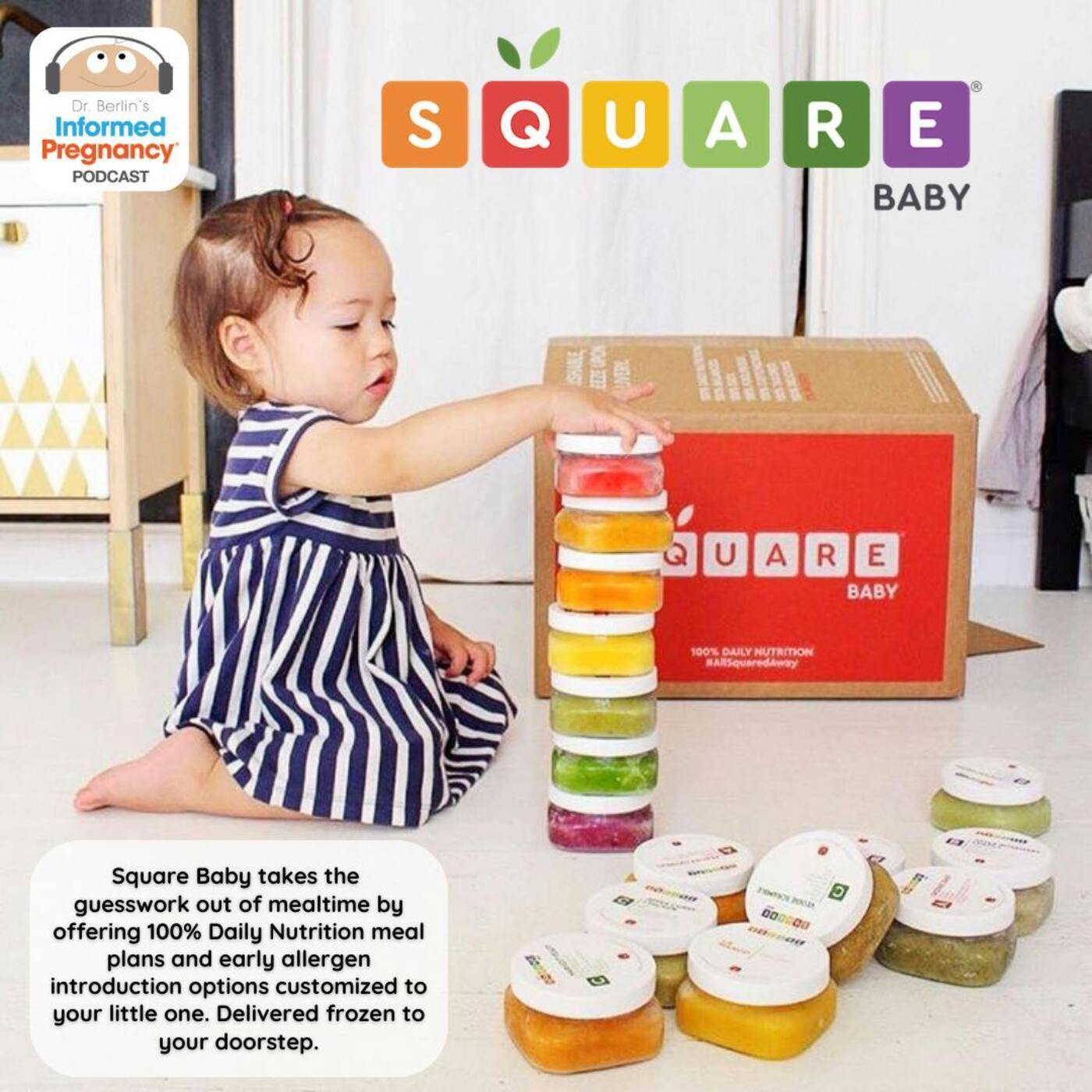
Feeding babies and toddlers as they grow can be challenging, to walk us through the different stages of nutrition and eating is Katie Thomson of Square Baby.

This episode is sponsored by Square Baby.
Connect with Square Baby online: www.squarebaby.com
Follow Square Baby here: www.instagram.com/squarebabyfood
Keep up with Dr. Berlin and the Informed Pregnancy Project online!
www.instagram.com/doctorberlin/
www.facebook.com/InformedPregnancy
Learn more about your ad choices. Visit megaphone.fm/adchoices
See Privacy Policy at https://art19.com/privacy and California Privacy Notice at https://art19.com/privacy#do-not-sell-my-info.
Key quotes
“You know guidelines are guidelines but listening to your baby and their cues and your intuition and your pediatrician Are always really great things to stay grounded in”
“Sure. So at four to six months, again, we're thinking more about variety versus volume. We're thinking about little tastes. Maybe it's little tablespoons here and there, but in general, whether you want to start with single ingredients or combo meals either is totally fine.”
“We don't talk about it as much for infants, but eggs are a magical superfood when it comes to choline. One egg is 100 percent of babies daily needs. So, you know, just thinking about ways to get choline rich foods, including eggs, is a great thing at this stage.”
“And I think it's so key to remember that continuing to introduce, knowing that they turn their head once, twice for a week, it does not mean, I mean, unless they're having an allergic reaction, right? Pause. But if it's just that they're not taking to it, don't give up.”
“that because there's so much information out there, because there are so many blogs and so much social media, so many opinions, but there's a lot of mom shaming. There's a lot of if you don't do it this way, you're doing it the wrong way. If you give your baby purees versus baby lead weaning or vice versa, that there's one way that's the right way, which is just absolutely not the case. So whether it's just understanding that every baby is a little different and their”
Related episodes
- Ep. 330 Square Baby Part 2: Early Allergen Introduction
- Ep. 328 Square Baby Part 1: 100% Daily Nutrition for Your Baby
- Ep. 366 Dr. Erica Rozmid: A Personal Experience with Microcephaly
- Ep. 334 Medela: The Science of Care
Transcript
AI-generated transcript with speaker labels — may contain errors, especially names and medical terms. Dr. Elliot Berlin, DC appears in blue; Katie Thomson in orange.
Download PDF of the Transcript
Dr. Elliot Berlin, DC [1:13] Welcome to the important pregnancy and parenting podcast. I'm your host pregnancy focus carpenter. Dr. Elliott Berlin You've tuned into the final sponsored episode of a three-part series of extremely helpful information about feeding babies and toddlers With my friends from square baby. My guest today a square baby co-founder isn't just a nutritionist and a businesswoman But she's also a mom and today she's gonna give us even more valuable information For moms dads and Caretakers of children Katie Thompson. Welcome back to the podcast. Thank you so much excited to be here I could probably do six episodes. I Could probably talk forever. So that would work out your
[2:19] Encyclopedic wealth of information. Let's start here. Let's pretend I'm a parent shopping for a food delivery plan for my Young child let's say four to six months old we're gonna go through the different ages four to six months old How do I decide what items are best for me? What kind of things should I look out for for the four to six month age bracket?
Katie Thomson [2:40] Yeah, this is certainly, you know a time of excitement for parents of kind of high anxiety taking on new milestones and new steps and Comparing our baby to another baby, you know first and foremost like pretty much everything You know check with your pediatrician or your baby's readiness for solids many babies are not ready until about six months I know with my first kiddo. He gobbled food down open his mouth for every bite It was like super fun experience Probably around five and a half months or so and the second baby Nolan he you know turned his head and spit it out and pretty much put me in the tears every night for about two weeks Just understanding that
[3:21] You know guidelines are guidelines but listening to your baby and their cues and your intuition and your pediatrician Are always really great things to stay grounded in Certainly four to six months is an important time from a kind of flavor window perspective Thinking about new tastes thinking about allergen introduction. I'll kind of dive into each of those things individually But also think about the fact that Breast milk formula should be the mainstay if not, you know, their exclusive diet till about six months So I know that breastfeeding is not easy or available or an option for every parent But certainly whether it's breast milk or formula that is the mainstay of their nutrition during this time
[4:04] And any food is a bit more, you know taste flavor of exploration little white So don't put too much pressure on food at this stage Being a big part of their nutrition. It's more so kind of pellet development and also great for Instagram Totally isn't that what parenting is all about? I think so those avocado pictures and right, my kids are 10 and 14 now and Facebook was just getting started when I had Jackson I guess it had been around a couple of years But I realized it was gonna stay and was probably the way I was going to Be able to show baby photos to my family So I was definitely a photo dump person at that stage anyway I think the other critical component four to six months is that research has shown recently with some landmark studies on allergen introduction that this
[4:53] Period of time is really best for early allergen introduction. So used to be when I had baby that we were told not to feed our baby an allergen like peanuts, tree nuts, eggs, any dairy, anything like that until they're at least one and sometimes three years old depending on the allergen. We were kind of made to feel as though if we did they could go into anaphylactic shock at any time it was very very scary. Recent research has actually shown that introducing allergens early and often so as early as four to six months and often meaning several times per week can actually help food allergies from developing. So that's in a powder format, right? So you might not be ready to do
[5:33] purees at four to six months. Maybe you're looking at adding little powdered peanut to your breast milk or formula. That's another option.
Dr. Elliot Berlin, DC [5:41] Peanut butter milk. That sounds nice. Yeah. Okay, but just to be clear, at four months, some babies are not ready to really have anything. But some babies are. It still wouldn't be the mainstay of their nutrition typically. But at six months, so then is that where you're saying oftentimes the shift starts to move, the needle starts to move towards eating solids?
Katie Thomson [6:06] Yeah, that's a good kind of general milestone for babies starting to have more and more bites and small meals. But generally there are some key milestones that pediatricians and AAP will tell you to look for when it comes to readiness. So there's a kind of a golden rule of doubling their birth weight, but also other just signs that you can see, you know, from your kitchen. Are they able to sit up and support their head, whether in a bumbo chair or something similar? It's very kind of intuitive, right? Can they hold their head and neck up? Are they showing interest in food? Do they look at your food, reach for it? Do they open their mouth to a spoon? And maybe even more obvious, but an important cue is whether they're
[6:47] able to really keep food in their mouth and swallow it. I mean, if they're spitting it out, they can't physically move the food, the puree to the back of their throat and swallow it. They're just not ready yet. And that's okay. Another sign might be that they're bringing their toys, their fist to their mouth.
Dr. Elliot Berlin, DC [7:01] I feel like it wasn't exactly the same for each of our four kids. That's right. And that's such a good reminder to just follow your gut, your instinct, the baby's cues and to just sort of let it happen. You know, remember one of them was like our dog as soon as we sat down at the table, just that sitting staring at you like, how come only you get to eat that? So that was a clear cue, but it also wasn't our first kid. I might've missed them on the first trial. Okay, so those are great milestones. And then when you are starting, I mean, we're so conscious when we start to put food into our baby, what are the kind of things that we're looking for in terms of the ideal selections?
Katie Thomson [7:40] Sure. So at four to six months, again, we're thinking more about variety versus volume. We're thinking about little tastes. Maybe it's little tablespoons here and there, but in general, whether you want to start with single ingredients or combo meals either is totally fine. One consideration about single ingredient that I really, really love is that especially for veggies, it really isolates a flavor. So if you only do combo meals, maybe your baby never really gets that true taste of broccoli. Maybe they've never really tasted something that kind of earthy, bitter umami flavor, because it's always sort of, you know, mixed in with other ingredients. So I think there
[8:21] is something that's really great and important about offering some singular flavors. At the same time, I'd love to debunk the myth that you need to introduce one food at a time and wait three to five days in between. It certainly is just not the case for non-allergenic foods. Certainly with allergenic food, it's great if you're going to introduce peanut, you know, don't do it with a whole bunch of other allergens, isolate it so that you can see if there is a reaction, it's easier to tell what the reaction might be from. But for non-allergenic foods, fruits and vegetables and grains, meats and things like that, it's totally fine to start with little combo
[8:57] meals.
Dr. Elliot Berlin, DC [8:58] So I hear you're saying single ingredients, but also combo meals. So you're saying don't mix it all together, give them an exposure to a flavor and then separately an exposure to another flavor, but it could be at the same meal.
Katie Thomson [9:11] Yeah, exactly. Don't think too much about hard and fast rules of this is okay, and that's okay, and this is good, and that is bad. But understanding that the combo meals, what that can be great for is, you know, a variety of foods and nutrients and flavors. It offers more of a palate development opportunity with all these varieties of flavors. However, the single ingredient food can really isolate, again, that more veggie forward flavor, which is just helpful in this period of time for palate development.
Dr. Elliot Berlin, DC [9:42] I think palate development is huge, especially, you know, once you're exposed to some of the more addictive flavors, it's hard to develop, go back and develop, you know, the earthiness. I think we talked about earlier, but I just love people who could drink straight juice, you know, greens that are pure greens. I'm struggling, I'm putting in apple and cucumber and all these things, because I grew up loving the sweets and the sugars. So it's, I think, cool for babies, setting the stage for them to have a long, nutritious life by giving that palette to them, as you said. And then once we're feeding them food, you know, it's a totally different experience. What do you do in terms of quantity?
Katie Thomson [10:23] So in this four to six month stage, again, this is just understanding your baby's readiness. Maybe it's a few teaspoons. If your baby's totally ready and they're towards that kind of five to six month range, you know, one to two meals a day is sort of the sweet spot. But again, listening to your baby's cues, understanding that where they are on that, you know, the timeline of introducing solids, you know, you might find that one baby gobbles down food quite readily. And the other one is taking a little bit more time to kind of take to this new idea of food. So not huge, fast rules around this four to six month stage. This is again, just trying to get them used to the idea. You're trying to introduce new flavors. You're
[11:01] trying to get them ready for when food is the mainstay of their diet. It seems to a degree that you could even start palate development before the babies start eating solid foods with a lactating mom to be able to eat different flavors and foods and pass them
Dr. Elliot Berlin, DC [11:17] on through breast milk. That's exactly right. So thinking about what we're eating when we're breastfeeding is really important because those flavors do pass through. So eat all the spicy food you want. Before we go to break, Katie, you mentioned a few times in passing that we look at allergens differently today than we used to when we were having babies, when you were having babies. And it used to be very scary. And there are all these guidelines on to hold off on giving any of those foods that are known to be more allergic type foods until the babies were older. But now we do it differently. So is there a particular time that's right and a sort of method for rolling out those higher allergy foods?
Katie Thomson [11:59] Absolutely. So four to six months is that key window when they say introduce allergens early and often that earliest four to six months, certainly talk to your pediatrician allergist. But in general, the recommendations are, you know, to offer them one at a time, you may want to opt to do it at home or even in a doctor's office. So probably not a great thing to do on the go when maybe you couldn't respond to a reaction, but great to do in kind of those safer settings. If you're going to do it as early as four months and they're not ready to take on solids, or really just not even, you know, able to kind of swallow the purees, then putting allergen powders such as ready set food, allergen
[12:40] introduction powders into your breast milk or formula are a great way to go. The importance about allergen introduction and the science behind it is that with any research, right, becomes very specific recommendations and thank goodness for those. So they learned that there are specific doses, efficacious doses that help to prevent food allergies from developing. So when they say I have allergens often, for example, with peanuts, it's two grams of peanut protein three times a week. So that can be kind of hard for a parent to figure out if you're just dosing peanut butter, you know, into a smoothie or something like that. So looking towards brands like Square Baby that are putting the research and the science into
[13:21] their meals and making sure that the doses are in fact, you know, developed towards those guidelines is really important. Don't put too much pressure on yourself, but at the same time, know that there is such thing as under dosing, right, and not giving the baby enough for it to really be efficacious or overdoing it, right. And kind of giving them too much in the beginning and then kind of affecting their ability to build up that tolerance. So certainly speaking to an allergist about a specific regimen is good, but in general, you know, a variety of foods early and often, you know, bites to start increasing over time is
Dr. Elliot Berlin, DC [14:00] some good general recommendations. Thank you for that. We're going to take a quick break and we'll be right back with Katie Thompson of Square Baby.

Dr. Elliot Berlin, DC [15:41] Welcome back to the Informed Pregnancy Podcast. We're talking to Katie Thompson from Square Baby. Okay, great information on the four to six month stage when we're just starting to put solids into the baby's mouth. Let's jump up a little bit, six to eight months. If I'm a parent of a six to eight month old, what changes do I make to the selections of my food choices for my baby's developmental level?
Katie Thomson [16:12] Yeah, so remembering that that four to six period was really about little tastes and maybe it's a little puree on a fingertip or on a spoon, starting to have a few bites or maybe a small meal. Now we're looking six to eight months, we're looking at about two meals per day, working up to like a four ounce or a half cup serving. So certainly food has gone from, you know, little bites and little tastes and little trials to a bit more of their nutrition throughout the day. So what I look for at this stage, especially as their new tummies just developing is easier to digest, smoother purees with maybe some texture. But I would avoid going, for example, you know, a cup of straight broccoli or
[16:55] white beans or something like that for a baby might send them into a gassy hysteria, which is not fun for parents or nobody, right? I remember I had a very gassy baby and I would do anything to make that stop, including my own diet and everything. It's a very stressful when they get colicky and are crying. So anything that you can do to kind of ease them into solids from a kind of tolerance perspective is good. Not to say that you can't give your baby, you know, a bite of white beans and broccoli amongst a balanced meal, but thinking about portion sizes when it comes to some of these castier foods, the other really important consideration are key nutrients at this period of time.
[17:35] So six to eight months, six to nine months is about when babies natural iron stores are depleting. So I remember going to the pediatrician's office and you know, you're doing your six month visit and they tell you your baby's low in iron and that's completely normal, but we need to start fortifying with iron. It's just sort of a scary moment to hear that your baby's sufficient in anything, you know, it's just sort of overwhelming, but keeping a calm head about it and knowing that there's plenty of foods and iron fortified cereals and things can really be helpful. So pureed meats for iron and zinc, like your vegetarian, looking at lentils and green leafies or iron fortified cereals again.
[18:14] The other thing is that to think about with iron is that vitamin C along with the meal can help to absorb the iron. So thinking about combinations like a beef with tomato or lentils with bell pepper, or iron fortified cereal with strawberries, each of these combinations is sort of the sweet spot for vitamin C and iron. It's funny because when I first learned this during my master's degree, I thought maybe that's why there's always ketchup on your hamburger. It's an evolutionary thing.
Dr. Elliot Berlin, DC [18:46] Well, at least now I can take solace in the fact that there is a nutritional benefit.
Katie Thomson [18:50] Right. We need this. Another key nutrient that I think is very seldomly talked about doesn't get a lot of air time is choline.
Dr. Elliot Berlin, DC [18:59] Yes, choline. Right.
Katie Thomson [19:00] Essential for brain development. We think about it in pregnant mothers. We don't talk about it as much for infants, but eggs are a magical superfood when it comes to choline. One egg is 100 percent of babies daily needs. So, you know, just thinking about ways to get choline rich foods, including eggs, is a great thing at this stage.
Dr. Elliot Berlin, DC [19:16] How do you prepare them for babies?
Katie Thomson [19:18] I think I mean, you can scramble the eggs and put it into a puree if they're at the stage where they're, you know, able to kind of pick up food and they're kind of doing a little bit more finger foods. And it's the perfect finger food if you do a hard boiled egg. Obviously, very careful that there's no shells, but, you know, it's very easy to pick up and to kind of gum it and swallow it. So whatever works best for your baby. Just make sure it's obviously fully cooked.
Dr. Elliot Berlin, DC [19:42] You always recommend the whole egg.
Katie Thomson [19:45] Yes. So there's a really important nutrients in the yolk and saturated fat that's very, very important for baby. And of course, you know, protein within the egg white. So I say good to go. Yeah. The other thing that's really important when you're shopping, especially. and the baby food aisle, there are a lot of very fruit heavy purees often found in pouches. It's sort of, you know, something that's happened with the baby food industry as the pouches came to market. And, you know, as a food manufacturer, I can tell you, you know, this is done primarily to kind of bring down the pH of the food. It's kind of a processing need, right? So when we went from jars to pouches, we saw more of the kind of earth's best turkey dinner and
[20:26] more balanced meals to a lot of very applesauce heavy pouches. So not that fruit is bad by any means. And I think it's important to give your baby the experience of, you know, tart fruits so that, you know, they can enjoy pineapples and berries and things like that. But just thinking about, you know, how much fruit is a part of your meals and a part of their daily diet, because as you're talking about, you know, pellet development, so, so key, and we have this incredible window, six to eight months, especially as a sweet spot where they are more eager than ever to accept new foods. If you think about when they turned this toddler stage, they have a bit more of an opinion. They have formed a bit more
[21:08] of their palette and their likes and dislikes perhaps. And it's a bit more challenging. So this is a key time to just introduce, reintroduce, you know, keep up with the exposure because even though if it takes you 10 times for your baby to like avocado, it's worth it. And they will get there. Another key thing that's kind of hard to find in many baby foods, but something to our own horn that square baby does very well are premium proteins. It's one of the pain points I felt when feeding my own kiddo. I think I told this story before how, when I was feeding him and I felt as though it was so hard to find a premium protein. And so the only protein option that I could find, it was sort of an
[21:49] isolated protein to add to the purees I was giving him with these little beanie weenies in a jar. It was just like the grossness was like in hot dog juice and how you must really want to give him protein to do this. So we love that, you know, we offer organic meats, egg, yogurt, sustainably caught salmon, a lot of different options that not only are proteins often, you know, an allergen source, right? So fish, milk through yogurt, eggs, but are offering key healthy fats and vitamins and minerals that are just so important during
Dr. Elliot Berlin, DC [22:22] this stage. If I want to make my own foods, you know, feed my baby, my own foods, everything that you're saying here sounds like things that I probably should have around the house for me too. They're just prepared differently for the baby. And I was just wondering, it's a lot of work. It's a lot of work, number one. So any tips and ideas on how to get all this nutrition, healthy nutrition in there without spending so much time on it, but then also quantities, what are we in like how much of each of these things? Definitely. So I mean,
Katie Thomson [22:56] certainly, you know, some parents have the time and truly enjoy making their food and all power to them. My co-founder, Kendall, made every meal, did it all. She's still a do it all person and someone I highly look up to. My reality was very different. I had zero time for it. I remember that I made some of his purees in the beginning, you know, mashed up the banana and the avocado, did some meals here and there on a weekend. But what I would find myself doing is I would get really excited. It would make this like adventurous meal. It's been half my Sunday doing it, whether it's shopping and the chopping and the steaming and the pureeing, right? And then you put it all in the ice cube tray. So you have all
[23:33] these little portions, which is awesome. But you've kind of invested all this time. You've got one meal. So you don't really give them the variety you're hoping for. That was at least my experience. What we've really tried to solve with Square Baby is taking all the guesswork out of, you know, feeding parents to really solve every pain point that we felt so that parents don't feel like they need to do all this research and understand, you know, allergen dosage and to make sure your baby's got enough veggies and protein, but to offer this hundred percent daily nutrition meal plan that's customized for your little one. In general, when you're thinking about making your own baby food,
[24:08] I mean, essentially you're making smoothies, right? So you want to make sure that you're thinking about food safety, right? That you cook foods that need to be cooked. It can't hurt to even steam things that maybe, you know, you for yourself might just dump into the blender. I found myself still steaming like blueberries really quickly and things like that. But certainly, you know, proteins and other foods that need to be cooked, that's very important step. And thinking about like the food pyramids, now the my plate, thinking about balancing their plate. So even if it's all mixed up in a puree, if you think about what a balanced meal looks like, it's half the plates,
[24:43] fruits and veggies, quarter of its whole grains and a quarter of its, you know, protein, right? So thinking about that in a very general way can be helpful. Of course, I love to say more veggie forward is great. It just helps with health development. It's very, very easy to get kids to like sweet food. and to have fruits as snacks and things. And so the more we can encourage that veggie acceptance
Dr. Elliot Berlin, DC [25:05] is a really, really good thing. I mean, it's great advice. I'm not sure that we talked about grains, specifically what kind of grains from six to eight months. Yeah. So we love to introduce
Katie Thomson [25:15] ancient grains and things that are a bit harder. It's very, we have a lot of barley and millet and quinoa and other grains that are a bit harder to find or harder to make sometimes might not be in your kind of rotation and really kind of minimizing rice. There's a lot of research and data on the arsenic and heavy metals inherently found in rice and in the soil. So there's no need to give rice if you don't have to. So there are plenty of other grains to give your kiddos, but really great for iron, for B vitamins and other nutrients. So great for fiber, just help with digestion. Yeah. I mean, it's square baby. In
Dr. Elliot Berlin, DC [25:52] addition to the know-how, the nutritional understanding that you bring into all of your meals is just doing it, you know, sourcing from the right places, the raw ingredients, understanding which foods for which stages, understanding food combinations, flavor exposure, palate development, allergy introduction. And then the amount of variety that I could offer my child when somebody else is doing it is going to be much greater than the amount that I could do on my own. And for me personally, I know for sure I'm not the only one who struggles with work-life balance, the holy grail. And I would much rather, even though it would be fun, I find it fun to make different food combinations and see how they react to them.
[26:38] I'd rather just spend that time with them and let somebody else do all of this if I'm able to. So, okay, there was no square baby when I had kids, but-
Katie Thomson [26:49] That's why I'm here now. There was no square baby for me either.
Dr. Elliot Berlin, DC [26:52] Yeah, but better late than ever.
Katie Thomson [26:55] That's right.
Dr. Elliot Berlin, DC [26:57] Let's take a little break. We're going to go into the next category of 8 to 12 months when we come back. Welcome back to the Informed Pregnancy Podcast. We're talking to Katie Thompson, co-founder of Square Baby, about nutrition for the little ones from when they very first start eating. And now we're all the way up to 8 to 12 months. What happens at
Katie Thomson [27:27] 8 to 12 months? So at 8 to 12 months, we're looking now at three to five solid, you know, meals, kind of small meals per day. That could look like, you know, around a half a cup or four ounce meals per day. Again, listen to your baby's cues. You will see some, you know, totally gobbled down food and others, you know, maybe leaning more towards those three meals a day. So listen to your baby's cues, understanding that really food is becoming a bit more of the mainstay of their diet and critical part of their nutrition. So thinking about, again, some of the common things we just talked about in six to eight months, but really focusing on keeping up that variety, thinking about eating the rainbow and various
[28:08] colors. That is an easy way of making sure that they're getting critical nutrients, right? Because every color is associated with various phytonutrients and different vitamins and minerals. So it's nice to think about ways in which, you know, you can make sure you're getting your kid the rainbow each day if you can. I found out that sprinkled colored donuts don't count. I know skittles. No, not so much either. Another thing that's really important about this stage is babies are ready for more texture. So what you don't want is to hold on to super thin, you know, smooth cures in which they're, you know, just taking down the equivalent of a yogurt or an apple sauce texture all the time. You really want to
[28:51] challenge your kiddo to take on new textures and flavors, you know, as soon as they're ready.
Dr. Elliot Berlin, DC [28:56] What do you mean by like examples of different textures?
Katie Thomson [29:00] So, you know, thinking about chunky meals, thicker meals, this might be a time where you've got, you know, a whole pea inside the puree that they have to kind of chew up and swallow. So baby food companies typically do a really good job of thinking about what foods and kind of sizes are going to be appropriate for each stage of development so that you can minimize those choking hazards and make sure that you have the best chance at success. But again, every baby is so different. Some babies are, you know, got a fistful of a whole sweet potato, right? And doing the baby-led weaning and they've totally got it down and they're eating the food and others kind of hang onto that puree stage a little
[29:39] bit longer. But in general, you want to see your baby start to take on more chunky foods. Maybe you're starting to do table foods alongside your purees. So what I found in my experience was that my babies did really well with purees, which I loved, once they kind of got over that first little two weeks for my younger baby. of introducing new, it's nice to do something successful alongside, so to kind of make sure they're getting the nutrition they need, you don't want everything to end up on the floor or in their hair or on your face as babies tend to play with food and throw it, which is also an important part of their journey. It's important thing for them to play,
[30:18] to experience, to explore and really kind of develop a good healthy relationship with food, right? It's totally fine for food to end up on the floor. But when we're thinking about nutrition, when we're thinking about allergen introduction, we do need some of that to get into their bellies. So thinking about doing a table food or something new that maybe they are either more likely to toss or not successfully get in their mouth, maybe they're more likely to spit it out. It's nice to do something successful alongside it. That's sort of the texture recommendation.
Dr. Elliot Berlin, DC [30:50] Get into your food. I feel like sometimes my kids are older now, but when they were little and we'd give them a new texture, it took a minute to get used to it. I mean, they'd put it in gum around a little bit. And sometimes the experience of that bigger piece going down would just feel weird to them. And they'd make these raw kind of, you can't see it, but you could probably imagine the face I'm making. And it would just take a few times for them to try that before they got used to it and it became normal for them.
Katie Thomson [31:18] Yeah. And I think it's so key to remember that continuing to introduce, knowing that they turn their head once, twice for a week, it does not mean, I mean, unless they're having an allergic reaction, right? Pause. But if it's just that they're not taking to it, don't give up. I remember being so frustrated that my son hated avocado and I was so excited to get him this healthy fat and this beautiful green food. I was so excited to get him and he was like, I'm not having it. And so, keep going. Then before you know it, he's getting the side of guacamole alongside you.
Dr. Elliot Berlin, DC [31:54] True story, I rejected avocado till I was around 25 years old.
Katie Thomson [31:59] Me too.
Dr. Elliot Berlin, DC [32:00] Oh, really? And then now I love it. Yeah, I was a very picky eater.
Katie Thomson [32:03] Oh, I wasn't picky. I just didn't like avocado and cilantro.
Dr. Elliot Berlin, DC [32:07] Oh yeah, cilantro is definitely a people love it or they hate it. I love it, but do you like it now or no?
Katie Thomson [32:12] I like it now.
Dr. Elliot Berlin, DC [32:13] Okay. See, health development is always a possibility. Never give up on your child. Okay. I mean, you have a gazillion pieces of information, data points for parents who like to research, parents who like to know and understand the science, the methodology. You've put a lot of that information on your website. What kind of things do you have up there?
Katie Thomson [32:36] Yeah, so certainly from a kind of ordering and customized nutrition perspective, we take the parent or caregiver through a quick little process to understand baby's age, month and year of birth so that we know what kinds of foods to recommend to them and then we take in any potential dietary restrictions or preferences. So if you're vegan or vegetarian or you're looking for foods that are higher in iron, our website will make it very easy to kind of filter through what you're looking for. And you can always adjust that. We think customization is incredibly important. We know one size does not fit all. And we certainly didn't need to put a stake
[33:11] in the ground and say, we're only a vegan company. We're only vegetarian or we're only paleo or we're only anything. It's knowing that balance, complete nutrition looks like a different diet to a lot of families and we want to support that. From an education perspective, certainly having information on allergen introduction and palate development and readiness for solids and even the various steps of what to think about just as we've talked about at each stage of development I think is really important. We also talk about heavy metals and how we can look for ways to reduce them and what our commitments are at Square Baby. And then we just try to be as accessible as possible
[33:51] As two founders, Kendall and I have taken every customer service call, every email, every question. We even have a storefront for the first three years of our company. And so we got to have all of these customer conversations one-on-one, which I think was such an important piece for us at the end of the day, we launched a company. Now having kids that are between 10 and 15 years old, clearly we're still very passionate about baby food and helping parents through this stage. So whether it's information on our website or just a way to talk to myself or another one of our dieticians, it's our goal to be very, very helpful in this process and to never gonna be prescriptive
[34:31] like your pediatrician or replace that. Certainly we can help with guidelines and other advice based on our menu.
Dr. Elliot Berlin, DC [34:39] That's amazing that you make yourself so accessible. I mean, every time I talk to you, I just think about all the different things that you need to know and to learn. Even when you talk about packaging, oh, this is why we switched to this kind of packaging or that kind of packaging and all of the nutritional information, the preparatory information, the being able to ship and all the different things involved in the logistics. of shipping and then to still be available for your families and your customers. It's incredible. So
Katie Thomson [35:06] I look up to you. Well, that is kind. Thank you. I think it's just something we're insanely passionate about, you know, and you don't get into this and throw your life into a startup without an incredible amount of passion to create change and to be the resource and be the company we wish we would have had 14 years ago when we were feeding our babies.
Dr. Elliot Berlin, DC [35:27] Because you have so much direct interaction with your clients, you get to see a lot and you get to kind of survey the field as to what people have and what they're missing, what they know and what they don't know. What are some of the things that you see the gaps in parent knowledge about
Katie Thomson [35:43] feeding little ones? It's a great question. The first thing that comes to mind is I think that because there's so much information out there, because there are so many blogs and so much social media, so many opinions, but there's a lot of mom shaming. There's a lot of if you don't do it this way, you're doing it the wrong way. If you give your baby purees versus baby lead weaning or vice versa, that there's one way that's the right way, which is just absolutely not the case. So whether it's just understanding that every baby is a little different and their readiness, their journey to solids, their preferences, all of those things, you know, they will hopefully eventually get to a very similar place if you do all the same things,
[36:22] but they might get there in a different way and that's okay. And knowing that, you know, whether doing solely baby lead weaning, even understanding that purees can be a great part of that. You think about what soup is and smoothies are and yogurts are those can be very puree like, you know, products, foods that are absolutely healthy and great to give to your baby. But you can use a puree as a dip or a sauce or on toast or all different ways to give them the balanced nutrition, the allergen reduction that they need. So I think just understanding that your intuition as a parent, as a caregiver is really valuable. So listen to your pediatrician, understand resources that are valid and research-based, but then at the day,
[37:11] also listen to yourself and I think give yourself some grace. I think that's really
Dr. Elliot Berlin, DC [37:15] important. That's really great advice. Thank you for all of this information. Thank you for everything that you do for helping us feed our little ones in the most successful way and the most nutritious way and giving them a great start in life. Katie, where can we find
Katie Thomson [37:30] you guys online? So squarebaby.com. We are just relaunching the company excited to be going national with our direct to consumer fresh baby food. So we'll be shipping to all of the lower 48 States. Very excited to be going to our website. You can place a customized order. We make it really easy to pause, to skip, to change your meal assortment and things like that. And of course we're always available. You can email us at hello at squarebaby.com goes right to my inbox with any questions. Honestly, we're here and we'd love to offer as well for your audience a Berlin 20 discount code for 20% off for first orders.
Dr. Elliot Berlin, DC [38:13] Amazing. 20% off your first order with the code Berlin 20. And remind us of the website squarebaby.com. Easy squarebaby.com promotion code Berlin 20 and get 20% off. Katie, thank you very much again. I'm probably going to listen to these a couple of times. You gave us so much information. It's hard to digest all at once. No pun intended, but it's one of those things that I'll go back and listen to and get new pearls and gems each time I listen. From the bottom of my heart, thank you.
Katie Thomson [38:44] Thank you. That is so kind. And I'm just so grateful for the opportunity to share and to hopefully be helpful and hope to feed lots of babies.
Dr. Elliot Berlin, DC [38:52] Amazing at home. Thanks for listening to the informed pregnancy podcast. If you like our program, share us with your friends, leave us some feedback and visit us online at informedpregnancy.com.
Want more pregnancy + parenting? Start your FREE TRIAL of Informed Pregnancy+ and get access to all our curated pregnancy and parenting content — original series, iconic birth films like The Business of Being Born, prenatal workouts and more.
