
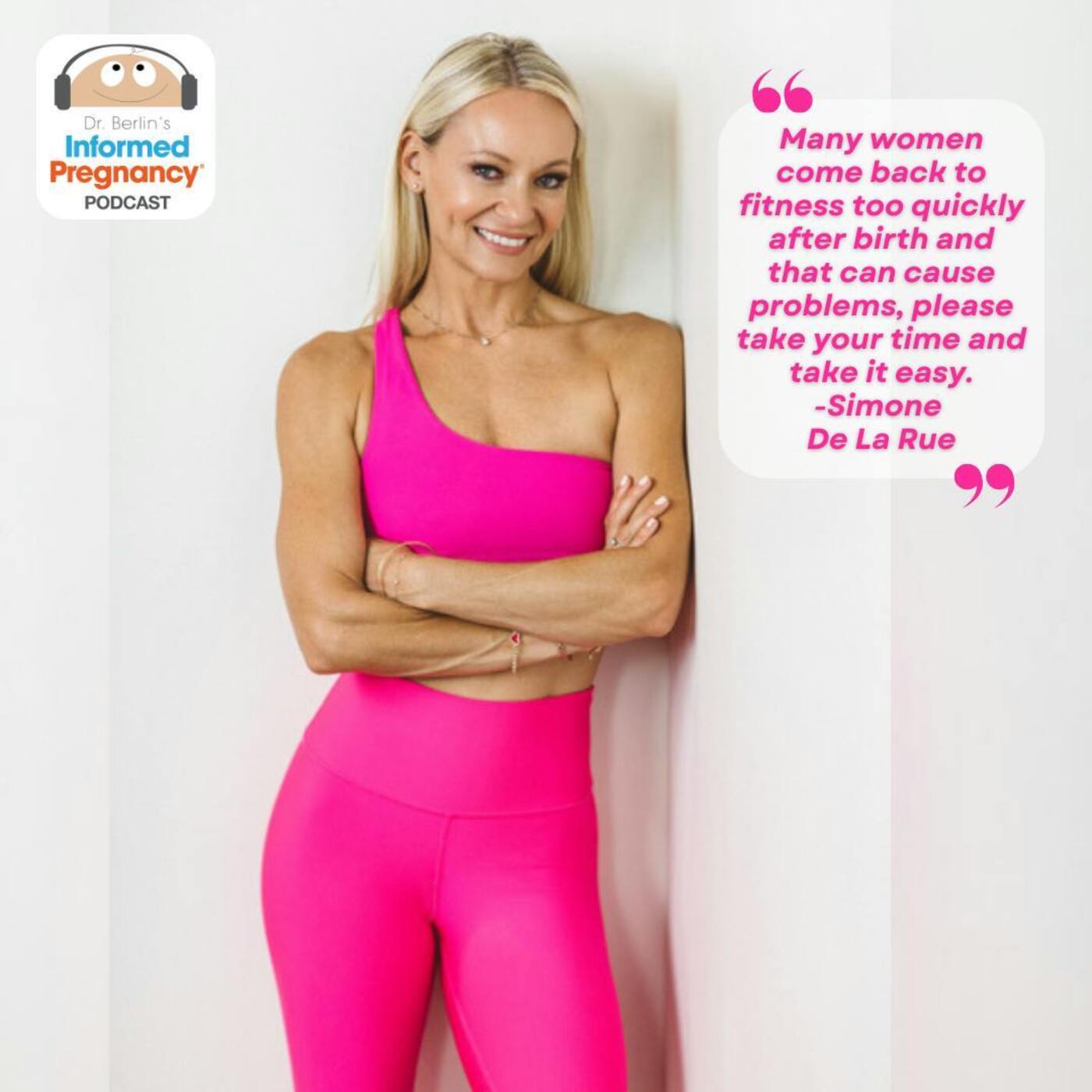
June 8, 2023 · 29 minutes · Episode 357
About this episode
Creator of the fitness program Baby by Simone and former broadway dancer Simone De La Rue talks about her dance career, fitness and wellness techniques, and becoming a first time mother at 42.

- Connect with Simone De La Rue online: https://www.instagram.com/simonedelarue.official/?hl=en and https://www.simonedelarue.com/
- Learn more about Tantrum Wine Pairings the Informed Pregnancy Blog: https://www.informedpregnancy.com/single-post/tantrum-wine-pairings-rose-hart-landsberg
- Start your FREE TRIAL of Informed Pregnancy+ and take Simone’s classes here: https://www.informedpregnancy.tv/baby-by-simone-prenatal-workout
Keep up with Dr. Berlin and the Informed Pregnancy Project online!
www.instagram.com/doctorberlin/
www.facebook.com/InformedPregnancy
Learn more about your ad choices. Visit megaphone.fm/adchoices
See Privacy Policy at https://art19.com/privacy and California Privacy Notice at https://art19.com/privacy#do-not-sell-my-info.
Key quotes
“But dancing in a room for an hour, I was like, oh, this is expressive.”
“I was terrified to even jump on the trampoline. I was like, will it fall out? You know,”
“So yeah, I wanted to share with women that you can still move.”
“I wanted this to feel inclusive.”
“because I actually think this is where the attention needs to be.”
Related episodes
- Ep. 362 Filmmaker Rani Khanna: More Than Blood
- Ep. 361 Rachel Mans: A Mother's Journey Through Pregnancy, Adoption, and Birth Work
- Ep. 355 Rumer Willis: Before Birth
- Ep. 382 Caitlin Wilder: Before Birth
Transcript
AI-generated transcript with speaker labels — may contain errors, especially names and medical terms. Dr. Elliot Berlin, DC appears in blue; Simone De La Rue in orange.
Download PDF of the Transcript
Dr. Elliot Berlin, DC [0:12] Welcome to the Informed Pregnancy and Parenting Podcast. I'm your host, pregnancy-focused chiropractor, Dr. Elliot Berlin. My guest today is a former Broadway dancer and current fitness trainer. She is the creator of the powerful prenatal workout program, Baby by Simone, currently streaming on Informed Pregnancy Plus. She had her first baby at age 43, and she's here to share her story. Simone De La Rue, welcome to the podcast.
Simone De La Rue [1:02] Thank you for having me, Dr. Berlin.
Dr. Elliot Berlin, DC [1:04] It's such an honor to have you and to also meet you for the first time. I've been hearing your name over and over again over the past many years from people who swear by you and how you've helped them, especially before, during, after pregnancy. So we want to learn where all that magic came from. Let's start at the beginning. Where are you from originally?
Simone De La Rue [1:21] I was born in England, but grew up in Australia.
Dr. Elliot Berlin, DC [1:24] So what does that make your accent?
Simone De La Rue [1:26] I honestly don't know. I've been living in America now for 15 years, and I have not picked up an American accent. I don't know. I think I sound Australian, but I grew up in Australia, so I'd assume that I've got that accent still.
Dr. Elliot Berlin, DC [1:41] Yeah, I don't know. I'm a little sensitive to accents, and I think there's unmistakable Australian, but there's also maybe a twist of the Brits. Maybe. I don't know. Okay, so you're a unique person. You're a fitness everything. How did that start?
Simone De La Rue [1:56] Yeah, so my previous life, I was a dancer, as you mentioned earlier on Broadway. I did that for 18 years, and then I got to the age of 36, and I decided that I didn't want to keep auditioning. I wanted to take power over my destiny and create my own business. And I'd always danced all my life. I'd never really trained at a gym, and people would say, oh, what do you do to stay fit? I was like, I just dance. And it was kind of like an aha moment of like, well, if I can bring my beauty and love of dance into fitness and help other women find that connection and that joy. Because for me, doing cardio on a treadmill or on a bicycle, even going for a run was always quite tedious.
[2:41] But dancing in a room for an hour, I was like, oh, this is expressive. It's creative. I'm having a great time doing it, and didn't actually realize how great it was for my heart health, my coordination, remembering from my memory. So that's kind of how the body by Simone was born over 12 or 13 years ago. And so I left dance and moved into fitness, and haven't really looked back since then. And I built four studios. I've got an online app and predominantly female clientele. And yeah, organically, each program that I've developed has kind of authentically grown from the stage that I was at in my life. And I know we'll probably dive into this deeper in a little bit,
[3:23] but I was a, what do you call it? When you're 43 and full pregnant. Advanced, maternal age, geriatric, mama. Yeah. We've changed the language now, right? From geriatric to advanced. No, no. And then, you know, that's how baby by Simone, we just changed the wording that program was born. Literally.
Dr. Elliot Berlin, DC [3:48] Yes. Going back to the earliest stages, if you were growing up in Australia, is that where you started dancing and how did you get from there to Broadway?
Simone De La Rue [3:58] That's a good question. So I started dancing in Australia. I actually did my very first musical when I was 18. I did Cats the musical. It was still one of my favorite roles to date. That was in Australia. And then, you know, as a dancer, you have a dream of London's West End. I still have a British passport. So that was like the part of this resistance. It was easy to go to and do shows there. And then when I got to London and I performed there, and then I was like, okay, now my dream is Broadway. And so I had to work really hard to come over to the US, you know, and get a green card so that I was able to perform on Broadway. But it's like anything when you reach that goal
[4:36] and you achieve that dream and you tick it off and you're like, well, what now? So, you know, it was definitely a long journey and I've seen a lot of the world through my love of dance and my career.
Dr. Elliot Berlin, DC [4:46] Do you have a favorite Broadway moment?
Simone De La Rue [4:49] Gosh, there's so many, but I think probably my last show was Promises Promises. It was with a show with Sean Hayes and Kristin Chenoweth. And it was just such a great group. of people and the cast really kind of became family and some of us still you know quite good friends with so that was probably you know a bit of sweet saying goodbye to it all but also you know leaving on a high. It seems like an extremely rigorous schedule. It is it was like eight shows a week and you perform in the evenings and then you perform you know two shows Saturday two shows Sunday so you never really had a regular life you know everyone else was working nine to five
[5:27] and then you just start working you know you go to the theater at six and you don't finish till eleven and then you're winding down you know so I don't miss that and I have to say I don't miss the auditions you know having to show up and hope that you're the right you know the vision that the director has for that role you know I don't miss having to go through that nasty
Dr. Elliot Berlin, DC [5:48] audition process. Yeah so I mean auditioning in general just seems like a mind screw every time you know being able to put yourself out there and knock on the door as if you're going to make that sale with your A game every time and then get a bunch of notes before you get the S. Correct yeah. Seems very challenging for most people. Okay do you miss the wide audience?
Simone De La Rue [6:12] Well it's interesting because I you know with my classes at Body by Simone I do one-on-one private training but I also do you know group classes and for me there's still a performance element to it you know I'm still connecting to you know a group of women so I don't miss the live audience because I still get to do live events when I teach exercise classes so I still get a taste of it. Okay do you miss the different styles of dance? Oh a little yeah as I said like I'm 48 now and I think about a lot of peers that I you know did theater with or I was trained in classical ballet school with a lot of them have given up now and they you know they've let it go because you do it's kind of once again
[6:56] you're a geriatric performer at this age so I still feel very blessed that I'm able to move my body and use my body and still have that creative outlet and expression. Sounds like
Dr. Elliot Berlin, DC [7:07] you took a change just at the right time. I think so yeah. All right you have a baby we're gonna take a break when we come back we'll find out about that experience don't go

Dr. Elliot Berlin, DC [8:54] welcome back we are talking to simone delarue from body by simone and baby by simone speaking of babies you had a baby and it sounds like your career you know you were very focused on it for a very long time when did having a baby sort of become something you were interested
Simone De La Rue [9:12] in yeah i never really grew up wanting or wishing you know um to have a child it was just i was so focused on dance you know from a very young age and then from dance then to building body by simone i was very ambitious i loved to travel and you know my body was my tool predominantly that was you know the thing that got me work and got me jobs and then i think i'm sure a lot of women could relate to this like the age of 40 you kind of have that moment of oh my goodness i'm old and if i don't do it now it's never going to happen in life i started to panic and think that i'd missed the boat and so then i did you know my husband at the time we're no longer together but we um you know focused on you
[9:53] know really trying to get pregnant and you know like they say when you take the pressure off and you stop trying saying is when you actually conceive. So when I hear now so many birth stories and so many different journeys of women and of my female clients, I actually realized how lucky I was to naturally, and you would know this too, naturally fall pregnant at the age of 43. So I do believe that it was a blessing and meant to be and just look at my little guide every day and just like so, so glad that he's in my life. But I was so, so worried when I fell pregnant because, you know, geriatric pregnancy. I remember Dr. Rothbart, who I love dearly, my OBGYN, you know, going, it's going to be okay. You're okay. Like,
[10:41] you know, this is women are doing it later in life now. And you know, kind of held by hand throughout it. But, you know, as an exercise junkie, I was terrified to even jump on the trampoline. I was like, will it fall out? You know, all these crazy things, these crazy thoughts that you have. You know, so I was very, very cautious throughout my pregnancy, you know, and you get to each milestone and you're like, whew, I made it, I made it. And then, you know, the birth story. Well, that's, I mean, how long have we got about that one?
Dr. Elliot Berlin, DC [11:12] Well, before we get to that, when you said you were trying, did you try also medical
Simone De La Rue [11:18] intervention or you were just trying naturally? Just try naturally. And that was also one of my things. It's just like, I'm just going to try naturally. I mean, I said it out to the universal spirits or angels or God, whoever you believe in and said, if it's meant to be, it's meant to be. I'm just going to try naturally. And if it doesn't happen, then I will, you know, accept that gracefully. You know, it's a huge financial cost. And at that time, it wasn't something that I, you know, could afford. So it was just like, let's just see what happens. And so, yeah, by the grace of God, I did fall pregnant.
Dr. Elliot Berlin, DC [11:51] And when you found out you were pregnant, did you already have a hunch?
Simone De La Rue [11:55] Did I have a hunch? That's a good question. I did not, because being a performer, being a dancer and also being very active, you know, my periods were very irregular. My menstruation cycle was irregular. And so I was late and I just thought, oh, well, it's just because I've been working out so much. And so I didn't really have a clue. And I remember taking the test. And that day, like an hour later, I had to film for my app, for my fitness app. I had to film a fitness class. And I remember taking the test and just being elated and shocked and terrified, all the feels, right? Just like, this is amazing. Oh, my God, this is happening. And then I had to go and do film, you know, a live workout.
[12:38] And I'm sure I must go back and look at that. But I'm sure I was just kind of glazed over with this, like, look, my life's about to change. My life's about to change.
Dr. Elliot Berlin, DC [12:49] So how were the different trimesters for you?
Simone De La Rue [12:53] I miss being pregnant. I loved it. It was probably the happiest I think I've been in my life. I know you hear stories of women that, you know, a lot of my clients have disliked it. They said, oh God, I didn't like putting on weight. I didn't like all the side effects that I loved it and embraced it. I didn't know if it was the good hormones pumping through my body. If you could bottle those and sell those, I would definitely be able to purchase. But yeah, I loved it. I really did. Yeah. And it was fascinating just to see because I've danced all my life and because I've exercised all my life and very in tune with my body, to see it changing in that way, I just thought was, you know, really quite fascinating.
[13:36] I watched my belly grow and, you know, all of the changes along the way.
Dr. Elliot Berlin, DC [13:41] A couple of things. First of all, you mentioned the geriatric pregnancy a few times now. So it seems to me, I'm not a medical doctor, but it seems to me that every person has a clinical health profile and that includes pregnant people. And one of the pieces of data inside that clinical health profile is your age. It's the one you can't change. But it also seems like when you look at the other pieces of data and they all fall into the green category where everything is good, you don't have diabetes, you don't have hypertension, you're a good BMI, good body weight, then that age number matters less and less and less all the time. Anecdotally, we see people in their 40s having amazing pregnancies
[14:21] who are generally healthy people. And then sometimes people in their 20s and 30s struggling really hard who are generally not in shape or have medical conditions that sort of make it much harder. So your advanced maternal age, but that again, for you, that's just that one piece you spend your whole life keeping your machine strong and fine tuned. So it seems like it would go better for you. And like it did. Yeah, very much. Did you have an immediate thought on how to approach fitness during pregnancy? This is where I started doing
Simone De La Rue [14:54] a lot of research and seeing what is out there for women, what advice, what guidance. And, you know, a lot of the books that you read are like, you know, walk around the block or, you know, sit on a yoga ball or, you know, do a wall sit. All of this is great advice, but if you've been active your whole life, you're going to want to do more than that. And so I think it was kind of always frowned upon for women, like don't exercise while you're pregnant, you know. And so I wanted to find a happy medium, like a healthy spot where you could still be active. You could still take care of your body, still get your heart rate up, but also making sure that you're taking care of the, you know, the developing fetus inside of you.
[15:35] And that's where like Baby by Simone was born because it was from my own need myself of like, well, I want to push myself a little bit more than walking, but I'm not going to necessarily, you know, do a high box jump holding a 20 pound weight or run a marathon, you know. So yeah, I wanted to share with women that you can still move. And I've had my studios for 12, 13 years. I've just seen the constant churn of women come in and out, you know, so many clients who then find out they're pregnant, they work out throughout their entire pregnancy and then obviously returning to exercise after giving birth. So that's why I did my pre and postnatal studies, just so that I was really,
[16:12] you know, up to date, um, other than my NASM training so that I could really guide and help women through this journey.
Dr. Elliot Berlin, DC [16:18] And for somebody who's not so fit, you know, or just exercises a couple times a week, you know, healthy, but not like dancer fit. Is Baby by Simone appropriate for them or are there things that you would modify?
Simone De La Rue [16:33] It's appropriate for all levels. And that's why I created it. And literally like there's each trimester, first, second and third trimester, so you're doing more active activity in the first trimester and by the third trimester, you're doing, you know, your belly breathing and your modified plank holds and things like that. So absolutely for all levels. I wanted this to feel inclusive. And I, of course, you know, it was approved by Dr. Rothbach, but it had to be, you know, something that could keep women safe. Yeah.
Dr. Elliot Berlin, DC [17:03] I'm so curious about filming it while you were super pregnant. Most people don't like to be on that side of the camera at that point. What was that like for you?
Simone De La Rue [17:12] That's a good question. Um, it's because I'm, you know, so used to being in a bra top and mid-drift and, you know, showing off my abs, my six pack. And here I am with this belly out to here and I can't touch my toes, but we really made sure that we celebrated this beautiful belly and, you know, glossed it over and gave it a bit of makeup and shine and made sure that it was really, you know, on show because I was so proud of it. It's really interesting. There's been a bit of a movement, I think, since like Rihanna, you know, she wears a lot of clothing with her pregnant belly out, and there's been a bit of a movement now that I've noticed a lot more
[17:47] women putting their bellies on show. You know, whether it's fashion statement or whatever, but, you know, we shouldn't be at home and hiding this. This is like beautiful. You know, let's get it out and display and normalize it a little bit more.
Dr. Elliot Berlin, DC [18:02] Oh, it's beautiful. All right. We're going to take another break and find out how you plan for your birth and how things actually went. Don't go anywhere. Welcome back. We're talking to Simone de la Rue. All right. So a couple of years till you got pregnant naturally, and then a very fit pregnancy. What was your plan for birth? Ha ha ha ha.
Simone De La Rue [18:34] I get that a lot. I know. Of course it was a natural birth and I was going to be the warrior who, you know, I'm giving birth and I'm doing this and of course they did not go to plan at all.
Dr. Elliot Berlin, DC [18:49] So you were planning to be in a hospital with a doctor.
Simone De La Rue [18:52] Correct.
Dr. Elliot Berlin, DC [18:52] Yeah. Doula or no doula?
Simone De La Rue [18:54] No doula.
Dr. Elliot Berlin, DC [18:56] And the warrior, were you saying unmedicated or vaginal or?
Simone De La Rue [19:01] Vaginal unmedicated. That was the plan. Yeah.
Dr. Elliot Berlin, DC [19:06] And was there a specific reasons why those things were important to you?
Simone De La Rue [19:11] Yeah. And this is the other thing that, you know, once, now that I have gone through this, I'm like, ah, like, why did I think that that was important, you know, the most important thing is that your child comes out safely and really, you know, but I think at the time it just because once again, I was always so connected to my body. It was always so physical for me. I just wanted to have that experience to feel what it feels like to birth.
Dr. Elliot Berlin, DC [19:34] And so that makes sense. I mean, I think always there's nobody who goes into labor thinking the most important thing is anything other than that you both come out healthy, but there's a lot of ways to get from point A to point B. And if you could sort of pick your path, there are different things that people would pick based on what's interesting or important to them. So it makes sense that you aim for that, but that's there's a detour, you still end up at the same destination via a different route, which it sounds like what happened to you? Did your labor start spontaneously?
Simone De La Rue [20:08] No, so I had to be, I think I was seven days overdue, so I was induced and then I was like 24 hours in labor and in the end I had to get an epidural and then that little Oscar's heart rate, you know, increased, elevated and so it was an emergency C-section and then the next thing I knew there he was in my arms, so. I mean was it a scary emergency C-section or more like we should get this baby out now? I don't think it was scary but it was just like he's coming out, we're going to get him out in the next half an hour and it's like okay, this is what's happening now, you know, and at that point, you know, what I said before, all you want to do is just make sure your little Bubba's okay, so it's like get him out any way that you
[20:53] possibly could, but I remember apparently I said, because you know, you're obviously pumped through it full of drugs, and I said to Dr Rothbart, you know, as he's like I'm going to make the incision, I'm like we beware of my abs, don't cut my abs. Did he preserve your abs? He did a very good job, yes. It's the best of the best. Yeah.
Dr. Elliot Berlin, DC [21:17] Yeah, so do you have a conscious memory of what that was like, any abdominal birth?
Simone De La Rue [21:22] You know, for me, the biggest thing, and this is what I've tried to say to women as well, that I've been so active, you know, my whole life, so in tune with my body, and then you have a C-section and then there you are like after three days, go home and take care of your baby, and I couldn't even sit up, you know, I couldn't even walk, and it's like how am I ever going to return to exercise, and I'm an active person, so once again, this is how then my postnatal program, so I've done, you know, lots of postnatal workouts for women returning to exercise after giving birth, because I actually think this is where the attention needs to be. So many women panic and say, oh, you know, finally I can work out again,
[22:01] and they come back too quickly, and they get diastasis recti because they haven't allowed time for the abdominal wall to heal, you know, or coming back from a C-section where it's even challenging to walk around the block, you know, at home when you're pushing the pram, so just becoming the awareness of that, but for me, it was such an aha moment. I was like, this is someone who is very, very fit, and I couldn't even, you know, lift my legs up out of the bed to get out of bed.
Dr. Elliot Berlin, DC [22:27] Wow. That also makes me wonder if earlier, before you had your cesarean, as my time supporting people during labor, I noticed a trend that more active and fit people tend to dislike the feeling of being anesthetized from the chest down, like trapped in the body, like your brain is like, let's get up and move around.
Simone De La Rue [22:49] Did you experience something like that? I did, yeah. I wanted to like walk around, and I couldn't, so yeah, it was very challenging for me because I can't just lay here, like I need to move, you know, it was like almost like a tribal kind of, you know, wanting to do like a dance almost, you know, during labor.
Dr. Elliot Berlin, DC [23:09] Yeah, like you see other animals do. Yeah, exactly. And then you said something interesting, which is that you're like, how am I ever going to work out again? And that's you, whose whole life has been active fitness workout. I hear that so many times in my postpartum patients, and I really think they wait sometimes, like you said, some jump in early, too early, and then some of them are just waiting for like a moment to strike them, like when it's time, but then, you know, six months go by. And so I'm curious in terms of you, how did you manage to get back into it and also if you have recommendations for others? Yeah, I definitely took my time.
Simone De La Rue [23:46] I know for vaginal birth, you know, the recommended healing time is six weeks, and for cesarean c-section is eight weeks, but I didn't do any abdominal work, like absolutely no sit-ups or crunches or even planks for months. I really like slowly worked on my stamina and like walking, and then I worked on my upper body and my lower body, and I really allowed a lot of time for everything to heal. And I remember being terrified the first time doing a plank and just thinking, oh my God, am I going to pop the stitches? You know, what's going to happen? So that's one of my pieces of advice to any of our postnatal mummies coming back. Please take your time, take your time. We always give modifications on how
[24:30] to do that because, you know, I've witnessed or seen a lot of women who you could put your fist in because they haven't allowed time for the abdominal world to heal. So I would say don't rush into it, but also, you know, it's even just taking it half an hour for yourself because when you're a new mum, just everything is about the child and you have no time for yourself at all. Even while they're napping, if you're just doing some squats quietly in the corner or, you know, anything that you can just to try and reconnect to your body. and reconnect to yourself and that's one of the things I hear so many women say they feel disconnected from themselves you know so just trying to find small
[25:09] little pieces even if it's five or ten minutes each day. You know after pregnancy 24 hours of labor and a cesarean birth do you feel like your body has come back to its pre-pregnancy state? It took me quite some time it really did and it was interesting to like the muscles so you know obviously when you're pregnant and your belly's growing and your belly's growing and so your pelvis you know moves and all of a sudden your glutes and hamstrings become more inactive because you're not using them anymore because your weight's this way you know or you're spending a lot of time sitting on your derriere on your tush and so for me that was one of the
[25:47] areas like I had to really focus on rebuilding my posterior chain you know my glutes and my hamstring again that took a long long time my arms were easier because you're picking up your child constantly and lifting them and holding them you know that's built in exactly that's the one you like I've got my weight here already but yeah it took me I would say probably at least two years you know and Oscar's now four and I'm just starting to feel really really strong again like back to my old strength so it definitely takes time and then when I have clients who've had two and three and four kids I'm like how on earth have you done this I really just kind of bow down to anyone that's had more than one child like you're a
[26:30] superwoman I bow down to anyone who's had even one child yeah so in four years of motherhood has that changed your outlook on life very much you know I was saying to someone the other day you think that it's our job to teach them right to be the parent and to teach them but really they teach us and one I just never thought I would have such a love like the unconditional love that I have for him is unbelievable and now everything revolves around him you know I love my work and you know I'm still passionate about helping women and helping my clients but he will always come first he comes before anything now and yeah I just part of me sometimes says oh I
[27:14] wish I didn't wait so long I wish I'd started sooner so I could have two or three more but life is how it's meant to be and you know we're always exactly where we're meant to be so I'm just grateful that I have him and
Dr. Elliot Berlin, DC [27:26] he gets the benefit from all that concentrated love yeah okay so when we keep talking about different workouts that you do different programs that you have where can people find you access you either online or by app or
Simone De La Rue [27:44] in person so in person for any Californians I have one studio in Brentwood on Sunset and Barrington opposite the Brentwood school we have classes going morning and night and I also offer private training one-on-one training for anyone who's feeling a bit nervous about jumping back into class and I also have my app which is body by Simone which you've iOS or an iPhone you can get it or if you have Android or you just prefer to go it's www.studio.bodybysimone.com I have thousands and thousands of workouts on there there's like a library that you can go on to and choose and put a filter so you can put 10 minutes if you just have 10 minutes so you can do
[28:29] 55 minutes there's muscle groups and body time but you know different areas there's all the different cardio's and strengths and obviously the pre and postnatal and of course now on your streaming platform you can get baby by Simone.
Dr. Elliot Berlin, DC [28:44] Simone thank you so much for joining me thank you for sharing your personal story thank you for all the incredible work that you do for women in general but also for pre and postnatal moms looking for how can they safely work out and effectively work out where can we find you on
Simone De La Rue [29:03] social media? Simone Delarue official is my page and then also body by Simone is my other fitness page so between the two you'll get a bit of Oscar love if you want to see cute kid pictures I've got a lot of Oscar love
Dr. Elliot Berlin, DC [29:21] yeah he's adorable wow thank you again and to our listeners if you'd like to find us online visit us at informedpregnancy.com
Want more pregnancy + parenting? Start your FREE TRIAL of Informed Pregnancy+ and get access to all our curated pregnancy and parenting content — original series, iconic birth films like The Business of Being Born, prenatal workouts and more.
