
September 14, 2023 · 40 minutes · Episode 372
About this episode
Mother, mentor, business coach, and host of the Birthworker Podcast Kyleigh Banks is here to discuss how she empowers doulas to thrive in business and turn their passion for birth into an impactful, sustainable, and wildly profitable career.

Connect with the guest!
- Check out Birthworker.com
- Follow the Birthworker podcast: https://www.instagram.com/birthworkerpodcast/
- Connect with Kyleigh Banks: https://www.instagram.com/theautonomymommy/
Keep up with Dr. Berlin and the Informed Pregnancy Project online!
- Check out Craniosacral Therapy for Infants and Newborns on Informed Pregnancy Blog: https://informedpregnancy.com/single-post/copy-of-title
- www.informedpregnancy.com
- www.instagram.com/doctorberlin/
- www.facebook.com/InformedPregnancy
- www.twitter.com/doctorberlin
Learn more about your ad choices. Visit megaphone.fm/adchoices
See Privacy Policy at https://art19.com/privacy and California Privacy Notice at https://art19.com/privacy#do-not-sell-my-info.
Key quotes
“it's like all of those things combined. A spiritual mentor, a mindset mentor, helping you release your fear and your anxiety.”
“Being able to say no to whoever you wanna say no to, say yes when you mean it, say no when you mean it, and then work on your mindset.”
“going with the flow actually is the ultimate birth skill. It's just that 99% of people aren't actually prepared to go with the flow.”
“I think you give birth how you live. And so I think the earlier you can start preparing, the better.”
“my goal is that people who love birth can become birth workers. But also when the time comes where they don't want to be on call, they can still be a birth worker in another capacity.”
Related episodes
- Ep. 354 Madison Young: After Birth
- Ep. 343 Kaitlin Solimine: Redefining Productivity in Caregiving
- Ep. 368 Maryn Green: Taking Back Birth
- Ep. 361 Rachel Mans: A Mother's Journey Through Pregnancy, Adoption, and Birth Work
Transcript
AI-generated transcript with speaker labels — may contain errors, especially names and medical terms. Dr. Elliot Berlin, DC appears in blue; Kyleigh Banks in orange.
Download PDF of the Transcript
Dr. Elliot Berlin, DC [0:12] I'm your host, pregnancy-focused chiropractor, Dr. Elliott Berlin. Not only is my guest today a mother and a leading figure in the doula community, but she's also a mentor to many doulas, a business coach, and the host of the Birth Worker podcast. Her personal journey includes a profound shift in her own birth plans, a compelling birth story, and an unexpected emergency reproductive surgery while traveling abroad. In this episode, we'll delve into what drew her to doula work and how she empowers doulas to thrive in their businesses. Kylie Banks, welcome to the podcast.
Kyleigh Banks [1:14] Hey, Dr. Berlin. Thank you so much for having me. Very excited to be here.
Dr. Elliot Berlin, DC [1:18] I mean, I'm very excited to have you here. And I want to hear about everything that we just talked about could be its own episode, but I wish I had a cool name like Kylie Banks.
Kyleigh Banks [1:27] Hey, your name is pretty cool. Berlin is a cool name.
Dr. Elliot Berlin, DC [1:31] Elliott Berlin, Kylie Banks. I don't know. We'll put up a poll. I think I lose. Let's start at the beginning. Where are you from originally?
Kyleigh Banks [1:39] Originally from Seattle. I moved away from Seattle when I was 18.
Dr. Elliot Berlin, DC [1:42] Ooh, Washington.
Kyleigh Banks [1:43] Yeah.
Dr. Elliot Berlin, DC [1:44] Rain?
Kyleigh Banks [1:45] A lot of rain.
Dr. Elliot Berlin, DC [1:46] Is it true? You said that with a Washingtonian accent.
Kyleigh Banks [1:48] Where are you from originally?
Dr. Elliot Berlin, DC [1:49] I'm in New York, but I pick up on people's accents, and I don't know my people from Washington say Washington.
Kyleigh Banks [1:56] Yeah. My grandma says it like that. My family's been in Seattle for, I want to say like five or six generations, so a very long time.
Dr. Elliot Berlin, DC [2:05] That's awesome. And then where'd you move to?
Kyleigh Banks [2:07] From there, I moved to Chicago for four years, and then Israel for four years, and then Florida for a good while.
Dr. Elliot Berlin, DC [2:14] That's a jag of a path. Why Chicago?
Kyleigh Banks [2:18] My dad had moved outside of Chicago, so I kind of followed right after high school.
Dr. Elliot Berlin, DC [2:23] Chicago is very cool.
Kyleigh Banks [2:24] I went to hair school, cosmetology school in Chicago.
Dr. Elliot Berlin, DC [2:27] What a fun place to be, like early 20s.
Kyleigh Banks [2:29] It was really, really fun.
Dr. Elliot Berlin, DC [2:31] Happening city.
Kyleigh Banks [2:32] Yes.
Dr. Elliot Berlin, DC [2:33] I wish I had hair. Okay, moving on, then what brought you to Israel?
Kyleigh Banks [2:38] Israel. So I went on Birthright. It's a free trip they do for Jewish youth, of course you know. And I went on Birthright, and I met an Israeli boy, and I fell wildly in love, and I immediately packed up everything and moved to Israel.
Dr. Elliot Berlin, DC [2:51] You met him while you were on Birthright?
Kyleigh Banks [2:53] Yeah. He was one of the Israeli soldiers that come and join for a couple of days. He was one of those soldiers.
Dr. Elliot Berlin, DC [2:58] Oh, wow. No kidding. Okay. So then Israel for four years, did you speak Hebrew?
Kyleigh Banks [3:04] When I moved there, no. When I lived there, I learned it. So I became a citizen over there. I did like full-time Hebrew classes. I ended up going to university in Hebrew, so like I learned math and science and economics in Hebrew.
Dr. Elliot Berlin, DC [3:19] Oh my goodness.
Kyleigh Banks [3:20] And that was also really fun.
Dr. Elliot Berlin, DC [3:22] My family, when I had just finished eighth grade, they went to Israel for a year.
Kyleigh Banks [3:26] Oh, wow.
Dr. Elliot Berlin, DC [3:27] And I did ninth grade in Israel. And it's one thing to sort of pick up straight language, but to learn science in Hebrew is, you know, all the periodic chart in Hebrew.
Kyleigh Banks [3:38] You know, math was my favorite because it was just numbers. So as long as I understood what the teacher was writing on the whiteboard, I was good. And the hardest courses were like history, where I was like, if this was in English, I still wouldn't understand it, but trying to do it in a different language, it was very hard.
Dr. Elliot Berlin, DC [3:53] Math is easy, too, because it's all like plus and minus.
Kyleigh Banks [3:56] Yes, exactly.
Dr. Elliot Berlin, DC [3:58] Okay. So what do you do now?
Kyleigh Banks [4:01] Yeah. So now I spend most of my time teaching doulas inside our program. So we have a doula training program and then a business program for birth workers. So most of my time is spent being a business owner, recording shows for my own podcast, and then coaching my students.
Dr. Elliot Berlin, DC [4:17] I mean, in Israel, you studied all those things, and then in Chicago, you did hair.
Kyleigh Banks [4:22] I know.
Dr. Elliot Berlin, DC [4:23] How did that turn into this?
Kyleigh Banks [4:25] You know, that's funny. So when I moved back to the States after I broke up with that Israeli guy, there were lots of different things that kind of caught my attention in terms of like building a career, and they all had to do with helping people in some way, more like helping people individually. So it was like, let me be a fitness coach or a spiritual coach or a mindset coach, or I'll help people overcome anxiety. And all those things were really fun, but they never took off. Like I never actually like did them for real. I never made any money doing them. And then when I met my current partner, my daughter's father, that's when I saw started listening to birth podcasts.
[5:02] And I was listening to birth podcasts and all of a sudden I heard the word doula and I was like, what the heck is a doula? And then I'm like, oh, it's like all of those things combined. A spiritual mentor, a mindset mentor, helping you release your fear and your anxiety. And so I was just like, this is such an amazing way to combine all of the stuff that I wanted to do for a long time into an amazing career. So I actually became a doula before I even got pregnant with my daughter.
Dr. Elliot Berlin, DC [5:27] Wow, there's so few of those. I feel like people become doulas before they are ready to have kids. Something that you said was interesting because I know one person who was a doula and became a corporate attorney.
Kyleigh Banks [5:41] Oh my gosh.
Dr. Elliot Berlin, DC [5:42] And I know someone who was a corporate attorney and became a doula. And I was like, that's so strange and random. And then they explained to me that they're not really, like as an attorney, you kind of have to advocate for your client and counsel your client and keep your client informed and calm. And being a doula is almost the same thing, but until you came along, one of them was a lot easier to make a living at.
Kyleigh Banks [6:09] Yeah, that's true.
Dr. Elliot Berlin, DC [6:11] We're gonna have to find out how you're changing that tide.
Kyleigh Banks [6:14] Absolutely.
Dr. Elliot Berlin, DC [6:15] And then what was doula like work before you had a baby? Like is going to birth weird?
Kyleigh Banks [6:21] It was strangely similar. So I like to say that when I had my daughter, it really just confirmed everything that I thought was true about birth. So before I had her, it was all just assumptions. Of course you can attend births, but until you've gone through it yourself, you still really don't know what the whole process is about. But having my daughter really just confirmed it all. It was like, okay, I thought all of that was true. Now I had my daughter. Now I know all of that was true. And the fire was relit inside of me to go help people have amazing birth experiences because my birth experience was, I would say pretty much flawless, dare I say easy.
[7:01] And not that the birth itself was easy by any means, but I never was even close to hitting my breaking point. So I didn't hit that point that most women and most of my clients hit and there's nothing wrong with it. But that point where it's, I can't do this anymore, I never even hit that point. And so that kind of sparked the next journey for me, which was becoming a childbirth educator. So that helped me almost take my birth prep and package it up in a way that I could teach other people. And so it was really, when I became a childbirth educator, I focused really heavily on autonomy and mindset. Being able to say no to whoever you wanna say no to,
[7:40] say yes when you mean it, say no when you mean it, and then work on your mindset. And through that, I became a pretty successful childbirth educator, which then spiraled on to becoming who I am and what I do today.
Dr. Elliot Berlin, DC [7:52] I would love to take a quick break. And when we come back, I wanna find out because it sounds like before you got into this whole world, your thoughts on birth were very, very different.
Kyleigh Banks [8:03] Yeah.
Dr. Elliot Berlin, DC [8:04] And that you really took your learning experience and brought it to a bunch of other people. And in that way, by bringing lots of other people through your genuine experience really attracted a large following. So let's take a little break when we come back. We'll find out about your journey. Don't go anywhere, we'll be right back.

Dr. Elliot Berlin, DC [10:00] Welcome back. We're talking to Kylie Banks, coolest name ever, and turns out to be a very cool person. So after all your journeys, like, at what point did you feel like, okay, now I want to have a kid?
Kyleigh Banks [10:13] It really wasn't until I met the right person, which I'm very grateful for. I'm sure many people have the same thought. But when I was growing up, I was one of the kids who feared birth to the point where I said, can I just go into a hospital and have them, like, put me out, put me under? I don't even want to feel a single contraction. And I remember, like, that was a true thought of mine several points throughout my childhood. But in my early adult life, I actually never even thought about kids. I never thought about the entire process. I was just off having fun being a young 20 something. And then it wasn't until I met my partner that I said, okay, let me start learning
[10:49] about birth. Let me start learning what my options are. Let me listen to stories. I was grateful for podcasts, just like this podcast, because that's where I really woke up to what kind of birth I wanted to have.
Dr. Elliot Berlin, DC [11:02] And I kind of feel like it's really awesome that you had that time to not even, like, have it on your radar to just enjoy that stage of life that you're in.
Kyleigh Banks [11:12] Yeah.
Dr. Elliot Berlin, DC [11:13] Pre-kids. When I was a kid and I learned where babies come from, I think that's when it was. I, like, went to sleep every night thanking God for being a dude. And now that I've been so involved in birth, it's kind of shifted to where I have, like, I don't know. It looks like the coolest thing on the planet that you guys do to be able to carry a baby and deliver a baby, feed a baby. So things have changed for me too.
Kyleigh Banks [11:39] Yeah.
Dr. Elliot Berlin, DC [11:40] I still don't know if I could do it, but I, at least, I'm not grateful that I don't get to do it anymore. Okay. Moving on. So then you met the right guy. And was it a conversation?
Kyleigh Banks [11:53] It was one of those, like, storybook movie moments where it was just like immediately like, let's try and have a kid. Let's be together forever. And, you know, it's interesting. I feel like women spend the majority of their life trying to avoid pregnancy. So you feel like the second that you have unprotected intercourse, that you're magically just going to fall pregnant, which is really funny when you start to learn about just conception, how that it doesn't typically happen that easy for most people. So I had only known my partner for, I had known him for less than a year when we got pregnant. And I remember people asking me, was it a surprise? And I had to think
[12:30] about it because no, it wasn't a surprise because we were trying, but also we had been trying for like the better part of a year. So when it actually finally happened, yes, it was a surprise. So I always enjoyed answering that question because in some ways it was a wonderful surprise. Misconceptions about that. And how are the different stages of pregnancy for you? They were fantastic. At that point, I was doula, a new doula. I was also working two days per week as a hairstylist still. And it was fantastic. I had a wonderful pregnancy. I gained 75 plus pounds during my pregnancy. So by the end, I felt very big, but health-wise, I was fantastic. Baby was fantastic. I went 41 plus two. And I want to say it was a fantastic
[13:19] pregnancy because my mindset and really it was a mindset that I started to develop before I even got pregnant. And in some ways I'm really lucky that it took me a few months to conceive because I got to prep my mindset that whole time when I was trying to conceive her. And so by the time it actually came to pregnancy and birth, it was a walk in the park
Dr. Elliot Berlin, DC [13:38] in the best way possible. Well, a couple of things. So you gained 75 pounds. Was that with healthy eating or did you start eating for two or somewhere in between? When I got
Kyleigh Banks [13:49] pregnant, I was a little bit underweight and then I ate for two. Okay. But you felt good.
Dr. Elliot Berlin, DC [13:56] I felt good. I did. Through the pregnancy. And tell me more about the mindset that you're talking about. What was the mindset and how'd you get there? Yeah. So for me, what it comes down
Kyleigh Banks [14:07] to is releasing all of your assumptions and your expectations. And so I very clearly remember, I was probably 39, 40 weeks pregnant. And at this point I went to the chiropractor three times per week. I had a transverse, asyncletic baby. And so towards the end, I was going quite a bit. She went into the perfect position by the time I gave birth. I remember him asking me, so Kylie, what's your plan to cope with the pain of birth? I believe that's how he said it. And I said, I don't know. I've never done it before. And I remember just the look on his face, like, aw crud. She's in over her head. She doesn't even know how she's going to cope with the pain. But it was a very honest
[14:50] answer on my end because I had read all the books. I had done all the hypno-birthing stuff. I haven't done all the ice cube holding and pain coping and all of it. I just… honestly, truly didn't know which one I was going to call upon during my birth experience. And I think what happens and what leads to some, not all by any means, but some traumatic birth experiences is the assumptions that we have going into it. And so another instance was, for instance, people would ask me, are you going to have a water birth? And my response was always, I don't know, I'm not in labor, like, ask me what I'm in labor. And that was such a beautiful mindset to have. And I think that really helped me with my second pregnancy,
[15:30] which I'm sure we'll talk about a little bit. But I just went into the whole thing with no assumptions with no expectations. And more importantly, with the confidence to make any decision in the moment. So that was my true like go with the flow attitude. It wasn't go with the flow as in like, I don't care, I'm just gonna listen to what the doctor says. It was a go with the flow as in I am so confident that I know what I need to know, that I can handle what I'm gonna go through, and that I can speak up for myself when and if I need to. And so I told my students for many years, and I continue to tell people, going with the flow actually is the ultimate birth skill. It's just that 99% of people aren't actually prepared to go with
[16:13] the flow. How did you get prepared to go with the flow? I think it started in my childhood, being the kid who always did exactly what they wanted, even when they got in trouble for it. Being the kid when my mom said, no, you can't have that, I would say why. And if she didn't have a good answer, I would just huff and puff. And I didn't understand like, why are you telling me no, like your answer is not even good. And being that kind of outspoken and free spirit person from childhood, I would say, which in fact was the best birth prep ever. I think you give birth how you live. And so I think the earlier you can start preparing, the better. And so it was speaking my voice, saying no, speaking up for myself,
[16:57] really again, since childhood. And it served me really well just throughout my pregnancy and
Dr. Elliot Berlin, DC [17:02] birth journey. So you didn't have necessarily a plan for each step of the way, you know,
Kyleigh Banks [17:08] it was sort of gonna let it unfold and go with the flow. But you surely had an idea for the setting and the providers. Yes. Yeah. When I got pregnant, I reached out to a home birth midwife and I hired essentially the first and only one that I had interviewed at that point. And it was an amazing experience. And so I had planned for a home birth the entire time and I ended up having an amazing nine hour home birth. It started at like seven 30 in the morning and I was done by four 30 in the afternoon. So I'd like to say it was just like a really hard day of work. And then I got to have a full night's sleep with my baby that night. How did it start?
Dr. Elliot Berlin, DC [17:48] I woke up at seven 21 and I went through how many seconds. Oh, okay. I only say that
Kyleigh Banks [17:59] because usually I do. Oh, that's why I do these interviews. And usually people are just like, I don't remember anything. Oh my gosh. That's so funny. It was the text to my midwife. That's how I know. Got you. Okay. So seven 21, few times I know,
Dr. Elliot Berlin, DC [18:12] and it's because text messages. Is that AM or PM? AM. So you woke up
Kyleigh Banks [18:16] seven 21 in the morning. Yeah, I had a full night's sleep the night before. And by the way, I had like no prodermal labor, like really not many Braxton Hicks, no quote unquote signs that labor was coming. And I was 41 plus two. So I woke up at seven in the morning, went to the bathroom, came back to lay down. And then I just noticed that my underwear was a little bit wet. So I assumed I was having just a little bit of leaking. And I went back to the bathroom and I noticed that it was a light tinge, like brownish color. And so I had no fear come across me at that point, but I knew, oh, this is probably some meconium. Let me text my midwife. And I just sent her a message
[18:55] that, Hey, you know, I'm leaking. It's a little bit like brownish in color. And of course, she said what I would say, all midwives say is, rest, go back to sleep, you know, eat some food, just hang out, especially for a first time mom, births can sometimes take a little bit longer. But again, please have no expectations going into your birth experience. And then by 850 or so my contractions were one minute on one minute off. So I had about an hour and a half in there until it hit like true active labor. So from waking up with nothing to true active labor.
Dr. Elliot Berlin, DC [19:30] I mean, what did that feel like to you? I mean, you sort of indicated, you don't really know what to expect, but what did it feel like compared to what you thought it might feel like? And especially being a doula,
Kyleigh Banks [19:41] like I did go in with some expectations. So to be honest, that first hour was the hardest part of my labor, which sounds so ridiculous, but I did not have a handle on my mindset for that first hour, especially when it started to ramp up, because my assumption was this is the very beginning. This could last for several days and oh my gosh, I feel like I'm being hit by a train. There were back to back, you know, double contractions often in that first hour. And I just remember looking at my partner at one point, like I put my hands up just like, I don't know what to do. He looked at me and he said, what do you want to do? And I said, get in the bathtub.
[20:21] He said, so get in the bathtub. And I did, I got in the bathtub then about like 850 or so. And I actually literally stayed in the bathtub without getting out until she was born at 430.
Dr. Elliot Berlin, DC [20:31] Wow. Yeah. That's quite a bath. So was the warm water alleviating for you?
Kyleigh Banks [20:37] It was. I think that, and then also just being able to float a little bit, take that pressure off. So I just laid down with my eyes closed, my head back on the rim of the bathtub and honestly just labored like a champ for the next several hours. So my midwife came probably closer to like 1130 or so. So she was only at the house for five hours before the baby was born, but at some point she had checked me and I was complete. I was, you know, seemingly ready to have a baby and it was another four hours until my baby came. So not four hours of pushing. So it was actually about four hours of fetal ejection reflex. So it was very intense. There was a lot less pain when I was pushing, but it did feel like I was vomiting.
[21:28] That was the sensation in my abdomen for about four hours. And so as we were getting closer to the end, my midwife put a little energy behind her words and said, Kylie, push this baby out. And within a couple of pushes, my daughter came out. There were a couple of things that I would change next time. I don't know if I would change them because I learned so much, but I didn't urinate. I didn't pee the entire time I was in labor. I didn't really change positions much. And so I know if I probably would have just stood up and like walked to the toilet, she probably would have come a few hours earlier, but in the end, it was perfect.
Dr. Elliot Berlin, DC [22:05] Wow. There's a story. And then was there anybody around you besides your midwife and your partner?
Kyleigh Banks [22:11] Yeah, my mother had flown in from Calgary and my sister had come from Seattle and my sister's a photographer. So she came and photographed her first birth experience and that was great.
Dr. Elliot Berlin, DC [22:24] And your first birth experience from different angles. Okay. Good. So we'll have great pictures for the pun when we release. All right, let's take another break because then things got a little interesting the second time around. We'll be right back. Welcome back to my newest friend, Kylie Banks. I'm learning a lot from you, your confidence and enthusiasm. It's interesting because sometimes you see doulas that attend birth before they have their own baby, and it's hard not to bring some of those experiences into their own birth. And if you did that, it sounds like you brought the positive experiences into your own birth, which is really cool. Okay.
[23:14] Then was it a plan to go for number two?
Kyleigh Banks [23:19] It was, we had been pretty set on being a one and done family, but sometimes God knows better than we know. And there was one day in January that we said, you know what? Let's have another. And we literally conceived this baby on the exact same day, which was that you said that that was the very first sign that this pregnancy was miraculous.
Dr. Elliot Berlin, DC [23:44] Okay. So you said, Hey, maybe we'll have another baby. And then that night you were pregnant.
Kyleigh Banks [23:49] Yes.
Dr. Elliot Berlin, DC [23:50] Wow. Okay. A whole nother, you know, podcast on what you were doing to prevent pregnancy. So how did that pregnancy progress?
Kyleigh Banks [24:01] That pregnancy, the moment I conceived, I had almost an out-of-body or like such an in-body experience rather that I've never had in my life, which was an overwhelming sensation immediately that you are pregnant. It is a girl. Her name is Remy. Well, it was unlike anything I've ever had in my previous pregnancy with my daughter, really just in my life at all. So that was again, another sign that this pregnancy was just miraculous. It was insane. So this pregnancy, we were planning, to be honest, we were in the middle of a move, we were planning on moving to Costa Rica of all places, and because we didn't know where we're going to end up, it depended on how fast we
[24:44] sold our house and other reasons we were planning to do this pregnancy completely off grid. So no midwife, no testing or anything like that. And I definitely had the confidence to do that based on the ease of my last birth and just my overall personality. I would say. And so the early pregnancy was fine. We didn't contact any midwives. We were just going about our normal life and we had a big vacation coming up. So we had a vacation. This was in March of 2023. We had a five week vacation and literally the night before we were supposed to fly out, I started having some spotting and some bleeding. And we were gonna go on vacation for five weeks, right?
[25:28] So there was a thought of, do we just go? We were going to Israel. So like across the entire world, do we just go? Should we go get checked out? And in the end, we decided, I decided that we should just do a quick stop at the ER here in the States and just see what's going on with the baby. And when we got there, they did a vaginal ultrasound and they couldn't find a baby in my uterus. They couldn't find signs of baby in my uterus but my blood numbers said that I was pregnant. And now looking back, I'm like, I question, why did I go on vacation? But you'll hear towards the end of the story that it was the most perfect thing that I could have done is to have gone on vacation.
[26:11] The doctor at the ER there said, you know what? If you wanna go on vacation, go but just go get checked up when you get to Israel. And something in my gut was just like, you're gonna be fine. And so when I got to Israel, I didn't go get checked up right away. And I just continued to be a tourist in the place that I used to live. And I was touring around with my daughter and my partner and my sister came on that trip too which was also fantastic. So we had some support as it got a little bit crazy. So that's kind of how the beginning of the pregnancy happened, unfolded until it really took a turn for the worst.
Dr. Elliot Berlin, DC [26:49] But I don't understand during this time that you're touristing around Israel, do you think you're pregnant?
Kyleigh Banks [26:55] So I know that there's not a baby growing in my uterus. I am under the impression that it's probably an ectopic pregnancy that's gonna clear on its own. That was-
Dr. Elliot Berlin, DC [27:05] So the doctor didn't see concerns like about fallopian tube or?
Kyleigh Banks [27:09] No, so they actually didn't see anything in the tubes either. And so they were just a little bit like, we don't know what's going on. They did see two, what they called cysts on my ovaries. Now I know that one of those was actually a growing baby either in or on my ovary.
Dr. Elliot Berlin, DC [27:28] How did it get over there?
Kyleigh Banks [27:30] I know, you got lost, dude, you got so lost. But yeah, I thought that it was just gonna be fine. I thought if something goes wrong, I'll notice the symptoms and I'll go to the hospital which in the end is exactly what I did.
Dr. Elliot Berlin, DC [27:43] Okay, so when did things ratchet up?
Kyleigh Banks [27:45] Yeah, so at this point I was about nine weeks pregnant and I had severe, severe, severe abdominal cramping that really felt like labor. It lasted about maybe 30 minutes and then it completely went away, completely. And at this point I'm like, well, I hear miscarriages can hurt a little bit. Like I hear when you have a miscarriage, it can feel like you're in labor. So at this point I'm still like, oh, it's probably just a miscarriage. My cervix is probably just opening and the baby's gonna get past here soon. And so we walked to the restaurant, we went to get dinner. I did some meetings with some of my staff members and I remember telling one of them like,
[28:26] why did I sign up to get pregnant again? Like this hurts and this isn't even like labor. This is like so not fun. And later that night I went to breastfeed my daughter in bed and as soon as I laid down in bed, I had the most intense, strange pain in like my collarbone, like in my neck and my shoulder and I knew just from going down the rabbit holes that that potentially meant that there was blood in my abdomen. So that's like one of the first signs of a ruptured tube. This whole time I thought it was just an ectopic pregnancy in my fallopian tube. And so my daughter was sleeping, my sister was at a party and I looked at my partner and I said, we gotta call 911.
[29:10] I think it's 101 in Israel. For some reason we knew that because we just wanted to be prepared in case something did come up. So we made sure to like, when we got there, we knew what the 911 number was and we called and an ambulance came and took us to the hospital, got to the hospital. By the way, my Hebrew is decent. So I didn't feel like I was unable to communicate with anybody. You know this, but everyone in Israel pretty much speaks English also. So I was totally fine in the language department. So we get to the hospital. The main hospital in Tel Aviv, there's no OBs like on staff overnight. It was a pretty calm day and they did some ultrasounds
[29:53] and all they could see was a lot of blood. And again, they thought it was just your normal ectopic pregnancy in a fallopian tube. I remember looking back, I like see a lot of signs of like, this was an emergency situation. Like if I had fallen asleep that night at the Airbnb, like I probably would not have woken up. I probably just would have bled to death inside my apartment, which is a crazy thought. I'm completely at peace with everything though. So if you're listening to this and you're wondering how I handled it, please know that I'm completely at peace with all of this. But I got to the hospital. I remember asking the doctor like, is this okay? Like is
[30:27] this an emergency? And I remember they didn't answer that question. All they said is we're just glad you're here in the hospital right now. And I would say within one hour of when we dialed 911, I was in surgery. And it wasn't until the surgery that they actually found out what had happened. My amazing doctor, Dr. Levy, he had told me that he had only seen something like this once before in his life. And this is a teaching hospital. This is like Tel Aviv hospital, the biggest hospital in all of Israel. And so when he had told me that, I was like, oh, wow. Okay. So that's why the ER in the States missed it. That's why no one really knew what was going on. Cause actually when he got in there to do the surgery,
[31:08] they couldn't tell really where the baby was growing. They just knew that my ovary ruptured and there was essentially fetal parts in and around.
Dr. Elliot Berlin, DC [31:17] Oh my, oh wow. So you're down an ovary.
Kyleigh Banks [31:23] So they just did what they call a wedge section. So they took a little chunk out of it, but I still have my ovary. Yeah. Two ovaries, two tubes, just a chunk down, down a chunk. Yeah, blessing. And I got four little holes in my belly. So it was a laparoscopic surgery. So I got four little holes all around my belly. It was so interesting. I remember that when I knew that the baby was not going to be growing into a baby, I remember saying, I hope I never forget this. Like I hope I never forget this pregnancy. And then here I am. And I have like the four scars on my body that they'll never go away. And this was really just a few months ago. It was like six months ago. Exactly. Yeah.
Dr. Elliot Berlin, DC [32:04] So I guess two questions. One, does that leave you any risk to future pregnancies and two, maybe it's too soon, but have you even considered whether or not you want to have more babies?
Kyleigh Banks [32:19] Those are great questions. So because of the language barrier and just the way the hospital system is set up and it's very similar in the States, like I never got to have a long conversation with the OBGYN. He was the OB on call. He came in to do surgeries and that's like it. So I never got to have a long conversation, especially after they send everything off to the labs and tested it. So as far as I know, and as far as they tell me that I'm at no increased risk and I should go on to have more babies, shall I want to? That being said, like there are still so many questions. And so I haven't seen an OB in the States. I have some documents, but they're mostly in Hebrew. So that's the answer to
[33:02] that question. And then we have chatted about having more babies. You know, it's interesting to think about having more kids once you go through a situation like that, because it just reminds you just how fleeting life can be and that positive outcomes are not guaranteed. And so there's definitely hesitation when it comes to having more children, but I would say it's not off the table, but we're not actively trying at this point.
Dr. Elliot Berlin, DC [33:28] Wow. I'm glad you're okay.
Kyleigh Banks [33:30] Thank you. Me too.
Dr. Elliot Berlin, DC [33:32] It sounds like both physically and spiritually you emerged victorious. Let's talk a little bit about the work that you do. We opened with it and we'll close with it. You mentor doulas and you help them thrive in business. My experience with doulas, and I was a doula for a long time, is that we're givers. And if we didn't have to, if doulas didn't have to, many of them would not even take money. But in order for a great doula to thrive and be able to help other people, they need to make a living. So with that in mind, I would say that also the majority of doulas that I interact with are not business people. And so they sometimes struggle to run the business end of things. So
[34:19] resources like the ones you're providing are invaluable both to them and to the community who needs the services of these doulas who need to be making a living. So tell me a little bit more about the work that you do and also about the Birth Worker podcast.
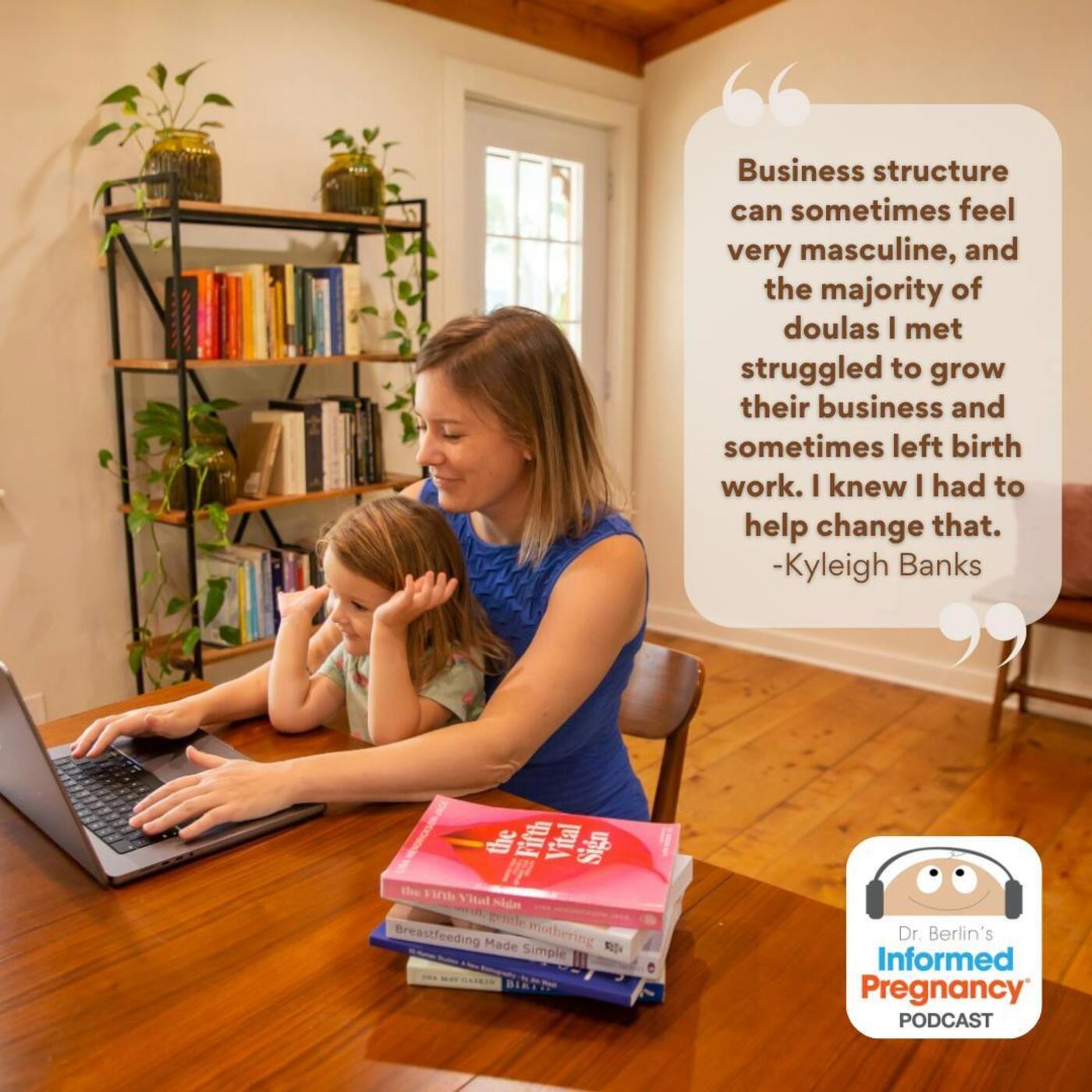
Kyleigh Banks [34:33] Yeah. So you're completely right. Most people who have the perfect personality and brain to be a giver and a supporter and a doula do not have joy and really just don't have the brain and the personality to run a business and run all those moving pieces. Business structure can sometimes feel really masculine. It's not always like there's feminine ways to do business. But when it comes to Birth Work and doula support, I mean is pretty feminine through and through. And so it is true. I would say majority of doulas that I meet struggle, struggle in some capacity to grow their business, whether that's a self-worth thing, a mindset thing, maybe they lack the structure, maybe they lack the framework, the strategy,
[35:18] whatever it is. Just know that you're completely correct. There are a lot of doulas out there who have a hard time. And so this whole thing was born. And when I say this whole thing, birthworker.com and the Birthworker podcast and our doula training program, it was born out of me becoming a fully booked doula and needing to find other good doulas to refer my clients to. And I'll never forget the day because it literally happened in one day. I reached out to several doulas in my area who I knew had been doulas in the past. They were all amazing women of my same personality of home birth, free birth, autonomy. They were amazing. And every single one that I reached out to said, I'm not attending births right now
[36:03] because essentially I didn't make enough money. I had to go back to my old job. One of them was actually a hairstylist, which was funny. She had to go back to doing hair and she's still doing hair to this day actually. And when they told me that they didn't make enough money that they couldn't do birthwork, I didn't like that because I was making enough money doing birthwork. And I thought, well, why don't I just help people figure it out? Because then we'll have more amazing birthworkers. Because like you said, a lot of people are struggling, which means that they quit. They stop doing birthwork. They stop serving women. And so what I first created was a doula training program. I knew that
[36:41] I couldn't teach doulas business unless I helped them actually become really good doulas in the first place. And it's hard to learn the skills to become a great doula in person three day training. I would be willing to say it's impossible. I think most people are quite surprised to find out that the basic doula training is only a couple of days. Yeah. And we're talking like three days to cover everything. So included in that is like lunch breaks and talking about pregnancy, birth, postpartum, bereavement, reproductive health, all of that in three days. There's no freaking way. And so that was the first thing that I created. It's called Birthworker Academy. It's our doula training program. And it covers
[37:20] everything from the self mastery. So overcoming your own triggers. I teach a lot about what makes my mindset so special, what led me to have an amazing birth experience, but also an amazing pregnancy loss. The whole journey was beautiful. And I know that a lot of people cannot say that. There's nothing better or worse about anyone's situations. It was a very beautiful experience. So we start there with self-development and triggers and we call it self-mastery. And then of course, like any doula training, we cover the birth theory, how to attend birth. But I don't stop there because I think it would do people a disservice if I didn't teach them how to make an income. So I go on to not only teach how to run a successful in-person doula
[38:02] business, but also how to run virtual workshops, how to do virtual childbirth education, how to make passive resources like eBooks and online courses, really just so people can burn out proof their business and make a sustainable business. Because no one's going to be able to be on call 24-7 for the rest of their lives. It's just not possible. I know you had did a podcast recently with Maren Green from Indie Birth. And it's so fun to hear her story because she agrees that just nobody can be on call for the rest of their lives. And so my goal is that people who love birth can become birth workers. But also when the time comes where they don't want to be on call, they can still be a birth worker in another
[38:41] capacity. And through that, the Birth Worker podcast was born. So I am the biggest birth nerd, but also the biggest business nerd. And so the Birth Worker podcast, we have amazing guest experts like yourself, Dr. Berlin, Dr. Stu, Dr. Nicole Rankins, Hencie Goer, one of my favorite authors, amazing experts come on. And we not only talk about birth, but we talk about creating a sustainable business. And podcasting has been so much fun. I love connecting with fellow podcasters. It's one of the greatest things we do. So we release two episodes per week, again, birth and business over at the Birth Worker
Dr. Elliot Berlin, DC [39:17] podcast. Amazing. Yeah. Everything you said is really powerful. I think that even if you want to be on call to be able to give enough of yourself to each of your clients without having to feel like you have to cram so many births into a month to make the living. So if you have some sort of other passive revenue stream or not on call revenue stream, then you don't have to burn out and you can be more available to the clients that you're supporting in pregnancy and labor and birth. Very cool. Well, we are at the end of our episode with you, at least our first episode with you. Have a sneaking suspicion you'll be back one day.
Kyleigh Banks [39:56] I would love to. I would love that. Awesome.
Dr. Elliot Berlin, DC [40:00] Thank you so much for sharing your beautiful birth story and your pregnancy loss story and all of your passion and enthusiasm and mindset. And for our listeners, where can we find you online?
Kyleigh Banks [40:14] Yeah, the Birth Worker podcast is a great place to start. So wherever you're listening to this podcast, just type in the Birth Worker podcast or you can go to birthworker.com and find all of our resources there. Amazing. Thanks for joining us at
Dr. Elliot Berlin, DC [40:27] Home. Thanks for listening to Informed Pregnancy. For more pregnancy and parenting information from our Informed Pregnancy media, visit informedpregnancy.com.
Want more pregnancy + parenting? Start your FREE TRIAL of Informed Pregnancy+ and get access to all our curated pregnancy and parenting content — original series, iconic birth films like The Business of Being Born, prenatal workouts and more.
