Kick off our holiday countdown with Part I. Dr. Berlin discusses numbers 10 through 6 of the top 10 most popular episodes of the Informed Pregnancy Podcast in 2024.
Links to the Informed Pregnancy Podcast and other media mentioned in today’s episode:
Trial of LaborTrial of Labor follows a small group of pregnant women and their journeys back to trusting themselves and their bodies after previous births ended in unplanned surgery. Each woman has chosen to plan a vaginal birth after Cesarean.
Key quotes
“The intended parents were in the room. They got to witness the moment that their babies took their first breath. They had this moment that so many wish and hope for, and I got to be front and center, literally right there to watch everything and be part of everything.”
“You grieve honestly for the dreams you didn't have, the pictures in your mind that never get to go in frames, but then you find the silver lining.”
“Hot tip. If you have a scheduled caesarean section, they may bump your time for the emergency C-sections, which makes total sense. So if you happen to decide to be scheduled at 2 PM, you could be there till 8 o'clock starving because you don't get to eat that day.”
“It was definitely a different experience. And honestly, it was my healing experience. It was my experience that I didn't want, but I made the best of it. And it made me realize that in that moment, I realized C-section doesn't have to be scary. C-section doesn't have to be traumatic. It doesn't have to be so impersonal.”
“I was empowered. I was the one informing them what my body needed, where I was going to go.”
AI-generated transcript with speaker labels — may contain errors, especially names and medical terms. Dr. Elliot Berlin, DC appears in blue; Rose Hart Landsberg in orange.
Dr. Elliot Berlin, DC[0:13] Welcome to the Informed Pregnancy and Parenting podcast. I'm your host, pregnancy-focused chiropractor, Dr. Elliott Berlin, joined today by our amazing producer, Rose Hart Landsberg. Welcome.
Rose Hart Landsberg[0:47] Yay. Thank you.
Dr. Elliot Berlin, DC[0:49] It's great to have you on the other side of the mic.
Rose Hart Landsberg[0:51] Glad to be here. And at home, you've tuned into a special 2024 Top 10 Picks of the Year countdown, stories that have touched hearts, sparked dialogue, and provided valuable insights into the diverse and inspiring journeys of pregnancy, childbirth, and parenting. These picks were chosen based on a combination of audience and staff favorites. In this first installment of two, we'll revisit picks 10 through 6, highlighting some of the most powerful and memorable moments from this past year.
Dr. Elliot Berlin, DC[1:23] I love how diverse these stories are. We have a surrogate, an advanced-age first-time mom, a birth worker and podcast host, which is somehow familiar to me, a director, a mom of three with three very different experiences, a free birther, a male birth worker, which again, somehow familiar, a successful musician and actress, a birth world legend, and a longtime show favorite, actress and mother of four. So we have a lot to cover. Let's get started.
Rose Hart Landsberg[2:01] My body was reactive to just getting birth. My body started to produce milk. My hormones were fluctuating. I was having night sweats, all of these different things. My body would wake me up because it assumed I needed to be feeding these babies that just came out of me. And I had to remind myself that they were home and that they were happy and I had to really talk myself back down. Okay, everything's good. It was an internal struggle for the first few weeks. Okay. So number 10 is episode number 391, and it's Joyce Wheeler, the gift of surrogacy.
Dr. Elliot Berlin, DC[2:37] All right. Surrogacy is becoming increasingly more popular. I used to see once in a blue moon a surrogate or somebody who was having a baby via surrogate, and now it's commonplace in the office. Yes, I really found this episode to be special, especially as someone who is
Rose Hart Landsberg[2:57] not a parent myself. I love that, you know, we got so many guests who, for one reason or another, either decided not to or not been able to carry a baby themselves. And there's always a lot of, you know, shame or just disappointment or just, you know, a lot of feelings. And I feel like this episode highlights how positive and fulfilling an experience it is for surrogates to be that person for someone. And so I just think that's an important thing for people to know is that it's not a burden at all. It's a calling and an honor for people to help others bring their kids into the world. You know, it's a really special thing.
Dr. Elliot Berlin, DC[3:43] I think that just like you said, there's various reasons why people are either unable or would struggle to carry a baby. And having this option is a huge game changer. We first had surrogates on the show. We had a guest, her name was Kalila Green, who was a surrogate. And it was really interesting sitting down and chatting with her back in episode 172 and hearing kind of all the different things that go into the arrangement between the person who's carrying the baby and the person who they're carrying the baby for. It got deeper when a patient of ours, her name was Lexi, Lexi Berry had a very difficult first birth and they told her don't carry any more babies. And she wasn't done having
[4:26] a family yet with one and having the option for a surrogate really made it possible for them to continue their family growth. And she really brought us into the experience of what it was like from the other side, from the mom who was the intended mom not carrying the baby.
Rose Hart Landsberg[4:43] Yeah. I was just going to say a lot of our episodes focus on a lot of the problems with the medical industry and hospitals with very valid reason, of course. And I think this is actually an example of the absolute amazing wonder that modern science and the modern medical industry, you know, a miracle that it can give people.
Dr. Elliot Berlin, DC[5:11] Yeah, I think that everything in medical advancement has the potential to do really good and the potential to do harm. And when they're used the right way, when they're used fairly sparingly, when they're used when people want them or need them, they are invaluable and life changing in a positive way. And when they're overused or forced on people who don't want them and need them, they can be life changing in a negative way. So, you know, it's important for us here to try to highlight both, you know, the pros and cons of different things so people can make more informed choices. I really loved episode number 391, our number 10 pick with Joyce Wheeler because
[5:47] after having Kalila kind of talk about surrogacy from a surrogate's perspective and Lexi talk about it from the intended mother's perspective, Joyce comes in almost with a third perspective. You know, she had babies of her own and then became a surrogate twice, but initially for a family member who was struggling. And then she became a surrogacy advocate and now works at a surrogacy clinic as a case manager. And hearing about all the different elements from that perspective was also kind of interesting and very eye-opening for anybody who might be considering surrogacy or knows somebody who's going through it and wants to know more about what the process is like
[6:26] without being nosy enough to ask.
Rose Hart Landsberg[6:28] Yeah, it really kind of personalized it as an industry because of course it is an industry. And like you said, it's so complicated. There are all these, you know, legal implications and just so many pieces. And so I think it's great to have someone like Joyce who can put a face and a heart to, you know, the person that you would ask those questions of who might, you know, be the one guiding you through the process.
Dr. Elliot Berlin, DC[6:58] Yeah. And I think that also Joyce really got into postpartum from the surrogate's perspective, which is really quite fascinating from both perspectives. But having that whole pregnancy and going home with no baby is a unique experience that, you know, can have a lot of challenges. And Joyce really got into that as well. So it's understandable why it's one of our top 10. And I think it's loaded with valuable information that's both educational and entertaining. And that's why it's a top pick.
Rose Hart Landsberg[7:29] Totally. Great host too.
Dr. Elliot Berlin, DC[7:31] Ah, decent, I would say. Here's a snippet from our episode with Joyce Wheeler.
Rose Hart Landsberg[7:38] The intended parents were in the room. They got to witness the moment that their babies took their first breath. They had this moment that so many wish and hope for, and I got to be front and center, literally right there to watch everything and be part of everything.
Dr. Elliot Berlin, DC[7:54] Now on to number nine.
Rose Hart Landsberg[7:58] You grieve honestly for the dreams you didn't have, the pictures in your mind that never get to go in frames, but then you find the silver lining.
Dr. Elliot Berlin, DC[8:07] Okay, it's Rachel Jirall, late motherhood and positivity. Oh my gosh, she is one of my favorite guests ever. She had a baby at 45, and I've rarely ever met somebody with that much energy in general during a pregnancy and during a pregnancy over 45. She's like a nuclear submarine. If I can attach my home generator to Rachel, we would have more energy.
Rose Hart Landsberg[8:31] I actually don't think that that's a compliment to call someone a nuclear submarine.
Dr. Elliot Berlin, DC[8:36] Well, I'm just talking about the energy perspective. If you listen, you'll know it's episodes number 396 and 397. Some of our most popular episodes in general are before and after birth stories. So we interview people during the pregnancy about the pregnancy and what they're planning for birth, and then after they have the baby and how the birth and early postpartum are going, and Rachel's just an incredible dynamo of energy. What's interesting is we have other episodes about pregnancy over 35, actually an incredible episode with Dr. Emiliano Giviera, number 85. One of the things that he talks about that I think is really important is everybody has a clinical health profile, and there's a bunch of
[9:21] data points on there. One of them is age, and you can't change that. When you're looking at somebody from a medical perspective during their pregnancy, you're looking at all these data points, you're looking at the whole clinical health profile, but sometimes we get really, really stuck on one point or another as if it defines the whole pregnancy. But when you look at someone and, okay, they're 45, but they are a healthy weight, and they are a healthy BMI, and they don't have high blood pressure, and they don't have diabetes, the whole clinical health profile starts to look different than if you're just focusing on one data point, which is the age. Rachel really exemplified that for me, like
[10:00] super healthy, super positive, really wanted whatever was best for her baby, open to different types of birth, and really just had a lot of energy, I think because of her mindset, all the way through. Normally people hit 35 or 36 weeks, and it's put a fork in me, I'm all done. She could have gone on, I think, for another month or two if she had to.
Rose Hart Landsberg[10:20] Yeah, I think this episode is important for a few reasons. Like you said, she's this really kind of positive, proactive person, and she put a lot of that into her career for a long time, which is common these days. And that used to mean kind of missing your window. And that's just not true anymore that, like you said, if you're someone who is healthy, either because of genetics or because of resources and education and all of those things, that it's totally reasonable and healthy to get pregnant at 45. And again, because that's so much more common these days, and I think that kind of the culture and the lore around pregnancy is slow to catch up with the reality that we still have these labels,
[11:15] like advanced maternal age that- Don't forget geriatric pregnancy. Yeah, geriatric pregnancy that aren't- I call them AARP babies. Exactly. It's a little bit outdated to be stocked or to act like that's out of the norm these days because it really isn't. Right. And I think to some degree,
Dr. Elliot Berlin, DC[11:39] medicine has a dual role here to both be cautious in the ways that are necessary, but also to be encouraging. And Rachel, again, just gives a lot of positivity and encouragement to the whole thing to anybody who's considering having a baby in the later 30s, early 40s. In addition to Pregnancy Over 35 with Dr. Shavira, we also have another episode called Pregnancy Over 40 with Michelle Johnson, who's also a podcast host. That's episode number 199. Also, Rachel, she was open to having a vaginal birth or cesarean birth, whatever was best for the baby. She was aiming for the vaginal birth and ended up towards the end realizing it was going to be a cesarean birth. And she went into the C-section and after the
[12:21] C-section recovery, there were definitely some hard parts for her and she is raw and open about them, but funny as hell and positive as can be. And again, I think it's really helpful. It's easy to get into a dark mindset sometimes when things don't go exactly how you planned and it's understandable, but it's also helpful to have a positive outlook and to have some humor infused into it. I just think it helps heal the mind, body and spirit.
Rose Hart Landsberg[12:48] It does and it's also something I often end up joking about with the moms that we talk to because often after an episode, there's some follow-up emails and whatnot. And so frequently we're working with people who have just become a mom literally within the last week. And the labor and the birth is just the first surprise out of many, many more. And so I think that's the point at which a lot of new parents are kind of realizing like, oh, it wasn't just one event and you get over that hurdle. Like that's just the first step and to have put so much import on the specifics of that first step seems almost comical when you're like,
Dr. Elliot Berlin, DC[13:37] and now we have 18 years of this. Yeah. I'm still getting surprises. My kids are currently all teenagers or older. Well, just to give you an insight of the energy that we're talking about, here's an excellent quote from Rachel Jarrell to bring us out to commercial.
Rose Hart Landsberg[13:54] Hot tip. If you have a scheduled caesarean section, they may bump your time for the emergency C-sections, which makes total sense. So if you happen to decide to be scheduled at 2 PM, you could be there till 8 o'clock starving because you don't get to eat that day.
Dr. Elliot Berlin, DC[14:09] So I took the first appointment of the day. We'll be right back.
Dr. Elliot Berlin, DC[14:24] Welcome back to the podcast. It's your host, Elliot Berlin and our producer Rose, and you've tuned into the top 10 picks of the year. And we're up to number eight.
Rose Hart Landsberg[14:38] Looking back, you know, it's really hard to see like the lack of education that I gave myself, but at the same time I took it as a learning experience. It wasn't what I wanted. It wasn't what I thought I would have, but it happened. And so I had to try to pull the positive out of it and say, what can I do better next time? And number eight is Megan Heaton from
Dr. Elliot Berlin, DC[15:01] Challenge to Advocacy. Megan's an incredible resource. She's a story of someone who really was knocked down in her birth experiences. The first two really, she had two caesarean births. One of them was pretty traumatic. And then she had a vaginal birth after a caesarean afterwards. And then she founded the VBAC link, which is a platform all about educating and supporting women who are pursuing vaginal birth after caesarean or VBAC. And in the process, actually helping people avoid having a caesarean birth the first time around that they don't want or don't need. And one thing I always say about caesarean birth is that the only thing worse than somebody having a C-section pushed on them that doesn't want
[15:45] it or doesn't need it is someone who doesn't need it, but doesn't have it available to them. It's an incredible tool. It's a powerful tool. It's a marvel of modern medicine, but like all the other ones used in a certain way, it's very beneficial and helpful and used another way, it can do a lot of harm. And we see all the time in our practice, people who just go in underprepared, under informed and end up having a slew of interventions that they didn't want, certainly, and arguably didn't need and end up feeling really crummy on the other side and wishing that they had done more research and self-advocacy before having their baby. Yeah, you do always say that. There are a couple of things that are
Rose Hart Landsberg[16:24] really important about this story from my point of view. And one is that it highlights the fact that the reason VBAC is such an issue is that when you have a caesarean, it keeps affecting your birth choices down the line, even years down the line. So it's not just a one day choice, it's a major surgery and that affects your postpartum period. And then it affects your ability to have a vaginal birth after that. And the other thing that's important about this story is that over the course of three kids, we really see Megan grow as a person and find her footing and her calling and advocacy for herself and for others. And even through that, through her finding the version of birth that she wants,
[17:24] she still had this pushback from other people in her life about her choices for her own labor. And that to me is crazy. Dr. Berlin knows better than most that I'm not someone who has trouble saying no to anyone about anything. But she has a number of examples in her story where she really spoke up and said what she wanted and still didn't get that. And I'm so glad that she is processing it and sharing it and using her experiences to help other people because I don't think anyone should have to deal with that.
Dr. Elliot Berlin, DC[18:13] Yeah, she's one of those people that gets knocked down and then doesn't stay down. She gets her brushes herself off and says, I'm going to help other people not get knocked down. And as a child birth educator, as a doula, as a podcast host, that's what she's really spending the rest of her whole career. That's what she's dedicated her career to. Getting knocked up, not knocked down. Oh, I'm glad you said that. Look, in my journey into prenatal care, I was really early on very confused about the whole VBAC thing because I only ever heard once a caesarian, always a caesarian. And I thought only really hardcore extremists would even try anything else. But once you start to do the research,
[18:53] you realize that nothing's totally safe. There are sometimes great options in both directions. Each one has some pros and cons associated with it. And the only person who could choose which risks or cons they want to take for which benefits is the person who's going to do it. And as more and more research comes out, we realize VBAC is for most people, the risks that are involved are in line with other obstetric risks that we take all the time. And I love that there's more advocacy about it. I was touched and moved and we made the film Trial of Labor, which is all about VBAC. I think the reason the four women who are in that film share their stories is so that other people can learn from their experiences and, you know,
[19:35] learn from the kind of mistakes that they feel like they made originally, and that could have been avoided had they had more information. The potential subtext of that film subtitle might be How to Have Your Second Birth the First Time Around. And a lot of people have told me after watching that film that it did empower them to take steps that improve their first-birth experience in ways that it wouldn't have been. And other feedback about that film, oddly, is sometimes partners don't understand the trauma that somebody who had a vaginal birth experiences. Not everybody experiences it, but for the people who do, it's sometimes hard for them to express why they feel traumatized.
[20:17] And feedback that we've gotten is that after people watch Trial of Labor, that it's the first time their partner really understands it, watching other women talk about it and express themselves. So I think that it's a powerful film, a good adjunct to Megan's episode, which is number 399. Trial of Labor is streaming on Informed Pregnancy Plus, which you can access at informedpregnancy.tv. And also on there is the VBAC preparation course from Mama Stay Fit, which is loaded with information for people who are considering a vaginal birth after cesare. Here's a quote from the episode with Megan, episode 399.
Rose Hart Landsberg[20:56] It was definitely a different experience. And honestly, it was my healing experience. It was my experience that I didn't want, but I made the best of it. And it made me realize that in that moment, I realized C-section doesn't have to be scary. C-section doesn't have to be traumatic. It doesn't have to be so impersonal.
Dr. Elliot Berlin, DC[21:16] All right. That concludes number eight, which means we must be up to number seven.
Rose Hart Landsberg[21:26] Fully Cardi B level was shaking my butt as hard as possible, where the whole room was trying not to giggle, I think. Mickey was like, that's good. That's good. Wow.
Dr. Elliot Berlin, DC[21:40] This is Riley Ebsen, another incredible guest, big personality, creative and resilient. She is a writer, director, and first time mom. And she is hilarious in the way that she directed her own pregnancy and birth. Yes, I love it. You know, she is literally in charge for a living. And the complete opposite of, you know, scared, timid, first timer, she made a call sheet. You know, she was on top of it. And also, you know, has the perfect personality to kind of inspire the group as a leader. But I really like that. You know, the mom's the leader, and she definitely led. I think during my years attending birth, it's always interesting to attend the birth of a career actor,
[22:31] because one of the things I noticed in general is that they take direction really well. So someone's like, breathing in a way that's making them more fearful than empowered, and you just give them a little tip. Hey, try this. And sometimes they'll just do that because they're so good at taking direction and immediately implementing it. And all of a sudden there's this major change. I've never been to a birth with a director who is the exact opposite. And it's funny on its premise, but she's also hilarious. And she did a home birth. And I think one of the things about home birth is, you know, also, I'm going to say, through my 20 years doing this, I have definitely learned a lot. And I come from a very
[23:11] medical background. And when I heard home birth, I was like, oh, that's only for tree hugging, Prius driving, vegan hippies. And then I realized that, like, lots of people do home birth. There's lawyers and doctors, and as it turns out, directors.
Rose Hart Landsberg[23:25] And then you realized you were time traveling to when Priuses had been invented.
Dr. Elliot Berlin, DC[23:29] Right. And I guess now they'd be Tesla driving hippies. I don't know. But she is just a great storyteller, like directors are. And she just is hilarious. And there are elements from her birth that are hilarious, too. Here's a quote from Riley.
Rose Hart Landsberg[23:44] I was empowered. I was the one informing them what my body needed, where I was going to go. I was leading this whole situation. Definitely want to check out Riley Epson's
Dr. Elliot Berlin, DC[23:54] Birth, episode 393. We're going to take a quick break and we will be right back with the rest of part one. Welcome back to the podcast. We are counting down the top 10 picks of Informed Pregnancy Podcast 2024. And we are up to number six.
Rose Hart Landsberg[24:30] So imagine like this like fancy chic hotel in the middle of West Hollywood on a Thursday, and you're rolling in at 6 a.m. so obviously in labor clutching your back. And I mean, the front desk and poor like valet guys valeting our car looked so alarmed. They were alarmed and probably like, please don't bleed all over our carpet.
Dr. Elliot Berlin, DC[24:50] Kara Sutton. Oh, my gosh. Kara Sutton is another one of those guests who has huge energy. She's very entertaining. I had the joy of working with her during the pregnancy here at our office physically, helping her get ready for the birth. And, you know, I gave up coffee on those days because after spending a half an hour with Kara, you're just buzzed from her energy. It's another episode about vaginal birth after cesarean in her case, vaginal birth after two c-sections and also a miscarriage. She had a difficult journey in her first couple of pregnancies. And it's another before and after episode where during episode three hundred and eighty eight, she's pregnant. She's had the two cesareans. She's had the miscarriage
[25:38] and she's determined to have a more empowering birth experience for this third baby. And, you know, when we do these episodes, we never know how they're going to come out. We just share the story. We want to share real stories regardless of outcome, because sometimes it goes exactly as you want. Sometimes it goes complete opposite and there's
Rose Hart Landsberg[25:54] everything in between. Yeah. Well, first of all, let me just say Dr. Berlin would never give up coffee. That's a bold-faced lie. But more importantly, you know, I think these two episodes are so poignant. She's such a lovely person. And, you know, there are a couple parts that stick out to me. One is that, you know, she had these two cesarean experiences and they were traumatic. And, you know, the first one, it left a mark emotionally. And when she ended up having a miscarriage during a sort of, you know, sweet moment with her kids when they were dressed up for Halloween as Disney princesses and she was alone with her husband out of town, she had a miscarriage. And the kind of surprising outcome of that was that
[26:50] it was empowering. It was something that was meant to happen to her body. And she was in charge of how it happened. And she was able to kind of sit and just be with herself and be in charge of it. And it ended up being a healing experience for her. In addition to, of course, being horribly sad. And I think that is, you know, sort of an intense way to illustrate the harm that it can do to a relationship that a woman has with her body to have medical procedures done that she doesn't want. So, yeah,
Dr. Elliot Berlin, DC[27:33] that really stuck with me. Me too. And it's interesting that what really helped her redevelop the connection with her body was the miscarriage and develop a trusting relationship that was able to bring her into wanting and executing a vaginal birth for the third go. I think that miscarriage is really under discussed. And for various reasons, people don't talk about it. And because of that, people don't realize how common it is. But it is a common part. It is almost a normal, natural part of the reproductive years. First of all, we know a lot earlier than we ever knew before that people are pregnant, so therefore those pregnancies end. I think not that far along ago, people just wouldn't have
[28:14] known that they were pregnant. So the number of miscarriages are happening is partially because we're just so much more aware of them. But they're a common part of having kids. Most people that I know that have two or three kids had a miscarriage somewhere in between. And it's part of the body's job is to kind of take that fertilization and see if it's healthy and compatible with life. If yes, nurture it. If not, reject it and start again. And if it was talked about more, especially these early miscarriages, I think it would be less startling. Otherwise it happens to you and it's like, why me? Why me? But I wonder, and we didn't talk about it in the episode, but I wonder if that's
[28:47] kind of realizing that her body does know what to do and when to do it is what kind of gave them a re-empowered relationship with each other.
Rose Hart Landsberg[28:54] Yeah, I believe, you know, she just said it wasn't viable and her body knew that. And you know, what also reminds me of actually is there are a lot of discussions like, you know, surrounding orgasmic birth and just labor, you know, pain and sensation in general. And that the kind of modern idea that you want or need to jump to an epidural to stamp out any pain or any sensation to me is related to whether or not you allow yourself to kind of feel and engage with the pain and the sensation of a miscarriage, that they're both, you know, the two sides to the coin that you feel and you experience loss with life, you know, pain with pleasure. I think that's related.
Dr. Elliot Berlin, DC[29:46] I think that anybody who's experienced miscarriage or somebody who has would benefit from this episode, but also on Informed Pregnancy Plus, we have a series called You Are Not Alone, which is powerful support and conversation about miscarriage and it explores it on a mental, emotional, and physical level. And it's gotten really powerful feedback on how helpful it can be and also CARES episodes. We also have several other episodes where people have shared their miscarriage experiences. Two that pop out in my head are Kate Mara and Ashley Williams. Oh, Claire Holt. There are many, many episodes where people just talk about it. And for most of them, it's like, oh my gosh, why me?
[30:30] And then you start to realize, oh, it's not just you. CARES episodes are episodes number 388 and 389, the before and after story. And it's a very powerful story with a very powerful guest. Here's a snippet from our episode with Kara Sutton.
Rose Hart Landsberg[30:50] I would take this experience over a cesarean any day. I think pushing out and getting to see my daughter come out of my body was incredible and healing and empowering, even though I hemorrhaged, even though she went to the NICU. All those things, ultimately I would still do it the way
Dr. Elliot Berlin, DC[31:10] I did it. All right. And that is the last pick in the first part of our two-part holiday countdown. Thanks for listening to the Informed Pregnancy podcast. Tune into the next episode when we count down from number five, four, three, two, and number one. For more pregnancy and parenting information just like this, visit us online at informedpregnancy.com.
Want more pregnancy + parenting? Start your FREE TRIAL of Informed Pregnancy+ and get access to all our curated pregnancy and parenting content — original series, iconic birth films like The Business of Being Born, prenatal workouts and more.
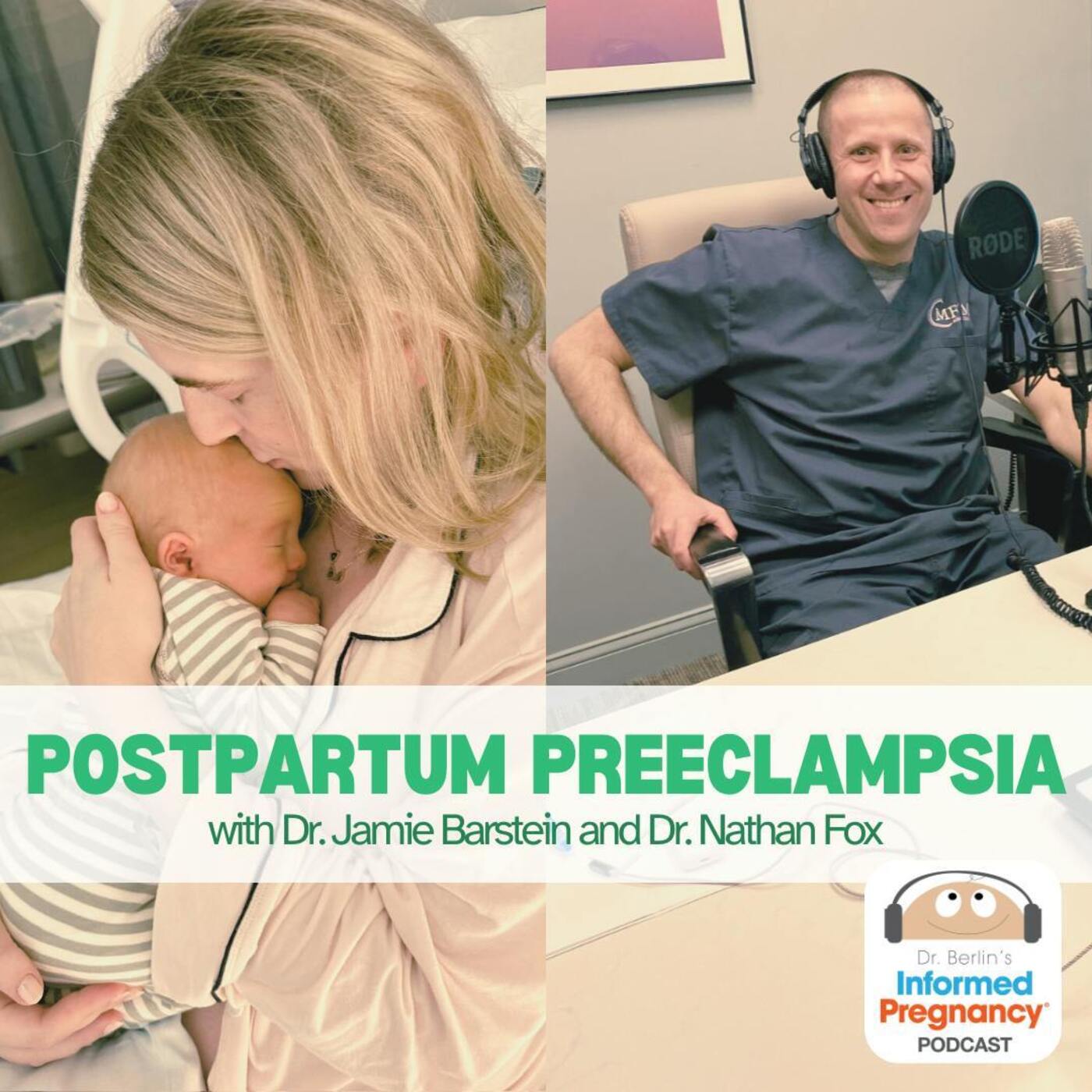
Preeclampsia, and specifically postpartum preeclampsia, is a serious and often misunderstood condition. We welcome two guests to discuss symptoms, treatments, and guidance about navigating the condition. Psychologist and mother Dr. Jamie Barstein shares about her personal experience with preeclampsia after her first baby and Dr. Nathan Fox, OBGYN and maternal fetal medicine specialist provides medical insight.
Listen to Dr. Fox’s podcast here, now streaming on InformedPregnancy+
Key quotes
“And I remember it so vividly. Something was plugged in wrong and I couldn't get to work. And I remember texting my sister-in-law saying, do I really need to check my blood pressure? Can I just go to bed? And she's like, you should check your blood pressure. And I checked it and it was 190 over 110.”
“And so that's why it's one of these things that's kind of silent because you don't know your blood pressure is high. You don't know you have protein in your urine. Most people are swollen. And unless you have headaches or shortness of breath, you usually aren't gonna have symptoms related to those blood disorders.”
“Preeclampsia does kill people. Preeclampsia can be fatal and that's why it's such a serious condition.”
“And that continues even after you go home after delivery. Even if someone's preeclampsia was not like your story and they just had it in their first pregnancy in the more quote unquote typical way, I would still tell them the next time around, even after you go home, check it every day for at least two weeks.”
“Yeah, lean on your medical sources, right? Like trust your gut if something feels off or wrong. Trust your gut. I think a lot to that on-call doctor who, you know, may have been exhausted and I don't know, said, why are you checking your blood pressure? Something doesn't feel right. That's why I'm checking it. So trust your gut and also, you know, and advocate for yourself. And then also be mindful of when your anxiety”
AI-generated transcript with speaker labels — may contain errors, especially names and medical terms. Dr. Elliot Berlin, DC appears in blue; Dr. Jamie Barstein in orange; Dr. Nathan Fox in teal.
Dr. Elliot Berlin, DC[1:12] 's I gotta Welcome to the Informed Pregnancy and Parenting podcast. I'm your host, pregnancy-focused carb director, Dr. Elliot Berlin. Today, we're covering a serious but often misunderstood condition, preeclampsia, and specifically, postpartum preeclampsia. I'm excited to bring you both personal and medical insights to help you recognize symptoms, understand treatment options, and know what it's like to navigate this experience. We're joined today by two wonderful guests. First, we have Jamie Barstein, a child and adolescent psychologist, but more importantly for this episode, a mom, and a patient who faced postpartum preeclampsia after the birth of her first child.
[2:10] She's here to share her story of unexpected symptoms and the adjustments she made to prepare for a second postpartum period. Also joining us, Dr. Nathan Fox, a board-certified obstetrician gynecologist specializing in maternal fetal medicine. Try saying that five times quickly. Dr. Fox completed his medical degree and residency at Mount Sinai, followed by a fellowship at Weill Cornell Medical College. He's now a clinical professor at Mount Sinai and provides high-risk pregnancy care at Maternal Fetal Medicine Associates of New York. He's been a previous guest on a number of episodes of this podcast, and you can find his awesome podcast, the Healthful Woman podcast,
[2:47] at healthfulwoman.com and every place you listen to podcasts. And also, we have a bunch of your podcasts on Informed Pregnancy Plus, streaming right into your living room or wherever you listen and watch. Dr. Fox also co-authored the relatively new book, The Unexpected, with Emily Oster, an economist and author which explores common pregnancy complications and emphasizes the importance of data-driven support from maternal healthcare. Dr. Fox, welcome to the podcast.
Dr. Nathan Fox[3:14] Thank you for that terrific eulogy.
Dr. Elliot Berlin, DC[3:16] Ha ha ha ha.
Dr. Nathan Fox[3:18] Yeah, I'll be ready. They can call on me.
Dr. Elliot Berlin, DC[3:19] Ha ha ha ha. All right, it's a really important topic, preeclampsia in general, and also postpartum preeclampsia, which for reasons I'm not quite sure I'm seeing or hearing a lot more about of recent. We can potentially jump into whether that's actually more cases happening or people just being more aware of it. But Jamie, let's start with you because you experienced it and it came out of the left field for you. What was your experience with your first pregnancy and birth?
Dr. Jamie Barstein[3:44] Yeah, thank you. And also, Dr. Fox, super cool, your book. I can't wait to read it.
Dr. Nathan Fox[3:50] You'll be the third.
Dr. Jamie Barstein[3:51] Awesome.
Dr. Nathan Fox[3:52] Yeah, Emily Oster. No, I'm kidding. Emily is a rock star, so.
Dr. Jamie Barstein[3:56] Yeah, she's my god in terms of, yeah, as a psychologist too, for her friends. I'm like, just listen to what she says and it'll ease your anxiety, so.
Dr. Elliot Berlin, DC[4:05] Well, if she's your god, I'm like one of her angels. Okay.
Dr. Jamie Barstein[4:09] Yeah, all right.
Dr. Elliot Berlin, DC[4:10] I love it. The one with the little red horns?
Dr. Jamie Barstein[4:12] Probably. Yeah, so my daughter who's now three and a half had a fairly smooth pregnancy with her. I mean, you know, all things considered was nauseous and a few different things, but for the most part, fairly smooth, nothing significant. And then my delivery, so I went into labor, my water broke and ended up unsuccessful vaginal delivery and had a C-section. So, you know, I'm exhausted. I had had surgery, I had labored for 30 hours and came home from the hospital a few days later and was like, I just don't feel right. Actually, it was a day later that I came home from the hospital. This is like day four of having my daughter. And you know, I don't think you're supposed
[4:57] to really feel right after you've had a C-section and had a baby, but my sister-in-law who's a doctor, I had reached out to her and I said, I'm having a hard time catching my breath. And so she said, you know, she asked me, do you have a headache? I said, yeah, I have a headache. I mean, I've had a headache for really nine months of pregnancy before I was seeing Dr. Berlin to help me with my headaches.
Dr. Elliot Berlin, DC[5:20] Oh, I'm grateful for your headaches then.
Dr. Jamie Barstein[5:22] Yeah, yeah. And my feet were swollen, which they had been when I left the hospital, but my mom was really, my mom was here helping and she was really worried about how swollen my feet were. So my sister-in-law said, you know what? You should check your blood pressure. The only reason why I haven't had a blood pressure cuff is because it was COVID. And so I had, you know, a blood pressure monitor. So I had some stuff at home because not all of my appointments were in person. But otherwise, I mean, I wasn't told by anybody to check my blood pressure. And I remember it so vividly. Something was plugged in wrong and I couldn't get to work. And I remember texting my sister-in-law saying,
[5:56] do I really need to check my blood pressure? Can I just go to bed? And she's like, you should check your blood pressure. And I checked it and it was 190 over 110. And she's like, call your doctor, but you need to go back to, you know, the hospital. At which point I called my doctor and the doctor on call said to me, why are you checking your blood pressure? Which leads to me hysterically crying, you know, like, I don't know, I'm checking my blood pressure because I was told to check my blood pressure. And I remember the doctor on call says to me, are you anxious? I'm like, of course I'm anxious. Like I just- I am now. Yeah, I was told, you know,
[6:29] and so I remember the doctor on call told me to take some deep breaths and then, you know, took some deep breaths, took my blood pressure again. You know, it was similar. I think it's maybe 189 over, you know, 110 or something, I don't know. And said the same thing, you know, go back to the hospital now. And I mean, I don't even think I knew what postpartum preeclampsia was. I'd heard of preeclampsia, but I don't think I really understood that it's something that could affect you in the postpartum period. I mean, I know they're checking your blood pressure at the hospital, but it was really quite shocking. You know, get there, find out. I had, and Dr. Fox,
[7:04] you'll make sure I'm saying this right, but elevated platelets and liver enzymes and kidney enzymes that were atypical.
Dr. Nathan Fox[7:12] Probably low platelets.
Dr. Jamie Barstein[7:14] Low platelets, opposite?
Dr. Nathan Fox[7:16] Oh, they could have been elevated, but probably low and elevated liver enzymes. Did they give you the diagnosis of help?
Dr. Jamie Barstein[7:24] You know, they didn't give me the diagnosis of help. And maybe you can talk about what that is, but I did have kidney, liver and platelet abnormalities. And then the biggest thing that I had actually at that point was I also had excessive fluid in my lungs.
Dr. Nathan Fox[7:40] Oh my God.
Dr. Jamie Barstein[7:41] They had started me on magnesium, but it was causing more fluid in my lungs or a complication. And so they stopped the magnesium to then get the fluid out of my lungs and then restarted me on the magnesium.
Dr. Elliot Berlin, DC[7:54] I feel like if this is a jigsaw puzzle, you've put together some of the middle pieces and we need to put the frame around it to get a little perspective. But before we go there with Dr. Fox with all the information, a few questions for you, Jamie. First of all, you know, that's a pretty high blood pressure for anybody. What's your normal blood pressure? Do you know how it typically runs?
Dr. Jamie Barstein[8:13] Yeah, I mean, it's pretty normal. Maybe like 110 over 70. That's normal, right?
Dr. Nathan Fox[8:19] Yeah, so this would be much higher. Also, I think those home blood pressure cuffs are notoriously not that accurate, but when it's that high, especially twice, then even if it was just a green light, yellow light, red light, you've got a red light twice. And then the other thing is, was your blood pressure normal in the hospital before you left? I assume it was at the discharging.
Dr. Jamie Barstein[8:41] Yeah, normal blood pressure in the hospital before I left. Normal blood pressure at every appointment or any time I took my blood pressure during pregnancy. Yeah, there was no concerns about my blood pressure. I mean, I was discharged with, you know, no concerns. I mean, you know, to be honest, I was pretty out of it, but I don't vividly recall. So, you know, I'm sure there's something in that packet that they give you, but nothing that was like, hey, make sure you're checking your blood pressure. Here are symptoms to look out for. Those were things that were told to me in my most recent postpartum. And they said, because you're at risk for postpartum preeclampsia,
[9:14] here's what to look out for. But I didn't get any of that in the initial discharge.
Dr. Elliot Berlin, DC[9:18] Got it. All right, Doc, let's talk about preeclampsia first. And also the sort of, I think a lot of people misunderstand the pre is not in reference to labor. Sometimes people think like preeclampsia means a clamps before you go into labor, but it's a state of not yet a clamps yet. You clear this all up for us.
Dr. Nathan Fox[9:36] Yeah, so first of all, Jamie, that's pretty scary. You were pretty sick. I know you're aware of this, but just for the listeners, that's a pretty impressive, not in a good way presentation for what you had, because I'm glad you're okay and you were okay. So preeclampsia essentially, it's a condition that's related to pregnancy, meaning the only people who get preeclampsia are either pregnant women or people who were just pregnant. So you can get it postpartum like you did. It's related to the placenta and why people get preeclampsia and why others don't. We don't exactly know. We know a lot about what happens when one gets preeclampsia. And we know that there are risk factors for preeclampsia,
[10:20] but exactly why it happens in someone and not someone else is not clearly defined. But when it happens, typically the most common manifestations are your blood pressure goes up, which most people don't have symptoms when that happens. Occasionally people will get headaches when that happens, but usually they have no symptoms. So that's reason number one why it's challenging. Number two, they get protein in their urine, which has no symptoms associated. You would not know if you were peeing out protein in your urine. So that's the second reason. Consequently, that's why at every prenatal visit, the two things we have you do is get your blood pressure checked and pee in a cup.
[10:57] It's essentially because we're looking for preeclampsia because you wouldn't know at home. And then on top of those things, there could be a whole myriad of complications related to your platelets could be low, your liver enzymes could be high. It can affect your brain and cause severe headaches and cause potentially seizures. That's where the word eeclampsia comes from when you get a seizure. And preeclampsia is a state before that. It can affect how the baby grows and develops if you're still pregnant. It can cause you to get fluid in your lungs like you had. It can cause a whole host of things. It causes typically a lot of swelling. However, probably 50% of pregnant women
[11:34] have a ton of swelling anyways. And so that's why it's one of these things that's kind of silent because you don't know your blood pressure is high. You don't know you have protein in your urine. Most people are swollen. And unless you have headaches or shortness of breath, you usually aren't gonna have symptoms related to those blood disorders. Now the chance of getting preeclampsia at baseline is ballpark 5%. So one in 20 women will get it. People with risk factors like if you have twins or if you are let's say much older or sometimes if you had IVF or if you're coming to pregnancy a little bit overweight, it can be higher, but higher means like 10%.
[12:12] The only people who have a very high chance of it typically are people who come into pregnancy with high blood pressure as a condition, people with a history of preeclampsia and people who are significantly older like people in let's say their late 40s or 50s have a much higher chance. But the bulk of them happen or present during pregnancy or in the hospital after you deliver. So most people, if they're gonna get it, like if they're in that five, 10, whatever percent, will have signs and symptoms while they're pregnant or in the first 24 hours, let's say after delivery, so it'd be picked up in the hospital. It's a little bit unusual to have what you had,
[12:48] which is you're perfectly fine and you're in the hospital for three days because you had a C-section and then go home and have it. Again, it happens. It is absolutely possible, but it's unusual. And for that reason, it's not currently recommended that everybody go home and check their blood pressure to look for preeclampsia, although it seems to make sense. It's not currently recommended, I think because the chance of it happening is very low and probably a lot of people will get false scares related to abnormal machines or they won't have access and then they're gonna have to go somewhere else to get their blood pressure. And I think, again, I'm guessing here,
[13:23] but my guess of why it's not routinely recommended for everyone is sort of the logistics of it might be complicated. But certainly for people at high risk, we do tell them to take their blood or at least I do tell them to take their blood pressure at home and actually tell them about once a day for a week or two after they go home. I don't know if I would have told you that because again, I haven't done a full evaluation of you but you don't appear to be high risk from your story at least before your first pregnancy. But it is a routine thing when you leave the hospital to tell people, hey, if you have things like headaches or shortness of breath or extreme swelling
[13:55] or this or that to give us a call and it's possible they told you and you don't remember because who the hell remembers what they tell you and leave the hospital? Or it's possible they didn't tell you, I don't know. But I would imagine most hospitals do give people some sort of education about that but it's hard to remember those things.
Dr. Elliot Berlin, DC[14:09] Do we know what's behind the changes that are taking place with the mechanisms that makes it happen?
Dr. Nathan Fox[14:14] It's essentially the body's reaction to hormones from the placenta. It's sort of parallel to gestational diabetes where the hormones of the placenta cause you to sort of your sugar metabolism to get slowed down. But here, instead of your sugar metabolism, it's your blood vessels clamping down causing high blood pressure. And then when they clamp down in various organs, they can cause problems there. There are a lot of molecular pathways that have been worked out relating to various what we call angiogenic factors that come from the placenta. Those are factors that sort of promote blood vessel development in the uterus. But again, why it happens in one person
[14:51] and not someone else, some of it is luck. Some of it is probably factors we have not elucidated and some of it is probably predispositions like genetic or health reasons to have that reaction to it.
Dr. Elliot Berlin, DC[15:04] Okay, I want to take a quick break. When we come back, we'll find out what happened, Jamie, with your experience after you were diagnosed and also more about treatment in general. Don't go anywhere, we'll be right back.
Dr. Elliot Berlin, DC[15:27] Welcome back, we're talking about preeclampsia and postpartum preeclampsia with Jamie Barstein and Dr. Nathan Fox. Okay, so Jamie, what happened after you got to the hospital? You got in and your blood pressure was high, you found the enzymes, your headache was pounding, your feet were swollen and they put you on magnesium but then fluid in the lungs.
Dr. Jamie Barstein[15:46] Yeah, so the fluid had to come out of my lungs and my memory's a little hazy. So I think, didn't they restarted me on the magnesium? Would that make sense, Dr. Fox, that they restarted the magnesium or no?
Dr. Nathan Fox[16:00] They would probably give you medicine to get the fluid out of your lungs. They probably gave you a medicine to lower your blood pressure and they may or may not have restarted the magnesium based on how you responded to those things.
Dr. Jamie Barstein[16:12] Sure.
Dr. Nathan Fox[16:13] You know, magnesium does not cure or even treat preeclampsia. It just prevents the seizures, right? It prevents eclampsia seizures and the chance of getting a seizure diminishes the farther you get away from delivery. So sometimes, even if we admit people to the hospital for preeclampsia after delivery, sometimes we give them magnesium, sometimes we don't and how long we give it if you're on it is also somewhat arbitrary. So it could have gone either way. I don't know what they did with your magnesium, but it is concerning if you have fluid in your lungs because one of the side effects of magnesium is respiratory depression. You sort of don't breathe this heavy
[16:48] and you lose your urge to breathe. So people with fluid in their lungs, we get concerned that we're gonna harm them if we give them magnesium. So it's a delicate balance.
Dr. Jamie Barstein[16:56] Right, and I remember that. And I remember it being serious. I mean, I'm sure that this maybe is every doctor's worst nightmare. My cousin who works in emergency medicine said it's his worst nightmare. I kept looking at everyone saying, am I going to die? Am I going to die? And everyone's response was, it's good you're here.
Dr. Elliot Berlin, DC[17:12] Oh my God, the response should be no, you're not gonna die.
Dr. Jamie Barstein[17:16] Well, maybe it was no, but as a medically anxious person already, this definitely fed my medical anxiety, which is like, you're not gonna die and also it's good you're here. We need to treat everything that's happening for you.
Dr. Nathan Fox[17:27] Preeclampsia does kill people. Preeclampsia can be fatal and that's why it's such a serious condition. And one of the components of the alarming high rate of maternal mortality in this country is related to preeclampsia. However, it is quite unusual to die from preeclampsia while under medical care, that is good. That's paying attention to you and caring for you. Again, there's no guarantees in life or anything, but it is very, very unusual to die from preeclampsia if you are under the watch of people who are watching you.
Dr. Jamie Barstein[18:02] And I should say, I mean, I was at a fantastic hospital under wonderful care. Like I'm a very privileged person and it was really, you know, this is a top notch place. So, yeah.
Dr. Elliot Berlin, DC[18:15] I have a couple of questions here. Dr. Fox, first of all, you know, people take magnesium during pregnancy to help them feel calm and to sleep better and for the muscle cramps to go away, wickedly different than what you're talking about.
Dr. Nathan Fox[18:28] Yeah, so the magnesium people take in pregnancy for that or even for constipation or for headaches is oral and it's in the order of hundreds of milligrams you take by pill. But when we give magnesium for preeclampsia, it's given either typically intravenously, sometimes intramuscularly, meaning a one-time injection like a shot, but most of the places in the U.S. will give it intravenously and you're typically getting two grams an hour. So 2000 milligrams every hour by drip. So it's a much higher dose and it does not typically make people feel calm, relaxed and delightful. It usually makes people feel like, it ranges from some people who are very lucky
[19:10] don't have symptoms, but it ranges to that to people saying they feel like they have the flu, they feel like their head is on fire, they feel like their body's on fire. Yeah, so that's a very common symptom. People typically describe magnesium as exceedingly unpleasant in one way or another. Again, not everyone, some people are fortunate that they don't feel so much of that, but it's not the same thing as the pills people take and giving someone the pills would not help for preeclampsia.
Dr. Elliot Berlin, DC[19:34] That's almost always how people describe it to me that miserable, they hate it and also seemingly they're in a part of, almost like an extra care part of the unit. Like an intensive care unit almost. The best description I've heard is flu in a bag.
Dr. Jamie Barstein[19:50] Yeah, it's pretty miserable. So sharks. And I remember feeling somewhat like kind of loopy too. I also hadn't slept for days and all this stuff, but yes, very loopy, very out of it. And then there's the emotional piece, right? Of like, I just had this brand new baby.
Dr. Elliot Berlin, DC[20:06] Yes, that's what I'm wondering. Your baby's at home and you're at the hospital just a few days after giving birth. Oh, they didn't let the baby come with you?
Dr. Jamie Barstein[20:14] You know, the baby could have come with me. You know, it was also COVID times too. So my husband came to the hospital with me and my parents who were home visiting, they stayed with the baby. The baby came to visit me during the day. But I mean, it was a lot. I couldn't really take care of her and then my husband was taking care of me. That was really, really emotional for me. And I kept saying like, wow, I'm so grateful that this is me who's sick and not my baby. I can't imagine the stories, you know, when the baby is sick or when both are sick, but it really was just a really emotional experience to be separated and you know, yeah, it was hard.
[20:54] It was really hard.
Dr. Elliot Berlin, DC[20:55] And then were you pumping?
Dr. Jamie Barstein[20:57] Yeah, so then I started pumping, breastfeeding was new. And so there was this kind of experience of like, I wanna make this work, but then she wasn't latching and how much of this is also like, have we given each other time to latch? The one nice thing was there's a lactation consultants at the hospital. So when the baby was with me, it's funny calling her the baby. She's three and a half, you know, but it's like, she's separate, different person. Then when she was with me, the lactation consultant was helping. But yeah, I started pumping earlier than I wanted to start pumping, but I did. And then I remember the video of my mom saying like, look, Emmy's having her first breast milk
[21:35] and kind of syringing the breast milk into her while I was at the hospital and she would come with her. Yeah, yeah.
Dr. Elliot Berlin, DC[21:42] This is postpartum, but Doc, you said that essentially preeclampsia could be quite dangerous and it generally happens during the end of pregnancy. So what are the treatments for it while you're still pregnant?
Dr. Nathan Fox[21:55] So the only cure for preeclampsia is to deliver the placenta, which of course means to deliver the baby as well. And so there's always a decision that has to be made when someone has preeclampsia or a form of preeclampsia with mild, moderate, severe, whatever it is, what to do. And if you're towards the end of pregnancy, if you're near the due date, it's pretty clear the best thing to do is deliver. If you're preterm, premature, then a decision has to be made. Is it better to deliver and cure the preeclampsia and have a premature baby? Or is it better to wait, sort of sweat it out a little bit with the preeclampsia and let the baby mature a little bit longer?
[22:37] And that's obviously a very complex decision based on how early are we talking and how severe are we talking? So those are the variables. But generally to treat, you have to deliver. There are things we do in addition to that, there's medications we give to lower someone's blood pressure, which just temporizes things and prevents maybe a stroke from happening. Again, the magnesium doesn't treat the preeclampsia, it just helps prevent seizures. And so it's really delivery. But the ironic thing is that you, Jamie, developed your preeclampsia after the placenta was already delivered. And so we can't deliver the placenta again, right? It's already out.
[23:13] And so for whatever reason, in some people, those changes linger. The most typical presentation of preeclampsia is someone either towards the end of pregnancy or in delivery, their blood pressure starts to go up, they have preeclampsia, we deliver the baby, deliver the placenta. And then at some point thereafter, they get better. Sometimes it's two hours, sometimes it's two days, sometimes it's two weeks, and rarely it's two months. But at some point, they just get better and they continue to improve. But for whatever reason, there's a few people who after the placenta is out, that's the first time they ever manifest with the condition and they have like a delayed response to it.
[23:53] And we don't know why that is, but if you just wait, it will eventually turn the corner and get better. So I'm sure in the hospital, what they were doing is watching you, making sure your blood pressure is okay and you're okay and nothing bad is happening to you while they watch you and just give it time. And eventually it will just self-correct, turn the corner and you'll get better. I assume at some point you went home, did you have to go home on blood pressure medicine? Or how long were you on it? Couple of weeks?
Dr. Jamie Barstein[24:20] Couple of weeks, yeah. I think at my six-week appointment, I was really pretty much off. I was really anxious to go off of it. I mean, I'll be honest, even for months, maybe a year or two years postpartum, if I ever felt like shortness of breath, which off anxiety, but you know. But if I ever felt that I've checked my blood pressure, like my blood pressure must be high again, there's that feeling back to, and it's a condition that I had and I no longer had it, but I think just that trigger of like, is this coming back to me again?
Dr. Nathan Fox[24:52] It's not unreasonable. There are a certain small percentage of people who developed preeclampsia who it never goes away. And then we realize, oh, they don't just have preeclampsia, they actually have high blood pressure, they have hypertension. Because again, not everyone has their blood pressure checked routinely and sometimes the only time it happens is when you're pregnant. And so we sort of coincidentally diagnose someone with hypertension during pregnancy and it sort of presents as preeclampsia and then if it never goes away, they have hypertension. So that sometimes happens. And also, and I'm sure they told you this, that people who get preeclampsia in pregnancy,
[25:25] for whatever reason that's not well understood in their lifetime have a higher risk of developing hypertension 10, 20, 30 years from now. And so it's something that it's appropriate to be on the lookout for it and to have your blood pressure checked periodically and get a physical once a year or whatever it is. And the same is true for like gestational diabetes. If you have that in pregnancy, you have a slightly higher risk in your lifetime of getting it. It could be 30 years later, it's crazy. But it appears to be it's mostly just unmasking something about your body and your health. Not so much that the preeclampsia changes your body into somebody who gets hypertension,
[25:59] but more likely it's unmasking some sort of predisposition to it.
Dr. Elliot Berlin, DC[26:03] Is the 5% all preeclampsia or was that 5%? Do we know what the percent is of women who get it postpartum?
Dr. Nathan Fox[26:11] Oh, of that 5%, the majority do not get it postpartum. I'd have to look up the exact number, but I would say probably if I had to guess 80 to 90% of those it's gonna present probably before they deliver. And the chance of getting postpartum preeclampsia alone more than three days after delivering, I would guess is under 1%.
Dr. Jamie Barstein[26:32] It's so interesting though, cause Dr. Berlin, you see a lot more pregnant people than I do, but just within friend groups, I've had two close friends recently who also had preeclampsia postpartum without really any symptoms and were only checking their blood pressure because of my experience. I think, and you asked this before Dr. Berlin about whether it's actually happening at a higher clip or whether we're just diagnosing it more. And I think it's probably a little bit of both. Some of the risk factors for preeclampsia are increasing amongst childbearing folks specifically age, BMI, use of fertility treatments, things like that. Again, that's not to scare people.
[27:13] Most people who have whatever age BMI or fertility treatments do great. And God bless, they should have kids, but there is factors. And so those risk factors are a little bit more common, but I do think there is, since there's a little bit more awareness, people are more likely to get their blood pressure checked and because it's so much easier to do it now with home blood pressure cuffs and remote monitoring systems. And there's all these ways to do it with like smart technology that I think more people are checking. How many of them would have been horribly harmed if they didn't check? Hard to know. Sometimes it's very mild and it would have just passed on its own
[27:48] without anyone knowing. And other times it's probably saved lives, but that's probably fortunately rare.
Dr. Elliot Berlin, DC[27:55] Right, but that all makes a lot of sense to me given those risk factors and given people are having babies later and having more in vitro and other assisted reproductive technologies and more multiples. But it doesn't explain Jamie's friends because I don't think any of them had those particular factors. But checking and being able to find it earlier also probably, as you said, once the placenta is out, it's gonna go away at some point. So if it doesn't cause too much of a ruckus, just high blood pressure and maybe some swelling in the feet, or you probably would not really separate that from things that you naturally feel postpartum anyway.
Dr. Nathan Fox[28:28] Correct.
Dr. Elliot Berlin, DC[28:29] So it could have been some of those more silent cases are on the radar now. Before we go to another break, I have one question that if I was sitting at home listening to this, I would wonder, because you said it's a reaction to the placenta. A popular trend for people to eat the placenta now, if you have these kind of things related to placenta, whether it's gestational diabetes or hyperemesis or preeclampsia, was there a consideration or thought to not eat that placenta?
Dr. Nathan Fox[28:58] I got an answer and then I've got a story. The answer is when people consume their placentas, typically they are first processed and the processing of the placenta probably denatures a lot of the proteins that would potentially do this. And secondly, when you take a placenta and you eat it and it gets digested, it's probably a lot different than it being inside your body and secreting things directly through your bloodstream. So as far as I know, eating the placenta would not increase the risk of preeclampsia. Now, hyperemesis, if you throw up because it's gross, then that's a possibility. People could do whatever they want with that. The data supporting its benefits are limited
[29:42] and there's potential for risk. I think it's probably not great benefit or great risk. It's just a little bit unusual. I was meeting with a couple and they were talking to me about, we don't have a lot of people in my practice who do this occasionally. So they're talking to me about their plans to take home the placenta and what they're gonna do with it, how they're gonna eat it, and how they're gonna prepare it and all these things. And I don't know, I guess I'm not judging them. I don't really care either way, but I guess something about my face gave away that I thought this was a little unusual. So the husband, he said to me, Doc, you don't believe in eating your placenta?
[30:14] And so I said, well, it's not a matter of belief. I mean, I believe people do it. Like that's fine if you wanna do it, go ahead. But you know, it's just, it's not my thing. I'm not into it. So he decided to push forward. He leaned in, you know, sort of like leaned in and gave me a very stern look and said, Doc, don't you know that all mammals eat their placentas? And so I leaned in and I said, not this mammal.
Dr. Elliot Berlin, DC[30:37] Also, by the way, some of the animals out there eat the baby too, but we don't.
Dr. Nathan Fox[30:41] Whatever, again, I'm not judging anyone. God bless. If that makes people feel like they're doing better or whatever it is, go for it. It's just not my thing.
Dr. Elliot Berlin, DC[30:48] I think it's only a matter of time before we have impossible placenta anyway. And then anyway, let's take a little break. When we come back, we're gonna find out more about Jamie's second pregnancy. And if there's anything you can do to try to mitigate your risk of preeclampsia, we'll be right back. Welcome back. We're with Jamie Barcyn and Dr. Nathan Fox talking about preeclampsia. And in this case, in particular, postpartum preeclampsia. So Jamie, you got pregnant again. Is there a concern that once you've had preeclampsia, you might get it again?
Dr. Jamie Barstein[31:29] Yeah, I think, is it 50%, is that right?
Dr. Nathan Fox[31:32] It depends. Probably somewhere between 25 and 50% based on the circumstances.
Dr. Jamie Barstein[31:38] Well, in my head, it was flip a coin. I might get it, I might not.
Dr. Nathan Fox[31:41] Yours is pretty severe. So the more severe it is, the more likely it is to happen again the next time around. So I would have said it's probably somewhere 25 to 50%. But we would have operated under the assumption that it's a strong possibility and we would have been all hands on deck for your next pregnancy.
Dr. Jamie Barstein[31:56] Well, it's interesting when you said you were pretty sick. I have to say that that really validated my experience because I felt really sick and I felt sick for a long time postpartum. I mean, who knows what a normal experience is. Of course, postpartum is an experience regardless, but I do feel like it took a while from my physical health to feel like, I could even go for a walk without being out of breath. Again, how much of that is just normal postpartum experience? How much of that is preeclampsia? And I knew I wanted to have a second child, but it was definitely something that I'm already run pretty medically anxious and this was definitely a factor in terms of,
[32:34] I know I wanna do this, but I wanna be really thoughtful and mindful. So yes, pregnant again and taking baby aspirin every day. So that's to decrease my chances of having preeclampsia, right?
Dr. Nathan Fox[32:49] Yes.
Dr. Jamie Barstein[32:50] Who's that word?
Dr. Nathan Fox[32:51] No one really knows. I mean, you could fill a semi with the things we don't know about this, but there's thoughts about how it alters various angiogenic factors in the placenta and in your blood vessels and how your response is. But ultimately, aspirin has been studied extensively in terms of reducing the risk of preeclampsia. And the studies are pretty consistent in aggregate when you look at very large numbers that people who take a low dose of aspirin in pregnancy have a slightly lower risk of getting preeclampsia. It reduces it maybe like 10 to 20%. And that's a relative reduction, meaning so if your risk was 10%, it'll lower it to 8%. It doesn't lower it from 10 to zero.
[33:35] The questions are how much aspirin? Like do you take 81 milligrams, which is baby aspirin in the US? Do you take 162 milligrams, which are two baby aspirins? Just for comparison, one full aspirin is 325. So a baby aspirin is one fourth of an aspirin and two baby aspirins would be one half of an aspirin. In Europe, they sell 100 milligrams, they sell 150 milligrams, and people have tried all those different ones. But it's pretty much universally recommended if you've had a history of preeclampsia in the next pregnancy to take some form of low dose aspirin. Interestingly, in my practice, we recommend it to everybody across the board. Like literally I would stick it in a prenatal
[34:15] if I could, because it doesn't appear to be any downside. And the only reason it's not recommended universally is because most people walk around with a low risk and so lowering it from 5% to let's say 4% or 3.5%, it may not be worth it to recommend to millions and millions and millions of people to take baby aspirin. But in our practice, we do recommend it to everybody.
Dr. Jamie Barstein[34:36] Are there other things?
Dr. Elliot Berlin, DC[34:37] Other things that will lower the risk?
Dr. Nathan Fox[34:39] Yeah. There's some evidence that taking calcium supplements will lower the risk. That's predominantly studied in people who have very low calcium intake. And so in the past, when these studies were first done, like 20, 30 years ago, they were looking at like other countries with poor nutrition. And they said, if we give them calcium, it lowers the risk. And people sort of pooh-pooted in the US to like, we're not a developing country. Like we have great nutrition, we eat, but no one I take care of drinks milk or has dairy, right? Dairy is like poison now for everyone. So no one gets the recommended calcium, which is a thousand milligrams a day.
[35:18] That's for non-pregnant people. So when you're pregnant, a thousand a day. So I always ask them like, how much dairy do you eat in a given day? So I was like, oh, I might have a yogurt and maybe I put some milk on my coffee. I'm like, all right, that's 400. That's it. So I tell them my idea.
Dr. Jamie Barstein[35:31] But in LA, it's a soy yogurt anyway.
Dr. Nathan Fox[35:33] Yeah. So I tell pretty much everyone.
Dr. Jamie Barstein[35:35] I was gonna say zero dairy. In fact, the first trimester I had dairy, I threw up so much that my doctor was, let's cut out dairy.
Dr. Nathan Fox[35:41] Yes. So I tell people that they should get a thousand a day of calcium from all sources, wherever, you know, dietary supplements, whatever it is. One of the nice things about calcium is you can buy it as gummies, which are delicious. They can't put a thousand milligrams of calcium in a prenatal because the prenatal would be so big. You'd have to cut it with a fork and a knife. So the typical prenatal only has like a hundred or 200 maybe. So other than those, if you have chronic hypertension, taking blood pressure medicine seems to lower your risk of getting preeclampsia. Having a healthy lifestyle, like some sort of regular exercise that gets your heart rate up tends to be helpful.
[36:21] There's some evidence of certain diets that might help, but probably not that much. And then most of it is just monitoring. I tell people have a history of preeclampsia when you're pregnant, to start taking your blood pressure at home once a day in the third trimester, to be on the lookout for things like swelling. Even if you think it's normal, just make sure to check your blood pressure. If you're checking it every day, then you wouldn't have to worry about your swelling. Signs like, you know, again, headaches and unusual symptoms. And that continues even after you go home after delivery. Even if someone's preeclampsia was not like your story
[36:54] and they just had it in their first pregnancy in the more quote unquote typical way, I would still tell them the next time around, even after you go home, check it every day for at least two weeks.
Dr. Jamie Barstein[37:03] Yeah, that's exactly what I was doing. Yeah, checking my blood pressure. I checked my blood pressure pretty much daily all of pregnancy, because I was also medical anxiety and had a great doctor who said like, great, you know, check your blood pressure. If you're feeling off, check your blood pressure. If anything, that's gonna help your anxiety, right? Like to know like, okay, it might just be pregnancy that I'm feeling off because pregnancy is strange and also good. Like you are at risk, check your blood pressure. Yeah, so hearing you say stuff, a part of me is like, oh man, I should have taken calcium. That would have been the one thing.
Dr. Nathan Fox[37:34] Ah, probably not.
Dr. Jamie Barstein[37:36] Yeah, like I did the exercising and the eating healthy, right? But that's, you know, perfectionism. But yeah, so, you know, was really thoughtful, really mindful monitoring myself. You know, we're at the hospital and I ended up with a planned C-section this time. You know, every time the blood pressure thing goes off, we're like, breathing a sigh of relief. And then came home, was monitoring my blood pressure and unfortunately it was high. It was not nearly like it was after my daughter. So it was, I think 165 over maybe 110 again, I can't remember. So unfortunately went back to the hospital Say that again was like such an emotional experience for me.
[38:16] And it was interesting. It was less about leaving some of my second as a boy and it was less about leaving him. I was really mindful of preparing my toddler for the time I'd be away from her. And I kept thinking like, she's gonna wake up in the morning and say, where's mommy? Kids are so much more resilient than we often think. That was a projection of my own anxiety. And as a child psychologist, you know, rationally, but was just so emotional. Like I can't believe I'm here again. I can't believe I'm doing this again. I mean, it turned out I had a much, much milder form and was there for 24 hours this time and then took medication at home. But it was still, I mean,
[38:52] it was a pretty emotional process of like, you know, I think there was a little bit of kind of trauma response for me of like, I'm back here. I'm doing this again. I can't believe it. I did the things I was supposed to do. I took my aspirin and I ate healthy and I exercise and have a healthy lifestyle. But the reality is it can affect anyone.
Dr. Nathan Fox[39:10] Yeah. I mean, it probably had a more mild course because you caught it earlier.
Dr. Jamie Barstein[39:15] Yeah, for sure.
Dr. Nathan Fox[39:16] Yeah. Meaning the reason the blood pressure is lower, if you waited two, three, four more days, it probably would have been much higher and it probably would have been worse.
Dr. Jamie Barstein[39:22] Yeah. Yeah. I was like, please don't give me magnesium. Remember I came out there like, so we have good and bad news. The good news is that, you know, you're normal in these areas, but the bad news is, you know, this is preeclampsia and we do need to start you on magnesium.
Dr. Elliot Berlin, DC[39:39] Oh, not a fun drug.
Dr. Jamie Barstein[39:40] Yeah. Is there anything you can tell? Like if you're trying to monitor yourself and you check your blood pressure and it's a little high, is there anything you can tell from a urine dipstick at home? It's blood work, right?
Dr. Nathan Fox[39:50] If you have urine dipsticks at home and you can check for protein, that's fine. But if your blood pressure is high, you should be bumping it up to a professional at that point anyways.
Dr. Jamie Barstein[40:00] Really? Not just Shatch EBT?
Dr. Nathan Fox[40:02] Yeah. No, I mean, Shatch EBT is a professional, but yeah, if you have protein in your urine, but your blood pressure is normal, usually you're gonna stay at home. But if your blood pressure is high, whether you have protein in your urine or not, you should be seen. It doesn't matter.
Dr. Elliot Berlin, DC[40:14] Got it.
Dr. Nathan Fox[40:15] Yeah.
Dr. Elliot Berlin, DC[40:16] Well.
Dr. Nathan Fox[40:17] Are we doing it again?
Dr. Elliot Berlin, DC[40:17] That's what I was gonna ask.
Dr. Nathan Fox[40:18] Oh, I got it. That's a lot of- Number three, come to New York. Me and your sister-in-law will take care of you.
Dr. Jamie Barstein[40:23] Yeah, right? I know. I have a great therapist, a lot of processing with my therapist on whether I could do it again.
Dr. Elliot Berlin, DC[40:28] Yeah.
Dr. Jamie Barstein[40:29] I will share, that was part of the emotional experience I was having being re-hospitalized. And you know, I was thinking like, yes, I'm really emotional right now. A lot's happening. Was like, oh my God, am I gonna be able to do this again? You know, and sometimes I have some thoughts around like, maybe this time it'll be the worst, but I appreciate what you're saying too, is like, maybe it was milder because I caught it. And with both times was under good care. I think the first time was really just the shock of it all. I mean, not to say you can ever predict how anything's gonna go when it comes to pregnancy or delivery or postpartum, but you know, I think it's helpful to know
[41:01] that it's so rare, but I do feel like that knowledge around it is so important because, you know, I asked 99% of my friends, they're like, I didn't even know this could happen postpartum.
Dr. Nathan Fox[41:13] I mean, you're a psychologist, you don't need me to tell you this, but you know, a lot of the times when it gets really tough for people is when it's not necessarily the fact that it happened. Right, because people sometimes have very challenging parts. It's sort of the experience when you go through and if your experience doesn't match your expectations, that shock is much worse. And so the second time around, it's a bummer, obviously, that you got it again, but your expectations were that this could happen, it might happen, you're watching for it. And so it happened, you're disappointed, but you typically wouldn't have the same level of like trauma that you would
[41:47] when it comes out of left field. And so the hard part about that is, okay, so does that mean I should scare everybody who's pregnant? Oh, this could happen to you. And it's sort of like, you know, all right, so for the person who it happens to, great, their expectations were matched, but then for everyone else, you're just scaring the hell out of them. And so it's a tough balance for, you know, how do you educate people and have them understand these things and know these things in a way that doesn't scare the hell out of them.
Dr. Jamie Barstein[42:13] Right, that instead you're your own advocate.
Dr. Nathan Fox[42:15] Yeah. It's tough, it's like meta medicine. You know, how do you do these things in a way that keeps people as delighted as possible through the course of their pregnancy, but also keeping them really informed and keeping them, you know, educated and so they could advocate. And it's a very tough balance.
Dr. Elliot Berlin, DC[42:32] As we wind down this episode, we've shared a personal story of not once, but twice postpartum preeclampsia, thankfully treated well, but still a very, very physical and emotionally challenging condition. And we've given some information about the percentages and likelihood that it would happen both before and after birth, some of the signs and symptoms to look out for and be aware of, and even a little prevention potentially. On top of that, as a final note, somebody listening who's pregnant or considering a pregnancy, what would you guys recommend, Jamie, having lived through it, and also Dr. Fox, this difficult balance that you're mentioning
[43:09] of sort of wanting to be on the lookout, but not wanting to be terrified?
Dr. Nathan Fox[43:13] Stay away from WebMD.
Dr. Jamie Barstein[43:14] Yeah, lean on your medical sources, right? Like trust your gut if something feels off or wrong. Trust your gut. I think a lot to that on-call doctor who, you know, may have been exhausted and I don't know, said, why are you checking your blood pressure? Something doesn't feel right. That's why I'm checking it. So trust your gut and also, you know, and advocate for yourself. And then also be mindful of when your anxiety is taking over and, you know, I always call it spiraling into a path of now this is making me feel worse versus I'm gonna seek information, I'm gonna seek care in order to make sure I'm okay.
Dr. Nathan Fox[43:51] Yeah, I agree with that 100%. I would also say, and this is a plug for you, Dr. Blinn, and I guess for me as well, I think everyone, again, whether you're pregnant, whether you're thinking of getting pregnant, you have to find the sources of information that work for you that are reliable, that are understandable and that speak to you. And for everyone that's different, obviously, I would say this podcast right here is a very good one. And I think mine is a good one. There's others that are good, obviously, whether it's that, whether it's a book, like you mentioned, Emily has written great books, whether it's her books, whether it's another book,
[44:25] there are good websites. You just have to find what they are and that they're, again, reliable and they speak to you in a way that some people want more medical ease and other people want more colloquial. And you have to see which one it is and then try to educate yourself as much as possible in a way that's not terrifying. So you sort of know what the possibilities are and what could happen. And I would rely on those much more so than just Googling and finding the worst option out there and saying, all right, I'm gonna die.
Dr. Elliot Berlin, DC[44:51] I trust everything you say, especially this being a great podcast. I take that to heart. Okay, well, I wanna thank you both for being here and Jamie sharing your personal story and Dr. Fox sharing your professional expertise. Very potent episode with a lot of valuable information that I know will be helpful to a lot of people. Doc, you've been on our podcast before. For example, we talked about anemia and low plate levels in episode 228, external cephalic version is actually a very popular episode, episode 299 and thrombophilia in episode 325. There are others.
Dr. Nathan Fox[45:26] 299, that was the big one.
Dr. Elliot Berlin, DC[45:28] 299, yeah, we almost made it there. But there's more of you to go around aside from people living in New York who can come see you and you can be their doctor. Where else can we find you, your podcast and other resources?
Dr. Nathan Fox[45:41] So you could find me prowling about either the Upper East Side of Manhattan or England, New Jersey. I'm the middle-aged guy with all the cubs paraphernalia in the wrong town. So you'll find me there. Yeah, I mean, the podcast is probably the best way. As you said, it's called healthfullwoman.com. It's a horribly named podcast because it's impossible to pronounce, but it's like the word helpful, but health. Helpful. Yeah, and everywhere you find podcasts, we have a website, healthfullwoman.com. And again, as you said, that I was privileged to co-author a book with Professor Emily Oster, who is the best of the best. And that was a really cool experience.
[46:20] We have a whole chapter on people with the history of preeclampsia and other things that have happened to people's first pregnancies.
Dr. Elliot Berlin, DC[46:26] Well, I'm glad you're keeping busy.
Dr. Nathan Fox[46:28] Doing my best, man. Doing my best.
Dr. Elliot Berlin, DC[46:30] Thank you guys again. And at home, thanks for listening to our podcast. For more pregnancy and parenting information, just like this, visit us online at informpregnancy.com.
Want more pregnancy + parenting? Start your FREE TRIAL of Informed Pregnancy+ and get access to all our curated pregnancy and parenting content — original series, iconic birth films like The Business of Being Born, prenatal workouts and more.
Birth doula, exercise scientist, founder of Mamaste Fit, and mother of four Gina Conley joins the podcast to talk about perinatal wellness and preparing the body for birth and postpartum.
“And so looking back, I'm like, I just needed someone to like tell me to breathe and to tell the nurse to turn the pitocin off”
“Exactly like there is room for a happy mom, too. And so I think the thing that really helped me was recognizing that emotions could coexist and they don't diminish each other. And so I can be really joyful and happy that my baby was here with us and that she's doing really well, while also mourning my birth experience and mourning this journey and the start of our story together.”
“It was incredibly healing. When people ask me like, what helped you really heal from your first birth? It was my second birth. I don't wanna put that on my baby. And I don't wanna like necessarily like tell people like the only way to heal from a traumatic birth is to have a better birth the next time. But that really was for me what helped me heal from it was knowing that this amazing birth experience could happen and feeling just so, so supported in it.”
“We're just looking for movement that brings you joy that makes you feel good in your body because you don't have to be in pain during pregnancy. There is some amount of discomfort that is probably expected, but you do not need to be in the debilitating pain. Pelvic pain is not a requirement. The solution is not to just give birth. There's a lot that we can do during pregnancy to be comfortable, to be pain-free, but most importantly is finding movement that feels good for you.”
“And then when it comes to the postpartum, being patient with that process is so, so important. If we rush it, we're gonna end up having more issues than helping us and there's no need. Like the only body that has created like life is the postpartum body. And that is incredible. Like we should honor that. Like there's no need to bounce back or to rush back to fit into this specific small size. Like being smaller does not mean better or healthy. Like we really just wanna be very gracious with ourselves as we navigate our motherhood journey.”
AI-generated transcript with speaker labels — may contain errors, especially names and medical terms. Dr. Elliot Berlin, DC appears in blue; Gina Conley in orange.
Dr. Elliot Berlin, DC[0:12] Welcome to the Informed Pregnancy and Parenting Podcast. I'm your host, pregnancy-focused chiropractor Dr. Elliott Berlin. Today, I'm thrilled to be joined by a birth doula exercise scientist, founder of Mama Stay Fit, author of Training for Two, and mother of four. She brings a wealth of knowledge about preparing the body for birth and recovery, and today we'll dive into her personal journey and expert insights. Gina Comley, welcome to the podcast.
Gina Conley[1:03] Thank you so much for having me.
Dr. Elliot Berlin, DC[1:05] It's a pleasure to have you, and you do incredible work, and you have a lot of experience both on the personal side of making babies and on the professional side of helping people who are making babies. I'd love to dig into both of them. Let's get started with a little bit of your background. Where did your journey into doula work and fitness for moms come from?
Gina Conley[1:25] So after the birth of my first daughter, I was actually still in the army, and I transitioned off of active duty into the civilian world, and I was trying to figure out what I was going to do when I grew up. After I no longer had the career that I had for the past seven years, and I decided that I was going to start doing pre and post-natal fitness in my local community. And after about a year of doing that, one of my prenatal clients asked me to be her doula, and I was like, sure, I will figure that out. Such an army attitude. And I was like, cool, I'll do it. So I took the Dona doula course, and I became her doula. I actually got to shadow a few other doulas, and then one of the
[2:08] doulas had me be her backup. And unfortunately, her father was going through a lot of medical complications. And so I got to back up a lot very quickly as a new doula. So I had a bunch of births under my belt very quickly, which is pretty uncommon for somebody that's just starting out as a doula. And so by the time I actually made it to my client who was pregnant, I already had attended over 10 births. And so I kind of it was like unfortunate, but also like lucky for me. And so I had a lot of experience supporting my very first clients that actually had hired me. And that's kind of how my journey began into the birth world. So I started in the
[2:47] fitness side, I ventured to the birth realm and realized that they obviously are all very connected to one another. So it made sense that I could provide support to somebody throughout their pregnancy with fitness. And I could then support them during their birth with movement and help you to guide them through the process and then help them recover in the postpartum. And so we ended up being able to provide this full spectrum support for our clients in person. And then a few years ago, we expanded to really offering a lot of our services online as well to folks that don't live near us. So we started in person, we still support folks in person and our gym and as a birth doula and then people
[3:24] all over the world, which is really awesome.
Dr. Elliot Berlin, DC[3:26] Did you say that prenatal and postpartum training started after you had your first?
Gina Conley[3:31] Yes, it did. So after I had my first is when I started my business primarily focusing on pre and postnatal fitness, because there wasn't that much out there at that time, there was like, maybe like one company really focusing on prenatal fitness, there weren't really any programs offered, especially for someone like me that was from an athletic background, like I was in the army, I wanted to do things that were challenging for me during my pregnancy, couldn't really find anything. So I was just kind of like doing what felt right in my body, just kind of modifying here and there as based on what made sense. And then in the postpartum, I was kind of like, well, what do I do now? Like, how do I get
[4:07] back to that level of fitness? And so fortunately, my mom is originally from South Korea. So she really kind of instilled in me to rest in the postpartum to take my time getting back to fitness. And I think that really helped me long term with my healing was being so mindful in that early phase of healing, like eating lots of nourishing foods, having tons of support. And so I wanted to create something for other women that provided a challenging fitness program during their pregnancy that was safe, but also helping to prepare them for birth. So there's a lot within our programming that helps somebody stay strong throughout their pregnancy, comfortable and
[4:45] pain free throughout their pregnancy, while also helping to prepare them to open their pelvis for birth. And then we have our programs to help them recover after, but this all started after the birth of my first daughter about seven years ago now.
Dr. Elliot Berlin, DC[4:57] Nice. Well, and then there's three more before we get to that. You said athletic background and military background. First of all, thank you for your service. But then also athletic background. Is that the military background or are they separate?
Gina Conley[5:12] Well, I was a collegiate athlete. So I ran cross country and track when I was in college. And then my athletic ness kind of continued when I was in the military from doing some pretty physically intensive jobs throughout my career. And so I left the military pretty good physical condition. And I wanted to figure out how to continue to do that as I kind of ventured into my childbearing years. And what I was finding was I had a lot of clients coming to me that wanted to stay strong throughout their pregnancy. They wanted to feel challenged, but they didn't know where to go. All the prenatal programs that they were doing were like really easy or like very gentle and
[5:46] they wanted something more. So we kind of provide that for folks that are looking for that next step in a way that is accessible, that has modifications, that has those offerings for folks that are not as much into fitness and they want to do things to help them prepare for birth. Like we include that for those folks as well, but definitely focusing on the athlete that wants to stay in shape throughout their pregnancy. But they want to be mindful of how they're moving and then recovering in the postpartum.
Dr. Elliot Berlin, DC[6:14] What is an exercise scientist?
Gina Conley[6:16] So my master's degree is in exercise science. So I don't necessarily refer to myself as an exercise scientist, but it's just my degree.
Dr. Elliot Berlin, DC[6:26] I mean, is it what it sounds like the program?
Gina Conley[6:29] Yeah, so it's just studying like human movement, like how does the body move? What are different like biomechanical movement patterns do? What muscles are involved? Like, how do all these kind of correlate to moving a human body? So that's kind of what my background and study was for my bachelor's and master's degree. And then of course, my study with like working with my clients and just researching body movement is kind of my background.
Dr. Elliot Berlin, DC[6:52] And a lot sort of has changed and developed over seven years, but during your time doing this type of work, what have you found, especially in the postpartum side is maybe the biggest gap in fitness, advice or accessibility for new moms?
Gina Conley[7:06] So when it comes to the postpartum realm, I think the hardest thing is the childcare aspect with exercising and having somebody that could either want to take care of your baby so that you could go to the gym and work out. A lot of gym childcares don't take babies younger than a certain age. So even if I went to like my local gym here, like I couldn't put my baby in it. So after they were six months or 10 months or 18 months, like some of the time frames are pretty large. And so then you're pretty limited on when you can work out. Like if you want to go to the gym, you got to wait until somebody else is available to watch your baby. If you're working at home, having
[7:39] this set up at your home and then trying to manage working out with your kids at the same time. So it can be pretty challenging to return to fitness in the postpartum. And what we found with our clients is during pregnancy, we have a lot of pregnant clients. Everybody wants to do stuff to help their baby, to help their pregnancy while they're pregnant. And then postpartum, it's a lot harder to get those clients to come back to the gym because it's just harder in the postpartum. We don't have as much support sometimes so that we can do workouts that feel accessible. And then there's a little bit of expectation management. Like our workouts are not going to look the same as
[8:11] pre-kids. I got four kids now. Like my workouts do not look the same as when Juno was in the army and I didn't have any children. Like I can't work out for two or three hours a day. I've got I've got a lot of competing demands and it's just not realistic for me. Like what I'm looking to train for is to be able to keep up with my kids, to play with them without being in pain, get up and off the floor, be able to pick them up and live a full life with my children. And so when we shifted to the postpartum, this is probably the first time that we have fitness goals for ourselves that are beyond aesthetics, that are beyond like certain performance goals. Like it's really just about being
[8:46] healthy and being able to move and to play with our children and to keep up with them not only right now in their postpartum but for years and decades to come. And so there's a little bit of shifting in our goals and our priorities when it comes to managing fitness in the postpartum. And a lot of it deals with how do we manage our kids? What do we do with them while we're working out? How do we involve them in it? Like what type of setup do we have that's available to us? And then just kind of adjusting our expectations of like what is my workout going to look like? It's probably going to have some interruptions because we got if you're working out with your baby, your
[9:19] baby's got their own little demands that they have for us. And so for me, sometimes my workouts are pretty smooth. I can get through like my 45 minute workout without really any interruptions. But most of the time, it's like every 10 minutes I'm stopping to give somebody a snack, to give somebody a toy, to nurse my baby. But I'm still exercising. I'm still moving my body, involving my kids in it. But it can just be challenging to find the time and to find the support to do so.
Dr. Elliot Berlin, DC[9:44] Yeah, everything I see and hear from our patients in the office echoes what you're seeing here. And then that's kind of like what's the first baby. And then when you're pregnant and you have a little toddler, you have both dynamics at the same time. Now you have no time for yourself and you're pregnant. And it just seems to exacerbate the whole cycle. So, you know, a little bit later in the podcast, I'm definitely going to want to pick your brains for some specific tips that we can give to help people find their fitness during and after pregnancy. And then of course, share your resources. Before we do that, I want to get into your own pregnancy and birth stories. We'll
[10:17] take a quick break and we come back. We'll see how your journey of four has been. We'll be right back. Welcome back. We're talking to Gina Conley from Loma. Stay fit. Okay, so you have four kids. Tell me about your experiences with pregnancy and birth. Obviously, there's a bunch of them, but also kind of what you've learned along the way and your professional birth career has developed along the way too. So how that influenced your personal experiences and how your personal experiences influence the work that you do.
Gina Conley[10:56] So my very first pregnancy, I had no idea about anything. Like I grew up terrified of childbirth and I just was like, you know what, people get pregnant. They just go to the hospital and then somehow a baby is born and I'll probably get an epidural. Like I was just very like, whatever happens, happens. I had no like real idea of like a birth plan or preferences and also just didn't know what options were available to me. Like, why would anyone do it in any other way? Like we have an epidural, like why would you not get one? And into my third trimester, I began to realize that there were people that actually gave birth without paying medication and that it could
[11:34] be this really cool experience and I was like, I wonder if I can do it. I think I want to try that.
Dr. Elliot Berlin, DC[11:40] And also what's weird that I found out is they're not ultra-hugging, pre-istriving vegan hippies.
Gina Conley[11:45] Yeah, like in all sorts of different places. So I began to explore or understand that there was other ways that people gave birth and I wanted to have an unmedicated birth. I wanted to give birth without an epidural. And so when I was nearing the end of my pregnancy, anyone that I had voiced this to was like, Oh, you just wait, wait until like you feel your first contraction, you're going to be screaming for an epidural. And it was just like a really unsupportive kind of vibe that I had going around me.
Dr. Elliot Berlin, DC[12:15] Before you jump too far further, that's a big flip from growing up terrified of birth and not really anybody ever did it without meds to like almost advocating for yourself to do it without meds.
Gina Conley[12:26] Yeah, it's just, I like started to get exposed that there were people that did it without medication. And I was like, Oh, that seems interesting.
Dr. Elliot Berlin, DC[12:34] Particular resources that touched you more than others.
Gina Conley[12:38] Not really not in the first pregnancy. I just think I started seeing like Instagram posts and stuff of people. I can't even remember where I saw it or what exactly like triggered me to like flip to the other side, but I kind of viewed it as maybe this will be a challenge. Like let me see if I can do it. I'm in really good shape. I could totally do it. Like it'll be probably the whole thing.
Dr. Elliot Berlin, DC[12:55] Fit people love challenges like that you pay people to challenge you like that.
Gina Conley[12:59] Yeah, I was like, I'll just do it with birth. So towards the end of my pregnancy, I hired a doula. My husband was like, we should get a doula. My friends all talk about how amazing doulas are. And I was like, yeah, let's hire a doula. And I started nearing the end of my pregnancy. And I showed up at my 40 week appointment and the nurse practitioner was like, well, here's your induction date and 10 days from now if you're still pregnant. And I was like, what do you mean that this is my induction? Like is something wrong with my pregnancy? Like it just felt like this arbitrary date. And so I became very, very stressed out. The days just kind of ticked by and I was
[13:35] still pregnant. I'd wake up and I was still pregnant. I hit 41 weeks and I was still pregnant. And I was so stressed because I felt that an induction would really impact my ability to have an unmedicated birth. I mean, at the time, my sister who works with me and mama say fit was a labor and delivery nurse. And she had not quite really been exposed to unmedicated birth. And she was like, Gina, induction's not a big deal. Like people get pitocin all the time. And she was very dismissive of how I was feeling. And now we have conversations about how that maybe wasn't a good approach for her. And so 41 and three was my induction date. At 41 and two, I
[14:12] started labor and I was like, I'm going to make sure I do everything to keep this going because I do not want to get induced tomorrow. And so I walked for miles. I was just like running around my house, all the things of opposite of what you should do during early labor. And I was just so stressed out that my contractions would not continue and that I would have to be induced the next day because I didn't quite understand like how the whole induction process worked. And so when my contractions are like four to five minutes apart, I was starting to need a little bit of support for them. I was starting to breathe through them a little bit more. And I
[14:46] was like, I need to go to the hospital because my app is telling me that it's time to go. Like we live like 40 minutes away from the hospital. I don't want to be in the car and like super labor. So we drove all the way to the hospital against my doula and my sister's advice. And I was like two centimeters. And instead of just going home and laboring at home, I was convinced that things would progress and I should just stay near the hospital. And looking back now, I know that I was just like really stressed out and I needed someone to just tell me that it was okay, that my labor was going to continue to progress. Like I wasn't going to get induced, like Gina, just
[15:24] take a breath and go sit down. But I didn't feel like I had that person that was telling me like the thing that I really needed to hear to like calm down, essentially to tell me that I was safe and that it was going to be okay. And so we just kind of like wandered around near the hospital. There's like a track nearby. We walked around, things continued to pick up. We went to dinner and at dinner, I was like, I cannot anymore. And I was starting to kind of shift into more of like an early act of labor at that point. Went back to the hospital and I was still two centimeters and I was just like, oh my God, what is happening? But for whatever reason,
[15:58] they admitted me at that point. And I didn't understand why they weren't admitting me. The midwife started talking about potosin. She's like, we're going to give you potosin to really get things going. And I was immediately horrified and I was like, potosin is going to ruin it for me. Like I cannot get potosin. And so I started asking immediately about what pain relief options I had, because everyone tells me that potosin is really bad and I'm not going to be able to handle it. And so she was like, well, if you don't want enough Aduro, I can give you IV pain meds. And it was just really nonchalant. She was like really dismissive and it was just not a
[16:29] very supportive vibe that I was getting from her. And my doula had no really no idea what's going on. My sister had no idea what's going on because I didn't know how to communicate what they were telling me. And so, like, I didn't know how to tell my support team, like what was even happening. And my husband wasn't really sure what was going on either. And then I had this midwife that was like really difficult to like communicate with. Like she was just really abrupt and like really abrasive with me. And I felt like I was like bothering her by being there and that she was angry at me. And so that was definitely not helping me anymore. So eventually we made
[17:02] it to the labor room. They started the pitocin. I'm already starting to panic because I'm afraid that the pitocin is going to go zero to a thousand really quickly because I didn't really understand it very much. And so they gave me IV pain meds and I was like, well, the IV pain meds just made me feel like very like drunk and like very tipsy. I didn't like how it made me feel. And as soon as it wore off, I started panicking because I was like, the pitocin is still on. I would like it to be turned off. I feel like my contractions are really close together. They feel very strong and I don't want the pitocin anymore. And so the nurse came in and she was like,
[17:39] we're not turning it off. And then I was like, I want to talk to the midwife and the midwife came in with her arms crossed and she's like, I heard you want to talk to me. And I was like, I do not want to talk to you. And so at that point, I just began to like mentally spiral where I was just like everyone is against me. The staff hates me. I don't know if I can manage this. And so looking back, I'm like, I just needed someone to like tell me to breathe and to tell the nurse to turn the pitocin off because I really don't know why they put me on pitocin because my contractions were consistent like they were happening. It wasn't like they were super spaced out
[18:13] or there was something going on. Like to this day, I don't know why they put me on the pitocin. And so I was like, I am mentally not OK anymore. Like I cannot handle like what is happening right now. I can't keep up with these contractions. And I started asking for an epidural. And so my doula really tried to like help me. Like we went to the bathroom. I felt like the nurse just like was hard to talk to. And little did I know that shift change was coming. And if I had just waited like another hour, it may have been a completely different experience for me because the staff that came on for day shift was phenomenal. Like they were so much better
[18:50] than the nighttime staff I had. But I felt like if I just had like a different nurse that could talk to me and like calm me down, like it would have been a different experience for me. So I got the epidural, shift change happened. And I remember before I got the epidural, I was like four or five centimeters at this point. And this was at like six or seven a.m. I was like complete and fully dilated by like nine a.m. So it was pretty quick from like when they last checked me to like when I was complete, which is a trend that I have with all of my labors, all of my labors. I tend to be like three or four centimeters for a really long time. And then all of a sudden
[19:27] I'm complete. And so my active labors are very quick once they transition. I'm obviously I didn't know this was my first time. And they checked me at like nine and I was almost complete or almost 10 centimeters. And they were like, well, do you want us to break your water and like to really just get things going? And in that moment, I like remember it to this day. I just felt so defeated, like I felt like everything that I wanted for my labor, like that empowering experience that I felt like all of these women who had unmedicated births had was just gone. And at that point, I was like, we'll just do whatever you want, I guess. I mean, everything else
[20:06] has been has been you guys. And I just remember feeling so defeated. And it absolutely crushes me as a doula when I find myself in that moment again with a client where it was just relentless from the medical staff. And I've had amazing experiences in hospitals as a doula as well. But sometimes you just get the wrong person who is just not vibing with you well, and it can just make it so bad. So eventually I was like 10 centimeters pretty quickly after that push for like two and a half hours. My baby was born screaming and they immediately took her for me to the warmer. And I was like confused why she didn't come straight to my chest. To this day, I don't know
[20:48] why they took her at that point. And I just felt really defeated from that birth. I obviously was excited that my baby was born, that she was healthy, that I was healthy. But it just felt like maybe that was the bare minimum like for us to be alive when and like thriving after your baby's born. But I just felt like emotionally like something was off for me, like I didn't leave that feeling really empowered or that this was some monumental moment in my life. And I really struggled with it for the next like three years before my son was born.
Dr. Elliot Berlin, DC[21:22] And so how did you work through it?
Gina Conley[21:26] Initially, I think I just kind of told myself that it was fine. And then eventually I began to tell myself that it was OK, that I was not happy with that experience. And to this day, I think I will have a hard time telling my oldest like her birth story without being really sad about it, especially since I wanted to have three really amazing, like empowering birth experiences. And so it really saddens me to the stage to know that my very first birth experience and one of the limited times that I mean, I only gave birth four times, like you can only do it so many times. And to know that one of the four experiences that I had with giving birth was like on the more traumatic side
[22:03] for me and emotionally defeating side for me just like breaks my heart. And it makes me so sad to know that there's a lot of women who have really hard birth experiences that everyone is healthy and happy or healthy at the end. Everyone's alive. But emotionally, we're not necessarily happy with how that went. And it feels like it's just the bare minimum for everyone to be alive. Like there's room for a happy mom to you and for an empowered mom.
Dr. Elliot Berlin, DC[22:28] That's a powerful thing that you just said, because I know that people sometimes it strikes them the wrong way when they didn't have the birth experience that they wanted or didn't feel like they were listened to or empowered or, you know, in the driver's seat for their birth experience. Like you said, you don't get to do it too often. Well, meaning people commonly say, you know, luckily you and the baby are healthy. Shouldn't we focus on that? But the way you just expressed it is right. Yeah, of course, we're grateful for that, but that's the bare minimum. And why should we, you know, especially in a country that has so many resources, where are we settling
[23:03] for the bare minimum?
Gina Conley[23:04] Exactly like there is room for a happy mom, too. And so I think the thing that really helped me was recognizing that emotions could coexist and they don't diminish each other. And so I can be really joyful and happy that my baby was here with us and that she's doing really well, while also mourning my birth experience and mourning this journey and the start of our story together. And so I had another friend that is still a real big part of Mama Say Fit to this day, who also had a birth that she was not expecting and she was not planning for. And so we really kind of bonded with each other over kind of healing from that. And I think what really helped
[23:43] both of us heal was coming to support this community with Mama Say Fit and providing like in-person support to our clients and to folks that are navigating their pregnancies, their postpartum and their birth, in addition to kind of expanding to the world. And so now we have a lot of folks that will message us and say, you know, I followed your Instagram. I did your program. I took your course. I had an amazing birth. And so I kind of look at that as well, because I had this first birth, I know that it can be bad for people, even when everyone is alive and healthy at the end. Like it can still be a hard experience and that's still meaningful. So now I'm going to create
[24:22] this course and these offerings to help folks have a better experience so they can learn from me. So that's kind of how I have mentally kind of dealt with it is kind of using it as like a silver lining, which I don't wish that I had that first experience. But my next three were definitely more aligned with what I think we're supposed to have when we give birth.
Dr. Elliot Berlin, DC[24:42] I'm super curious about the second because that's the first one after the experience that you had. How did you go into that one? And what was the plan for that birth and how did it go?
Gina Conley[24:53] So this birth, I initially had planned to give birth in the hospital again, same hospital as my first, but I was more with the midwives within my clinic this time. I was doing like centering. So I was with one midwife with like a group of other folks that were due around the same time as me. And so I was navigating this pregnancy with the intention to again, try to give birth unmedicated without an epidural. I was going to try it in the hospital first and then maybe for a future baby, we'll think about home birth. And so this was kind of our plan. I was preparing for it. I was feeling kind of nervous about it. And then COVID hit and my son was born in 2020
[25:32] and this was my third trimester when the shutdown happened. And I was very concerned about who is going to be at my birth, like who is going to be allowed at my birth because for some folks, like the hospital that I was going to give birth that there was question on whether or not the partner was even going to get to be there. Like, could my husband even be at the birth? We're definitely not going to be able to have a doula. My sister and my mom were not going to be able to be there. I had a birth photographer. She was not going to be able to be there. So it was going to be me and maybe my husband. He wasn't even going to be allowed to be in triage with me.
[26:03] So there was going to be a period of time where I was going to be laboring by myself. And so I felt very, very anxious about this. And at this time, it was March and my son was born in June. So I was like, well, maybe it'll be fine by June. Like, surely this is only going to last a week. We all know it did not last a week. But I was like, I don't want to find myself in June. And there's still lots of restrictions or things have gotten worse and not be able to find a midwife to get birth at home so that people that I want to be there can be there. And so I talked to my husband. I was like, I don't want to give birth in the hospital because I don't want to be by myself.
[26:40] Like, I don't want to give birth by myself. Like, that does not sound like a good time to me. And I was like, I want to do a home birth and I want to find a midwife. And he was like, sounds good. Let's do it. Like, I don't want to give you to give birth by yourself either. And so in North Carolina, only certified nurse midwives or CNMs can practice legally. And so I started trying to reach out to find a certified nurse midwife because we have limitations on the type of midwives that can practice. They're also very limited in number. And at the time, midwives could not practice independently. They had to have like an OB kind of sign off on them.
[27:12] Now they can practice more independently. But it's there's still a lot of restrictions. And so we are very limited on home birth midwives that are available. So there was one that I had worked with as a doula that I really wanted to be my midwife. And I had worked with her a few times and I debated asking her what her availability for June was. But she actually goes on vacation every June. And so she would not have been available even if I had reached out to her like immediately about finding out that I was pregnant. So in my third trimester, I'm like, I don't know if anyone's going to be available. And so I reached out to her and she happened
[27:47] to have canceled her June vacation because of COVID. And so she was available. She was wide open. Her schedule was wide open.
Dr. Elliot Berlin, DC[27:54] Oh, COVID's working in your favor.
Gina Conley[27:56] I was like, please be my midwife. And she was like, sure, I will. And she said that she ended up taking on a lot of folks like last minute because people were wanting this and she didn't want to turn them away because she felt obligated to support. So we secured our midwife in like the last month. And then for the next three months, we're like fighting insurance to get approval to give birth at home. But we had paid her in cash. We were like, well, if we don't get reimbursed, we don't get reimbursed. And then everything that I was kind of wanting for my birth happened. Like I wanted to wake up with contractions like I did with my first after a full night of sleep.
[28:33] I wanted my friend who does massages to like come to my house and give me a massage and early labor. I wanted to labor throughout the day and then give birth at night. And everything that I wanted happened in his birth, which was wild because I was very concerned that like something crazy would happen again or like something would interfere with my ability to give birth at home. And then like, I was like, maybe I'm gonna go too far past my due date, but I just kind of accepted and tried to surrender to it as much as I could. And I actually went into labor one day past my due date. And so I woke up in labor. I was having my mild contractions and I was really excited,
[29:12] but I wanted to be more mindful about it this time. So I focused more on like resting and like eating and like when I felt like it doing some movement, labor just kind of slowly progressed through the morning. And then my friend came over. She gave me a massage and early labor, which kind of really helped to pick things up. We went for a few walks and then my midwife came over to check on us. I had started to transition into more active labor. So she stayed and like her birth assistant came as well. And we just kind of labored together. It felt really manageable the whole time. Like I felt so supported in my environment and so comfortable in my environment.
[29:48] And then towards the end of my labor, like I had never experienced this part of labor before, like without an epidural. And so I wasn't sure what sensations to like look for. And I started feeling myself feel very panicked where I was like, I don't know if I could do this. I don't know how much longer I can do this. And I remember looking at like my clock on my TV and it said like 8.30 at this time. And I was like, oh my God, like how much longer am I gonna have to do this? And I was starting to feel like really emotional about it. And my sister says that she knew at that point I was in transition because she had asked me a question and I was like, I don't know,
[30:22] like I don't know, I don't know. And then like 10 minutes later I started pushing. So I had this like vision for myself to give birth in the pool. And for whatever reason, I put the birth pool in our kitchen but I've labored primarily in the bedroom. I don't know why I did this. I should have put the pool in the bedroom. So my vision was I was gonna go push in the pool and give birth to my son in the pool that my husband was gonna catch the baby. And I was standing next to the bed when I had my urge to push. And I was like, we are giving birth to this baby right here. We're not making it to the pool. So we ended up giving birth to my son like right there by my bed or on my bed.
[31:03] And my husband was actually the first person to catch him and bring him to my chest, which was like a big moment for us because my husband's father was actually not at his birth. And so he had a pretty strained relationship with him the first few years of his life. And so it was like a really big deal to us that my husband was the first person to touch our son and to give him to me. But he like came flying out. This dude had like no chill. He was just like shot out as soon as his head was born. And all of us were kind of like not prepared for how fast he was gonna be born. Actually, when I was pushing, a light bulb exploded in our bathroom, which is important for our future birth of mine.
[31:42] And so it was like this big powerful moments that happened. And then bam, this kid is like in the world. And so it was like-
Dr. Elliot Berlin, DC[31:51] I thought for sure you were gonna say a figurative light bulb exploded.
Gina Conley[31:54] Like a literal light bulb exploded in our bathroom. And looking back on it was like the perfect birth. Like it was like everything that I wanted. I felt so supported and empowered. And like as soon as he was born, I was like, I need to do this again. I need like 10 more children. And my husband was like, can we wipe the blood? Can we wipe the blood off first before we start talking about like more kids?
Dr. Elliot Berlin, DC[32:16] That's a wildly different response to your first birth. Was it a first period of healing in a way?
Gina Conley[32:22] It was incredibly healing. When people ask me like, what helped you really heal from your first birth? It was my second birth. I don't wanna put that on my baby. And I don't wanna like necessarily like tell people like the only way to heal from a traumatic birth is to have a better birth the next time. But that really was for me what helped me heal from it was knowing that this amazing birth experience could happen and feeling just so, so supported in it. And after my son was born, my husband and I were like, we are never gonna give birth in a hospital unless like medically necessary. Like if we just have a normal pregnancy, like we are 100% just gonna do this at home.
[32:59] Even if it's not a pandemic.
Dr. Elliot Berlin, DC[33:01] Yes, even if it's not a pandemic. Well, that's a markedly better birth experience. And then you had two more babies, I guess, you know, on your way to 10 more. And I'm curious also how those birth experiences went. And we're definitely gonna have to pick your brain for some tips for pregnancy fitness, postpartum fitness, and learn more about the resources that you have both for people local to you and virtually online. We'll be right back.
Dr. Elliot Berlin, DC[33:36] Welcome back. We're talking to Gina Conley from Mama Stay Fit. Two very different birth experiences with your first two kids. How the other two go?
Gina Conley[33:43] The next two we decided to just do homework from the start. So we had the same midwife that supported us for our next two births. And my husband actually didn't know that we were gonna have more than two children. I sort of sprung it on him when I said we're actually gonna have three and then four. But he was obviously a willing participant. I didn't force him to do anything. So for the next birth, so I didn't get a water birth with my son. And in between my second and third birth, my sister gave birth. And she gave birth in this freestanding birth center in California in Monterey. And it was this very serene birthing goddess birth. And I was like, I'm gonna have that next time.
[34:19] With my son, I was like screaming, like I was roaring him out. Like it was a very powerful experience, but I was very loud. And she was like a super quiet, like serene birther. And I'm like, I can have that too. I did not have that for this next one, spoiler. So I was like, I'm gonna have a water birth. It's gonna be amazing. And so for my third, I was like, well, the reason why I didn't go into labor early or around my due date with my first is because I was super stressed out. So I'm gonna be super relaxed and my baby will be born around her due date. But I went into labor at 41 and three with my third. And I was very sad, like after I passed 41 weeks.
[34:58] So it was the same thing. I woke up one morning and my labor had just started. I was feeling the contractions, was super excited about that. And then we had a hurricane that was coming through. So I was a little nervous that there was a hurricane going on outside. And so the power went out at one point and my midwife was like, it's okay. And I'm like, I need hot water. If we don't have any power, we're not gonna have hot water. I require this for my labor. And she was like, don't worry. Hundreds and thousands of women have given birth without electricity before. And I'm like, I don't care. I live now and I want electricity. It did go back on within an hour
[35:32] because we do live within city limits. So the people that do all the power stuff was able to fix whatever lines were broken. And so labored, it was really similar to my son's birth where once after labor picked up, it was pretty quick from there. And I did start pushing in the pool, but then I had to get out because my baby's heart rate was pretty low. And so my midwife wanted me to be on the bed because if there is anything after she's born it's much easier to resuscitate on a firmer surface. And so I willingly got out of the tub because I was like, yes, I would like assistance if needed. So she was born like within like two pushes after I got out of the bed.
[36:08] And I was kind of like bummed. I didn't get the water birth but it was still a really amazing experience. But I felt like I had put a lot of pressure on myself to like have this specific birth. Like I really wanted the serene water birth. Like I felt like I was putting on a performance in a way to have this specific birth and put a lot of pressure on myself. And so in hindsight, I was like, well, I should just accept the way that I give birth is very loud. It's very powerful and it's okay. I'm not a serene birther. Like it's totally fine. Yes, it was very primal. And actually like two or so months after I gave birth to my third, one of my friends, I supported her birth
[36:47] and it was her second unmedicated birth. And she was like, Gina, I'm really scared for pushing. And I actually had a moment before I knew I had to push with my third that I was like, this is gonna be intense. I'm kind of nervous for the intensity of pushing. And so I just kind of looked at her and was like, I feel you. Like pushing can be really scary. I was just here. And her husband was like, that is not helpful. And she was like, this is so helpful. You be quiet. And I was like, I see you. I know how you feel right now. I'm with you in this. And so when I came to my fourth and last planned baby, I always like to say because you never know. I really just wanted to take the pressure off of myself.
[37:28] And I was like, you know what? Yes, I would love to have experienced a water birth. If I don't, it's fine. Like now I'll give birth on the bed. I'll give birth forever. Like it'll still be an amazing experience because I'm just so surrounded by so much love and support and everyone believes in me and everyone is just there to help me. Like I don't have anyone that's gonna come into my space that's gonna mess with my vibe. And so I just felt very comfortable and excited to give birth at home again. And so the same thing, I woke up. I was actually before my due date, which I was surprised by. I really thought I was just someone that gave birth at 41 weeks.
[38:05] And so it was like two days before my due date and I woke up, I was having some mild contractions and I was like, oh man, okay, we're doing this before or do you like, this is awesome. Really similar to my other births where I just kind of labored throughout the day. And then once the sun set, things really pick up for me pretty quickly from there. So really long early labor is very fast, active labor. But I was not expecting it to be as quick as it was this time. The previous ones were like three to four hours for active labor. For this one, it was maybe an hour, hour and a half once the active labor began, so pretty quick. And I was not expecting that.
[38:43] Yeah, so usually what I do with my contractions is I feel them build, they peak and they release and like, oh, and it's this very like manageable contraction. And so I would just focus on the peak of the contraction and then I would pretend the rest of it wasn't a contraction. And I would talk myself through this progressive relaxation and it always felt very manageable. This labor, my most recent one, it felt like it was just a little bit hard for me to like keep up. I didn't have that opportunity to like, just focus on the peak. Like the whole contraction just felt really intense. Like it was always manageable, but it just felt more intense than my previous labors.
[39:22] And I was kind of confused by it, but I just like kept telling myself like, okay, well, your labors, the active labors only last like three hours. We've been here for like half an hour, an hour. You've just got like two more hours to go. Like it'll be fine. And so I just kind of kept telling myself that, but then I felt like I was in transition already. And I was like, I just have so much time left. Like I can't already be in transition. With this labor, for my previous ones, I always had like a lot of people at my births. Like I had my sister, my mom, the midwife, her birth assistant, a doula, like photographer. Like it was always kind of like a little bit of a party.
[39:57] But for this one, I just really wanted to be just, but I still had a bunch of people in the house, but I wanted to be more secluded when I labored. And so I spent a lot of time in the shower because no one really followed me in there. And I just kind of wanted more like privacy with it to really allow myself to just kind of surrender to this experience. We didn't have a hurricane this time. We didn't have a light bulb exploding. So like the energy and the power of the birth externally was not there. It was just all internal for me. Like I was doing a whole lot that I didn't realize. And I started to feel a little bit more like weepy and a little bit more panicked,
[40:33] which is my usual transition. I just start feeling much more emotional, which for me in general, being really emotional is a very vulnerable thing for me. And so this is just kind of me like releasing that vulnerability, which I think really just helps me kind of transition to pushing. And so my husband like knew that I really wanted a water birth, but I was okay if I didn't get one. And so I was starting to feel a little like pushy in the shower. And I was like, I'm feeling a lot of pressure. It just doesn't feel like it's been enough time, but I think I'm gonna start pushing soon. Like I think I'm gonna have this baby soon. And so my sister was like trying to encourage me
[41:06] to get back to the pool. And I was like, I feel really good right here. Like I feel like maybe I need to go to the bathroom. Like I don't really know. And my husband, I remember him saying like, if Gina starts pushing and she wants to be in the tub, I'll just pick her up and carry her to the tub. Like she will make it to the tub. Like we will make sure that she gets into the water, like for when she starts pushing. So I started to feel a little bit more pressure and decided that I wanted to go back to the pool. So I went to the pool and this is where I started to feel the urge to push and just started kind of bearing down. All my kids came and were like surrounding the pool
[41:41] and were like just kind of like waiting for their baby sister to be born. And it just felt like super intense as usual. I was making tons of noise. Like I was roaring this baby out. And then I was in between pushes and I knew that her head was gonna be born soon. And I really wanted to focus on like her head being born cause I was in the water and I didn't wanna tear also. And so my next interaction came and I was like really quiet and like super focused on trying to like ease her head out. That nobody except for like my husband and my midwife knew that her head was crowning. And so I gave birth to her head and I was like, hey, her head's out guys.
[42:21] And I just said like her head's out. And everyone was like, what? Cause I was so like serene and like I had my calm, serene water. I got it. And then I like didn't know what to do cause her head was born. I was like, oh, what do I do? And so my midwife was like, just keep pushing. Okay. But I was sitting so low in the pool that like I didn't have room to get her out. And so my midwife gave me a little bit of assistance. I actually felt her rotate to like finish her rotation to be born. And so my midwife helped me guide her shoulders and the rest of her body out. And I sat back and I had my baby on my chest after having my water birth finally. And I was a serene birther.
[43:03] Like it was like all of the things that I like kind of surrendered to accepting may not ever be a reality for me. And that I was just going to accept my birth for whatever it was going to be because it was exactly what I needed. Like all the things that I kind of wanted secretly like happened, which was like really awesome. So I finally had a water birth. We didn't lose power this time. No light bulbs. No explosions. It was just really fast compared to my normal labor. All my kids got to be there to see their baby sister to be born. My husband was there and my mom and my sister were there. And I left that labor just feeling so happy with how much love was surrounding me
[43:43] and just feeling so, so supported and empowered in this experience. And I was like, I wish everyone felt this like after they gave birth that they just left it feeling like I can conquer the world. Like I am amazing. Like I am woman, hear me roar. Like everyone surrounding me is like, you are amazing. And it just sometimes it makes me so sad to know that that's not everyone's reality. It wasn't mine with my first. And I'm very, very thankful that I've had three really empowering and wonderful birth experiences since, but I wish I had it for all four.
Dr. Elliot Berlin, DC[44:17] What an arc of birth experiences. Really interesting journey that you had there. We're almost out of time, but I do want to tap into just the last couple of minutes here, maybe a tip for somebody who's pregnant and not sure what to do in terms of fitness and a tip for someone who recently had a baby is not sure what to do with fitness. And then we'll find out where the resources you have that are available that people can tap into for much more information.
Gina Conley[44:44] So for pregnancy, the thing that I recommend is just to move in whatever way feels good for you. Like there's no like set checklist of you must do things in the specific way in order to have whatever birth experience, whatever experience you're looking for. We're just looking for movement that brings you joy that makes you feel good in your body because you don't have to be in pain during pregnancy. There is some amount of discomfort that is probably expected, but you do not need to be in the debilitating pain. Pelvic pain is not a requirement. The solution is not to just give birth. There's a lot that we can do during pregnancy to be comfortable, to be pain-free,
[45:20] but most importantly is finding movement that feels good for you. And obviously I have tons of recommendations on different types of movements to do to feel more comfortable, to be more pain-free, to continue to have a strong core, to help create more space within your pelvis when it comes to birth to help support your baby's positioning. But ultimately the most important thing is to find movement that feels good for you because there are so many benefits to exercising throughout your pregnancy, both for you and for your baby. And there really isn't a whole ton of risk involved with it unless you have some sort of complication with your pregnancy.
[45:50] So when it comes to the postpartum, the biggest thing is to give yourself some grace. Like it's hard postpartum and the journey into motherhood is really challenging. And so what I would really recommend to somebody that is looking to return to fitness after birth is to take your time. There's really no need to rush the process and rushing the process after giving birth to return to fitness in the postpartum is probably gonna cause more issues than help. And so giving yourself that first month or two to just kind of rest, do gentle movement, do some walks, maybe some gentle core exercises, really just reconnect with your core and your pelvic floor,
[46:24] connect with your baby, and then begin a very gradual return to fitness. And so we're thinking about what are our final movement patterns that we're trying to make it back to? What type of exercise are we trying to make it back to? And how can we gradually rebuild that and know that it's gonna be a long process. It's gonna be like six months to a year probably if we're like really consistent with it. But what I have found for my clients is probably like most realistic is it's probably gonna take you a year because life happens, you go on vacation or maybe get sick, you get sick. Something's going on where there's gonna be interruptions in that return to fitness.
[46:57] And it's okay, like again, we're not training for the CrossFit Games or some crazy competition, like we're training to be healthy as mothers and to be able to do things with our children, get up and off the floor, like keep up with them for decades to come. So we wanna think about like our long-term health as well. So when it comes to pregnancy, just move your body, how it feels good for you. And then we can go further with that if you want like more specific exercises, like things that you can specifically do to help with pelvic pain, to help create space within your pelvis. But ultimately we want it to be movement that you enjoy because it's gonna be easier for you to do.
[47:30] And then when it comes to the postpartum, being patient with that process is so, so important. If we rush it, we're gonna end up having more issues than helping us and there's no need. Like the only body that has created like life is the postpartum body. And that is incredible. Like we should honor that. Like there's no need to bounce back or to rush back to fit into this specific small size. Like being smaller does not mean better or healthy. Like we really just wanna be very gracious with ourselves as we navigate our motherhood journey.
Dr. Elliot Berlin, DC[48:01] I might have waited too long. My firstborn is 20 years old and I still haven't fully recovered. But those are really both great advice. Gina, tell me where we can find you online and what we get there, what kind of resources are available.
Gina Conley[48:13] So you can find us mostly on Instagram. We're at MamaStayFit. So it's like namaste, but with an M at the front and then fit. We post tons of content there to help you with prenatal fitness, postpartum fitness, childbirth education. Both my sister and I run the page. She's a labor and delivery nurse and a student midwife. So you get kind of the medical perspective on things. You get like the doula perspective and the fitness perspective. And so we just like to vomit onto people with tons of education and free info because we want the information to be accessible. We're also on YouTube, our channel is MamaStayFit as well. We post workouts over there, tons of educational videos.
[48:48] And then we have all of our online courses. So you can find us on our website at MamaStayFit.com. Everything is MamaStayFit just to make it really easy.
Dr. Elliot Berlin, DC[48:54] That is very simple.
Gina Conley[48:56] We have childbirth education, pre and postnatal fitness. And I also have a book now, Training for Two, which is all about prenatal fitness. So if you're looking to kind of understand the why behind everything that we do at MamaStayFit, especially for prenatal fitness and those exercises that you can do, my book Training for Two is gonna include that with pictures, QR codes to videos. It's a really beautiful book. The publisher did an amazing job with the design of the book. It's full color, the pages are thick. So we offer a lot because we wanna support people during their pregnancy, their birth and beyond. It is such an important time for folks in their lives.
[49:32] We only give birth so many times and we just really wanna help people have that empowering experience as they go into motherhood because it's gonna impact generations to come. If we have empowered mothers, motherhood is just gonna be so much more joyous and so much more fun. And it's just gonna impact the next generation.
Dr. Elliot Berlin, DC[49:48] The enthusiasm that is inside you kind of explodes out of you like a light bulb during a birth. Gina, thank you so much for joining me, sharing your personal story and your professional insights. I really appreciate having you. And at home, thanks for listening to the Informed Pregnancy podcast. For more pregnancy and parenting information just like this, visit us online at informedpregnancy.com. I got a whole lot.
Want more pregnancy + parenting? Start your FREE TRIAL of Informed Pregnancy+ and get access to all our curated pregnancy and parenting content — original series, iconic birth films like The Business of Being Born, prenatal workouts and more.
Aerospace engineer Rachel Kenney builds and tests space instruments at the NASA Jet Propulsion Laboratory – and she just had her first baby. As someone living with Bipolar I disorder, she discusses her pregnancy, birth, and postpartum period, including why she chose not to breastfeed at all because of her diagnosis.
Key quotes
“miraculously got to six to seven centimeters. It was groundbreaking. And we were able to say, hey, no C-section at this point,”
“okay, it's been three, four days now that she's been off of her meds. How are we going to do this? I felt strong and I was able to speak up for how I was doing”
“So I think I just knew I needed to take care of myself”
“I was able to have a full night's sleep as I was recovering, because that was deemed very important with bipolar one. And so with my family and with my husband, I've had really a village that has been able to support me.”
“Yeah, thank you so much. I hope it's not uncharted territory for others that they can have resources. I've been able to dig some up and hopefully it can help someone that's curious about it.”
AI-generated transcript with speaker labels — may contain errors, especially names and medical terms. Dr. Elliot Berlin, DC appears in blue; Rachel Kenney in orange.
Dr. Elliot Berlin, DC[0:12] Welcome to the Informed Pregnancy and Parenting Podcast. I'm your host, Pregnancy Focus Car Director, Dr. Elliot Berlind. My guest today is an aerospace engineer. She works at the NASA Jet Propulsion Laboratory, building and testing space instruments, and she also just had her first baby. She's here to talk about what it was like going through pregnancy, birth, and postpartum as someone living with bipolar type 1, and why she chose not to breastfeed at all because of her diagnosis. Rachel Kinney, welcome to the podcast. Well, it's nice to see you again.
Rachel Kenney[1:08] You too. The last time that I saw you, we were going through our chiropractic adjustments post birth. But I guess the first time I saw you was when I was breech.
Dr. Elliot Berlin, DC[1:19] Yes, the baby was head up. And now I assume the baby is still head up mostly.
Rachel Kenney[1:24] Mostly. And she was head down for birth, which was the goal, which was the goal indeed. So feeling really good about that part.
Dr. Elliot Berlin, DC[1:33] Yeah, I'm so glad that worked out for you. All right. There's so much to talk about with you. I want to jump right in. Just a little quick background on you. Where are you from? What do you do? And how did you get to do that?
Rachel Kenney[1:43] I'm from the East Coast. I'm from Manassas, Virginia. My own dad was a chiropractor as well. But Staten Island.
Dr. Elliot Berlin, DC[1:52] Yes. Yes. I'm a chiropractor from Staten Island.
Rachel Kenney[1:56] Yeah, it's wild how we have found each other. And he's the one that got me into space. He knew I was interested. And we went to Parent Child Space Academy together when I was nine years old.
Dr. Elliot Berlin, DC[2:09] So what is that like?
Rachel Kenney[2:11] It was incredible. I mean, flying spaceships together when I was nine and blasting off rockets and just doing that in Huntsville, Alabama, got me into liking space. And I think it was, you know, history from there. It was nice to have him support me in that.
Dr. Elliot Berlin, DC[2:30] Wow. It's cool that you kind of knew that you were interested in it. It was cool that your dad picked up on it and, you know, moved it forward for you, made that opportunity available to you. And it's cool that that's what you're doing now. It doesn't always happen that way. You know, some kids just have no clue what they like. And then some parents don't realize that the kids know what they like or don't have it in them to help them explore and develop in that way. That's really cool. I mean, rocket science.
Rachel Kenney[2:54] Yeah, I've been out here for about eight years. Like you said, building and testing space instruments. I still find it completely fascinating. Now that I'm off of maternity leave and back to work. I still really like what I do. But now as a mom, I have this whole other genre of life that I've learned a lot about. And it's been great to have this whole other part of me that's come from that.
Dr. Elliot Berlin, DC[3:21] Are you one of those people that love what you do at work and love what you do at home?
Rachel Kenney[3:25] I don't know. I mean, I might be early to say that, but I think that is a lovely goal.
Dr. Elliot Berlin, DC[3:32] Okay, great. Let's talk a little bit about bipolar because you're open about it, which is great, I think, because I was very curious in a lot of different ways as a parent in particular, because you were diagnosed on the younger side. So tell me about your history with it. How did you find out about it have manifest for you? And how do you treat it?
Rachel Kenney[3:52] So I found out my first semester at MIT for undergrad, there were no signs before that sort of like a golden child scenario. Even my mom was a psychologist, there weren't any indicators beforehand. But I had my first manic episode and was hospitalized that first semester, they say a lot of stress can bring it out. But from there, I was able to figure out the diagnosis and figure out medication that would work for me after about two years of titrating. Often on meds, I found lithium, which I'm still on today about a decade later, and stayed on throughout my pregnancy. So I think figuring out I was bipolar and being able to be a high functioning bipolar person at work and in my
[4:41] relationships, I wasn't sure if I'd be able to go through motherhood and become a parent. But with a lot of support, I've figured out how to do it so far. And so now about four months after birth, still bipolar and still okay. So I'm feeling really pleased that I can say that.
Dr. Elliot Berlin, DC[5:02] Is there something that one would look for in themselves or in their kids? Four clues? I know you didn't really have any. But now that you're more experienced with it,
Rachel Kenney[5:12] I think I would look for the genetic side of things, maybe seeing if anyone in the family had had it. There can be environmental factors that lead to it. Like a lot of stress can bring it out. For me, there weren't any family indicators or clear signs that I was likely to get it. So I would probably recommend looking at sleep. If there's issues with sleeping, that was a big leading sign that something wasn't okay with me. With mania, it's a lot of feeling euphoric or high if there's a lot of ups and downs that seem more extreme and more of a long duration, then it's just good to talk to a professional and see if there's something that could be
[5:58] done. My main phrase is, it doesn't have to be this hard. If things are feeling like a roller coaster, there are ways to make it feel more stable.
Dr. Elliot Berlin, DC[6:09] In terms of your experience, what does it feel like for you unmedicated like the experience of each of the phases of bipolar?
Rachel Kenney[6:18] When I was going through those initial two years of figuring out what meds would work well for me, I was feeling more depressed in the spring and more manic in the fall. And that's just the rhythm that I personally had. Sometimes people have it more on a weekly cycle or a monthly cycle. But for me, it was revolving around those seasons and just feeling more depressed. It's so hard to talk about when you're not in it. But feeling down for me just was not wanting to do things and just wanting to stay more in bed to a point where it was getting in the way of normal life. And so when I am on lithium, I am very stable. And it's sort of been this miracle of figuring
[7:11] out, hey, maybe my brain chemistry was off, and I need some help. And so when I am on it, I am feeling more normal, I get regular emotions. And I can tell if I need to up or lower the dose with my psychiatrist, but it is something that is very manageable. And I was able to do a lot of looking into what I could do to become a mom with it.
Dr. Elliot Berlin, DC[7:39] It's great that you're able to manage it. And it sounds like over time, you've really developed an understanding of how to keep it at bay.
Rachel Kenney[7:46] Definitely. I did figure out I would have to go off it. You mentioned unmedicated. The recommendation is to try and not be on it when I was going through labor. And so there were several days in my birth story that I was not on lithium, which led to just some interesting things with my family knowing that I wasn't on it. And how I looked and how I felt and what made that part of my birth story different when it came to my birth plan and what I actually told the doctors.
Dr. Elliot Berlin, DC[8:19] Interesting. Okay. Well, I'll tell you what, let's take a little break. When we come back, we'll talk about how you planned for the pregnancy or the research that you did on pregnancy with the condition with the medication. And same for postpartum and we'll get your actual birth story and find out where those elements come in. We'll be right back.
Dr. Elliot Berlin, DC[8:49] Welcome back. We're talking about Rachel, Kenny, new mom and aerospace engineer. Fascinating person. I do feel very lucky that I got to hang out with you a lot, at least for the end of your pregnancy. Let's talk about this. So in terms of planning for pregnancy, birth, postpartum, with bipolar, that's under control with lithium, there's a lot to think about what kind of information did you get? What went into your planning?
Rachel Kenney[9:18] A few years prior to deciding to have a kid or to try to have a kid. I talked to some professionals about what it would mean to be on lithium while pregnant. I had found out through some experimenting with my psychiatrist that I need to be on lithium to be stable. And so because of that, I found out that it was possible for a baby's heart to not be formed correctly if a mom is on lithium during pregnancy. And so because of that risk, I found out that if I were to try and have a baby, I would find out if the heart was viable during the pregnancy, maybe a little later than I would like. And so in that planning process, I found out that risk, that's the number one big risk. I worked with my
[10:18] partner, my husband to figure out if we even wanted to have kids, especially from a climate activism perspective. So going through all of the bipolar side of things and our relationship, we made the decision to try and have a kid.
Dr. Elliot Berlin, DC[10:36] Okay. And then was trying difficult to take one?
Rachel Kenney[10:41] No, I actually had a copper IUD for 10 years. I had the copper one because it doesn't have any hormones. So it wouldn't mess with my lithium. I took that out because it was around the expiration date. And then two months later, found out I was pregnant. I was in a state where I wasn't trying really hard with my partner, but also not trying not to. And so it was just really amazing to find out that I was pregnant. It was because I was working on my thyroid, which is just a separate issue for me. And my endocrinologist said, hmm, you know, you're five days late on your period. I don't think you can prove to me right now that you're not pregnant. And so I went home
[11:27] and took a test and it just lit up immediately.
Dr. Elliot Berlin, DC[11:30] Lo and behold. Right. So during the pregnancy, did you have to adjust the lithium?
Rachel Kenney[11:37] Yes, I was able to make it as low as possible for me. After that experiment that I mentioned, I figured out a certain amount of milligrams that was too low for me. So I kind of had a sweet spot that I figured out. And especially in the first trimester when all the organs are forming, that was when I wanted to have it the lowest. So I was able to kind of work through my medication, all while not knowing that the heart was okay. So I didn't actually figure that part out until 21 weeks. And so, you know, in the preparation, I was aware of that risk, and going through stuff with my thyroid, trying to figure things out. But honestly, mentally, I was really in a
[12:28] good place. So I was, you know, ready and stable relationship and just kind of had all the resources possible professionally to help me plan for it.
Dr. Elliot Berlin, DC[12:40] That must have been crazy nerve wracking 21 weeks.
Rachel Kenney[12:44] I know, right? I mean, that's like half of the pregnancy not knowing. I think I actually surprised myself with how calm I was because I was aware of the risks. And I knew that if something wasn't okay, we would be able to find it. I think that my worry was, what if there was something that I didn't find out until birth, I was under the impression that I'd be able to find out about the baby's heart at a good point, you know, before the possible termination time here in California. I mean, if the baby was not going to live 21 weeks is getting closer to pushing it. So I think, knowing that I lived in California, and being able to have all of the professionals guiding the process,
[13:31] especially because it's a high risk pregnancy, really helped ease my mind, just knowing that there would be a solution, even if it was a long wait.
Dr. Elliot Berlin, DC[13:42] Makes me nervous. But I already know the ending and thankful everything worked out. How was the different stages of pregnancy in your mind and body?
Rachel Kenney[13:52] In my mind and body, pregnancy was wonderful. I really was enjoying it. I was able to work out and still go to work and still feel like myself. I felt like, wow, I mean, I think that as a woman and deciding to have a kid, I feel so privileged to have a special healthy pregnancy. I feel like I could have decided not to try. But I feel like I personally would have been missing out. I liked the feeling of the first kicks and going through everything. By the end, I felt like I could keep going. So that was really nice for me. I mean, what a surprise. It could have gone anyway, but I felt really fortunate.
Dr. Elliot Berlin, DC[14:43] I'm glad that it worked out. I mean, the look in your eye, the glow, the glint, when you talk about it, you know, it kind of makes me feel like I want to try that.
Rachel Kenney[14:54] Right. And then getting to finding out what the word breach means and having an upside down baby and going through the spinning babies methods and just trying things. I mean, at that point in time, I was already knowing that I wanted to work with a doula Stephanie Enton in the preparation. And so my husband, Stephanie and I were a solid team and my dog, you know, the four of us were doing yoga and preparing and figuring out, you know, how to try and have this magical natural birth. And then the breach, you know, concept comes up that, hey, maybe there's going to be a C-section and how to grapple with that mentally when we've been working so hard towards a goal together. I
[15:44] think just all those little steps and milestones that we reached throughout the pregnancy. It's just nice to look back at them now. It does feel like a long time ago, even though it was not that long ago.
Dr. Elliot Berlin, DC[15:59] Yeah, I mean, so much changes right after the baby comes, the rear view mirror, things are closer than they appear. Right, right. Start to seem ages ago, even though it wasn't that long. What was the planning for birth like?
Rachel Kenney[16:14] We knew that and by we, I mean, you know, my husband and working with Stephanie, we knew that we wanted to try and labor as much as possible at home, but then have a hospital birth, it's possible to have lithium withdrawal symptoms in a baby that's been inside of a mom that's on lithium. And so that part felt really important to me to have the help of the hospital, even though the plan was to try and have as much of the labor at home. So that was the initial plan and what our birth plan was based off of.
Dr. Elliot Berlin, DC[16:53] So as natural as possible, but in the hospital in case the baby needed support for lithium withdrawal, what would that look like?
Rachel Kenney[17:02] It said that the baby might be lethargic or just show more signs that would appear within the first two days. So it wouldn't be something that the parents would have to worry about when they go home, but something that could be monitored by doctors there. So in that case, we already knew that the NICU team would be stationed in our room because of the nature of the high risk pregnancy and the fact that the mom's on lithium. And so there were just some documented signs that could be lessened by not taking lithium 24 to 48 hours before the birth. I knew that if it was this magical natural birth that we were planning for, I could take my lithium at 9 p.m. at
[17:50] night and then start labor at 10 p.m. at night. And that's something that the high risk perinatologist and my psychiatrist said, you know, don't worry about that. We're gonna just try the best we can to not have as much lithium in the system as the baby is being born. And so that was sort of what went into the planning.
Dr. Elliot Berlin, DC[18:12] Okay, so you mentioned earlier that once you went off the lithium, things got interesting.
Rachel Kenney[18:18] Yes, the birth plan kind of went out the window, which is so almost entertaining to hear people say that often that, you know, what were the well laid plans didn't come to fruition. I ended up having a planned lithium stoppage because I was getting closer to 42 weeks, very comfortable pregnant, not dilated at all, just a very hard zero centimeters for a while. And so weighing the risks, and especially with the high risk pregnancy, just trying to figure out what I wanted, I ended up going through acupuncture and all these sorts of things to try and help encourage the timeline along, but the baby had their plans. I don't know, do you have a phrase for that that
[19:12] you say like that the baby comes out when the baby wants to come out?
Dr. Elliot Berlin, DC[19:16] I mean, they're on their own timeline. And my guess my phrase for that is not all cookies bake in 24 minutes, and you want them fully big, not when 24 minutes go by. So right. I was just recalling the end of pregnancy for you in sort of stark contrast to most people, because usually around 3637 weeks, people just like put a fork in me, I'm done. You know, I'm ready to have this baby you look like you're gonna go play pickleball or, you know, a lot of energy or moving great. You look almost comfortable and super healthy. It was interesting. I remember making a note of that in my mind.
Rachel Kenney[19:53] Right. The joke was up, you know, she's got a long torso. So there's a lot of room going on in there. Yeah, yeah. I mean, it just feels like kind of wild to look back at that time and that feeling and that decision to go through induction at the hospital when it almost seemed like things were good. And there were no signs that mom or baby were needing an eviction. And so I think weighing the risks and having the high risk pregnancy allowed me to make that decision, even though it was really hard and wasn't what we had been planning. And so I think it did end up being the plan from the decision to do induction after planning to have all of this, you
[20:45] know, hard work with our doula at home. That was probably the toughest part, I think. But once I made that decision, I knew had to stick with it. And so not having lithium was a bonus to that. The induction process for first time moms is allegedly sometimes two to three days long. And that was pretty true for me. I was in there two to three days, I think it was about 44 hours from the first cervical softener pill that I took. Allegedly anymore. Right, right. It was confirmed. And I'm glad that someone told me that going in, because I would have been, you know, just absolutely blown away to find out that, you know, just taking these three cervical softener
[21:34] pills is 12 hours. And then at the end of it, I'm still pretty much zero centimeters, you know,
Dr. Elliot Berlin, DC[21:41] that you took by mouth or vaginal.
Rachel Kenney[21:43] I took the pills by mouth, the OB could have ordered the pills by mouth or vaginal. They happen to do the pills by mouth. That's their usual go to.
Dr. Elliot Berlin, DC[21:55] And then your cervix was not
Rachel Kenney[21:57] responsive. Right. And so I ended up being someone that the balloon was suggested for. Instead of layering on different methods, it was recommended to try the balloon first, and then pitocin later. So I did do the balloon. That was probably the most painful part of labor. You know, spoiler, there was an epidural later that I think allowed me to think that the balloon insertion was actually the most painful part for me. It was about 45 minutes. They said place the balloon. Yeah. They said it was the longest they'd ever seen it.
Dr. Elliot Berlin, DC[22:39] Wow. Is that because your cervix was so shut?
Rachel Kenney[22:42] Yes. They said it was like a fingertip dilated. But I think that they also said that's sort of a subjective term. You know, who's fingertip and what part of the fingertip, you know, big fingers, that might be three centimeters.
Dr. Elliot Berlin, DC[22:58] I know. I know. I know. That's
Rachel Kenney[23:00] the perfect example of why it's subjective. And so they said, you know, sometimes people are on morphine or fentanyl when they're doing the balloon insertion. But because I still had my birth plan that had originally been aiming for this natural birth, it had said, you know, no big drugs. Like, it's always better for me to do the epidural because it's localized, rather than putting other things through my whole system. And so it would have been potentially better to be on at that point. But it wasn't even a discussion because it was laid out clearly on the birth plan. But yeah, I had already advocated for myself against this.
Dr. Elliot Berlin, DC[23:44] I'm going to say that in my doula days, I definitely have witnessed the Foley balloon placement all over the map. Some people seem to not even know what's happening. Like it's effortless and almost painless. And for some people, it seems agonizing. And I don't know fully what causes the difference from one person to the next. But I've seen one in particular sticks out for me, a very, very strong, tough person with the same birth plan that you had. And for some reason, she was just incredibly sensitive to the placement of the balloon. So I don't know. But, you know, you are also an incredibly tough person. So if you had to describe it that way means to me that it
[24:25] was very, very intense. All right. So now I'm all in suspense, but we need to take a little break and we come back. We'll find out how the rest of induction and birth went in postpartum. Also, we'll be right back. We are back with Rachel Kinney and we had this excruciating balloon place to all of us. What happens next?
Rachel Kenney[24:56] Well, I will say that I would, you know, if I decide to go through birth again, I would consider a balloon again. If I knew if I was more dilated first, that would be my go-to. I was then able to start Pitocin and there were contractions being encouraged. At that point, the balloon was eventually removed, which caused my water to break.
Dr. Elliot Berlin, DC[25:23] Oh, wow. During the removal, because you hit four centimeters
Rachel Kenney[25:26] removed because it was the end of its time. It was it was like another 12 hours and the expectation was four centimeters, but I had noted down in my notes that at that time, when they removed the balloon, it was pretty disheartening because it was expected to be at least three to four centimeters dilated, but I was only one to two after.
Dr. Elliot Berlin, DC[25:54] Oh, really? After they took it out and your water broke.
Rachel Kenney[25:57] Yeah. So I think, you know, it was supposed to be, you know, it depends on how much they fill the balloon with how much CCs. And so it was filled to a point where it was expected to be three to four. It was only one to two. And at that point, the water broke and there were signs of meconium that had been passed in the womb from the baby. And so we essentially went through another half day of waiting around to get to that four centimeters. They guessed it was only a 25% chance of having a vaginal delivery.
Dr. Elliot Berlin, DC[26:33] Oh, wow.
Rachel Kenney[26:33] At this point, just because of how slowly it was going and the water was already broke and there was meconium. Like there were so many factors at this point that made it look like a low likelihood. And there was a time limit that I was given. Like, hey, you have two hours until we're going to do a C-section if you agree. And let's just see what you can do. So with the doula, I was able to do some different positions using gravity, you know, sitting up on top of the bed. And I just miraculously got to six to seven centimeters. It was groundbreaking. And we were able to say, hey, no C-section at this point, because of the meconium and the water breaking, some
[27:22] different variables were at play. I started a fever. So there were antibiotics. I think there were just a lot of moments that everyone and myself included thought there'd be a C- section. But after about those 44 hours, I got to 10 centimeters. So it was like, let's go. I had the epidural. I was preparing
Dr. Elliot Berlin, DC[27:45] to push super energizing, considering, you know, the odds were so stacked against you.
Rachel Kenney[27:51] Right. I was laying on the hospital bed, making a playlist for my C-section because I was just thinking that I wanted to be mentally prepared for that. But I got to 10 centimeters. This was actually on my birthday. So people were, you know, placing bets. Come on my birthday. It's actually a fourth of July. So, you know, they're talking about, yeah, the doctor came back from, you know, fourth of July party and I was already crowning. I was going. I mean, it was great. I had, you know, waves crashing in the background. I had a nice hypnobirthing playlist going and it was just really fast and effective and empowering. So, I mean, after 44 hours, I think pushing
[28:35] was approximately 20 minutes. It was just so liberating and I couldn't believe it was imaginal delivery at that point. But I think, you know, going back to lithium, I was several days off of my meds. So when figuring out if I was going to do a C section, you know, my mental health was part of the consideration. Like, okay, it's been three, four days now that she's been off of her meds. How are we going to do this? I felt strong and I was able to speak up for how I was doing mentally. And so at that point, the whole NICU team was in the room and there actually weren't any lithium withdrawal symptoms noted in the end, probably because of the lack of
[29:23] lithium in my system that helped. Yeah. And, you know, something separate from my lithium story, but, you know, crucial to the birth story, the baby was born and didn't cry. And so it turned out to be a, you know, a meconium plug and we needed the NICU team there for something completely unrelated to my lithium, but ended up being such a wonderful blessing that they were in the room because they went ahead and intubated her after being born. And so she's okay now and perfectly healthy. And we've gone through testing and she went through the NICU. But because of my lithium, we had the whole crew ready for something that didn't actually happen, but it was, you know,
[30:11] amazing to have something
Dr. Elliot Berlin, DC[30:13] else. Yeah. We have a word for it in Hebrew, but I don't know how you say it in English. We call it, uh, someone was looking out for you. Exactly. Okay. So you had the baby now getting back on lithium was an option to breastfeed while on lithium or is that not really an option? Was it a choice? I'd call
Rachel Kenney[30:34] it a choice. There's differing opinions that I've heard. I'd heard that, you know, for me with lithium, I do need to take blood tests. It's one of the few mental health meds that you take a blood test to see if your blood is in a certain therapeutic range and making sure that it's working for you. So it's possible that the baby would need to take blood tests and would be getting lithium through the breast milk. And apart from the lithium aspect, just the mental health for me with bipolar one sleep is critical. So waking up every few hours to either pump or breastfeed was considered by one of the lactation consultants. I talked to a bigger deal than the
[31:18] lithium itself. So making sure that I could have sleep and be able to recuperate during postpartum was a big consideration. So it was a choice not to breastfeed. And I never did. I never have.
Dr. Elliot Berlin, DC[31:35] Okay, so knowing that you weren't going to breastfeed, what kind of planning did you do? Because, you know, you give birth to your baby and your body starts making milk. What sort of plan did you do for yourself and also for the baby?
Rachel Kenney[31:49] I actually felt like there are more unknowns surrounding this than the birth itself for me, because so many people that I know or encounter have at least tried breastfeeding. And so this decision to not breastfeed from the get go was something I was able to find a little Reddit community of other people that for whatever reason, mental health or medications have decided not to. So I think looking at that community, it was helpful to see different posts. And I read up a lot on what you can do and talk to my OB. And so I knew that there was kind of a recipe that I would aim for and just see how it goes. For me, you know, that included wearing a tight sports
[32:35] bra. I had heard of binding, you know, tightly around the breast. I ended up trying that provided some relief, but a lactation consultant said it's no longer a recommended practice anymore.
Dr. Elliot Berlin, DC[32:49] Did they say why?
Rachel Kenney[32:51] I don't know. I'm not sure. I just sort of thought, okay, well, you know, it's kind of a pain to do. And I'm okay with just trying other things.
Dr. Elliot Berlin, DC[33:02] Well, instead of providing relief, relief from what were you getting engorged?
Rachel Kenney[33:07] So I was getting engorged. I'd say day five after pregnancy, I was the most engorged, like so, so, so, so, so full. I almost think I would have had a pretty decent supply or at least in that initial day because of how much I felt like I had, you know, there was also the recommendation used cold cabbage. So I just feel like my family would just find pieces of cabbage around because I was just leaving a trail of, you know, you're allegedly supposed to break the stems of the cabbage and that's supposed to release something. You know, it's like I make a list and even if it's a placebo effect, I still want to try it. I did tell you about the Cabo cream, the
[33:52] cabbage breast cream. I found that online. That was just me, you know, like lurking around looking for things and it felt good. And I think it was much easier than an actual cabbage. I wasn't leaving a trail behind me when I was putting this cabbage cream on, but yeah, it's, you know, Cabo cream. I would probably recommend that to other people that are trying to stop breastfeeding or trying to never start.
Dr. Elliot Berlin, DC[34:18] Yeah, yeah, wait. So you put it on, you feel some instant relief.
Rachel Kenney[34:22] Yeah, it felt cooling and you know online it had some good reviews from other people who felt the same. So I felt like I had kind of found this hack that was fun and wouldn't involve real cabbage. Same with ice packs though. Ice packs are recommended. I feel like I tried various sizes. I had some favorites like circular little gel ice packs and Sudafed is recommended and I think that's maybe more common. I've heard of that from other folks, but it was like every four hours Sudafed. They said no expressing and that's like in bold. I saw it in bold all caps on one of my sheets from my OB, like don't let the milk out, you know, don't stimulate don't stimulate more production.
[35:12] Right. And so eventually, you know, by day five time frame leaking actually provided relief and that I wasn't doing that. You know, I was just leaking on my own and I was like, you know, thank goodness because it's been trying to come out, you know, like mint and sage. Hot tea is also recommended.
Dr. Elliot Berlin, DC[35:32] Did you have the urge to express?
Rachel Kenney[35:35] Um, I had the urge to, I think, just instinctively. I feel like I wanted the pain to go away, so that just felt like a solution. The pain for me only lasted those few days, but it was so strong that it actually was overwhelming and got worse when I looked at my baby or touched my baby.
Dr. Elliot Berlin, DC[36:02] That's what I was wondering. Like usually that stimulates a let down. Right.
Rachel Kenney[36:06] Right. And so I kind of had a, I don't know, a set of real talks with my hair team, which in that point was my mom and my husband saying, Hey, you know, there is this brand new, beautiful baby and it really hurts to look at and touch her. Can you provide more skin to skin right now while I'm trying to handle myself? And I think like looking back, I'm kind of surprised that I wasn't feeling like a bad mom at that point because it's like, Oh, I'm not breastfeeding. I'm not even holding, you know, that day. Five was pretty much the one main day of intense engorgement and pain for me. And so I think I just didn't have the mental capacity to feel like a bad mom
[36:51] because there was just so much physical stimulation going on that I didn't have the bandwidth to feel like I was not, you know, doing my role as a parent well. So I think I just knew I needed to take care of myself and after that and to this day I haven't leaked. I haven't had any pain like I'm back to normal essentially with my breasts. And so it's really wild to look at the difference of how I felt then and now and just how quick it was. It was fleeting. I can hold her now all the time and I basically feel like I turned it off.
Dr. Elliot Berlin, DC[37:34] Did you think about different feeding options for the baby in addition to formula?
Rachel Kenney[37:40] Yeah, I think you have the option of getting breast milk other than formula. I think that we were really into a sustainable organic version of formula that would feel like we were giving her the best that we could find, like the best money could buy. And so it kind of felt like this is the route we're going to take. You know, in the NICU she was on formula and didn't have any problems with it. And so we ended up going that route and not looking back. So, you know, to this day almost four months old, she's only had formula.
Dr. Elliot Berlin, DC[38:20] Do you wish that there were other options available?
Rachel Kenney[38:23] I don't know. I think there's so much good in breast milk. I mean, that would be cool to look at other options like that and maybe, you know, consider them if I had more information about them. I think it was sort of like, oh, breastfeed or formula. Either I do it or I provide formula. And that kind of seemed like the two options that were there that we were even looking at.
Dr. Elliot Berlin, DC[38:52] Got it. What would you, I mean, outside of all those things, now you've had a few months postpartum and a few months of mothering. What's that experience been like?
Rachel Kenney[39:02] Really wonderful. I think that the scare of birth was again fleeting. Like it was a moment of trauma that were actually in this health and brain study that I had already opted to join out of the Children's Hospital of L.A. So I went when I was pregnant with our baby and then now have brought her back. So we've had multiple ways that she's been tested, like her brain function after being intubated. And so I currently don't feel like I'm harboring any guilt or pain or anxiety around that. So we've just really been able to enjoy things. I've kind of learned that having a partner that's fully on board is very important for many weeks. I was able to have
[39:54] a full night's sleep as I was recovering, because that was deemed very important with bipolar one. And so with my family and with my husband, I've had really a village that has been able to support me. You know, my mom, my aunt and my cousin helping with the night shifts was just incredible. And I feel like makes me feel tingly inside knowing that I have this team around me.
Dr. Elliot Berlin, DC[40:24] It's amazing that you have such great support. And I just wonder if that's also a large part of why pregnancy was so enjoyable for you and also now postpartum. It's really great. The whole journey is really interesting and fantastic. I really appreciate you coming on and sharing so openly about bipolar and your experience with it, about lithium and your experience with it. And, you know, I think that probably a lot of people wonder, can I have a pregnancy? Can I have a postpartum? And what would that look like? And you've painted the picture for us. And it's a really beautiful picture in your case. It may not be the same for everyone, but I really haven't
[41:06] had these discussions before, nor have I had a discussion with anyone about how to immediately, you know, stop your milk right after you give birth. So this has been really educational for me. And I'm sure for our audience as well.
Rachel Kenney[41:20] Yeah, thank you so much. I hope it's not uncharted territory for others that they can have resources. I've been able to dig some up and hopefully it can help someone that's curious about it.
Dr. Elliot Berlin, DC[41:33] Thanks, Rachel. And at home, thanks for listening to the Informed Pregnancy podcast. For more pregnancy and parenting information just like this, visit us online at informedpregnancy.com.
Want more pregnancy + parenting? Start your FREE TRIAL of Informed Pregnancy+ and get access to all our curated pregnancy and parenting content — original series, iconic birth films like The Business of Being Born, prenatal workouts and more.
“But as the hours and the contractions were getting stronger and stronger I decided that I was going to take it. So I could rest and have some sleep because I had like pretty much by that is like Wednesday, Thursday, Friday, Saturday like four nights of not being able to sleep. I think on Thursday and Friday I was able to take naps in between but on Saturday and Sunday I wasn't able to sleep at all.”
“Yeah and I was like okay so what is next? What are we supposed to do now? And you know I was kind of like gone right? It was a very vulnerable place where I was too and in my mind and with all the pain that I was like feeling I was not really like a hundred percent present in that moment.”
“And this whole time I was just like talking to the baby like you know I'm ready you're ready we're doing this work together but yeah it was just a marathon it was really intense.”
“very focused in what I was doing one of the nurses was kind of like coaching me through the pushing and I was working through the contractions and I was able to push my baby”
“so you can prepare yourself for everything but at the end when you're in those moments that's when you have to make the decisions and I think I made the decisions knowing and moving alone according to like the possibilities you know I made the choice of having a home birth”
AI-generated transcript with speaker labels — may contain errors, especially names and medical terms. Dr. Elliot Berlin, DC appears in blue; Jackie Amézquita in orange.
Dr. Elliot Berlin, DC[0:36] Welcome to the Informed Pregnancy and Parenting podcast. I'm your host, pregnancy-focused chiropractor Dr. Elliott Berlin. My guest today is a remarkable artist, an incredible human, and a brand new mama, Jackie Amazgita. Last time we spoke, Jackie was just about to give birth, and she shared her plans for birth, and today we have the privilege of hearing about how the journey actually went. Jackie, welcome back to the podcast.
Jackie Amézquita[1:01] Thank you. Thank you for having me.
Dr. Elliot Berlin, DC[1:03] It's an honor to have you and to spend a little time with you again. I got to see you so much during the pregnancy. Now your baby has stolen all of the thunder, all of the attention. I'm all by myself, but it's for a good cause. I wanted to just recap quite a journey you had before the baby came. Initially, you had thought about having a home birth inspired by your family tradition, and then you had some health concerns, so you switched to a hospital birth with the ovarian cyst and the fibroids early in the pregnancy, and then as you got closer, the health concerns were resolved, and you decided to go back to your original plan, and then last time we spoke to you, you were getting very, very close to going into labor.
[1:46] How was the end of your pregnancy and the beginning of your birth?
Jackie Amézquita[1:51] We had to make a U-turn. We had to make a U-turn right at the end of my pregnancy. We wanted to have a home birth, and so, you know, we went pretty much with that plan in mind after we got the okay from the hospital, and I was super excited. My partner also was excited about that, but we ended up having the baby in the hospital. Did something change before labor started? Yeah, yeah. So it was a long labor, so it was pretty much almost a week. My mucus plug, I lost it on a Wednesday, and then after that, I started having this period pains or very mild cramping, and I was like, oh, okay, so this might be the start, right? And then after that, pain started increasing, increasing, increasing, but I was like, okay,
[2:41] so I think I can handle this, but I think I'm in labor. Then by probably midnight, I woke up my partner, and I was like, hey, this is increasing. I think I'm having contractions, and the pain is just a little more intense and intense. You need to wake up. So he stayed up with me that night. We stayed up. We went into the living room, and we were just doing kind of like walking around and just resting at the same time, eating food, and in the morning, we called up Cordula to just let her know that contractions have started.
Dr. Elliot Berlin, DC[3:15] What is this in relation to your due date?
Jackie Amézquita[3:17] So it was actually the day after, because my due date was on Wednesday, on July 10th, so it was like July 11th.
Dr. Elliot Berlin, DC[3:24] So you started feeling cramping and mucus plug loss on Wednesday?
Jackie Amézquita[3:29] On Wednesday.
Dr. Elliot Berlin, DC[3:30] Things picked up overnight?
Jackie Amézquita[3:32] Right.
Dr. Elliot Berlin, DC[3:33] Woke up your partner, and now it's Thursday day after your due date. Dula's on alert?
Jackie Amézquita[3:38] Yes.
Dr. Elliot Berlin, DC[3:39] Yeah, it feels like labor. Is it intense?
Jackie Amézquita[3:42] It was intense, but I can still handle it. And we don't need the doula to come. We can just do this on our own. We told our midwife what's happening, so that way she was aware of where we were during that time in labor.
Dr. Elliot Berlin, DC[3:58] So at this point, no U-turn. You're planning to progress on labor and have your baby.
Jackie Amézquita[4:03] Yeah, yeah. So we were like, okay, great. So we're just like, this is where we are. So contractions started becoming closer, and so we were like, oh, okay, it's getting closer. They were every 15, 20 minutes, and the intensity was a little bit more than what I was experiencing the night before. So I felt, okay, we're getting closer. But I remember that that night, the intensity of the contractions were higher than the night before. So I was like, oh, we're getting closer, right? So it's another day. But we went into Friday, and I was still having contractions, getting closer, but not every three minutes, one minute, a minute and a half.
Dr. Elliot Berlin, DC[4:49] Were you able to sleep at all on Thursday night?
Jackie Amézquita[4:51] No, I wasn't able to sleep at all on Wednesday, Thursday, or even Friday.
Dr. Elliot Berlin, DC[4:56] Okay, so then Friday, I'm not 100% sure what you're saying. On Friday, they were getting closer together now?
Jackie Amézquita[5:03] Closer together.
Dr. Elliot Berlin, DC[5:04] Like every, sometimes two minutes?
Jackie Amézquita[5:06] No, like every five minutes. Like let's say every five minutes, yeah.
Dr. Elliot Berlin, DC[5:10] So every five minutes, that's still pretty intense for no sleep and being at it for that long. And had the doula or midwife come by yet at all?
Jackie Amézquita[5:19] No, not yet, not yet. We were like, okay, we can still do this, but the midwife said that she was going to come and stop by and just check on me and see where I was. And we called our doula if she could come and, you know, support us, because the contractions were just getting closer together and the pain was really strong. And my partner was getting really tired.
Dr. Elliot Berlin, DC[5:41] And this is Friday?
Jackie Amézquita[5:42] And this is Friday, yeah.
Dr. Elliot Berlin, DC[5:44] But your water's still intact?
Jackie Amézquita[5:46] My water wasn't still intact, yeah.
Dr. Elliot Berlin, DC[5:48] All right, so they come over?
Jackie Amézquita[5:50] So yeah, so we asked our doula if she could join us on Saturday, because I felt like, okay, we can still handle this even though like contractions were getting closer. And this was like, we didn't know what to expect in terms of like how long we were going to go for, right? I thought, okay, the longest you can go can be like three days, right? So I can be in labor for like three days. So our midwife came and check on us. She asked me if I wanted to do a cervical exam or if I, you know, just wanted to wait and see where I was going to get that night. And my water was like still intact. So we decided to just continue and wait for all doula to arrive in the morning,
[6:35] because the pain was like getting really intense. And I was still having contractions say like every five or like 10 minutes, but they were not like a minute long yet. So they were like 30 seconds, 40 seconds, but every like 10 minutes. So they were not regular.
Dr. Elliot Berlin, DC[6:51] Hmm. After all that time.
Jackie Amézquita[6:53] Yep.
Dr. Elliot Berlin, DC[6:54] You know, I'm trying to picture just even being someone supporting you, I would be toast by now.
Jackie Amézquita[7:00] Yeah. Yeah. My partner was really tired and I was also concerned about how very little sleep I was able to get in not having like strength to push the baby. I was trying to, you know, hydrate and drink plenty of different fluids. I decided to also go in the shower as the contractions were getting more intense and trying to find some relief and like different like positions and places in my home.
Dr. Elliot Berlin, DC[7:33] Was the shower helpful at all?
Jackie Amézquita[7:35] Yeah, the shower was really helpful. It felt nice. Yeah, it felt nice. I didn't want to get out.
Dr. Elliot Berlin, DC[7:41] You guys took a birthing class together and you know, you prepared for potentially unmedicated birth. Are there things from the class that were helpful?
Jackie Amézquita[7:48] I think like the information of knowing that at the beginning of labor, before we were in active labor, I was supposed to be resting. So I could potentially use all that energy that I was storing in my body, could be used for like, you know, the long stretch of the active labor. Also, how to interview a midwife or a doula. What kind of like snacks should I be having during the time in labor?
Dr. Elliot Berlin, DC[8:17] That's the most important. What kind of snacks did you have?
Jackie Amézquita[8:20] I had lots of like protein snacks, peanut butter bars, cheese, like slices of cheese, and like little stuff, small stuff that I could digest, salami.
Dr. Elliot Berlin, DC[8:32] One of the things I love about attending home birth in those years was the spread of food. It's always like a nice spread at a home birth.
Jackie Amézquita[8:40] Yeah, we were trying just to have like stuff that I was able to eat, that it was not going to be that heavy, but I still was going to take, you know, these vitamins and all this like protein to have energy.
Dr. Elliot Berlin, DC[8:52] Yeah, exactly. Give you sustenance to power you through. So Saturday, still nothing doing, really. So Saturday, still nothing doing, really.
Jackie Amézquita[9:01] No, no, no, no, no.
Dr. Elliot Berlin, DC[9:02] So you sound like a car that's in neutral and somebody's stepping on the gas
Jackie Amézquita[9:07] and it's revving up and making all this noise, but not going anywhere. Yeah, I was like, for sure. The baby's going to be born Saturday, right? Like it's been going pretty much since Wednesday, Thursday, Friday. I was like, no, no, no, the baby's not going to go more than Saturday. The latest like Sunday, but I don't think we're going to get there. I was like Saturday. Ordulla arrived early in the morning. She showed us like some techniques of how to hold my hips. So how Julio can put like pressure on my hips and support me during the moments of contractions. And that was so relieving. I was like, why didn't we call Ordulla before? Why were we doing all this by ourselves?
[9:50] And like some other like different positions and using the reboso to how to like, you know, shake the apples. And I was like, oh, like, this feels so good. Like I'm having like such a relief that now I just want to do a lot to like be supporting me that I don't want my partner to be supporting me because, you know, she is doing this amazing job on helping me going through the contractions. And also Julio can have a break.
Dr. Elliot Berlin, DC[10:13] Yeah. Oh, you have a fresh support when he wakes up.
Jackie Amézquita[10:17] Yes, exactly. And that's how, you know, we started pretty much taking turns where the doula was with me for a period of time. And then Julio was taking a break. And then she was, you know, supporting me. And then, you know, they were backing up each other so I could always have someone with me during those painful contractions. And in the morning, they were kind of like going a little bit easy, not that strong, like afternoon. Like they started like going like crazy, insane, like strong. And I felt like I was like splitting in half.
Dr. Elliot Berlin, DC[10:56] Oh, in your back?
Jackie Amézquita[10:58] Yeah, yeah.
Dr. Elliot Berlin, DC[10:59] Oh, that's the worst.
Jackie Amézquita[11:01] And then on my back, but I also was feeling that on my legs and my hips and just trying to go again in the shower to get a little bit more of relief.
Dr. Elliot Berlin, DC[11:12] Yeah. This is still Saturday?
Jackie Amézquita[11:14] This is still Saturday.
Dr. Elliot Berlin, DC[11:15] It's hard to keep track here. Okay. Still Saturday, but it sounds like you came into Saturday night, still going, maybe even going stronger.
Jackie Amézquita[11:24] Yeah, yeah. So that day, the midwife came over and we talked about like having a cervical exam. But she also mentioned that because of how the duration of my contractions and the time, she thought that I was like probably dilated like six to seven centimeters and that I was like getting really close to delivering the baby. And of course I got like excited, right? Like I was like, okay, so I'm pulling through the pain. We're still medicated. I can do this. And like it was pretty much like moving my body around as much as I could, like doing all these yoga poses. Child pose was the best for me. I was able to have some relief on my hips. But as soon as I was like coming up again,
[12:15] like the contractions were just like hitting me stronger.
Dr. Elliot Berlin, DC[12:18] Wait, so did you decide not to do the cervical check?
Jackie Amézquita[12:21] I decided not to do the cervical check because my midwife mentioned that she thought I was already dilated seven centimeters. So I was like, okay, let's avoid, you know, the intrusiveness in my head, right? Of the cervical check in this moment. You think I'm this far along in labor. So I was like, okay, we're getting closer.
Dr. Elliot Berlin, DC[12:42] Yeah, maybe not. I think it's an appropriate time. Let's take a little break because I need one just to rest up from what's happening here in the story. And then when we come back, we'll find out what happens next. We'll be right back.
Dr. Elliot Berlin, DC[13:07] Welcome back. We're talking to Jackie Ameskita. So your quick home birth has now turned into Wednesday, Thursday, Friday, Saturday, still laboring pretty hard, unmedicated, finding lots of different things that help you feel better for bits of time. Like a shower, child's pose, double hip squeezes. I probably didn't say that right.
Jackie Amézquita[13:31] You did.
Dr. Elliot Berlin, DC[13:32] Oh, thanks. Not nearly as beautifully as you say. And the midwife is like, okay, your body's signs are telling me things are progressing. You're probably getting there. So you keep going. Now it's Saturday afternoon evening.
Jackie Amézquita[13:47] Yes. So I was like, okay. So we're here with this is Saturday. We're about to go into Sunday. Probably baby is going to be born at night because that's when contractions are getting harder. And we pretty much go into Sunday and no sleep again Saturday night. No sleep again Saturday night. So Julio was able to sleep that night and he was still supporting me until like midnight. And then the doula took over. So she was there supporting me from midnight until 6 AM. And then Julio woke up and then she was able to take a little break and then he was able to take over. But I had like zero sleep that night. I was like exhausted.
Dr. Elliot Berlin, DC[14:30] I can't imagine the combination of not sleeping and working so hard many days in a row now. Even with the salami and cheese.
Jackie Amézquita[14:38] Nope, it was not doing it.
Dr. Elliot Berlin, DC[14:39] Not enough. Okay. So what happens on Sunday?
Jackie Amézquita[14:43] So on Sunday like things still the same. I'm getting a little more let's say maybe not concerned but I was a little like wondering like for how long this is going to go. And you know it's been since Wednesday. Now it's Sunday. Baby has to be born today. My midwife suggested on Saturday that I could take like two Benadryl and like chamomile to kind of like allow my body to rest for some time. So I can be like rested and ready to push you know the next day. But I opted to not take that because she also mentioned that I could get a little bit like drowsy. And I was like no I want to be you know bullying myself and feeling all these contractions and be aware of my body.
[15:34] And so I opted for not taking that on Saturday. But as the hours and the contractions were getting stronger and stronger I decided that I was going to take it. So I could rest and have some sleep because I had like pretty much by that is like Wednesday, Thursday, Friday, Saturday like four nights of not being able to sleep. I think on Thursday and Friday I was able to take naps in between but on Saturday and Sunday I wasn't able to sleep at all.
Dr. Elliot Berlin, DC[16:06] Okay. So what options do you have?
Jackie Amézquita[16:10] So it was that and just pretty much wait and see what will happen. And so for that I think my midwife came around 7 p.m. on Sunday night and I decided to take the two Benadryl and the chamomile tea around 10 p.m. And I was like okay I'm ready to rest and with some pillows and I'm going to do it in my bed because it's the place where I feel most comfortable at home. And that was just insane. I don't even remember how much in pain I was but I just remember that my body just took on this ride of like a roller coaster of contractions that I couldn't even keep track of. And that was pretty much the doula and my partner getting ready because we thought okay so we're here.
[17:05] She called my midwife and I think she heard like the sounds that I was making and she thought okay you know she's ready like we're coming over. And during that time I wasn't like really aware of like what was happening in the room. I was like literally like gone. I just remember having my midwife by my side like kind of talking to me and you know coming back from this unknown place that I was and you know telling me that we were ready and this was on Sunday night.
Dr. Elliot Berlin, DC[17:39] Right okay is that when I got a phone call?
Jackie Amézquita[17:42] That's when you got a phone call yep. Okay and by the way I think we had an appointment scheduled for like Tuesday or Wednesday.
Dr. Elliot Berlin, DC[17:53] We had an appointment scheduled for Thursday. And then you had been having contractions Wednesday and you're like you know I'm going to stay close to home this baby must be coming. So I was very surprised on Sunday to get a message from your doula saying so Jackie Stone labor maybe you can come over. I don't even remember exactly what it was but I had had my own like 24 hour marathon of something. It wasn't birth related and I was just not even sure I could get there safely.
Jackie Amézquita[18:26] No I hear you.
Dr. Elliot Berlin, DC[18:27] Be helpful once I got there and it broke my heart because I would do anything to help you. But I was very surprised that you were still in labor on Sunday at home. So is there some point where they sort of check you and get a sense?
Jackie Amézquita[18:39] Yeah it was on Sunday. It was exactly on Sunday when they checked me and so my midwife was like okay so I need to perform like a cervical check to see where you are so we know how far along things are and you know how we move forward. So she performed my cervical exam and then she asked me do you want to know how far you are or do you want to wait? And I was like of course like I want to know right? And I was like okay we're probably eight or nine and I was like shocked when I heard that I was four centimeters.
Dr. Elliot Berlin, DC[19:11] Oh wow that's like getting kicked in the gut.
Jackie Amézquita[19:14] Yes and then she mentioned that during the cervical check she mentioned the baby's head the position of the baby was not the correct one that she was asyncletic.
Dr. Elliot Berlin, DC[19:23] Oh not lined up with the runway.
Jackie Amézquita[19:26] Oh shoot well I guess that makes sense with all those contractions not really progressing me.
Dr. Elliot Berlin, DC[19:32] Right. Oh wow I'm sorry I mean even how the story ends by now but that moment must have been so devastating.
Jackie Amézquita[19:40] Yeah and I was like okay so what is next? What are we supposed to do now? And you know I was kind of like gone right? It was a very vulnerable place where I was too and in my mind and with all the pain that I was like feeling I was not really like a hundred percent present in that moment. So I was trying to trust my team on what was the best decision to do and so she asked me like how do you feel? And I was like oh I don't know how do I feel. You know after hearing this honestly I'm just riding this wave of contractions right now and I don't even know what that means you know. And on top of hearing that I was four centimeters dilated and that the baby's was asyncletic and she explained me
[20:27] that in her experience like she had like babies coming up with you know like a little head cone but that goes away and I was like oh no so here we go into this cascade of interventions that you know I was trying to avoid to have if you know the birth doesn't go like with any bumps on the road.
Dr. Elliot Berlin, DC[20:51] Yeah but at the same token we talked about in the previous episode that you were open to switching to hospital birth if you needed it and that you had a plan for that.
Jackie Amézquita[21:01] Right yeah so we were seeing at the hospital like my whole pregnancy and yeah so we made the last two weeks pretty much before birth the change of going through a home birth that was something that I really wanted to do but we were also like okay if we had to switch to the hospital. But at the same time it was kind of like a hard decision to make in that moment when I wasn't sure you know what was happening next and it was not a decision that I could make or I didn't have to make at that moment because I could see how things were going to progress in the morning and where I was. So I was like okay wait maybe if I get adjusted and my body is like prepared for this
[21:42] things can just start like speeding up right. And this whole time I was just like talking to the baby like you know I'm ready you're ready we're doing this work together but yeah it was just a marathon it was really intense.
Dr. Elliot Berlin, DC[21:57] It's hard to get a sense of whether you're in your head or not in your head. I agree. Are the memories from this point now looking back are they clear or blurry?
Jackie Amézquita[22:10] There's a few ones that are blurry but there's like other ones that are like really clear. I felt like also my team was getting really tired it was already Monday morning and I was like holding into the idea of still having a home birth but also like thinking okay we might have to switch to a hospital birth. My midwife came back again on Monday to do another cervical exam to see where I was and that was around like 4 p.m.
Dr. Elliot Berlin, DC[22:41] Oh wow so late and I mean not early Monday morning.
Jackie Amézquita[22:44] Yeah and so I was still four centimeters late and then she said like you probably are four and a half and I was like whoa no like it's been more than you know 12 hours and I'm still almost there the same.
Dr. Elliot Berlin, DC[22:58] Yeah you're almost in the same place but that's 12 hours but also five days.
Jackie Amézquita[23:04] Exactly so I was exhausted and then I was just trying to decide if I should like stay home or go to the hospital but at the same time because I was doing all these yoga poses and all these movements that I felt like my tailbone was not like aligned and our midwife referred a chiropractor to us who was able to come over to the house and that was like around 9 p.m. on Monday night and by that I was just like okay no like let's get the bags ready to go to the hospital because I don't think I can do it anymore.
Dr. Elliot Berlin, DC[23:40] Did the chiropractor end up coming?
Jackie Amézquita[23:43] Yes.
Dr. Elliot Berlin, DC[23:43] What did they do?
Jackie Amézquita[23:45] She pretty much like adjusted my back. It was like the same routine that we do when I was there with you and I told her about the baby being asyncletic. I didn't have the amazing massage that I get with you by the way. It was just adjustments yes and then like probably like 10 to 15 minutes after she left that was around maybe 11 p.m. almost midnight on Monday night like the contractions just started like coming one after another one after another which I had experiencing before because I was having contractions that were like three minutes long.
Dr. Elliot Berlin, DC[24:28] Wow to not really have a break
Jackie Amézquita[24:31] and how do you relax into a three-minute surge at that point? I was just trying to be in child post. I found that to be the most comfortable position for me just child post but every time I was like coming out of child post the contractions were like getting stronger and stronger and stronger and stronger.
Dr. Elliot Berlin, DC[24:51] You tell people sometimes you know they expect your labor to take a good 24 hours on the first one and like 24 hours that's forever and I'm just thinking it's Monday night and you went into labor on Wednesday or you started having surges on Wednesday. Okay so it's late Monday night what happens next?
Jackie Amézquita[25:09] So I decide to pretty much call a friend and ask her if she could pick us up so we could go to the hospital because by that time my partner wasn't even able to drive and my doula was not even you know in the position to be driving too so I was like I think we need extra support here and I am ready to go to the hospital.
Dr. Elliot Berlin, DC[25:31] Okay that means we should probably take a break and when we come back we'll find out what happens next. Welcome back we're talking to superhero Jackie Amesquita. I don't even know how you got this far I mean women in general are so powerful and so able to reach deep inside and do things like this but this is extraordinary above and beyond and you had said you were open to the switch if you needed to the switch back to the hospital and it sounds like that's where you're headed at this point late Monday night.
Jackie Amézquita[26:17] Yeah yeah so you know I called this friend she came and picked us up and I had pretty much like a diaper bag with baby stuff ready and I have like a bag with me just in case you know we needed a switch but I didn't have everything in there so I just asked my doula if she could put some of my clothes in the bag and I told my partner that I had this friend coming over to take us to the hospital and those moments were like really intense like I had no sleep pretty much Hulu had no sleep in her doula had no sleep so it was just like what is like the best decision to make right now so I had to you know put myself together in those moments and like try to make these calls and be like hey like it's
[27:00] time please come and take us to the hospital and they were here like within like 30 minutes I will say 40 minutes okay in the big picture that's quick yeah in the big picture but to me that was forever right I get it yeah I was like where are you why are you taking so long and then the ride to the hospital was just insane it was like 15 20 minutes okay yeah you're in close to the car now yeah in the car with the bumps and the turns and yes it was child's pose no nothing so I was just you know like there just screaming my lungs out and yeah by that moment I was like please I need an epidural okay I mean who wouldn't at this point we're able to get it quickly we got to the hospital so when we got to the hospital
[27:52] they took us in right away because you know we were seen there before and we explained them that we were like laboring in a home that I was like four centimeters dilated oh wait you know what I forgot to tell you the part of my water oh where did it break that was on Monday after all this intense pain I totally missed the water so it was on Monday around 5 p.m and that's also when the pain started like intensifying oh that makes sense mm-hmm yeah was it a big gush it was a big gush yeah where were you I was standing in my living room okay and I was like whoa okay this is my water for sure okay so at the hospital were you able to get the epidural quickly I actually got the epidural around 2 a.m.
[28:38] okay not terribly long not terrible long and did it work right away yes it did I was able
Dr. Elliot Berlin, DC[28:44] to take a nap I was like did you fall asleep immediately I was able to rest yes and not immediately but I was able to take a rest okay and what else did they do at the hospital did they do their own check I mean I'm sure the monitoring the baby now constantly they put me on
Jackie Amézquita[29:04] the you know the contraction monitor and also on the monitor to hear baby because you know my water broke so I was like wearing this diaper right so they check in to see if it was you know my water the one that really broke and so they discovered that I had like macronium and so and then there was another thing but the baby is strong right the heart rate looks good yes the heart rate was strong everything was okay that I was gonna get like the epidural they put me in a room I had the epidural I was able to rest and they kept you know checking in every like 30 minutes to see how the baby and I was and about like an hour after I got the epidural
[29:48] contractions stop and so yeah so they were like okay so your contractions have like stopped and I pretty much like stopped feeling them too and so they were like okay so we're gonna give you pitocin right to get it going again to get it going again and I was like okay so this is one of like something that I didn't want to get but also I understand that I need this in order to continue with progressing labor where it especially must be on their clock now with the water broken exactly so they were able to regulate my contractions after three to four hours so by this it was already Tuesday right and almost a week almost a week and so we had the midwives at the at the hospital coming in and checking on me and so they introduced
[30:37] themselves I was not in pain so it was like really nice but I was kind of like gone because I was out of it with you know all this like long stretch of days having all these contractions and she suggested to do a cervical check so we could see how dilated I was I was like okay here we go maybe it's gonna be like a six or seven and we'll see how far along I am and then she performed the cervical check and then I was 10 centimeters dilated
Dr. Elliot Berlin, DC[31:11] oh another surprise only this time a nice one I felt a kick in the gut last time and now I feel a little euphoric
Jackie Amézquita[31:20] yes so I was just super excited you know for a moment I thought okay we're gonna go into a c-section and that's where you're headed yeah yeah and she said like if you are ready to push we can go now or you can take a break you can take a nap and I can come back in a couple of hours and you know you can start pushing and I was like okay I take option two I'm gonna take a nap I'm gonna rest and then you know I'll be ready to push so did you get a good nap and did Julio nap yes I think Julio had a nap from midnight until 6 a.m he fell asleep on the couch because he was exhausted oh he's gonna need to say a car after and then he woke up around 6 a.m and then that's when I you know broke the
[32:12] news to him like hey like I got the epidural but contractions like stopped so I got into pitosing and then so I started explaining him well what's going on and then he was wide awake by then so I got to nap how long did you rest before pushing uh I think it was like about two hours two hours and a half that's nice yeah yeah it was and then did you feel strong pushing uh I did I did you know they give you like this button where you can like kind of like press in if you want to get more medication more of the epidural in but I was still feeling the contractions I think that was something that I wanted to experience and work with my body out of curiosity when they checked you did they feel like oh now the baby's lined up better
[33:03] the baby was lined up better oh okay great so how was pushing it was a beautiful moment I was very focused in what I was doing one of the nurses was kind of like coaching me through the pushing and I was working through the contractions and I was able to push my baby
Dr. Elliot Berlin, DC[33:21] in like 51 minutes oh wow it tingles now it's so beautiful because always even when I'm at a birth like that moment that triumph you know when you've done it is always a big moment I'm usually like teary-eyed but the more intense you know the effort to get there the work that you put into to get there it's just even a bigger payoff at the end like just the triumph is huge well congratulations on that I do have a million questions about everything from what it felt like to finally meet your baby for the first time to the immediate post-birth care the golden hour postpartum motherhood but we only have a couple of minutes left so I'm gonna ask two questions one looking back and now having had a little time to process
[34:10] is there anything you would have done differently I only ask that because I think that sometimes you go through birth and it could be a different version of the same question you go through birth and you learn things that you couldn't have learned without going through birth so are there things that you learn that you couldn't have learned and would you do anything
Jackie Amézquita[34:27] differently I think like you just said it like you can try to you know be ready for either or but you never know how things are going to go in that moment so it's pretty much going into those moments and like going through them and learning and making decisions about what's the best thing to do when you're in those moments I think we try to do as much as we could to prepare for having one a home birth do a hospital birth right like took the birthing classes nursing classes going to acupuncture doing you know adjustments and chiropractor so you can prepare yourself for everything but at the end when you're in those moments that's when you have to make the decisions and I think I made the decisions knowing and moving
[35:16] alone according to like the possibilities you know I made the choice of having a home birth right at the end of my pregnancy I was thinking okay we're gonna do a hospital but I did it like after you know having an okay and knowing that that was possible but then there were other complications at the end that we were not prepared for because that's something that I didn't know but it sounds like you rolled with the punches very
Dr. Elliot Berlin, DC[35:40] well yes sounds like you were flexible and malleable and had support and had strength from the inside and when things weren't going how you envisioned you were able to think through you were able to find ways to calm your mind and calm your body and progress the journey
Jackie Amézquita[35:57] forward yeah yeah I try to like mentally just you know prepare myself for the intensity of what labor could be I also surrounded myself by other women who had children and you know we talk about their experience especially my aunt who had five children also try to call for the strength of all the women in my family and ask them to be there with me in those moments and that way I felt that I was not alone that I have like all this powerful lineage of women that have given birth before me that's a lot that's happened to yeah
Dr. Elliot Berlin, DC[36:39] my last question is has this experience in motherhood changed your art at all
Jackie Amézquita[36:46] that is interesting because I feel that I will continue making the same work that I will be making but I think there will be maybe some changes added to the work but I still don't know what those changes are I think those are going to happen when I am in the process of
Dr. Elliot Berlin, DC[37:07] making that makes sense Jackie I think you're very inspirational and strong and powerful and I'm inspired by you and I'm grateful to you for coming to share your story both before and after before we go where can we find you in your beautiful art online I have a website
Jackie Amézquita[37:28] that is at www.jackieamesquita.com or also I'm an Instagram at Jackie Amesquita
Dr. Elliot Berlin, DC[37:36] that's making it easy on us Jackie Amesquita thank you so much again for joining me and at home thanks for listening to the informed pregnancy podcast for more pregnancy and parenting information just like this visit us online at informedpregnancy.com
Want more pregnancy + parenting? Start your FREE TRIAL of Informed Pregnancy+ and get access to all our curated pregnancy and parenting content — original series, iconic birth films like The Business of Being Born, prenatal workouts and more.